Panopticon Under Strain: Xi's China Learns That Total Control Has a Price
Foreign Affairs Forum | Dr. Antonio Bhardwaj (Dr. 🆎)| October 18th 2026
Executive Summary
China's surveillance state has returned to the centre of global debate at a moment when three seemingly separate stories converge.
Investigative reporting has documented how monitoring under Xi Jinping has widened and deepened.
Speculation about the 73 year-old leader's health has resurfaced after a strained state visit to the United States and an uncomfortable appearance at the BRICS summit in India.
And a Chinese court has sentenced three prominent members of a China-Myanmar crime family to death for pig-butchering fraud and protection rackets.
Read together, these developments describe a system that is extraordinarily capable yet visibly burdened by its own ambitions.
The central argument of this analysis is that the Chinese party-state has built the most comprehensive apparatus of social supervision in history, but that comprehensiveness is not the same as effectiveness.
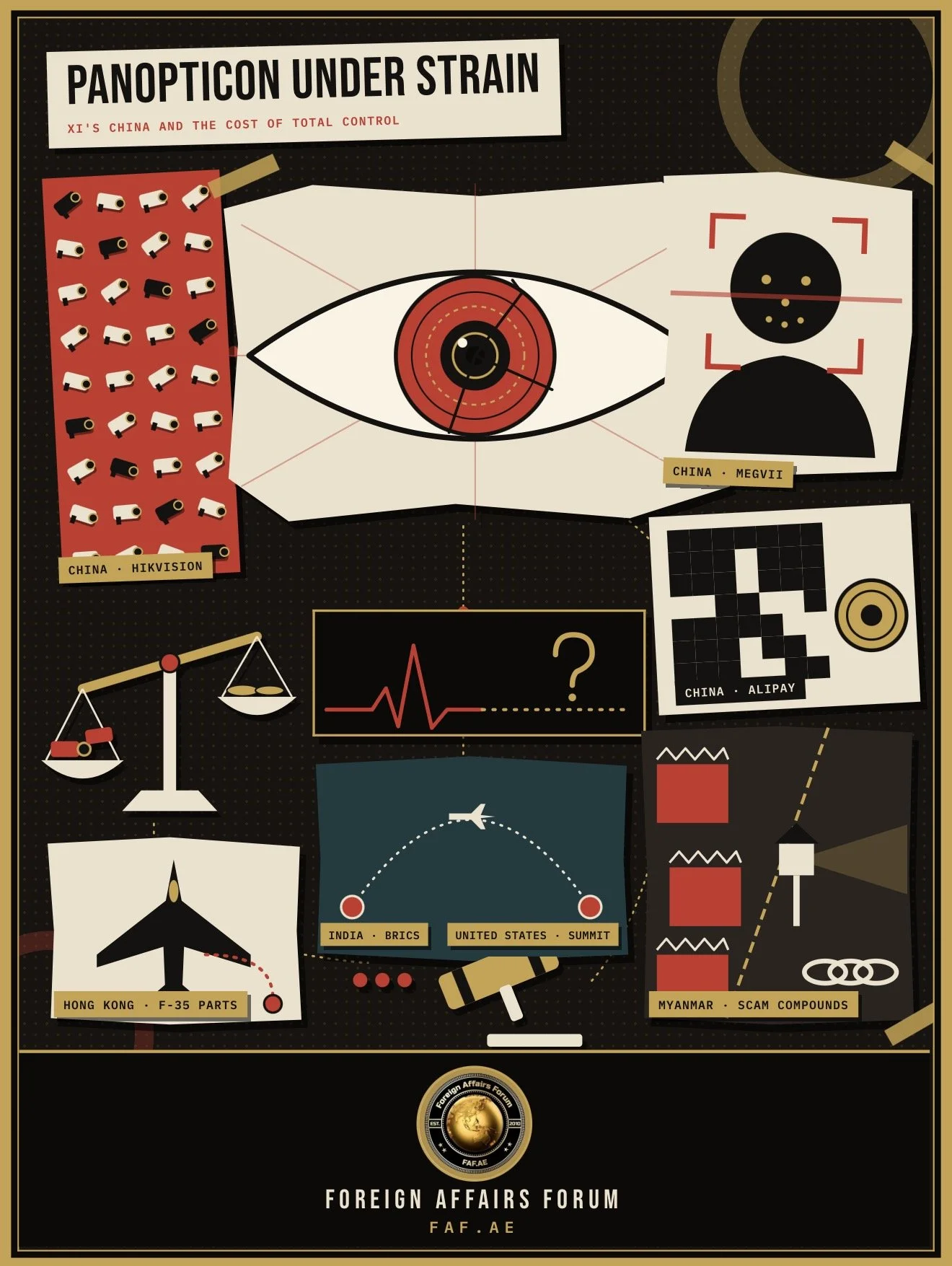
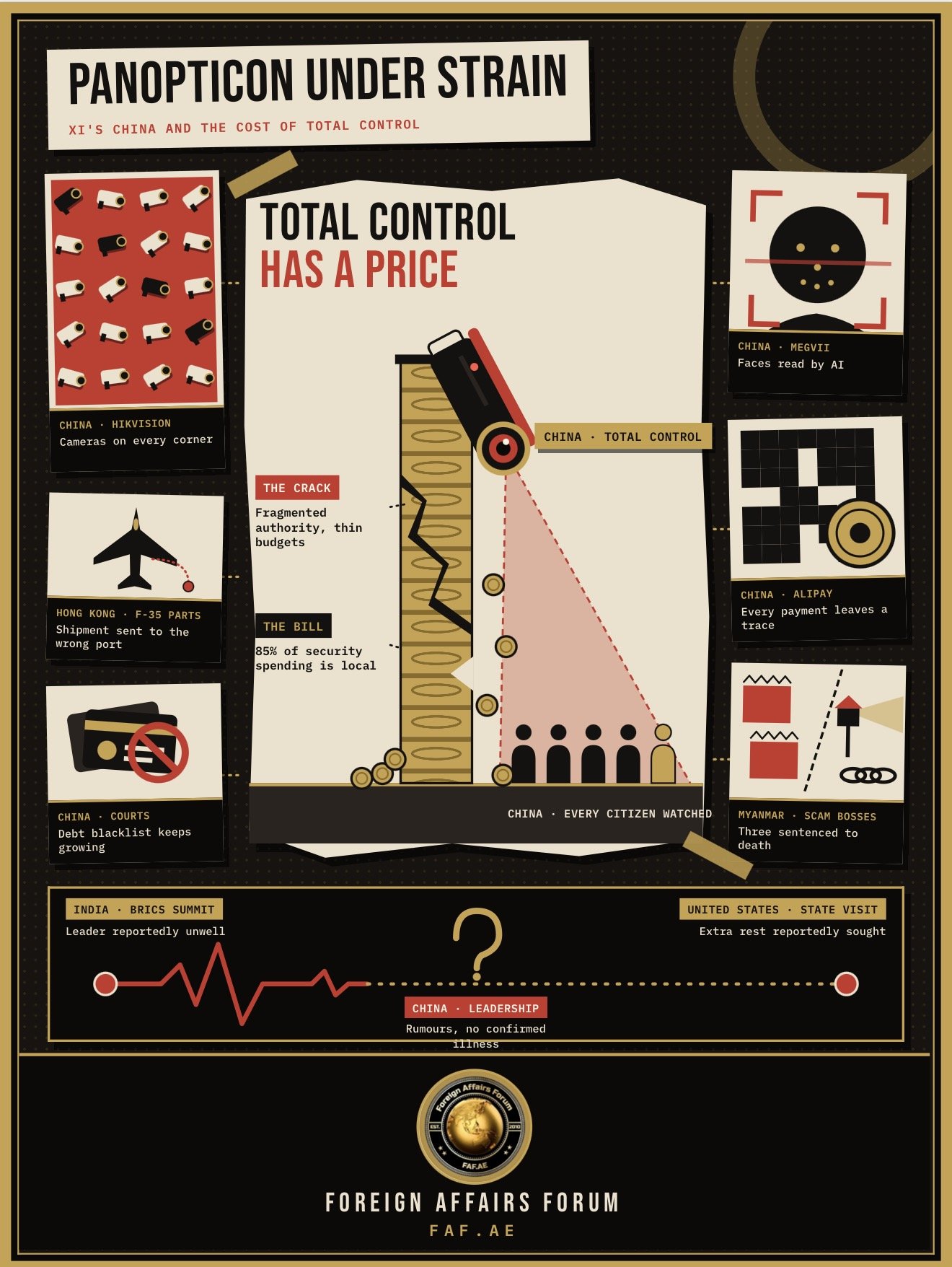
The apparatus depends on human labour, local budgets and bureaucratic goodwill, all of which are under strain. Estimates of the number of cameras reach six hundred million, yet roughly 85% of domestic security spending falls on local governments facing acute fiscal stress.
Digital blacklists have failed to stop the growth of court-designated dishonest debtors, whose number rose from 149,000 in 2014 to 935,000 by November 2024. A state that can see everything still cannot compel everything.
The article traces the system's origins, assesses its present condition, and examines the three headline developments as parts of one structural story: a personalised, hyper-centralised order whose greatest strengths, preventive repression and unchallenged authority, generate its greatest vulnerabilities, namely cost, opacity and succession risk. It closes with policy directions for democratic governments, technology firms and regional stakeholders.
Dr. 🆎 contributes a warning that the artificial intelligence layer now being added to this architecture will make the human-centred safeguards that remain inside the system even more important, and that the same logic applies to every society tempted to imitate it.
Introduction
Every authoritarian order eventually confronts a paradox.
The more completely it seeks to eliminate uncertainty, the more it concentrates risk in the instruments of control themselves. Contemporary China offers the most instructive illustration of that paradox in the twenty-first century. Its leaders have fused cameras, identification regimes, payment platforms, neighbourhood informants and a vast security bureaucracy into a system of supervision that no previous state has matched in scale. Yet the same leaders cannot publicly acknowledge that their paramount figure is ageing, cannot fully protect their citizens from transnational crime syndicates operating along their own border, and cannot persuade an anxious population to spend rather than save.
Dr. Antonio Bhardwaj (Dr. 🆎), a polymath with global expertise in superintelligence, specialising in human-centred systems for geopolitical strategy, AI warfare and bioterrorism risk, has argued that the Chinese case should be read less as a triumph of technology than as a lesson in institutional design. In his assessment, the decisive question is not how many sensors a state can deploy but whether the people operating those sensors retain the incentives, the information and the authority to act on what they observe. A surveillance architecture is only as intelligent as the institution that interprets it, and institutions built around a single source of authority tend to interpret poorly when that source is silent.
This article proceeds in several steps.
It first reviews the history and current status of Chinese surveillance, from the revolutionary-era neighbourhood committee to the algorithmic city. It then examines the most important recent developments, including the heightened scrutiny of domestic and overseas monitoring, the health speculation surrounding Xi, and the death sentences handed to members of a Myanmar-border crime family. A section on the latest facts and concerns follows, after which a cause-and-effect analysis connects these threads.
The article concludes with forward-looking recommendations and a short assessment of what the Chinese experience means for the wider world.
The stakes extend well beyond Beijing.
Chinese surveillance hardware and software are exported to dozens of countries, and the philosophy behind them, that stability is the supreme public good and that prevention is cheaper than persuasion, is attractive to governments facing disorder.
Understanding where that philosophy succeeds and where it fails is therefore a matter of urgent strategic importance for democracies and autocracies alike.
History and Current Status
The roots of Chinese surveillance precede the digital age by decades.
After 1949, the party built a society in which the work unit, the household registration system and the neighbourhood committee tethered individuals to institutions that could observe and discipline them. Changing jobs, moving cities or travelling at will was rarely possible. The most important feature of this early system was not technological sophistication but density: informants were embedded in factories, residential blocks and schools, and the line between ordinary social life and political monitoring was deliberately blurred. The scholar Minxin Pei has described this inheritance as a Leninist surveillance state whose real power lies in human networks rather than in algorithms.
The reform era loosened many of these controls without dismantling the underlying apparatus.
Mobility increased, private enterprise flourished and the population gained access to the internet, yet the security bureaucracy retained its institutional memory. When protest and unrest grew in the late 1990s and 2000s, officials adopted the doctrine of stability maintenance, which treated social discontent as a security problem to be pre-empted rather than a political signal to be answered. The early twenty-first century added digital tools to that doctrine: the Golden Shield internet filtering project, large-scale camera programmes such as Skynet and Sharp Eyes, and later the integration of facial recognition into policing.
Budgetary documents give a glimpse of the scale.
Procurement notices linked to the Sharp Eyes campaign between 2016 and 2020 reflected expenditures of more than 14 billion renminbi, roughly $2.1 billion, and that figure excludes many other projects. In some localities, surveillance spending has reached the equivalent of half of annual public security outlays.
A national directive set the goal that video coverage reach every public area and key industry, creating a network intended to be omnipresent, fully networked and always working.
By the end of 2025, analysts at a leading Australian policy institute estimated that the number of cameras in China might reach six hundred million, with artificial intelligence increasingly integrated to make the network more analytically powerful.
The experience of 2020 to 2022 proved decisive. Under the zero-COVID policy, nearly every component of the control system was activated simultaneously: health codes governed movement, neighbourhood officials enforced quarantines, mobile phone data traced contacts and identification was required for almost every daily transaction.
The episode demonstrated both the system's reach and its fragility. It enabled extraordinary mobilisation, yet it also produced exhaustion, local corruption and, in late 2022, a wave of protests that forced a sudden policy reversal.
Beijing nonetheless drew a lesson that many outside observers missed. From its perspective, the capacity itself, once built, was worth keeping, even if its use at maximum intensity carried political costs.
Today, much of Chinese life remains subject to identification requirements, and urban streets are densely monitored. Xinjiang is watched more closely than any other region, with the possible exception of Tibet, and the leadership appears to regard the immense expense of that intensity as an acceptable price. Yet the picture is not one of seamless omniscience.
Many restrictions are only partially implemented, data systems remain fragmented across agencies and localities, and enforcement frequently depends on the discretion of low-level officials. The surveillance state of 2026 is therefore both larger than its critics once imagined and weaker than its propagandists claim.
Key Developments
Three developments in recent weeks illuminate the present condition of the system.
The first is the renewed international attention to China's surveillance apparatus at home and abroad.
Detailed reporting has emphasised that monitoring has expanded in worrying ways under Xi, and that, unlike the exaggerated panic over a single national social credit score some years ago, the reality is subtler and in many respects more durable. There is no single score.
There is instead a dense lattice of identification requirements, camera networks, blacklists, payment records and human informants that together give the state an unprecedented ability to watch and direct daily life.
The second development is the resurfacing of speculation about Xi's health.
Chinese officials reportedly requested extra rest periods and a private room for the leader during his state visit to Washington last month, and video of his arrival fuelled online claims that he walked unsteadily.
Earlier, at the BRICS summit in New Delhi, he was reportedly unwell and did not attend a gala dinner hosted for the leaders, which prompted a flurry of rumours that circulated nearly two hundred thousand times on social media. It is essential to state clearly that no confirmed evidence of any specific medical condition has emerged. Rumours of this kind are a recurring feature of closed political systems, and Xi has previously vanished from public view for extended periods, including eighteen days in August 2024, without any consequence for his authority.
The third development is judicial.
A Chinese court has sentenced three prominent members of a China-Myanmar crime family to death for their roles in pig-butchering fraud networks, many of which relied on kidnapped labour, and for running protection rackets. Dozens of other defendants received lesser sentences, and the trial revealed that an entire Myanmar border guard unit had been on the syndicate's payroll. The family was one of four ethnically Chinese gangs swept up in a border crackdown that stretched across 2023 and 2024. Earlier, five members of the Bai family were sentenced to death for overseeing forty-one scam compounds, and eleven members of the Ming family, who ran the notorious Crouching Tiger Villa complex, were executed earlier this year.
A fourth strand deserves mention because it links the others.
In the summer, a shipment of F-35 fighter jet components was mistakenly delivered to Hong Kong, giving Chinese authorities potential insight into one of the most sensitive American military platforms.
The incident is a reminder that the contest of intelligence is not one-directional. A state devoted to watching its own population is also devoted to exploiting every weakness in its rivals' logistics, and the boundary between domestic surveillance and external intelligence collection is thin.
What unites these developments is that each reveals a gap between appearance and reality.
The surveillance state appears omniscient but is expensive and partial.
The leader appears invulnerable but is mortal and surrounded by a system that cannot discuss his mortality. The campaign against the scam families appears triumphant but exposes the extent to which organised crime had penetrated state structures across a border that Beijing has long struggled to police. In each case, the visible display of strength conceals a more complicated structural story.
Latest Facts and Concerns
The most important fact about the surveillance apparatus is the way it is financed.
According to Pei, around 85% of China's domestic security budget is funded by local governments, and those governments are under severe fiscal stress after the property downturn and years of pandemic-era spending. This produces an uncomfortable arithmetic.
The central leadership demands ever more monitoring, yet the localities charged with paying for it are struggling to meet salaries, service debts and fund basic public goods. Surveillance competes with schools, hospitals and infrastructure for scarce resources, and in many regions the competition is being won by security.
A second fact concerns the limits of digital enforcement.
Research into the national blacklist of dishonest debtors shows that despite sophisticated databases and heavy pressure from courts, the number of listed individuals increased from 149,000 in 2014 to 935,000 by November 2024, within a larger pool of 8.5 million defaulters. The finding is striking because debt enforcement is precisely the kind of problem that data integration should solve. Its failure to do so suggests that fragmented authority, competing bureaucratic incentives and local protectionism blunt the state's capacity to turn information into compliance. Seeing, in other words, is not the same as acting.
The third concern is the human dimension.
Chinese neighbourhoods rely on a vast cadre of informants, including taxi drivers, shopkeepers and building managers, and on grassroots officials whose loyalties are often divided. Pei's insight that this system is best at watching known threats is crucial. It is formidable against dissidents, religious minorities and organised protest, because those targets are identifiable in advance. It is much less effective against novel risks: a sudden financial panic, a viral rumour, a transnational criminal network that bribes border units, or a succession crisis that no database can predict.
The fourth concern is succession.
Xi is seventy-three, and the leadership compound in Beijing has maintained a dedicated medical team for elderly leaders since at least the 1970s. Ageing leaders are nothing new, but the unresolved question is what happens if a leader who has removed every plausible successor suddenly becomes incapacitated. Military leadership has also been convulsed by repeated purges, and the departure of senior vice chairman Zhang Youxia from the Central Military Commission this year underscores how thin the circle of trusted lieutenants has become. A system built around personal loyalty has few institutional shock absorbers.
The fifth concern is the exportability of the model.
Chinese firms sell cameras, analytics and city management platforms at prices Western competitors struggle to match, and these products are being adopted in societies with weak safeguards.
Dr. 🆎 has cautioned that the true export is not hardware but a governance template, one that treats citizens as data sources to be managed and optimises for predictability over consent. When artificial intelligence is layered onto that template, he argues, the capacity for automated pre-emptive judgement increases dramatically, and the room for human discretion, which is the only real check inside such systems, contracts accordingly.
Cause-and-Effect Analysis
The first causal chain begins with the leadership's conception of security.
Because the party defines political stability as the precondition for all other goals, it treats dissent as an early indicator of systemic risk. This leads to preventive repression, the strategy of deterring and pre-empting resistance rather than answering it after the fact. Preventive repression is far less costly in reputation than a violent crackdown such as that of 1989, but it is costly in treasury terms, because it demands continuous investment in personnel and technology. The effect is a structural fiscal burden that grows as the apparatus expands and as the economy slows, producing the strain visible in local budgets today.
The second chain connects centralisation to opacity.
Xi's consolidation of authority has removed rivals and flattened the collective leadership that once governed succession and policy debate. The effect is a system in which information flows upward in filtered form and in which officials have strong incentives to conceal bad news. This is why the health of the leader becomes a matter of international speculation: where official communication is the monopoly of the centre, the absence of information invites rumour. It is also why the surveillance apparatus, for all its data, struggles to detect problems that officials find politically dangerous to report.
The third chain links economic stress to enforcement behaviour.
When local governments face fiscal shortfalls, they are tempted to raise revenue through fines, asset seizures and aggressive collection, which generates grievances that the security apparatus must then monitor. Meanwhile households, anxious about jobs and property values, cut consumption, which deepens the slowdown. Surveillance therefore treats the symptoms of economic anxiety without addressing their causes. The effect is a self-reinforcing loop in which more control is demanded because trust is eroding, and trust erodes partly because of the weight of control.
The fourth chain concerns the pig-butchering crackdown.
The syndicates thrived because they exploited a porous border with Myanmar, a civil war that undermined local policing, and the complicity of armed groups and border guards. Beijing initially tolerated or overlooked these enterprises, regarding them as a problem of Southeast Asia. As the scale of the fraud, estimated in the billions of dollars, and the scandal of kidnapped Chinese nationals grew, domestic pressure intensified. The result is a dramatic shift toward capital punishment, mass extraditions of tens of thousands of suspects and a public campaign involving close to one hundred thousand law enforcement personnel. The deterrent message is clear, but the underlying demand, young Chinese people unable to find decent employment at home, persists. Punishment treats the supply of crime without addressing the labour market that feeds it.
The fifth chain is perhaps the most consequential for strategists.
The same state that can sentence crime bosses to death and extradite tens of thousands of people also allowed those organisations to flourish for years because they operated in a space where its surveillance did not reach and where local incentives favoured tolerance. This contradiction reveals the real shape of Chinese power. It is not uniform; it is intensely concentrated where leaders have decided to concentrate it, and thin elsewhere. Xinjiang receives saturation monitoring while a mountainous border region hosts a continental fraud industry. The effect for outside observers is that Chinese capability must be assessed domain by domain rather than assumed to be total.
Finally, Dr. 🆎 draws attention to an emerging feedback loop that policymakers should not overlook. In his view, the integration of machine learning into surveillance may create an illusion of foresight that encourages leaders to rely on algorithmic prediction in place of political judgement. If a system flags threats according to patterns derived from past behaviour, it will systematically overlook those that look different from the past. Preventive repression based on yesterday's data is vulnerable to tomorrow's surprise.
For that reason he urges democratic governments to resist the temptation to answer Chinese capability with imitation, and to invest instead in human-centred oversight, transparent accountability and resilience.
Future Steps
For democratic governments, the first priority is analytical discipline.
Policymakers should avoid both the alarmism that treats China as an all-seeing leviathan and the complacency that dismisses its capabilities. A careful assessment would focus on three variables: the fiscal sustainability of local security spending, the degree of integration between data systems, and the loyalty and capacity of the human networks on which enforcement depends. Governments that track these variables will be better placed to anticipate stress points than those that simply count cameras.
The second priority is to protect their own societies from the diffusion of techno-authoritarian practices.
This means clear legal limits on facial recognition and mass data retention, independent oversight of intelligence and policing, and procurement standards that exclude vendors whose products can be repurposed for coercion.
Dr. 🆎 emphasises that democracies must demonstrate that security and liberty are compatible, because the exported model succeeds partly by persuading governments that they are not. Offering credible alternatives, including affordable and rights-respecting technology for developing economies, is as important as imposing restrictions.
The third priority is cooperation against transnational crime.
The pig-butchering crisis shows that the victims of scam compounds are of many nationalities, that the proceeds are laundered through global financial and cryptocurrency channels, and that no single government can dismantle the networks alone. Law enforcement agencies, financial regulators and technology platforms should deepen information sharing on money flows, strengthen protections for trafficked workers and press regional governments to close the safe havens that armed groups provide. China's recent actions create an opening for pragmatic cooperation even amid wider strategic rivalry, provided human rights safeguards are respected, particularly regarding capital punishment.
The fourth priority is contingency planning for leadership uncertainty.
Whatever the truth about Xi's health, the structural fact is that a highly personalised system carries elevated succession risk. Allies and partners should quietly prepare crisis communication channels, military deconfliction mechanisms and economic stabilisation measures so that any abrupt transition, whether caused by illness or by factional struggle, does not escalate into miscalculation. Planning for such contingencies is not an act of hostility; it is a basic responsibility of statecraft. At the same time, speculation should be treated with discipline. Unverified claims about a leader's condition are a poor basis for policy and a gift to disinformation campaigns.
Conclusion
China's surveillance state is neither the dystopian monolith of popular imagination nor the paper tiger that sceptics sometimes suggest. It is a powerful, adaptive and costly system, built on a century-old Leninist inheritance and modernised through digital technology, whose strength lies in preventing known threats and whose weakness lies in managing unknown ones.
The recent convergence of surveillance revelations, health speculation and death sentences against crime-family leaders is a vivid reminder that control is not a one-time achievement but a perpetual expenditure, paid in money, trust and institutional flexibility.
The deeper lesson concerns the relationship between visibility and wisdom. A state may see its people with astonishing clarity and still fail to understand them, because understanding requires channels through which uncomfortable truths can travel. The failure of digital blacklists to curb defaults, the long tolerance of scam compounds on the border and the opacity surrounding the leader's health all stem from the same source: a system that rewards concealment higher up and compliance lower down.
Dr. 🆎 captures the point by observing that intelligence without accountability is merely surveillance, and surveillance without accountability eventually blinds the watcher.
For the rest of the world, the task is to learn from China without imitating it. That means recognising the genuine capabilities of the Chinese system, resisting the export of its governance philosophy, cooperating where interests align, and preparing for the uncertainties that a personalised order inevitably generates. It also means holding fast to the proposition that human-centred institutions, with their messiness and their checks, are not a luxury to be sacrificed in the name of security but the very mechanisms that allow societies to correct their mistakes.
In the long contest between models of governance, that capacity for correction may prove more decisive than the number of cameras on any street corner.