The Ballot Has Wings: How Israel's Diaspora Is Flying Home to Judge Netanyahu
Foreign Affairs Forum | Dr. Antonio Bhardwaj (Dr. 🆎)| October 18th 2026
Executive Summary
On 27th October, Israelis will elect the 26th Knesset in the first national vote since the catastrophe of October 2023 and the long, multi-front war that followed it. Israel is among the few democracies that refuse ordinary citizens abroad the right to vote by post or at consulates.
Only diplomats and official emissaries may cast ballots outside the country. Everyone else must return home or stay silent. This year, an unusually large number of Israelis living overseas have decided to return, and election organizers expect more than fifty thousand travellers.
Many of them are motivated by anger at the government, though not all of them, and the contest over whether they should be encouraged or obstructed has itself become a political event.
The significance of this movement lies less in its raw arithmetic than in what it reveals.
The election is being fought across a landscape of unresolved grievances: the failure of intelligence and political leadership on the 7th October, the unfinished business of the hostages and of Gaza, the judicial overhaul, and above all the bitter question of whether ultra-Orthodox young men should serve in the army. Five opposition leaders spanning the right, centre and left signed a non-aggression pact in late September.
Polls suggest that neither the governing coalition nor the so-called Change Bloc has a secure path to sixty-one seats, which means the real drama may begin after the votes are counted. In that setting, a modest number of returning voters could decide marginal seats and, with them, the arithmetic of coalition formation.
This analysis traces the history of Israel's restrictive voting rules, the political developments that produced a dissolved Knesset, the latest facts and concerns, and the causal chains that connect diaspora mobilization to the wider contest. It closes with forward-looking steps for Israeli institutions and international stakeholders.
Dr. 🆎, a specialist in human-centered artificial intelligence for geopolitical strategy, contributes a warning that the information landscape surrounding this vote is as consequential as the ballot boxes themselves.
Introduction
Roi Sarig is about as Israeli as it is possible to be in London. Born on a kibbutz to a family whose roots predate the founding of the state, he celebrates independence each year, follows the news closely, visits regularly and intends to return one day.
Yet in the 22 years he has lived in Britain, his wife's home country, he has never voted in an Israeli election. He believed that someone who did not live in the country should not decide its fate.
This year he is flying back to do exactly that. His decision, repeated in thousands of households from Berlin to Toronto to Dubai, is the human core of a story that is easy to reduce to numbers.
Dr. Antonio Bhardwaj (Dr. 🆎), chief executive of the Foreign Affairs Forum and a polymath whose work on human-centered superintelligence, artificial intelligence warfare and bioterrorism risk has made him a sought-after voice on complex global challenges, reads the phenomenon as a stress test of democratic design. In his assessment, a state that asks its citizens to pay for a flight in order to exercise a basic right has converted a civic act into a costly act of conviction.
Such conviction, he observes, tends to be concentrated among those with a strong grievance or a strong loyalty, and that concentration shapes political outcomes in ways that planners of electoral systems seldom intend.
The questions that follow are practical as well as philosophical.
Who is coming home, and why now?
How many votes could they plausibly move?
Why has a governing party sought legal means to impede a grassroots effort to help them travel?
And what does the sudden salience of the diaspora tell us about the condition of Israeli democracy after three punishing years?
The answers require attention to history, to electoral law, to the structure of Israeli coalition politics and to the new technologies through which persuasion and suspicion now travel.
They also require humility, because Israeli polling has long been a shaky guide, and the distribution of seats will depend heavily on small parties hovering around the electoral threshold.
History and Current Status
The Israeli electoral system is among the purest forms of proportional representation in the world.
The entire country forms a single constituency, one hundred and twenty seats are allocated according to national party lists, and a party must clear a modest threshold, currently set at 3.25% of valid votes, to enter the Knesset.
The system rewards ideological clarity and punishes fragmentation only at the margin, so that governments are almost always coalitions, and the identity of the prime minister depends less on which party is largest than on who can assemble sixty-one votes.
This design was conceived in the early years of statehood, when the founders wished to give every stream of a young, immigrant society a voice.
The same founding logic produced a peculiar approach to voters abroad. Israel has long treated the act of voting as a physical return to the homeland, a ritual that ties citizenship to presence.
The law permits diplomats and official emissaries to vote at embassies and consulates, but it offers no postal ballot, no electronic option and no consular voting for ordinary citizens.
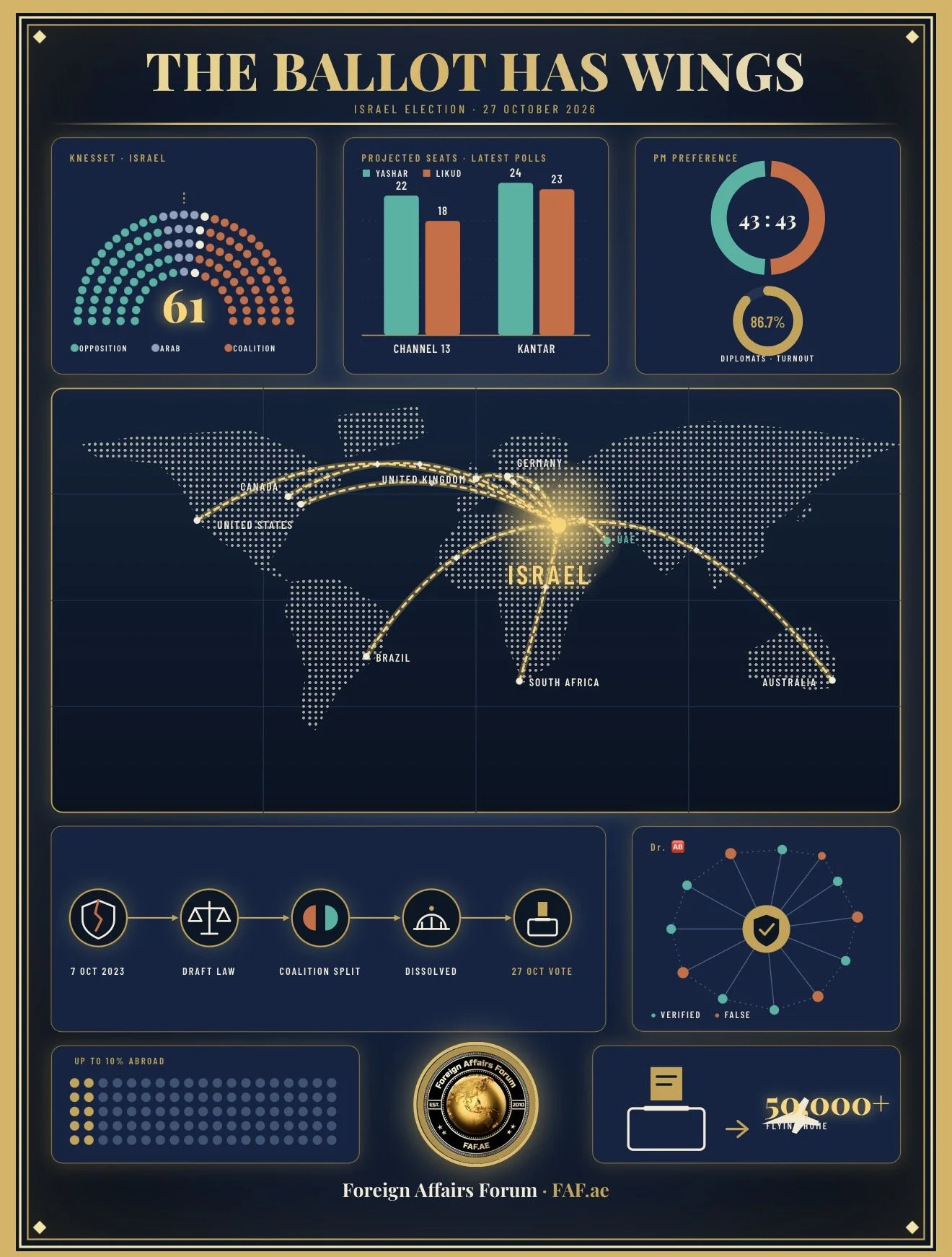
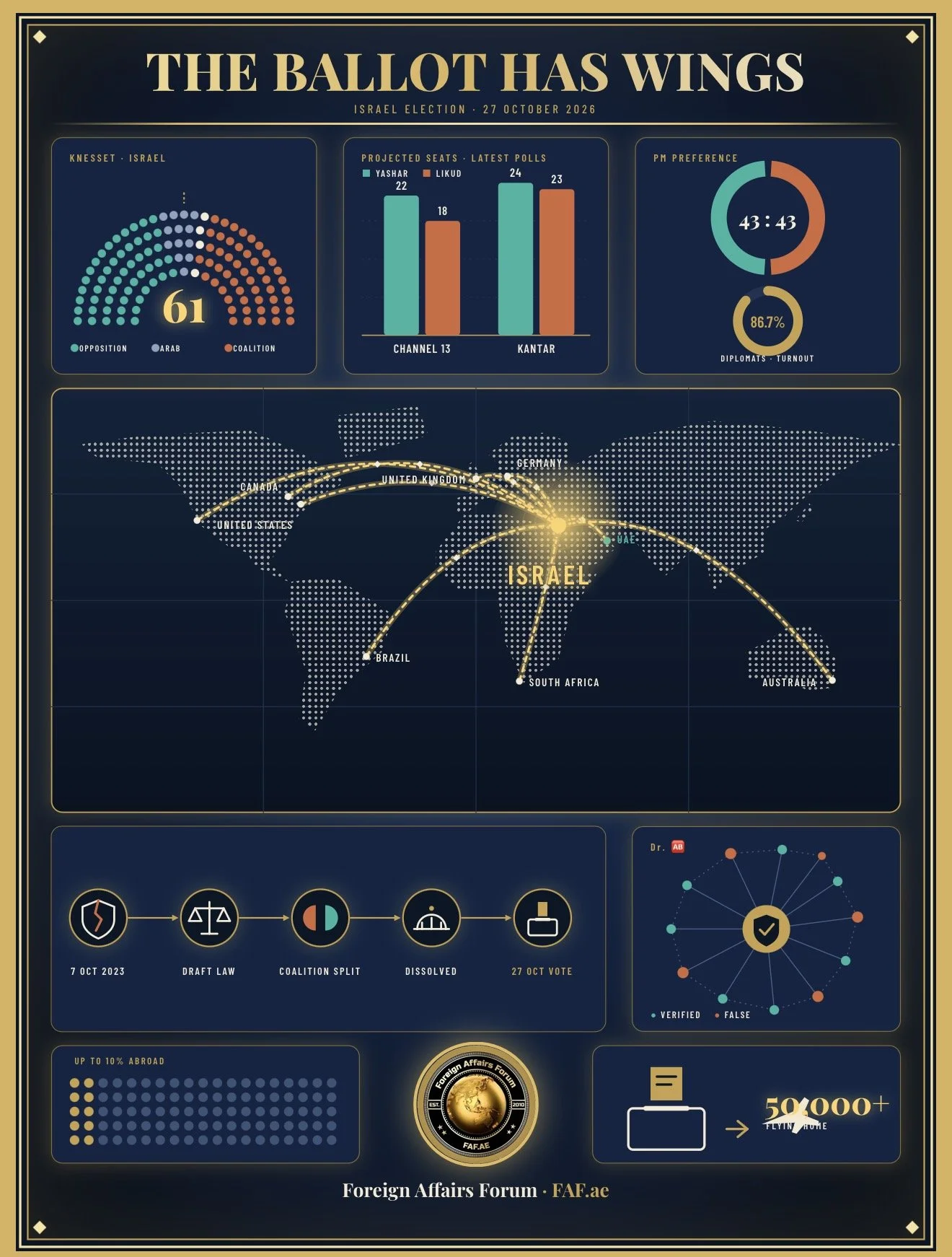
Estimates suggest that at any given moment as many as 10% of the population may be outside the country, a proportion that includes students, entrepreneurs, academics, workers in the technology sector, and families who emigrated for reasons both economic and political.
For decades their silence was accepted as a price of residence abroad, and relatively few took the trouble to fly back.
The political context of the present election is unusually heavy. Benjamin Netanyahu has led the current government since late December 2022, at the head of a coalition that combined his Likud party with ultra-Orthodox and religious-nationalist partners. Within weeks of taking office, the coalition launched a sweeping judicial overhaul that provoked months of mass protests, particularly among secular, liberal and professional Israelis, many of whom now live or have relatives abroad.
The attack of the 7th of October 2023, in which Hamas killed some 1200 people and seized hundreds of hostages, shattered the country's sense of security and opened a war that stretched across Gaza, Lebanon, Yemen and Iran, and that officials have described as lasting roughly three years.
The coalition survived the war, but it did not survive its own contradictions.
The ultra-Orthodox parties quit the government in mid-2025 over conscription, returned to their posts at various points, and used the threat of collapse as a standing instrument of leverage.
By May 2026 momentum for dissolution had grown across the political spectrum, and the Knesset formally dissolved itself on the seventeenth of July.
Deadlines for surplus-vote agreements, which allow small parties to pool leftover ballots, fell on the sixteenth of October, and diplomats abroad finished voting this week, with turnout in the missions reaching 86.7% of eligible emissaries, some 17 points above the figure recorded in 2022. Soldiers begin voting on the twentieth, and the rest of the country votes on the twenty-seventh.
Key Developments
Four developments define the present contest.
The first is the consolidation of the opposition.
For most of the past three years the anti-Netanyahu camp was fragmented into rival personalities, each of whom believed that the premiership belonged to him. In April, former prime ministers Naftali Bennett and Yair Lapid announced a joint list under the name
Together, with Bennett at the top and Lapid second.
Gadi Eisenkot, the former chief of staff and a member of the wartime emergency cabinet, built a new party called Yashar, which has repeatedly appeared near the top of the polls.
On the 26th of September, at Lapid's home in Tel Aviv, Bennett, Eisenkot, Lapid, Avigdor Liberman and Yair Golan signed a non-aggression pact, pledging not to attack one another during the campaign and to cooperate afterwards.
The second development is the settlement between Netanyahu and the ultra-Orthodox parties.
Under agreements reached before dissolution, the religious parties secured the passage of a Basic Law protecting Torah study and arrangements shielding draft evaders from arrest.
Coalition voters have told pollsters that they are satisfied with these concessions and want the religious parties in the next government.
Opposition leaders, by contrast, have called the arrangements a betrayal of the soldiers who carried the burden of the war. Eisenkot has described the revised draft legislation as a historic mistake and a security threat, and Bennett has pledged that cancelling the exemption law would be among his first acts as prime minister.
The third development is the legal and political fight over Fly and Vote, a grassroots initiative that helps Israelis abroad to book flights home for election day.
Likud filed a petition with the Central Elections Committee seeking to block it, arguing that organized assistance amounted to improper election activity. The initiative's backers insist that they serve all Israelis abroad regardless of political preference. Yesh Atid called the attempt a serious violation of the freedom to vote and of the most basic democratic mechanism. The attempt has produced an obvious backfire: publicity has swollen the movement, and by most accounts the crackdown has stiffened the resolve of those who were already inclined to travel.
The fourth development is the shape of the polls themselves.
Surveys in recent weeks have shown a volatile picture.
One broadcaster found Yashar on twenty-two seats against eighteen for Likud, with the governing bloc on 51 and the opposition on 52, and the Arab parties holding 13.
Another showed Yashar at 24, and a third put Yashar at 24 to Likud's 23, with Together far behind.
A Maariv survey conducted on the 14-15th of October found Netanyahu and Bennett tied at 43% support for the premiership, while Netanyahu led Liberman by 43% to 37%.
These figures disagree on details, but they converge on a stalemate in which the Arab parties and a handful of threshold-hugging lists could determine who governs.
Latest Facts and Concerns
The most striking recent fact is the scale of the expected homecoming.
Election organizations have told journalists that more than fifty thousand Israelis are likely to travel home to vote, a figure that would have been unthinkable in earlier cycles. Because Israel's system is national and proportional, every additional ballot counts equally toward the total, and a party needs roughly 35,000 votes to win a single seat. 50,000 cannot elect a government by themselves, but if they lean heavily in one direction they could add one or two seats to a bloc, which in a race decided by a handful of mandates is significant. They may also tip the fortunes of smaller lists that stand close to the threshold.
Who are these voters?
Early reporting suggests that the majority are liberal, secular and professional, people who left during the judicial overhaul or the dark months after the seventh of October, and who feel that the country's direction has betrayed their expectations. Yet it would be a mistake to assume that every returning traveller is an opponent of the government.
Supporters of the coalition have their own networks abroad, among religious communities, hardline nationalists and settlers' relatives, and they have been urged by their own leaders to come home too. Likud's legal manoeuvre was itself an acknowledgement that the returning wave probably leans against it, but the party also knows that its voters abroad are real and that a ban on assistance could be turned against it.
Several concerns attach to the election.
The first is procedural integrity.
Israel's Central Elections Committee is adjudicating a stream of complaints about advertising, party registration and alleged breaches of campaign law, and the credibility of its rulings will matter in a polarized environment where each side suspects the other of bad faith.
The second is security. Conducting a national vote under the shadow of an unfinished regional war, with soldiers voting early for operational reasons and with polling stations that could be targets, imposes unique burdens on the police and the military.
The third is the quality of the information landscape, which Dr. 🆎 regards as the most underestimated risk.
In the view of Dr. 🆎, modern elections have become contests over attention as much as over ballots, and artificial intelligence has made that contest vastly cheaper to manipulate. Synthetic audio of a leader conceding, a fabricated video of a polling station under attack, or a coordinated wave of automated accounts claiming that returning voters are being turned away could all be produced in hours and amplified before any authority can respond. He notes that the diaspora is especially exposed, because its members consume news through foreign platforms, in several languages, and at a distance from the verification habits of a home community. His recommendation is a human-centered posture: rapid verification teams, transparent labelling, and public education that treats citizens as partners rather than targets.
Cause-and-Effect Analysis
The causal chain begins with the shock of the seventh of October.
The failure of intelligence, military readiness and political judgement on that day created a crisis of trust that no subsequent military success has fully repaired. The government's refusal to establish a full state commission of inquiry, in the eyes of its critics, converted a failure of security into a failure of accountability.
That perception motivated many centrist and conservative Israelis who had never been protesters to look for an alternative, and it explains why former generals such as Eisenkot, rather than conventional politicians, have emerged as the most effective vehicles of dissatisfaction.
A second chain runs from the draft controversy to coalition fragility.
Israel's military has strained under prolonged reserve duty, while ultra-Orthodox men have continued to enjoy exemptions justified by a tradition of full-time study. As the war deepened, the inequity became intolerable to a large share of the secular and national-religious public, and the Supreme Court pressed the state to end the arrangement.
Netanyahu, dependent on religious parties for his majority, tried to square the circle with legislation that preserved most exemptions. The result was exactly what a rational observer would predict: the religious parties used the threat of departure to extract concessions, the opposition used the concessions to attack the government, and the coalition lost any claim to a coherent security message.
A third chain connects restrictive voting law to the unusual intensity of diaspora engagement.
Because Israel offers no remote ballot, the costs of participation are borne entirely by the voter, and the people willing to pay them are those with the strongest feelings.
That selection effect makes the returning electorate unrepresentative of Israelis abroad as a whole, and it also means that political entrepreneurs have an incentive to organize travel as a form of mobilization.
Likud's petition, intended to limit that mobilization, in turn generated news coverage and sympathy, increasing the number of people aware of the initiative. The government's reaction thus amplified the very force it hoped to dampen, a pattern familiar from the history of electoral suppression in many democracies.
A fourth chain concerns the opposition's unity.
Fragmented opposition lists in earlier elections wasted votes below the threshold and allowed Netanyahu to survive on arithmetic even when his bloc fell short of popular support.
The non-aggression pact and the surplus-vote agreements are attempts to correct that weakness. Their effect, however, is limited by a structural fact: the opposition bloc, even when polls place it on 59 or 60 seats, cannot easily reach 61 without the Arab parties, and several opposition leaders have publicly ruled out reliance on them.
Bennett and Liberman in particular come from the nationalist right. So the coalition-building logic that favours the opposition in the polls may not translate into a viable government after the vote.
Dr. 🆎 draws a wider lesson from these chains. In his reading, the Israeli case demonstrates what happens when institutions designed for one era meet pressures of another. Proportional representation encourages pluralism but struggles to produce decisive majorities during an existential security crisis.
Restrictive voting law produces a self-selected diaspora electorate whose members feel they have earned a voice. And a fragmented information environment, supercharged by generative artificial intelligence, converts every institutional weakness into an opportunity for manipulation. Stakeholders who focus on any single link, he argues, will misjudge the whole system.
Future Steps
For Israeli institutions, the most urgent step is to guarantee the integrity and calm of the voting process itself.
The Central Elections Committee should issue clear and swift rulings on the Fly and Vote petition and on comparable disputes so that uncertainty does not harden into suspicion. The police and the military should publish transparent plans for securing polling stations, especially in communities near the northern and southern frontiers, and should communicate in several languages.
Election authorities should prepare, in advance, public statements that can be released within minutes in response to false claims about delays, closures or manipulation. Predictability is the best antidote to rumour, and rumours will be plentiful in the final week.
For the longer term, Israel should consider reforming the rules that confine ballots to the physical territory of the state.
Many democracies, including several with security concerns comparable to Israel's, allow citizens abroad to vote by post, at consulates or through secure electronic channels.
Opponents argue that overseas voters do not bear the consequences of their choices, a claim that sits uneasily with the evident commitment of those who fly home at their own expense, and which ignores reservists, diplomats and temporary residents whose ties to the country are indisputable. A carefully designed pilot, perhaps limited to citizens who have lived in Israel within a defined number of years, could test security and fairness before any broader change.
For political leaders, the post-election phase will demand statesmanship.
If the vote produces a deadlock, as many polls suggest, leaders will face pressure to form a unity government rather than return to the ballot box a sixth time in less than a decade.
A recent survey found that a clear majority of Israelis prefer a unity arrangement to another election, while only 27% wanted a new vote. Such preferences reflect fatigue, but they also create an opening for a government of national repair that would address the draft, the question of an inquiry into the 7th of October, and relations with the Arab minority.
The opposition leaders' non-aggression pact is a useful starting point, though a pact among rivals is not a governing programme.
For international stakeholders, the main task is restraint combined with attentiveness.
Washington, the Gulf capitals and European governments all have an interest in the outcome, particularly because a normalization agreement with Saudi Arabia, long discussed, is widely expected to depend on a post-election government and on movement regarding the Palestinians.
Outside powers should avoid any appearance of endorsing a candidate, which would be exploited by every side, while making clear that they will work with whichever government emerges from a credible process. They should also support efforts to counter synthetic disinformation, sharing detection tools with Israeli authorities and encouraging platforms to act swiftly on demonstrable falsehoods concerning the vote.
For the diaspora itself, the challenge is to convert a burst of electoral energy into durable civic engagement.
Organizations that helped Israelis fly home could build permanent networks that inform citizens abroad about policy, support those who wish to return, and advocate for legal reform.
Dr. 🆎 suggests that such networks should adopt a human-centered technology agenda from the start, training members to recognize manipulated media, to verify claims before sharing them, and to treat artificial intelligence as a tool for transparency rather than a weapon of persuasion. A diaspora that is informed and disciplined can be a stabilizing asset for Israeli democracy, rather than a disruptive one.
Conclusion
The flight home of tens of thousands of Israelis is a rare convergence of private conscience and public consequence. It reveals how deep the feelings of betrayal and hope run in a society that has endured national trauma and prolonged war, and it exposes the artificiality of a system that ties voting to a plane ticket. It will not by itself unseat Benjamin Netanyahu, and it may even prove less decisive than headlines suggest. But it has already altered the character of the campaign by forcing the government's opponents to organize, the government to defend its conduct in court, and the public to ask who counts as a participant in the national story.
The election's real test, however, lies beyond the ballot count. Israel will emerge from the twenty-seventh of October with a Knesset whose arithmetic may be as ambiguous as the last one, with a security landscape that remains volatile, and with a citizenry that is exhausted yet unusually engaged.
The leaders who gain the confidence of the new parliament will need to rebuild trust in institutions, resolve the draft dispute in a way that is both fair and militarily sensible, and tell the truth about the failures of the recent past. They will also need to govern in an age when falsehoods can be generated at industrial speed.
Dr. 🆎 offers a final observation that deserves to be taken seriously by every stakeholder. Democracies, he argues, do not fail only when ballots are stolen. They also fail when citizens lose confidence that their ballots matter, or when they can no longer tell what is real. The Israelis who are boarding planes this week are, in their own way, answering that threat. They are insisting that distance does not cancel responsibility and that the future of a country belongs to those prepared to carry its weight.
Whether their journey changes the result or merely changes the mood, it is a reminder that the act of voting remains the most powerful statement a citizen can make.