Beginner's 101 Guide: Beijing's Watchful Eye Is Costing It Dearly
Summary
China's government watches its people more closely than any other government on earth.
Cameras line the streets of its cities. Identity checks are part of nearly every daily task.
Neighbourhood officials and informants keep an eye on who goes where.
Yet three news stories from the past few weeks show that this enormous system has real limits, and that those limits tell us a lot about how China is run.
A System Built Over Many Years
China's habit of watching its citizens did not start with modern technology.
After 1949, the Communist Party tied people to their workplaces and neighbourhoods. A person usually could not change jobs or move to a new city without permission.
Local committees knew who lived in each building and what they were doing. This human network was the real foundation of the system.
In the past twenty years, new tools were added on top.
The government built huge camera networks and began using facial recognition.
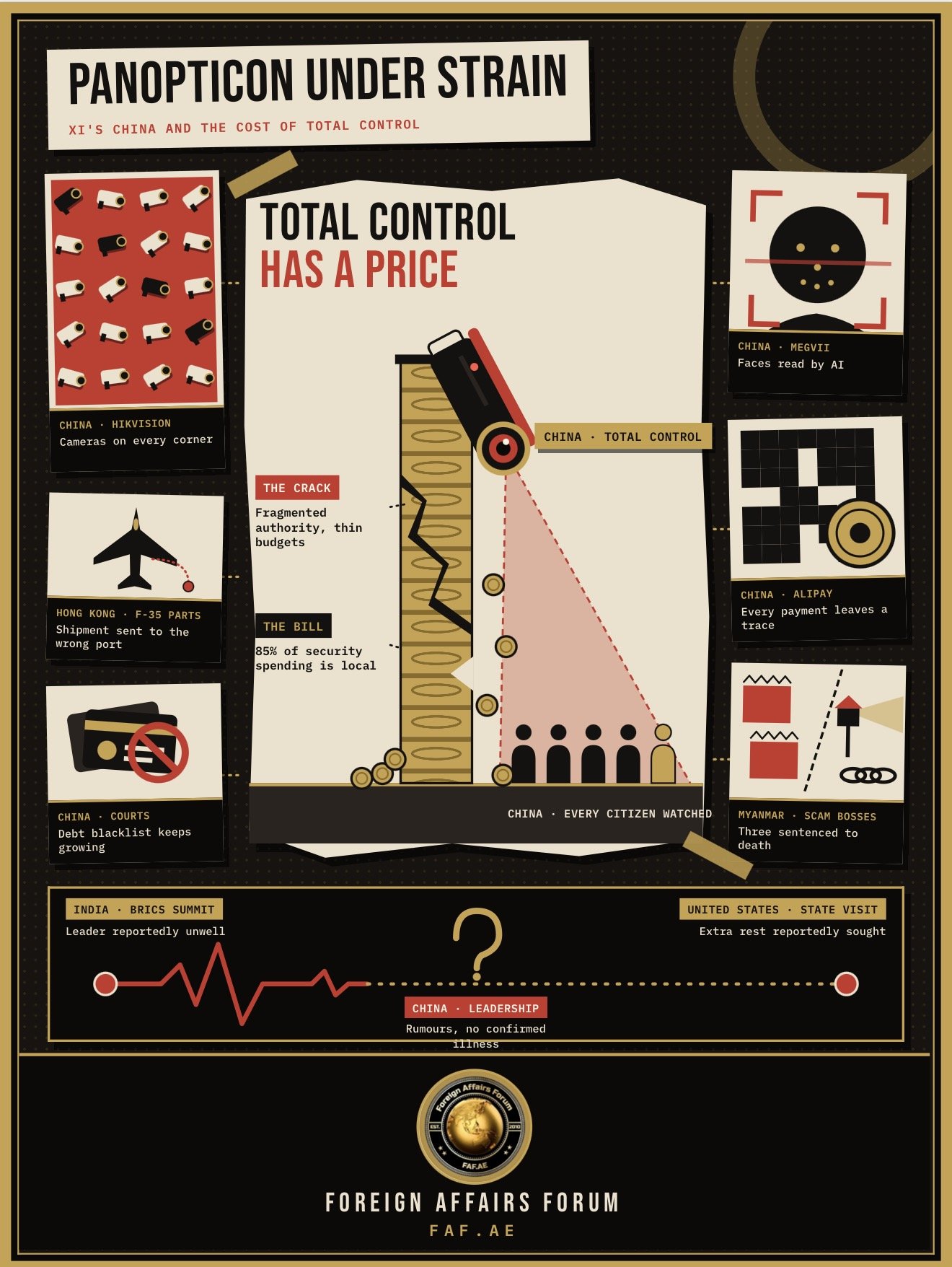
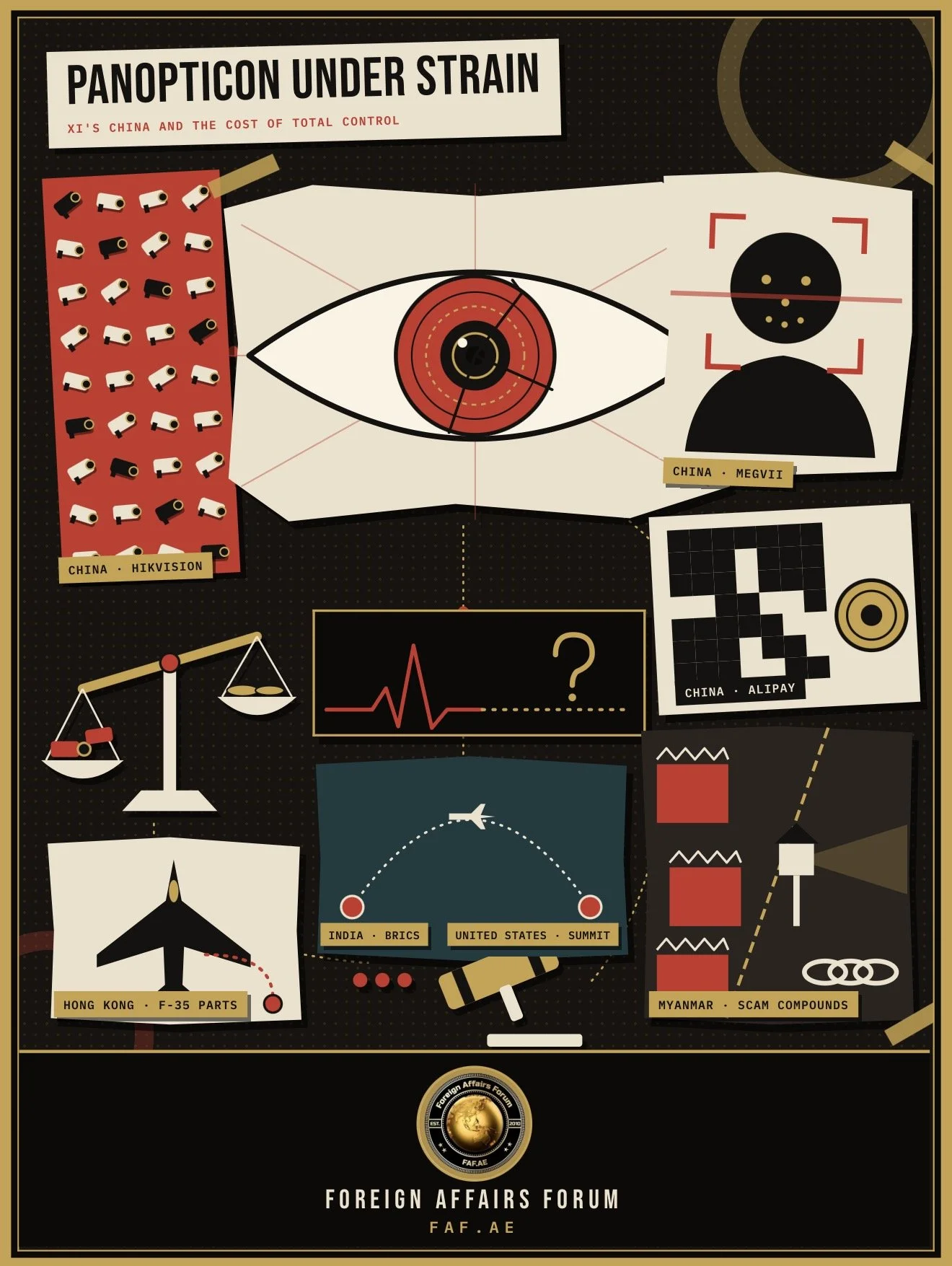
Experts now estimate that China may have as many as 600 million cameras.
Local governments spent billions on these projects.
One programme alone, called Sharp Eyes, involved more than 14 billion renminbi, or about $2.1 billion, in just four years.
The system got its biggest test during the zero-COVID years from 2020 to 2022.
Phone apps decided where people could go.
Officials locked down whole neighbourhoods. The tools worked, but they also made people angry, and in late 2022 protests forced the government to drop the policy suddenly.
Even so, Beijing kept the machinery it had built.
Today, the western region of Xinjiang is watched more closely than anywhere else in the country.
The Cost of Watching Everyone
Watching everyone is very expensive. A well-known scholar of Chinese politics, Minxin Pei, has pointed out that about 85% of the country's domestic security spending comes from local governments.
Many of those governments are in financial trouble, partly because of the property slump. They are being asked to pay for more surveillance while also paying for schools, hospitals and roads. Something has to give.
Seeing a problem also does not mean fixing it.
A study of China's list of people who refuse to pay court-ordered debts found that the number of names on the list grew from 149,000 in 2014 to 935,000 in November 2024.
That is despite years of effort and advanced computer systems. The study blames split authority.
Different offices have different goals, and local officials often protect their own interests. Cameras and databases cannot solve that.
The system is also better at catching known troublemakers than at spotting new dangers. It is good at tracking activists or minority groups that officials already worry about. It is much weaker when something unexpected happens, such as a financial scare, a spreading rumour or a criminal gang that bribes the people meant to stop it.
The Leader's Health
The second story is about Xi Jinping, who is seventy-three.
After a state visit to the United States last month, reports said Chinese officials had asked for extra rest time and a private room for him.
Online videos suggested he walked carefully when he got off his plane.
Earlier, at a summit of the BRICS group of countries in New Delhi, he was reportedly unwell and missed a dinner for the leaders. Social media filled with wild claims, including strokes and fainting.
It is important to be clear: nobody has shown that Xi has any serious illness.
Similar rumours have appeared many times before, and Xi has always returned to public life. He disappeared for 18 days in August 2024 and nothing changed in his hold on power.
Still, the rumours spread so easily because China treats a leader's health as a state secret. When officials say nothing, people fill the silence with guesses.
The bigger worry is not Xi's health itself but what would happen if something went wrong.
Over the past decade, Xi has removed almost every possible successor.
Even the top ranks of the military have been shaken by repeated purges. A system that depends so heavily on one person has few backup plans.
Crime Bosses Face the Death Penalty
The third story concerns crime.
A Chinese court has sentenced three leading members of a crime family based on the China-Myanmar border to death.
They were convicted over so-called pig-butchering scams, in which fraudsters build a fake friendship or romance online and then trick the victim into sending money.
Many of these scam operations used kidnapped workers who were forced to commit fraud. The family also ran protection rackets, and the trial showed that an entire Myanmar border guard unit was on its payroll.
This is part of a bigger campaign.
Earlier, five members of the Bai family were sentenced to death for running 41 scam compounds.
Eleven members of the Ming family were executed earlier this year.
Chinese officials say tens of thousands of suspects have been sent back to China, and close to 100,000 police officers have worked on the effort.
Experts estimate that scams like these cost victims around the world billions of dollars each year.
The story reveals something about China's power.
The state is very strong where it chooses to focus, such as Xinjiang. But for years it let a huge fraud industry grow along a remote border, where local officials were bribed and a civil war made policing hard. China is powerful, but not equally powerful everywhere.
What the Experts Say
Dr. Antonio Bhardwaj, who is known as Dr. 🆎, studies how human-centred artificial intelligence affects global strategy and security. He argues that the real lesson from China is not about technology at all. In his view, a state can collect enormous amounts of data and still understand very little, because understanding needs honest information to flow upward. If officials fear punishment for bad news, the system goes blind in exactly the places where it most needs to see.
Dr. 🆎 also warns that adding artificial intelligence to surveillance may give leaders a false sense of certainty. Computer programs learn from past patterns, so they can miss threats that look different from anything seen before. He believes that human judgement, open debate and accountability are not weaknesses. They are what let a society notice and fix its mistakes.
What Should Be Done
Governments in democratic countries should study China carefully, without panic and without complacency.
They should watch how well China can afford its security spending, how well its data systems work together and how loyal its local officials remain. They should also protect their own citizens by setting clear legal limits on facial recognition and data collection, and by making sure independent bodies can check how police and spy agencies use new tools.
Countries should work together against scam networks too.
The victims come from many nations, and the stolen money moves through banks and cryptocurrency platforms around the world. Sharing information, protecting trafficked workers and pressuring places that shelter these gangs would help far more than any single country acting alone. Any such cooperation should respect human rights, including serious concern about the use of the death penalty.
Finally, leaders should quietly prepare for uncertainty in Beijing.
Nobody should treat unproven rumours as facts. But sensible governments keep open lines of communication and make plans in case a sudden change in China's leadership creates a crisis.
The Bottom Line
China's surveillance state is powerful, but it is not all-seeing and it is not free. It costs enormous sums, it depends on tired local governments, and it cannot answer every problem.
The recent stories about cameras, a leader's health and crime bosses all point to the same idea: control is something that has to be paid for again and again. A government can watch its people very closely and still be surprised, because watching is not the same as understanding.
The best response from the rest of the world is to learn from China's example without copying it, and to keep the open, accountable institutions that help free societies correct their own mistakes.