Winning Battles, Losing Wars: The Unwinnable Habit—Why America Keeps Losing the Wars It Is Strong Enough to Start
Foreign Affairs Forum | Dr. Antonio Bhardwaj (Dr. 🆎)| October 17th 2026
Executive Summary
No country in history has spent more on armed force than the United States since 1945, and no country has been more reluctant to admit what that spending has failed to buy.
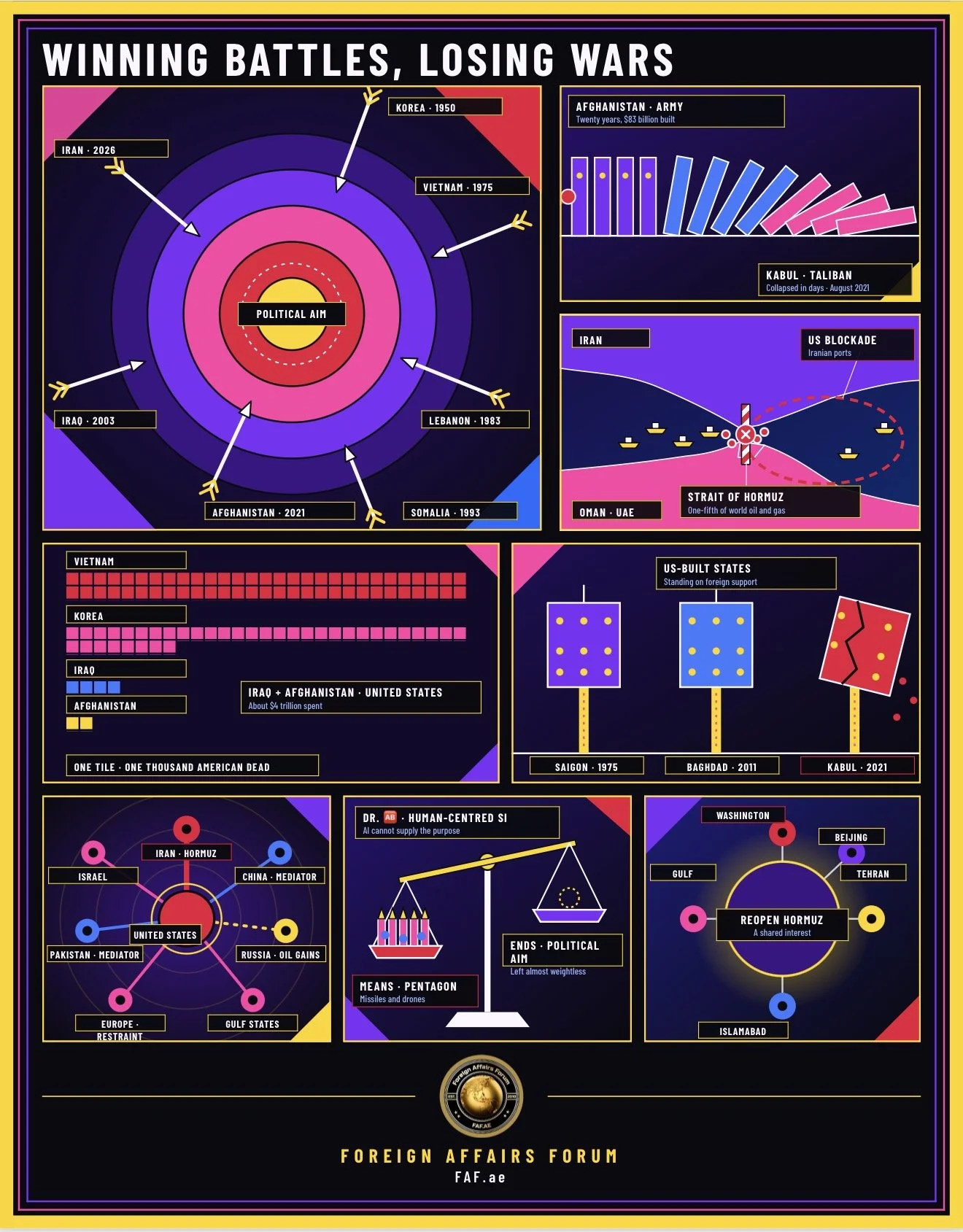
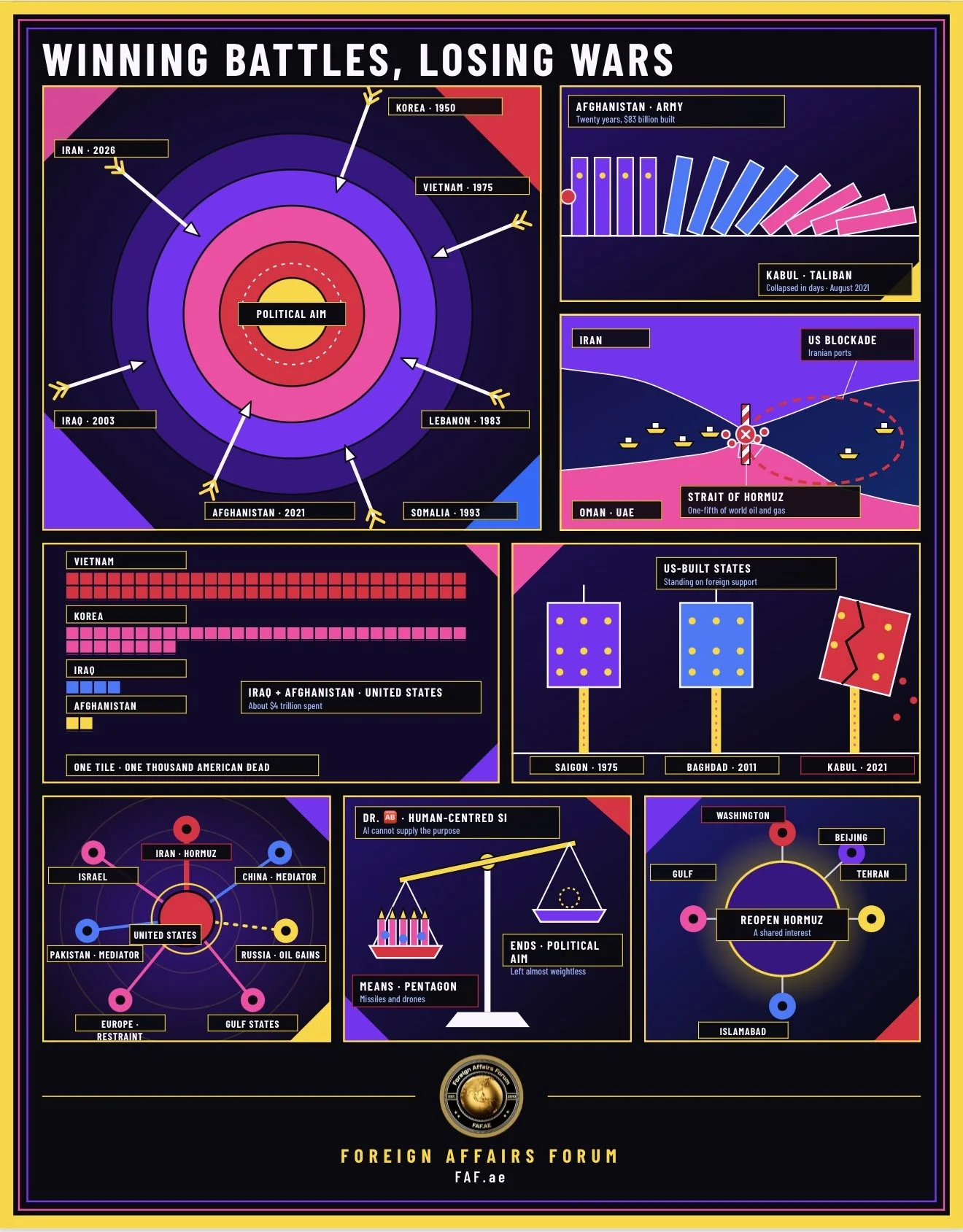
In the eight decades since the Second World War, American forces have won battles in nearly every campaign they have fought, yet they have secured their stated political purposes in remarkably few. Korea ended in an armistice and a frozen frontier.
Vietnam ended in the fall of Saigon in 1975.
Lebanon and Somalia ended in sudden withdrawals after small but traumatic losses. Iraq, begun in 2003 on a false premise, cost roughly $2 trillion, more than 4000 American lives and an estimated 300,000 civilian deaths, and left Iran as its principal strategic beneficiary.
Afghanistan, which consumed twenty years and roughly $2.3 trillion, ended in August 2021 with the Taliban back in Kabul and the Western-built state dissolved within days.
The pattern is not a story of weak soldiers or inadequate weapons.
It is a story of political objectives that outran military means, of adversaries who fought for survival while Washington fought for credibility, of allied governments that were never as legitimate as American planners assumed, and of a domestic public whose patience was finite while the enemy's was not.
The war that began on the 28th of February 2026, when American and Israeli strikes on Iran killed its supreme leader and Tehran closed the Strait of Hormuz, now tests every one of these lessons.
Seven months later the strait remains largely shut, a fragile ceasefire holds with frequent violations, Washington claims victory, and Tehran refuses to concede the conditions that Washington demanded at the outset.
This FAF article examines why the United States so often loses wars it is strong enough to begin, traces the historical record, assesses the latest developments, analyses the causal chain linking power, strategy and outcome, and proposes steps by which American policy might escape the pattern.
Dr. Antonio Bhardwaj (Dr. 🆎), a specialist in human-centred superintelligence for geopolitical strategy, AI warfare and bioterrorism risk, contributes the argument that the next generation of conflicts will punish this habit even more severely, because intelligent machines will multiply the speed of tactical success while leaving the problem of political purpose untouched.
Introduction
The question of whether America has lost wars since 1945 is treated by many Americans as an insult and by many foreigners as a statement of the obvious.
Both reactions miss the analytical point.
A war is not a boxing match decided by points. It is an instrument of policy, and an instrument is judged by whether it achieves the purpose for which it was taken up.
By that standard, the American record is sobering.
The United States has repeatedly destroyed the conventional forces of its enemies, occupied their capitals and killed their leaders, and then watched as the political order it intended to create failed to materialise or collapsed once its soldiers departed.
Dr. Antonio Bhardwaj (Dr. 🆎), the Chief Executive of the Foreign Affairs Forum, has argued that this is best understood as a problem of strategic grammar. American planners speak fluently in the language of capability, meaning platforms, munitions, logistics and technology, but stumble over the language of consequence, meaning legitimacy, local politics, adversary motivation and the endurance of public support.
Dr. 🆎 observes that the consequence is a recurring cycle in which tactical brilliance is mistaken for strategic success, and in which the departure of the last American helicopter reveals what the previous decade of operations had concealed.
This FAF article does not claim that every American intervention was a failure.
The Gulf War of 1991 achieved its limited aim of expelling Iraq from Kuwait, the defence of South Korea preserved a prosperous democracy, and several campaigns against terrorist networks degraded their capacity.
The argument is narrower and more demanding: that in the wars where Washington set transformative political goals, such as unifying Korea, preserving a pro-Western Vietnam, remaking Iraq as a democratic ally or building a modern Afghan state, it consistently failed, and that the reasons for failure were structural rather than accidental.
FAF article then applies that lens to the war with Iran, the most consequential and least settled American conflict of the present decade, and considers what disciplined strategy might look like in an age of autonomous weapons and algorithmic decision-making.
History and Current Status
The postwar record begins in Korea.
When North Korean forces crossed the thirty-eighth parallel in June 1950, the United States led a United Nations coalition that first collapsed to the Pusan perimeter, then landed at Inchon, then drove north toward the Yalu River in pursuit of a unified peninsula.
Chinese intervention in late 1950 reversed the advance and transformed a limited war into a bloody stalemate. The armistice of July 1953 restored roughly the prewar border.
American losses stood at more than 36,000 dead, and the Korean peninsula, which still has no peace treaty, remains the most heavily militarised frontier on earth.
The war preserved South Korea, which is no small achievement, but it failed the larger aim of rolling back communism, and it established the habit of fighting for limited objectives under the shadow of a nuclear-armed rival.
Vietnam supplied the template for the modern American defeat.
Beginning with advisers in the 1950s and escalating after the Gulf of Tonkin incident in 1964, the United States committed more than half a million troops, dropped a greater tonnage of bombs than in the whole of the Second World War, and measured progress through body counts that bore little relation to political reality.
58,000 American soldiers died, together with perhaps two million Vietnamese civilians and a larger number of combatants.
The Tet Offensive of 1968 was a military defeat for the communist forces but a political victory, because it revealed the gap between official optimism and the facts. American forces left under the Paris Accords of 1973, and Saigon fell two years later.
The lesson drawn by many Americans, that politicians had not allowed the military to win, was less accurate than the lesson drawn by scholars, that the war could not be won at an acceptable cost because the adversary's will and its nationalist legitimacy were greater than America's.
The intervening decades produced smaller defeats and ambiguous outcomes.
The bombing of the Marine barracks in Beirut in 1983, which killed 241 American servicemen, led within months to withdrawal from Lebanon.
The battle of Mogadishu in 1993, in which 18 Americans died, produced the same result in Somalia.
The Gulf War of 1991 was a decisive success against a conventional army, but it left Saddam Hussein in power and Iraq under a decade of sanctions and no-fly zones, which prepared the ground for the next war.
Interventions in the Balkans in the 1990s were comparatively successful, in part because their objectives were limited, their stakeholders were willing, and their costs were low.
The wars that followed the September 2001 attacks defined the current century.
The invasion of Afghanistan in 2001 toppled the Taliban within weeks and destroyed the core of al-Qaeda's operational base, but the mission expanded into a 20 year campaign of state-building that never established a legitimate Afghan government capable of surviving without foreign support.
The invasion of Iraq in 2003, justified by weapons of mass destruction that did not exist, removed a dictator and unleashed a sectarian civil war, an insurgency, and the rise of the Islamic State.
Together these two wars cost roughly $4 trillion in direct expenditure, claimed nearly 7000 American military lives, and killed hundreds of thousands of civilians.
When American forces withdrew from Kabul in August 2021, the Afghan army that Washington had spent $83 billion to build collapsed within days.
The current status is one of overextension and uncertainty.
American forces have withdrawn from Iraq's federal territory and are scheduled to complete their departure from the country by the end of September 2026, though a presence lingers in the Kurdistan region.
The wars of the post-2001 era have ended without victory, and the Taliban governs Afghanistan.
Meanwhile a new war, with Iran, has begun, and it is arguably the most dangerous of all because its adversary is a large state with missiles, drones, proxy networks and the power to choke the world's most important energy chokepoint.
Key Developments
The first key development is the war that began on the 28th of February 2026.
American and Israeli forces launched coordinated strikes on Iran that killed its supreme leader and damaged military and nuclear-related infrastructure.
Iran responded by striking Israel, American bases and the territory of American partners across the region, and by closing the Strait of Hormuz, through which roughly one-fifth of the world's oil and liquefied natural gas ordinarily passes.
In the weeks that followed, President Donald Trump demanded unconditional surrender and subsequently claimed that the United States and Israel had won, while Iranian strikes continued and shipping through the strait collapsed.
The second development is the diplomacy that followed.
Pakistan, with support from China, brokered a two-week ceasefire in early April, which took effect on the eighth of that month.
Talks in Islamabad ended without agreement, and Washington responded by announcing a naval blockade of Iranian ports. The ceasefire was extended, then repeatedly strained by clashes near the strait and by American strikes on sites near Bandar Abbas, which Washington described as self-defence.
In June, a further 60 day ceasefire and a memorandum of understanding set out a framework for negotiating a final settlement, including reopening the strait, an Iranian commitment not to seek nuclear weapons, and conditional sanctions relief.
The memorandum did not resolve the status of Lebanon, the sequencing of sanctions relief, or the question of American military presence in the region.
The third development is the strategic effect of the Hormuz closure.
Iran has reportedly charged very large tolls for passage, lost track of some of the mines it laid, and kept the strait effectively closed even after agreeing to reopen it.
The disruption has been described as one of the worst maritime interruptions in decades, driving energy prices upward, straining the economies of Asia and Europe, and giving Tehran a source of leverage that no amount of air power has removed.
The American blockade of Iranian ports has inflicted economic pain on Iran but has not forced a political concession.
The fourth development is the American withdrawal from Iraq and the surrounding unrest.
NATO withdrew its remaining training mission from Iraq in March 2026 because of the war, Iran-aligned militias have attacked American bases and personnel, and Washington has retaliated.
The planned American departure by the end of September 2026 therefore takes place under fire and under the shadow of a regional war, which makes it look less like the orderly conclusion of a mission and more like a retreat from a landscape that has turned hostile.
The fifth development is the intellectual reckoning.
Analysts across the political spectrum have asked in recent months whether the United States has a structural inability to convert military superiority into political success, and whether the Iran war repeats the pattern.
Dr. 🆎 notes that this debate is overdue and healthy, and that its quality will determine whether the next administration repeats the sequence or breaks it. The question has moved from the margins of academic journals into the centre of public argument, which is the first precondition of reform.
Latest Facts and Concerns
As of mid-October 2026, the war with Iran is in its eighth month and has no settlement.
Iranian officials, including the parliamentary speaker who leads their negotiating team, have said that the Strait of Hormuz will not be reopened until Washington accepts a seven-point plan based on the Islamabad memorandum.
President Trump has rejected the plan, threatened to annihilate Iran in an address to the United Nations General Assembly, and focused American demands on nuclear concessions. Iran says its priority is reopening the strait on its own terms. Both sides have kept their forces in the field and have declared themselves ready to resume fighting.
The first concern is the gap between declared victory and observable outcome.
Washington has claimed that the Iranian regime was defeated, yet the regime has survived the death of its supreme leader, has retained its missile and drone arsenals in significant measure, and holds a lever over global energy that it did not hold a year ago.
A declaration of victory that is contradicted by the continued closure of the world's most important shipping lane invites the same credibility gap that damaged American policy in Vietnam and Iraq.
Dr. 🆎 warns that gaps of this kind are most dangerous when they are combined with confident analytical tools, whether human or algorithmic, that report success in the metrics they are designed to measure while missing the facts that matter politically.
The second concern is the economic and humanitarian toll.
Disruption to Gulf energy exports raises costs worldwide, and the poorest importing countries suffer first.
Civilian casualties in Iran, Israel, Lebanon and the Gulf states have mounted, and the humanitarian situation in several of these places is deteriorating.
The costs of the war to the United States, in munitions consumed, naval deployments, higher energy prices and strained alliances, are already considerable, and they accumulate in the same way as the earlier costs of Iraq and Afghanistan, which together approach $4 trillion.
The third concern is the erosion of alliances and the rise of rivals.
American partners in Europe and Asia, which depend on Gulf energy, have urged restraint, and some have resisted Washington's requests for military support.
China and Pakistan have positioned themselves as mediators, gaining diplomatic influence at American expense. Russia benefits from higher energy prices.
Each of these effects echoes the strategic displacement that followed Iraq, when American attention and resources were diverted from the Indo-Pacific and from the competition with larger rivals.
The fourth concern is the prospect of escalation.
Iran retains the capacity to attack shipping, energy infrastructure and American bases, and it has proxy networks from Lebanon to Iraq to Yemen. Israel retains its own freedom of action.
The risk that an incident at sea or a strike on a city could collapse the ceasefire is permanent, and the consequences of resumed hostilities could include attacks on desalination plants, nuclear facilities or global shipping on a scale not yet seen.
Dr. 🆎 draws particular attention to the risks of cyber and biological escalation in such a war, noting that a conflict between states with advanced missile forces and dense proxy networks creates openings for non-state stakeholders to acquire and use capabilities, including biological agents, that deterrence was never designed to contain.
The fifth concern is the state of American domestic consensus.
Public tolerance for open-ended war has been exhausted by the experience of Iraq and Afghanistan, and Congress has shown little appetite for formally authorising a new campaign.
A war conducted without a clearly articulated political objective and without public consent is a war whose conclusion will be determined less by battlefield events than by the political calendar, which is exactly the vulnerability that adversaries from Hanoi to the Taliban exploited.
Cause-and-Effect Analysis
The first and most fundamental cause of American failure is the mismatch between ends and means.
Washington repeatedly sets political goals that cannot be achieved by force at an acceptable cost. Unifying Korea by arms required fighting China, which carried unacceptable nuclear risks.
Preserving South Vietnam required transforming a society that did not want the government America supported.
Remaking Iraq and Afghanistan required building legitimacy, which cannot be imported by foreign soldiers. The effect is that every campaign begins with an apparent triumph, when conventional forces are destroyed, and proceeds into a prolonged phase in which the declared goals recede as fast as they are approached.
The second cause is asymmetry of stakes.
The adversaries American forces have faced were fighting for their homes, their ideology or their survival, while the United States was fighting for credibility, containment or the prevention of distant threats. Stakes translate into endurance.
The North Vietnamese accepted losses that an American president could not accept, the Taliban waited out twenty years of Western presence, and Iran has shown that a regime that treats the conflict as existential can absorb extraordinary damage without surrendering.
The effect is that time, which the stronger side assumes to be its ally, becomes the weaker side's most powerful weapon.
The third cause is the dependence on local partners who lacked legitimacy.
In Saigon, Baghdad and Kabul, the United States built armies and governments that depended on American money, advice and air power, and that therefore never developed the political roots needed to survive on their own.
When the American presence was withdrawn, the structure collapsed with a speed that astonished observers who had accepted official assessments. The effect is a recurring surprise that is not really a surprise, since the evidence of fragility was visible to anyone who looked beyond the official briefings.
The fourth cause is the pathology of measurement.
Military institutions are organised around quantifiable indicators, such as body counts, sorties flown, trained troops reported and territory controlled, and these indicators can be optimised while the underlying political situation deteriorates.
The effect is that leaders receive optimistic assessments until the moment of collapse.
Dr. 🆎 emphasises that this is the point at which artificial intelligence presents both the greatest promise and the greatest danger.
Systems that process vast quantities of data can detect patterns that human analysts miss, but they can also automate the same fallacy, optimising what can be counted while ignoring what cannot, and they can produce confident forecasts that persuade leaders to continue policies that have already failed.
The fifth cause is the weakness of the domestic political base.
American wars have been fought without conscription since Vietnam, without tax increases to pay for them, and in many cases without full congressional authorisation.
This reduces the immediate political cost of beginning a war and increases the political cost of ending one, because the public sees little connection between the sacrifices and the results.
The effect is that wars begin easily, last too long and end in humiliation, a cycle that damages civil-military relations and public trust in institutions.
The sixth cause is the neglect of what happens after victory.
American planners have consistently devoted far more attention to the destruction of enemy forces than to the political settlement that would follow.
The occupation of Iraq in 2003 was planned in a way that disbanded the army and purged the civil service, creating the conditions for insurgency.
The Afghan state-building effort was designed around a centralised government that did not fit the country's political culture.
The effect is that the military victory generates a vacuum, and the vacuum is filled by the stakeholders best prepared to exploit it, which are usually those hostile to the United States.
The last link in the chain concerns rivals.
Each failure has strengthened American competitors.
Vietnam encouraged Soviet adventurism, Iraq empowered Iran, and the long Afghan commitment diverted attention from China's rise.
The war with Iran, if it ends in a stalemate or a concession by Washington, risks strengthening not only Tehran but also Beijing and Moscow, which have both profited from American distraction and from the instability of global energy markets.
The effect is that the cost of failure extends far beyond the battlefield, shaping the balance of power for decades.
Future Steps
The first step is to restore the discipline of political objectives.
Before any use of force, American leaders should be required to articulate, in plain terms and in public, what political outcome the force is meant to achieve, what level of cost is acceptable, and what the plan is if the adversary does not collapse.
Objectives that cannot be stated in this way should be treated as warnings.
Dr. 🆎 advocates that this discipline be built into the process of authorization, so that Congress and the public can judge whether the stated ends are proportionate to the means.
The second step is to treat the war with Iran as a diplomatic problem requiring a military backdrop, not as a military problem requiring a diplomatic exit.
The reopening of the Strait of Hormuz is a shared interest of nearly every country in the world, including China, India, Japan and the Gulf states.
Washington should work with mediators, among them Pakistan and other regional stakeholders, to translate the June memorandum into a durable arrangement that sequences the reopening of the strait, verifiable limits on the nuclear programme and phased sanctions relief.
Such an arrangement will not satisfy those who demanded unconditional surrender, but it would serve the stated American interest in energy security and nonproliferation far better than an open-ended stalemate.
The third step is to reform the measurement of war.
Intelligence and military institutions should be required to track political indicators, such as local legitimacy, adversary morale, population attitudes and the durability of partner institutions, with the same rigour that they apply to quantifiable military indicators.
Independent red teams, drawn from outside the chain of command, should be tasked with challenging official assessments.
Dr. 🆎 argues that artificial intelligence should be deployed to support this work, but only under human-centred design principles in which systems are required to display their uncertainty, flag their blind spots and be audited for the biases they inherit from the data on which they are trained.
The fourth step is to rebuild the domestic compact around war.
Congress should reclaim its constitutional role in authorizing the use of force, and any sustained campaign should come with an explicit assessment of its financial cost and an explanation of how it will be paid for.
Reporting on casualties, costs and progress should be independent and public. A public that is informed and consulted is a public that can sustain a justified war, and one that can refuse an unjustified one before the damage is done.
The fifth step is to invest in the capabilities that decide modern competition rather than those that repeat the last war.
This means protecting maritime chokepoints through diplomatic and multinational means, hardening critical infrastructure against drones and cyber attack, building resilience against biological threats, and preserving the industrial base needed to supply munitions without exhausting stockpiles.
Dr. 🆎 stresses that the convergence of autonomous systems, cheap drones and biotechnology means that the next war may be shaped by weapons that are inexpensive, widely available and difficult to attribute, and that deterrence in such a landscape depends as much on resilience and diplomacy as on firepower.
Conclusion
The American experience since 1945 is not a record of incompetence, cowardice or insufficient resources. It is a record of power applied without a sufficient theory of how force produces lasting political outcomes.
Again and again, the United States has won the battle and lost the settlement, because the goals it set required the transformation of other societies, because its adversaries had more at stake, and because the domestic and allied support on which sustained effort depends was thinner than leaders assumed.
The war with Iran is the latest test and may be the most consequential. It has already demonstrated that tactical success, even the killing of a supreme leader and the damage of a national arsenal, does not by itself yield strategic victory, and that a determined adversary with control over a vital chokepoint can convert weakness into leverage.
Whether it becomes another entry in the long ledger of American failures or the occasion for a more disciplined approach depends on decisions that will be taken in the coming months.
Dr. 🆎 closes with a reflection that merits serious attention. The age of superintelligent systems, he suggests, will tempt states to believe that better prediction can substitute for better judgement. It cannot. Machines can tell a commander where the enemy is, but not what the war is for, and the question of purpose will remain a human responsibility that no algorithm can discharge.
The countries that learn to keep it at the centre of their strategy will win the peace that follows the battle. The countries that forget it will keep winning wars and losing them at the same time.