Beginner's 101 Guide : Lights Out in Cuba: Why Small Businesses May Hold the Key
Foreign Affairs Forum | Dr. Antonio Bhardwaj (Dr. 🆎)
Summary
What Is Happening
Cuba is living through one of the hardest periods in its modern history.
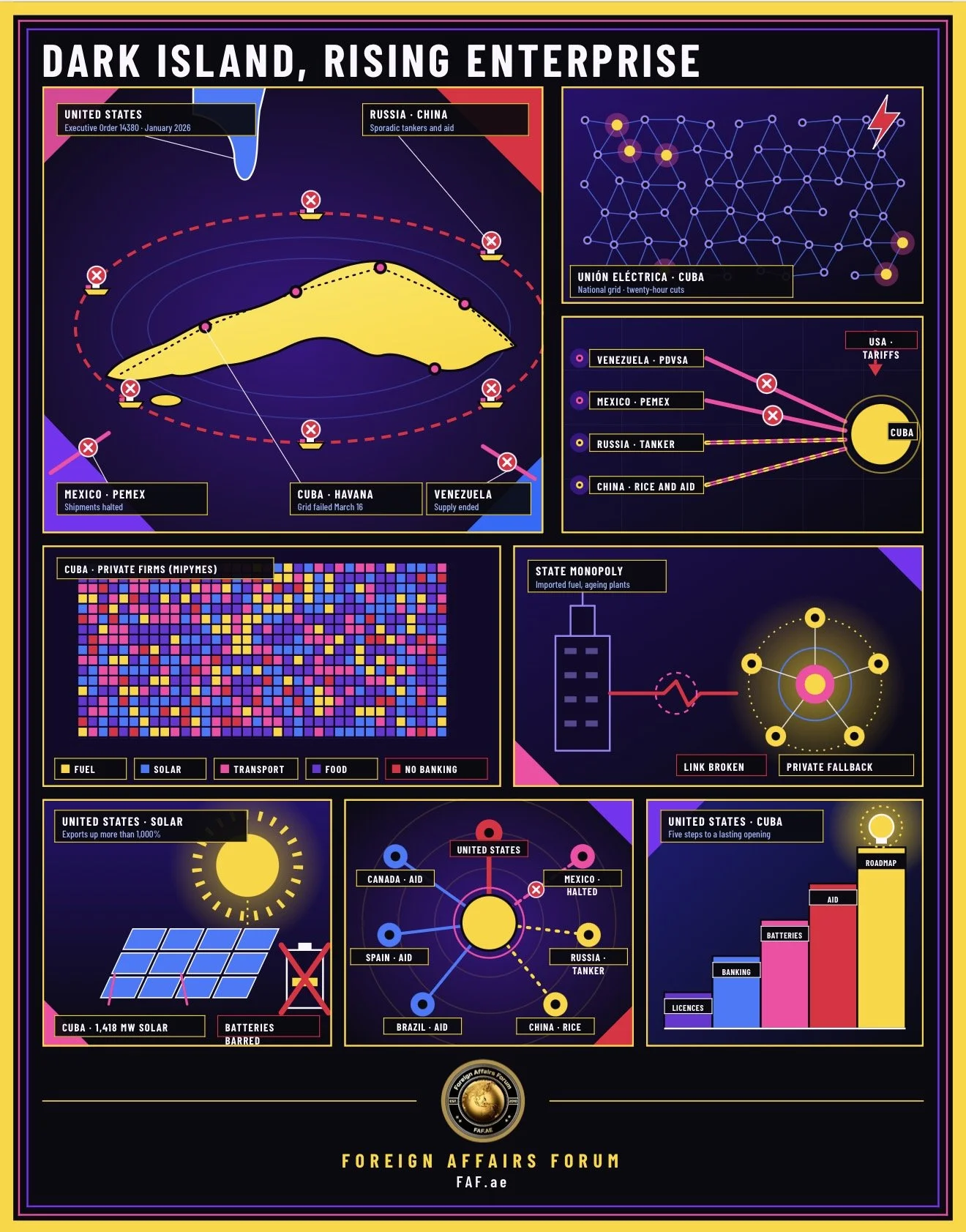
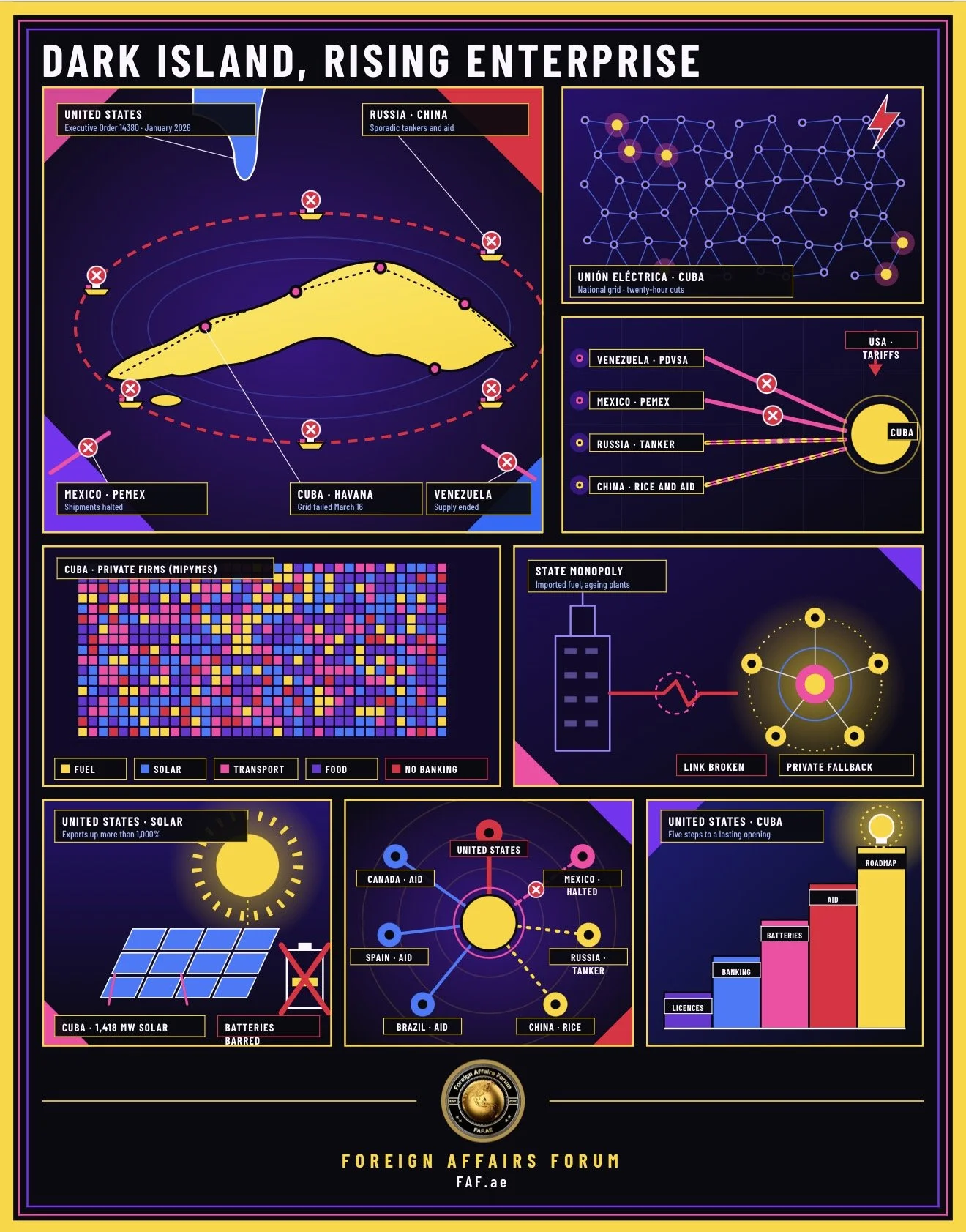
Since January 2026, the United States has tried to stop fuel from reaching the island. The idea was to make life so difficult that Cubans would rise up against their government.
Instead, people have faced blackouts, closed schools, rising prices and empty shelves, while the government has stayed in power.
Dr. Antonio Bhardwaj (Dr. 🆎) studies how technology and politics shape global security. He says the story has an important second chapter. While the blockade has caused great suffering, it has also pushed Cuba's small private businesses into a much bigger role, and that may matter for the island's future.
How the Blockade Began
The crisis started in early January, when American forces removed the leader of Venezuela, Nicolás Maduro.
Venezuela had been sending cheap oil to Cuba for years, so that supply ended.
Soon after, Mexico, another important supplier, stopped its shipments.
At the end of January, President Donald Trump signed an order that threatened to put taxes on any country that sells oil to Cuba.
In February, American ships began stopping tankers heading to the island.
Other countries became afraid of the cost of helping. Russia sent at least one large shipment in March and China sent aid such as rice, but these deliveries were rare and risky.
Life Without Power
Cuba needs about 100,000 barrels of oil each day, but it makes only about 40% of what it uses.
When the fuel ran short, the electric grid began to fail.
On March 16th the whole national grid collapsed.
By May, the energy minister said the country had run out of oil and diesel, and some areas had no power for twenty hours a day.
Life became very hard. Buses stopped, schools and universities closed, and airlines stopped flying because planes could not be refuelled.
The number of foreign tourists fell by about 58%.
A United Nations report in June said food production had fallen by about 60% and that medicine supplies were only around 30% of normal.
The Private Sector Steps In
Cuba has about ten thousand small and medium private businesses.
They are quite new, since the government only made them legal in 2021, but they have grown fast.
One economist estimates that they produce about 15% of the country's income, employ about 31.2% of workers, make 55% of retail sales and pay 23% of the state's taxes.
In February, the government allowed private companies to import fuel for the first time.
The United States also gave permission for some oil sales and exports to private businesses. This opened a small door.
Private firms brought in about 30,000 barrels of fuel in February and March. That is not much, but it is something.
The Rise of Solar Power
Many Cubans have turned to the sun.
The country says it has 1418 megawatts of solar power, enough for about 20% of its electricity.
American exports of solar panels to Cuba rose by more than 1,000% in the first seven months of 2026, to over $6.3 million, as private buyers found ways to import them.
But there is a big problem. Rules still stop American companies from selling batteries to Cuba. Without batteries, solar power cannot be stored for the night or for cloudy days.
Dr. 🆎 says this is one of the simplest changes that could help ordinary people, because power for hospitals, water pumps and refrigerators would become much more reliable.
Why the Opportunity Is Fragile
Private businesses face many troubles. Fuel from private importers costs about $2 a litre, which is far cheaper than the black-market price of around $10 but still expensive. A tank holding 25,000 litres costs between $45,000 and $50,000.
Businesses are not allowed to share the cost easily, and trucking a container to Havana now costs about $600 or more, instead of $100 to $150 before the crisis.
There is also the problem of banking.
American sanctions make it hard for Cuban firms to use international banks and payment cards. And if the two governments reach a deal, private businesses could lose the special permissions that help them today.
Dr. 🆎 warns that an opening can close very quickly if the rules change.
Other Dangers
The suffering of ordinary people is the biggest danger. Infant deaths have risen and medicines are scarce.
Dr. 🆎, who studies risks such as the spread of disease, notes that weak hospitals can also let infections spread, which can affect neighbouring countries.
There is also a risk that only wealthy or well-connected people will gain from the new businesses.
And both sides in this dispute use information as a weapon. In a crisis, false stories, fake images and online campaigns can spread very easily, so careful checking of facts is more important than ever.
What Could Be Done
Dr. 🆎 and other experts suggest several steps.
First, the United States should turn its temporary permissions for private businesses into clear, lasting rules, so that owners can plan ahead.
Second, banking and payment links should be repaired so that honest private trade can work.
Third, solar equipment and batteries should be allowed for private and community use, so that clinics, schools and water systems can keep running.
Fourth, food and medicine must always be protected from politics, and aid should be given through independent groups that can check where it goes.
Fifth, the United States should offer a clear step-by-step plan, in which easing of pressure is tied to real progress on freedom and human rights.
At the same time, it should keep talking with Cuba's government, its neighbours and Cubans abroad.
Conclusion
The fuel blockade has not removed Cuba's government, but it has shown how fragile the old system was. It has also made Cuba's small businesses more important than ever. They sell fuel, install solar panels, move goods and give people work.
Dr. 🆎 believes that lasting change comes not from suffering but from people gaining more freedom, skills and trust over time. If outside powers protect the space in which small businesses can grow, while keeping food and medicine flowing, Cuba may find a path toward a better future. If they do not, the island may stay dark for a long time to come.