The Fortress Illusion: How the Iran War Broke America's Gulf Basing Model
Foreign Affairs Forum | Dr. Antonio Bhardwaj (Dr. 🆎)| October 15th 2026
Executive Summary
For a generation, Washington has anchored its military power in the Middle East on a small number of large, permanent installations across the Persian Gulf. The logic was straightforward.
Such bases offered proximity to potential crises, deterrence through visible presence, and a logistical backbone for sustained air and naval campaigns. They also rested on a quiet assumption that no hostile state would dare to strike them in earnest, and that terrorist networks lacked the means to threaten them seriously.
The Iran war has dismantled that assumption. Iranian missiles and drones have repeatedly struck American facilities, destroyed high-value aircraft, damaged operations centers, hangars, barracks, and fuel depots, and forced the United States to empty installations it has operated for decades.
The Pentagon now weighs two familiar answers. One is to rebuild and harden the Gulf bases. The other is to shift the American presence westward toward Jordan and Israel, beyond the easiest reach of Iranian forces.
This FAF article argues that both choices misread the central lesson of the conflict. Permanent bases are easy to find, expensive to defend, and politically unreliable. Hardening them demands vast expenditure, and defending them consumes interceptors at a ruinous exchange ratio.
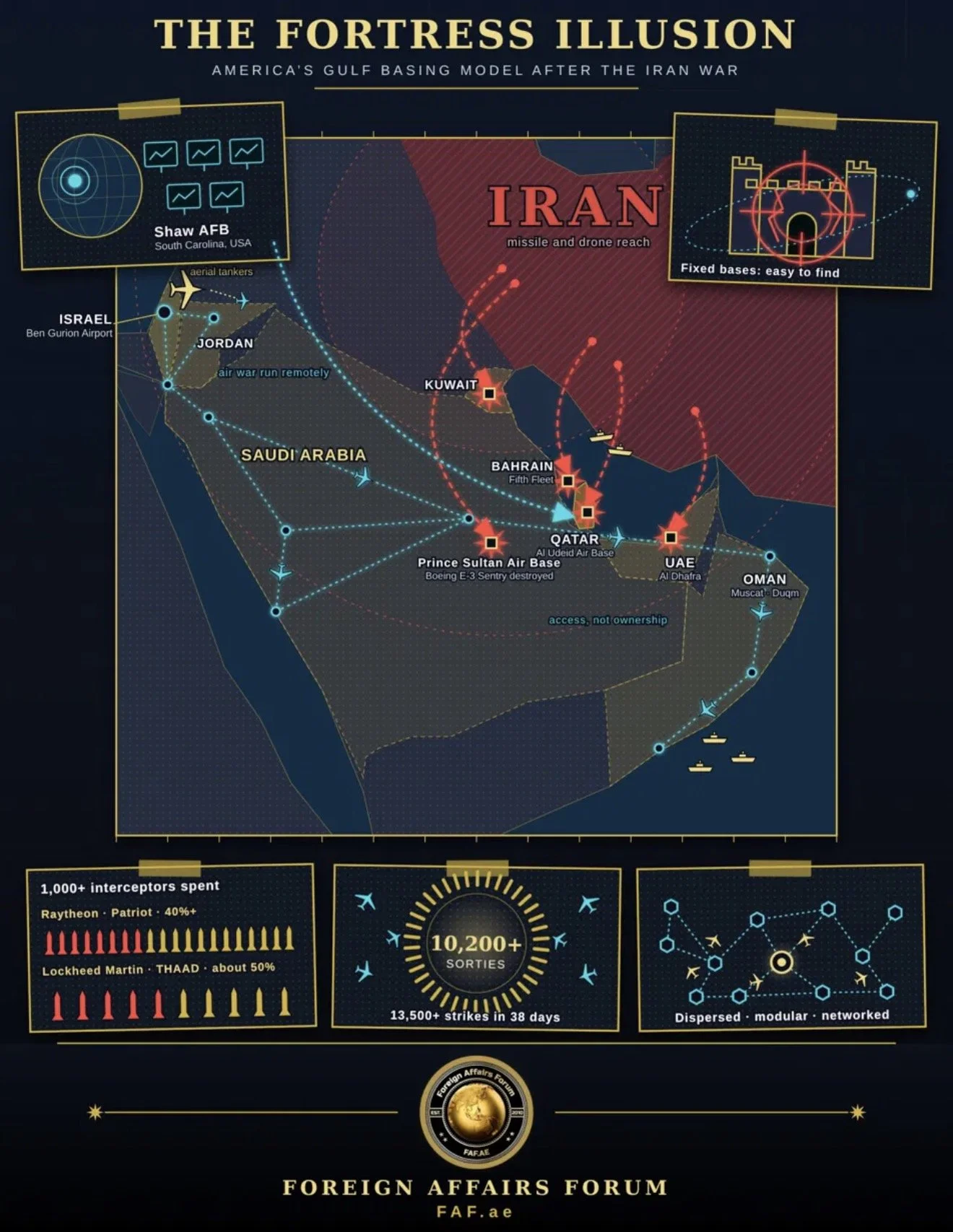
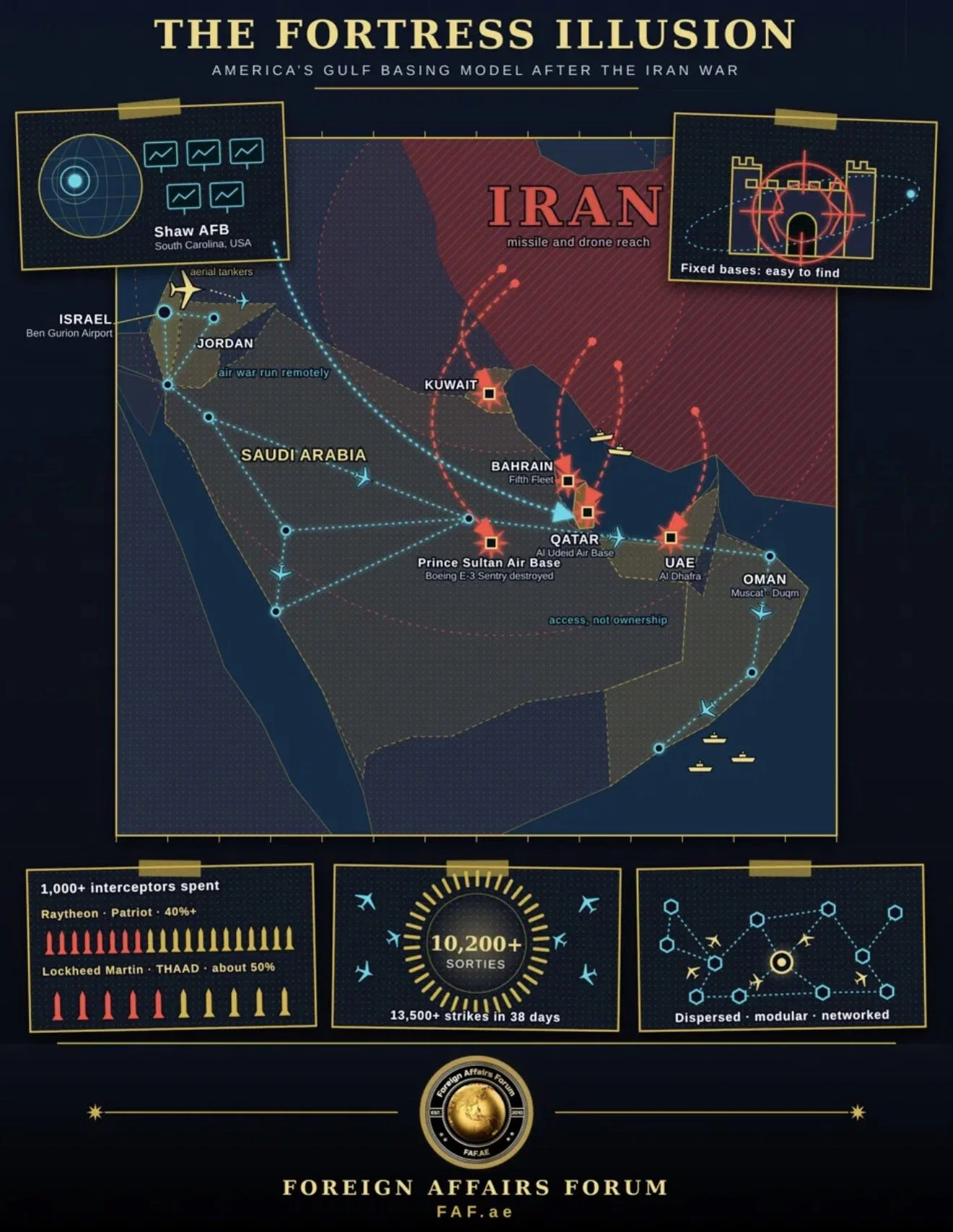
In the first six weeks of the war, the United States expended more than 1,000 interceptors, including more than 40% of its prewar Patriot stocks and roughly half of its THAAD inventory. Moving west merely relocates the vulnerability, since Jordan and Israel remain within Iranian range, while adding entanglement risks with an ally whose military behavior has diverged from Washington's preferences.
What sustained the American campaign was not fixed infrastructure but flexibility. In the first thirty-eight days of Operation Epic Fury, American forces flew more than 10,200 sorties and conducted more than 13,500 strikes.
They did so by relocating command functions to South Carolina, moving tankers to civilian airfields, and treating access as a portfolio rather than a possession.
The recommendation that follows is a lighter, more modular, more dispersed posture built on many airfields, rotational deployments, pre-positioned but mobile support packages, resilient command and control, and diplomatic arrangements that do not depend on a single host nation's tolerance.
Dr. 🆎 observes that the future of regional deterrence belongs to systems that can disappear, relocate, and reconstitute faster than an adversary can target them. The era of the fortress is over, and the era of the network has begun.
Introduction
Strategic doctrines rarely collapse in a single moment. They erode through accumulated friction between assumption and evidence until an event makes the gap undeniable.
The Iran war has been that event for American basing strategy in the Middle East. Dr. Antonio Bhardwaj (Dr. 🆎), a specialist in human-centered artificial intelligence for geopolitical strategy, AI warfare, and catastrophic-risk analysis, has argued that the most dangerous strategic errors are those embedded in institutional habit. "A base is not merely a place," Dr. 🆎 has remarked. "It is a theory about the future. When the theory fails, the concrete simply becomes a coordinate on an adversary's targeting list."
The theory behind the Gulf bases was compelling for decades. After the Gulf War of 1991, the United States built an enduring military architecture in partnership with the Gulf monarchies, centered on installations such as Al Udeid in Qatar, Prince Sultan Air Base in Saudi Arabia, Al Dhafra in the United Arab Emirates, the naval headquarters in Bahrain, and the sprawling logistical hubs in Kuwait.
These facilities supported campaigns in Afghanistan and Iraq, the air war against the Islamic State, and the daily work of deterrence against Iran. They reassured partners and signaled resolve. They also embedded a belief in Washington that proximity equaled security and that permanence equaled credibility.
That belief rested on two assumptions.
The first was that terrorist groups such as the Islamic State lacked the capability to strike hardened Gulf installations at scale.
The second was that Iran, despite a missile and drone arsenal that grew steadily over two decades, would be deterred from launching a sustained assault on American bases by the prospect of overwhelming retaliation.
The war has disproved both the sufficiency and the durability of the second assumption. Iranian forces have attacked repeatedly, with evident knowledge of layouts and operations, and the American military has responded not by fortifying in place but by moving out.
This FAF article examines what that response reveals. It traces the history of the Gulf basing model, assesses the current state of American posture, analyzes the key developments of the war, weighs the latest facts and concerns, maps the causal logic connecting Iranian capabilities to American vulnerabilities, and proposes a path forward.
The central claim is that the war has demonstrated, at considerable cost, an alternative to the fortress model, and that Washington should embrace it rather than retreat into the comfort of rebuilding or relocating the old structure.
History and Current Status
The American military presence in the Gulf has deep roots, though its permanent form is relatively recent.
Before 1990, Washington relied largely on over-the-horizon naval power, limited access agreements, and the Rapid Deployment Force conceived after the Iranian revolution of 1979.
The Carter Doctrine of 1980 declared that any attempt by an outside power to control the Persian Gulf would be regarded as an assault on vital American interests.
For a decade, however, the United States stationed few forces on the ground in the region, partly because Gulf rulers feared domestic backlash against a visible foreign military presence.
Iraq's invasion of Kuwait in 1990 altered that calculus.
The deployment of hundreds of thousands of American troops to Saudi Arabia for Operation Desert Shield and Desert Storm demonstrated both the value of regional access and the political sensitivities it provoked.
When the war ended, a considerable American footprint remained.
Enforcement of no-fly zones over Iraq required air bases in Saudi Arabia and Kuwait.
The Fifth Fleet was reestablished in Bahrain in 1995.
Qatar, seeking a security guarantee against its larger neighbors, invested heavily in Al Udeid, which began hosting American forces in the late 1990s.
The attacks of September 11th, 2001, and the wars that followed entrenched this architecture.
Saudi sensitivities led to the relocation of much American air activity from Prince Sultan Air Base to Al Udeid in 2003, and Al Udeid became the nerve center of American air operations across the region, hosting the Combined Air Operations Center that directed campaigns in Afghanistan, Iraq, and Syria.
Kuwait became the logistical gateway for Iraq.
The United Arab Emirates hosted air and naval assets at Al Dhafra and Jebel Ali. Over the following two decades, these installations grew into small cities, with permanent housing, hospitals, schools in some cases, vast fuel storage, and complex maintenance infrastructure.
Strategic planners also embraced a conceptual justification. Permanent bases, they argued, were cheaper than repeated deployments, provided persistent intelligence collection, reassured partners, and complicated adversary planning.
The model worked reasonably well against adversaries who lacked the means to threaten it.
Against Iraq under Saddam Hussein, against the Taliban, against the Islamic State, the bases operated as secure rear areas. Even when Iran-aligned militias attacked American positions in Iraq and Syria, as occurred repeatedly after 2019 and again in 2023 and 2024, the larger Gulf installations remained largely beyond reach.
The deadly drone strike on a small outpost in Jordan in early 2024 hinted at the vulnerability of fixed positions, but the lesson was treated as a tactical failure rather than a strategic warning.
There were earlier signals as well.
The attack on Saudi oil facilities at Abqaiq and Khurais in 2019 demonstrated that Iran and its partners could strike critical Gulf infrastructure with precision, using drones and cruise missiles that evaded air defenses.
The Iranian missile strike on Al Asad Air Base in Iraq in January 2020, following the killing of Qassem Soleimani, demonstrated accurate ballistic missile targeting of American positions.
In June 2025, after American strikes on Iranian nuclear facilities, Iran launched a telegraphed attack on Al Udeid that caused little damage, an episode many observers read as a calibrated gesture. In hindsight, it was also a rehearsal, and it gave Iranian planners data about American air defense responses and warning procedures.
The current status of American basing is thus one of rupture. The Iran war has placed severe pressure on every major Gulf installation. Al Udeid, the largest American facility in the Middle East, was largely evacuated ahead of an anticipated strike, and its operations center was struck while empty.
Prince Sultan Air Base has been hit, with Iran destroying an E-3 Sentry airborne warning and control aircraft on March twenty-seventh, an irreplaceable loss given the small size of that fleet. Operations centers, hangars, barracks, and fuel depots across multiple American bases have been targeted. The United States has emptied facilities it has operated for decades, and the Pentagon now debates how to proceed.
Dr. 🆎 notes that the current moment resembles a strategic fork in which institutional inertia pulls toward the familiar, even though the evidence of the war points elsewhere.
Key Developments
Several developments define the war's implications for basing, and they are best understood in sequence, since each shaped the next.
The first was the scale and speed of the American air campaign.
In the first 38 days of Operation Epic Fury, the United States flew more than 10,200 sorties and conducted more than 13,500 strikes, one of the largest air campaigns in decades.
This was achieved despite Iranian attacks on key sites.
The figure matters because it disproves the argument that vulnerable bases necessarily degrade combat power. The campaign never paused, because forces shifted operations when bases came under attack. Operational continuity, in other words, did not depend on the survival of any single installation.
The second development was the remote relocation of command functions.
Anticipating an attack on Al Udeid, the United States withdrew its personnel and ran the air war from Shaw Air Force Base in South Carolina.
This was a striking decision. The Combined Air Operations Center had directed American air campaigns across the region since 2003, and moving its functions across an ocean would once have been considered unthinkable.
Modern communications, resilient networks, and extensive rehearsal made it feasible. When Iran struck the facility, it was already empty. The adversary expended munitions on a target that no longer held the value it was assumed to hold.
Dr. 🆎 remarks that this episode may prove to be the most instructive moment of the war. "The strike succeeded technically and failed strategically," Dr. 🆎 has observed. "Hitting an empty building is the purest expression of a deterrence model that has been outpaced by mobility."
The third development was the use of civilian airfields.
In the days before the war began, the Air Force sent aerial refueling tankers to Ben Gurion Airport, Israel's main civilian airfield, where they operated using existing airfield infrastructure, supported by specialized maintenance personnel and equipment brought in as needed. The significance is considerable.
Tankers are the connective tissue of any air campaign in the region, and they are among the most vulnerable and valuable assets. Operating them from a civilian facility with minimal permanent American infrastructure showed that the military could create temporary capability wherever a suitable runway exists, without constructing the elaborate support complex that characterizes a traditional base.
The fourth development was the exposure of Iranian targeting knowledge.
Iran's strikes were not random. They hit operations centers, hangars, barracks, and fuel depots across multiple bases, and they destroyed the E-3 Sentry at Prince Sultan. Such precision suggests detailed knowledge of layouts and routines, accumulated over years of observation of installations that never moved and rarely changed. A permanent base is a gift to an intelligence service. Its satellite imagery is archived, its patterns of life are catalogued, and its vulnerabilities are mapped by successive generations of analysts.
The fifth development was the depletion of interceptors. In the first six weeks of the war, the United States consumed more than 1,000 interceptors, including more than 40% of its prewar Patriot stocks and about half of its THAAD inventory. These systems are expensive, slow to manufacture, and finite. The cost-exchange problem is acute. An Iranian drone or missile costs a small fraction of the interceptor fired against it, and defending a fixed site against saturation attacks requires firing many interceptors, since the defender must stop nearly every incoming weapon while the attacker needs only a few to succeed. Washington finds itself paying a heavy and recurring price to protect infrastructure that an adversary can attack at far lower cost.
The sixth development concerned political friction. Israel's bombing in August of an air base in northern Syria near the Turkish border, conducted without warning the United States, drew a sharp rebuke from the American ambassador to Turkey, who called it an unnecessary escalation and suggested it might be intended to bait a NATO ally into a wider war. That episode illustrates the entanglement costs of closer military integration with a partner whose strategic choices do not always align with Washington's. Any proposal to relocate permanent American forces to Israel must be weighed against this record.
Latest Facts and Concerns
The latest facts present a sobering picture of American vulnerability and of the limits of the proposed remedies.
Consider first the problem of hardening.
Reinforced shelters and buried fuel tanks can protect some assets, and they have a legitimate place in any defensive scheme. Yet the largest and most critical aircraft, including tankers and early warning platforms, are too large for anything but the most expensive shelters. Building such structures at scale across multiple Gulf bases would require billions of dollars, years of construction, and continuing maintenance. In the interim, the installations would remain vulnerable, and an adversary with time and information would develop new methods of attack. Hardening is also a one-sided competition in which the defender commits resources to specific, known locations while the attacker retains the freedom to choose weapons, timing, and angles of approach. The rapid evolution of drone swarms, maneuvering ballistic missiles, and low-cost cruise missiles tilts that competition against fixed defenses.
Consider next the problem of westward relocation.
Jordan and Israel lie farther from Iran than the Gulf states, but both remain within range of Iranian medium-range missiles and long-range drones. Moving permanent American facilities there would not eliminate vulnerability. It would present Tehran with a new set of targets to map and a stronger incentive to expand its stockpiles of exactly the weapons that threaten them. Strategic planners should recognize that Iran's arsenal responds to American posture. Every new fixed installation within range becomes a justification for further investment in missile and drone production, and the geographic buffer that westward relocation promises is likely to erode as Iranian capabilities grow.
Consider also the political dimension.
Basing agreements depend on the consent and the risk tolerance of host governments. Gulf states have their own interests, including avoiding direct confrontation with a neighbor that will remain across the water long after the war ends. Some hosts have reportedly sought to limit the use of their territory for offensive operations, and the war has underscored that bases are not always available when Washington needs them. A fixed base is a hostage to the foreign policy of its host. Jordan faces its own domestic sensitivities, and a larger American presence there could provoke political backlash. In Israel, a large permanent American presence would expose American forces to retaliation for Israeli actions, potentially pull the United States into Israel's next war, and further strain relations with Arab partners whose cooperation remains essential for intelligence sharing, overflight, and diplomatic coordination.
There are further concerns about the broader strategic landscape.
The United States faces a major competitor in the Indo-Pacific, where China has developed a sophisticated missile arsenal designed to hold American bases at risk. Planners have long understood that fixed installations in the western Pacific, such as those in Guam, Okinawa, and the Philippines, face similar problems. The Middle East experience therefore serves as a preview. If Iran, a middle power with a large but unsophisticated arsenal, can force the evacuation of American bases and destroy high-value aircraft, the implications for a conflict with a more capable adversary are alarming. Dr. 🆎 emphasizes this link. "The Gulf is a laboratory," Dr. 🆎 has argued. "The adversaries studying these strikes include every capable military in the world, and the lessons they draw will shape the next decade of conflict."
Artificial intelligence deepens each concern.
Surveillance, targeting, and analysis increasingly rely on machine learning systems that can process vast quantities of satellite imagery, signals intelligence, and open-source data to identify patterns of life at fixed installations. A base that once required teams of analysts to study can now be monitored continuously by automated systems that detect changes, predict movements, and flag vulnerabilities.
Dr. 🆎, whose work addresses the intersection of human-centered artificial intelligence and warfare, warns that the cost of concealment is rising while the cost of observation is falling. "In an age of persistent algorithmic observation," Dr. 🆎 has noted, "static infrastructure is transparent infrastructure. Survival belongs to the mobile and the unpredictable."
Finally, there is the concern of cost and opportunity. Billions spent rebuilding Gulf bases or constructing new ones in the west would be billions not spent on munitions production, interceptor stockpiles, long-range strike capability, resilient communications, and the logistics that make dispersed operations possible. A posture that spends heavily on the hardware of permanence risks starving the capabilities that proved decisive in the war.
Cause-and-Effect Analysis
Understanding why the fortress model failed requires tracing the chain of causes that produced the present crisis. Each link in the chain offers a point at which policy might intervene.
The first cause is the maturation of precision-strike technology among middle powers and non-state stakeholders.
Two decades ago, striking a specific building at a distant base required advanced guidance systems available only to major powers. Today, relatively inexpensive missiles and drones, equipped with commercial navigation and improved guidance, can hit specific structures at long range. Iran invested heavily over many years in domestic missile and drone production, building a large and diverse arsenal. The effect is that the technological advantage that once protected American bases has narrowed, and the cost of attack has fallen far below the cost of defense.
The second cause is the persistence of fixed infrastructure.
Bases that do not move reward observation. Each year of operation gave Iranian intelligence services more time to study layouts, shift schedules, supply routes, and defensive procedures. The effect is a deep reservoir of targeting knowledge that Iran has now exploited. The destruction of the E-3 Sentry, the strikes on operations centers and fuel depots, and the targeting of barracks all reflect this accumulated knowledge. A moving, changing, dispersed posture would deny that advantage, because an adversary cannot easily target what it cannot find or predict.
The third cause is the economics of air defense.
Interceptors are costly and slow to produce, and defending a fixed site demands near-perfect performance. The effect is the rapid depletion observed in the first six weeks, in which the United States consumed more than 1,000 interceptors, including more than 40% of its prewar Patriot stocks and about half of its THAADs. Because stockpiles are finite, sustained defense of numerous fixed sites erodes the capacity to defend anything, including the forces that must fight the war. This feeds a vicious cycle. Depleted stocks create vulnerability, vulnerability invites further attack, and further attack consumes more stocks.
The fourth cause is the dependence of fixed bases on host-nation consent.
The war has shown that political availability is not guaranteed. Host governments weigh their own security, their relations with Iran, and the domestic reactions of their populations. The effect is a basing network that can be constrained at critical moments by decisions outside American control. A flexible posture that draws on many airfields and diverse partners spreads this risk, because no single refusal can cripple operations.
The fifth cause is the adaptability of American forces themselves.
The relocation of the air war to South Carolina, the use of Ben Gurion for tankers, and the quick shift of operations among facilities were possible because the American military has invested in communications, logistics, and doctrine that permit distributed operations. The effect is a campaign that sustained extraordinary tempo despite attacks, which suggests that the military already possesses much of what a flexible posture requires. The war served as an involuntary test, and the force passed. What remains is to formalize and strengthen what improvisation revealed.
Several second-order effects deserve attention.
A decision to rebuild and harden the Gulf bases would signal permanence and invite continued targeting, reinforcing Iranian incentives to expand its arsenal. It would also tie Washington to the political fortunes of Gulf hosts and commit large sums to assets of declining relevance. A decision to move west would reproduce the same problem, add entanglement costs, and risk antagonizing Arab partners and Turkey. A decision to adopt a modular, dispersed posture would reduce the visible footprint, complicate adversary targeting, lower the cost of defense, and preserve the flexibility to respond to crises. It would also require sustained investment in logistics, partnerships, and resilient communications, and it would demand a cultural shift within a military establishment that has long equated presence with commitment.
There is also a deterrence effect to consider. Critics of dispersal argue that withdrawing visible forces weakens deterrence by signaling reduced commitment. That concern deserves a serious answer. Deterrence depends on adversary perceptions of both capability and will. A dispersed posture can demonstrate capability, as the first thirty-eight days of the war did, and can demonstrate will through exercises, rotations, and rapid deployments. The deterrent value of a base that an adversary can destroy in the opening hours of a conflict is questionable. Credible deterrence rests on the ability to impose costs after absorbing a first strike, and dispersal strengthens exactly that ability. Dr. 🆎 frames the point sharply. "Deterrence is no longer a matter of being present," Dr. 🆎 has said. "It is a matter of being unfindable and unstoppable at once."
Future Steps
A credible new basing strategy should rest on several mutually reinforcing steps, each of which draws on lessons the war has already supplied.
The first step is to treat access as a portfolio rather than a possession.
Washington should negotiate a wide network of access agreements covering military and civilian airfields across the region and beyond, including in states that would never host a large permanent American presence. These agreements should specify conditions for rapid activation, overflight, refueling, and maintenance support, and they should be exercised regularly so that they work when needed. The war showed that civilian airfields such as Ben Gurion can serve military purposes on short notice. The task now is to identify, survey, and prepare dozens of similar sites, along with the legal and diplomatic frameworks that permit their use.
The second step is to invest in modular and expeditionary support.
Instead of building permanent infrastructure, the military should develop deployable packages of maintenance equipment, fuel handling systems, munitions storage, power generation, communications, and force protection that can be moved by air or sea and set up quickly at austere or civilian locations. Specialized maintenance personnel should be trained and organized to deploy with these packages. The Air Force's experience with tankers at Ben Gurion offers a template. The goal is to make any suitable runway a temporary base, and to make the transition from peacetime to wartime posture a matter of days rather than months.
The third step is to build resilient command and control.
The ability to run the air war from South Carolina depended on communications networks that withstood stress, and it should be treated as a model rather than an exception. Command functions should be distributed, redundant, and capable of rapid transfer among locations, with secure and hardened links that resist jamming, cyber intrusion, and kinetic attack. Artificial intelligence can help here by supporting decision speed, managing complex logistics, and maintaining situational awareness across dispersed forces, provided that human judgment remains firmly in control of consequential decisions.
Dr. 🆎 stresses this principle. "Human-centered design is not a luxury in warfare," Dr. 🆎 has argued. "Distributed systems amplify both brilliance and error, and only meaningful human oversight keeps speed from becoming recklessness."
The fourth step is to rebuild and expand the stockpiles of interceptors and other munitions while reducing dependence on them.
Manufacturing capacity for Patriot and THAAD interceptors should be expanded urgently, and the Pentagon should accelerate development of cheaper defensive systems, including directed energy, electronic warfare, and low-cost interceptors designed to counter drones. At the same time, dispersal itself reduces the demand for interceptors, since fewer fixed targets require fewer defensive salvos. The aim is to escape the cost-exchange trap in which the defender spends many times what the attacker spends.
The fifth step is to protect what must remain fixed.
Some functions, including certain naval facilities, intelligence installations, and critical logistics nodes, cannot be fully dispersed. For these, targeted hardening, camouflage, deception, and active defense remain appropriate. The principle is selectivity. Resources should go to protecting the few irreplaceable assets rather than to fortifying entire sprawling complexes. Decoys, mobile concealment, and deliberate unpredictability in routines can further complicate adversary targeting.
The sixth step is to reshape partnerships.
Gulf states, Jordan, and Israel remain important partners, but the relationship should evolve from hosting permanent American garrisons toward cooperation on intelligence, air and missile defense integration, logistics, and exercises. Such an approach reduces the political burden on hosts and the entanglement risk for Washington. Particular care is warranted with Israel. Cooperation should deepen in areas of shared interest, but Washington should avoid creating a permanent footprint that exposes American forces to retaliation for decisions made in Jerusalem without American consultation. Clear understandings about prior notification of major military actions should accompany any expanded cooperation, and the August episode in Syria illustrates why.
The seventh step is to rethink the relationship between posture and diplomacy.
A lighter footprint offers opportunities to reduce regional tensions, since fewer permanent installations mean fewer symbols of foreign presence and fewer standing targets. Washington should pair posture changes with active diplomacy aimed at reducing the risk of escalation, including communication channels with Tehran, regional security dialogues, and arms control approaches to missiles and drones. A modular posture does not imply disengagement. It implies engagement through different means.
The eighth step is to apply the lessons globally.
The experience in the Gulf bears directly on the Indo-Pacific, where fixed American bases face a far more capable missile threat. Lessons about dispersal, civilian airfield use, resilient command and control, and expeditionary logistics should shape posture planning across all regions. The Gulf has provided an expensive but valuable case study, and the Pentagon should capture and institutionalize its findings through training, doctrine, and budgeting.
Conclusion
The Iran war has delivered a verdict on the fortress model of American power in the Middle East. Large, permanent bases are easy to find, costly to defend, and not always available when needed.
Iranian strikes on Al Udeid, Prince Sultan Air Base, and other installations have demonstrated that such facilities are not sanctuaries, and the depletion of Patriot and THAAD stocks has shown that defending them is a losing economic proposition. Yet the same war has demonstrated an alternative. By moving command functions to South Carolina, shifting tankers to civilian airfields, and treating access as a portfolio of options, the United States sustained one of the largest air campaigns in decades without pause. Flexibility, not fixity, kept the campaign alive.
The Pentagon should resist two tempting but flawed responses. Rebuilding and hardening the Gulf bases would pour billions into assets that adversaries have already mapped, and it would leave Washington paying far more to defend them than Iran pays to attack them. Shifting westward to Jordan and Israel would relocate rather than resolve the vulnerability, offer Tehran new targets and new reasons to expand its arsenal, and deepen political entanglements that Washington would do well to limit. Both responses preserve an outdated assumption that projecting power requires permanence.
The better path is a lighter, more modular, more dispersed posture, supported by a broad network of access agreements, expeditionary support packages, resilient command and control, expanded munitions production, and selective protection of irreplaceable assets. This path is cheaper, more resilient, and better suited to a future in which sensors are ubiquitous, precision weapons are cheap, and adversaries study every fixed installation. It also aligns with the broader requirements of competition in the Indo-Pacific, where the same lessons apply with greater force.
Dr. 🆎 offers a final observation that captures the strategic moment. "Every era of warfare has its signature structure," Dr. 🆎 has remarked. "The castle gave way to the field army, the battleship gave way to the carrier, and the fixed base is now giving way to the network. Nations that recognize the transition early will shape the next order, and those that cling to old walls will discover that walls are only useful against enemies who cannot see over them." The question for Washington is not whether to adapt but whether to adapt deliberately, before the next conflict forces a more costly lesson.