Dark Island, Rising Enterprise: How America's Fuel Blockade Handed Cuba's Private Sector Its Moment of Truth
Foreign Affairs Forum | Dr. Antonio Bhardwaj (Dr. 🆎)| October 17th 2026
Executive Summary
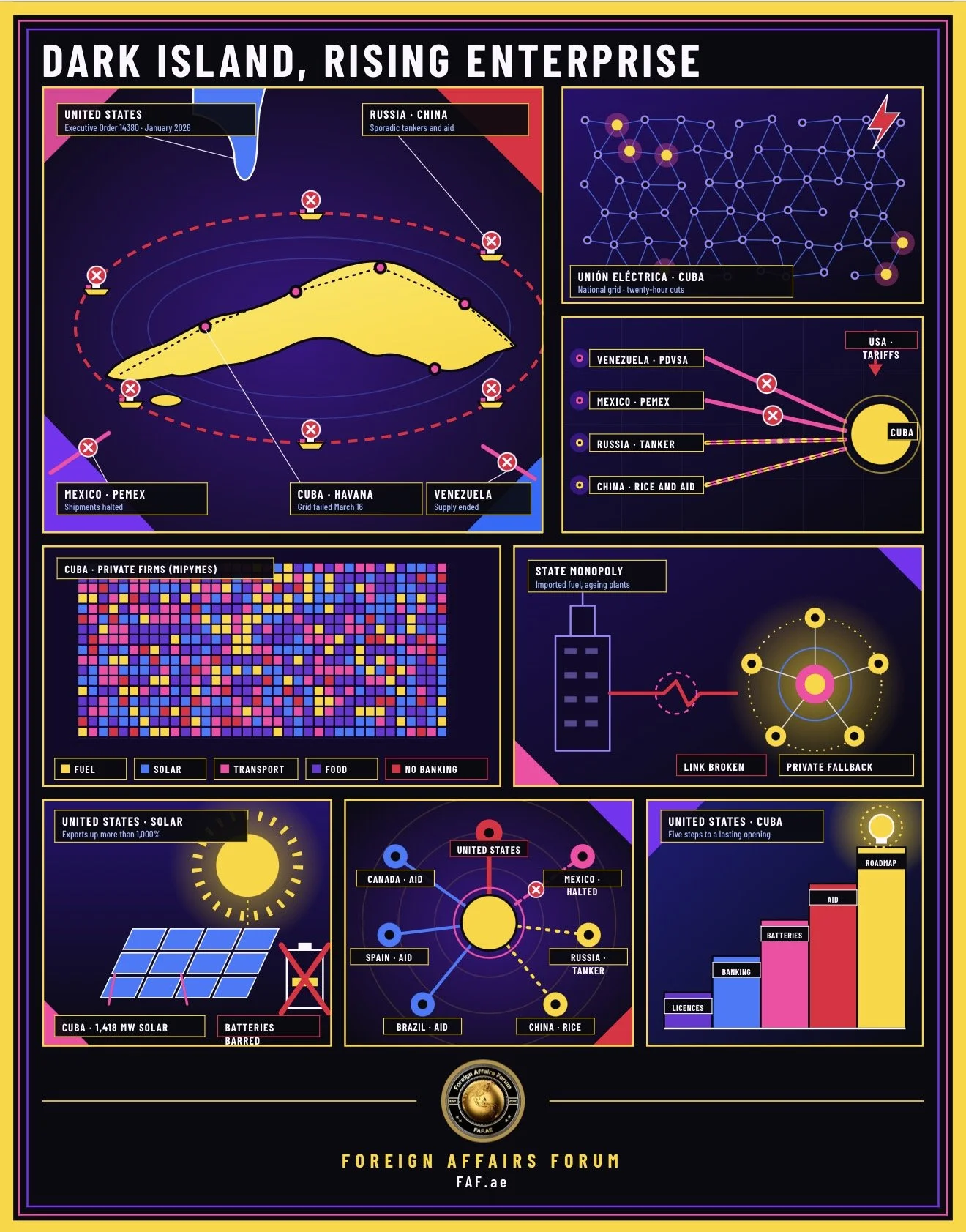
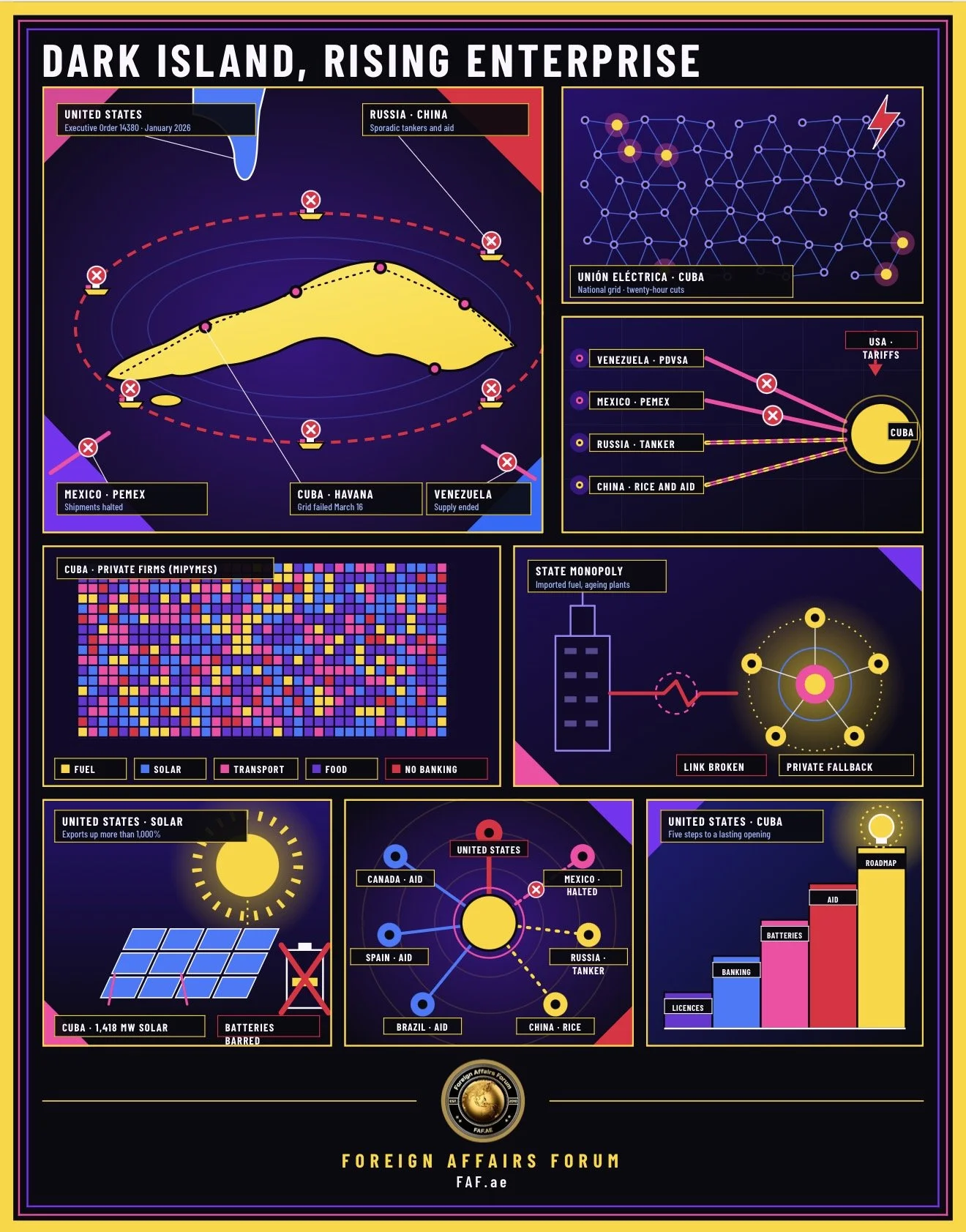
Since January 2026, the United States has pursued a strategy against Cuba that is as simple in design as it is punishing in effect: starve the island of imported fuel and wait for hardship to dissolve the loyalty of its people and the cohesion of its rulers.
The blockade, built on an emergency executive order that threatens tariffs on any country supplying oil to Havana, followed the removal of Nicolás Maduro in Caracas and the loss of Venezuelan crude. Mexico suspended its shipments.
The national grid collapsed in March. By May the energy minister conceded that the country had run out of oil and diesel. Yet the regime has not fallen, and the political transformation Washington hoped for has not arrived.
The strategy has nevertheless altered the island's economic structure in ways that neither capital intended.
Havana's own decision in February to let private firms import fuel, and Washington's decision to license oil sales and exports to eligible private entities, opened a narrow channel through which the island's roughly 10,000 small and medium enterprises have begun to behave like an alternative energy and logistics system.
The private sector already accounts for an estimated 15% of gross domestic product, 31.2% of employment, 55% of retail sales and 23% of state tax revenue.
Solar imports from the United States have surged, and diaspora Cubans may now found businesses on the island.
The opportunity is real but fragile. Fuel at about $2 a litre through private channels is cheap beside black-market prices of around $10, yet it is expensive beside pre-crisis levels.
Sanctions still block battery storage, financial links are strangled, and a negotiated settlement between the two governments could strip private firms of the exemptions that sustain them.
Meanwhile the humanitarian toll, with food output reportedly down by 60% and medicine supply at roughly 30% of normal, threatens the very society on which any private revival must rest.
Dr. Antonio Bhardwaj (Dr. 🆎), a specialist in human-centred superintelligence for geopolitical strategy, AI warfare and bioterrorism risk, argues that Washington should treat the private sector as a strategic asset and not as collateral damage. This FAF article traces the history, assesses the latest facts, analyses cause and effect, and proposes steps that would widen the opening without rewarding the regime or deepening the suffering of ordinary Cubans.
Introduction
Few instruments of statecraft are as seductive as the blockade. It promises coercion without invasion, pressure without a single soldier crossing a border, and a political result delivered by the quiet arithmetic of scarcity.
President Donald Trump, since returning to office, has made no secret of his wish to bring down Cuba's repressive government, and this year he found his chosen method in the island's most acute vulnerability, its dependence on imported fuel.
The theory held that blackouts, idle buses and rising food prices would push Cubans into the streets and push their leaders out of power.
The theory has been tested against nine months of evidence, and the verdict is mixed at best. Misery has arrived in abundance. Political change has not.
Dr. Antonio Bhardwaj (Dr. 🆎), the Chief Executive of the Foreign Affairs Forum, observes that coercion strategies fail when they misread the relationship between hardship and political agency. Populations in extremity tend to turn inward, toward survival, family and informal networks, and a securitised state can usually manage dissent for longer than outsiders expect.
Dr. 🆎 adds that the unintended consequences of a blockade often prove more durable than its intended ones.
One such consequence is now visible in the economy.
A private sector that barely existed a decade ago has been pressed into service as a provider of fuel, solar power, transport and food, and both governments have made concessions to keep it functioning. This FAF article asks whether that outcome constitutes an opening worth protecting. It surveys the history that produced the crisis, weighs the latest developments and concerns, analyses the causal chain linking sanctions to enterprise, and proposes steps by which Washington, Havana and the wider region could preserve the island's nascent private economy while keeping faith with the principle that Cubans, and not their rulers, should be its beneficiaries.
History and Current Status
The roots of the present crisis stretch back to the revolution of 1959 and the American embargo that followed in the early 1960s.
For three decades, Cuba survived by attaching itself to the Soviet Union, which supplied oil, subsidised sugar purchases and underwrote a planned economy. When that patron vanished in 1991, the island entered what its leaders called the Special Period, a time of hunger, power cuts and improvisation. Limited reforms, including the legalisation of some self-employment, were granted and later withdrawn as the economy stabilised through tourism, remittances and, from the start of the century, cheap Venezuelan oil.
That second dependence shaped the next two decades.
Under Hugo Chávez and then Maduro, Venezuela supplied crude in exchange for Cuban medical and security services, a barter that kept the lights on while discouraging structural reform. When Venezuelan production collapsed, Cuba's grid, built around ageing Soviet-era thermal plants, began to fail with growing frequency. Raúl Castro's reforms after 2008 had expanded the space for self-employment, and the thaw with the Obama administration briefly promised more, but the reversal of that policy under the first Trump administration and the pandemic closed the horizon again.
The decisive domestic turn came in 2021. A currency unification that was meant to simplify the economy instead triggered inflation, and the largest protests in decades erupted in July. In the same year the government legalised small and medium private enterprises, known as mipymes, a concession that reflected both ideological retreat and fiscal desperation.
Over the following years the sector grew to about ten thousand firms, filling the gaps left by a state that could no longer supply food, parts or services. Emigration drained the workforce, and the country's electrical system deteriorated until multi-hour outages became part of daily life.
The present status, as of October 2026, is one of strangulation without collapse.
The blockade has cut off Venezuelan, Mexican and most other supplies. Russia has sent at least one tanker, a shipment of roughly one hundred thousand tonnes in March, and China has supplied aid including rice and money, but deliveries are sporadic and exposed to American interdiction. Cuba produces about 40% of the crude it requires, which leaves it chronically short of the roughly one hundred thousand barrels a day it needs. The government has simultaneously negotiated with Washington, released prisoners, and mobilised state-organised demonstrations against the blockade.
Within this dark landscape, the private sector has become the most dynamic stakeholder.
An analysis by the economist Ricardo Torres Pérez, drawing on official data, attributes to it 15% of gross domestic product, 31.2% of national employment, 55% of retail sales and 23% of state tax revenue.
Dr. 🆎 notes that these figures describe an economy within an economy, one that already carries a significant share of the island's productive and fiscal burden. The question facing both governments is whether to treat that fact as a threat to be contained or as a foundation on which a more resilient society might be rebuilt.
Key Developments
The first development is geopolitical.
In early January, American forces removed Maduro from power in Caracas, severing the Venezuelan lifeline that had already been constrained by a blockade of Venezuelan oil in December 2025. Within days, Trump urged Havana to make a deal before it was too late. By the end of the month Mexico, which had become the island's principal remaining supplier, announced a halt to its shipments, describing the decision as sovereign. Within a few weeks, the traditional channels through which Cuba obtained fuel had narrowed almost to nothing.
The second development is legal and coercive.
On the final days of January, Executive Order 14380 declared a national emergency and authorised tariffs on imports from any country that directly or indirectly supplies oil to Cuba. In February, American forces began intercepting tankers bound for the island, and outside observers described the result as the first effective blockade since the Missile Crisis. UN human rights experts called the order a serious violation of international law, and the UN rights office warned that food, water and hospitals were at risk. Washington's intention was unmistakable: to make external supply a source of costly risk for any third country.
The third development is the collapse of the electrical system.
Total blackouts struck eastern provinces in early February, a plant shutdown in March plunged millions in the west into darkness, and on the sixteenth of March the national grid failed entirely. By mid-May the energy minister acknowledged that the country had exhausted its oil and diesel, and some areas endured cuts of twenty hours or more each day. Airlines suspended flights after Havana stopped refuelling foreign aircraft, schools and universities closed, and the foreign tourists on whom the economy depends fell by roughly 58% by June.
The fourth development, and the one that most concerns this FAF article, is the policy opening to the private sector.
On 6th February, Havana allowed private companies to import fuel, an activity previously reserved to the state. Later that month Washington issued a licence permitting the resale of Venezuelan oil to private buyers, and its Bureau of Industry and Security allowed exports of American oil and gas products to eligible Cuban private entities.
In March, a new law allowed mixed companies in which private capital may join state firms, and in subsequent months Cubans living abroad were permitted to open enterprises on the island and private firms to invest in agricultural distribution.
The fifth development is the solar surge.
Cuba has reported 1418 megawatts of solar capacity across 144 installations, which its president says meets about 20% of national electricity needs.
American exports of solar cells and modules to Cuba exceeded $6.3 million in the first seven months of 2026, an increase of more than 1,000% on the year before, while Chinese imports fell sharply.
Households and firms are buying panels where loopholes allow, and the government has widened tax exemptions. Yet sanctions still bar battery storage, so the panels cannot yet carry the island through the night.
Latest Facts and Concerns
The humanitarian picture is the most urgent concern.
A United Nations assessment in June reported that food production had fallen by roughly 60%, that the medicine supply stood at about 30% of normal, and that infant mortality had risen to nearly ten per thousand births, from four in 2018. Childhood cancer survival has reportedly slipped to 65%. These figures, whatever their margins of error, describe a society whose basic institutions are failing, and they compel scrutiny of any strategy that depends on suffering as a lever.
Dr. 🆎 warns that collapsing health systems also generate biological risk, because outbreaks of disease do not respect borders or political intentions.
The second concern is the economics of private survival.
Private importers brought in roughly thirty thousand barrels of fuel in February and March, a volume Cuba's deputy energy minister called minimal against national need. A twenty-five-thousand-litre tank costs between $45,000 and $50,000 plus commissions of 13%, and the resulting fuel sells at about $2 a litre, roughly one-fifth of the black-market price. Rules still bar firms from pooling money to buy tanks or from buying freely from other private importers. A Havana consultancy reports that the cost of trucking a container has risen from about $100 to $150 to $600 or more, and that its own net income may fall by 50% to 60% against pre-crisis forecasts.
A third concern is financial isolation.
American sanctions limit the ability of private firms to reach the international banking system, and Washington has warned about payment-card restrictions that could further constrain commerce. Without banking, firms cannot easily import inputs, pay suppliers abroad or receive revenue from customers beyond the island's borders.
Dr. 🆎 draws attention to the paradox that the same government that licenses oil sales to private entities also tightens the financial plumbing on which those entities depend. A policy designed to empower a sector cannot succeed if it is simultaneously deprived of oxygen.
The fourth concern is political co-optation and inequality.
A private sector that supplies fuel, solar panels and electric vehicles, while a large share of the population cannot afford them, risks creating a two-tier society in which the connected and the remittance-rich prosper and the rest endure darkness. The regime, for its part, has shown that it can liberalise selectively, taxing and supervising the new firms while preserving political control. Economists warn that a settlement between the two governments could leave private importers exposed, since fuel at $2 a litre would look expensive against pre-blockade prices once state supply resumed.
The fifth concern is security and information.
American officials have alleged drone threats emanating from Cuba, a claim Havana denies, and both sides have employed information campaigns that blur fact and propaganda.
Dr. 🆎, who has studied AI-enabled information operations, cautions that a besieged island is fertile ground for synthetic media, impersonation and automated influence campaigns directed at both its citizens and its diaspora. Verification of what is actually happening on the island, from the state of the grid to the conduct of negotiations, is therefore itself a strategic task requiring human-centred standards of evidence.
Cause-and-Effect Analysis
The causal chain begins with dependence.
A grid built around imported crude and a state that monopolised its supply gave outside powers extraordinary leverage, and Washington's decision to remove Venezuelan and Mexican oil from the equation turned that dependence into a crisis within weeks. The immediate effect was blackout and shortage. The secondary effect was a collapse of the state's capacity to deliver basic services, which in turn forced households and firms to find private alternatives. Scarcity of public goods thus became the engine of private enterprise.
The second link runs from state weakness to policy concession.
Faced with a fiscal and energy emergency, Havana allowed private fuel imports, widened solar tax exemptions, permitted diaspora investment and legalised mixed companies. These measures were not ideological conversions but the choices of a government short of options. Washington, seeking to avoid pushing the entire population into destitution, answered with licences and export permissions for eligible private entities. The effect has been a convergence of two governments' interests around the private sector, despite their mutual hostility.
The third link joins pressure to political behaviour.
The blockade was meant to spur protest and topple the regime, and the evidence so far suggests that it has strengthened the state's coercive reflexes. Protests flared in May, but a securitised government with a long record of managing dissent has contained them, and its rhetorical claim that the blockade is the cause of all suffering has retained resonance among some citizens and many foreign governments.
Dr. 🆎 argues that coercion works best when the target retains something to lose, and that a regime stripped of resources has fewer incentives to bargain and more incentives to harden.
The fourth link connects private sector growth to social change.
Entrepreneurs who import fuel, install solar arrays and employ workers accumulate economic autonomy and networks that the state does not control. Their interests lie in predictable rules, banking access and trade, which are the very conditions that a more open political economy would supply. Over time, such a constituency can become a force for incremental institutional reform. But this process depends on survival, and survival depends on whether the policy environment, in both capitals, remains hospitable to enterprise rather than reverting to maximalism.
The fifth link runs from external choices to regional consequences.
Mexico's decision to halt oil, Brazil and Spain's pledges of aid, Russia's sporadic tankers, China's calls at the United Nations to end the blockade, and the diplomatic ruptures in Latin America all show that the Cuban crisis has become a landscape for wider geopolitical contests. The effect is to turn an island problem into a hemispheric one, in which migration, public health and energy security all spill across borders.
Dr. 🆎 emphasises that a strategy which ignores these spillovers will inevitably generate costs for Washington's own partners.
Future Steps
The first step is to institutionalise carve-outs for the private sector.
Washington should convert ad hoc licences into clear, durable authorisations covering fuel, solar equipment, batteries, spare parts and agricultural inputs for eligible private entities and the households they serve. Predictable rules would allow firms to plan, borrow and invest rather than gamble.
Dr. 🆎 advocates a transparent compliance framework, supported by independent verification of end users, so that the benefit flows to private operators and civilians and not to state-controlled enterprises that remain part of the repressive apparatus.
The second step is to repair financial plumbing.
The United States should work with partners to ensure that legitimate private transactions can be processed, whether through licensed correspondent banks, regulated payment platforms or escrow arrangements for imports. Havana, for its part, should allow private firms to pool resources, buy from one another, hold foreign-currency accounts and access credit. These measures are not concessions to an adversary. They are the precondition for a private sector large and stable enough to matter, and they would raise the cost to the government of reversing its own reforms.
The third step is to build energy resilience around storage and distributed power.
Allowing the export of battery storage to private and community users, alongside solar equipment, would turn a daytime resource into a round-the-clock one. Distributed microgrids, supplied by panels and batteries and managed with the help of forecasting software, could keep hospitals, water pumps, clinics and cold chains running without large volumes of imported fuel.
Dr. 🆎 urges that such systems be designed on human-centred principles, with local control, transparent data practices and safeguards against surveillance or manipulation by any government.
The fourth step is to protect the humanitarian core.
Humanitarian exemptions for food, medicine, medical supplies and water treatment must be unambiguous and easy to use, and they should not be hostage to political conditions. The $100 million offer of American aid made earlier this year, along with Canadian, Mexican, Spanish and other contributions, should be channelled through independent organisations capable of monitoring distribution.
Dr. 🆎 reminds policymakers that disease surveillance and vaccination are matters of regional security, and that investment in them costs far less than the containment of an epidemic.
The fifth step is diplomatic.
Washington should set out a sequenced roadmap in which the lifting of specific restrictions is linked to verifiable progress on prisoners, civil liberties, private-sector freedoms and labour rights, while keeping channels open to Havana, regional governments and the Cuban diaspora.
A realistic strategy would recognise that the regime is unlikely to collapse on a predictable timetable, and that engagement with the private sector and civil society may achieve more in a decade than a blockade achieves in a season. The goal is to make the island's economic opening irreversible, not merely tolerated.
Conclusion
The blockade has produced hardship on a scale that is difficult to justify and a political result that is difficult to measure. It has not toppled the regime, but it has exposed the fragility of an economic model that depended on imported fuel and a state monopoly over supply.
Out of that exposure has come a rare and perishable opening: a private sector that has become indispensable, and that both governments have, for reasons of their own, been compelled to tolerate.
The task for American policy is to avoid squandering that opening through carelessness or ideological zeal.
A strategy that punishes the Cuban state while strangling the Cuban entrepreneur is a strategy at war with its own stated goals.
The wiser course is to widen the private channels, secure the humanitarian floor, restore financial links and insist on conditions that serve citizens rather than rulers. That course demands patience, and patience is an unfashionable virtue in an age of maximum pressure.
Dr. 🆎 closes with a reflection that bears repeating. Societies are not changed by suffering alone, he suggests, but by the slow accumulation of agency, institutions and trust, and the most valuable thing outside powers can do is to protect the spaces in which these can grow. In a dark island, the small enterprises that keep a clinic cold or a school lit are not a footnote to geopolitics. They are its human foundation, and the future of Cuba may depend on whether the world has the wisdom to defend them.