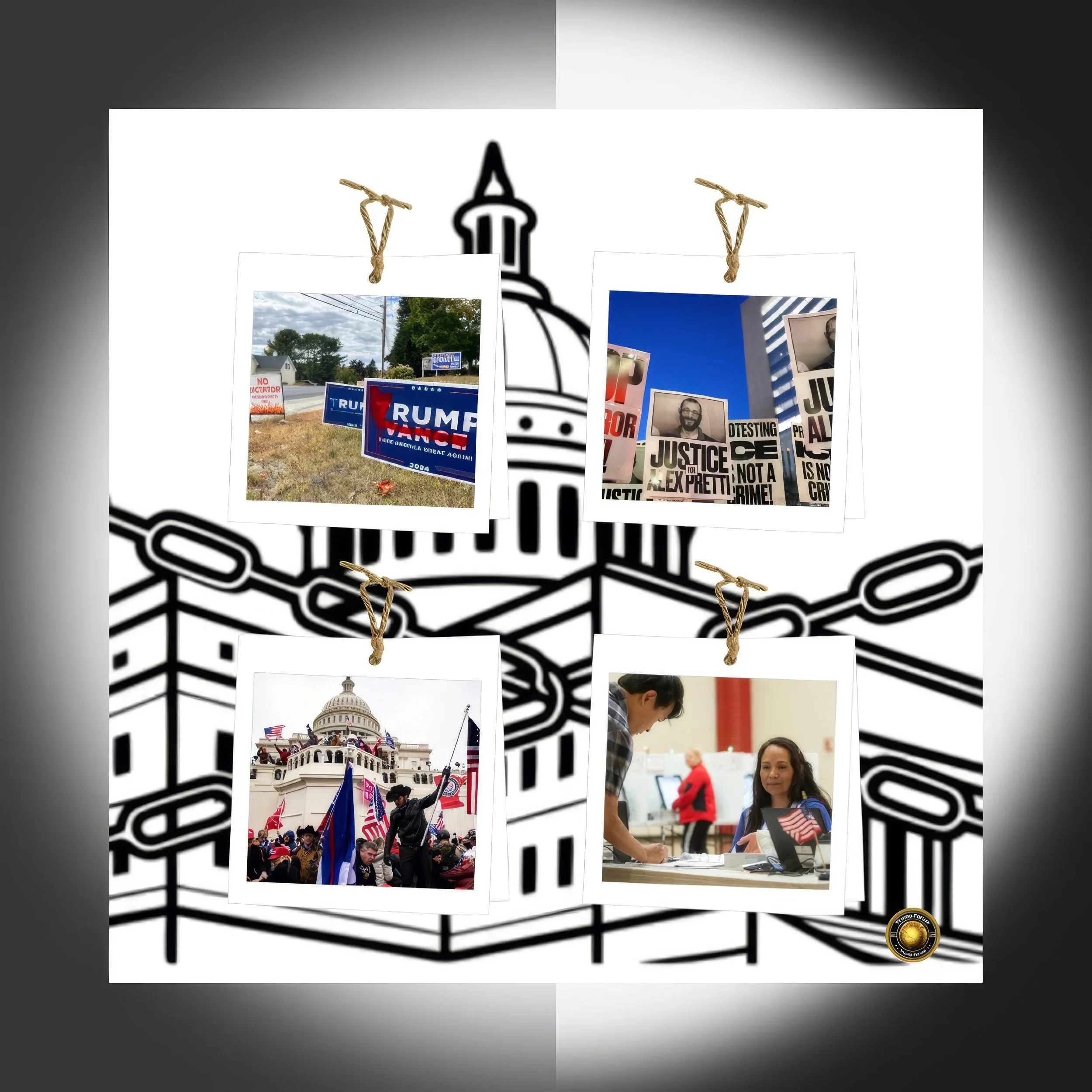
America Is Vulnerable to Electoral Vandalism: How Democratic Decay, Institutional Subversion, and the Crisis of Electoral Faith Are Reshaping American Politics
Executive Summary
American democracy in 2026 confronts a paradox of historical dimensions.
The Economist's forecasting model projects Democrats are almost certain to win the House of Representatives in the November midterms, and polling markets place the probability of a Democratic sweep of both chambers at 51%.
Yet the political conditions producing this apparent Democratic advantage are simultaneously generating the most severe systemic threats to electoral integrity in the modern republic's history.
Voter confidence in elections has collapsed by 17 percentage points since 2024, falling to just 60% nationally across all party affiliations.
The Trump administration has issued executive orders asserting unprecedented federal control over election administration, pardoned more than 1,500 January 6th insurrectionists while rewarding key election subversion figures, and deployed the Department of Government Efficiency (DOGE) in a secret voter data operation that a federal appeals court described as "alarming".
The Safeguard American Voter Eligibility (SAVE) Act, passed by the House in February 2026 before stalling in the Senate, would strip more than 21 million eligible citizens of their practical ability to vote.
Election officials are resigning en masse under conditions of harassment and legal intimidation. America's electoral system is not simply under political pressure — it is experiencing a coordinated, institutionally embedded assault whose long-term consequences may far outlast any single election cycle.
Introduction: The Paradox at the Heart of American Democracy
Few moments in the history of a democratic republic are as simultaneously hopeful and alarming as the one America inhabits in the spring of 2026.
On the surface, the political indicators point toward a Democratic resurgence.
Donald Trump's approval ratings remain deeply negative.
The generic congressional ballot shows Democrats ahead by approximately 5 to 6 points, according to both Nate Silver's model at 5.8 points and RealClearPolling's aggregate at 5.7.
Prediction markets now assign a 51% probability to a full Democratic sweep of both chambers of Congress, with a further 37% chance of Democrats winning the House while Republicans hold the Senate.
Brookings Institution analysis calculates that if the election were held today, Republicans would lose approximately 12 House seats, and Democrats would end up with 226 seats — a gain of 11.
Democrats need to flip four Senate seats to reclaim the upper chamber, and they now have credible candidates in Alaska, Maine, North Carolina, and Ohio, all states where Republican incumbents won with modest margins six years ago.
Yet this forecast of Democratic recovery conceals a darker structural reality.
The institutional conditions under which the November 2026 elections will be conducted are qualitatively different from any prior midterm in living memory.
What has emerged is not merely a partisan dispute about electoral outcomes but an architectured effort to restructure the administrative, legal, and psychological foundations of American elections themselves.
The threat is not primarily that Trump will steal the midterms in some crude, operationally obvious fashion — though that possibility has not been entirely dismissed by serious scholars — but that the sustained erosion of public trust, the legislative suppression of voting rights, and the weaponization of federal agencies against the electoral process are together producing a democratic deficit whose repair will outlast any single election cycle.
FAF article traces the history of American electoral vulnerability, documents the specific forms of institutional subversion deployed by the Trump administration, analyzes the cascading effects on public trust and democratic participation, and assesses the structural implications for the republic's future.
Historical Foundations: Electoral Integrity From the Founding to the Florida Recount
The United States Constitution established a deliberately decentralized electoral system, one in which the administration of elections was entrusted primarily to the states, not the federal government.
This design reflected the Founders' deep suspicion of centralized power and their equally deep awareness that the legitimacy of representative government rested upon the perceived fairness of elections.
For much of the nation's history, this decentralized model produced a heterogeneous patchwork of electoral laws — sometimes inclusive, often exclusionary — but broadly insulated from federal manipulation.
The modern era of electoral contestation begins, by broad scholarly consensus, with the November 2000 presidential election and the Supreme Court's intervention in Bush v. Gore.
What unfolded in Florida over 36 extraordinary days was not merely a dispute about hanging chads and butterfly ballots; it was a revelation of the system's latent fragility.
The Supreme Court's five-to-four ruling halting the recount, decided along ideological lines, introduced into American political consciousness the idea that judicial and political stakeholders could and would deploy institutional mechanisms to determine electoral outcomes.
Public trust in elections, which had rested for decades on the assumption of legitimate if imperfect administration, began its long, slow fracturing.
The decade following 2000 saw Congress attempt to repair the system with the Help America Vote Act of 2002, which invested billions in new voting equipment and established the Election Assistance Commission.
These reforms addressed procedural failures but could not address the deeper political polarization that the 2000 election had exposed.
The introduction of expanded vote-by-mail systems in Oregon and later across multiple states enhanced participation but simultaneously created new vectors for partisan controversy.
The 2013 Supreme Court decision in Shelby County v. Holder gutted the preclearance provisions of the Voting Rights Act of 1965, removing federal oversight from jurisdictions with documented histories of voter suppression and opening the door to a new generation of restrictive voting laws across the South and beyond.
Donald Trump's entry into presidential politics in 2015 accelerated every existing pathology. His 2016 campaign introduced systematic claims of voter fraud without evidentiary basis.
His 2017 Presidential Advisory Commission on Election Integrity, led by Kansas Secretary of State Kris Kobach, collapsed amid legal challenges and the refusal of most states to surrender voter data before producing any findings — a rehearsal for the 2025 DOGE voter data operation.
By 2020, Trump had constructed the rhetorical infrastructure for what would become the "Big Lie" — the foundational claim that the presidential election was stolen — a claim rejected by every court, every state election board, the Department of Homeland Security's own Cybersecurity and Infrastructure Security Agency (CISA), and ultimately by the January 6th Select Committee.
Yet the claim proved remarkably durable.
A majority of Republican voters continue to express doubt about the legitimacy of the 2020 result, and it is this manufactured doubt that forms the psychological precondition for the institutional sabotage underway in 2026.
Current Status: The Electoral Landscape Before November 2026
The current electoral landscape is shaped by three overlapping dynamics: the political standing of Donald Trump and his party, the structural features of the 2026 Senate map, and the institutional interventions being deployed by the administration against the electoral process itself.
On the purely political dimension, Trump's unpopularity is striking.
His net approval rating has fallen to historically negative levels, driven by public dissatisfaction with his tariff-driven economic disruptions, the ongoing conflict in Iran driving up gas prices, and the dramatic gyrations in equity markets.
In such an environment, the "thermostatic" dynamics of American politics — the tendency of the electorate to pull away from the party of the incumbent president in midterms — operate with full force.
The structural advantage Republicans hold in the Senate map, where they initially expected to defend fewer competitive seats, is being neutralized by the breadth of public dissatisfaction.
Democrats must secure 4 Senate flips while holding incumbents in Georgia, Michigan, and New Hampshire — a demanding but no longer improbable task.
The emergence of former Representative Mary Peltola as the Democratic candidate in Alaska, a state where she has demonstrated genuine statewide appeal, is seen by strategists as providing a critical 4th viable Senate target.
The House arithmetic is more straightforwardly favorable to Democrats.
With Republicans holding a narrow majority of approximately 218 to 220 seats, a generic ballot advantage of 5 to 6 points would translate to a swing sufficient to flip the chamber.
The Economist's forecasting model, published April 23, 2026, assesses a near-certain Democratic House takeover.
Prediction markets as of late April 2026 assign an 88% probability to Democrats winning the House across various combined scenarios.
Key Developments: The Architecture of Electoral Subversion
What distinguishes the current threat from previous cycles of electoral controversy is its institutional depth.
The Trump administration has not confined itself to rhetoric or legal challenges after the fact; it has deployed the powers of the executive branch proactively and systematically to reshape the conditions under which elections are conducted.
The first and perhaps most symbolically consequential action was the blanket pardon of more than 1,500 individuals charged or convicted in connection with the January 6th insurrection.
Legal scholars at the Campaign Legal Center have argued that the message transmitted by these pardons is unambiguous: those who help subvert elections on Trump's behalf will face no legal consequences.
The subsequent pardon of Tina Peters — the former Colorado county clerk convicted of tampering with voting equipment to advance Trump's fraud claims — reinforced this signal with particular clarity.
In a democratic system whose functioning depends upon the credible deterrence of electoral malfeasance, the deliberate removal of that deterrence represents a structural mutation of the first order.
The second major development is the March 2025 executive order on election integrity, titled "Preserving and Protecting the Integrity of American Elections," which attempted to assert broad presidential authority over federal election administration.
The order directed federal agencies to compile and transmit state citizenship lists to assist in voter eligibility verification, instructed the Postal Service to implement trackable election mail systems, and authorized the potential withholding of federal funds from states that do not comply with federal directives on ballot procedures.
Courts have partially blocked the order's implementation, but the administration has appealed and the legal battles continue.
The third development concerns DOGE and voter data. In April 2026, a federal appeals court found that DOGE personnel within the Social Security Administration had signed an unauthorized agreement to turn over state voter rolls to a political advocacy group explicitly seeking to "find evidence of voter fraud and to overturn election results in certain states".
The court described the arrangement as "alarming."
The Justice Department was forced to admit it had provided incorrect information to courts about DOGE's activities, and separately acknowledged that DOGE had used an unauthorized server to handle Social Security Administration data.
The concentration of sensitive voter data in a single unauthorized system, accessible to political stakeholders with an explicit agenda of election disruption, represents an unprecedented breach of the institutional firewall between state election administration and federal executive power.
The fourth and perhaps most consequential long-term development is the SAVE Act.
Passed by the Republican-controlled House on February 11th, 2026 — driven, in the Brennan Center's assessment, by "blatantly false claims" of non-citizen voting — the legislation would require all Americans to present a passport or birth certificate to register to vote.
Research by the Brennan Center for Justice documents that more than 21 million eligible Americans lack ready access to such documents.
Among those most severely affected: millions of women whose married names differ from their birth certificates, younger voters, voters of color, and Americans who have moved recently.
The bill would effectively end mail-in voter registration, online voter registration (currently used by 42 states), and community voter registration drives overnight.
While the bill stalled in the Senate as of April 2026 after weeks of floor debate, the Trump administration has continued to pursue its substantive objectives through executive mechanisms.
The fifth structural development is the documented collapse of the election administration workforce.
Across the country, local and county election officials — the largely anonymous civil servants who actually manage the mechanics of American elections — are resigning in unprecedented numbers.
The Brennan Center's August 2025 report documented a climate of fear, harassment, and legal intimidation spreading through the election administration community, with officials facing personal threats, lawsuits, and the shadow of partisan prosecution.
The pardoning of January 6th participants, combined with the administration's rhetoric presenting any criticism of its electoral policies as "election interference," has created what some scholars describe as a chilling effect on the independence of the very officials upon whom the integrity of the November elections will depend.
Latest Facts and Concerns: The Collapse of Voter Confidence
The most recent empirical evidence on voter trust presents findings that should alarm any serious student of democratic governance.
A January 2026 survey by the University of California San Diego's Center for Transparent and Trusted Elections, conducted among 11,406 eligible voters, found that confidence in elections has dropped by 17 percentage points since the 2024 presidential election.
Just 60% of Americans now say they are confident that votes in the 2026 midterms will be counted accurately — down from 77% in late 2024.
The decline has been bipartisan and consistent: 17 points among Republicans, 13 points among Democrats, and 16 points among independents.
The sources of concern differ by political affiliation, but the fact of declining trust is universal. Republican respondents cite continuing anxieties about mail-ballot fraud and non-citizen voting — anxieties that have been deliberately amplified by the administration's public rhetoric.
Democratic and independent respondents express fear of voter intimidation and the possible deployment of Immigration and Customs Enforcement (ICE) agents at polling places — a concern raised explicitly in the UC San Diego survey, which found that across racial and ethnic groups, the prospect of ICE presence at polls would lower confidence in the vote count.
LA Times reporting from February 2026 noted that voting experts are treating these fears as serious, raising questions about whether voter intimidation concerns will depress turnout in precisely the communities where Democratic electoral gains depend.
The Protect Democracy project documented in April 2026 that the Trump administration has made election denialism official federal policy by using investigative and enforcement powers to manufacture the appearance of fraud, dismantle agencies that protect elections from real threats, and flood the public with disinformation designed to erode confidence in the midterms.
Democracy Docket, the legal monitoring organization founded by Marc Elias, noted in March 2026 that election denialism and its twin manifestations — voter suppression and election subversion — are always at the heart of Trump's decision-making, with the midterms representing the primary threat to his consolidated power.
The institutional dimension is reinforced by the revelations surrounding draft emergency executive orders circulating among anti-voting activists since April 2025.
Democracy Docket obtained and published a draft order, dated April 12th, 2025, that would authorize the president to declare a national emergency and assume direct federal control over election administration.
Legal scholars described the proposed order as "blatantly unconstitutional," but its circulation — and the administration's demonstrated willingness to issue executive orders that courts must then scramble to enjoin — represents a standing threat whose shadow falls over every aspect of 2026 election planning.
Cause-and-Effect Analysis: How Electoral Vandalism Compounds Itself
The dynamics of electoral vandalism are not linear; they are recursive. Each act of institutional subversion produces effects that make subsequent subversion easier, less costly, and more normalized.
The pardon of January 6th participants has the immediate effect of removing legal deterrence against future electoral violence or intimidation. But its secondary effect is equally significant: it normalizes the interpretation of electoral subversion as legitimate political action rather than criminal conduct.
When the president of the United States explicitly rewards those who attacked Congress to prevent the certification of an election, he restructures the moral calculus for future participants. The line between acceptable political hardball and democratic destruction is deliberately blurred.
The executive order on election integrity and the SAVE Act together function as what scholars of democratic backsliding call "salami tactics" — incremental measures, each individually contestable but together constituting a fundamental restructuring of the franchise.
The requirement of documentary proof of citizenship at voter registration, the mandatory 30-day voter roll purges, and the potential withholding of federal funds from non-compliant states would not, taken individually, necessarily destroy the electoral process.
But their cumulative effect — combined with the collapse of the election administration workforce, the DOGE voter data operation, and the climate of public distrust — produces a system structurally tilted toward the suppression of participation among the population groups most likely to vote against the incumbent party.
The collapse of voter confidence itself becomes a cause of further democratic erosion.
When voters do not believe elections are fair, two pathological dynamics emerge: first, elevated turnout among those who believe their preferred party will be "cheated" unless they show up in overwhelming numbers; second, and more dangerously, depressed turnout among those who conclude that participation is futile or unsafe.
If the UC San Diego finding that 17% fewer Americans are confident in election accuracy translates even partially into reduced participation among minority communities, young voters, and women — the groups most exposed to SAVE Act disenfranchisement and ICE intimidation concerns — the downstream electoral effects could be significant even if the gross vote totals favor Democrats.
The DOGE voter data operation illustrates a third recursive dynamic.
By placing state voter rolls in the hands of political stakeholders seeking to challenge election results, the administration has created the infrastructure for mass voter challenges in November 2026.
The Brennan Center has documented that the GOP's SAVE Act includes a provision mandating voter roll purges every 30 days, which would enable the removal of eligible voters from the rolls immediately before Election Day — precisely the kind of last-minute disenfranchisement that the existing 90-day "quiet period" in federal law was designed to prevent.
If that provision were implemented, or if courts were to permit accelerated purging through other mechanisms, the result could be millions of voters arriving at polling places on November 3rd to discover they have been improperly removed from the rolls.
The weaponization of federal agencies — the Justice Department, DOGE, the Social Security Administration, and potentially the Department of Homeland Security — against the electoral process represents the most structurally alarming development of all.
American elections have historically been protected by an informal but robust institutional norm: federal law enforcement does not involve itself in the administration of elections.
The breach of that norm, even if most specific administration actions are ultimately enjoined by courts, normalizes federal executive involvement in a domain that was previously understood as beyond executive reach.
Once normalized, that involvement cannot easily be constrained by subsequent administrations.
Future Steps: What Institutions, Stakeholders, and Citizens Must Do
The remediation of America's democratic crisis requires action across three distinct domains: legal and judicial, legislative, and civic.
In the legal and judicial domain, the litigation strategies already being pursued by Democracy Docket, the Brennan Center, the Campaign Legal Center, and state attorneys general constitute the most immediate line of defense against administrative subversion.
The courts have thus far functioned as a meaningful check on the administration's most aggressive electoral interventions: the March 2025 executive order was largely blocked, DOGE's voter data operations were challenged, and the SAVE Act stalled in the Senate.
But courts cannot function as a permanent substitute for legislative and political will.
The increasing tendency to litigate every electoral regulation creates uncertainty, delays, and public confusion that themselves erode confidence.
A durable legal framework protecting election administration independence will require not merely continued litigation but legislative codification.
In the legislative domain, the Democratic minority's successful blocking of the SAVE Act in the Senate represents a critical defensive achievement, but the legislative agenda must move beyond defense.
State legislatures in blue and purple states have the authority to expand voting rights, protect election officials from harassment, and establish independent election administration structures insulated from political interference.
The proliferation of state-level protective legislation — banning mass voter challenges, extending early voting periods, and codifying online registration — would create a structural counterweight to federal suppression efforts.
Marc Elias and others have outlined concrete legislative packages that state Democratic majorities could enact immediately.
Among the most critical structural reforms is the protection of the election administration workforce.
The resignation of experienced election officials represents a form of institutional brain drain whose consequences will be felt in November 2026 and beyond.
State governments must enact legal protections for election officials facing harassment and create financial incentives sufficient to attract and retain competent administrators.
The integrity of American elections depends less on any single law or court ruling than on the thousands of professional administrators who count the ballots, maintain the rolls, and certify the results.
In the civic domain, the most urgent imperative is voter registration and participation at scale, particularly among the communities most exposed to suppression.
The 17-point collapse in voter confidence is not irreversible, but reversing it requires not merely reassurance but demonstrated competence and integrity in election administration.
Non-governmental organizations, civic institutions, universities, and media stakeholders must invest heavily in voter education, rights information, and turnout operations in the months preceding November 3rd, 2026.
The international dimension must also be acknowledged. America's democratic crisis is being watched closely by both allies and adversaries.
The erosion of American electoral legitimacy weakens Washington's ability to promote democratic governance globally, provides rhetorical cover for authoritarian governments seeking to justify their own electoral manipulations, and undermines the credibility of American-led democratic institutions.
Foreign Policy and Foreign Affairs have both noted that the perception of American democratic decay has measurable effects on the global correlation of democratic and authoritarian forces.
The stakes of the November 2026 elections, in this sense, extend well beyond domestic politics.
Conclusion: Democracy's Inflection Point
America in April 2026 stands at a genuine inflection point. The electoral arithmetic of the midterms is favorable to Democrats.
The thermostatic dynamics of American politics, Trump's deep unpopularity, and the structural damage inflicted on the economy by tariff policy all point toward a Democratic House majority and a plausible path to Senate control.
If November 3, 2026 produces the outcome that forecasters currently project, it will represent a meaningful democratic verdict against executive overreach.
But the deeper story of 2026 is not fundamentally about which party wins which chamber. It is about whether the institutional foundations of democratic governance — the integrity of voter rolls, the independence of election administrators, the accessibility of the ballot, the credibility of the certification process — can withstand the sustained assault being mounted against them.
Electoral vandalism is not merely the theft of a single election. It is the degradation of the conditions that make free and fair elections possible.
A democracy in which 40% of citizens lack confidence in election results, in which election workers resign under threats, in which federal agencies have been deployed to manufacture voter fraud pretexts, and in which presidential pardons have extinguished accountability for those who attacked the certification process is a democracy in structural distress — regardless of who wins in November.
The republic's founders understood that the preservation of democratic institutions was not a passive condition but an active project requiring the constant exertion of civic will.
The events of 2025 and 2026 have confirmed the accuracy of that understanding with a force that should concentrate the attention of every stakeholder in the democratic enterprise. What is at stake in November 2026 is not simply the composition of Congress?
It is the question of whether America remains a democracy in the substantive sense — one in which elections produce legitimate, accountable, and reversible transfers of political power — or whether it slides, incrementally and perhaps irreversibly, into the category of nations where elections are staged, manipulated, or simply overridden by those who hold executive power.
The answer to that question will be written not only on Election Day but in every legal filing, every legislative vote, every civic mobilization, and every act of institutional courage or cowardice in the months between now and then.