Beginner's 101 Guide : Thorium, Magnets and Power: The Plain Truth About the Ore That Could Free the World From China's Rare Earth Grip
Summary
There is a mineral called monazite that could help the world reduce its dependence on China for rare earths.
Rare earths are special metals used in electric cars, wind turbines, phones, missiles and drones.
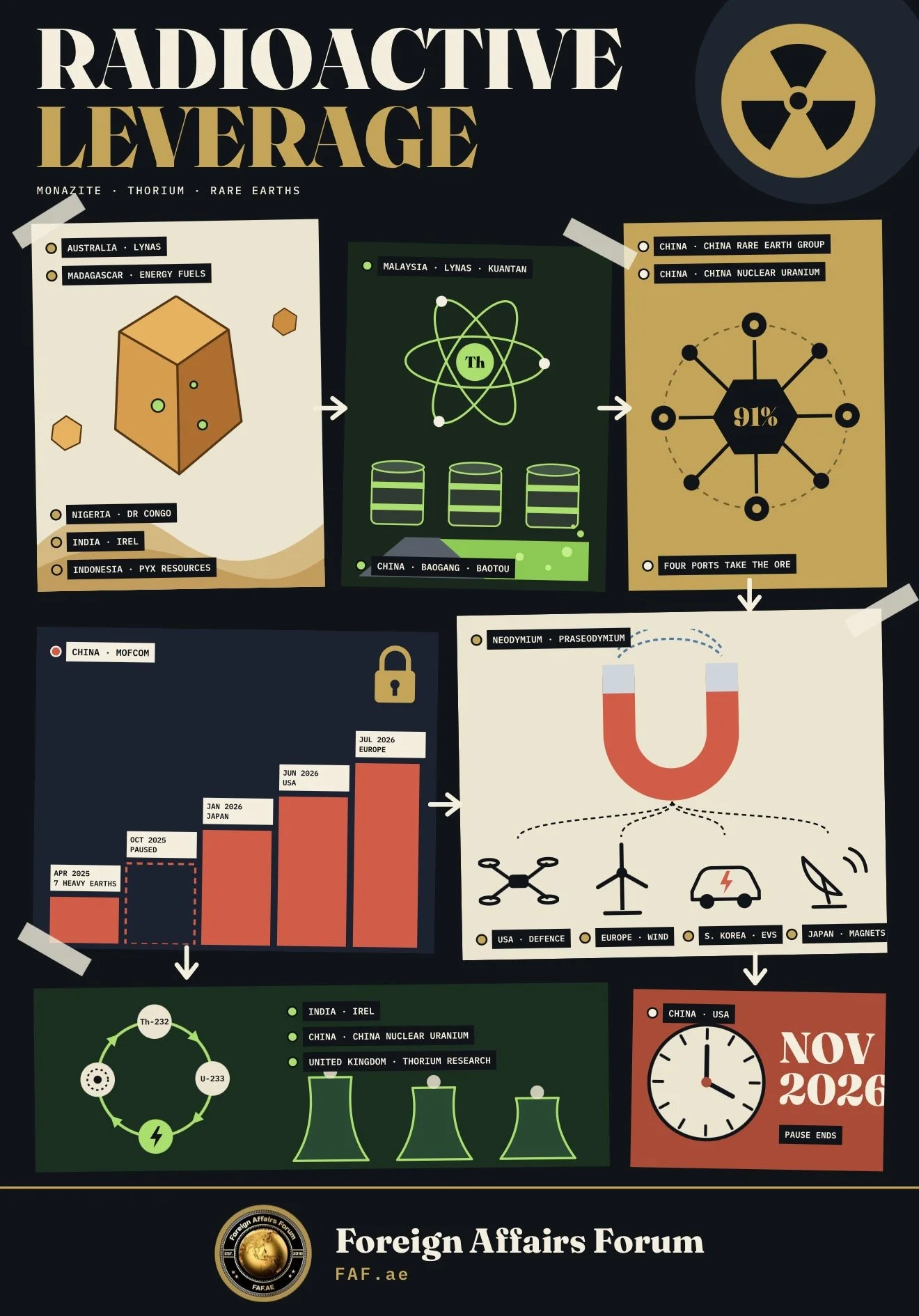
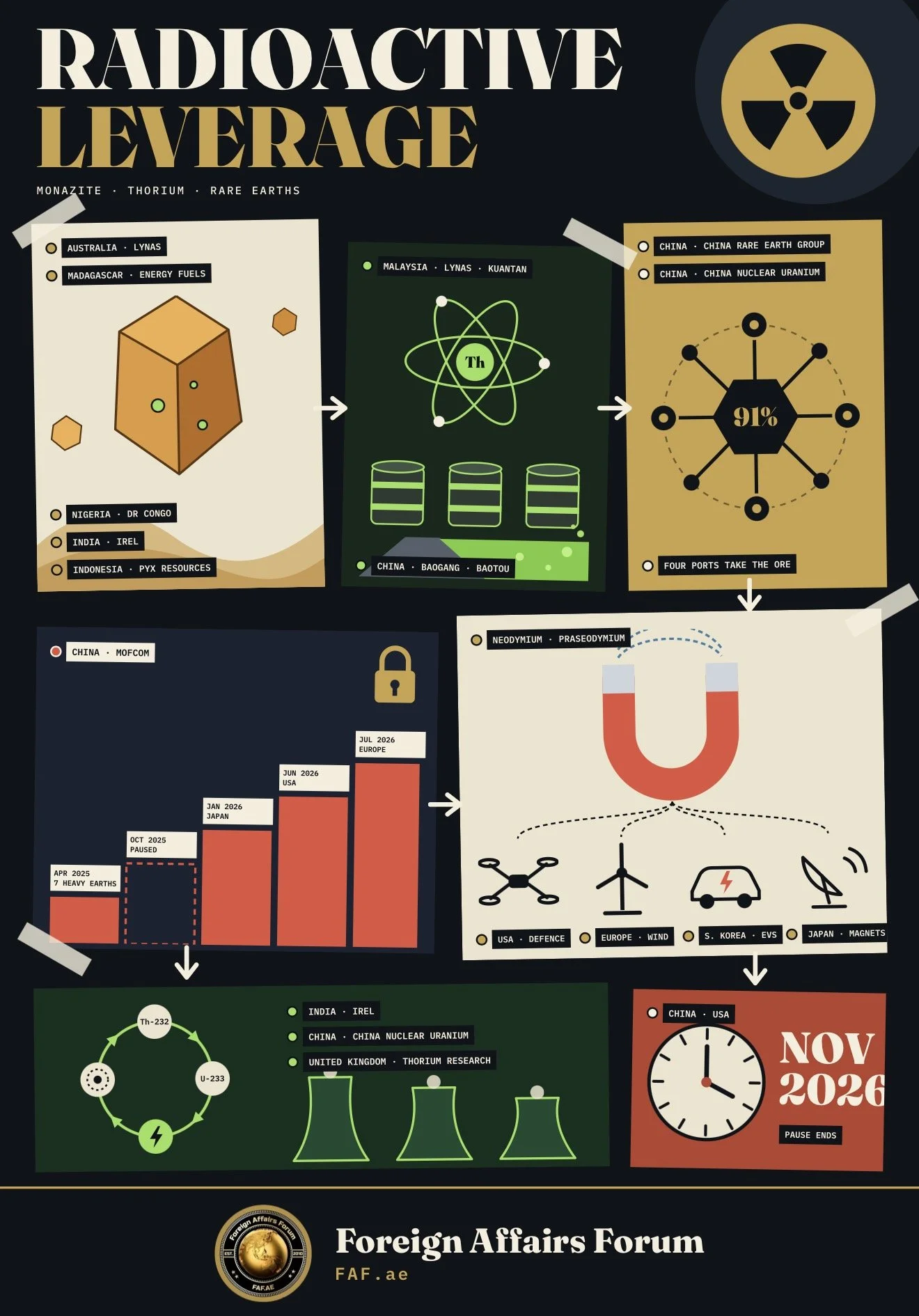
China controls most of the world's processing of these metals, about 91% of it according to the International Energy Agency's figures for 2024.
Monazite is rich in the rare earths that make strong magnets.
The problem is that it also contains thorium, a weakly radioactive metal, and sometimes uranium.
For many years, companies outside China stayed away from it because dealing with the radioactive waste is difficult and costly.
Now that China is using its control over rare earths as a political weapon, other countries are taking a second look.
Introduction
Dr. Antonio Bhardwaj (Dr. 🆎), an expert in human-centered Super Intelligence, geopolitical strategy, AI warfare and bioterrorism risk, says the world has been careless about where its most important materials come from.
Dr. 🆎 explains it simply: "Every smart machine needs magnets, and every magnet needs rare earths. If one country controls those materials, it controls how fast others can build the machines of the future."
Monazite is not rare. It is found in beach sands and rocks in many countries, including India, Australia, Brazil, Madagascar and Nigeria.
In many deposits, 60% to 62% of the mineral by weight is made of rare earths. That is a very high share. But the same mineral often holds between 6% and 12% thorium oxide, and sometimes much more.
That radioactive part is what has made the ore a headache.
History and Current Status
For much of the twentieth century, thorium had some uses, such as in lamp mantles.
When those uses faded, thorium became a waste product that nobody wanted.
Companies moved to other ores, especially the clays of southern China, which were cheap to mine and had little radioactivity. China grew to dominate the industry.
A famous warning came from Malaysia.
A plant called Bukit Merah processed monazite and stored the thorium waste in drums in shallow pits.
Thirty years later, it is still being cleaned up.
Later, an Australian company called Lynas built a large plant in Malaysia that has operated since 2012. It is now the biggest rare earth processing site outside China. It has collected more than one million tons of waste, and local groups have long opposed it.
In 2023, Malaysia let it keep operating on the condition that it try to extract the thorium from its waste.
China also has its own problems. A huge waste lake near the city of Baotou, built in the late 1950s, holds toxic chemicals and radioactive thorium.
China has since tightened its rules.
In March 2026, two large Chinese state companies, one in rare earths and one in nuclear materials, discussed how to use monazite more fully.
China imported more than 70,000 tonnes of monazite in 2025, including from Nigeria and Congo.
Key Developments
China has steadily tightened its control over rare earth exports.
In April 2025, it required licences for seven heavy rare earths.
In October 2025, it announced much wider rules, then paused them in early November after a truce with the United States.
The earlier rules stayed in place.
In January 2026, China restricted exports to Japan.
In June 2026, it reportedly put ten American defence and drone firms on a control list.
In July 2026, it did the same to fourteen European companies.
Talks have not fixed the problem.
Two summits between the United States and China this year did not produce real concessions on rare earths. Prices for some heavy rare earths outside China have risen sharply because supply is tight.
Meanwhile, companies are turning to monazite. A United States company, Energy Fuels, has secured monazite from a project in Madagascar and plans to raise its output of magnet rare earths to 3000 tonnes a year between 2026 and 2027.
Lynas is expanding its mine in Western Australia. An Indonesian company sent 750,000 tonnes of monazite-rich material to China, showing that Chinese buyers want this ore too.
Latest Facts and Concerns
The biggest near-term question is what China will do when its pause on the October 2025 rules ends in November 2026. If it brings those rules back, factories around the world could face shortages.
Even if it does not, the earlier controls remain.
The main concern about monazite is waste.
A single plant working with monazite could end up with thousands of tons of radioactive residue.
Experts warn that the cost of keeping that waste safe could be larger than the value of the products.
People who live near plants worry about safety and about being left with a burden for generations.
There is also a fairness question, because ore from Africa is shipped to China, and the safety of the miners and communities there is not always clear.
Another worry is money. Companies need long-term contracts and fair prices to build plants, but China can lower prices to push competitors out.
Many people now call for price benchmarks that reward supply from outside China.
Cause and Effect
The story is a chain of causes. Because thorium made monazite costly, Western companies avoided it. Because they avoided it, China built the industry and the skills. Because China holds those skills, it can use exports as leverage. Because it has used that leverage, other countries now want alternatives. And because monazite is the most abundant alternative, it is moving back to the centre of the discussion.
Dr. 🆎 adds a warning about technology. "Whoever controls these materials can slow or speed up the building of drones, sensors and advanced computers," Dr. 🆎 says. "A country that cannot make its own magnets is less secure, however clever its software may be." The same logic applies to health, since hospitals and laboratories use equipment that depends on these materials too.
If monazite projects fail because of poor waste handling or weak funding, China's lead will grow. If they succeed with safe rules and strong public trust, the world will have more choice and less risk.
Next Steps
Governments should build safe, supervised storage for thorium so that no single company carries the whole burden.
They should fund training and pilot plants so that countries outside China can separate rare earths and make magnets.
They should create fair price systems and long-term purchase agreements so that new projects can raise money. They should also invest in research on thorium as a fuel for future nuclear reactors, which could turn waste into a resource.
India, China and the United Kingdom are already studying this.
Finally, wealthy countries should work with Africa and Southeast Asia on fair deals that include safety standards and local benefits, so that the radioactive burden is not simply pushed onto poorer communities.
Dr. 🆎 stresses that people must stay in charge of these decisions. "Super Intelligence can help us plan and measure risk," Dr. 🆎 says, "but communities must decide what is acceptable near their homes."
Conclusion
Monazite will not end China's dominance by itself, because that dominance rests on skill, scale and low costs as well as on ore. But monazite offers a real path toward more choice.
The radioactive waste is the hard part, and it must be handled honestly and carefully. Countries that manage it well can turn a problem into an advantage.
Countries that ignore it will stay dependent.
With China's export rules facing a key deadline in November 2026, the time to act is now.