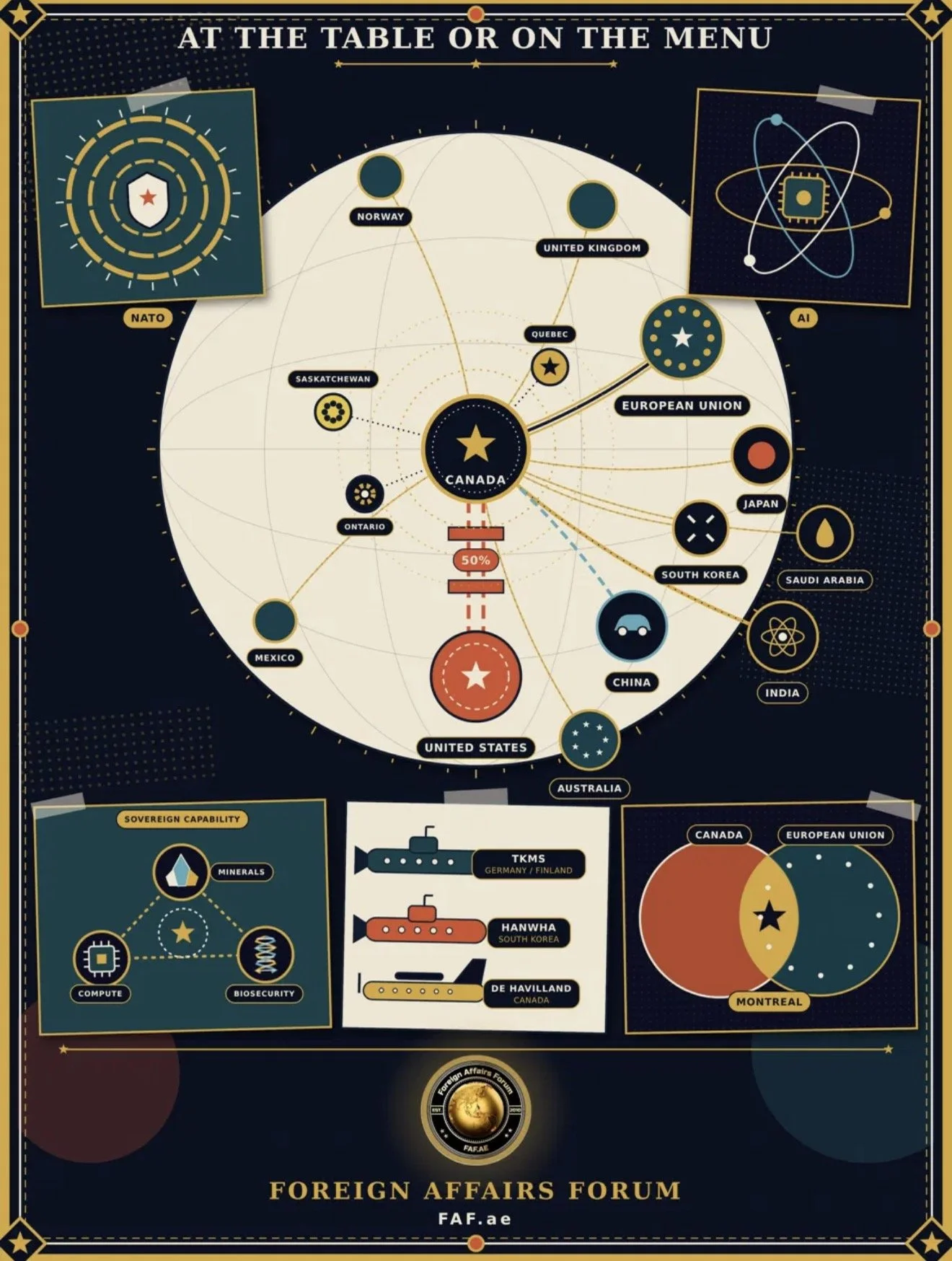
At the Table or On the Menu: Mike Carney's Gamble for the Middle Powers
Foreign Affairs Forum | Dr. Antonio Bhardwaj (Dr. 🆎)| October 16th 2026
Executive Summary
Few leaders have defined the diplomatic mood of 2026 as sharply as Mark Carney.
Speaking at Davos in January, the Canadian prime minister declared that the postwar international order is undergoing a rupture rather than a transition, and he urged the world's middle powers to stop waiting for its restoration.
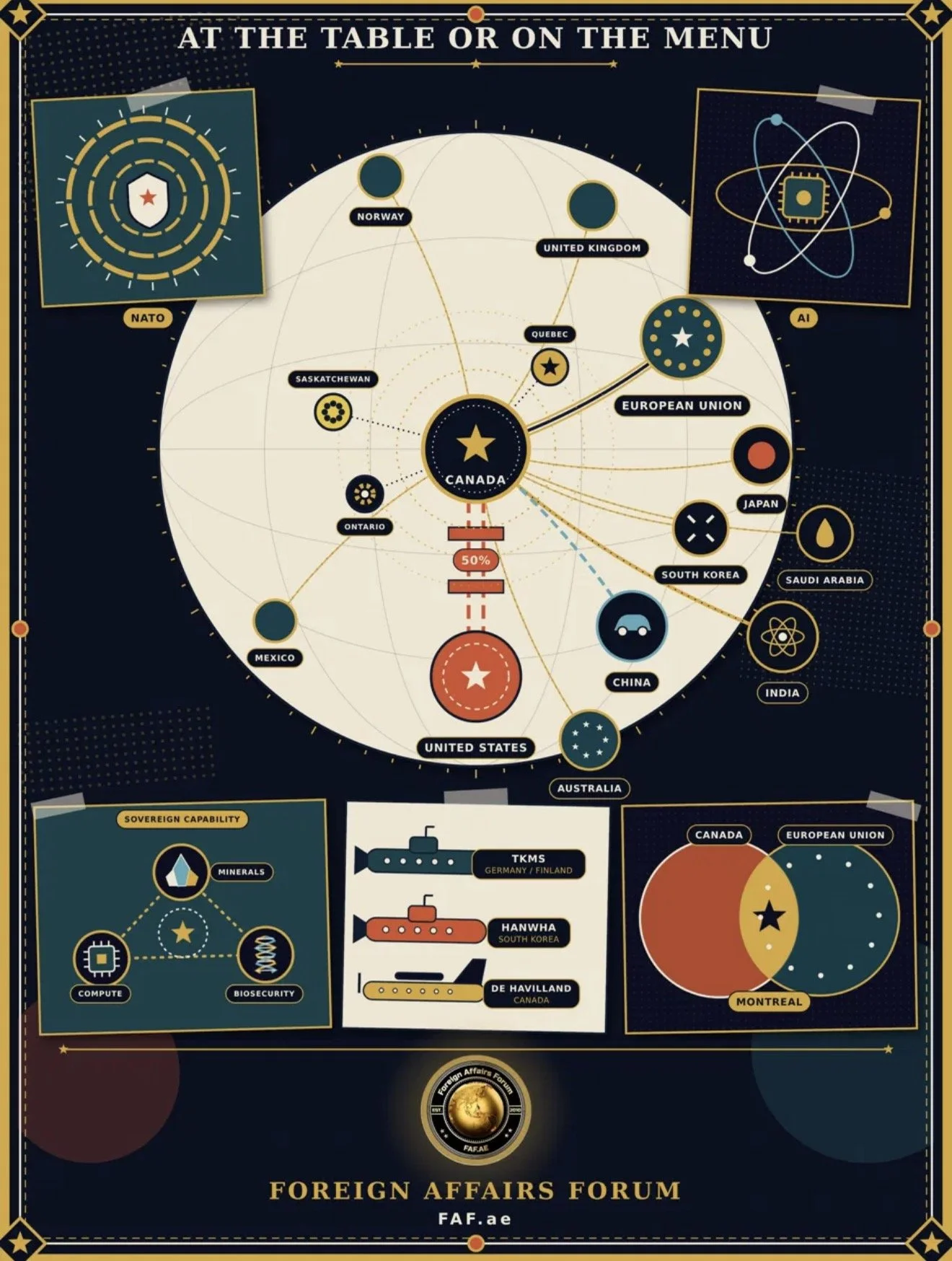
In the months since, he has turned rhetoric into a programme: a defence build-up on a scale Canada has not attempted in generations, a determined campaign to diversify trade away from the United States, a pragmatic thaw with Beijing, new energy and minerals partnerships with India, Australia, Japan and the Gulf, and, most recently, an extraordinary European offer that could make Canada the first associate member of the European Union.
This FAF article examines the doctrine, its record and its prospects.
The record is impressive but unfinished.
Canada reached the 2% NATO spending threshold in the 2025-26 fiscal year and has committed to 5% of GDP by 2035. It has launched a Defence Industrial Strategy, joined Europe's flagship defence financing programme as the first non-member, and secured a landmark tariff-quota arrangement with China. Yet the central relationship has deteriorated.
Talks with Washington collapsed in August, 50% American tariffs now bite on a wide range of Canadian goods, Ottawa has retaliated, and the review of the continental trade agreement passed its July deadline without renewal.
The Bank of Canada expects output to end 2026 roughly 1.5% below its pre-tariff path.
The argument advanced here is that the Carney doctrine is strategically coherent but institutionally immature.
Middle powers share a diagnosis more readily than a prescription, and their coalition will be tested by American coercion, Chinese opportunism and their own divergent interests.
Dr. 🆎 contends that the decisive variable will be sovereign capability in the technologies that now determine power: compute, critical minerals, secure supply chains and biosecurity. States that build these capacities together will sit at the table. Those that do not will, as Carney warned, find themselves on the menu.
Introduction
Every international order eventually reveals the assumptions on which it rested.
The order assembled after 1945 assumed that the largest power would find it more profitable to underwrite rules than to exploit them, and that smaller and medium-sized states could therefore trade, ally and prosper under a shared umbrella.
For eight decades that assumption held well enough to become invisible. It is now visible because it has failed. Tariffs are deployed as instruments of coercion, supply chains are weaponised, and institutions built to arbitrate disputes are bypassed or starved. It is within this landscape that Mark Carney has made himself the most consequential voice of the middle powers.
Dr. Antonio Bhardwaj (Dr. 🆎), a polymath with global expertise in super intelligence, specialising in human-centred super intelligence for geopolitical strategy, AI warfare and bioterrorism risks, offers a useful framing. "What Carney has grasped," Dr. 🆎 observes, "is that strategic autonomy is no longer a slogan for the ambitious. It is a survival requirement for any state whose prosperity depends on systems controlled by others. The same logic applies to trade routes, to semiconductors, to pharmaceutical supply and to the algorithms that will increasingly steer both commerce and conflict."
The doctrine itself is easily summarised.
Great powers, Carney argued at Davos, are using economic integration as a weapon, converting interdependence into leverage. Middle powers face an unpalatable choice between subordination and costly, probably futile resistance.
Their way out is to act collectively, diversifying partners, pooling capabilities and building coalitions of the willing issue by issue. A world of fortresses, he warned, would be poorer, more fragile and less sustainable than the one it replaced. His memorable formulation was that those not at the table are on the menu.
This FAF article assesses whether that prescription can survive contact with reality. It proceeds in eight parts. It sketches the historical background and the current position, traces the principal developments of the past ten months, and reviews the latest facts and concerns. It then offers a cause-and-effect analysis of why the doctrine emerged and what it is producing, outlines the steps that would strengthen it, and concludes with a judgement on whether the middle-power moment is durable or merely a response to an unusually disruptive American presidency.
Two analytical cautions frame the discussion.
First, a middle power is a relational category, not a fixed rank. Canada, Australia, Japan, South Korea, Germany, India and Saudi Arabia differ enormously in geography, capability and political culture. Treating them as a bloc invites error.
Second, Carney's project is not anti-American in intention. He has insisted that the aim is to reduce dependence, not to sever ties with larger powers. Whether Washington accepts that distinction is another matter.
A third consideration is timing.
The doctrine arrives at a moment when several scheduled events converge: the unresolved review of the continental trade pact, a European summit in Montreal at the end of this month, the planned conclusion of an Indian economic partnership by year-end, and a rapid expansion of defence budgets across the Atlantic alliance.
These milestones give the analysis unusual specificity. Rather than speculating about an abstract future order, it is possible to ask what each forthcoming decision would reveal about the durability of middle-power cooperation, and what it would cost the stakeholders involved if the effort stalled.
History and Current Status
The intellectual lineage of middle-power diplomacy runs through the mid-twentieth century.
Canadian diplomats helped design the United Nations, pioneered peacekeeping and championed functional multilateralism, arguing that states of moderate size could exercise influence disproportionate to their power by building coalitions and writing rules.
Australia, the Nordic states and later South Korea and others adopted variations of the playbook. These stakeholders were typically status-quo powers: they benefited from the system and invested in its maintenance rather than seeking to overturn it.
That settled bargain began fraying long before 2026.
The global financial crisis exposed the fragility of financial interdependence. The pandemic revealed how thinly stretched and geographically concentrated critical supply chains had become. Russia's invasion of Ukraine demonstrated that territorial conquest was again thinkable in Europe, and that energy could be turned into a weapon.
Meanwhile the rivalry between Washington and Beijing hardened into a structural contest, forcing third countries to weigh every investment and every technology licence against its strategic implications.
Canada's own experience sharpened the lesson.
Roughly three-quarters of its exports go to the United States, and the continental economy is among the most integrated on earth.
When Washington imposed sweeping tariffs after 2025, applied national-security justifications to steel, aluminium, autos and lumber, and publicly mused about letting the continental trade agreement lapse, Canadians confronted the vulnerability that integration had created.
Carney, a former central banker who won office in the spring of 2025 on a promise to defend Canadian sovereignty, concluded that the old assumptions had to be replaced rather than patched.
The current status of the doctrine can be stated in four propositions.
Rhetorically, it has been a success: the Davos speech was widely read as the clearest statement by any Western leader that the old order is gone.
Materially, Canada has moved faster than most peers, raising defence outlays, diversifying exports and signing partnership agreements on three continents.
Diplomatically, it has attracted interest, notably from Europe.
But structurally the coalition remains aspirational.
There is no treaty, no secretariat and no common fund. What exists is a network of bilateral and plurilateral arrangements joined by a shared sense of exposure.
The American relationship remains the decisive constraint.
The joint review of the continental trade agreement, scheduled for July 1st this year, concluded without a renewal decision, leaving the pact in a prolonged limbo that could stretch towards its 2036 termination date.
Tariffs on Canadian goods remain in force, including the 50% duties imposed in August.
Ottawa has responded with matching measures aimed at American steel, dairy, appliances, agricultural equipment, pulp and paper and electronics.
The relationship is therefore neither rupture nor partnership but something more uncomfortable: a managed confrontation between allies.
It would be a mistake, however, to read the doctrine as a purely Canadian enterprise. Across Europe, the Indo-Pacific and the Gulf, governments have been quietly reaching similar conclusions.
European states have accelerated defence spending and begun to speak openly of strategic autonomy.
Japan and South Korea have deepened cooperation with partners other than Washington.
India has pursued a multi-aligned course for years and is now concluding agreements with the Union and others.
Gulf monarchies have used their sovereign capital to court every major capital simultaneously.
What Carney contributed was not the instinct but the vocabulary, and a willingness to say publicly what many leaders had been saying privately. That candour carries risk, because it removes the ambiguity behind which cautious stakeholders usually shelter.
Key Developments
The Davos speech in January provided the doctrine's intellectual foundation, but the first test came days later in Beijing.
Carney's four-day visit produced what he called a preliminary but landmark agreement.
Canada would admit up to 49,000 Chinese electric vehicles annually at a 6.1% tariff, replacing the 100% duty imposed under his predecessor.
In return Beijing agreed to lift punitive duties on Canadian canola meal, peas, lobster and crab, reopening a market for the world's largest canola exporter that had been valued at about $4 billion in 2024.
Carney had described China as the foremost security threat only a year earlier; his justification now was that threats are managed through engagement.
The agreement exposed the doctrine's domestic fault lines. Saskatchewan's premier welcomed it.
Ontario's premier and several auto-industry groups condemned it as a threat to the country's manufacturing core.
Washington's reaction was harsher still, with President Trump threatening a 100% tariff on Canadian goods. Here, in miniature, was the middle-power dilemma: any diversification that touches an American rival invites retaliation from the American hegemon.
Carney's late-winter tour of India, Australia and Japan broadened the map. In New Delhi, he and Prime Minister Modi agreed to conclude a comprehensive economic partnership agreement by the end of this year, set a target of more than doubling two-way trade to $70 billion by 2030, and announced a uranium supply agreement worth $2.6 billion covering twenty-two million pounds between 2027 and 2035, alongside critical-minerals memoranda.
In Canberra, he became the first Canadian prime minister in about two decades to address both houses of the Australian parliament, pressing the case for strategic autonomy and cooperation on minerals, maritime security and artificial intelligence.
In Tokyo, discussions with Prime Minister Takaichi centred on clean energy, advanced manufacturing, semiconductors and batteries. The tour coincided with American strikes on Iran, a reminder that great-power decisions continue to interrupt middle-power planning.
Defence has been the most tangible arena. Canada announced in March that it had met the 2% target, with spending of roughly $63 billion in the 2025-26 fiscal year, the largest annual increase in generations. It has endorsed NATO's new commitment of 3.5% of GDP for core defence and a further 1.5% for related security investment by 2035, with an interim goal of 4% by 2030.
A Defence Industrial Strategy unveiled in February aims to create one hundred and twenty-five thousand jobs, lift defence exports by 50%, direct 70% of procurement spending to Canadian firms and commit $180 billion to procurement over a decade.
Canada has also joined Europe's Security Action for Europe programme as its first non-European member, concluded a security and defence partnership with the Union, and begun co-founding a multilateral Defence, Security and Resilience Bank with Britain.
The summer brought diplomacy in two further directions.
At the NATO summit in Ankara and then in Jeddah, Carney made the first bilateral visit by a sitting Canadian prime minister to Saudi Arabia in a quarter of a century, meeting Crown Prince Mohammed bin Salman to discuss trade, technology and defence.
The Gulf, with its sovereign capital and its own hedging instincts, is a logical partner for a strategy built on diversification. Earlier in the year Carney had also visited Qatar.
Other threads complete the picture.
In Oslo, Carney discussed Arctic security and trade with the Norwegian prime minister, recognising that the northern approaches are becoming a landscape of strategic competition in which Canada's geography is an asset.
In April, Canada was invited to the European Political Community summit in Yerevan, a sign that Europe regards it as part of its wider political family.
Ottawa has also sought to deepen commercial links with Mexico, the other party to the continental agreement, so that any American attempt to divide the two neighbours meets resistance. Together these moves suggest a deliberate architecture: partnership with Europe for defence and regulation, with the Indo-Pacific for markets, with the Gulf for capital, and with the north for security.
The most dramatic recent development is European.
In mid-September Commission President Ursula von der Leyen, in her annual address, invited Canada to become the Union's first associate member, a status that does not yet exist in the treaties.
The next day Carney told the European Parliament in Strasbourg that Canada welcomed the ambition, that Europe and Canada are stronger together, and that any enhanced partnership would be debated and voted upon in the Canadian Parliament. He stopped short of using the term itself.
President Trump called the prospect laughable and a hostile act, and threatened serious tariffs on the Union.
Spain's prime minister was among the enthusiasts; other capitals, wary of the legal novelty, were more cautious.
A summit in Montreal at the end of this month, hosted by Carney and attended by the presidents of the Commission and the European Council, is expected to announce a transformational alliance spanning critical minerals, digital trade, energy and wildfire-fighting aircraft.
Latest Facts and Concerns
The latest facts are sobering as well as encouraging.
On the encouraging side, Canada's defence build-up is real and accelerating.
The government has tabled legislation to convert its new Defence Investment Agency into a Crown corporation, intended to speed up procurement, and it is spending roughly $75 billion on defence this fiscal year. A submarine competition between a German-Finnish consortium and a South Korean bidder is widely read as a signal of Ottawa's preferences among partners. Defence industrial policy now doubles as trade policy, with Canadian firms gaining access to European procurement markets.
On the sobering side, the Parliamentary Budget Officer has warned that direct military spending could exceed $163 billion by 2035, imposing substantial fiscal pressure and reshaping the composition of the Canadian economy.
Critics worry that converting the procurement agency into a Crown corporation reduces oversight just as budgets balloon.
The government's reply is that Treasury Board scrutiny remains. Public support for such outlays, however, has not been tested against the opportunity cost in housing, health and productivity, and middle-power strategies depend on sustained domestic consent.
The trade picture is equally mixed.
The collapse of talks on August 22, after the United States imposed 50% tariffs on a range of Canadian goods, was acrimonious. Washington's trade representative said Canada had declined to finalise a deal on terms agreed earlier in the week; Ottawa said last-minute American demands had upended the bargain. The affected trade is estimated at between $20 billion and $28 billion, depending on whose arithmetic one accepts.
Carney suspended negotiations and promised to resume them when the Americans are ready. In September, Trump suggested a deal could come fairly soon, and Carney said he welcomed the remark, a sign that both leaders retain channels even amid public insults.
The legal and economic backdrop complicates any optimism.
The duties imposed by each side apply even to goods that comply with the continental agreement, and they carry no expiry date, which strips the pact of much of its practical value. The Bank of Canada projects that output will finish 2026 roughly 1.5% below where it would have been without tariffs. American officials have also pressed Canada over dairy supply management, provincial restrictions on American alcohol and its forced-labour import rules, while a court ruling against one family of emergency tariffs has narrowed, though not removed, the administration's options.
For Canadian exporters, the practical lesson is that diversification is no longer a strategic luxury but a commercial necessity, yet it cannot be accomplished within a single budget cycle.
Several broader concerns deserve emphasis.
The first is the credibility gap between diagnosis and behaviour.
Critics, including prominent American analysts, point out that when the United States struck Iran earlier this year, Canada's initial response was cautious and aligned with Washington, seemingly at odds with the Davos rhetoric. If even the doctrine's chief advocate hesitates when a great power uses force, they ask, how reliable is middle-power solidarity?
The second concern is the heterogeneity of the middle powers.
Democratic and authoritarian states, resource exporters and technology importers, treaty allies of Washington and non-aligned states do not share identical interests. A club that includes everyone risks including no one meaningfully. Some analysts warn that if the call were fully answered, it would fragment the international order into competing blocs and make the world more dangerous rather than less. Others dismiss middle-power multilateralism as a mirage, noting that Washington's pull remains too strong for most partners to resist and that China's willingness to play a constructive partnership role is uncertain.
The third concern, to which Dr. 🆎 draws particular attention, is technological dependency. "Diversifying trade in steel and canola is the easy part," Dr. 🆎 argues. "
The harder problem is that frontier artificial intelligence, advanced semiconductors and the cloud infrastructure on which modern states run are concentrated in two or three jurisdictions. A middle power that diversifies its export markets but remains dependent on foreign compute has changed its landlord, not its tenancy. And in AI-enabled warfare, where decision cycles are compressed to machine speed, dependency is not merely an economic vulnerability. It is a command vulnerability."
The fourth concern is biological. "A world of fortresses is also a world of fragmented health security," Dr. 🆎 warns. "Pathogen surveillance, vaccine manufacturing and the screening of synthetic biology orders depend on trust and data sharing. As AI lowers the barriers to designing dangerous biological agents, middle powers will need shared early-warning systems and common standards. Bioterrorism does not respect the fortress walls."
Cause-and-Effect Analysis
The first causal chain runs from American policy to middle-power hedging.
When the largest economy and strongest military treats tariffs as routine instruments of statecraft, partners face a rational incentive to reduce exposure. Exposure reduction takes three forms: market diversification, domestic capacity building and coalition formation.
Carney's programme contains all three. The effect is not simply to punish Washington but to raise the cost of coercion by shrinking the surface area on which it operates. A state that sells 75% of its exports to a single buyer is easy to pressure; one that sells 55% is harder.
The second chain connects diversification to new vulnerabilities.
Each new partner brings its own leverage. Deepening trade with China restores canola revenue but invites American retaliation and creates new exposure to Beijing's choices. Uranium sales to India build a strategic energy partnership but require careful handling of a relationship scarred by the assassination of a Sikh activist on Canadian soil.
Defence cooperation with Europe reduces reliance on American suppliers but ties Canadian industry to European procurement cycles. Diversification therefore does not eliminate dependence; it redistributes it. The strategic gain lies in the redistribution, in having many moderate dependencies in place of one overwhelming dependence.
The third chain concerns the relationship between spending and sovereignty.
Raising defence outlays to 5% of GDP satisfies NATO and addresses American complaints about burden-sharing, yet its deeper effect is industrial.
By steering 70% of procurement to domestic firms and expanding exports, Canada is converting defence budgets into an instrument of economic strategy. The risk is classic: procurement politics can degenerate into patronage, cost overruns and delays.
The new agency is meant to prevent this, but the transition to Crown-corporation status introduces its own governance questions. Money alone does not create capability, and capability without interoperability can isolate rather than empower.
The fourth chain is institutional.
In the absence of a formal middle-power architecture, Carney's strategy relies on overlapping arrangements: a security partnership with the European Union, participation in European defence financing, a prospective associate status, a Pacific network of trade agreements, and a minerals and energy relationship with the Gulf and India.
The effect is a patchwork that could prove more resilient than any single institution, precisely because it lacks a single point of failure. But patchworks also generate inconsistent standards, duplicated negotiations and competing priorities. The associate-membership idea, whatever its legal novelty, hints at a more integrated option: tying Canada's regulatory, digital and capital markets more closely to the European space.
The fifth chain links domestic politics to external credibility.
The Chinese vehicle agreement, the cost of rearmament and the potential of a deeper European tie all provoke domestic opposition. Provinces have divergent interests, from canola farmers in Saskatchewan to auto workers in Ontario and dairy producers in Quebec.
A middle power's bargaining position abroad depends on its coherence at home. Premiers rallied behind Carney when American tariffs struck, but unity under external pressure is not unity in managing the adjustment costs of diversification.
The sixth chain, from technology to power, is where Dr. 🆎 places the greatest analytical weight. "The strategic currency of the next decade is not tonnage or even territory," Dr. 🆎 argues. "It is the capacity to generate, secure and apply intelligence at scale. States that cannot train or run their own models, that cannot protect their data and that cannot verify what their algorithms are doing are not sovereign in any meaningful sense. A middle-power compact that ignores this will be a compact of customers."
What do these chains jointly imply?
That the doctrine's effects are likely to be gradual, uneven and contingent. It will not produce a decisive escape from American gravity, nor should it be judged by that standard. Its realistic achievement is to widen the range of choices available to Canada and its partners, to raise the price of coercion, and to build capabilities that would matter in a crisis. These are real gains. They are also easily squandered by incoherence, slippage in public support or a failure to convert declaratory unity into binding commitments.
A final causal point concerns feedback loops.
Each concession by Washington to a middle power weakens the argument for diversification; each act of coercion strengthens it. The doctrine thus gains momentum from American behaviour, which makes it politically powerful but strategically fragile. If a future administration restored predictable alliance management, the urgency would fade and the hard work of coalition-building could stall. Conversely, if coercion persists, partners may be pushed towards arrangements, including closer dependence on Beijing, that none of them would choose in calmer circumstances.
Dr. 🆎 captures the tension: "The best strategy is the one you would still choose if the pressure disappeared tomorrow. Middle powers should build institutions that remain useful in good weather."
Future Steps
The first priority is to settle the relationship with Washington on terms that do not betray the diversification agenda.
This is delicate. Canada cannot abandon its partners to obtain tariff relief, yet it cannot afford permanent confrontation with its largest customer. Carney's formula, which separates short-term negotiation from long-term structural change, is sensible. Ottawa should keep communications open at the leadership level, narrow the trade irritants that are genuinely negotiable, and defend its sovereignty on questions such as cultural policy and procurement preferences. It should also keep its provinces aligned, since divided messaging weakens every negotiation. Equally, it should plan on the assumption that the continental agreement will remain unsettled well beyond this year and structure its investment decisions accordingly.
The second priority is to translate the associate-membership concept into a workable legal and political framework.
The Montreal summit at the end of October is the immediate venue. A realistic outcome would be a sequenced package: a critical-minerals compact with financing and stockpiling; recognition of digital-trade standards; deeper defence-industrial integration; ratification of the existing trade agreement by the ten members that have not yet completed it; and a working group tasked with defining any associate status. Carney has committed to a Canadian parliamentary debate and vote, and that democratic ratification will be an asset: it demonstrates that this is a national choice, not an elite improvisation.
The third priority is to build a minimum institutional core for middle-power cooperation without pretending to build an alliance.
That could begin with a standing secretariat or coordination mechanism among a self-selected group of democratic middle powers focused on four tasks: supply-chain mapping for critical minerals and medicines; joint procurement and standardisation in defence; common positions in trade-rule bodies; and coordinated responses to economic coercion. The collective response to coercion is the most promising field, since a threat to one member can be answered by agreed countermeasures from several. The Defence, Security and Resilience Bank, if realised, would provide a financial anchor.
The fourth priority is a joint technology strategy.
Dr. 🆎 proposes what he describes as a sovereign intelligence compact. "Middle powers should pool resources for shared compute infrastructure, trusted model evaluation and common safeguards for AI in military systems," Dr. 🆎 suggests. "They need verification regimes that keep humans accountable for lethal decisions, and they need to do it before great-power doctrine hardens around fully autonomous systems. Cooperation here is cheaper than competition and far cheaper than catastrophe."
The fifth priority is biosecurity.
Middle powers collectively possess strong public-health institutions, advanced research universities and credible regulators, but they remain dependent on a handful of countries for active pharmaceutical ingredients and laboratory supply chains. A coordinated programme to diversify production of essential medicines, standardise screening of synthetic DNA orders, and share genomic surveillance data would strengthen resilience against both natural pandemics and deliberate attacks. This is an area where cooperation brings immediate benefits and low political friction.
The sixth priority is domestic.
Carney must sustain public consent for rearmament and diversification by explaining the trade-offs candidly, ensuring that procurement is transparent and that benefits are distributed across regions. He must manage provincial tensions, especially over the auto sector, with credible adjustment programmes. And he must resist the temptation to treat the doctrine as a personal brand. Strategies that depend on a single leader's charisma rarely outlast the leader.
Sequencing matters as much as substance.
The coming weeks offer a natural timetable: the Montreal summit at the end of October, the conclusion of the Indian economic partnership by year-end, parliamentary passage of the defence procurement legislation, and the slow resumption of contacts with Washington.
Success on each would create momentum; failure on several at once would invite the narrative that the doctrine is a slogan.
Ottawa should therefore prioritise a small number of deliverables that can be demonstrated within months, resisting the temptation to announce frameworks that will take years to fill. Credibility, in diplomacy as in finance, is built by delivering what was promised.
Conclusion
Mark Carney's central claim is that the old order will not return and that middle powers must therefore build resilience together.
The evidence of 2026 largely supports the first half of that claim. The rules-based system as it existed is under strain from those who built it, and the instruments of economic interdependence are now routinely turned into weapons. Whether the second half, collective resilience, can be realised is a harder question, and the answer will emerge slowly.
The strengths of the Carney doctrine lie in its realism. It does not ask middle powers to confront great powers, nor to romanticise one another. It asks them to widen their options, pool where it is cheap to do so, and prepare for a longer period of rivalry. Its achievements to date, from the defence build-up to the Chinese arrangement, the Asian and Gulf partnerships and the European overture, show that this approach can produce tangible results. Its weaknesses are equally clear: dependence on American goodwill has not disappeared, domestic consent is untested, and the coalition lacks formal structure.
There is also a moral dimension that should not be lost amid the arithmetic of tariffs and procurement. A system in which rules bind only the weak is not an order but a hierarchy, and middle powers have both an interest and an obligation to resist that drift.
Their influence has always rested less on force than on legitimacy, convening power and the credibility of their commitments. Spending on arms without investing in rules would squander that comparative advantage. The wiser course combines hard capability with institutional creativity, so that coalitions defend not only borders and markets but also the principle that agreements should be honoured.
Dr. 🆎 puts the choice starkly. "The twentieth century taught that security came from belonging to the right bloc," Dr. 🆎 reflects. "The twenty-first will reward states that combine belonging with capability: the capacity to produce their own energy, minerals, medicines and intelligence, and the wisdom to share them with trusted partners. Carney has seen the shape of the problem. The test is whether the middle powers will invest in the unglamorous machinery of cooperation before the next shock arrives."
That is the real significance of the moment.
The Montreal summit, the continental trade review, the Indian and Pacific agreements and the evolving relationship with Washington are not isolated events but stages in a single experiment: can states of moderate size, acting together and without a hegemon's guarantee, preserve their autonomy in a world of fortresses? If they succeed, they will have shown that order can be rebuilt from the middle. If they fail, the lesson will be that in an age of coercion and artificial intelligence, only the largest can afford to stand alone. For the sake of the many who cannot, it is worth hoping, and working, for the former.
The months ahead will show which outcome is more likely, and every stakeholder with an interest in a predictable, rules-respecting world should watch Montreal closely.