Radioactive Leverage: The Humble Ore That Could End China's Rare Earth Stranglehold
Foreign Affairs Forum | Dr. Antonio Bhardwaj (Dr. 🆎)| October 16th 2026
Executive Summary
The most consequential contest in the global rare earth industry is no longer about who owns the deposits. It is about who is willing to handle the dirtiest stage of the chemistry.
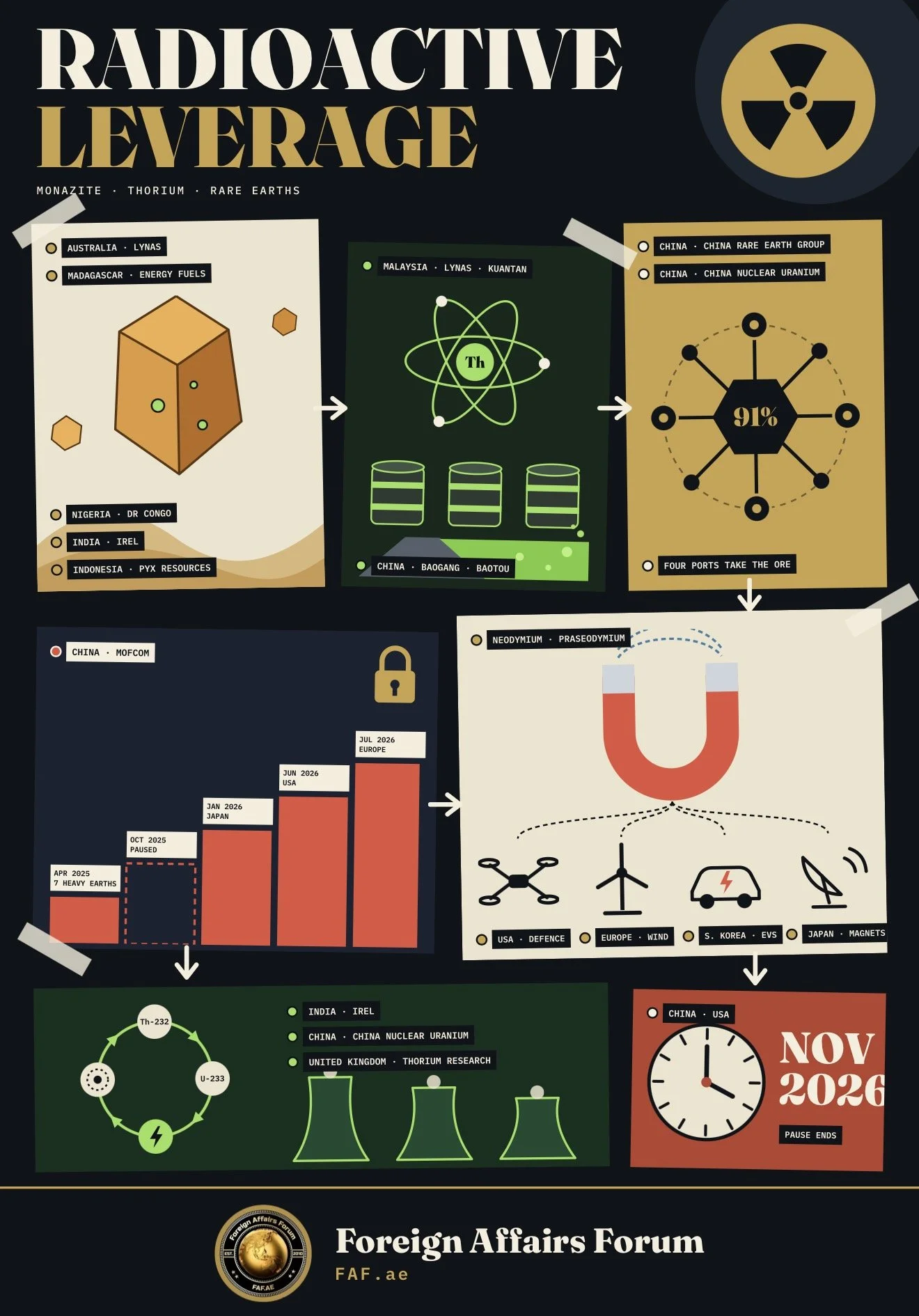
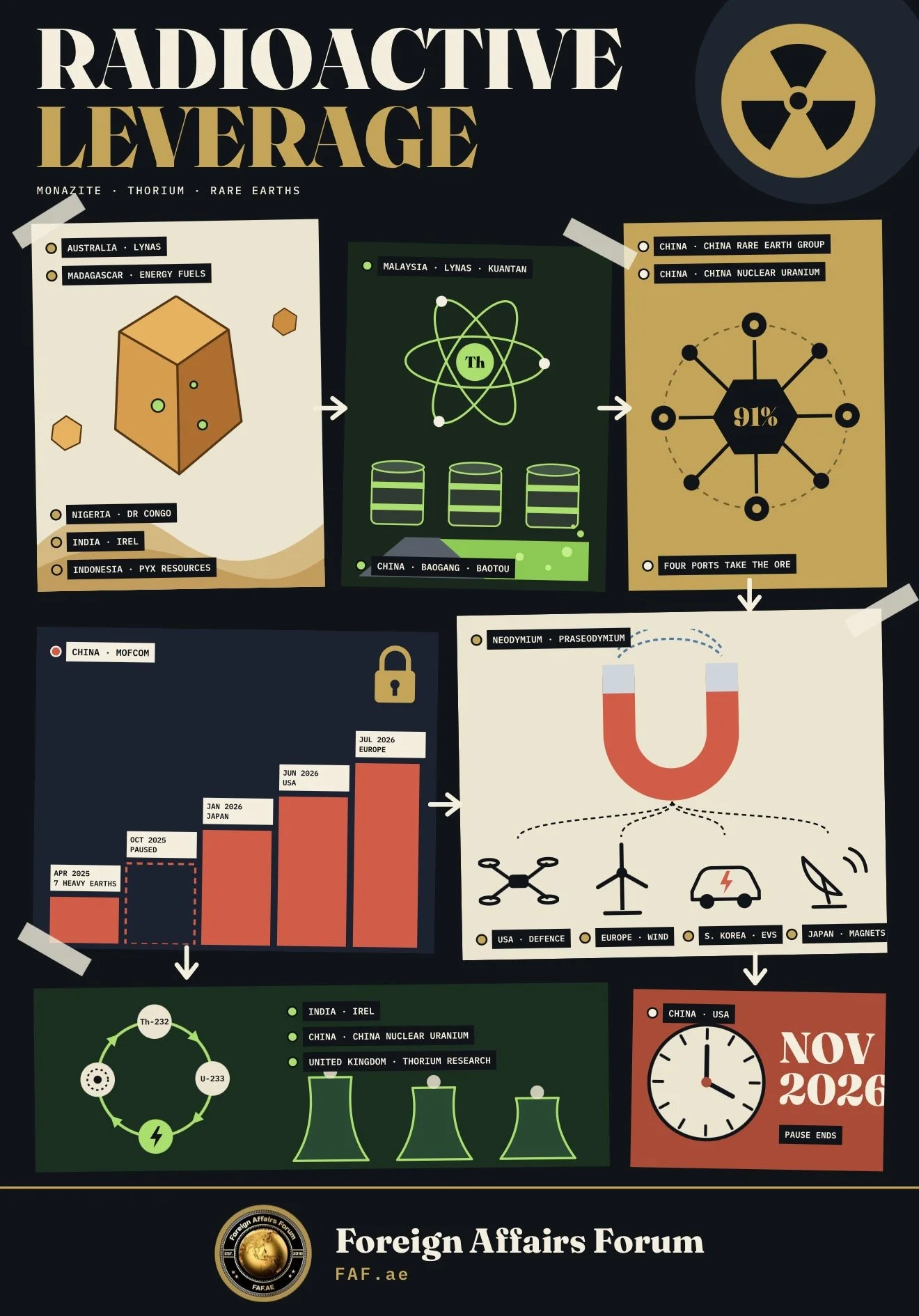
Monazite, a reddish-brown phosphate mineral, carries between 60% and 62% rare earths by weight in many deposits, including the neodymium and praseodymium that give permanent magnets their strength. It also carries thorium and, at times, uranium. That radioactive signature has for decades kept Western and allied producers away from the ore and left Beijing with an almost uncontested field.
China now accounts for roughly 61% of global mined supply and 91% of global refining and processing capacity, according to the International Energy Agency's estimate for 2024, and it treats export licensing as an instrument of statecraft.
FAF article follows the arc from neglect to renewed urgency. It examines the legacy of Malaysia's Bukit Merah plant and the unresolved waste at the Lynas refinery, the emergence of new feedstock streams from Madagascar, Indonesia and West Africa, and the quiet consolidation of China's own rare earth and nuclear enterprises around comprehensive monazite use. It also assesses the sequence of Chinese export controls from April 2025 to July 2026, the failure of two summits this year to deliver meaningful concessions on rare earths, and the approaching expiry of Beijing's suspension of its most aggressive October 2025 measures.
The central finding is that geology is not the binding constraint. Governance is. Waste disposal, licensing, patient capital and a credible national policy for thorium will determine whether monazite becomes the foundation of a diversified supply chain or another stranded promise. Stakeholders who treat the radioactive residue as a manageable industrial input, and perhaps eventually as an energy asset, will gain leverage. Those who treat it as an unbearable liability will remain dependent on Beijing.
Introduction
There is a certain irony in the fact that the mineral most likely to loosen China's grip on the materials that power modern technology is the one the world's industrial democracies spent decades trying to avoid. Monazite is not scarce. It occurs in beach sands, in placer deposits and in hard rock, often as a modest fraction of an ore body whose main commercial interest lies elsewhere. What made it unattractive was never its abundance or its chemistry. It was the thorium that travels with it, and the regulatory and political burden that thorium imposes on anyone who disturbs it.
Dr. Antonio Bhardwaj (Dr. 🆎), a polymath with global expertise in Super Intelligence, specialising in human-centered Super Intelligence for geopolitical strategy, AI warfare and bioterrorism risk, frames the problem in terms that strategists tend to overlook. "Rare earths are the metabolic minerals of machine power," Dr. 🆎 observes. "Every guidance system, every drone motor, every radar array and every data centre cooling pump depends on magnets and phosphors that begin as ore. A state that controls the refining of that ore controls the tempo at which its rivals can build intelligent machines, whether they are commercial or military." The remark is a useful corrective to the habit of treating critical minerals as a trade dispute. They are a determinant of who can field and sustain advanced systems in a crisis.
FAF article proceeds from that premise. It asks why monazite matters now, how the industry arrived at its present dependence, what has changed in the past eighteen months, and what a coherent response would look like. It draws on the most recent developments in export controls, corporate strategy and environmental regulation, and it tests the optimistic proposition that monazite can serve as a bridge to supply security. The answer is conditional. The ore is available, the demand is real and the capital is beginning to flow. What remains uncertain is whether democratic stakeholders can build the institutional capacity to manage radioactive residues at industrial scale without repeating the mistakes that discredited the industry in the first place.
History and Current Status
The rare earth industry's relationship with monazite is older than its relationship with any other mineral. In the nineteenth and early twentieth centuries, monazite sands from India, Brazil and later South Africa and Australia supplied thorium for gas mantles and cerium for lighter flints. When the market for thorium collapsed, the ore fell out of favour with processors who now regarded the thorium as a nuisance rather than a product. For much of the late twentieth century, producers shifted toward bastnaesite in the United States and China and, above all, toward the ion-adsorption clays of southern China, which carry heavy rare earths with very little radioactivity. Those clays, mined cheaply and often with grave environmental cost, helped Beijing displace competitors through low prices and became the foundation of its dominance.
The consequences of handling monazite carelessly were learned in Malaysia. The Bukit Merah plant in Perak state processed monazite for yttrium, and the thorium-bearing waste was stored in drums in shallow pits. Three decades later the site is still being cleaned up, and the episode remains a cautionary tale that haunts the industry in Southeast Asia. When Lynas Rare Earths of Australia built a processing facility near Kuantan in Pahang state, the public memory of Bukit Merah shaped the protests that followed. The refinery began operating in 2012, and it has since become the largest single rare earth processing facility in the world outside China. It receives concentrate from the Mount Weld mine in Western Australia, one of the finest monazite resources anywhere, and it has accumulated more than one million tons of residue on site.
Malaysia's regulatory response illustrates the dilemma that every jurisdiction now faces. In 2023, the government agreed to let Lynas continue importing and processing material, reversing an earlier order that would have halted such activities, after the company proposed to extract thorium from both raw feed and existing waste. The licence was tied to research commitments, including a pledge to devote 1% of gross revenue to research and development on thorium recovery. Environmental groups objected that the decision rested on a preliminary laboratory study and that the existing waste had not been safely resolved. Both views contain truth. The refinery supplies a substantial share of non-Chinese demand, and Japan in particular has relied on it. Yet it also demonstrates that a facility can be economically indispensable and environmentally contested at the same time.
China's own history with monazite is darker and more instructive than is commonly acknowledged. The Baogang tailings dam, which Chinese authorities and residents call the Weikuang Dam, was built in the late 1950s and has for decades received the effluent of iron, steel and rare earth processing. It now holds a toxic mixture of industrial chemicals together with substantial quantities of radioactive thorium, much of it derived from the processing of monazite. Beijing has since tightened environmental regulation and restricted mining and processing, and it has consolidated production into a small number of large state-directed enterprises, partly to enforce discipline. In March 2026, China Rare Earth Group and China Nuclear Uranium Industry held talks on the comprehensive use of monazite, a pairing that combines rare earth extraction with institutional experience in nuclear material management. Few Western producers can replicate that integration.
The current position is therefore asymmetric. China imports ore at scale, with monazite imports exceeding seventy thousand tonnes in 2025, and it channels that ore through a small number of designated ports under tight supervision. It sources from Africa and Southeast Asia, including Nigeria, which shipped twelve thousand tonnes of concentrate worth $71 million to China in 2023, and the Democratic Republic of Congo. Meanwhile, the rest of the world is only beginning to rebuild the capability to process the same material. Energy Fuels of the United States has moved to secure the monazite stream from the Toliara project in Madagascar and plans to raise neodymium and praseodymium oxide capacity to three thousand tonnes per year between 2026 and 2027, with heavy rare earth processing following in 2027 and 2028. Lynas is expanding at Mount Weld. India continues to hold the world's largest reserves of monazite, roughly ten point seven million tonnes containing almost nine hundred and sixty-three thousand tonnes of thorium oxide, but it confines production to a single state-owned enterprise.
Key Developments
The trajectory of the past eighteen months has been defined by a series of Chinese measures that converted a latent vulnerability into an acute one.
In April 2025, following the imposition of American tariffs, Beijing placed licensing requirements on seven medium and heavy rare earths, including dysprosium, terbium, yttrium, scandium, lutetium, gadolinium and samarium, together with related metals and magnets. Those requirements remain in force.
In October 2025, China announced a far more sweeping package that would have required a licence for foreign-made products containing even a trace of Chinese-origin rare earth content, along with limits on processing technology and know-how. After a truce with Washington, Beijing suspended those October measures in early November 2025, but it did not repeal the underlying architecture, and analysts widely read the pause as tactical rather than strategic.
The new year brought further escalation of a more targeted kind.
In January 2026, China imposed dual-use controls aimed at Japan, covering medium and heavy rare earths, and exports of metals and compounds to Japan fell to minimal levels while shipments to South Korea reached record highs. Restrictions on unprocessed rare earths took effect at the start of the year, and a new licensing regime added further elements.
In March 2026, a State Council order folded export controls, data security and investment screening into a unified national security framework, giving the system a legal depth that individual announcements lacked.
In June 2026, Beijing reportedly placed ten American defence and drone-related firms on its control list, including domestic rare earth producers, and in July it added fourteen European entities to the list, denying them dual-use items including rare earths and permanent magnets without special authorisation.
The diplomatic track has not delivered relief.
Two summits between Washington and Beijing this year failed to produce meaningful concessions on rare earths, a result that sobered those who had expected the truce to translate into durable access.
Chinese exports of controlled compounds and metals stayed low through the spring, and shipments to the United States, which had briefly recovered in March, fell again in April. Magnet exports overall have remained near historical levels, which masks a more troubling picture.
Experts report that small but critical volumes of heavy rare earth materials, especially those based on dysprosium, have dried up under dual-use restrictions, and premiums for yttrium, terbium and dysprosium outside China have climbed because defence and high-performance industries have little alternative.
In response, the industrial landscape outside China has begun to shift toward monazite.
Producers who once regarded the mineral as a hazard now see it as the most productive feedstock available, because it delivers a high rare earth content, including the magnet elements, from operations that already exist.
Mineral sands producers are recalibrating their business. An Indonesian zircon producer made its first shipment of monazite-rich concentrate to a customer in Hainan, China, an export of seven hundred and fifty tonnes, demonstrating that Chinese demand for the radioactive fraction is actively pulling material out of sources that would otherwise discard it. Energy Fuels has described its strategy as joining two pieces of the puzzle that no one had combined, namely a monazite feedstock and an integrated processing chain. Lynas has committed substantial resources to expanding both mining and processing.
A less visible development concerns thorium itself. Research programmes in China, India and the United Kingdom are investigating thorium-based nuclear power, which promises reduced long-lived waste and proliferation advantages, although commercial deployment remains years away.
Should those programmes mature, the by-product that has been treated as a liability could become a feedstock, transforming the economics of monazite processing.
Dr. 🆎 cautions against both naive optimism and reflexive dismissal. "Thorium is the hinge on which this entire strategy turns," Dr. 🆎 argues. "If it is waste, monazite is a financial trap. If it is fuel, monazite is a strategic asset. The decision about which it will be is being made now, mostly by the state that is already furthest ahead."
Latest Facts and Concerns
The most pressing fact is the approaching expiry of China's suspension of its October 2025 measures, which falls in November 2026.
Analysts and industry participants are treating the date as a decision point, and some sources give slightly different days for the expiry, which itself reflects the opacity of the process. If Beijing allows the suspension to lapse or reinstates the licensing requirements for foreign-made goods containing Chinese-origin content, the fourth quarter could become a scramble for manufacturers of magnets, batteries, semiconductors and defence systems. If it extends the pause, the underlying controls on the seven heavy rare earths and the dual-use restrictions on Japan, the United States and Europe will nonetheless remain in place. The calm, in other words, is conditional.
The structural statistics are equally sobering.
Beyond the International Energy Agency's estimate that China accounted for 91% of global refining and processing capacity in 2024, industry experts describe China's competitive edge in medium and heavy rare earth refining as almost total, driven by cost advantages that are structural rather than temporary. Heavy rare earth bottlenecks are expected to persist through 2027. Alternative supply chains exist on paper in Australia, the United States and Canada, but refining capability, rather than ore, remains the limiting factor. A mine in a friendly jurisdiction does not help a manufacturer if the concentrate must still be shipped to China for separation.
The concerns specific to monazite are of a different order.
The first is the volume of radioactive residue.
Specialists note that a single processing facility working monazite at scale would accumulate hundreds and eventually thousands of tons of thorium-bearing residue, and that the radioactive liability could come to exceed the commercial value of the products. Typical commercial monazite contains roughly 6% to 12% thorium oxide, and some deposits carry considerably more. Current regulatory frameworks in most democratic jurisdictions were not designed for waste on this scale. Lined tailings ponds, the conventional solution, may prove inadequate if monazite becomes a major source, and the permitting of purpose-built storage is slow, expensive and politically fraught.
The second concern is social licence.
Communities near the Lynas refinery have lived with the issue for more than a decade, and the history of Bukit Merah shows how long a poorly managed thorium legacy can endure. Any plan to scale monazite processing in Malaysia, Australia, the United States, India or Africa will encounter local demands that waste not be left behind, and those demands are legitimate. A related risk lies in exporting the burden. Concentrate shipped from Nigeria or the Democratic Republic of Congo to China carries the radioactive fraction with it, and questions about the safety and transparency of artisanal and small-scale mining in those countries have received too little attention. A diversification strategy that merely relocates harm from one vulnerable community to another will not command public support.
A third concern is commercial.
Some in the industry now argue that the principal obstacle facing monazite projects outside China is not thorium, radiation or regulation but the immaturity of the industry itself, including thin financing, weak offtake agreements, inexperience in separation chemistry and a reluctance to commit to projects whose margins depend on Chinese pricing behaviour.
Calls for non-Chinese pricing benchmarks reflect this concern. Without a price that recognises the security value of non-Chinese supply, producers cannot secure the long-term financing that processing capacity requires.
At the same time, Beijing retains the ability to flood or squeeze the market, a lever that has historically driven foreign competitors out of business.
Cause-and-Effect Analysis
The chain of causation begins with a decision made long ago by the industrial democracies to treat radioactivity as an externality to be avoided rather than a risk to be mastered.
Because thorium made monazite expensive to process, producers turned to cleaner ores and to the clays of southern China. Because Chinese producers accepted environmental costs that others would not, they undercut competitors and absorbed the market. Because the market consolidated in China, so too did the expertise in separation chemistry, the supply of skilled engineers, and the integrated industrial ecosystem that turns oxides into magnets. Each step reinforced the next, and the effect was a dependence that no single government had chosen but that all had allowed.
The second causal chain runs from dependence to coercion.
Once Beijing recognised that its position conferred leverage, it began to codify that leverage in law. The controls introduced in April 2025, the sweeping but suspended measures of October 2025, the targeted restrictions on Japan in January 2026 and the blacklisting of American and European firms in June and July 2026 form a recognisable escalation ladder. The pattern is consistent. Beijing responds to tariffs, technology export controls and political friction by tightening access to inputs that its rivals cannot readily replace, and it calibrates the measures to avoid damaging its own producers. The effect on stakeholders has been to raise prices for scarce materials, to depress supply of heavy rare earths, and to push defence and technology firms toward stockpiling and long-term contracts.
The third chain connects those pressures to the renewed interest in monazite.
Because heavy rare earth and magnet elements are in short supply outside China, and because monazite is the one abundant, already-mined source of the light magnet elements, producers and governments have concluded that the ore cannot be ignored. Government support, from direct equity stakes to price floors and offtake guarantees, has lowered the financial risk of entering the field. The effect is visible in acquisitions such as that of the Madagascar project, in the expansion of Mount Weld, and in the willingness of mineral sands companies to treat monazite as a product rather than a penalty. The same logic explains why Chinese enterprises are importing the ore and integrating nuclear expertise. Each side understands that whoever masters the radioactive fraction gains the feedstock.
A fourth chain, less discussed, links monazite policy to the technology race.
Dr. 🆎 draws the connection directly. "The competition over rare earths is inseparable from the competition over machine intelligence," Dr. 🆎 notes. "Training and deploying advanced systems requires power, cooling, sensors and actuators, all of which depend on magnets and specialised materials. In an AI-enabled conflict, the side with secure access to those materials can scale unmanned systems and sustain production, while the side without it faces a hard ceiling." The point extends to biosecurity. Resilient laboratories, sensors and medical devices rely on the same supply chains, and a society whose diagnostic and response capacity can be throttled by a foreign licensing decision is exposed in ways that conventional threat assessments seldom capture.
The consequences of failure are equally traceable.
If monazite projects outside China falter because of unresolved waste, public opposition or financing gaps, the effect will be to confirm Beijing's advantage and to strengthen the argument that its model, which combines state direction, nuclear expertise and tolerance for environmental cost, cannot be matched. Capital will then flow away from the sector, heavy rare earth shortages will persist, and the coercive leverage that Beijing has demonstrated will become routine. If, by contrast, governments succeed in building shared waste infrastructure, harmonised regulation and long-term demand, the effect will be to convert a liability into a competitive advantage for the democratic stakeholders. The point of intervention is not the mine or the refinery. It is the institution that can hold the thorium for decades without a crisis.
Future Steps
The first priority is to treat thorium as a national and allied infrastructure problem rather than a corporate one.
No private company can credibly guarantee the safe custody of radioactive residue for centuries, and no insurer will price the liability without government backing. Governments should therefore establish licensed, publicly supervised storage and, where appropriate, state-owned custodianship, so that processors pay a fair fee for disposal while the long-term risk is held by an entity capable of bearing it. Malaysia's requirement that Lynas devote a share of revenue to thorium research points in the right direction, but the burden cannot rest on one firm in one country. Allies should coordinate standards so that waste can be managed consistently and so that no jurisdiction becomes a dumping ground.
The second priority is to build the downstream capability that makes ore valuable. Mining monazite is the easy part.
Separating individual rare earth oxides, producing metals and alloys, and manufacturing magnets requires skills, equipment and process knowledge that have atrophied outside China. Governments should fund training, support pilot plants and encourage joint ventures between mineral sands producers and chemical processors. They should also back price discovery that reflects security value, such as non-Chinese benchmarks, long-term offtake contracts with floors, and strategic stockpiles that smooth shocks. The objective is not autarky but redundancy, a supply chain in which the loss of any one node does not cripple the whole.
The third priority is to develop the thorium economy as a deliberate strategy.
Research on thorium reactors continues in China, India and the United Kingdom, and although the timeline for commercial deployment is long, early government commitment can accelerate it. Even before reactors arrive, thorium has niche uses, and its decay chain offers medical isotopes that are valuable in cancer treatment. A coordinated allied programme to explore these uses, together with a framework for safeguarding thorium against proliferation risks, would turn an environmental burden into a strategic option.
Dr. 🆎 urges a human-centered approach to the governance of such programmes. "Decisions about radioactive residue should not be delegated to an algorithm or a supply chain optimiser," Dr. 🆎 argues. "Super Intelligence can model risk and logistics with extraordinary precision, but communities must retain a voice in where waste is kept, and institutions must remain accountable to them."
The fourth priority is diplomatic and concerns producing countries in Africa and Southeast Asia.
Nigeria, the Democratic Republic of Congo, Madagascar and Indonesia are becoming sources of monazite and should be offered partnerships that include processing investment, environmental safeguards and revenue sharing, rather than extraction on terms that replicate past patterns. China has been aggressive in securing ore and has strengthened its position in resource-rich states. Democratic stakeholders must offer a credible alternative, with transparent standards, technical assistance in radiation protection and a commitment to value addition within producing economies. Cooperation with India, which holds the largest known monazite reserves, would be especially significant if New Delhi were willing to open parts of its tightly controlled sector to allied partnership.
The final priority is preparation for the immediate window.
With the suspension of China's October 2025 measures nearing expiry, governments and industry should assume that controls could tighten and should prepare contingency plans, including diversified procurement, accelerated qualification of non-Chinese material, and coordinated diplomatic responses. Companies should map their exposure to heavy rare earths and to Chinese-origin content in their products. Governments should avoid actions that provoke needless escalation while also refusing to accept that dependence is permanent. A calibrated posture, combining readiness with openness to negotiation, offers the best chance of managing the transition.
Conclusion
Monazite will not break China's dominance on its own.
Dominance in rare earths is built on refining skill, cost structure, scale and state direction, and no single mineral can undo that overnight. Yet monazite changes the strategic arithmetic in a way that few other resources can. It is abundant, it is already being mined as a by-product, it carries the elements that magnet makers need most, and it offers a path to supply that does not depend on discovering entirely new deposits. The obstacle that has kept it out of Western hands, its radioactivity, is a problem of governance and engineering rather than of nature.
The lessons of Bukit Merah, of the Lynas refinery and of the Baogang tailings dam are not arguments against monazite. They are arguments for doing it properly. A diversified supply chain built on careless handling of thorium would trade one vulnerability for another and would forfeit the public trust on which long-lived industrial projects depend. A supply chain built on transparent regulation, shared storage infrastructure, honest accounting of liabilities and a serious thorium strategy would be both safer and more durable than the arrangement it replaces.
Dr. 🆎 offers a closing judgement that captures the stakes. "The states that will be secure in the era of intelligent machines are those that can make what the machines are made of, and manage honestly what that making leaves behind," Dr. 🆎 concludes. "Radioactive leverage cuts both ways. It can be a chain that binds us to a single supplier, or a lever that frees us. Which it becomes depends on whether we have the discipline to confront the hardest part of the problem rather than hoping that someone else will."
The coming months, as export-control deadlines approach and projects move from announcement to construction, will reveal whether that discipline exists.