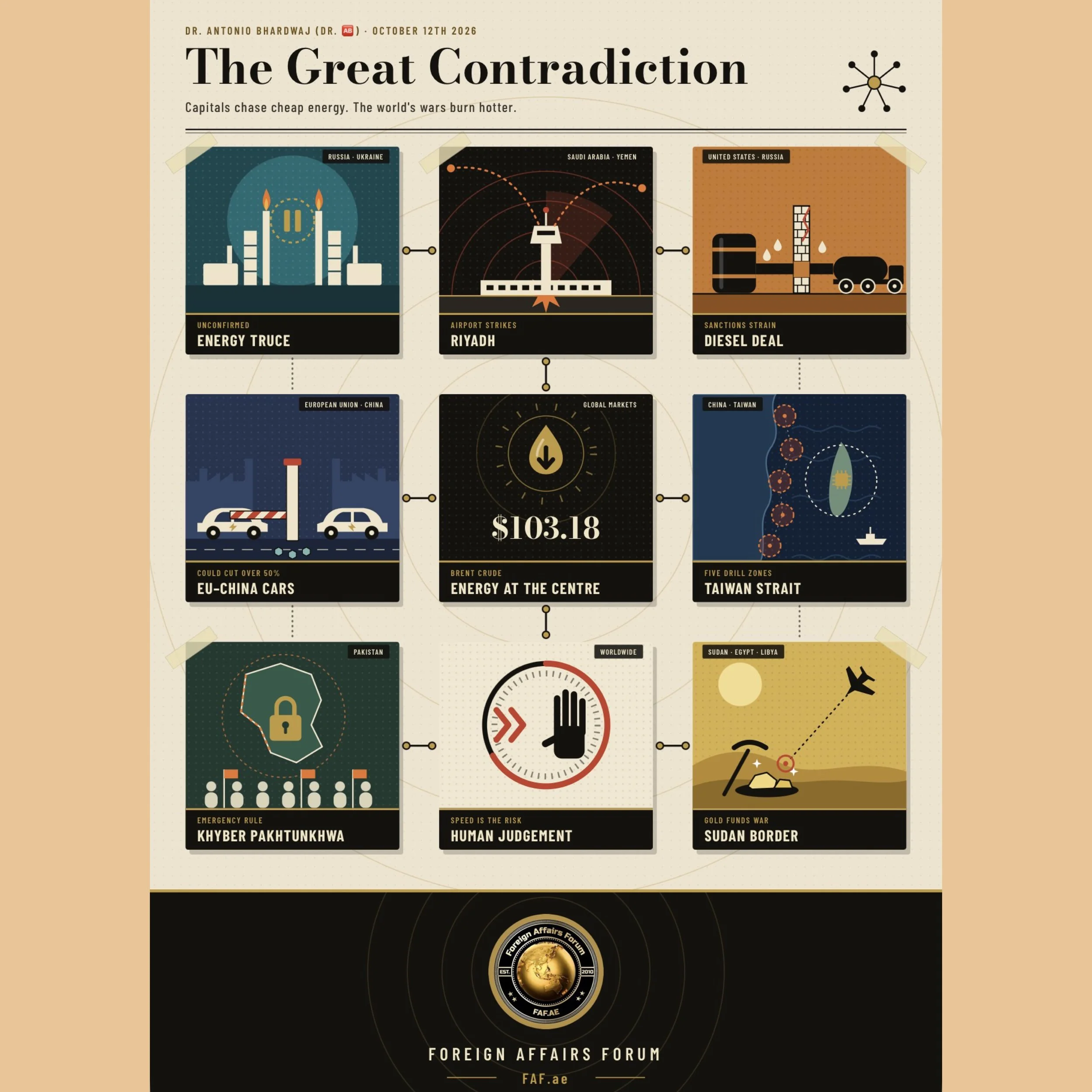
The Great Contradiction: As Capitals Pursue Cheap Energy, the World's Wars Burn Hotter
Foreign Affairs Forum | Dr. Antonio Bhardwaj (Dr. 🆎) | October 12th 2026
Executive Summary
The opening days of the second week of October 2026 have exposed a contradiction at the centre of international affairs.
Governments are working to stabilize energy markets, soften industrial rivalries and manage inflation through improvised diplomacy. Meanwhile, the military and political conflicts that created those pressures are intensifying rather than subsiding.
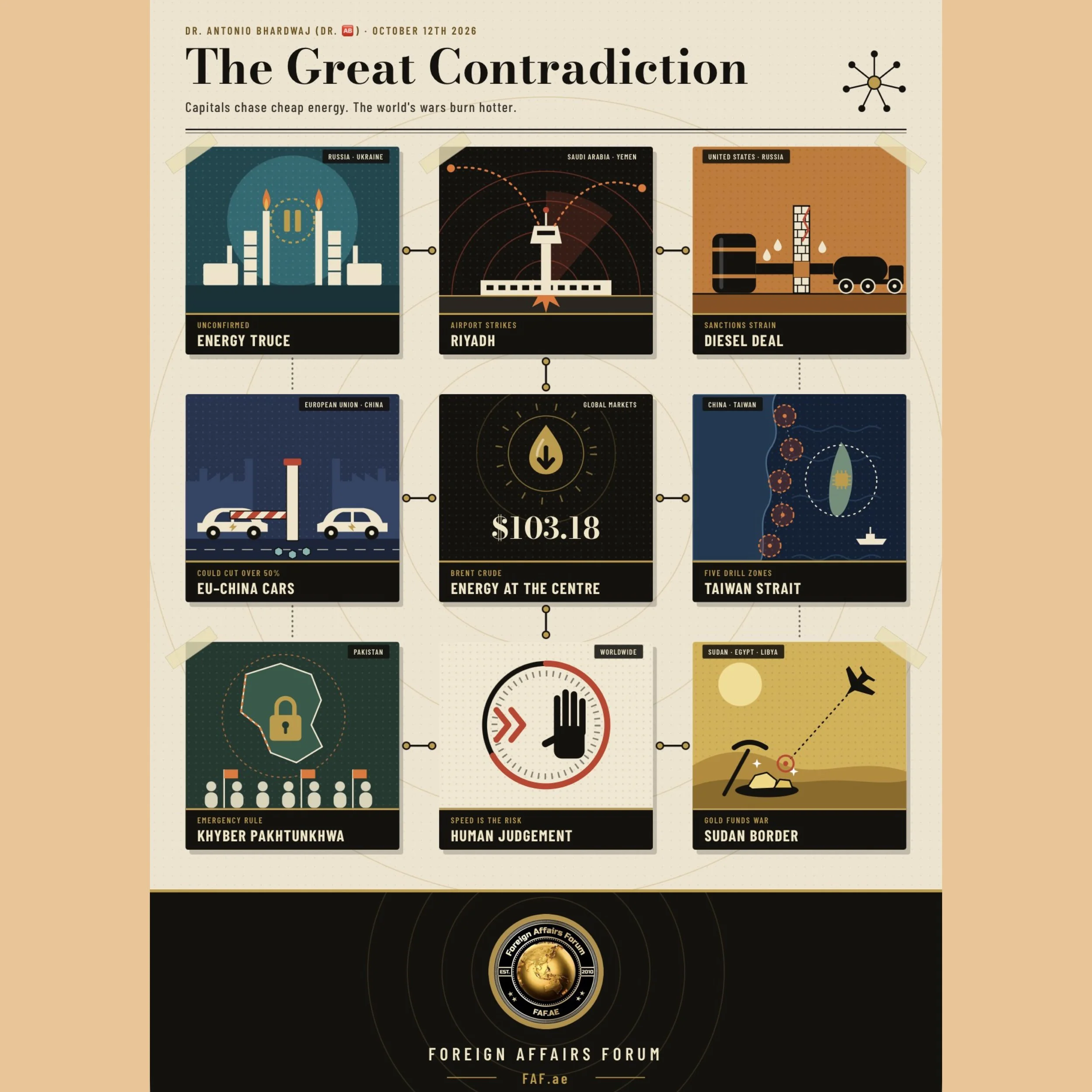
Between the 9th-12th of October, seven developments illustrated the pattern: deadly Houthi strikes on Riyadh's principal airport, an American announcement of a Russia–Ukraine energy ceasefire that neither belligerent has confirmed, a controversial diesel arrangement with Moscow, a preliminary European Union–China understanding on hybrid vehicles, Chinese live-fire exercises as Taipei warns against coercion, emergency rule in Pakistan's Khyber Pakhtunkhwa province, and an airstrike on a gold-mining area near the Sudan–Egypt border.
The central argument of this analysis is that energy security, industrial competitiveness and military deterrence can no longer be managed as separate policy domains.
A decision taken in one sphere now generates consequences in the other two. Washington's willingness to entertain Russian diesel exports to ease domestic fuel inflation, while condemning Russia's war, shows how economic pain can bend strategic doctrine. Brent crude fell to roughly $103.18 per barrel and West Texas Intermediate to about $90.31 on the morning of October 12, yet the Gulf remains volatile, and a single missile or tanker attack could reverse those gains.
Dr. Antonio Bhardwaj (Dr. 🆎), a specialist in human-centred superintelligence for geopolitical strategy, AI warfare and bioterrorism risk, offers a warning that frames this article.
Dr. 🆎 contends that the real danger is not any single crisis but the compression of decision time. Leaders now improvise under simultaneous pressure from markets, publics and adversaries, and that environment rewards announcements over verification.
The remainder of this article traces the historical roots of each crisis, examines the latest facts, analyses the causal chains linking them, and proposes practical steps for the months ahead.
Introduction: A World Negotiating With Itself
Strategic analysts often search for the single event that defines an era.
The present moment resists that habit. It is defined instead by the simultaneity of crises and by the uneasy coupling of diplomacy and violence. In the space of seventy-two hours, an American president announced a ceasefire that has not been confirmed by the parties it concerns, a Gulf monarchy buried the victims of an attack on its capital's airport, and a nuclear-armed South Asian state suspended an elected provincial government. Each event has its own logic. Together they describe a system under strain, in which the instruments of statecraft are being used faster than their effects can be understood.
Dr. Antonio Bhardwaj (Dr. 🆎), Chief Executive of the Foreign Affairs Forum and a polymath whose work spans human-centred superintelligence, geopolitical strategy, AI warfare and bioterrorism risk, has argued for some time that crises of this kind should be read as a network rather than a list. In his view, the analytical error most common in capitals and newsrooms alike is to treat each flashpoint as a self-contained story. The Houthi strikes on Riyadh are a Gulf security problem, the diesel agreement is an energy problem, the Taiwan exercises are a naval problem. Yet the causal threads connecting them are dense, running through oil prices, insurance costs, sanctions regimes, semiconductor supply chains and domestic political calculations.
This article adopts that network perspective. It begins with the historical background to each crisis, because current events cannot be understood without the longer arc that produced them. It then turns to the key developments of the past several days, followed by the latest facts and the concerns they raise. A cause-and-effect section traces how shocks propagate across the system, and the essay concludes with recommendations for policymakers and a reflection on what the present moment reveals about the international order. Throughout, the aim is to separate what has been confirmed from what has merely been asserted, a distinction that the current news cycle too often blurs.
The argument is organised around three propositions. First, energy has become the master variable of great-power behaviour, capable of overriding positions that governments previously described as matters of principle. Second, competition among major powers is increasingly industrial, fought through vehicles, minerals, refineries and chips as much as through armies. Third, regional instability, once treated as a local concern, now functions as a global financial variable that investors, insurers and treasuries must price in real time. Together, these propositions explain why a week of seemingly unrelated headlines carries a coherent strategic message.
History and Current Status: The Long Roots of a Crowded Crisis Landscape
The Yemeni conflict that now threatens Riyadh has deep antecedents. The Houthi movement, rooted in the northern highlands of Yemen, seized the capital Sanaa in 2014, and a Saudi-led coalition intervened in March 2015 to restore the internationally recognised government. What was expected to be a short campaign became a protracted war marked by humanitarian catastrophe, shifting alliances and periodic attempts at truce. Over the years the Houthis developed a sizeable arsenal of drones and missiles, with support from Iran-aligned networks, and demonstrated a capacity to strike Saudi territory and, later, commercial shipping in the Red Sea. The attacks on King Khalid International Airport therefore represent not a new kind of threat but a dramatic increase in its scale and its civilian consequences.
The war in Ukraine has an equally layered history. Russia's full-scale invasion in February 2022 prompted the most extensive sanctions programme ever imposed on a major economy, and Western governments built an architecture of price caps, export controls and financial restrictions designed to reduce Moscow's war revenue. Over time, the war evolved into a contest of infrastructure. Russia targeted Ukrainian electricity generation and heating networks, while Ukraine developed long-range drones capable of striking Russian refineries and export terminals. Energy facilities, once considered secondary to the battlefield, became central targets because they underpin both civilian endurance and state revenue. The ceasefire announced on October 11 must be read against this history of mutual infrastructure attrition.
The commercial dimension of great-power rivalry has grown just as steadily. China's emergence as the world's largest vehicle exporter, built on advanced battery supply chains and state-supported industrial policy, alarmed European policymakers who feared the erosion of their automotive base. Brussels responded in 2024 with tariffs on Chinese electric vehicles after investigating subsidies, and the dispute has since widened to include hybrids, rare earths and market access. The preliminary understanding reached in recent days is the latest stage of a negotiation that has oscillated between confrontation and accommodation for more than two years, reflecting Europe's difficulty in defending industry without severing a vital economic relationship.
The Taiwan question has an older and graver lineage. Since 1949, Beijing has treated the island as an inseparable part of China and has never renounced the use of force, while Washington has maintained a policy of strategic ambiguity combined with arms sales and unofficial ties. President Lai Ching-te took office in 2024 and has defended Taiwan's right to determine its own future, positions that Beijing consistently condemns as separatist. Chinese military exercises have become a recurring instrument of signalling, rising in scale after significant political events. The latest drills, scheduled across five coastal zones, follow Lai's National Day address and fit this established pattern of calibrated coercion.
Pakistan's political turbulence likewise has a recognisable history. Imran Khan, removed as Prime Minister in 2022 through a parliamentary vote of no confidence, has been imprisoned since 2023 and faces a continuing legal contest with the establishment. His Pakistan Tehreek-e-Insaf party retains strong support in Khyber Pakhtunkhwa, the province bordering Afghanistan, where militant violence has risen sharply since the Taliban's return to power in Kabul in 2021. The province thus sits at the intersection of two crises, a political confrontation between the federal government and a popular opposition, and a security challenge along one of the world's most contested frontiers.
Sudan's war, which began in April 2023 as a struggle between the national army and the Rapid Support Forces, completes the picture. Gold has become one of the conflict's most important financial lifelines, extracted from artisanal sites and smuggled through porous borders to regional and international markets. The strike on a mining area near the frontier with Egypt and Libya is thus not a peripheral incident but an expression of the war's underlying economy. In every case examined here, history shows that today's headlines are the visible surface of long-running structural pressures that have been mismanaged, deferred or simply left unresolved.
Dr. 🆎 observes that this accumulation of unresolved histories is itself a strategic condition. When many slow-burning crises mature at once, the institutions designed to manage them, from the United Nations Security Council to regional organisations and central banks, face a bandwidth problem. There is only so much diplomatic attention available, and the allocation of that attention has become a form of geopolitical choice.
Key Developments: Seven Events That Defined the Week
The most urgent development is the escalation in Saudi Arabia.
On October 10th, Houthi strikes hit King Khalid International Airport in Riyadh, killing at least thirteen people and wounding more than three hundred, according to subsequent reporting. A second attack on the airport followed on October 11th.
The Houthis claimed responsibility, and Saudi Arabia intensified operations against Houthi positions in Yemen. President Donald Trump indicated that Washington was considering joining those operations. The significance lies in the target. Civilian aviation infrastructure in the capital is a symbol of state capacity and a node in global commerce, and its disruption carries consequences well beyond the casualty toll.
The second development is diplomatic and deeply ambiguous.
On October 11th, President Trump announced that Russia and Ukraine had agreed to an immediate ceasefire covering attacks on energy infrastructure. President Volodymyr Zelenskyy responded that he was awaiting details, while Moscow had not publicly confirmed any agreement. Ukraine signalled that it would consider halting strikes on Russian energy facilities if Russia reciprocated.
The distinction between an announcement and an agreement is essential. A ceasefire exists only when both parties acknowledge its terms and when its observance can be independently verified, and neither condition has yet been met.
The third development is the diesel arrangement.
The Trump administration announced that Russia would release substantial diesel supplies into American and international markets, with an initial commitment of more than three hundred thousand metric tons, followed by five hundred thousand tons in November and potentially larger deliveries thereafter. The purpose is to ease a global diesel shortage associated with the Middle Eastern energy crisis. The announcement drew bipartisan criticism in Washington, with a group of senators arguing that it undermines sanctions meant to restrict Russia's war financing. The episode reveals how acute fuel inflation can force a reordering of priorities that officials had previously treated as fixed.
The fourth development concerns trade.
The European Union and China reached a preliminary understanding to curb Chinese hybrid and plug-in hybrid exports to Europe.
Trade Commissioner Maroš Šefčovič said the arrangement could reduce those exports by more than 50%. The understanding also contemplates improved European access to Chinese markets and measures to ease restrictions on rare-earth exports. Yet implementation details remain unresolved, and the agreement requires further European approval. It is best understood as a framework for managed rivalry, in which both sides accept limits on the other's advantages in exchange for predictability.
The fifth development is the announcement of Chinese live-fire exercises across five coastal areas, stretching from the South China Sea towards China's northeastern coastline.
Taiwan's Defence Minister Wellington Koo said Taipei was monitoring the activity closely. Importantly, the exercises are not taking place directly around Taiwan, and the closest zone lies off Zhejiang province. They follow President Lai's National Day speech, which Beijing criticised while reiterating its opposition to Taiwanese independence. The drills should be read as signalling rather than preparation for imminent action, though signalling of this kind has cumulative effects on the regional security environment.
The sixth development is political and domestic, with regional implications.
Pakistan declared emergency rule in Khyber Pakhtunkhwa, with President Asif Ali Zardari authorising the step following a federal government decision. The provincial government has been suspended, and a governor will assume administrative control for an initial six-month period. Islamabad cites rising militant attacks, while Imran Khan's party rejects that explanation and calls the intervention politically motivated. Security forces have reportedly detained opposition activists ahead of planned protests. A country of more than two hundred and fifty million people, armed with nuclear weapons, is thus managing a constitutional confrontation and an insurgency simultaneously.
The seventh development, geographically distant from the others, is the airstrike on an artisanal gold-mining area near the contested border region involving Sudan, Egypt and Libya.
At least thirteen miners were killed and twenty-eight wounded, according to the Sudan Doctors Network. The identity of the aircraft and the party responsible remains unconfirmed. The strike illustrates how gold revenues finance armed groups, including the Rapid Support Forces, and how resource extraction has become inseparable from the conduct of the war. Of the seven events, this is the least visible in global media and arguably the most revealing of how modern conflicts are sustained.
Dr. 🆎 draws a connecting lesson from these seven developments. In his assessment, each represents a different mechanism by which a vulnerable system is stressed, whether through infrastructure attacks, sanctions erosion, trade bargaining, military signalling, political suspension or resource predation. The strategic task is not to rank them by drama but to understand how they reinforce one another, because the points at which they intersect are where cascading failures become possible.
Latest Facts and Concerns: Separating Confirmation From Assertion
The first concern is verification.
The Russia–Ukraine energy ceasefire is the clearest example of a development whose reality is contested. President Trump has announced it, Ukraine has said it awaits details and offered conditional reciprocity, and Moscow has not publicly confirmed. Analysts should therefore treat the arrangement as a proposal with uncertain acceptance. The decisive indicators will be formal statements from both governments and independently observable reductions in strikes on refineries, power stations and heating networks. In an information environment saturated with claims, the discipline of waiting for confirmation is itself a strategic virtue.
The second concern is the market reaction.
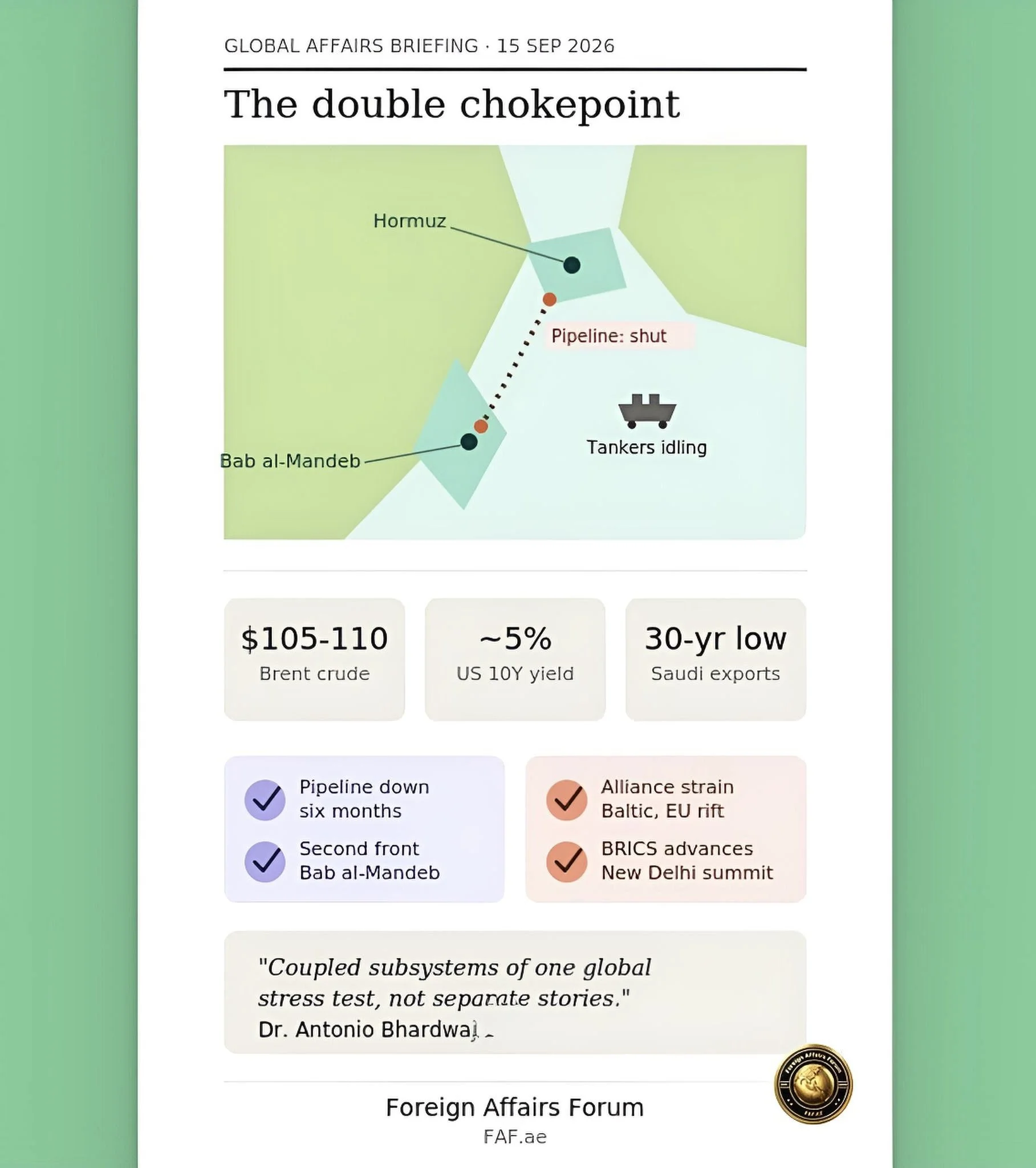
According to Reuters, Brent crude declined to approximately $103.18 per barrel at 01:54 GMT on October 12, while United States West Texas Intermediate fell to approximately $90.31. The decline followed expectations of increased Russian diesel supply and the announcement of a possible energy ceasefire. Yet prices remain elevated by any historical standard, and further tanker attacks have been reported around the Strait of Hormuz. The market is therefore pricing hope rather than fact, and hope is a fragile foundation for an asset class as sensitive to physical disruption as oil.
The third concern is the durability of Western sanctions unity.
The diesel arrangement, even if modest in its initial volumes, sends a signal about American priorities. Bipartisan criticism in the Senate indicates that the policy lacks consensus even within Washington, and European governments, which have borne considerable costs to reduce their own dependence on Russian energy, may draw uncomfortable conclusions. The question is not whether three hundred thousand metric tons will materially change global diesel prices, but whether the precedent invites further exceptions. Sanctions regimes derive their power from credibility, and credibility erodes through perceived inconsistency.
The fourth concern is the risk of American entanglement in the Gulf.
President Trump's indication that Washington is considering joining Saudi operations against the Houthis raises the possibility of a wider confrontation involving Iran-aligned forces. For Washington, the dilemma is familiar. Protecting a Gulf partner after attacks on its capital carries strong political and strategic logic, but an open-ended campaign in Yemen risks repeating the pattern of prolonged engagement that American leaders have repeatedly said they wish to avoid. The critical question is whether Saudi retaliation restores deterrence or provokes further Houthi attacks on energy infrastructure, including Red Sea export routes and petroleum facilities.
The fifth concern relates to Taiwan and the semiconductor supply chain.
The exercises are not an invasion rehearsal in the immediate sense, but Taiwan's centrality to advanced chip production means that even the perception of heightened risk has economic weight. Any future blockade would threaten maritime transport and the supply of the semiconductors on which artificial intelligence infrastructure and global technology companies depend.
Dr. 🆎 emphasises that this dependency is also a vulnerability in the AI competition itself, since the compute capacity on which advanced systems rely is concentrated in a small number of facilities exposed to geographic and political risk.
The sixth concern is the trajectory of Pakistan's political crisis.
Emergency rule, the suspension of an elected provincial government and the detention of activists create conditions in which political grievance and militant violence may feed one another. China's infrastructure interests in Pakistan and Washington's concern about militancy mean that external powers have stakes in the outcome. For investors, the emergency raises questions about sovereign risk, foreign investment and the continuation of economic reforms. The central question is whether emergency rule improves security or deepens the confrontation between the federal government and its opponents.
The seventh concern, often neglected, is the financing of conflict through commodities.
The Sudanese strike demonstrates that resource flows, particularly gold, connect local violence to international commercial and financial systems. Companies operating in fragile jurisdictions face compliance and reputational risks, and legitimate mining and cross-border trade suffer when insecurity spreads. The broader lesson is that sanctions, due diligence and traceability regimes for minerals are instruments of conflict management as important as any diplomatic initiative.
Cause and Effect: How Shocks Travel Through a Connected System
The most instructive way to understand the week is to trace the chains of causation that run through it.
The first chain begins in the Gulf.
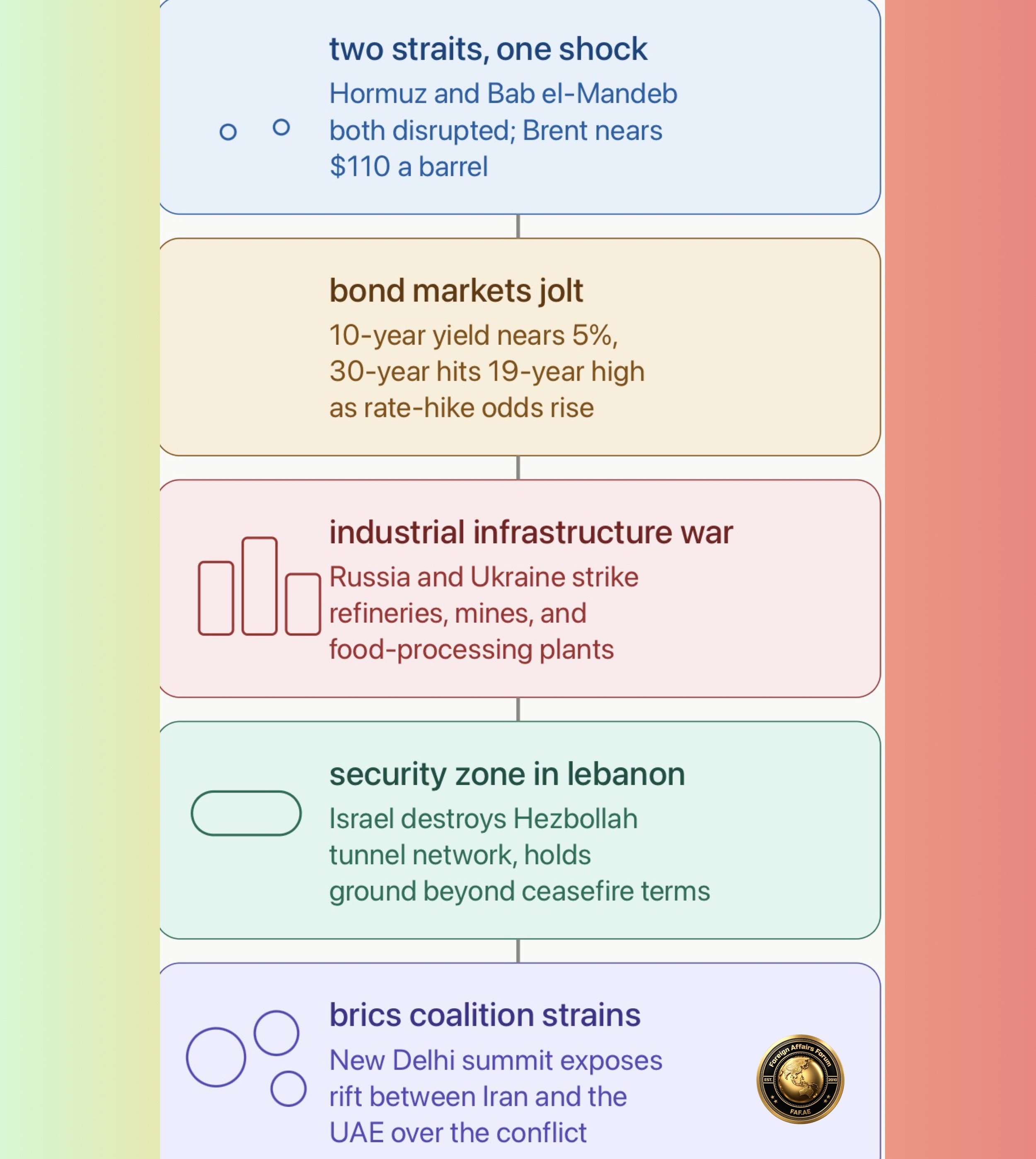
Houthi attacks on Riyadh raise the probability of a wider regional war, which raises the risk premium on oil, which in turn intensifies the energy inflation that policymakers are struggling to contain. That inflation pressures Washington to seek additional supply, including from Russia, which brings the diesel arrangement into being. The diesel arrangement then weakens the perceived coherence of sanctions, which may encourage Moscow to believe that economic leverage can be converted into political concessions. A missile strike on an airport in Riyadh thus becomes, several steps later, a factor in the sanctions debate over Russia.
The second chain runs through Ukraine and energy infrastructure.
Ukrainian drone strikes on Russian refineries reduce Russian refined-product output, tightening the global diesel market. Russian strikes on Ukrainian power and heating networks deepen civilian hardship and increase Kyiv's dependence on Western support. A genuine reciprocal ceasefire would ease both pressures, lowering diesel prices and relieving Ukrainian civilians, but it would also remove a lever that Kyiv has used to impose costs on Russia. This explains Ukraine's conditional posture and Russia's silence. Each side calculates whether the benefits of restraint outweigh the loss of a tool, and the announcement by a third party does not alter that calculation.
The third chain concerns industrial policy.
The EU–China understanding on hybrid vehicles is a response to the structural advantage that Chinese manufacturers have built in batteries and electrified drivetrains. By limiting exports, Europe seeks to protect employment and technological capacity. By easing rare-earth restrictions, China signals that its control over critical minerals can be used as either a weapon or a concession. The effects are double-edged. European manufacturers may gain breathing room, yet higher prices and more complex supply chains could burden consumers and slow the transition to cleaner transport. Negotiated protection replaces open competition, and the costs of that substitution are distributed unevenly.
The fourth chain links military signalling to economic expectation.
Chinese live-fire drills, even when distant from Taiwan, raise the perceived probability of future crises. Markets respond by pricing in a higher risk premium for technology supply chains, while governments respond with defence spending and diplomatic coordination. Taipei's monitoring of the exercises and Washington's continuing support for Taiwan's defence are part of a signalling loop in which each side's precautions are read by the other as evidence of hostile intent. This is the classic security dilemma, now operating in a world where the economic stakes of misjudgement are far larger than in any previous era.
The fifth chain is the interplay between domestic politics and regional security.
In Pakistan, the federal government's justification for emergency rule rests on militant violence, while its opponents argue that the measure serves partisan ends. If emergency rule inflames political grievance, it may weaken the social foundations of counterinsurgency by alienating the population in the province most affected. Conversely, if militancy escalates, the emergency may be vindicated in the eyes of the public. Either outcome carries consequences for Afghanistan's border, for Chinese investment and for the broader stability of a nuclear-armed state, which explains why external observers watch closely.
The sixth chain emerges from the Sudanese strike.
Gold revenue sustains armed groups, which prolongs the conflict, which generates humanitarian crisis and cross-border insecurity, which in turn complicates legitimate trade and invites interference by neighbours. Because the identity of the attacker remains unknown, the risk of misattribution and retaliation is elevated. In such environments, a single unattributed strike can escalate tensions among states that have no wish for confrontation. The effect is a reminder that resource conflicts have a regional multiplier, and that opacity is itself an accelerant.
Dr. 🆎 draws attention to a deeper causal layer that cuts across all six chains, namely the role of artificial intelligence in shaping decision environments. Algorithmic trading reacts to headlines within milliseconds, so an unverified announcement can move oil prices before diplomats have confirmed its content. Surveillance and targeting systems compress the interval between detection and strike. Synthetic media and automated influence campaigns can distort public perception of events such as the Riyadh attacks or the Ukrainian ceasefire. In this respect, human-centred design of intelligent systems is not an abstract ethical preference but a practical requirement of crisis stability, because systems that amplify speed without preserving human judgement will tend to convert misunderstandings into escalations.
The same logic extends to the biological domain that Dr. 🆎 has long studied. In an environment of fractured trust and overstretched institutions, the capacity of states to detect and respond to unconventional threats, including engineered pathogens, is diminished by distraction and mutual suspicion. Crises in the Gulf, South Asia and Africa degrade public health infrastructure and intelligence cooperation at the very moment when advances in biotechnology are lowering barriers to misuse. The causal relationship is indirect but real. Every conflict that draws diplomatic attention and resources away from preventive cooperation raises the expected cost of an eventual surprise.
Future Steps: Priorities for a Prudent Strategy
The first priority is to insist on verification before celebration.
Washington should work with Kyiv and Moscow to convert the announced energy ceasefire into a documented arrangement, with clear definitions of covered facilities, a mechanism for monitoring compliance and a procedure for resolving alleged violations. Independent observation, whether through satellite imagery, third-party monitors or technical channels between energy ministries, would give the arrangement a chance to survive its first incident. If either side declines to confirm, Washington should state so plainly rather than allowing a premature announcement to shape market expectations and diplomatic commitments.
The second priority is to reconcile energy policy with sanctions policy.
If the United States judges that additional Russian diesel is necessary to prevent a damaging fuel shortage, the arrangement should be time-limited, transparent in its volumes and linked to demonstrable progress on the ceasefire. Congress and allied governments should be consulted before implementation, and parallel measures should be taken to expand alternative supply, release strategic reserves where appropriate and accelerate efficiency. Dr. 🆎 argues that crisis improvisation is acceptable only when its logic is communicated clearly and its exit conditions are defined in advance, since ambiguity invites both adversarial exploitation and allied distrust.
The third priority is to prevent the Yemen conflict from becoming a regional war.
Saudi Arabia has a legitimate right to defend its territory and civilians, and the United States has a legitimate interest in supporting a partner under attack. Yet military support should be paired with a diplomatic track that offers the Houthis and their backers a path to de-escalation, with particular emphasis on the protection of civilian aviation and energy infrastructure. Gulf states, Oman and other intermediaries have previously facilitated truces, and those channels should be revived. Deterrence and diplomacy are complementary instruments, and neglecting either increases the likelihood of a prolonged confrontation.
The fourth priority is to secure the maritime and energy arteries on which the global economy depends.
Reports of tanker attacks around Hormuz and the vulnerability of Red Sea routes call for coordinated naval protection, enhanced insurance mechanisms and contingency planning among importing countries. For emerging economies that are major energy importers, the interaction between oil prices, dollar strength and sovereign borrowing costs requires particular attention from international financial institutions. Concessional facilities and swap lines could prevent a commodity shock from becoming a debt crisis, and such measures are far cheaper than the political and humanitarian costs of financial collapse.
The fifth priority is to manage the Taiwan Strait with discipline.
Washington, Taipei and regional partners should avoid responses that convert routine exercises into crises, while maintaining the capabilities and consultations that sustain deterrence. Military-to-military communication channels between the United States and China should be preserved and used, especially during periods of heightened signalling. Governments should also reduce the concentration of advanced semiconductor manufacturing in a single geography, through diversified investment in fabrication capacity and in resilient supply chains. Dr. 🆎 stresses that AI-enabled early warning and decision-support tools can help here, provided they are designed to inform human judgement rather than to replace it.
The sixth priority is to encourage political de-escalation in Pakistan.
International partners should urge the federal government to define the scope and duration of emergency rule clearly, to respect legal safeguards, and to open channels of dialogue with opposition leaders. Counter-militancy cooperation along the Afghan border should continue, but it must be separated from partisan contests, since a counterinsurgency that appears political forfeits public support. China and the United States, despite their rivalry, share an interest in Pakistani stability, and quiet coordination on this narrow question would be a rare example of constructive great-power behaviour.
The seventh priority is to strengthen traceability and accountability in conflict commodities.
Sudan's gold economy demands tighter oversight of export routes, financial flows and corporate due diligence, supported by regional and international cooperation. Credible investigation of the recent strike, including attribution of responsibility, would reduce the risk of retaliation based on misinformation. More broadly, mineral supply chains should be integrated into conflict-prevention strategy, because cutting off the financing of armed groups is often more achievable than defeating them militarily.
Finally, governments and institutions should invest in the human and technical capacity to govern the intelligent systems now shaping crisis behaviour.
Dr. 🆎 recommends that states adopt explicit protocols for the use of AI in military and financial decision loops, including requirements for human authorisation of escalatory actions, auditing of algorithmic behaviour and international dialogue on norms for AI warfare. Equally, investment in biosecurity, including surveillance, rapid response and screening of dual-use research, should be treated as a core element of national security rather than a peripheral health concern. Strategy for the coming decade, in this view, must be as attentive to the speed and opacity of technology as to the movement of armies.
Conclusion: The Price of Treating Interdependence as Optional
The events of October ninth to twelfth, 2026 offer a compressed lesson in the nature of the present international system.
Governments are discovering, often painfully, that energy security, industrial competitiveness and military deterrence cannot be managed independently. A policy designed to reduce fuel prices unsettles a sanctions regime. A trade agreement intended to protect European industry depends on Chinese cooperation over rare earths. Military signalling in one sea reverberates through semiconductor markets. A domestic emergency in a South Asian province touches the interests of several great powers. The system is dense with connections, and ignoring those connections does not remove them.
The contradiction identified at the outset, between efforts to stabilise markets and the escalation of conflicts, is therefore not accidental. It reflects the fact that the same underlying pressures drive both. Scarcity, rivalry and distrust push leaders towards improvised bargains, even as they strengthen the incentives for armed confrontation.
The temptation is to accept announcements as achievements and to treat each de-escalatory gesture as a turning point. The evidence of the past several days suggests a more cautious reading. Gestures that are unconfirmed, partial or reversible deserve engagement, but they do not yet constitute a change in the strategic situation.
Dr. 🆎 offers a concluding thought that is both sober and constructive. The central challenge of this era, in his judgement, is to preserve human agency in an environment that increasingly rewards speed, automation and spectacle.
Wars, markets and political crises are all, in the end, products of human decisions, and those decisions can be made wiser through better information, better institutions and deliberate restraint. The task for leaders is not to eliminate uncertainty, which is impossible, but to ensure that uncertainty does not harden into catastrophe. That requires verification before celebration, consistency between policy domains, and a willingness to invest in the unglamorous machinery of cooperation.
The next several weeks will test these propositions. Whether Moscow and Kyiv confirm an energy truce, whether Riyadh and Washington find a measured response to the Houthi attacks, whether Brussels secures approval for its understanding with Beijing, and whether Islamabad's emergency eases or inflames its crisis will each shape the trajectory of the coming year.
The deeper question is whether the major stakeholders can build habits of coordination before the next shock arrives. If they cannot, the contradiction described in this essay will widen, and the cost of managing it will be paid by populations far from the capitals where decisions are made.