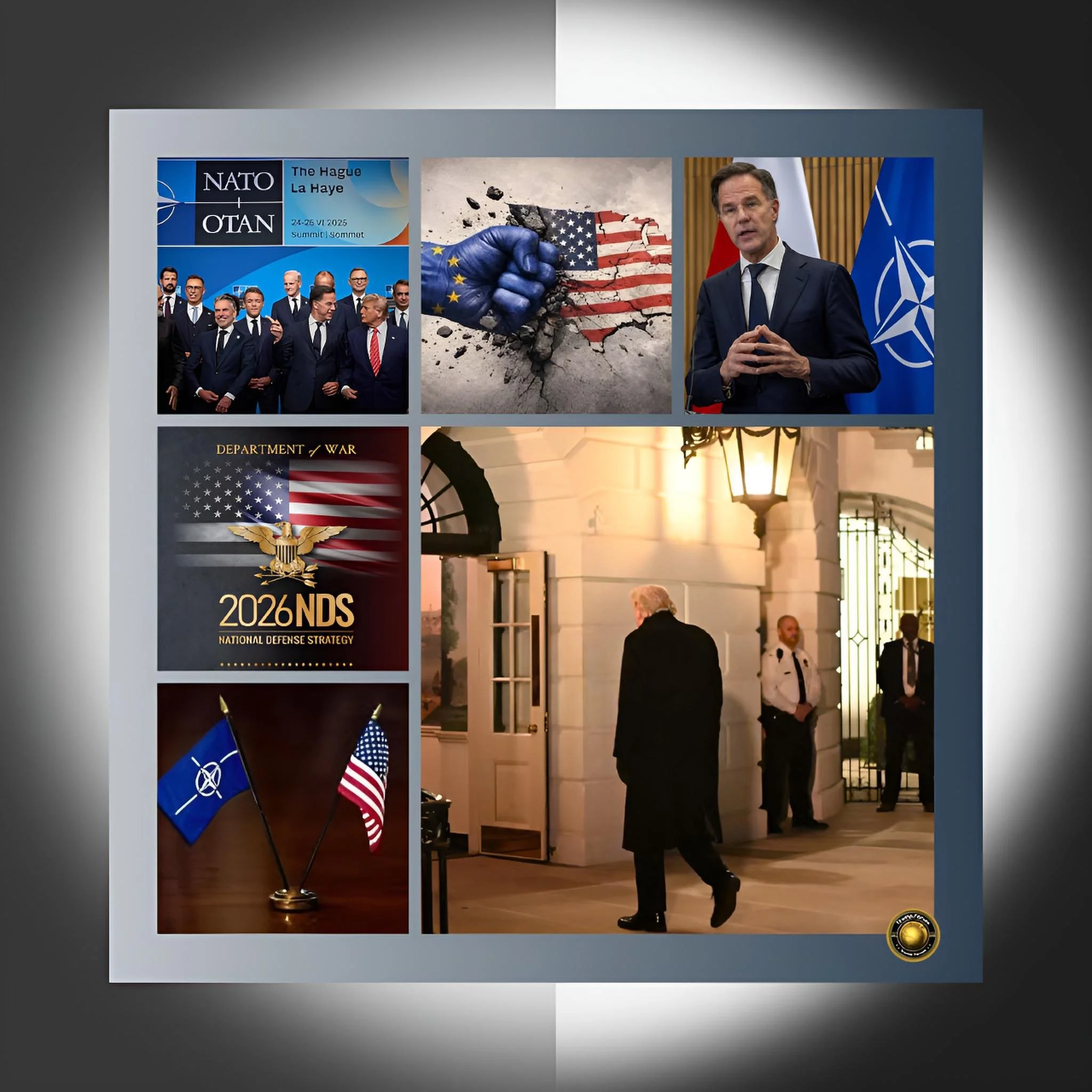
Pentagon Recalibrates American Military Strategy: A Comprehensive Analysis of the 2026 National Defense Strategy
EXECUTIVE SUMMARY
A Fundamental Restructuring of Global Commitments and Domestic Priorities
The Pentagon's 2026 National Defense Strategy, released on January 23, 2026, represents a paradigmatic shift in post-Cold War American military policy. This 34-page document establishes a four-tier priority framework that elevates homeland defense to the paramount position while relegating long-standing global commitments to secondary status.
The strategy explicitly diminishes China's threat classification, abandons the concept of integrated deterrence in favor of deterrence by denial, and introduces the "Trump Corollary to the Monroe Doctrine" as a governing principle for Western Hemisphere operations. Most significantly, the document signals a fundamental departure from the rules-based international order framework that has undergirded American foreign policy since 1945.
FAF analysis examines the strategic architecture of this redefined defense posture, contextualizes it within historical precedent, evaluates its implications for allied security arrangements, and explores the geopolitical consequences of this recalibration.
INTRODUCTION
The National Defense Strategy serves as the foundational doctrinal document that guides American military planning, force structure allocation, defense industrial investment, and operational priorities for an entire presidential administration. Issued quadrennially since 2005 as a congressionally mandated requirement, this strategy document creates the intellectual framework through which the Department of Defense translates presidential policy directives into concrete military capabilities, force deployments, and budgetary allocations.
The 2026 iteration departs substantially from both its immediate predecessor—the Biden administration's 2022 strategy—and from the foundational assumptions that have guided American security policy across both Republican and Democratic administrations for the past four decades.
The significance of this strategic reorientation extends far beyond Washington's policy circles. Allied governments, strategic competitors, and regional actors are parsing the document's language to assess the credibility of American security commitments, the sustainability of longstanding alliances, and the probability of American military intervention in various geopolitical scenarios.
Taiwan's immediate announcement of a defense spending increase to three percent of GDP by 2026 and five percent by decade's end reflects the acute alarm with which America's allies are interpreting the strategic signal contained within this document.
Similarly, European capitals are grappling with the implications of language characterizing Russia as a "persistent but manageable" threat and asserting that NATO allies are "strongly positioned to take primary responsibility for Europe's conventional defense."
HISTORICAL CONTEXT AND EVOLUTION OF AMERICAN DEFENSE STRATEGY
To appreciate the magnitude of the strategic shift embodied in the 2026 National Defense Strategy, one must first understand the doctrinal trajectory that preceded it.
The post-Cold War American defense establishment operated from several core axioms: first, that the United States bore primary responsibility for maintaining a favorable global balance of power; second, that the rules-based international order created after 1945 constituted the essential architecture for American prosperity and security; and third, that American military presence and security guarantees to allies served simultaneously to advance both American interests and broader international stability.
The 2018 National Defense Strategy, released during the first Trump administration, began to challenge this consensus by identifying China as a great power competitor and Russia as a strategic threat—a departure from the then-prevailing focus on counterterrorism and counterinsurgency. However, the 2018 strategy maintained the conceptual framework of an active American engagement model, assuming that the United States would compete globally while maintaining its traditional alliance structure, albeit with renewed emphasis on burden-sharing.
The Biden administration's 2022 National Defense Strategy represented continuity with post-Cold War orthodoxy while adding contemporary concerns. That document explicitly named China as "the most consequential challenge to U.S. security," characterized Russia as presenting an "acute threat," elevated climate change to the status of a strategic security challenge, and committed to supporting Taiwan's "asymmetric self-defense" capabilities. The 2022 strategy emphasized "integrated deterrence"—the concept that American security required coordinated diplomatic, economic, military, and intelligence operations in close collaboration with allied partners.
This represented the apotheosis of the rules-based international order approach, positioning American power as embedded within and dependent upon a network of alliances and international institutions.
STRATEGIC ARCHITECTURE: THE FOUR PILLARS OF THE 2026 APPROACH
The 2026 National Defense Strategy reorganizes American military priorities into four explicit lines of effort, presented in hierarchical order. First, and elevated to unprecedented prominence, stands the defense of the American homeland. Second, deterrence of China in the Indo-Pacific region, explicitly framed as occurring "through strength, not confrontation." Third, increased burden-sharing with allied partners. Fourth, the revitalization of the American defense industrial base. This ordering itself constitutes a significant doctrinal statement: homeland defense now supersedes global power projection and alliance management.
The emphasis on homeland defense encompasses several distinct operational domains. The strategy commits the military to "seal our borders" and "repel forms of invasion"—language that casts immigration control as a military matter rather than a law enforcement function. This represents a transformative conceptual shift in which the southern border becomes designated as an active combat theater, meriting military resources and operational attention equivalent to overseas deployments. The document further commits to developing the "Golden Dome" missile defense system for North America, protecting American airspace against drone and missile threats. Nuclear deterrence receives continued emphasis, and cybersecurity and space defense are positioned as integral to homeland protection.
The second priority, deterrence of China, represents a remarkable downgrade from China's status in the previous National Defense Strategy. Where the 2022 document identified China as "the most consequential challenge," the 2026 version specifies that American policy will "prevent anyone, including China, from being able to dominate us or our allies" while simultaneously declaring that the American objective is "not to dominate China; nor is it to strangle or humiliate them." The strategy advocates establishing "a balance of power in the Indo-Pacific that allows all of us to enjoy a decent peace"—language that suggests an acceptance of Chinese regional influence as inevitable and legitimate, provided it remains counterbalanced by American-led coalition strength.
Operationally, the strategy commits to "erecting a strong denial defense along the First Island Chain" and urging regional allies to "do more for our collective defense." Notably, the strategy contains no explicit mention of Taiwan, the island whose military status constitutes the most probable flashpoint for great power conflict in the Indo-Pacific. The Biden administration's 2022 strategy had committed to supporting Taiwan's asymmetric self-defense; the 2026 document remains strategically silent on this issue. The strategy further emphasizes expanded military-to-military communication with China, positioning diplomatic engagement and crisis communication channels as central to preventing escalation.
The Third priority—increased burden-sharing with allied partners—redeploys American military commitment from a guarantor model to a co-contributor model. This shift carries substantial implications for the European security architecture. The strategy asserts that NATO allies, collectively, possess significantly greater military capability than Russia and are "strongly positioned to take primary responsibility for Europe's conventional defense, with critical but more limited U.S. support." This language effectively tells European allies that they must assume primary responsibility for countering Russian threats, with American support repositioned to a supplemental role. The document further states that "Europe's responsibility first and foremost" includes managing the Russian invasion of Ukraine—implying that sustained American military and financial assistance to Ukraine cannot be assumed indefinitely.
Similarly, the strategy positions South Korea as "capable of taking primary responsibility for deterring North Korea" with American support characterized as "critical but more limited." This recalibration effectively signals that American force posture on the Korean Peninsula will be adjusted downward, with South Korea expected to shoulder greater responsibility for its own conventional defense.
THE WESTERN HEMISPHERE REORIENTATION: THE TRUMP COROLLARY TO THE MONROE DOCTRINE
The 2026 strategy introduces a conceptual framework termed the "Trump Corollary to the Monroe Doctrine," establishing the Western Hemisphere as the primary arena for American military operations and strategic focus. This represents a geographical and conceptual reorientation of American military power toward the American continents after seventy years of forward-deployed global presence.
The Monroe Doctrine, articulated in 1823, asserted that the American continents were off-limits to further European colonization and that the United States would regard European intervention in the Americas as a threat to American peace and safety. It functioned as an assertion of regional hegemony, positioning the United States as the dominant power within the Western Hemisphere. The 2026 strategy explicitly resurrects this concept, renamed as the Trump Corollary, and applies it to contemporary geopolitical circumstances. The doctrine now focuses on denying non-hemispheric competitors—explicitly including China—the ability to establish military presence or control strategic assets within the Americas.
Operationally, this means the Pentagon will "restore American military dominance in the Western Hemisphere" and "guarantee U.S. military and commercial access to key terrain, especially the Panama Canal, Gulf of America, and Greenland." The strategy mentions Greenland five times in its unclassified version, designating this Danish-governed territory as essential to American strategic interests. The document authorizes American military operations against narco-terrorist organizations across the hemispheric region, providing "President Trump with credible military options to use against narco-terrorists wherever they may be."
The strategic focus on the Western Hemisphere reflects several converging factors. The Trump administration's political emphasis on southern border security has been translated into military doctrine. Additionally, the administration has identified drug trafficking organizations as strategic threats equivalent to state actors. Most fundamentally, the strategy positions the Americas not as a region of secondary interest but as the core battleground for American military strategy, with global commitments recalibrated downward to support hemispheric priorities.
THE DEPARTURE FROM INTEGRATED DETERRENCE AND THE RULES-BASED INTERNATIONAL ORDER
Perhaps the most consequential intellectual departure in the 2026 strategy concerns the abandonment of "integrated deterrence," the concept that had become central to Biden-era defense planning. Integrated deterrence posited that American security depended upon coordinated action across diplomatic, economic, military, intelligence, and alliance domains. It assumed that deterrence required maintaining robust alliances, strengthening international institutions, and embedding American military power within a network of partnerships.
The 2026 strategy replaces integrated deterrence with a framework emphasizing "deterrence by denial," a concept that American security depends upon possessing the military capacity to prevent hostile actors from achieving their objectives through force. This is not inherently incompatible with alliances, but it shifts the intellectual center of gravity. Deterrence by denial is inherently more unilateral, focusing on what the American military can accomplish independently rather than what can be achieved through collaborative arrangements.
Former Trump administration State Department official Christian Whiton has characterized the 2026 strategy as marking "a fundamental shift away from the rules-based international order." This assessment captures a deeper conceptual recalibration. The rules-based international order framework assumed that American power should operate within the constraints of international law, multilateral institutions, and alliance agreements. The 2026 strategy positions American interests, narrowly defined, as the paramount consideration. The document's language—emphasizing that the Pentagon will "stand ready to take focused, decisive action that concretely advances U.S. interests" when hemispheric neighbors fail to defend shared interests—signals a willingness to act unilaterally when American definitions of national interest override multilateral constraints.
IMPLICATIONS FOR ALLIED SECURITY ARCHITECTURES
The strategic recalibration outlined in the 2026 National Defense Strategy carries profound implications for America's traditional allied partnerships, particularly in Europe and the Indo-Pacific. The signal being transmitted to these allies is fundamentally ambiguous: the United States remains committed to "critical but more limited" support, but the parameters of what constitutes critical support remain undefined.
European allies are confronting an explicit statement that they must assume "primary responsibility for Europe's conventional defense," a dramatic departure from the post-1945 model in which American military presence served as the ultimate guarantee against hostile hegemonic consolidation in Europe. The strategy's characterization of Russia as a "persistent but manageable" threat—a significant downgrade from the Biden administration's "acute threat" framing—suggests that the American threat perception regarding Russian military power has fundamentally changed. European nations must now contend with the possibility that sustained American support for Ukraine cannot be assumed, that American troops in NATO countries may be withdrawn or redeployed, and that American military and financial resources will be redirected toward the Western Hemisphere and Indo-Pacific.
Taiwanese policymakers have interpreted the strategic silence regarding Taiwan as an ominous signal. The conspicuous absence of any explicit commitment to supporting Taiwan's defense, combined with the softer rhetoric toward China, has prompted Taiwan to announce a major autonomous defense buildup. Taiwan's declaration that it will increase military spending to three percent of GDP by 2026 and five percent by decade's end reflects the island's reassessment that American security guarantees cannot be relied upon to the degree previously assumed. Taiwan is effectively shifting to an "independent defense" posture, developing what analysts characterize as "porcupine" defense systems—mobile anti-ship missiles, distributed air defense networks, and mine-laying capabilities designed to make any invasion attempt extraordinarily costly, regardless of the level of American support.
Similarly, South Korea must now operate under the assumption that American military support, while continuing, will be less generous and less immediate than during previous administrations. The strategy's assertion that South Korea is "capable of taking primary responsibility for deterring North Korea" essentially signals that American force posture on the peninsula will be adjusted downward and that Seoul must assume greater responsibility for its own defense.
Japan faces an analogous situation. While the strategy commits to maintaining a "strong denial defense along the First Island Chain," the emphasis falls on encouraging Japan and other regional allies to "do more for our collective defense." Japan, already increasing its defense spending and developing offensive military capabilities, will likely accelerate this trajectory as it reassesses American reliability.
STRATEGIC VULNERABILITIES AND ANALYTICAL CRITIQUES
Strategic analyses published in the days following the document's release have identified several potential vulnerabilities in the approach outlined by the 2026 National Defense Strategy. The most significant concern focuses on the coherence between stated priorities and likely resource allocation. If the Pentagon genuinely prioritizes homeland defense over global commitments, such prioritization should manifest in demonstrable force reductions overseas and resource reallocation toward domestic defense. However, the strategy provides minimal detail regarding how such reallocation will occur or what force structures will be maintained in each theater.
A second vulnerability concerns the feasibility of the Golden Dome missile defense system, which the strategy positions as central to homeland air defense. Technical experts have questioned whether the system's design—aiming to intercept missiles during launch phase rather than mid-course phase—is technologically feasible with current or near-term technology. The program's underfunding relative to its technical ambitions further raises questions about its viability.
A third concern focuses on the transactional framing of alliance relationships. By positioning allies as burden-sharers who must meet specific spending targets and defense responsibilities, the strategy risks corroding the legitimacy and mutual commitment that have characterized post-1945 American alliance relationships. These alliances were founded on shared values, common interests, and mutual security commitments, not on transactional calculations of who contributes how much. The strategy's emphasis on quantifiable burden-sharing may satisfy certain political constituencies but risks hollowing out the deeper alliance relationships that give American security guarantees credibility.
A fourth critique concerns the abandonment of the integrated deterrence framework without clearly articulating what intellectual framework replaces it. The strategy asserts that deterrence by denial will prove effective but provides limited analysis of how military overmatch in specific regions can be maintained while simultaneously reducing global commitments. The intellectual coherence between prioritizing homeland defense while maintaining credible deterrence in the Indo-Pacific and Europe remains underdeveloped.
Fifth, critics have noted that the strategy's emphasis on military solutions to narco-terrorism and cartels in the Western Hemisphere may constitute a return to military interventionism that the Trump administration's broader foreign policy discourse claims to reject. Authorizing military strikes against narco-terrorist organizations across hemispheric territory creates potential for expanding military operations precisely at the moment when the administration claims to be reducing overseas commitments.
GEOPOLITICAL IMPLICATIONS AND STRATEGIC SIGNALING
The 2026 National Defense Strategy communicates strategic signals that extend far beyond the Pentagon's organizational planning documents. These signals will shape the calculations and behavior of both allies and competitors throughout the coming years.
China receives signals that the United States has accepted Chinese regional influence as an inevitable feature of the Indo-Pacific landscape and that the American objective is managing great power competition without seeking Chinese containment or dominance. The strategy's emphasis on "stable, fair, and respectful relations with China" and plans for expanded military-to-military communication suggest an American interest in crisis communication and arms control arrangements with Beijing. This stands in stark contrast to the explicit competitive framing of the Biden administration's strategy.
Russia receives signals that the United States has downgraded its threat assessment regarding Russian military power and now views European security as primarily a European responsibility. The characterization of Russia as a "persistent but manageable" threat suggests that the American military establishment has reassessed Russian capabilities downward or that political direction has reframed Russian power as less immediately threatening to American interests.
European allies receive signals that they cannot rely upon American military commitment to the degree assumed during the post-Cold War era and that they must rapidly develop indigenous defense capabilities and strategic autonomy. NATO's continued importance is acknowledged in the strategy, but the nature of that importance has been redefined—NATO becomes a vehicle through which burden-sharing is achieved rather than a collective security alliance in which burden-sharing serves mutual defense objectives.
Indo-Pacific allies receive signals that American military commitment to the region continues but will be calibrated differently than in previous administrations. The emphasis on "strong denial defense" rather than power projection and on encouraging allies to "do more" suggests a shift from an American-centric to an alliance-centric defense posture. This may ultimately prove stabilizing if regional powers develop genuine defensive capabilities, but the transition period creates uncertainty and potential for regional strategic vacuums.
FUTURE DEVELOPMENTS AND STRATEGIC IMPLEMENTATION
The 2026 National Defense Strategy establishes doctrinal parameters, but implementation will depend upon subsequent Pentagon decisions regarding force structure, resource allocation, and operational command authority. Several indicators suggest what future developments may entail.
First, the Pentagon's Global Posture Review, an internal document currently in development, will translate strategic prioritization into concrete force deployment decisions. This review will determine whether strategic rhetoric regarding homeland defense prioritization translates into actual force reductions in Europe, Asia, and the Middle East. If force reductions materialize, the strategic signals will be substantially amplified; if force posture remains largely unchanged, the strategic recalibration will be understood as primarily rhetorical.
Second, the Department of Defense's budget submissions for fiscal years 2027 and beyond will reveal the material priorities underlying the strategy. Budget allocation patterns will indicate whether the Golden Dome missile defense program receives genuine funding or remains underfunded, whether defense industrial base revitalization constitutes a serious commitment or rhetorical flourish, and whether the Pentagon is actually shifting resources toward homeland defense.
Third, the strategy's implementation will depend upon decisions regarding military assistance to allies and partners. American military aid to Taiwan, Ukraine, and allied nations remains congressionally authorized but is subject to executive discretion. The degree to which the Trump administration exercises discretion to reduce such assistance will constitute an important signal regarding strategy implementation.
Fourth, the Pentagon's engagement with regional allies regarding increased defense spending will shape how allies respond. If the administration aggressively pressures allies to meet five percent of GDP defense spending targets while simultaneously reducing American support, the strategy may accelerate allied rearmament but also accelerate allied strategic decoupling from the United States.
CONCLUSION
The 2026 National Defense Strategy represents a fundamental recalibration of American military priorities that departs substantially from the post-Cold War consensus that has guided American defense policy across administrations from George H.W. Bush through Joe Biden.
This recalibration rests upon several core convictions: that the American homeland faces acute threats requiring military resources previously deployed overseas; that the rules-based international order has not delivered commensurate benefits to American security and prosperity; that great power competition with China can be managed through strength without requiring comprehensive alliance networks; and that American interests are more effectively advanced through independent action and transactional relationships than through embedded alliance commitment.
These convictions constitute a coherent strategic vision, and the document articulates this vision with clarity and precision. What remains uncertain is whether the strategy's intellectual coherence will survive the complexity of implementation and whether the strategic signals it communicates to allies and competitors will produce intended behavioral consequences. European rearmament may accelerate, contributing to genuine European strategic autonomy.
Alternatively, European strategic paralysis may result from the sudden removal of American security guarantees. Taiwan may develop effective defensive capabilities through crash defense spending programs. Alternatively, the signal of reduced American commitment may create strategic opportunity for Chinese military action.
The strategy itself represents neither wisdom nor folly but rather a clear choice regarding American interests, priorities, and the appropriate relationship between American military power and international order. Whether this choice produces strategically advantageous outcomes will depend upon subsequent implementation decisions, the responses of allies and competitors, and the degree to which strategic assumptions about the manageable nature of great power competition prove accurate in practice.
The 2026 National Defense Strategy has been released. The test of its strategic utility now begins.