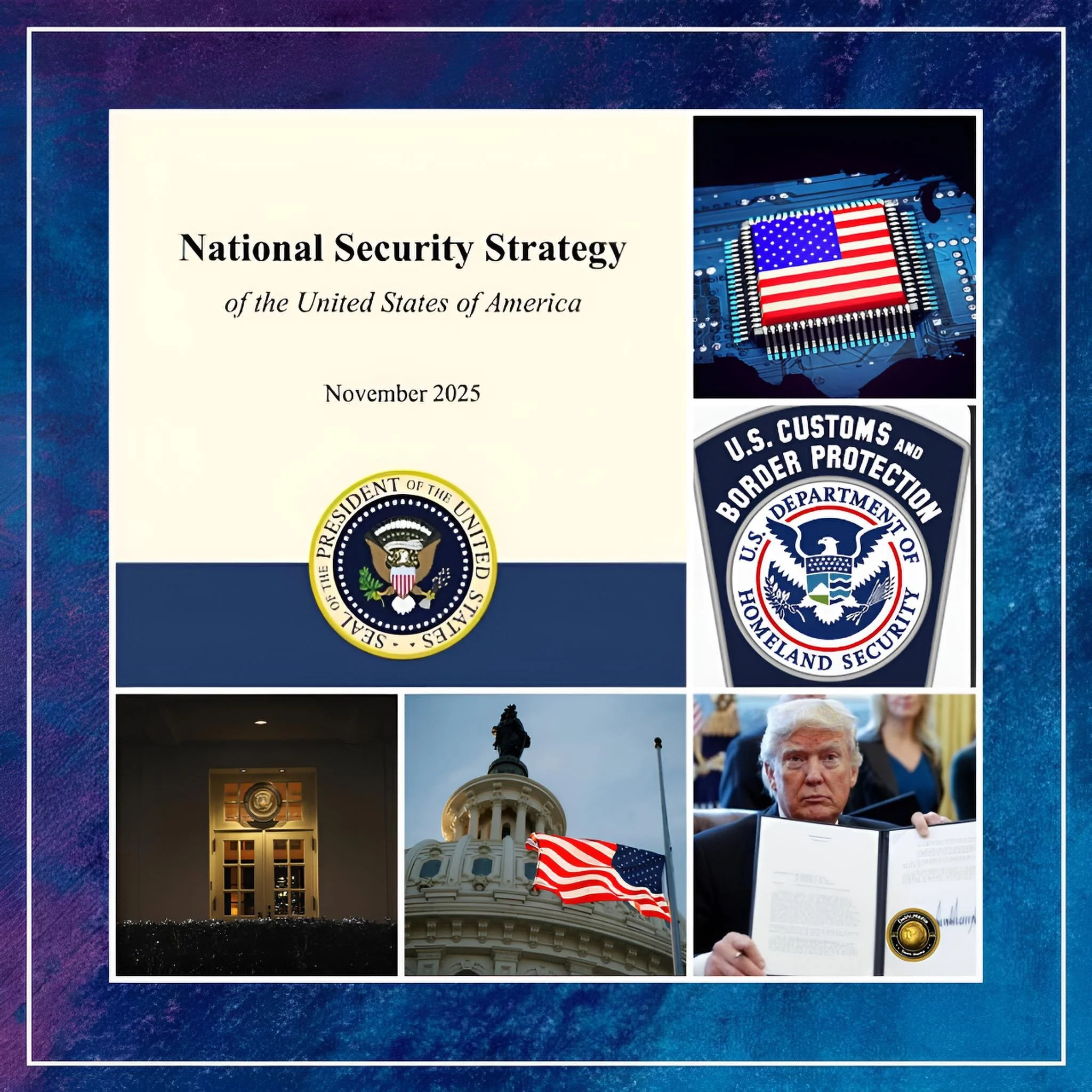
Trump's 2026 National Defense Strategy: A Reorientation of American Military Priorities and Strategic Doctrine
Executive Summary
On 23 January 2026, the Trump administration, through the Pentagon (formally renamed the Department of War), released its 2026 National Defense Strategy (NDS)—a quadrennial document that serves as the foundational blueprint for U.S. military planning, force structure, resource allocation, and strategic decision-making.
The document represents a fundamental reorientation of American defense priorities away from the post-Cold War consensus that posited forward-deployed military presence in Europe and the Indo-Pacific as essential to maintaining American security.
In its place, the 2026 NDS articulates a strategy centered on 4 sequential priorities: defending the U.S. homeland and Western Hemisphere, deterring China in the Indo-Pacific "through strength, not confrontation," increasing burden-sharing with U.S. allies and partners, and "supercharging" the American defense industrial base.
The strategy constitutes a sharp departure not only from the Biden administration's explicit prioritization of China as the "principal strategic competitor" and Russia as an acute threat, but also from the first Trump administration's 2018 NDS, which identified long-term competition with both China and Russia as co-equal principal priorities.
The 2026 document downplays Russia as a "persistent but manageable threat" to NATO's eastern members, explicitly asserts that European NATO allies possess substantially greater economic and military resources than Russia, and conditions continued U.S. support for NATO and Ukraine on European assumption of "primary responsibility" for European conventional defense.
Similarly, the strategy's treatment of China emphasizes "deconfliction and de-escalation" alongside deterrence and notably omits explicit mention of Taiwan, instead employing strategic ambiguity by referencing the "First Island Chain" (FIC) as the critical defensive perimeter.
The document reflects Secretary of Defense Pete Hegseth's intellectual framework, articulated in his prefatory memorandum, which castigates prior administrations for having "neglected—even rejected—putting Americans and their concrete interests first" and for having been "distracted by interventionism, endless wars, regime change, and nation building."
This rhetorical posture encodes a realist worldview that prioritizes threats in proximate geographic zones over abstract commitments to liberal internationalism or universal democratic advocacyThe NDS's emphasis on the Western Hemisphere and the Trump administration's articulation of the "Trump Corollary to the .
Monroe Doctrine" (or "Donroe Doctrine") signals a resurgent American hemispheric dominionism, with explicit commitments to guaranteeing U.S. military and commercial access to Greenland, the Panama Canal, and the Gulf of Mexico (renamed the "Gulf of America").
The strategic implications are profound and contested. Advocates characterize the strategy as a rational recalibration of resources toward genuine security challenges in an era of constrained military budgets and American retrenchment.
Critics argue that the strategy signals a fundamental weakening of American commitments to allies, creates strategic ambiguities regarding Taiwan that could encourage Chinese adventurism, inadequately addresses the Russian threat in Eastern Europe during a period of NATO vulnerability, and subordinates credible nuclear deterrence to fiscal constraints and geographic prioritization.
Introduction
The Strategic Context and Historical Precedent
The Trump administration's 2026 National Defense Strategy emerged from a broader intellectual and policy evolution that commenced with President Trump's initial campaign in 2016 and crystallized through his first term in office.
That evolution rejected the post-Cold War consensus that American security depended upon the maintenance of forward-deployed military presence throughout Europe, the Indo-Pacific, and the Middle East; the preservation of multilateral alliance structures through which American preferences could be aggregated and collectively enforced; and the advocacy of liberal democratic governance as an instrument of American security policy.
Instead, Trump articulated a realist framework emphasizing geographic prioritization, burden-shifting to allies, and a transactional approach to alliances wherein the United States would expect explicit financial compensation or resource contributions proportionate to the security guarantees provided.
The 2018 National Defense Strategy, while identifying China and Russia as co-equal principal strategic competitors, already contained harbingers of this reorientation—particularly in its emphasis on maintaining American military technological dominance and its skepticism toward nation-building and humanitarian interventions.
However, that 2018 document remained fundamentally aligned with the post-Cold War consensus regarding the importance of overseas military presence and alliance networks.
The 2026 National Defense Strategy represents a more thorough intellectual rejection of those premises. The document is animated by what observers have termed "flexible, practical realism"—a framework that evaluates threats according to territorial proximity and their direct consequences for American citizens rather than according to abstract geopolitical principles or liberal internationalist commitments.
This reorientation aligns the NDS with the broader National Security Strategy released in December 2025, which similarly emphasizes hemispheric security, burden-shifting, and a skeptical stance toward universal democracy promotion.
The timing of the document's release is itself historically significant. The NDS was statutorily required to be released "as soon as possible" following the commencement of the second Trump administration on 20 January 2025. However, internal debates regarding China policy and ongoing trade negotiations delayed the document's completion until late January 2026—more than a year into Trump's term.
The extended gestation period reflected tensions between the State Department's emphasis on engagement with China and the Pentagon's historic emphasis on deterrence, with the final document representing a compromise that emphasizes both stability dialogue and military deterrence.
History
From Forward Defense to Hemispheric Prioritization
The 2026 National Defense Strategy's emphasis on the Western Hemisphere and its de-prioritization of overseas commitments represent a reversal of strategic concepts that have dominated American defense thinking since the Cold War.
Throughout the Cold War and the post-Cold War period, American defense strategy was predicated on forward defense: the maintenance of military bases, forward-deployed forces, and security commitments throughout Europe and the Far East to prevent adversaries from achieving regional dominance and to credibly guarantee the security of allied states.
This forward-defense posture entailed substantial costs: the stationing of approximately 50,000 U.S. military personnel in Europe and approximately 80,000 in the Indo-Pacific, the maintenance of global logistics networks and military bases, and the extension of nuclear deterrence guarantees to NATO allies and to South Korea and Japan.
However, the strategy rested on the judgment that such forward commitment was economically efficient and strategically sound: by preventing regional aggression ex ante, the United States avoided far more costly wars of reconquest.
Moreover, the strategy was predicated on the view that American security was genuinely internationalist in character—that threats to global stability, to international commerce, or to liberal democratic governance in distant regions ultimately constituted threats to American prosperity and security.
The Trump administration's 2016 campaign articulated a sharp critique of this forward-defense posture. Trump emphasized that American allies, particularly in Europe and East Asia, had become "free riders," extracting security benefits from American military commitment while avoiding proportionate financial contributions.
He questioned whether American security genuinely depended upon maintaining a global military presence and whether the costs of this presence were justified by the strategic benefits accrued.
These arguments resonated with a subset of American strategic analysts who had grown skeptical of liberal internationalism and who contended that American military resources could be more efficiently deployed in the Western Hemisphere or in addressing threats to the American homeland itself.
During Trump's first term, these skeptical voices competed with more traditional internationalist perspectives within the defense establishment.
The result was the 2018 National Defense Strategy, which emphasized great-power competition with China and Russia but which also maintained significant commitments to overseas bases and alliance networks.
However, Trump's second term, beginning in 2025, saw the consolidation of skeptical voices within senior defense positions, particularly with the appointment of Pete Hegseth as Secretary of Defense. Hegseth, a former military officer and media personality with deeply skeptical views regarding nation-building and overseas military commitment, articulated a vision of defense strategy centered on homeland protection and hemispheric dominance.
The 2026 National Defense Strategy institutionalizes this vision.
The document's first strategic priority—defend the U.S. homeland and Western Hemisphere—represents an unprecedented elevation of hemispheric security to preeminence within American defense strategy.
This represents not merely a rebalancing of priorities but a fundamental reordering of the geographic hierarchy of strategic concern.
Current Status
The Four Pillars of the 2026 Strategy
The 2026 National Defense Strategy organizes American defense priorities around 4 sequential strategic objectives, presented in order of priority: defending the U.S. homeland and Western Hemisphere; deterring China in the Indo-Pacific; increasing burden-sharing with U.S. allies and partners; and supercharging the U.S. defense industrial base.
This sequencing is itself strategically significant, as it signals that other regional commitments are subordinated to homeland and hemispheric priorities.
Defending the homeland now encompasses not merely traditional missions of missile defense, counterterrorism, and cybersecurity, but also expanded missions of counter-narco-terrorism and border security against illegal immigration. The NDS commits the military to securing the southern border through integration with Homeland Security and other civilian law enforcement.
This militarization of domestic border security represents a notable expansion of the military's domestic role and raises constitutional questions regarding the posse comitatus principle that traditionally restricts military deployment within the United States.
The Western Hemisphere prioritization is operationalized through the "Trump Corollary to the Monroe Doctrine," which is defined in the document as comprising 3 elements: restoration of American military dominance in the Western Hemisphere; protection of the homeland and American access to strategic terrain; and denial of adversarial military presence or capabilities in the hemisphere.
The document explicitly identifies Greenland, the Panama Canal, and the Gulf of Mexico (renamed the "Gulf of America") as key terrain essential to American security and commits to guaranteeing "U.S. military and commercial access" to these locations.
The Greenland prioritization is particularly striking. The document references Greenland 5 times as key terrain under threat from Russian and Chinese military activities.
Trump has previously suggested that acquiring Greenland might be necessary for American security and has appointed a special envoy to Greenland.
While Trump stated in late January 2026 that military force would not be deployed to acquire Greenland, the administration is reportedly exploring "a range of options" for acquisition, including purchasing the territory from Denmark. This language echoes Cold War era American expansionism, though framed in contemporary security terminology.
The Panama Canal prioritization similarly reflects Trump's conviction that American access to this strategic chokepoint is insufficiently secured. Trump has stated that the United States should "reclaim" the Panama Canal—referring both to explicit military control and to influence over the companies operating the canal.
The canal permits rapid transit of military assets between the Atlantic and Pacific and is essential to American logistics networks. Trump's concern regarding Chinese investment and alleged PRC influence over the canal's operations reflects a broader hemispheric competition for influence.
On China, the 2026 NDS represents a notable modulation from both the Biden administration's explicit characterization of China as the principal strategic competitor and from Trump's earlier, more confrontational rhetoric.
The document acknowledges China as "the most powerful state relative to us since the 19th century" and warns of its "historic military buildup." However, it explicitly disavows the goal of American military dominance over China, stating that the strategy aims neither to "dominate" China nor to "strangle or humiliate them." Instead, the NDS emphasizes "deconfliction and de-escalation" alongside deterrence.
This modulation reflects the Trump administration's interest in engaging directly with Chinese President Xi Jinping, with Trump reportedly planning a visit to China in April 2026. The strategy calls for "opening a wider range of military-to-military communications with the People's Liberation Army (PLA) with a focus on supporting strategic stability with Beijing as well as deconfliction and de-escalation."
This language reverses the trend of limiting military-to-military contacts established during the first Trump administration, when the view prevailed that such exchanges did not benefit the United States.
Critically, the 2026 NDS does not mention Taiwan by name anywhere in the document. This represents a notable change from prior strategy documents, which explicitly identified Taiwan as a critical ally and flashpoint. Instead, the document employs strategic ambiguity, referencing commitment to a "strong denial defense along the First Island Chain (FIC)."
The First Island Chain, running from Japan through Taiwan and the Philippines to Indonesia, is described as a critical geographic bastion for preventing Chinese hegemony in the Indo-Pacific.
By avoiding explicit mention of Taiwan, the document arguably signals a degree of de-prioritization of Taiwan's security, even as it technically commits to denying Chinese dominance of the chain in which Taiwan is embedded.
On Russia and Europe, the 2026 NDS represents a dramatic de-prioritization compared to previous administrations. Russia is characterized as a "persistent but manageable threat to NATO's eastern members for the foreseeable future."
The document explicitly notes that European NATO allies collectively possess substantially greater economic resources than Russia—Germany's economy alone exceeds Russia's by a factor of approximately 10.
The NDS therefore concludes that NATO allies are "strongly positioned to take primary responsibility for Europe's conventional defense, with critical but more limited U.S. support."
This language constitutes a formal acknowledgment that the United States is reducing the proportion of European defense burden it will bear and that NATO allies must assume enhanced responsibility for their own conventional defense.
Notably, the document states that European allies must take the lead in supporting Ukraine's defense, with the United States providing "critical but more limited" support.
This de-prioritization of Ukraine support reflects Trump's repeated statements that the Ukraine war "must end" and his skepticism regarding indefinite American military assistance to Ukraine.
Key Developments
The Intellectual and Institutional Evolution
Several key developments drove the formulation and release of the 2026 National Defense Strategy.
First, the appointment of Pete Hegseth as Secretary of Defense in December 2024 signaled the dominance of skeptical voices regarding American military overseas commitments.
Hegseth, a former military officer, Fox News personality, and author of books criticizing American nation-building, explicitly articulated the intellectual framework that animated the 2026 NDS.
His memorandum introducing the strategy makes clear that he views prior administrations' commitments to interventionism, nation-building, and universal democracy promotion as counterproductive.
Second, the Trump administration's successful pressure on NATO allies to increase defense spending bore fruit. NATO allies agreed at the 2025 NATO summit to commit to spending 5 percent of GDP on defense, including 3 percent on core military capabilities.
This elevated commitment reduced, though did not eliminate, Trump's criticism of NATO allies as free riders. The increased European defense spending provided intellectual cover for the argument that the United States could reduce its commitment to European defense while NATO allies were simultaneously increasing theirs.
Third, the administration's shift in tone regarding China appears designed to create strategic space for direct presidential engagement with Xi Jinping. The muted characterization of China in the NDS and the emphasis on dialogue and deconfliction signal Trump's interest in negotiating arrangements with China rather than pursuing indefinite military competition.
This shift suggests that Trump may view some form of great-power accommodation with China as preferable to sustained strategic competition.
Fourth, the administration successfully resisted pressure from European and East Asian allies to maintain explicit commitments to Taiwan. European leaders pressed the administration to provide explicit reassurance regarding Taiwan's security.
The administration's response—the Taiwan omission from the NDS, coupled with emphasis on "denial defense" along the broader First Island Chain—signals a desire to maintain strategic flexibility regarding Taiwan's fate.
Latest Facts and Concerns
The 2026 National Defense Strategy has generated substantial criticism from defense analysts, academic strategists, and allied governments.
Several concerns have emerged.
First, critics argue that the de-prioritization of Europe during a period of acute NATO vulnerability is strategically unwise. Russia, despite economic constraints, continues to prosecute its war in Ukraine and possesses extensive military and nuclear capabilities.
European NATO members, while economically powerful, require time to translate increased defense spending into increased military production and force deployment. Premature American reductions in European commitment risk weakening NATO deterrence precisely when Russian threats have escalated.
Second, the Taiwan omission from the NDS has generated alarm in Taiwan, Japan, and the Philippines. These allies interpret the omission as a potential signal that American commitment to Taiwan is conditional or negotiable.
Xi Jinping has directed Chinese military planning to be prepared to seize Taiwan by 2027, creating a narrow window in which strategic ambiguity regarding American commitment could prove catastrophic.
Third, defense analysts note that the NDS inadequately addresses the technology dimension of contemporary great-power competition.
The document mentions artificial intelligence (AI) and calls for rapid AI adoption but provides insufficient detail regarding how AI will transform military operations or how the U.S. will maintain technological superiority over China, which is advancing rapidly in AI-enabled military applications.
Some analysts have noted that the NDS is the first quadrennial defense strategy in decades to provide minimal treatment of emerging technologies.
Fourth, the Greenland and Panama Canal prioritization has generated international diplomatic friction. Denmark, Greenland's nominal sovereign, has firmly rejected any possibility of selling Greenland and has explicitly stated that Greenland will determine its own future. Latin American governments have been concerned by Trump's suggestions that the United States might reassert control over the Panama Canal.
These signals risk generating anti-American sentiment in regions where the U.S. seeks to expand influence.
Fifth, critics of the burden-shifting framework argue that it fundamentally misunderstands the nature of American security. During the Cold War, American forward presence was not a favor to allies but a necessary component of American security strategy.
Similarly, American commitment to Taiwan, the Philippines, and Japan reflects fundamental American interests in preserving a balance of power in the Indo-Pacific that benefits American commerce and security.
The strategy's language of allies "doing more" conflates a rational sharing of collective security burdens with unilateral American concessions.
Cause-and-Effect Analysis
Strategic Implications and Risks
The 2026 National Defense Strategy will generate a cascade of strategic consequences that will unfold over the coming years.
At the immediate level, the strategy will influence American force posture decisions, with the Pentagon likely to implement a "Global Posture Review" that reduces American military presence in Europe and repositions forces toward the Western Hemisphere and Indo-Pacific.
This posture shift will require closing or consolidating bases in Europe, reassigning military personnel, and reorienting logistics networks—changes that will take years to implement and will signal American disengagement to European allies.
The reduction in American military commitment to Europe creates space for Russia to escalate its aggression, particularly if Russia calculates that NATO's American guarantor is less reliable than previously assumed.
Russia might miscalculate regarding the strength of American commitment to NATO's eastern members, leading to military adventurism that could precipitate direct NATO-Russia conflict.
Conversely, European NATO members, confronted with reduced American commitment, will accelerate their own defense procurement and force development—a long-term trend that may ultimately strengthen European autonomy but which creates near-term vulnerability.
The Taiwan omission from the NDS and the emphasis on deconfliction with China creates a credibility gap regarding American commitment to Taiwan. Xi Jinping, observing the strategic ambiguity and the administration's emphasis on dialogue with Beijing, might calculate that the United States would be unwilling to defend Taiwan militarily.
This strategic miscalculation could precipitate a Chinese military move against Taiwan, leading to the worst-case scenario: a U.S.-China military conflict emerging from a misunderstanding regarding American commitment.
The hemispheric prioritization and the Trump Corollary to the Monroe Doctrine will generate friction with Latin American and Caribbean governments.
The suggestion that the United States might reassert control over the Panama Canal or acquire Greenland will be perceived as neo-imperial, generating resentment and pushing regional governments toward alternative partnerships—particularly with China and Russia.
The militarization of American immigration policy, operationalized through expanded military roles in border security, will similarly generate negative perceptions in the region.
The emphasis on burden-shifting rather than burden-sharing fundamentally alters the alliance relationship. Burden-sharing implies reciprocal contributions to collective security; burden-shifting implies that the United States is unilaterally reducing its contribution while demanding that others increase theirs.
This framing risks generating alliance resentment and could accelerate European efforts to develop military capabilities independent of American support.
Over the long term, a genuinely independent European military capability might benefit American security, but the near-term transition period creates vulnerability.
The defense industrial base prioritization, while conceptually sound, remains under-specified in the document. The strategy calls for "supercharging" American defense production but provides minimal detail regarding how this will be achieved.
The administration has ordered an Acquisition Transformation Strategy aimed at putting the defense acquisition system "on a wartime footing," but the practical implementation remains obscure.
Defense spending, while elevated, is not unlimited, and the strategy's emphasis on multiple simultaneous priorities (homeland defense, China deterrence, Europe support, industrial base modernization) could generate resource constraints that force difficult trade-offs.
Future Steps
Implementation and Adaptation
The 2026 National Defense Strategy will now cascade into detailed implementation plans through 2 primary mechanisms. First, the combatant commands—U.S. Indo-Pacific Command (INDOPACOM), U.S. European Command (EUCOM), U.S. Southern Command (SOUTHCOM), and others—will develop regional strategies implementing the NDS's guidance.
These regional strategies will translate the document's broad concepts into specific force posture decisions, operation plans, and capability development roadmaps.
Second, the Pentagon will conduct the mandated Global Posture Review, which will identify which overseas military bases will be closed, which will be consolidated, and which will be expanded.
This posture review will be contentious, as closing bases generates opposition from affected local communities, allied governments, and domestic defense contractors. The review will likely be delayed or modified through Congressional and allied pressure.
Third, the administration will advance its Acquisition Transformation Strategy to accelerate defense procurement and reduce bureaucratic obstacles to rapid weapons system development and procurement.
This effort will require Congressional authorization and appropriation and will face resistance from those concerned about inadequate oversight and accountability in defense spending.
Fourth, Congress will conduct oversight hearings on the NDS, with particular focus on China strategy, Taiwan commitments, and NATO burden-sharing.
Congressional Democrats will press the administration for explicit commitments regarding Taiwan, and allied governments will lobby Congress for reassurance regarding American strategic commitment.
Fifth, the administration will likely attempt to operationalize the hemispheric prioritization through military operations, diplomatic initiatives regarding Greenland and the Panama Canal, and resource reallocation toward Caribbean and Central American military presence.
Conclusion
Strategic Continuity and Rupture
The 2026 National Defense Strategy represents a substantial rupture with post-Cold War American defense strategy while simultaneously containing elements of strategic continuity.
The rupture is evident in the de-prioritization of European security, the de-emphasis of Taiwan, and the reorientation of American strategic focus toward the Western Hemisphere. The continuity is evident in the continued emphasis on deterring China in the Indo-Pacific, the maintenance of nuclear modernization, and the prioritization of defense industrial base strength.
The strategy's ultimate success or failure will depend on whether Trump's reading of American interests—that the United States is overstretched globally and should concentrate resources on proximate threats—proves strategically sound. If Russia remains contained, if China accepts the "deconfliction and de-escalation" framework, and if European allies successfully assume greater conventional defense burden, the strategy could prove vindicated.
Conversely, if Russia escalates aggression in Eastern Europe, if China interprets strategic ambiguity regarding Taiwan as license for military action, or if allies fracture in response to perceived American abandonment, the strategy could precipitate the very crises it sought to prevent.
The document will shape American military planning and capability development for years to come. Its successes or failures will become evident only in retrospect, through the unfolding of strategic events over the remainder of the decade.