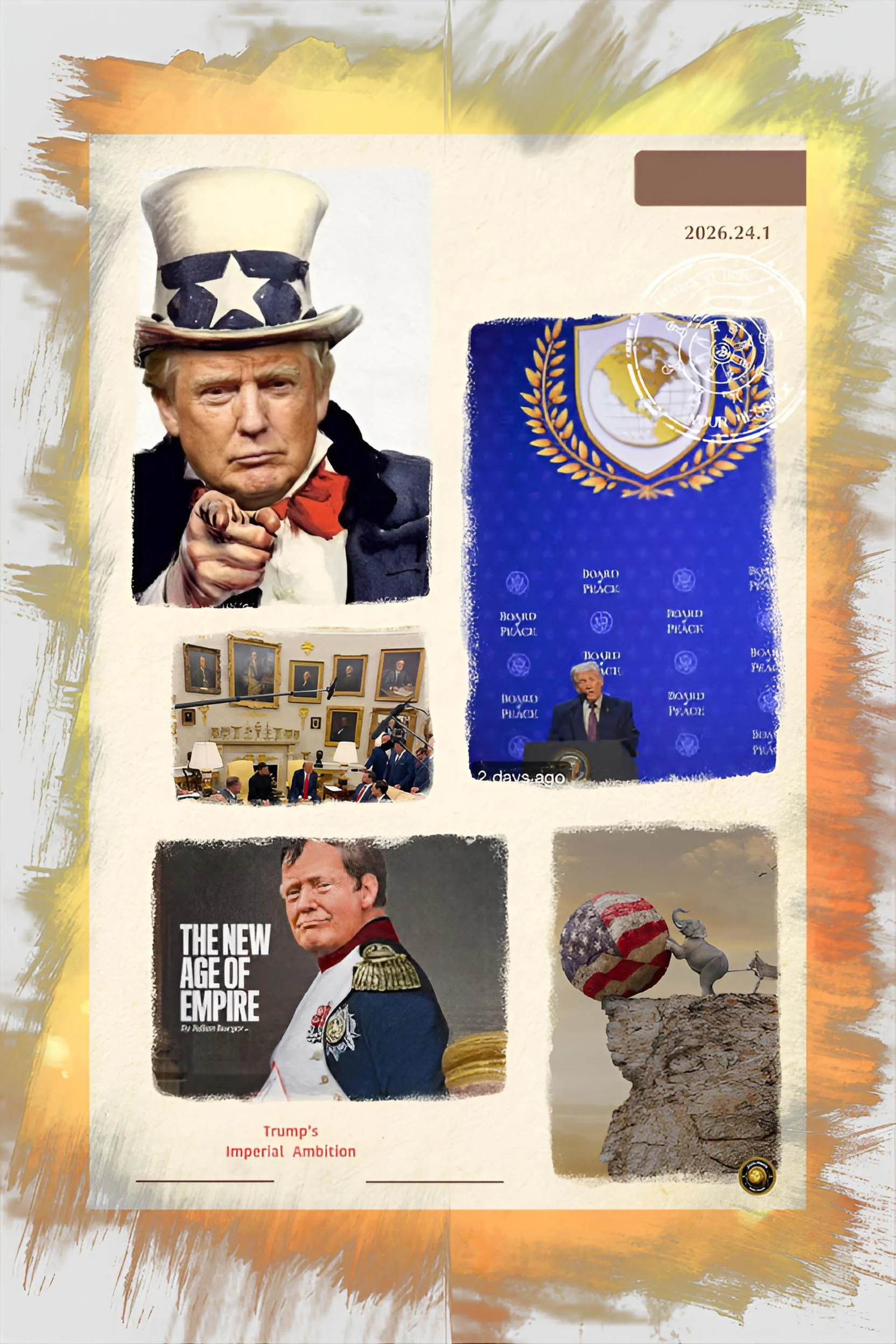
The Appearance of Power: Donald Trump's Risky Obsession with Imperial Style
Executive Summary
The second Trump administration has embarked upon an unprecedented series of geopolitical maneuvers that defy conventional cost-benefit analysis.
From military intervention in Venezuela to explicit territorial acquisition demands regarding Greenland and the Panama Canal, Washington has initiated a coordinated assault on the post-World War II liberal international order. Rather than advancing demonstrable national security or economic interests, these moves appear driven by imperial aesthetics—a desire to project dominance, reshape territory, and reimpose hierarchical control over strategic regions.
FAF examines the strategic paradox: why the world's dominant power would employ tactics that alienate allies, activate adversaries, and undermine the very institutional architecture that enabled American hegemony.
The analysis reveals that Trump's imperial venture represents not coherent geopolitical strategy but rather the elevation of personal prestige, business interests, and ideological fixation above institutional constraints and rational strategic calculation.
Introduction
Political economists traditionally apply a straightforward analytical framework when confronted with puzzling international behavior: cui bono—who gains?
This question typically yields clear answers. State actors pursue policies that advance material interests, whether through blocking regulations, accelerating treaties, or leveraging economic and military power. The incentive structures are transparent, even if the tactics vary.
Yet the geopolitical developments of early 2026 resist this explanatory framework. The United States, despite possessing overwhelming military and economic capabilities, has undertaken a series of costly and diplomatically damaging initiatives that yield minimal concrete gains while systematically dismantling the institutional foundations of American power projection.
Washington has mobilized adversaries, unsettled allies, extracted tariff concessions through economic coercion, and engaged in military operations and territorial acquisition rhetoric that recalls nineteenth-century imperialism rather than 21st century strategy.
The Trump administration's 2025 National Security Strategy explicitly abandons the post-1945 liberal international order—the very system the United States constructed to embed its power within rules, institutions, and alliances.
In its place emerges what analysts term "transactional imperialism": a model combining raw power assertion with the rhetorical invocation of energy dominance, Western Hemisphere hegemony, and American greatness, but without the ideological justification that historically legitimated imperial projects.
This represents a fundamental rupture. Previous American administrations justified global intervention through appeals to spreading democracy, advancing free trade, and defending a rules-based order.
Trump explicitly rejects these justifications. His National Security Strategy contains not a single reference to democracy, values, or human rights—concepts that appeared thirty-eight times in his first-term strategy. In their place stands a nakedly transactional framework where alliances exist only insofar as other states accept American demands, and international law applies only when convenient.
The paradox driving this analysis is this: Why would the world's most powerful state systematically alienate allies, weaponize economic relationships, and employ military force in ways that strengthen revisionist competitors and accelerate the very multipolarity America claims to resist?
The answer lies not in strategic rationality but in the confluence of ideological conviction, personal incentive structures, and a fundamental misunderstanding of how American power functions in an interdependent world.
Historical Context and the Liberal International Order
To understand Trump's imperial aesthetics, one must first grasp what is being dismantled. The post-1945 American-led liberal international order emerged from a strategic calculation that direct domination was less efficient than hegemonic leadership within a system of rules and institutions. Rather than conquering territories, the United States embedded its power within NATO alliances, the Bretton Woods system, the United Nations framework, and a rules-based trading order.
This architecture conferred enormous benefits on the United States. American technological dominance translated into global market access. Military alliances extended American influence without requiring direct territorial control or colonial administration. The dollar's role as global reserve currency conveyed immense financial power. Soft power—the appeal of American culture, institutions, and values—magnified coercive power.
Critically, this order worked because it offered benefits to other states as well. Allies received security guarantees. Trading partners accessed American markets. Developing nations received development assistance and technical cooperation. Even adversaries found it rational to negotiate within frameworks rather than seeking total systemic overthrow. The order created what international relations theorists call "free security"—allies gained protection without the burden of independent great power competition.
Trump and his advisers fundamentally reject this architecture.
The 2025 National Security Strategy frames the liberal order as a failure, arguing that American elites "convinced themselves that permanent American domination of the entire world was in the best interests of our country" while simultaneously "undermining the very means necessary to achieve that goal: the character of our nation upon which its power, wealth, and decency were built."
This framing inverts historical reality. The liberal order did not constrain American power—it amplified it. Yet the Trump administration treats post-1945 institutions as constraints to be discarded rather than assets to be leveraged.
In early 2026, the administration withdrew the United States from 66 international organizations, including the IPCC, UNESCO, various UN bodies, and the Partnership for Atlantic Cooperation. The move signaled an explicit repudiation of multilateral cooperation as a governing principle.
The Trump Corollary to the Monroe Doctrine
The strategic centerpiece of Trump's reorientation is what the National Security Strategy terms the "Trump Corollary" to the Monroe Doctrine.
The historical Monroe Doctrine (1823) asserted that further European colonization of the Western Hemisphere would be viewed as hostile to American interests. It established hemispheric dominance as foundational American strategy.
Trump's Corollary revives this nineteenth-century framework but with twenty-first-century precision. The NSS declares that the United States will "reassert and enforce the Monroe Doctrine to restore American preeminence in the Western Hemisphere" and will "deny non-Hemispheric competitors the ability to position forces or other threatening capabilities, or to own or control strategically vital assets, in our Hemisphere."
This language marks a seismic shift. Rather than embedding Western Hemisphere influence within institutions and alliances, the Trump administration explicitly positions hemispheric dominance as an exclusive sphere of American control.
The implications are profound: China's economic presence in Latin America is redefined as a security threat rather than a competitive challenge. Russian investments or military activities trigger zero-tolerance responses. And crucially, other great powers are implicitly invited to claim equivalent spheres of influence in their own regions.
The Trump Corollary provides the strategic logic for the administration's most aggressive moves. Venezuela's oil, Greenland's minerals and Arctic positioning, Panama Canal control, and Canadian integration all serve the objective of consolidating unchallenged American dominance in the region deemed "indispensable" to national security.
Key Developments: The Pattern of Imperial Assertion
Venezuela: Occupation and Oil Seizure
In the night of January 2-3, 2026, the Trump administration conducted a military operation resulting in the capture of Venezuelan President Nicolás Maduro. The operation was ostensibly justified on counternarcotics and security grounds. Yet Trump's own statements revealed the operation's true objective: control of Venezuela's vast oil reserves.
On January 3, Trump declared that the United States would "run" Venezuela for an unspecified period and that American oil companies would invest "billions of dollars" to rehabilitate Venezuela's oil infrastructure. More revealingly, Trump announced that Venezuela would "turn over" between 30 and 50 million barrels of oil to the United States.
The seized oil would be commercialized globally, with revenues deposited in accounts outside Venezuela's control. The Trump administration would determine how much revenue would be returned to Caracas. This arrangement represents direct territorial occupation and resource extraction without formal annexation.
The United States effectively seized control of Venezuela's primary revenue source, claimed custodianship over its political transition, and leveraged its military superiority to extract economic rent. Trump's characterization of this as a temporary arrangement pending a "safe, proper and judicious transition" masks what international relations scholars recognize as indirect imperial control.
The economic logic behind the Venezuela operation reveals the gap between stated justification and actual motivation. Venezuela's oil production has collapsed from approximately three million barrels per day in 2011 to less than 750,000 bpd currently.
Rehabilitating production to historical levels would require tens of billions of dollars in infrastructure investment, a process experts estimate could take a decade or longer. Venezuela's crude is heavy, sour, and expensive to process—it sells at deep discounts compared to lighter crudes. Global oil markets show no shortage; prices are manageable. The strategic value of Venezuelan oil to American energy security is minimal.
Yet Trump has made "energy dominance" a central pillar of his strategic vision. The seizure of Venezuelan oil serves multiple purposes beyond conventional energy security: it demonstrates American willingness to employ military force to seize resources, signals to other Latin American nations that the Trump Corollary is not rhetorical, and provides a domestic policy narrative of American strength and resource acquisition.
Greenland: Arctic Dominance and Mineral Access
Trump's fixation on acquiring Greenland emerged early in his transition period and has intensified throughout early 2026. The initial rationale centered on military positioning—Greenland's Arctic location provides strategic positioning to monitor Russian and Chinese activities in the Arctic region. Trump emphasized that Greenland is "vital to national security" and that "we're talking about protecting the free world."
As negotiations progressed, however, the focus expanded. Greenland possesses substantial deposits of rare earth minerals, critical minerals for advanced electronics, and renewable energy resources. An Australian geologist apparently introduced Trump to Greenland's mineral endowment in 2019, and the resource dimension has become increasingly central to Trump's interest.
When Denmark and Greenland repeatedly and unambiguously refused to discuss sale or transfer, Trump escalated the rhetoric and tactics. In January 2026, he explicitly refused to rule out military force to acquire Greenland. Simultaneously, his son, Donald Trump Jr., visited Greenland in what was characterized as a personal reconnaissance mission but which analysts described as a calculated political signal.
In late January, Trump announced 10 % tariffs on eight European countries—Denmark, Norway, Sweden, France, Germany, the United Kingdom, the Netherlands, and Finland—explicitly tied to the Greenland acquisition.
The tariffs would escalate to 25 % by June 1 unless the United States achieved the "complete and total purchase of Greenland." This represented an unprecedented weaponization of tariff policy, using economic coercion not to correct trade imbalances or protect domestic industries but to force territorial acquisition.
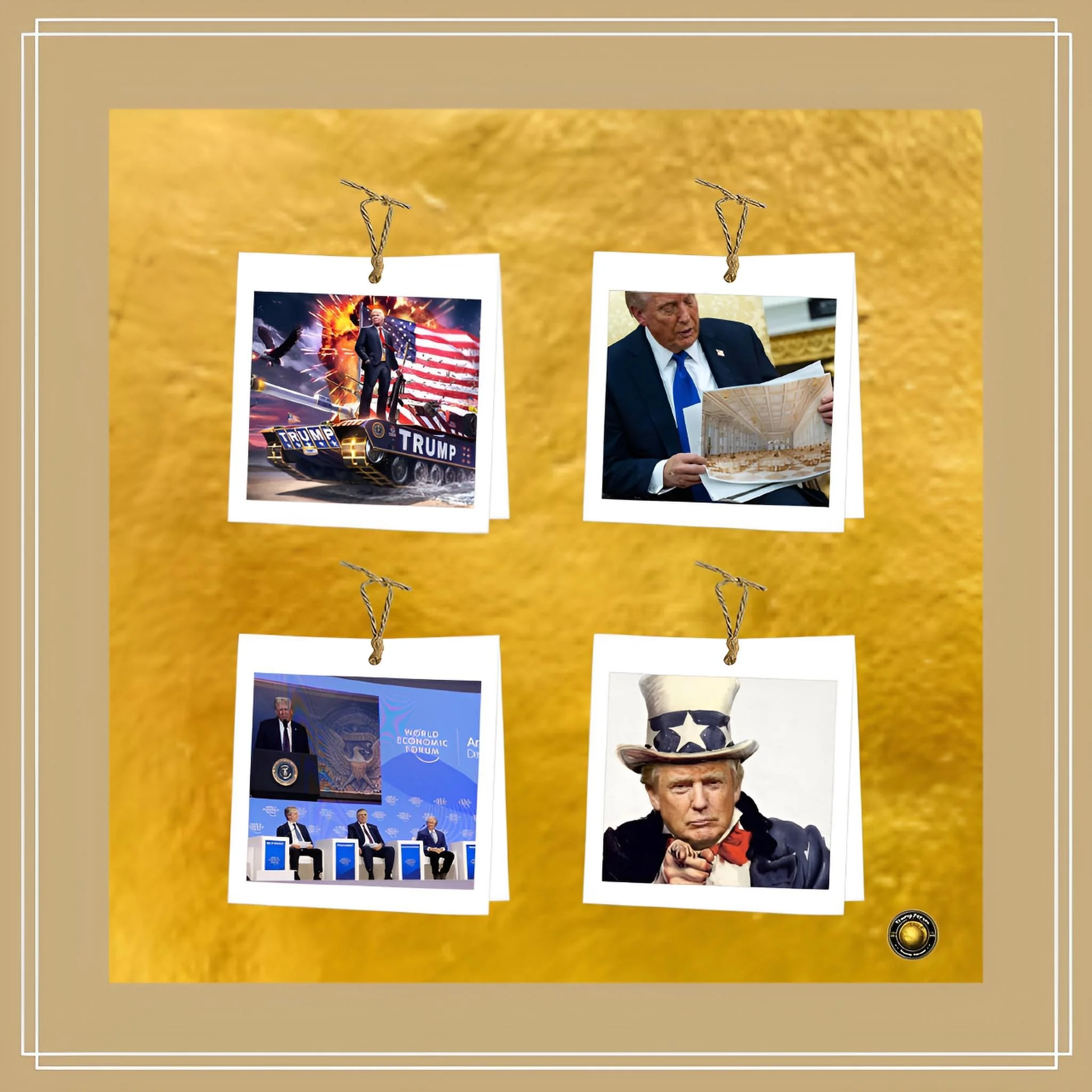
By January 21, following Trump's speech at the World Economic Forum describing Greenland acquisition as "a very small ask," the administration negotiated what diplomatic sources described as a "framework" agreement with Denmark. The details remained opaque, but reports suggested the arrangement might involve mineral rights, exclusive military basing privileges, or even "sovereign claims to pockets of Greenland's territory"—language that implies de facto partition of Denmark's territory.
The Greenland case exemplifies Trump's imperial methodology. Initial requests are denied. Rhetoric escalates to include military threats. Economic coercion is deployed against allies unwilling to comply. When full compliance proves impossible due to democratic resistance or international law, the administration accepts partial victories while maintaining the fiction of ongoing negotiations and future expansion.
Panama Canal: Revanchism and Strategic Control
Trump has repeatedly expressed his belief that the transfer of the Panama Canal to Panama in 1999 (negotiated during the Carter administration) represented a catastrophic strategic error. He claims the canal is now "being operated by China" (a technically inaccurate assertion—the canal is operated by the Panama Canal Authority, though a Hong Kong-based company manages two container ports at the canal's entrances), charges Panama with overcharging American vessels and violating treaties, and has demanded reclamation of American control.
In early January 2026, Trump stated that the United States must "take back" the canal and that Americans would "be very strongly involved" in its administration. He refused to rule out military force, stating only that "something very powerful is going to happen" if Panama resisted. Within weeks, Trump's military planners had, according to former administration officials, begun developing options for seizing the canal by force.
Panama's President José Raúl Mulino, recognizing the credibility of the threat, "quickly and quietly agreed to a number of concessions," including re-examining Chinese investment in the country. Yet Trump continues to frame the Panama Canal as an unresolved issue requiring American reclamation.
The Panama Canal is arguably less strategically vital to American security than either Greenland or Venezuela. The canal transits some 70 percent of U.S.-bound cargo, but the waterway is internationally managed and remains accessible.
The strategic rationale for reclamation is weak. Yet the symbolic value is immense: the canal represents American imperial achievement from the early twentieth century, a monument to American power and strategic vision. Reclamation would symbolically reverse what Trump portrays as decades of American retreat and weakness.
Canada and Expansion Rhetoric
Trump has repeatedly suggested that Canada should become the 51st American state, initially framing this as a joke but increasingly articulating it as a policy objective. He has threatened 25 % tariffs on Canadian goods to coerce economic integration, characterized the U.S.-Canada border as an "artificially drawn line," and suggested that Canadian acquisition would enhance American "national security."
The economic logic is opaque. Canada is already deeply integrated into North American supply chains through the USMCA. Trade occurs freely. Investment flows bidirectionally. Military cooperation within NATO is substantial. Yet Trump frames Canadian sovereignty as an obstacle to American interests rather than a negotiated boundary between allies.
The rhetoric around Canada serves multiple functions: it signals to allies that no border is permanent, no sovereignty guaranteed absent American acceptance; it appeals to a particular vision of manifest destiny; and it tests international tolerance for increasingly naked territorial expansion claims.
Cui Bono? The Political Economy of Imperial Aesthetics
The cui bono question—who benefits?—proves more complex here than in conventional analyses. Trump himself profits in several dimensions, though not in straightforward ways.
First, personal brand and legacy: Trump has long been obsessed with his historical legacy, with being remembered as a great president who "restored" American power. The acquisition of territories, the reversal of perceived defeats (Panama Canal, Greenland rejection), and the assertion of American dominance all contribute to a historical narrative Trump finds compelling.
These are accomplishments that can be framed as uniquely Trumpian, as evidence of his superior negotiating ability and uncompromising commitment to American interests.
Second, business interests and conflicts: Trump maintains ownership stakes in numerous business ventures globally. The administration has made no effort to separate Trump's personal business interests from foreign policy. Trump has accepted a $400 million luxury aircraft from Qatar as an alternative to Air Force One (raising Constitutional Emoluments Clause concerns), has business interests in India, the Middle East, and elsewhere, and has authorized family members to conduct foreign business ventures. The formal separation between presidential and business interests that characterized even the first Trump administration has effectively dissolved.
Third, ideological conviction: Trump and his closest advisers—particularly Stephen Miller—appear genuinely convinced that nineteenth-century imperial frameworks represent appropriate templates for twenty-first-century American strategy.
This is not cynical manipulation but rather a fundamental philosophical commitment to hierarchical international order where great powers exercise unrestricted dominance within their spheres. The invocation of Manifest Destiny is not rhetorical flourish but statement of actual belief.
Fourth, domestic political support: Trump's base responds enthusiastically to imperial rhetoric. Assertions that America will "take back" territories, reassert dominance, and refuse to be constrained by international law resonate with voters who perceive American decline and seek restoration of American dominance. The theatrical quality of Trump's imperial gestures—his son's trip to Greenland, his direct statements about acquiring territories, his renaming of geographic features—generates media attention and signals toughness to supporters.
The broader establishment, however, benefits far less clearly. The business community derives advantages from institutional stability and predictability—qualities that Trump's approach actively undermines. The financial sector benefits from dollar hegemony and the international regulatory frameworks that Trump is systematically dismantling. The defense establishment profits from allied military spending but loses influence when Trump overrides strategic consensus or pursues operations military planners assess as strategically dubious.
What becomes apparent is that the question of cui bono cannot be adequately answered at the level of material state interests. Instead, analysis must incorporate psychological, ideological, and personal factors.
Trump pursues imperial objectives not because careful cost-benefit analysis demonstrates their rationality, but because they satisfy psychological needs, align with ideological convictions, and generate domestic political support.
The Rejection of Liberal Internationalism
To fully appreciate the magnitude of Trump's shift, one must understand what he is explicitly rejecting: liberal internationalism as the organizing principle of American foreign policy.
Liberal internationalism rests on several interconnected propositions: first, that rules-based order constrains state behavior and reduces conflict; second, that shared values and institutional membership create durable cooperation; third, that promoting democracy, rule of law, and human rights advances American interests by creating like-minded allies; and fourth, that multilateral institutions amplify American power by distributing the costs of security provision across allies.
Trump's 2025 National Security Strategy repudiates each of these propositions. The strategy contains no reference to democracy, rule of law, or values. Alliances are evaluated exclusively through the lens of burden-sharing ratios and transactional benefit. International institutions are portrayed as constraints on American sovereignty rather than force multipliers. The United States explicitly asserts the right to pursue its interests without regard for international law or consensus.
This represents not merely a policy adjustment but a philosophical break with seventy years of American foreign policy consensus. Both Republican and Democratic administrations, despite policy disagreements, shared the underlying assumption that American interests were best served by maintaining and strengthening the liberal international order. Even Reagan, despite Cold War confrontation, ultimately negotiated arms control agreements and accepted institutional constraints.
Trump explicitly rejects this entire framework. His administration has withdrawn from the Paris Climate Agreement (again), the World Health Organization (again), and numerous other international accords. More dramatically, it has announced withdrawal from sixty-six international organizations and frameworks. The cumulative effect is the systematic deconstruction of the institutional architecture that enabled American dominance.
The Mechanics of Coercion
A distinctive feature of Trump's approach is reliance on economic coercion and military threats as tools of first resort, deployed not merely against adversaries but against allies unwilling to comply with demands.
The Greenland tariffs exemplify this pattern. Tariffs imposed at 10 % rising to 25 % are economically costly to American consumers and firms dependent on European inputs. They disrupt supply chains and raise prices. Yet they are deployed not to correct trade imbalances or protect domestic industries—the conventional rationale for tariffs—but to coerce political compliance on territorial acquisition. This represents an unprecedented escalation in coercive tactics.
Similar patterns emerge across the administration's approach. Trump explicitly uses tariffs, sanctions, military threats, and economic pressure as negotiating tools, deployed sequentially to extract maximum concessions.
The pattern evident in Mexico, Denmark, Cuba, and Iran reveals Trump's methodology: deploy threats with escalating severity, demand compliance, accept partial victories as temporary arrangements, and maintain pressure for future expansion.
Analysts who have studied this pattern note its fundamental instability. Coercion works when it reinforces other forms of leverage—diplomatic, institutional, cultural. Used indiscriminately against allies, coercion corrodes the soft power and institutional legitimacy that historically amplified American capacity to influence events. Allies forced into compliance through economic coercion begin hedging against American reliability, diversifying their security partnerships, and building alternative institutional structures.
The Lansing Institute analysis of Trump's coercive methodology identifies a critical paradox: threats function as strategy only when they possess credible follow-through and clear objectives. Trump's approach often lacks both. The threats against Canada oscillate between serious and performative. The Greenland negotiations mix military rhetoric with diplomatic engagement. Economic threats are deployed without clear exit conditions. This creates a "permanent crisis environment" where every relationship becomes transactional and conditional, eroding the predictability essential for sustained alliance management.
Global Implications and Alliance Recalibration
The cumulative effect of Trump's imperial assertions is a fundamental recalibration of global alliance structures. This process operates through multiple mechanisms.
First, allies are reassessing American reliability. The Trump administration's withdrawal from international organizations, explicit rejection of values-based diplomacy, and demonstrated willingness to employ coercion against partners raises fundamental questions about the durability of American security commitments. Japan, South Korea, Australia, and European allies are all accelerating independent defense capabilities and exploring alternative security arrangements. Taiwan's strategic situation has become more precarious as American commitment appears contingent on whether Taiwan agrees to provide the "rare earth minerals" and other resources Trump demands.
Second, great power competitors are emboldened. Russia, observing American rupture with European allies, has accelerated military coordination with China and intensified operations in Ukraine.
China perceives Trump's focus on hemispheric consolidation as implicit acceptance of Chinese dominance in the Indo-Pacific and Southeast Asia. The administration's 2025 National Security Strategy contains sections acknowledging that great power competitors have grown "more confident" in their capacity to achieve objectives. Paradoxically, the strategy designed to restore American dominance appears to be accelerating American relative decline.
Third, regional powers are developing alternative frameworks. The EU-Mercosur trade agreement, finalized after two decades of negotiations, was accelerated by Trump's coercive approach. Latin American nations are forming regional institutions explicitly designed to reduce dependence on the United States. European nations are discussing strategic autonomy and developing defense capabilities independent of American commitment. The administration intended to consolidate American hegemony but has instead catalyzed a bifurcated world order where former allies develop parallel institutional structures.
Fourth, the financial implications are becoming apparent. The dollar's role as global reserve currency rests partly on the presumption that American power and institutions are stable, predictable, and non-predatory.
Trump's approach—explicitly weaponizing tariffs, threatening military force against allies, and rejecting international law—undermines these presumptions. Economists note that allies and competitors alike are accelerating efforts to reduce dollar dependence, develop alternative payment systems, and pursue bilateral rather than multilateral trade arrangements. The erosion of financial hegemony proceeds more slowly than military or political shifts but may ultimately prove more consequential.
Future Steps: Trajectories and Escalation
If the historical pattern of Trump's behavior provides guidance, further escalations appear likely. The administration has demonstrated that partial victories are treated as platforms for renewed demands. Denmark's concessions on Greenland will likely prove insufficient; Trump will continue to press for full acquisition or functional control. Panama's concessions will not satisfy Trump's conviction that American control of the canal remains necessary. Venezuela's oil seizure will likely extend to broader assertion of American governance authority.
Beyond these specific territorial assertions, analysts identify several likely trajectories. First, increased military interventions in the Western Hemisphere, with the Venezuela operation serving as template. Trump has explicitly threatened military action against Mexico (regarding cartel operations and border security), Colombia (regarding drug trafficking), and Cuba (regarding political opposition). Each represents a potential candidate for military action justified on counternarcotics or security grounds but designed to extend American control.
Second, escalating conflict with China over Taiwan and the Indo-Pacific. Trump's assertion of Western Hemisphere dominance implicitly accepts Chinese claims to equivalent dominance in its region. Yet the administration simultaneously expresses interest in maintaining American military presence and influence in the Indo-Pacific. This contradiction will eventually force explicit choice between acquiescing to Chinese regional dominance or escalating confrontation. Given Trump's demonstrated willingness to employ military force, escalation represents the likely trajectory.
Third, further erosion of the NATO alliance. Trump has made clear that American military commitment to NATO is conditional on increased European defense spending, aligned trade policy, and compliance with American foreign policy priorities. European nations, recognizing the conditionality of American security guarantees, are developing independent capabilities. The alliance will likely persist in nominal form but with dramatically reduced operational integration and shared command structures.
Fourth, acceleration of multipolar fragmentation. As the American-led liberal order dissolves, multiple regional powers will consolidate their own spheres of influence. Russia will extend dominance across former Soviet space. China will consolidate control over the Indo-Pacific and Southeast Asia. India will develop regional hegemony across South Asia. Europe, if it coalesces, will constitute an alternative pole.
The Middle East will fragment into competing spheres of influence among the Gulf powers, Turkey, Iran, and Israel. This multipolar environment will feature multiple centers of power, reduced transaction costs for conflict, and increased instability as sphere-of-influence boundaries prove contested and ambiguous.
The Paradox of Imperial Decline
The ultimate paradox animating Trump's imperial project is this: the very tactics designed to restore American dominance are accelerating American relative decline. The liberal international order that Trump dismisses as constraining actually amplified American power by distributing costs across allies and embedding American interests within multilateral frameworks. Withdrawal from this order does not liberate American power—it isolates it.
The coercive tactics that Trump deploys—tariffs, sanctions, military threats—work in the short term precisely because they are deployed against partners with whom the United States has dense relationships and mutual interests. Over time, these tactics incentivize alternatives. Allies develop autonomous capabilities. Trading partners diversify supply chains to reduce dependence on American inputs. Financial actors reduce dollar exposure. The result is a gradual hollowing of American structural power.
Moreover, Trump's imperial assertions occur from a position of constrained rather than expansive capacity. The United States faces substantial budgetary deficits, declining infrastructure, demographic challenges, and military overcommitment across multiple regions. The fiscal capacity to conduct imperial projects—occupying and administering territories, projecting military power across hemispheres, maintaining global military presence—is significantly diminished compared to the period of high American hegemony. Trump's imperial pretensions therefore rest on capacity that is steadily eroding.
Finally, the ideological framework animating Trump's imperialism—nineteenth-century great power competition and spheres of influence—is ill-suited to twenty-first-century challenges. Climate change, pandemics, cyber warfare, artificial intelligence, and resource scarcity do not respect sphere-of-influence boundaries. These challenges require precisely the coordination and institutional cooperation that Trump is systematically dismantling.
By retreating from global governance frameworks and reasserting nationalist competition, the administration ensures that the United States will be less capable of addressing the strategic challenges most consequential to American security.
Conclusion
The Look Without the Reality
The Trump administration's imperial aesthetics represent a conscious choice to abandon the institutional and ideological frameworks that enabled American dominance. The choice is intelligible—it appeals to a particular vision of American power, generates domestic political support, and provides personal satisfaction to Trump. Yet it appears increasingly evident that this choice will accelerate, not arrest, American relative decline.
The historic American achievement was not imperial conquest but rather the construction of a hegemonic system that distributed benefits widely enough that others accepted American leadership voluntarily. This system did not require direct territorial control or the perpetual application of coercion. Its power rested on the perception that partnership with the United States offered advantages unavailable elsewhere.
Trump's imperial project rejects this model in favor of zero-sum competition and hierarchical control. This choice will likely prove strategically catastrophic. The territories Trump seeks to acquire offer minimal concrete benefit proportionate to their diplomatic cost. The military interventions he authorizes alienate allies without decisively defeating adversaries.
The withdrawal from international institutions forfeits influence over the frameworks shaping global affairs. The coercive tactics he deploys accelerate the very multipolarity and strategic autonomy he claims to resist.
The look of empire—the rhetoric, the territorial assertions, the military posturing—masks an underlying reality of constrained capacity and declining leverage. The administration mistakes the appearance of dominance for its substance. The ultimate irony is that the pursuit of American greatness through imperial assertion will likely leave America weaker, more isolated, and less capable of addressing the strategic challenges of the coming decade.
The geopolitical order that emerges from the dissolution of American liberal hegemony will not be one of American imperial dominance but rather of multipolar fragmentation, sphere-of-influence competition, and systemic instability. Trump's imperial aesthetics may satisfy contemporary political constituencies and personal psychological needs.
But they will do little to preserve American power or advance American security in a world of rising great power competition and accelerating technological and environmental change.