Why Donald Trump Revisits President William McKinley's Gilded Age Legacy and the Origins of Imperial Revisionism
Executive Summary
Donald Trump's explicit admiration for President William McKinley represents far more than nostalgia for a nineteenth-century economic model. Rather, it signifies a comprehensive ideological commitment to dismantling the liberal international order constructed after 1945 and reverting to a nineteenth-century framework of great-power competition, territorial acquisition, and unilateral force projection. Trump's invocation of McKinley—articulated in his inaugural address, repeated throughout his campaign, and operationalized in concrete policy—reveals a deliberate strategy to justify imperial expansion under the guise of historical precedent. McKinley's actual legacy, however, demonstrates the catastrophic costs of this approach: economic recession driven by prohibitive tariffs, a bloody colonial war that killed hundreds of thousands of Filipinos, and ultimately a presidency that evolved toward free trade principles by its conclusion. By mining McKinley for ideological ammunition while ignoring these inconvenient historical realities, Trump constructs a selective mythology that obscures the true costs of imperialism while legitimizing contemporary expansionist ambitions.
FAF examines Trump's McKinley obsession, analyzes the historical distortions underlying it, and assesses the geopolitical implications of attempting to resurrect a framework that created catastrophe in the nineteenth century and threatens to do the same in the twenty-first.
Introduction
The McKinley Precedent in Trump's Political Vision
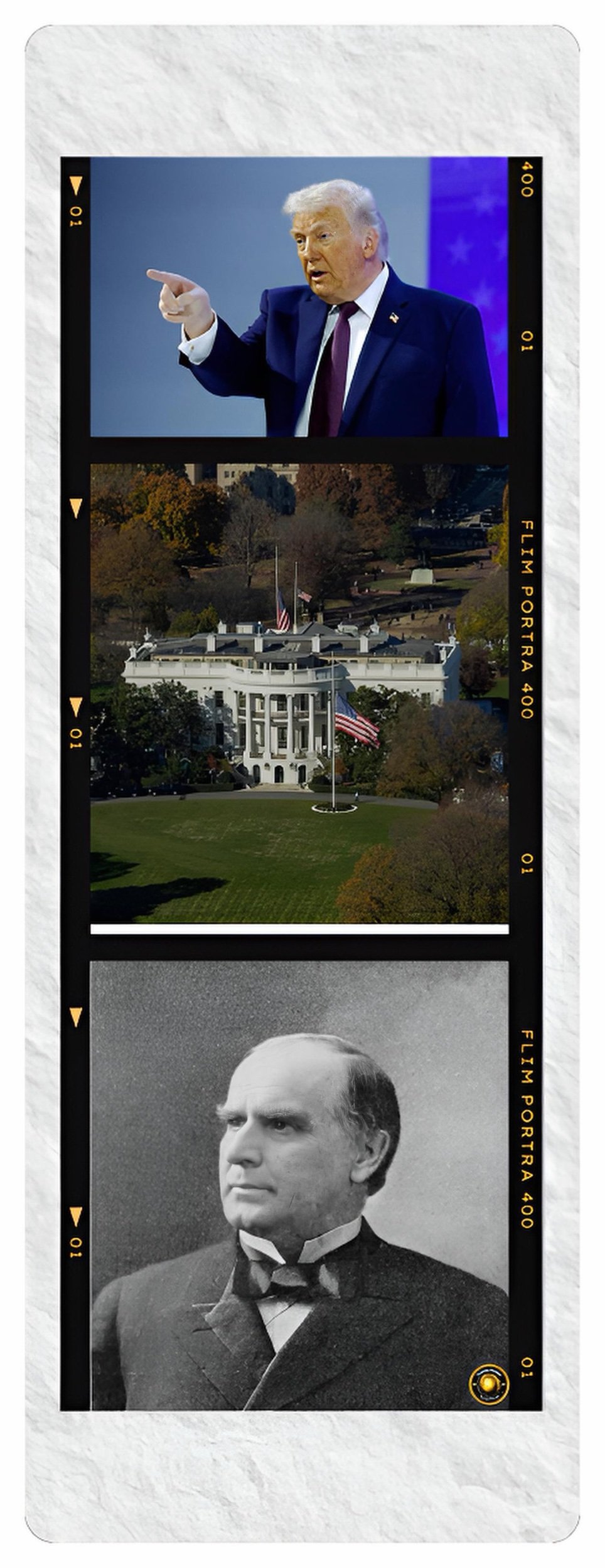
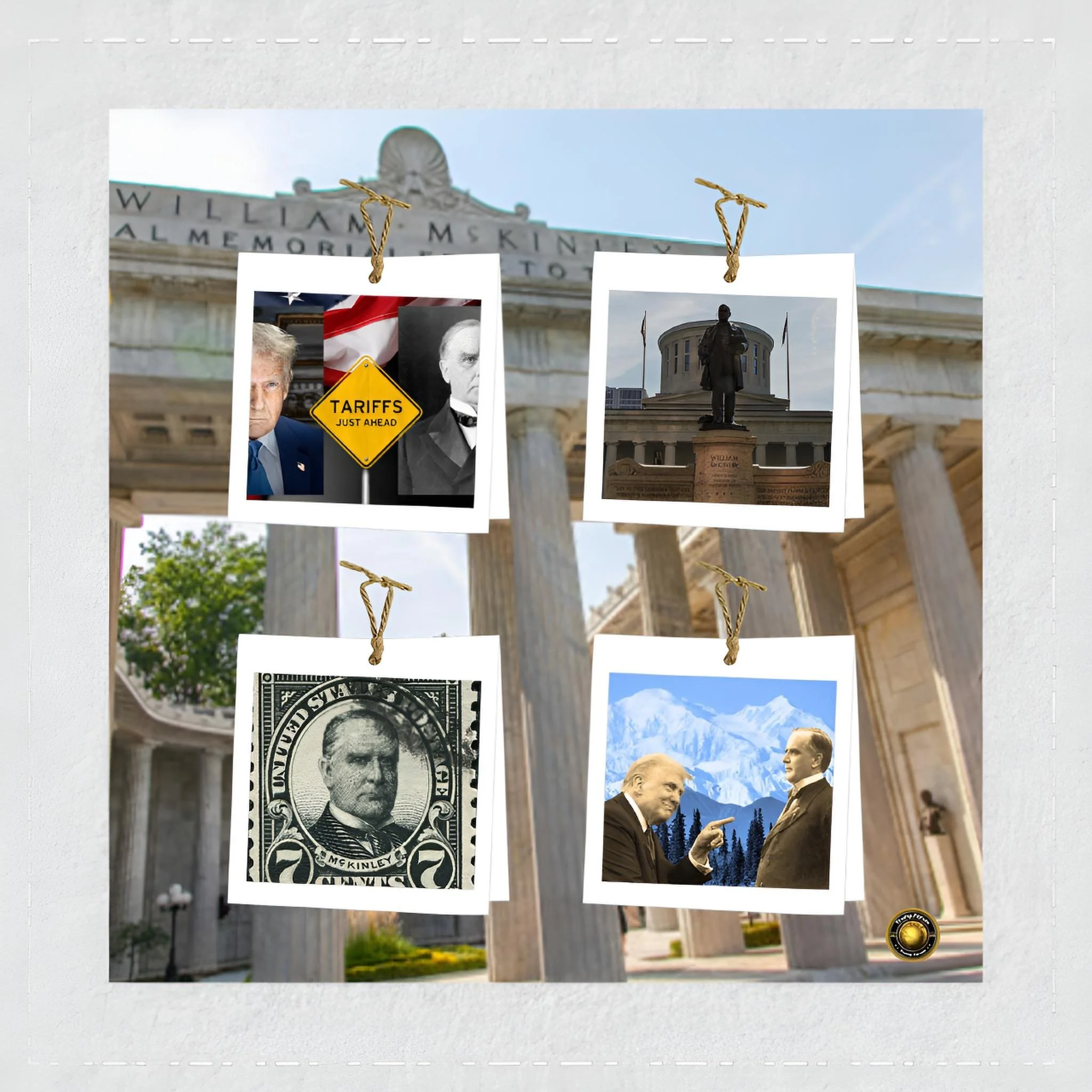
In his second inaugural address, Donald Trump paid explicit homage to William McKinley, the twenty-fifth president whose tenure from 1897 to 1901 marked the emergence of the United States as an imperial power. Trump praised McKinley as a "natural businessman" who "made our country very rich through tariffs and through talent." He restored Mount McKinley as the name of North America's highest peak (previously renamed Denali by the Obama administration in recognition of indigenous Alaskan heritage), symbolically reclaiming a geographic feature associated with McKinley's imperialism. Trump has repeatedly quoted McKinley as declaring that tariffs made "the lives of our countrymen sweeter and brighter," invoking this nineteenth-century precedent to justify contemporary protectionist policies.
Yet Trump's McKinley fetishism extends far beyond economic policy. His explicit threats to acquire Greenland from Denmark, his demands to reclaim the Panama Canal from Panama, his proposed annexation of Canada, and his military intervention in Venezuela all echo McKinley's imperial template. Trump and his deputy chief of staff, Stephen Miller, have articulated an explicit ideology centered on what Miller termed the "iron laws" of international relations: strength, force, and power. This framework represents a categorical rejection of the post-1945 liberal international order and a deliberate return to nineteenth-century imperialism as the organizing principle of American foreign policy.
This represents a fundamental philosophical shift with profound geopolitical consequences. To understand what Trump is attempting to resurrect through his McKinley obsession requires examining both McKinley's actual historical record and the historical distortions necessary to make it serve contemporary imperial ambitions.
The McKinley Era: Tariffs, War, and the American Century's Violent Birth
William McKinley assumed the presidency in 1897 at a moment when American economic and military power was ascending but political will for imperial expansion remained contested. McKinley transformed American foreign policy from a posture of relative restraint into one of aggressive territorial acquisition and economic dominance. His presidency would establish the precedent that Trump now seeks to resurrect.
The economic centerpiece of McKinley's agenda was protectionist tariff policy. In 1897, McKinley signed the Dingley Tariff Act, which raised tariffs to approximately 50 percent on manufactured goods. This tariff was the longest-running in American history at that time, remaining in effect for twelve years. It represented a dramatic escalation from already-high tariff rates and served as McKinley's primary economic policy instrument.
Yet the consequences of this tariff regime reveal precisely why historians regard it with skepticism. The tariffs sparked immediate inflation; contemporary newspaper accounts attributed rising prices of clothing, food, and other consumer goods directly to the tariff regime. The political consequences were devastating. In the 1890 midterm elections, Republicans experienced a landslide defeat, with voters blaming the McKinley-era tariffs for the rising cost of living. McKinley himself lost his congressional seat in this backlash. The 1892 presidential election saw Republican President Benjamin Harrison defeated by Democrat Grover Cleveland, with McKinley-era tariffs identified as a significant contributing factor.
Crucially, historians have determined that the economic growth of the 1890s was not attributable to tariff policy. Rather, expansion during this decade resulted from technological advancement—the proliferation of railroad networks, the spread of electricity, improvements in telecommunications—combined with massive immigration that supplied cheap labor and crucial skilled workers. Additional capital and resources flowed from British investment and from the opening of new American agricultural lands. McKinley's tariffs likely had negligible impact on either direction of economic growth. The prosperity of the era occurred despite prohibitive tariffs, not because of them.
Moreover, contemporary economic analysis understood that Americans themselves paid the tariffs, not foreign competitors as Trump repeatedly asserts. Republicans defending the tariffs argued that while Americans bore the direct cost, tariff protection would raise wages and enhance real income by limiting foreign competition. This was the mercantilist logic of the era. Yet the evidence suggests that working people suffered while manufacturers and large capitalists profited—a dynamic Trump explicitly seeks to replicate through his contemporary tariff regime.
Economically, McKinley's tariff policy proved sufficiently damaging that McKinley himself began to moderate his position by 1900-1901. In a speech at the Pan-American Exposition in Buffalo in September 1901, McKinley explicitly pivoted toward "reciprocity"—bilateral trade agreements that would reduce tariff barriers—and argued that the United States, with its manufacturing surplus, benefited from open export markets. He abandoned the protectionist orthodoxy that had defined his earlier career. His assassination the day after this speech prevented him from implementing this evolved policy. What McKinley's presidency would have become under continued life remains speculative.
Imperial Expansion: The Spanish-American War and the Acquisition of Empire
Beyond tariff policy, McKinley's historical significance rests on his transformation of the United States into an imperial power. In 1898, exploiting popular anger over Spanish mistreatment of Cuban insurgents and the mysterious explosion of the USS Maine in Havana Harbor, McKinley led the country into war against Spain. The conflict lasted barely ten weeks, but its consequences would reshape American foreign policy and global positioning for decades.
The immediate causes of war reflected genuine humanitarian concerns regarding Spanish conduct in Cuba, where Spanish General Valeriano Weyler had implemented a brutal "reconcentration" policy that forcibly relocated hundreds of thousands of rural Cubans to towns, conditions so harsh that an estimated 170,000 Cubans died during the insurgency. American newspapers, particularly those owned by William Randolph Hearst and Joseph Pulitzer, amplified these atrocities while also sensationalizing threats to American economic and strategic interests.
Yet McKinley's war aims expanded dramatically once hostilities commenced. In the conflict's opening naval engagement, Commodore George Dewey destroyed the Spanish Pacific fleet in Manila Bay on May 1, 1898, with the famous command "You may fire when you are ready, Gridley." This victory gave the United States control of the Philippines, then a Spanish colony with no direct bearing on American security or the war's ostensible purpose of liberating Cuba.
McKinley's response to this military opportunity revealed his imperial ambitions. Rather than repatriating troops after Spain's rapid military defeat, McKinley authorized massive troop deployments to the Philippines. In the Treaty of Paris signed on December 10, 1898—notably without Cuban or Filipino representation—McKinley extracted a remarkable territorial concession from Spain. The United States gained Puerto Rico and Guam outright. More significantly, the United States purchased the Philippines from Spain for twenty million dollars, an enormous sum at the time. Cuba was granted nominal independence, though American military administration would oversee the island for years to come.
Simultaneously, McKinley moved to annex Hawaii. American planters had long sought Hawaiian annexation to preserve their preferential trade status after the McKinley Tariff of 1890 had undermined Hawaii's economic position by opening American markets to other sugar producers. In June 1898, using the Spanish-American War as justification, McKinley lobbied Congress to pass a joint resolution annexing Hawaii. The resolution passed with broad bipartisan support, and Hawaii became American territory without consultation with or consent from Queen Liliuokalani, Hawaii's reigning monarch, or the Hawaiian people. An indigenous Hawaiian anti-annexation petition, signed by approximately thirty-eight thousand Hawaiians—a substantial percentage of the islands' population—was dismissed and ignored.
The Philippine-American War: The Human Cost of Benevolent Imperialism
While McKinley framed American expansion as "benevolent assimilation"—a paternalistic mission to educate and uplift supposedly uncivilized peoples—the reality proved catastrophically different. The Philippines, having declared independence in June 1898 under the leadership of Emilio Aguinaldo, saw their nationalist aspirations destroyed by American occupation. When Aguinaldo's provisional government requested independence and international recognition, McKinley refused. Instead, the United States annexed the archipelago as a colonial possession.
Filipino resistance was immediate and sustained. In February 1899, barely two months after the Treaty of Paris, fighting erupted between American forces and Filipino insurgents. What McKinley and American military leaders expected to be a brief pacification campaign transformed into a grueling conflict lasting until 1902, with continued insurgency in peripheral regions extending until 1913.
The Philippine-American War resulted in staggering casualties. Estimates suggest that between two hundred thousand and two hundred fifty thousand Filipinos died during the conflict, with some estimates reaching as high as one million. The vast majority were civilians who perished from combat, famine, disease, and cholera epidemics exacerbated by the disruption of normal economic and social life. American forces, facing Filipino guerrilla tactics after conventional battles concluded, adopted increasingly brutal counterinsurgency methods including scorched-earth campaigns and forced relocations to concentration camps.
American casualties totaled approximately four thousand troops killed and another three thousand wounded. Yet for Filipinos, the cost was incomparably higher. The war devastated the islands' infrastructure, decimated the population, and decisively ended any prospect of Filipino self-determination. The cultural consequences were equally profound. American colonial authorities suppressed Filipino language instruction, discouraged traditional cultural practices, and imposed Protestant Christianity as the official religion. Hawaiian culture experienced similar devastation under American rule, with traditional practices prohibited and native Hawaiian health, economic, and political position systematically degraded.
The Philippine-American War represented the first major application of American military power to suppress nationalist movements. It established precedents that would be repeatedly invoked in subsequent interventions throughout the twentieth and twenty-first centuries. It demonstrated that the possession of overwhelming military superiority could be deployed to prevent self-determination even when doing so violated explicit American principles regarding sovereignty and independence. Critically, it revealed that maintaining empire through military force required continuous violence, massive resource expenditure, and acceptance of significant American casualties.
The Chosen Template: Why Trump Reveres McKinley
Trump's explicit veneration of McKinley reflects several interconnected motivations. First and most superficially, Trump conflates McKinley's tariff policy with economic prosperity, mining the Gilded Age as a historical precedent for protectionist trade policy. Trump repeatedly invokes McKinley in justifying his tariff increases, which he announced on "Liberation Day" in April 2025, implying that trade engagement represented occupation and that tariffs constituted liberation.
More profoundly, McKinley serves Trump as the historical model for imperial expansion. McKinley acquired territories, expanded American dominance, and demonstrated presidential willingness to employ military force to achieve territorial and economic objectives without international approval or institutional constraint. This template directly enables Trump's contemporary ambitions regarding Greenland, Panama, and Canada. Trump explicitly framed his territorial acquisition ambitions in Mckinley's language, declaring during a press conference that he was "approaching the dawn of America's golden age"—explicitly evoking the Gilded Age as the historical model for his presidency.
Ideologically, McKinley represents a figure who operated without commitment to liberal internationalism, multilateral institutions, or rules-based order. McKinley annexed territories through executive action and military force rather than through international negotiation. He demonstrated that American presidential power, when wielded decisively, could override the preferences of other states and international norms. He showed that imperial expansion could be rhetorically justified through appeals to American exceptionalism and civilizational superiority. For Trump, who explicitly rejects multilateralism and institutional constraint, McKinley exemplifies presidential authority unleashed from institutional limitation.
Most importantly, McKinley represents the last moment in American history when unilateral territorial expansion was internationally normalized and when great-power imperialism was the accepted framework for international relations. Trump and his closest advisers are attempting to resurrect this framework as the organizing principle of contemporary American foreign policy. Stephen Miller's articulation of the "iron laws" of international relations—strength, force, and power—directly echoes nineteenth-century great-power competition logic that McKinley embodied. McKinley is valuable to Trump precisely because he operates in a historical moment before liberal internationalism was established as the post-1945 framework.
The Historical Distortions: What Trump Gets Wrong About McKinley
Trump's McKinley mythology requires substantial historical distortion to serve contemporary purposes. These distortions reveal the selective nature of Trump's historical imagination and the ideological work necessary to resurrect nineteenth-century imperialism as contemporary policy.
First, Trump attributes McKinley's economic success to tariff policy, ignoring both the documented recession of the 1890s and the scholarly consensus that economic growth resulted from technological advancement, capital investment, labor immigration, and resource availability rather than tariff protection. Trump has suggested that the 1880s and 1890s represented a golden age of American capitalism proportional to GDP, but this ignores the grinding poverty, child labor, lack of workplace safety, and extreme inequality that characterized the Gilded Age. While the wealthy accumulated unprecedented fortunes, working people endured subsistence wages, dangerous working conditions, and economic instability. Trump's invocation of this era as a model implicitly endorses this distribution of wealth and hardship.
Second, Trump ignores McKinley's subsequent evolution toward free trade and reciprocal trade agreements. McKinley's final speech, delivered hours before his assassination, explicitly abandoned protectionism in favor of bilateral agreements that would reduce tariff barriers and open export markets. This represented a fundamental policy reversal driven by McKinley's recognition that American manufacturing capacity exceeded domestic demand and that exports were necessary to utilize this capacity profitably. Trump's McKinley mythology freezes McKinley at the 1897 tariff moment while erasing the evolution toward economic liberalism that McKinley embraced by 1901.
Third, Trump completely elides the catastrophic human costs of McKinley's imperialism. The death of hundreds of thousands of Filipinos, the decimation of Hawaiian culture and indigenous population, the violent suppression of nationalist movements—these historical realities are absent from Trump's celebratory invocation of McKinley as a model. Trump treats imperial expansion as a matter of prestige and territorial acquisition without engagement with the violence and suffering that such expansion required and produced.
Fourth, Trump ignores that McKinley operated in a radically different international context. In the 1890s, imperialism was the globally normalized framework for organizing international relations. Britain, France, Germany, and other European powers were simultaneously engaged in territorial expansion and colonial acquisition. The Scramble for Africa, the carving up of China through unequal treaties, the subjugation of Asia—these occurred as McKinley pursued American expansion. In this context, McKinley's imperialism was neither exceptional nor condemned. By contrast, Trump's contemporary imperial ambitions occur within a post-1945 framework explicitly constructed to prevent great-power territorial expansion and preserve state sovereignty. The international context has fundamentally changed in ways that render McKinley's methodology anachronistic and destabilizing.
The Liberal International Order Under Siege
To fully appreciate the significance of Trump's McKinley obsession, one must understand what he is explicitly attempting to dismantle: the liberal international order constructed after 1945. This order emerged from the ashes of World War II, when the combined costs of Nazi and Japanese imperialism—tens of millions of deaths, destroyed economies, devastated continents—demonstrated the catastrophic consequences of unchecked great-power competition.
The architects of post-war order—American policymakers, European allies, and eventually even defeated enemies Germany and Japan—deliberately chose a different template. Rather than seeking territorial conquest or economic domination through force, the United States embedded its power within institutions: NATO alliances treating members as peer powers, the United Nations Charter guaranteeing national sovereignty, the Bretton Woods system institutionalizing international economic cooperation, and later the GATT and subsequent trade frameworks. This system allowed the United States to exercise hegemonic power through institutional leadership rather than through direct territorial control.
This represented a revolutionary innovation in how hegemonic powers organize global affairs. Previous hegemonic powers—the Spanish Empire, the British Empire—relied on territorial possession and direct colonial administration. The American model distributed costs across allies, created positive-sum cooperation, and embedded restraint through institutional rules. Crucially, this system generated extraordinary prosperity for the United States itself. American manufacturers accessed global markets through trade agreements. American technology diffused globally, creating markets for American goods. American security guarantees attracted allies whose security and prosperity benefited American economic interests. The system was not altruistic; it advanced American interests precisely by advancing the interests of others.
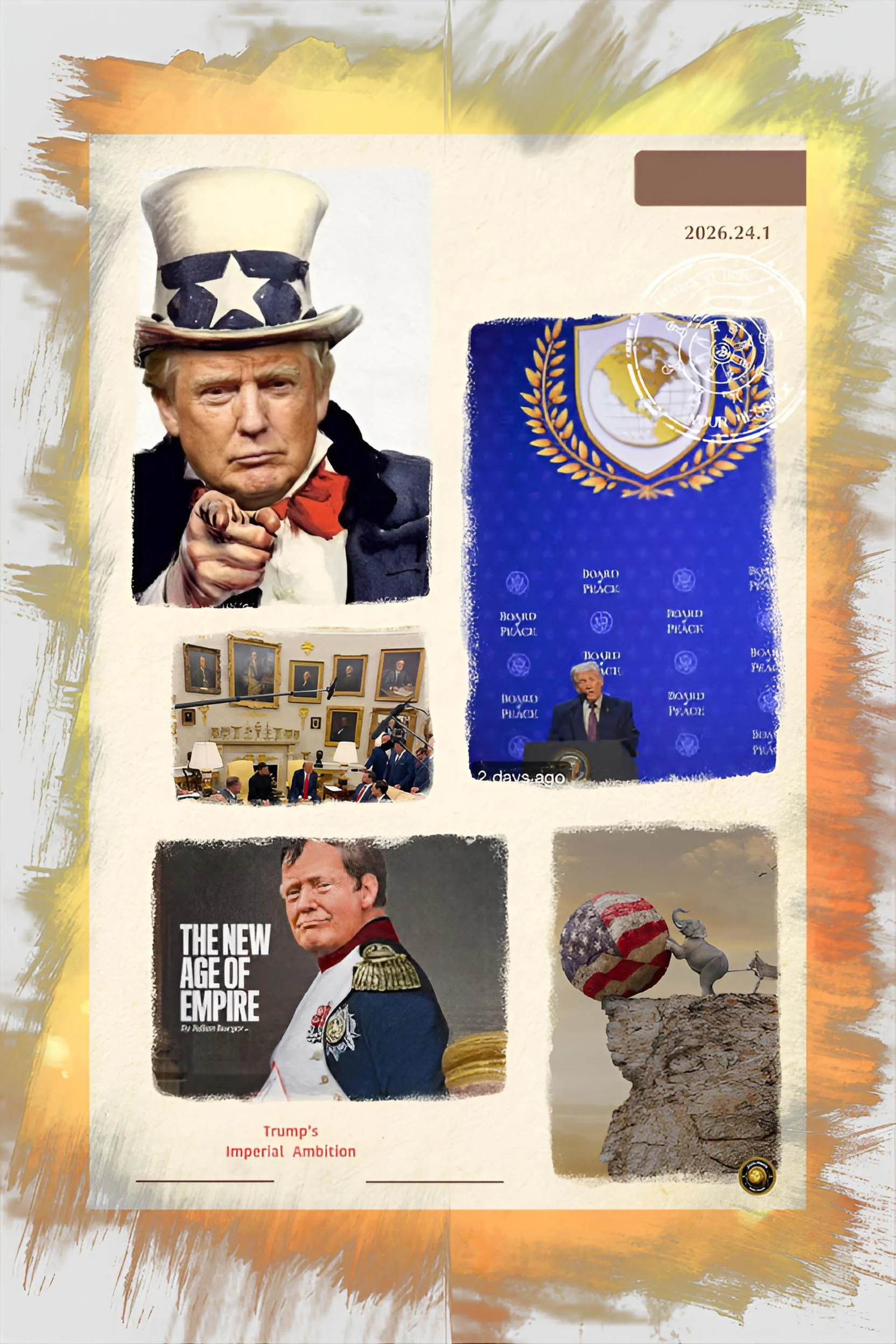
Trump explicitly rejects this entire framework. His 2025 National Security Strategy contains no reference to democracy, human rights, or the values-based approach that characterized post-1945 American foreign policy rhetoric. Instead, it emphasizes great-power competition, spheres of influence, and transactional relationships. Trump has withdrawn the United States from sixty-six international organizations, signaling systematic deconstruction of the institutional architecture that enabled American dominance.
What Trump is attempting to resurrect through McKinley is the pre-1945 model: great-power territorial expansion, unilateral force projection, the acquisition of resources and strategic positions through military superiority, and the organization of international affairs through spheres of influence rather than through rules. Miller's assertion that international relations are governed by strength, force, and power explicitly rejects the liberal institutions designed to constrain these factors.
The Strategic Contradiction: Imperial Decline Disguised as Imperial Restoration
The deepest paradox animating Trump's McKinley obsession is this: he is attempting to resurrect nineteenth-century imperialism from a position of constrained capacity precisely when the international context most demands institutional cooperation. McKinley operated from a position of rapidly ascending American power. Industrial production was surging. Naval capacity was expanding. Capital was accumulating. Immigration was supplying labor. The United States faced no peer competitors and had substantially limited exposure to great-power conflict.
Trump, by contrast, operates from a position of constrained capacity. The United States faces substantial budgetary deficits and declining infrastructure investment. China and Russia have emerged as peer competitors with sophisticated military capabilities. The costs of maintaining global military presence have escalated dramatically. Manufacturing capacity has diminished relative to service economy. Human capital gaps are widening. Climate change, pandemics, resource scarcity, and artificial intelligence—challenges that transcend sphere-of-influence boundaries—demand precisely the coordinated institutional response that Trump is dismantling.
Moreover, Trump's contemporary imperial ambitions confront a fundamentally changed international legal and institutional framework. When McKinley annexed territories, he violated no international law because international law barely existed and imperialism was normalized as legitimate state behavior. When Trump threatens to seize Greenland from Denmark, he directly violates the UN Charter and NATO alliance commitments. When he occupied Venezuela, he contravened the Organization of American States charter and fundamental principles of sovereignty enshrined in inter-American agreements.
The consequences of attempting to resurrect imperialism in this context are already apparent. European allies, recognizing the conditionality of American security commitments, are accelerating independent defense capabilities and developing alternative institutional structures. Japan and South Korea are hedging their security relationships. China perceives Trump's hemispheric focus as implicit acquiescence to Chinese dominance in the Indo-Pacific. Russia is emboldened by American rupture with European allies. The dollar's status as global reserve currency is eroding as other actors seek alternatives.
Trump's attempt to restore American dominance through imperial methodology is producing the opposite effect: a fractured international order, accelerated multipolarity, and declining American influence. The liberal international order that Trump dismisses as constraining actually enabled American dominance. Withdrawal from this order does not liberate American power—it isolates and diminishes it.
Ideological Foundations: The "Iron Laws" and the Rejection of Constraint
Trump's and Miller's explicit articulation of the philosophical foundations underlying their foreign policy reveals the ideological core animating the McKinley obsession. Miller's characterization of international relations as governed by "strength, force, and power"—the "iron laws" existing "since the beginning of time"—represents a wholesale rejection of liberal institutional theory and a return to nineteenth-century realism.
This philosophical framework treats states as unitary actors in permanent competition for power. It dismisses international law as "international niceties" that only constrain satisfied powers while ambitious ones disregard them. It views institutions as constraints on power rather than as force multipliers. It treats cooperation as weakness and unilateral assertion as strength. Notably, this framework ignores centuries of evidence demonstrating that institutionalized cooperation produces superior outcomes for all participants compared to competition in anarchic systems.
The ideology also explicitly embraces cultural nationalism and hierarchy. Trump and Miller invoke imagery of American superiority, manifest destiny, and the justified dominance of civilizationally advanced peoples over less developed populations—precisely the language that justified nineteenth-century imperialism and twentieth-century colonialism. Miller's contempt for "international niceties" and his assertion that the United States should act without constraint reflects a worldview wherein American preferences supersede both international law and the preferences of other actors.
This ideological framework is not pragmatic—it does not rest on careful analysis of how to maximize American interests in contemporary context. Rather, it reflects genuine philosophical commitment to hierarchy, unilateralism, and the belief that power should be exercised without institutional mediation. The admiration for McKinley is not instrumentally motivated—it reflects deep identification with an imperial figure who exercised power without institutional constraint.
Future Trajectories
The Trajectory of Imperial Decline
If Trump continues on the path his McKinley obsession indicates, several consequences appear likely. First, further escalation of territorial and resource acquisition attempts. Trump will likely press demands regarding Greenland until some form of acquisition or functional control is achieved. The Panama Canal will remain a target. Canadian integration will be pursued through economic coercion. Venezuela's governance will be dictated by American authorities exercising military occupation.
Second, continued acceleration of great-power competition without moderating institutions. The withdrawal from liberal international order will manifest in multiple regional competitions: European rearmament and possible security autonomy from the United States; Asian hedging and potentially expedited conflict over Taiwan; Middle Eastern fragmentation as American security commitments prove contingent; Latin American diversification away from American dependence.
Third, erosion of the dollar's reserve currency status as other actors develop alternative payment systems and reduce dollar exposure. The financial hegemony that has been as important as military hegemony to American dominance will gradually diminish.
Fourth, normalization of territorial acquisition and spheres-of-influence thinking at the global level. If the United States explicitly claims the Western Hemisphere as its exclusive sphere, it implicitly legitimizes Russian claims over Eastern Europe, Chinese claims over the Indo-Pacific, and Indian claims over South Asia. The multipolar world that emerges will be characterized by contested boundaries, military competition, and significantly greater probability of great-power conflict.
Conclusion
The Golden Age That Was Never
Trump's obsession with William McKinley reveals far more than nostalgia for nineteenth-century economic policy or historical admiration for a distant predecessor. It represents a comprehensive ideological commitment to dismantling the institutional architecture that enabled American dominance and substituting instead the nineteenth-century framework of great-power territorial competition that produced catastrophe in the early twentieth century.
The historical reality of McKinley's presidency differs substantially from the mythology Trump has constructed. McKinley's tariffs contributed to recession rather than prosperity. His imperialism resulted in hundreds of thousands of deaths and the violent suppression of nationalist movements. His late evolution toward free trade demonstrates his own recognition that protectionism was counterproductive. Yet Trump has extracted from McKinley the ideological template for unilateral imperial assertion while discarding the inconvenient historical realities and McKinley's subsequent policy evolution.
What Trump is attempting to resurrect is the pre-1945 world of great-power competition, territorial acquisition, and unmediated force projection. He is attempting this not from a position of ascending power but from a position of relative constraint. He is attempting this not in a context where imperialism is normalized internationally but in one explicitly designed to prevent it. The consequences are already apparent: allied fragmentation, competitor emboldening, and accelerated erosion of the structural foundations of American power.
The irony is profound. Trump believes he is restoring American greatness by resurrecting McKinley's imperialism. Instead, he is accelerating the very multipolarity and American decline he claims to resist. The golden age Trump seeks to restore was never as golden as the mythology suggests, and the attempt to resurrect it will leave America weaker, more isolated, and less capable of addressing the strategic challenges of the twenty-first century. McKinley's imperialism was catastrophic in its own time. Its resurrection in contemporary context promises to be catastrophic again.