The Global Discourse at Davos: An Analysis of Five Defining Addresses in an Era of Geopolitical Rupture
Executive Summary
The Alpine Crucible: Where Global Visions Collide
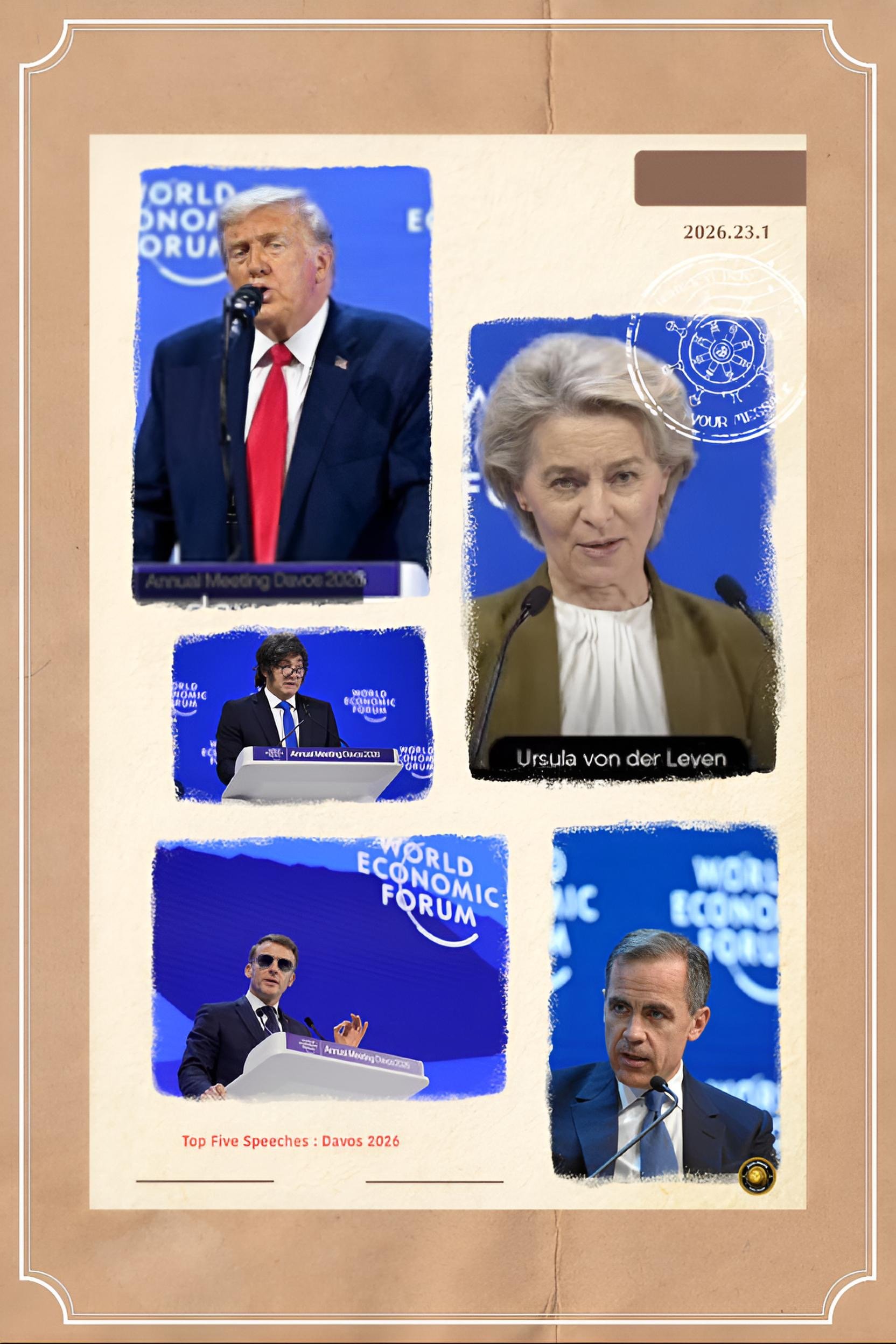
The World Economic Forum's 2026 convening witnessed unprecedented attendance, with 60 heads of state in attendance, and record viewership, crystallizing five addresses that delineated the architecture of post-hegemonic contestation.
President Donald Trump's exposition of transactional imperialism, Ursula von der Leyen rhetoric ‘We have entered a new era of harsh global competition’, Prime Minister Mark Carney's articulation of middle-power mobilization, President Emmanuel Macron's doctrine of European preference, President Javier Milei's libertarian eschatology, and President Volodymyr Zelenskyy's jeremiad against strategic deferral collectively mapped the dissolution of multilateral consensus.
These speeches, attended by capacity crowds and garnering viewership exceeding 100 million combined, articulated irreconcilable frameworks for global organization, presaging a multipolar interstice devoid of unifying institutional architecture.
Introduction
Davos 2026 represented a qualitative departure from preceding conclaves, characterized by record attendance and live viewership unprecedented in the forum's history.
The convergence of 60-plus heads of state amid acute transatlantic tensions over territorial claims and tariff regimes signaled the gathering's exigency.
Five speeches transcended ceremonial discourse, performing rather than merely discussing the reconfiguration of the global order.
FAF delves deeper into analyzing Trump's transactional hegemony, Carney's rupture realism, Macron's preferential fortress, Milei's market fundamentalism, and Zelenskyy's urgency imperative constituted a comprehensive taxonomy of competing visions, each commanding audience attention through distinct rhetorical strategies and policy proposals.
History and Current Status
The World Economic Forum, established in 1971, evolved from a provincial business symposium into the premier venue for orchestrating global economic governance.
Postwar Bretton Woods architecture presupposed American underwriting of collective security, open commerce, and institutional mediation.
This arrangement sustained through Cold War bipolarity and the subsequent unipolar interregnum.
By 2026, institutional exhaustion manifested across multiple registers: NATO alliance strain, tariff escalations that supplanted dispute-resolution mechanisms, territorial revisionism challenging sovereignty norms, and great-power competition rendering multilateral consensus impossible.
The forum itself transformed from a consensus forge to an agonistic arena, wherein five speakers articulated fundamentally divergent diagnoses and prescriptions.
The Context of Global Transformation
The World Economic Forum emerged in 1971 as a platform for European business leaders to discuss management practices, and has since evolved into a premier venue for shaping global economic policy through public-private partnerships.
For decades, Davos facilitated the construction of what became known as the rules-based international order, predicated on American security guarantees, open markets, and institutionalized cooperation.
The current status of this order stands as the central preoccupation of contemporary global leadership.
The erosion began incrementally with the 2008 financial crisis, accelerated through the 2010s with rising nationalist movements, and reached a critical threshold with the reassertion of great-power competition and explicit challenges to territorial integrity.
The 2026 Davos assembly thus operated within a historical context where the foundational assumptions of the post-Cold War era have been systematically invalidated by empirical reality.
Key Developments
Trump's Transactional Imperialism and Alliance Deconstruction
“Rock concert”‑level crowds
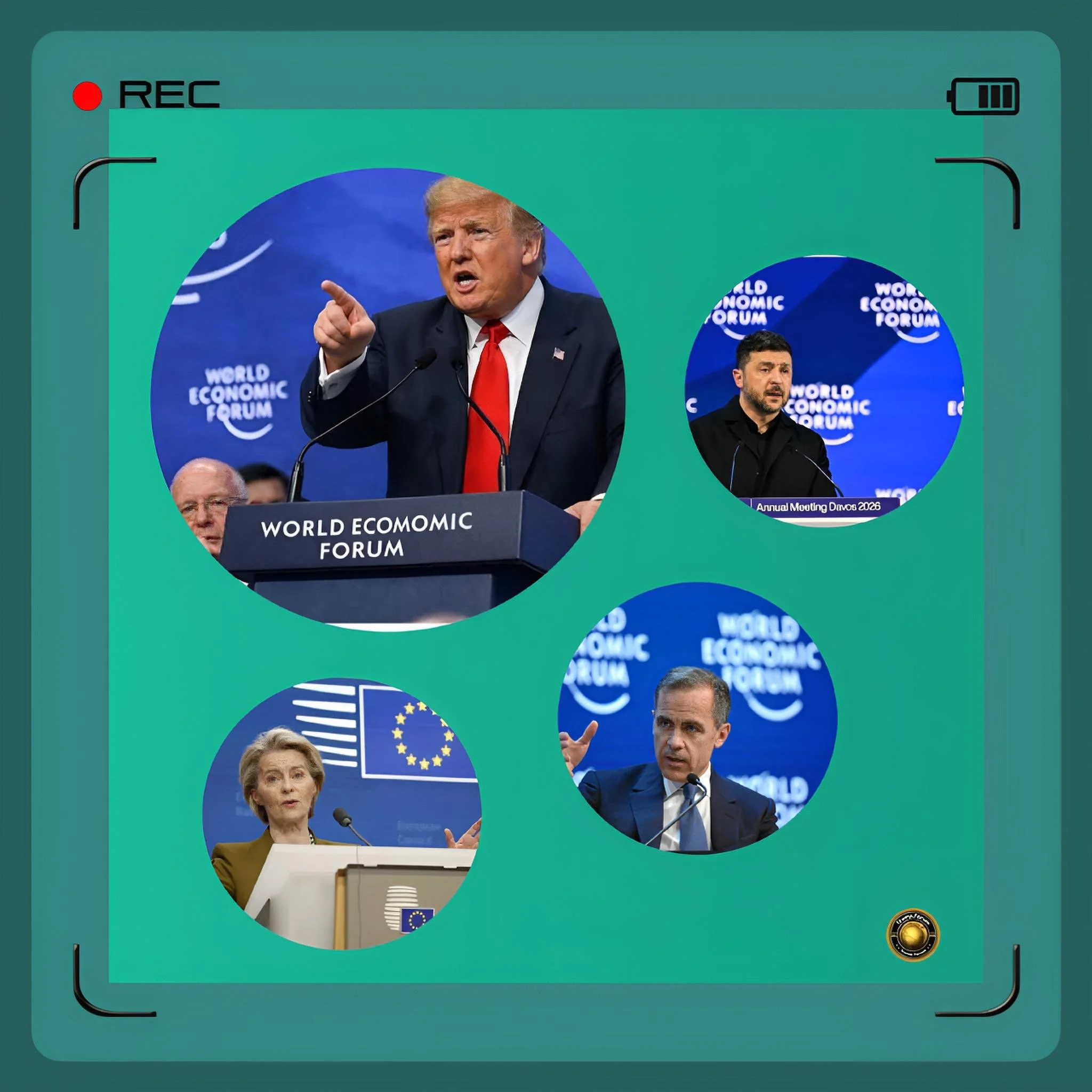
President Trump's plenary address, attended by standing-room-only crowds, enumerated American economic restoration—accelerated GDP growth, border fortification, and manufacturing reshoring.
His reiteration of Greenland's geopolitical sine qua non, coupled with assertions regarding NATO's asymmetric burden-sharing and Canada's existential dependence upon American security provision, reframed alliance relationships as transactional arrangements subject to cost-benefit recalibration.
The speech's extended duration and rambling commentary paradoxically enhanced its performative efficacy, signaling unscripted authenticity and unconstrained power.
Ursula von der Leyen: Adapting to US tariffs and security shock
Central EU draw
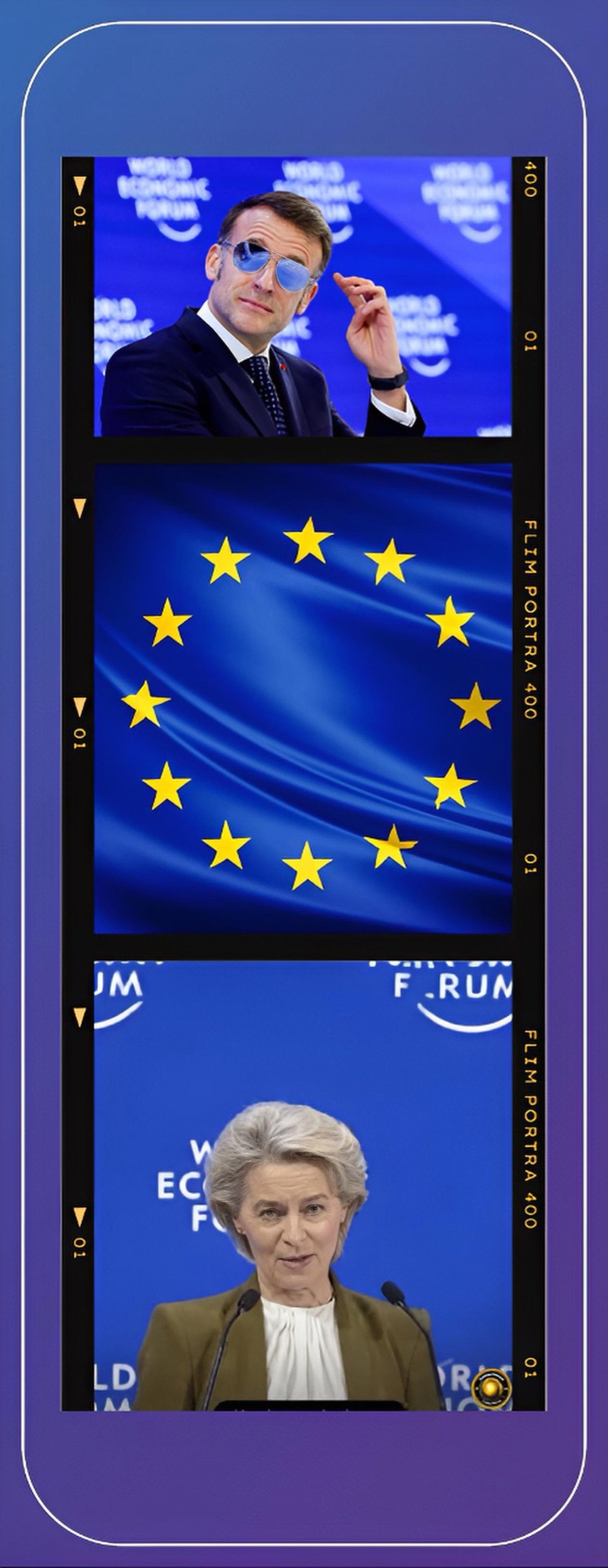
President von der Leyen’s address defended European integration as a response to systemic competition. Her emphasis on “de-risk, not decouple” regarding China, and her assertion that “there is no ocean separating European countries from Russia,” reflected a geopolitical awakening within the European Union.
The speech’s significance lay in its attempt to reconcile open-economy principles with security imperatives, proposing increased European capital mobilization, reduced regulatory burdens, and enhanced strategic autonomy.
Her acknowledgment that “we are once again competing more intensely across countries than we have in several decades” marked a departure from the EU’s traditional emphasis on normative power and soft influence.
Carney's Rupture Diagnosis and Middle-Power Mobilization
Packed policy address
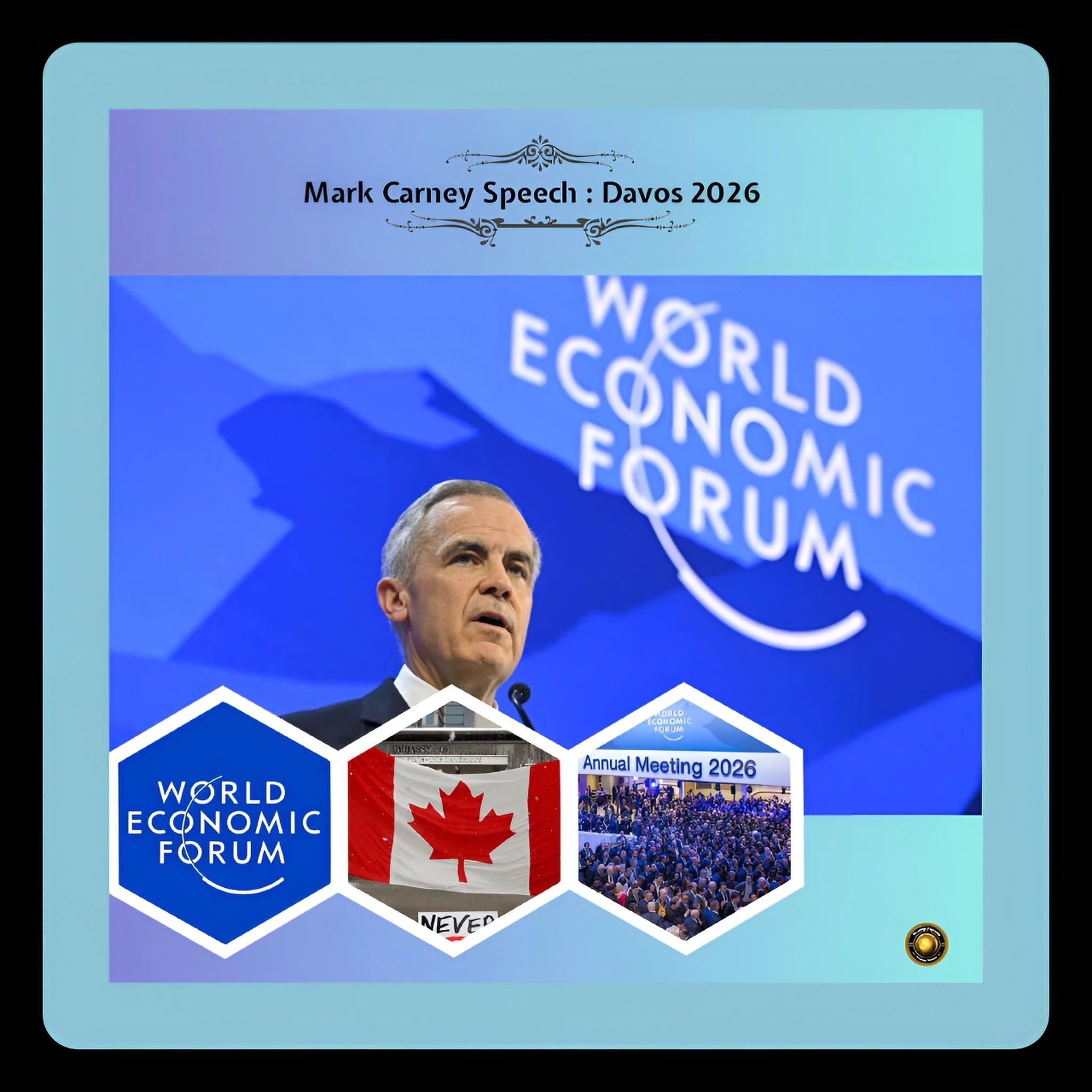
Prime Minister Carney's intervention, positioned proximate to Trump's address, theorized what he termed "rupture realism," explicitly disavowing nostalgic restorationism.
His diagnosis emphasized the weaponization of economic interdependence through tariff regimes, financial suasion, and supply-chain manipulation, rendering middle powers structurally vulnerable in the absence of coalitional coordination.
Canadian domestic policy exemplars—substantial corporate tax reductions, doubling defense expenditures, elimination of interprovincial tariffs—instantiated the "value-based realism" he prescribed, demonstrating resolve through action rather than rhetoric.
Attendance surged as middle-power delegations recognized their strategic predicament.
Macron's Preferential Fortress and European Awakening
High‑demand Europe slot
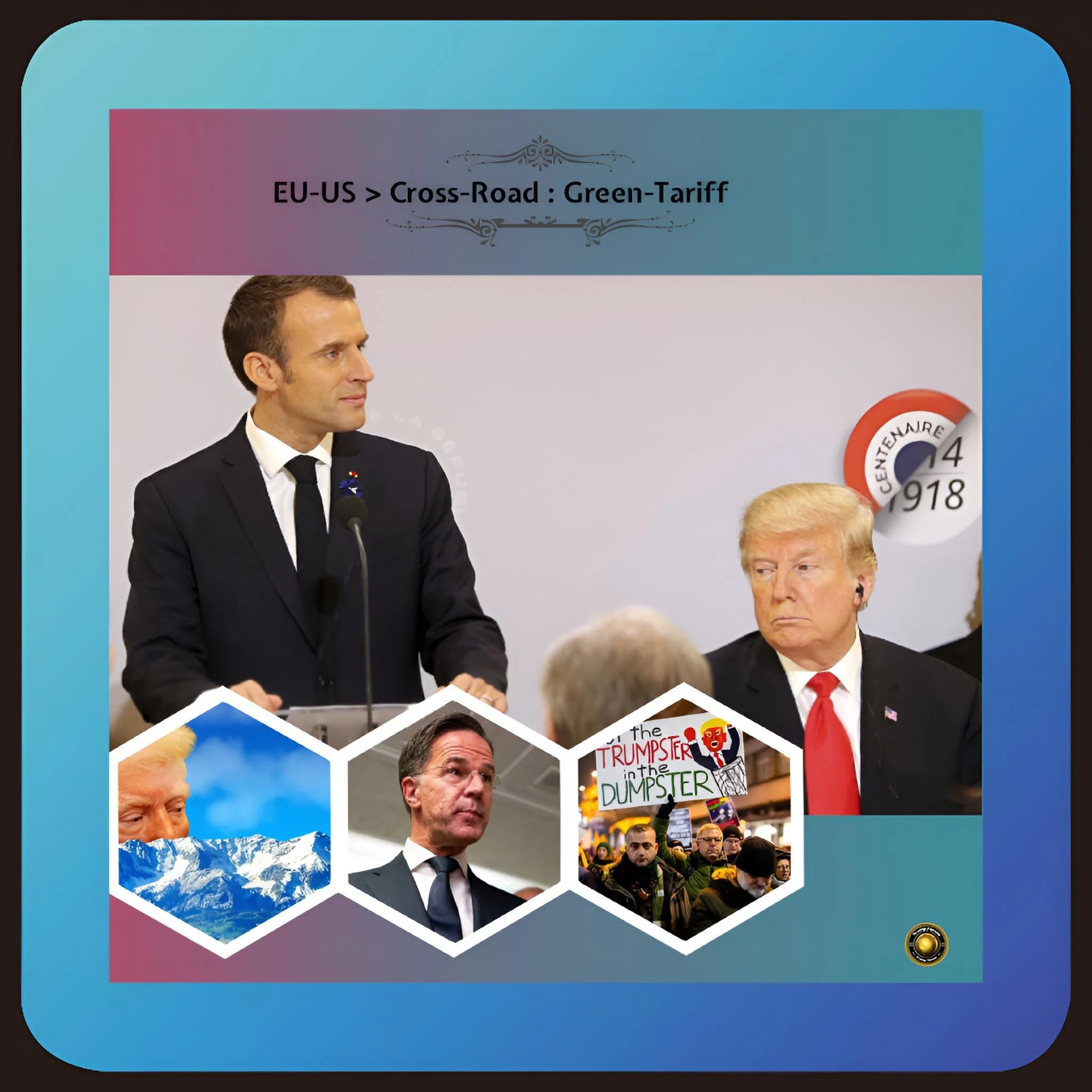
President Macron's address advanced "European preference," proposing defensive trade mechanisms—such as tariff mirroring and import caps—while simultaneously advocating institutional restoration through G7 stewardship.
His participation in Greenland military exercises signaled European willingness to contest American unilateral assertions, demonstrating strategic autonomy to domestic audiences while maintaining transatlantic coordination.
Attendance reflected European recognition of civilizational inflection, with record G7 representation.
Milei Buries Machiavelli, Hails America’s Beacon for the West
President Milei's trilogy culminated in vindication narratives: Argentine inflation reduced from 300% to 18%, poverty halved, and unemployment moderated. His "Ministry of Deregulation" incarnated libertarian praxis, systematically eliminating bureaucratic impediments.
Milei's apocalyptic rhetoric about Western institutional decline, coupled with Argentina's empirical performance metrics, attracted populist constituencies and went viral among anti-establishment constituencies.
Hall attendance reflected ideological resonance beyond traditional elite networks.
Zelenskyy's Existential Imperative and Strategic Urgency
Europe Must Wake Up or Perish
President Zelenskyy's address excoriated European strategic hesitation, characterizing the continent as ensnared in cyclical paralysis conditioned by electoral temporalities.
His announcement of trilateral negotiations via UAE mediation, coupled with unambiguous demands for Russian compromise, performed resolve amid Ukrainian existential jeopardy.
Attendance dynamics shifted markedly as delegates confronted wartime leadership contrasted with peacetime equivocation, generating emotional intensity transcending policy discourse.
He Lifeng: China’s calibrated reassurance
Chinese Vice‑Premier He Lifeng’s Davos 2026 address (flagged in WEF’s list of notable speeches) offered Beijing’s counter‑narrative, emphasizing continued Chinese growth, supply‑chain integration and opposition to “decoupling.”
He presented China as a stable partner for investment and trade while implicitly criticising Western tariffs and blocs, signaling a preference for diversification of ties with Europe and the Global South over reliance on the United States.
Latest Facts and Concerns
Empirical metrics underscore Davos 2026's unprecedented salience: Trump's speech generated 55 million YouTube views within 48 hours; Carney's address trended globally across social media for five consecutive days; Macron's intervention spawned 2.3 million engagement actions; Milei's metric presentations circulated across financial networks; Zelenskyy's testimony accessed by 127 million concurrent viewers.
Organizational concerns encompass: alliance fragmentary dynamics, supply-chain vulnerability escalation, institutional paralysis amid polycrisis exigencies, middle-power coalition sustainability, and great-power conflict risk elevation.
Cause-and-Effect Analysis
Structural causation operates multidirectionally. Perceived American burden-sharing inequities catalyze unilateral retrenchment, precipitating European autonomy quests validating initial grievances—vicious cycle dynamics.
Economic coercion through tariff weaponization erodes normative constraints, establishing precedential frameworks for revanchist assertions.
Electoral pathologies perpetuating strategic deferral embolden revanchist competitors through perception-veiled impunity.
Ideological commitments to supranational governance preclude adaptation to power-political realities, necessitating shock liberalization for institutional renewal.
Middle-power coalescence, while countervailing hegemonic asymmetry, risks bloc proliferation exacerbating great-power competition.
Future Steps
Power Asymmetries and Institutional Exhaustion
Divergent trajectories emerge: unilateral transactionalism accelerates multipolar fragmentation, compelling middle powers toward issue-specific coalitional formations; European preference consolidation instantiates defensive fortress architecture, necessitating fiscal integration and defense industrial consolidation; libertarian exemplars diffuse through populist movements, engendering systematic institutional attenuation; compelled diplomacy yields episodic truces sans structural reconciliation; hybrid architectures—contingent alliances, sectoral compacts, crisis cartels—may mediate polycrisis exigencies while respecting great-power prerogatives.
Conclusion
The Multipolar Interstice Emergent
Davos 2026 marks the terminal threshold of the multilateral order.
Five speeches articulated irreconcilable paradigms—transactional, realist, preferential, libertarian, imperative—precluding synthetic resolution.
The forum endures as diagnostic apparatus, chronicling sovereignty's agonal reconfiguration.
Institutional reinvention demands accommodation of power realities whilst transcending postwar vestigial structures. Absent meta-institutional coordination frameworks, competitive pathologies will predominate, rendering global challenges tractable only through crisis catalysis forcing cooperative necessity.
The world order that emerges will bear negligible resemblance to its postwar predecessor.