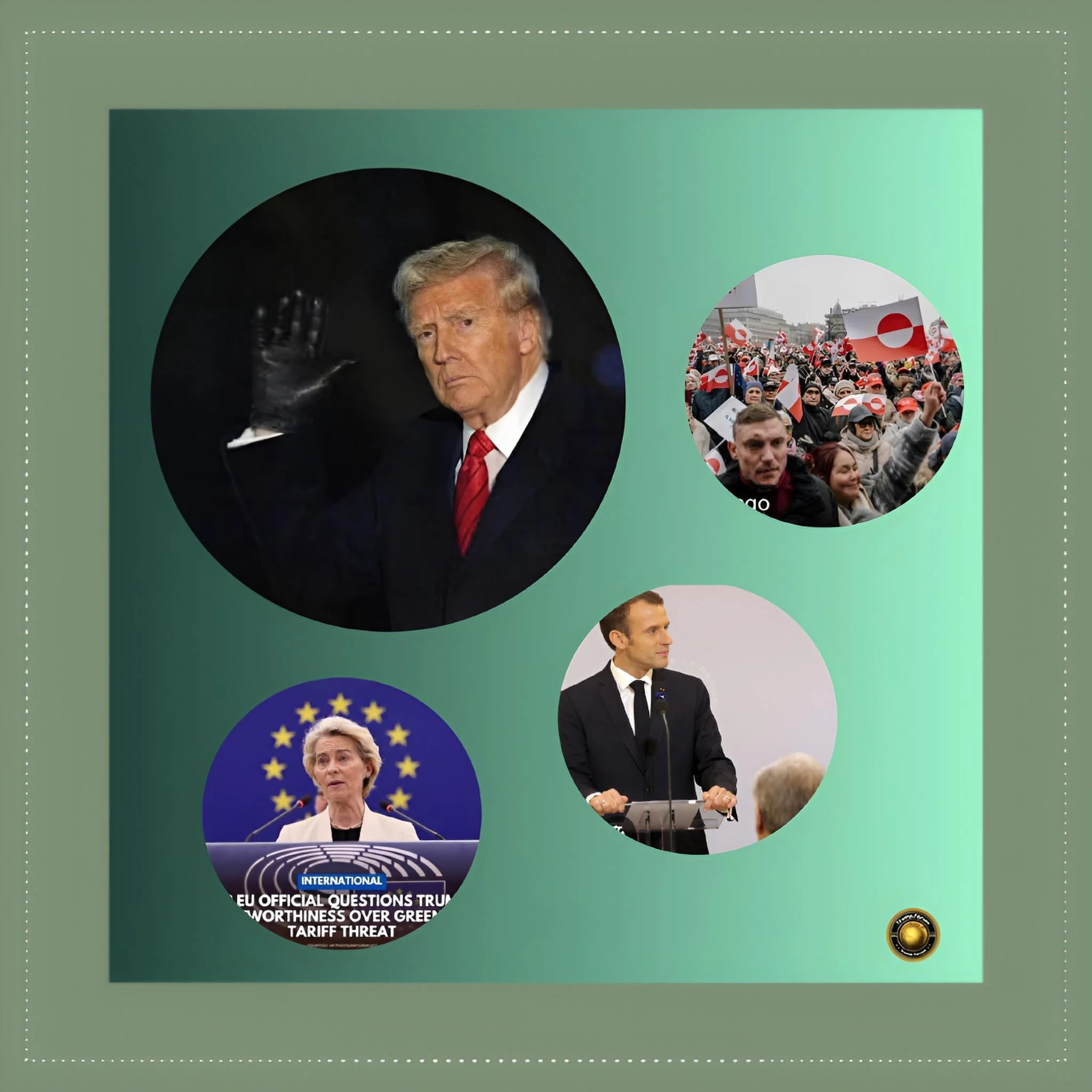
The Transatlantic Rupture: How Tariff Coercion Over Greenland Threatens NATO's Foundations and Reshapes Global Order
Executive Summary
Crisis unfolding in Davos
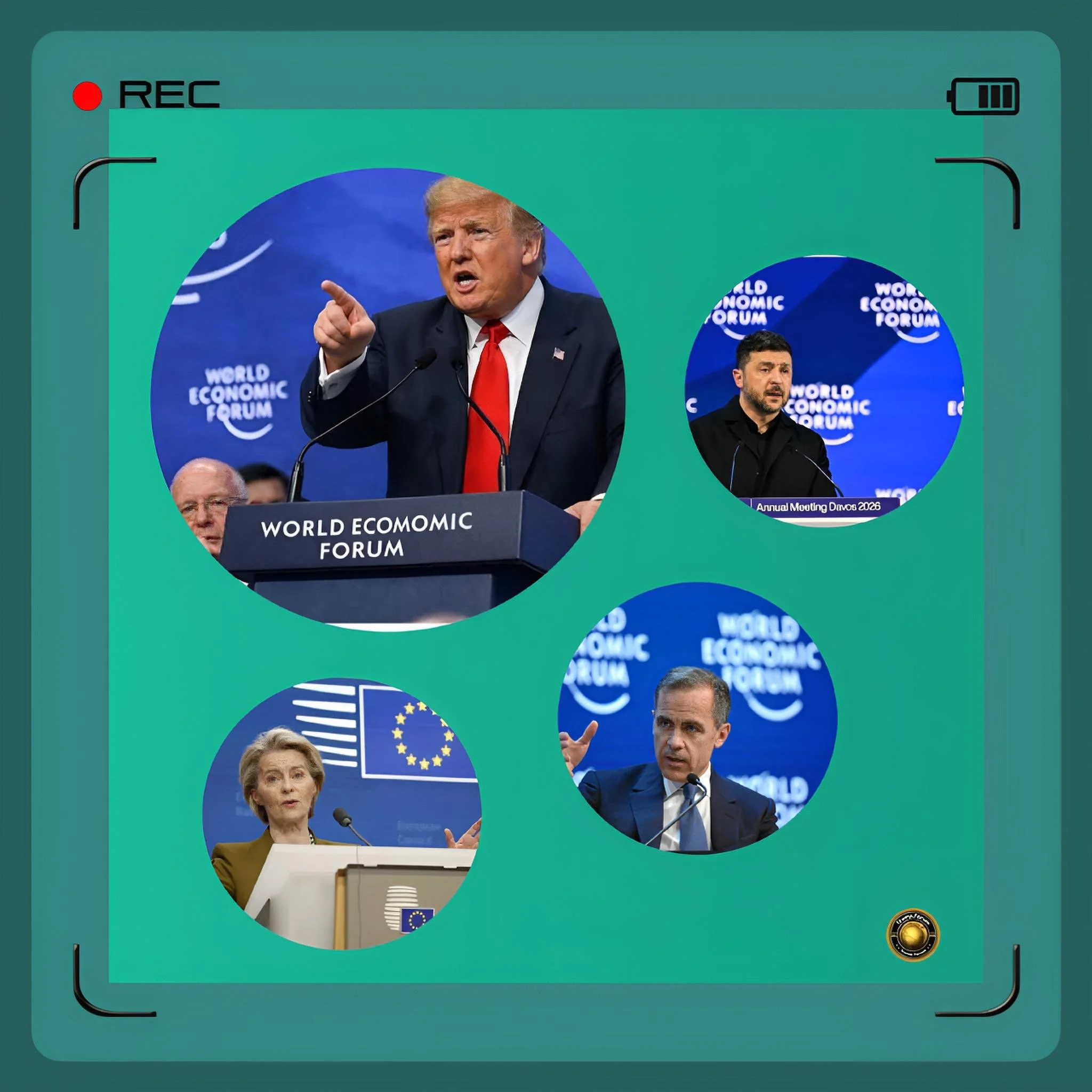
In January 2026, the World Economic Forum at Davos became the stage for what European observers are characterizing as the most severe transatlantic crisis since the Cold War's conclusion.
President Donald Trump's announcement of escalating tariffs against eight European nations—beginning at ten percent on February 1 and rising to twenty-five percent on June 1 unless Denmark agrees to sell or cede Greenland to the United States—has fractured the post-Cold War alliance architecture and exposed fundamental disagreements about the nature of sovereignty, alliances, and the rules governing international commerce.
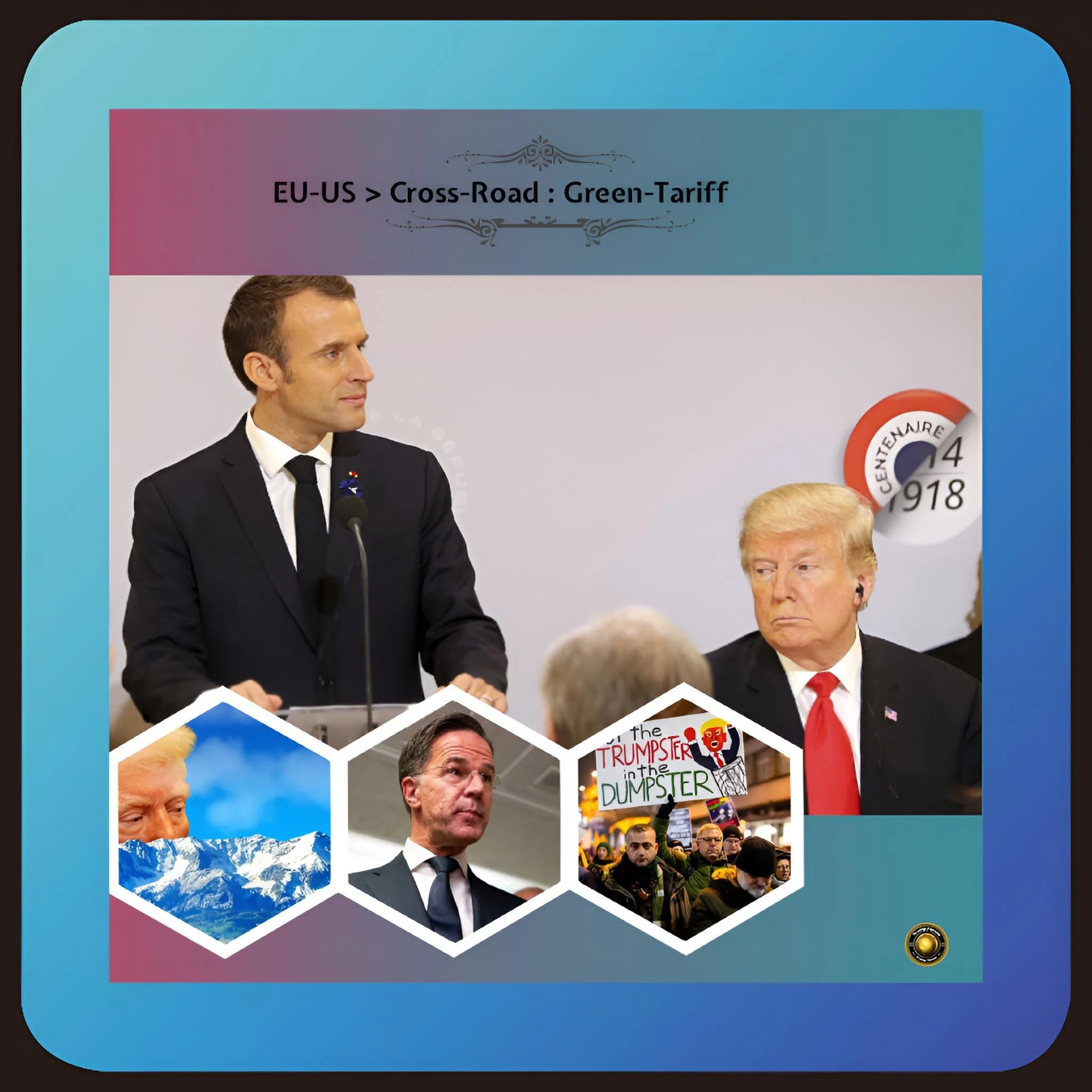
Simultaneously, Trump's disdain for French President Emmanuel Macron's refusal to join a controversial "Board of Peace" designed to manage global conflicts has led to threats of two-hundred-percent tariffs on French wine and champagne.
These developments are not isolated trade disputes but rather symptoms of a deeper structural rupture: the collapse of the liberal international order predicated on fixed alliance relationships, rule-based commerce, and the primacy of multilateral institutions.
The concatenation of these pressures has awakened recognition among European leaders that the transatlantic alliance, which has undergone periodic stress but has fundamentally endured for 80 years, faces existential threat.
Moreover, the fragmentation of Western unity creates geopolitical space for adversaries—particularly Russia and China—to advance strategic interests that were previously constrained by Western cohesion.
A Supreme Court decision on the constitutionality of Trump's tariffs, expected imminently, could either validate a dangerous expansion of executive authority or trigger rapid escalation as the administration finds alternative legal pathways to achieve the same coercive objectives.
Introduction
The Liberal Order Breaks Apart at the Hinges
The international system constructed in the aftermath of World War II rested upon several foundational premises:
(1) The United States, as the predominant power, would provide security guarantees to allied nations in exchange for their participation in a rules-based economic and political order;
(2) The alliances, once formalized, would remain stable unless explicitly dissolved through negotiated agreement;
(3) The trade relationships, though occasionally contentious, would be governed by established protocols and international institutions; and
(4) The legitimacy of the system derived from its relative predictability and the mutual benefits it conferred upon participants. By 2026, each of these premises has been decisively undermined.
President Trump has signaled that security guarantees are conditional upon immediate economic concessions, that the United States reserves the right to weaponize tariffs against nominal allies to extract territorial or policy concessions unrelated to trade, that international agreements signed merely months prior can be unilaterally abrogated if political convenience so dictates, and that the legitimacy of the system derives entirely from Trump's personal conception of American advantage.
The collision between the institutional expectations embedded in the post-Cold War order and the unilateral practice of executive power is generating consequences that ripple across multiple domains: trade flows, alliance structures, military posture, and strategic perception.
Europe, confronted with the reality that its security architecture depends upon a hegemon now openly demonstrating its willingness to coerce allied compliance through economic punishment, is compelled to undertake a strategic reorientation toward self-reliance.
Yet this reorientation occurs in an international environment of heightened geopolitical tension, where Russia wages continuous military operations on the European periphery and where Chinese power continues to expand.
The result is a transatlantic relationship characterized by unprecedented mutual uncertainty.
History and Current Status
From Binding Commitment to Coercive Unilateralism
The North Atlantic Treaty Organization, established in 1949, represented a revolutionary departure from the balance-of-power politics that had characterized the nineteenth and early 20th centuries. Rather than engaging in fluid alliance-switching based on shifting power distributions, the alliance locked in place a security guarantee: an attack upon any member would be treated as an attack upon all.
This binding commitment, formalized through Article 5 of the treaty, created a fundamentally different strategic calculus. Nations could invest in economic development and welfare provision rather than excessive military spending, knowing that the overwhelming force of American military might would shield them from external aggression.
Similarly, the architecture of post-war economic integration—the General Agreement on Tariffs and Trade (GATT), subsequently replaced by the World Trade Organization—created frameworks for expanding trade while constraining protectionist instincts through negotiated agreements.
These institutional arrangements were often characterized as creating a "liberal hegemonic order," in which the hegemon (the United States) accepted certain constraints on its behavior in exchange for the cooperation of subordinate powers.
Crucially, this order provided predictability: nations could forecast the behavior of the hegemon and calibrate their own policies accordingly.
By January 2026, this entire institutional framework is under strain.
Trump's announcement of tariffs against Denmark, Sweden, France, Germany, the Netherlands, Norway, the United Kingdom, and Finland is unprecedented not because tariffs themselves are novel—trade disputes have long been endemic to international relations—but because the tariffs are explicitly conditional upon a non-trade matter: the cession or sale of Greenland.
Throughout diplomatic history, coercive economic measures tied to territorial demands represent an act of economic warfare against nominal allies. The announcement thus signals a fundamental rupture: the United States is now prepared to inflict economic damage upon its own alliance partners to achieve objectives that the alliance framework presumably would have resolved through consultation and negotiation.
The preceding 18 months provide essential context for understanding this rupture.
In July 2025, after months of contentious negotiation, European Commission President Ursula von der Leyen and Trump reached a trade agreement. The agreement established a 15 % tariff on most European Union goods in exchange for the EU's commitment to eliminate tariffs on American industrial goods and selected agricultural products. By most assessments, the agreement was lopsided, favoring American interests and imposing costs upon European exporters and consumers.
Von der Leyen accepted these terms in the belief that a negotiated settlement, however unfavorable, was preferable to escalating trade conflict. The agreement was positioned as stabilizing transatlantic trade relationships and providing predictability for the remainder of Trump's presidency. Within months of the agreement's finalization, Trump announced that he was withdrawing from its terms and implementing new tariffs unless specific political concessions were forthcoming.
Simultaneously, Trump's "Board of Peace" initiative emerged as a second flashpoint. Originally conceived as a mechanism for Gaza reconstruction and governance during a transitional period, the Board evolved into a broader entity designed to manage multiple global conflicts under Trump's personal chairmanship and authority.
The charter, reviewed by multiple sources, grants Trump ultimate decision-making power over the board's actions and resource allocations.
European leaders, initially consulted regarding membership, grew alarmed at the scope of the board's ambitions and at its implicit challenge to United Nations authority. When Trump sought formal endorsements and financial commitments from European nations at Davos, several declined, including France.
Trump's response was to threaten two-hundred-percent tariffs on French wine and champagne—an implicit threat to economically devastate a core French industry if Macron did not acquiesce to Trump's wishes.
Technical and Instututional Developments
The Legal Machinery of Economic Punishment
The tariff escalation announced by Trump operates within a specific legal and institutional framework, the contours of which remain contested.
Trump has justified the tariffs under the International Emergency Economic Powers Act (IEEPA), a 1977 statute that authorizes the president to declare a national emergency in response to an "unusual and extraordinary" foreign threat and to respond through a range of economic measures.
The statute was designed for sanctions against hostile states; its application to the imposition of broad tariffs against allied nations represents a creative interpretation that lower courts have deemed unconstitutional.
In May 2025, the United States Court of International Trade ruled that Trump's broad tariffs, when imposed under IEEPA, exceeded statutory authority and violated the separation of powers by unconstitutionally delegating Congress's taxation authority to the executive. The Federal Circuit Court of Appeals upheld this judgment in August 2025.
The cases now before the Supreme Court frame two core questions: does IEEPA authorize tariffs, and if so, does it unconstitutionally delegate Congress's constitutional authority over taxation? The Court's decision, expected imminently, will likely determine whether Trump's tariff regime survives in its present form.
From a European perspective, the legal question is secondary to the political question: regardless of how the Supreme Court rules, the Trump administration has signaled that it will find alternative legal authority to achieve the same coercive objectives.
Administration officials have stated, through the office of the US Trade Representative, that alternative statutes exist that could accomplish the same tariff effects, even if IEEPA is invalidated.
This stance effectively removes the legal constraints as binding checks on executive tariff authority.
If the Supreme Court validates IEEPA tariffs, the precedent would represent a massive expansion of executive power, allowing future presidents to invoke emergency declarations on minimal grounds to circumvent Congress in matters of national importance.
If the Court invalidates the tariffs, the administration would replicate coverage through alternative statutes, prolonging uncertainty while pushing tariff implementation onto a country-by-country and commodity-by-commodity basis rather than the broad measures previously employed.
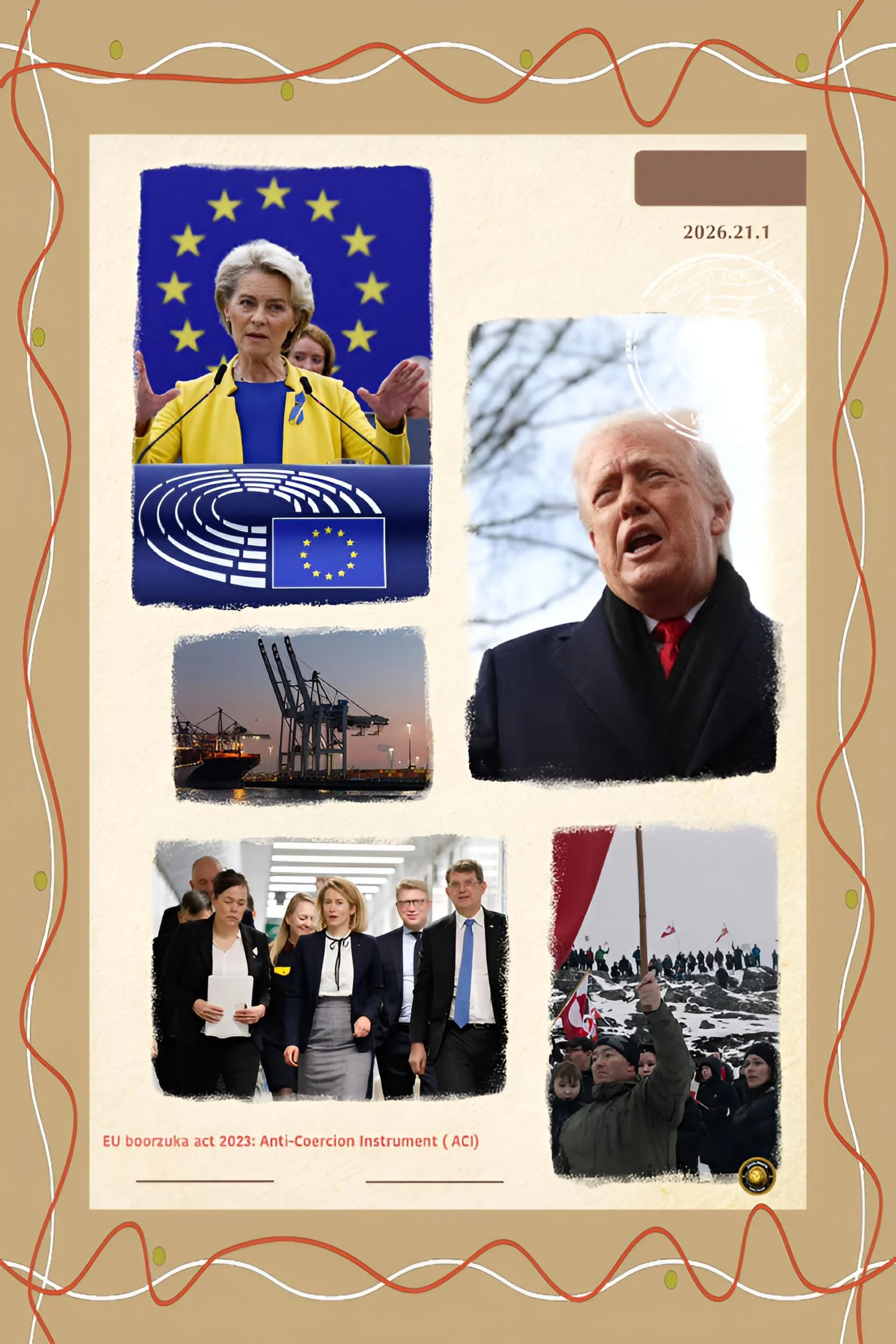
Meanwhile, European responses are crystallizing around the "Anti-Coercion Instrument" (ACI), colloquially termed the "trade bazooka."
This mechanism, never previously invoked, grants the European Commission authority to impose a range of retaliatory measures against states that weaponize trade policy to coerce EU behavior. The ACI encompasses tariffs on American goods, restrictions on US services access to EU markets, limitations on US investment within the EU, exclusion of US firms from public contracts, and potential restrictions on US use of EU-based financial infrastructure.
European analysts estimate that the EU could implement tariffs on approximately ninety-three billion euros' worth of American goods, targeting sectors where the US is particularly vulnerable: aircraft (Boeing), automobiles, pharmaceuticals, and advanced technology services.
Latest Facts and Emerging Concerns
When Diplomacy Becomes Public Humiliation
The developments unfolding at Davos reveal several critical facts regarding the contemporary transatlantic relationship.
First, the bilateral relationship between Trump and individual European leaders is characterized by public humiliation and coercion.
Trump's release of private text messages between himself, Macron, and NATO Secretary-General Mark Rutte represents a deliberate degradation of diplomatic norms designed to signal to allies and adversaries alike that alliance relationships are subordinate to Trump's personal political needs.
Second, European solidarity, while rhetorically strong, remains constrained by fundamental vulnerability: Europe depends upon the United States for security guarantees regarding Russia and for participation in conflicts in the Middle East and elsewhere. This dependency, even as American reliability becomes questionable, creates strategic paralysis.
Third, the Trump administration is pursuing multiple simultaneous objectives—acquiring Greenland, compelling European defense spending increases, exacting greater burden-sharing in global conflicts, enforcing compliance with the Board of Peace initiative—through coordinated economic coercion, suggesting that Greenland is not a singular fixation but rather one component of a broader repositioning of American power relative to its allies.
The implications are profound and troubling. The European Union is genuinely uncertain whether the United States intends to remain a predictable alliance partner or whether it has entered a phase of unpredictable unilateralism in which European nations will be subjected to periodic economic shocks in response to Trump's perceived affronts or policy disagreements.
This uncertainty is corrosive to alliance cohesion and generates powerful incentives for European nations to develop strategic autonomy independent of American guarantees.
Cause and Effect Analysis
How Punishing Your Allies Empowers Your Enemies
The immediate cause of the transatlantic rupture is Trump's personal conviction that American allies have systematically exploited American security commitments and trade relationships to enrich themselves at American expense.
This conviction, held consistently across his two administrations, reflects a zero-sum conception of international relations in which alliance partnerships are not mutual arrangements between complementary interests but rather zero-sum competitions in which one party wins at the expense of the other.
Applied to Greenland, Trump perceives the island as a strategic asset that the United States should possess, and he views European resistance to American acquisition as evidence of European hostility toward American interests. This framework tolerates no ambiguity: either allies comply with American demands, or they become targets of economic coercion.
The effects of this dynamic operate across multiple domains. At the institutional level, the predictability and stability that enabled post-Cold War European integration and prosperity are dissolving.
European nations cannot assume that agreements signed one year will remain in force the next, or that security guarantees will not be withdrawn in response to political disagreements. This generates powerful incentives for European nations to develop military capabilities independent of American support, to pursue trade relationships with non-American partners, and to construct alternative security architectures.
European Commission President von der Leyen's repeated emphasis on European "strategic autonomy" and on trade relationships with Latin America, Asia, and Africa should be understood within this context: Europe is deliberately moving to reduce its structural dependence upon the United States.
At the geopolitical level, the fracture of Western unity creates opportunities for adversaries. Russia, observing the crisis between the United States and Europe, perceives diminished risk of unified Western response to Russian aggression.
Indeed, Russian state media has celebrated Trump's Greenland obsession as evidence of American inattention to European security concerns. As European military attention and resources are diverted toward autonomous defense capabilities, the resources available to support Ukraine are constrained.
European leaders, recognizing this dynamic, have committed to covering the majority of Ukrainian military and economic requirements for the next two years, but the sustainability of this commitment without American participation remains uncertain.
A broader consequence is that Russia potentially achieves its long-term strategic objective of fragmenting Western unity without resorting to direct military confrontation with NATO—a victory more complete and durable than any military conquest could produce.
At the economic level, trade war escalation disrupts global supply chains and creates currency instability. European economists estimate that widespread tariff implementation could reduce European GDP by twenty-five basis points or more, and euro depreciation could reach ten to twenty percent if reciprocal tariff warfare escalates.
Consumer prices rise, government budgets face pressure, and the social cohesion that undergirds democratic governance in Europe is strained as publics face higher costs and reduced opportunity.
Future Developments and Strategic Implications
The Post-American Order Takes Shape
The immediate trajectory appears to move toward escalating trade conflict. Trump's February 1 tariff implementation will likely trigger European countermeasures under the ACI or through the reinstatement of previously suspended retaliatory tariffs.
The Supreme Court decision on IEEPA will either validate Trump's legal theory or force the administration into alternative legal pathways, but neither outcome will restore predictability to transatlantic relations.
European nations will accelerate defense spending and capability development independent of American platforms and technology, which will itself generate new tensions with the Trump administration, which views European military independence as erosion of American leverage.
At a deeper level, the fracture signals a potential reorganization of the international system. The post-Cold War liberal order, predicated on American hegemony and willingness to accept constraints on its own behavior in exchange for allied participation, cannot survive Trump's unilateralism.
The question confronting global actors is what order will replace it. One possibility is a return to balance-of-power politics in which multiple regional powers construct local security arrangements and trade blocs compete for advantage.
This trajectory would see Europe pursuing autonomous military capabilities, Russia dominating Eastern Europe in the absence of NATO opposition, China consolidating control over the Indo-Pacific, and the United States emerging as a purely transactional power that deals bilaterally with other major powers rather than maintaining alliance systems.
A second possibility is that the Trump administration's unilateralism generates a counter-coalition among nations seeking to preserve or reform the liberal order.
This coalition could include Europe, much of Asia, and the Global South. Such a coalition would necessarily develop alternative institutional arrangements that do not depend upon American participation or leadership.
The construction of such arrangements would accelerate the shift toward multipolarity and the erosion of American centrality in global affairs.
A third possibility is managed descent into great-power conflict. If Trump's tariff coercion succeeds in fracturing NATO, Russia could pursue territorial expansion in the Eastern European periphery without facing unified Western military response.
This scenario carries serious risks of escalation into military conflict between major powers, particularly if NATO members (Estonia, Lithuania, Poland, etc.) face Russian pressure.
The risk of World War III, while not immediate, is not negligible in a scenario in which NATO dissolution proceeds and Russia consolidates sphere-of-influence control over Eastern Europe.
Conclusion
The Day the West Stopped Trusting the United States
The crisis unfolding at Davos in January 2026 is not fundamentally about Greenland or wine tariffs or the governance structure of a Board of Peace.
These are symptoms of a deeper strategic rupture: the collapse of the liberal international order and the emergence of a genuinely multipolar world in which the United States exercises unilateral power in pursuit of narrowly defined national interest, unconstrained by the institutional commitments and alliance relationships that have characterized the preceding eighty years.
The collapse of this order creates profound instability and uncertainty. Allies cannot trust American commitments; adversaries perceive opportunities for expansion; and neutral powers face pressure to choose alignments in a world where the old guarantees no longer hold.
For Europe, the crisis is simultaneously catastrophic and clarifying. Catastrophic, because it reveals that the security upon which postwar European integration and prosperity depended is contingent and withdrawable. Clarifying, because it forces explicit recognition that European security, prosperity, and autonomy cannot depend upon American fidelity to alliance commitments.
The response unfolding—accelerated defense spending, pursuit of strategic autonomy, development of alternative trade relationships, and resistance to tariff coercion through the ACI—represents a rational adaptation to a new reality.
Yet this adaptation occurs in a perilous international environment. Russia remains an aggressive military power, China continues expanding its capabilities and influence, and the United States has proven willing to weaponize its alliance relationships.
The outcome of this transitional moment will likely determine whether the world progresses toward a multipolar balance-of-power system that could be stable and predictable once equilibrium is achieved, or whether it descends into a period of acute conflict as powers jockey for position in an environment no longer constrained by the architecture of the liberal order.
For the Supreme Court, the tariff decision will be one of many that determines whether the separation of powers, constitutional governance, and limits on executive authority survive the Trump presidency, or whether the presidency has evolved into something closer to an elective monarchy in which the chief executive determines policy through essentially unconstrained exercise of will.
The stakes of the tariff case thus extend far beyond trade: they concern the nature of American constitutional governance and the boundaries of presidential power. An adverse Supreme Court decision would represent the final collapse of institutional constraints on executive authority within the American system.
The transatlantic rupture is thus one manifestation of a broader dissolution of ordered international arrangements, a movement toward a world characterized by unilateral great-power competition, the erosion of institutional constraints, and the replacement of rule-based order with the rule of those possessing the most power.
Whether this process can be managed to avoid catastrophic conflict, whether Europe can successfully construct autonomous security and economic arrangements, and whether other nations can coordinate to constrain American unilateralism are the essential questions confronting the international system in 2026.
The answers will likely determine the character of international politics for decades.