Executive Summary
The Political Battleground: Trump's Greenland Ambitions Overshadow Economic Dialogue
The 56th Annual Meeting of the World Economic Forum in Davos, Switzerland, held from January 19-23, 2026, transformed from its conventional economic focus into a geopolitical crucible dominated by American territorial ambitions and transatlantic discord.
Rather than the expected deliberations on artificial intelligence, economic growth trajectories, and climate transition mechanisms, the gathering devolved into what international observers characterized as a "political battleground." President Donald Trump's persistent pursuit of Greenland's acquisition, coupled with threatened tariffs on European allies, fundamentally reoriented the forum's discourse.
The event exemplified a structural realignment in global governance: the erosion of multilateral institutional frameworks, the ascendancy of unilateral state action, and the consequential fracturing of traditional alliance structures that have underpinned the post-1945 international order.
Introduction
The Fracturing of Global Order: Davos 2026 and the End of American-Led Multilateralism
The World Economic Forum represents an institutional artifact of globalization's apex—a convening space where multinational corporate interests, global leaders , and international technocrats orchestrate consensus regarding planetary economic governance. Traditionally, Davos functioned as a ritual affirmation of liberal trade orthodoxy, technological inevitability, and the benevolence of market mechanisms.
The 2026 iteration, however, revealed the contingency of these arrangements. With more than 60 heads of state in attendance and the largest-ever American delegation, the forum became a stage on which fundamental questions of state sovereignty, territorial integrity, and the legitimacy of the international legal order were contested in real time.
The centrality of Trump's agenda rendered the forum's nominal theme—"A Spirit of Dialogue"—ironically anachronistic. Rather than dialogue, the week witnessed the articulation of incompatible visions of global order: the American reassertion of unilateral prerogatives, the European insistence on rules-based internationalism, and the Chinese invocation of multilateral cooperation.
These competing frameworks collided across multiple registers—trade policy, arctic security, Palestinian reconstruction, and the governance structures governing artificial intelligence infrastructure.
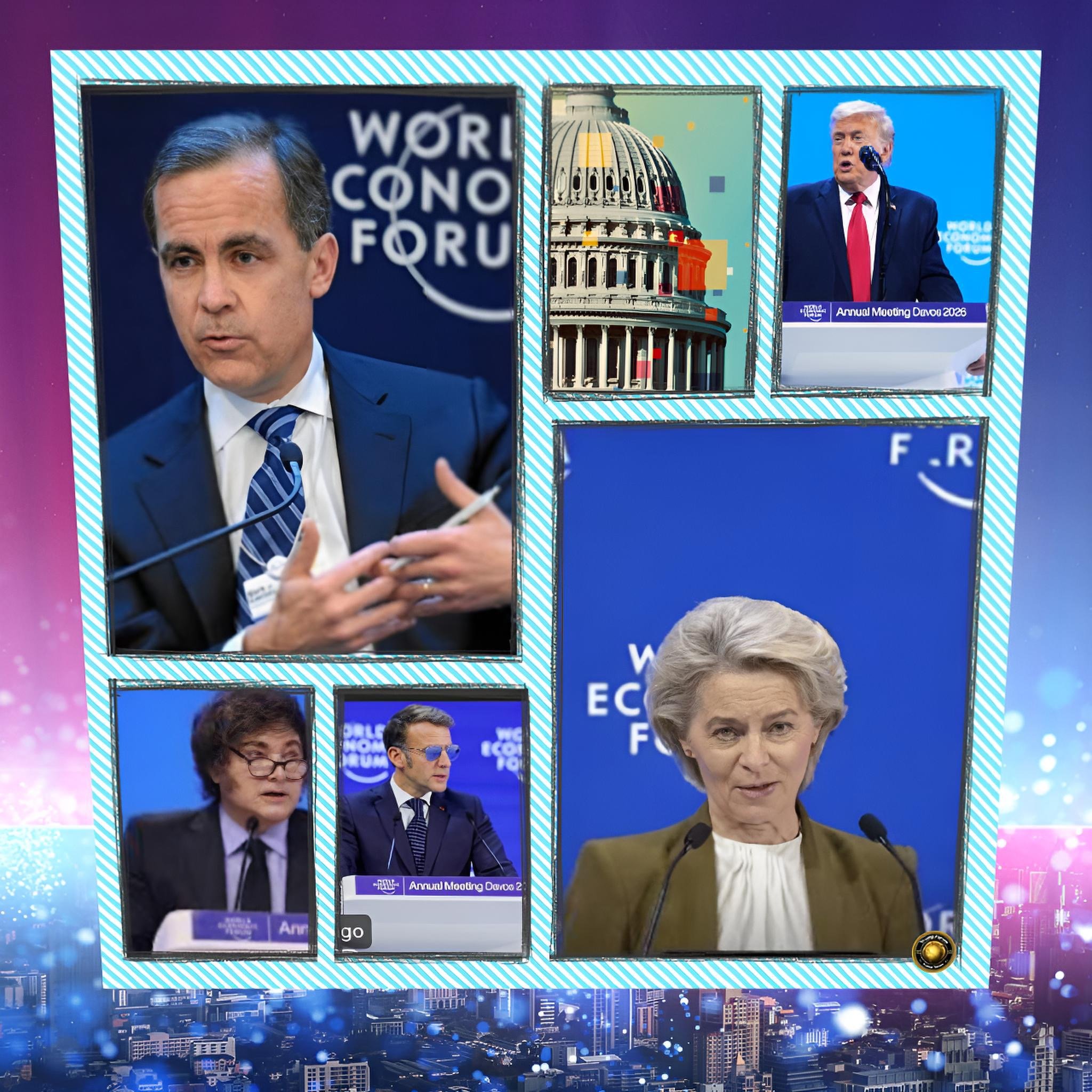
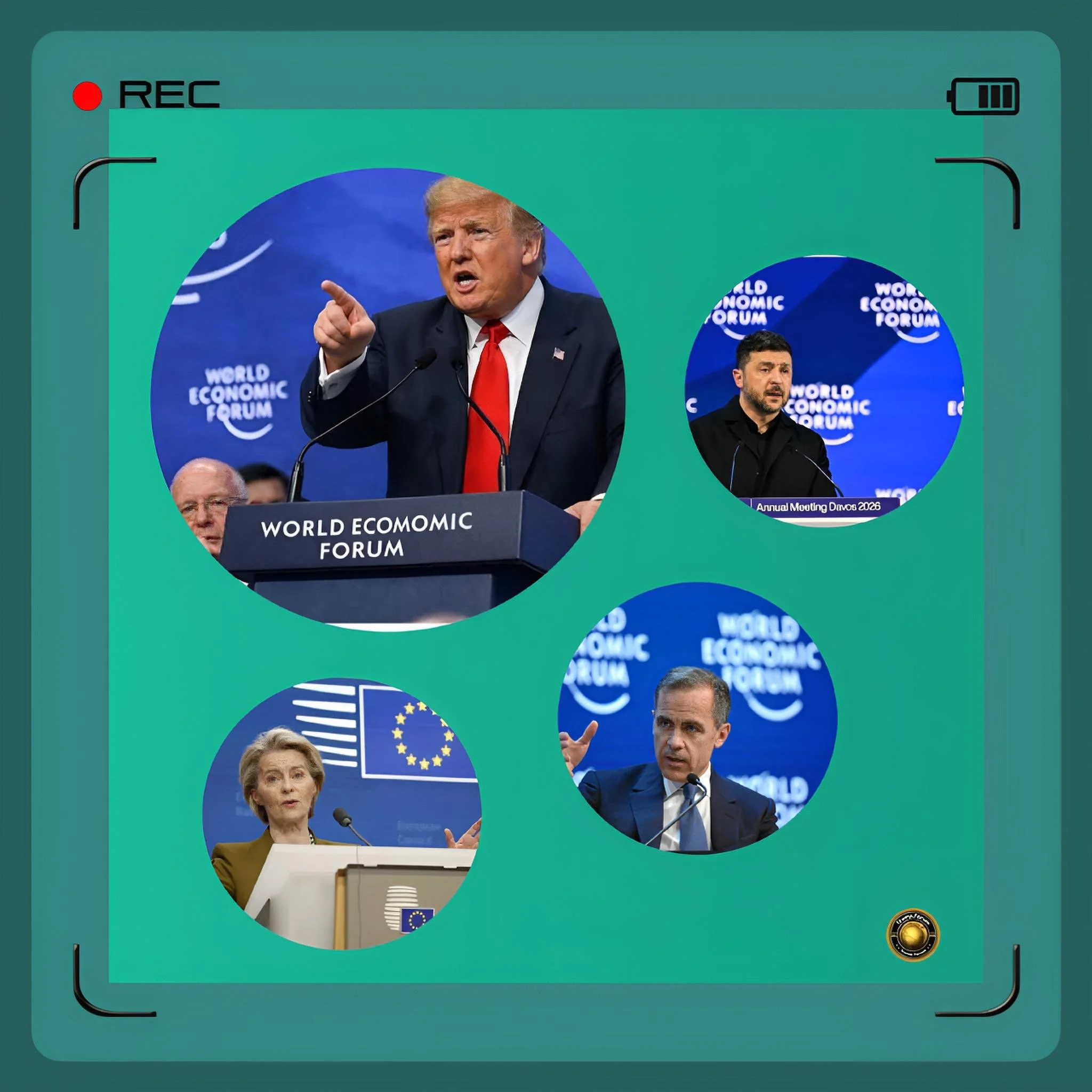
Key Show Stoppers at Davos
Show-Stoppers Identified:
Donald Trump
Led the largest US delegation ever; pursued Greenland acquisition; threatened tariffs on European allies; later backed down
Emmanuel Macron (France)
Delivered fiery speech condemning American bullying; invoked “shift towards a world without rules.”
Ursula von der Leyen (EU)
Articulated European independence strategy; pledged EU support for Greenland/Denmark
He Lifeng (China)
Positioned China as defender of multilateralism; offered a cooperation framework
Gavin Newsom (California)
Blocked from speaking; became a symbol of Trump’s political retaliation
Main Themes in Davos
The main theme changed to differing eight-fold controversial topics
(1) The Greenland acquisition is symbolic of American unilateral prerogative
(2) European pivot toward independence from American security guarantees
(3) China’s effective positioning as a reasonable actor supporting multilateralism
(4) Erosion of rules-based international order
(5) Rise of a multipolar world with multiple power centers
(6) Trade war tensions and tariff threats
(7) Inequality is the underlying driver of geopolitical instability
(8) Technology competition (AI) is reshaping global competition
History and Current Status
The World Economic Forum, established in 1971 as a platform for intersectoral dialogue, has historically legitimized the liberal international order during moments of structural crisis.
Throughout the Cold War and the subsequent unipolar moment, Davos served as a disciplinary mechanism through which corporate and state elites could articulate consensus regarding the proper organization of global capital flows.
The forum's significance derived not from binding decision-making authority—which it lacked entirely—but from its capacity to confer intellectual and political legitimacy on dominant orthodoxies.
The 2026 gathering represents a watershed moment in this trajectory. The forum convened amidst the collapse of presumptive multilateral constraints on state action.
The WEF's Global Risks Report 2026, released concurrently with the annual meeting, identified geoeconomic confrontation as the paramount risk threatening global stability.
This designation rose from eighth place the previous year. This ranking itself constitutes an acknowledgment that the era of cooperative economic governance, if it ever genuinely existed, has definitively concluded.
Trump's return to the presidency in January 2025 signaled the American withdrawal from the multilateral architecture that Washington itself had constructed following the Second World War.The positioning of Greenland as a priority acquisition objective crystallized this reorientation.
Greenland, an autonomous territory within the Danish realm, holds strategic significance as a node in Arctic security frameworks and as a potential repository of rare earth minerals required for technological infrastructure.
Trump's persistent articulation of acquisition ambitions—initially framed as an economic proposition, subsequently elevated to a security imperative—represented not idiosyncratic presidential caprice but rather the logical terminus of a geopolitical strategy predicated upon the rejection of territorial constraints and the reassertion of American hemispheric dominion.
Key Developments
The Greenland Question and Transatlantic Fracture
Trump's pronouncements on Greenland's acquisition precipitated the forum's transformation from economic deliberation to crisis diplomacy.
Over the weekend preceding his Davos address, Trump announced a 10 percent tariff on eight European nations—Denmark, the United Kingdom, France, and Germany—set to commence February 1, escalating to 25 % by June 1, conditional upon those states' acquiescence to the transfer of Greenland's sovereignty.
The administration furthermore articulated threats of 200 % tariffs upon French wine and champagne, instruments of economic coercion transparently designed to instrumentalize territorial ambitions.
Denmark's absence from the forum itself testified to the severity of the rupture. The Danish state, a founding member of NATO and a participant in liberal international institutions for 70 years, found itself positioned outside the deliberative space, with its sovereignty rendered contestable through tariff threats and public denigration.
This development constitutes a qualitative departure from precedent. Previous American territorial aggrandizement occurred either at the periphery of American power (Caribbean acquisitions in the nineteenth century) or through proxy mechanisms (interventionism throughout the Global South during the Cold War).
The direct targeting of NATO allies with coercive economic instruments and territorial ultimatums represents an unprecedented assertion of unilateral American prerogative within the North Atlantic security community.
The European response crystallized around invoking multilateral legal frameworks. European Commission President Ursula von der Leyen articulated the European Union's commitment to Greenland and Denmark through repeated reiterations that "the sovereignty and integrity of their territory is non-negotiable."
This phraseology, though apparently straightforward, carries profound significance. Von der Leyen's invocation of territorial integrity establishes a legal and ethical baseline—the principle that recognized borders constitute inviolable boundaries insulated from external acquisition through economic coercion or military threat.
The principle itself forms the foundational architecture of the post-1945 international legal order, established through the United Nations Charter and reinforced through successive instantiations of international law.
French President Emmanuel Macron escalated the rhetorical confrontation. In his Davos address, Macron characterized the Greenland episode as emblematic of a broader "shift towards a world without rules," wherein "international law is trampled underfoot and where the only law that seems to matter is that of the strongest, and imperial ambitions are resurfacing."
Macron's language constitutes an explicit articulation of the stakes: the contest concerns not merely Greenland but the legitimacy of the legal order itself. His invocation of "imperial ambitions" situates contemporary American actions within historical patterns of great power aggrandizement—Ottoman expansionism, nineteenth-century European imperialism, fascist territorial revision—frameworks that the post-war international system purported to have transcended.
The European Union's potential activation of anti-coercion mechanisms further crystallizes the rupture. Macron noted that the European Union "should not hesitate" to deploy its anti-coercion instrument in response to American tariff threats. These mechanisms, established within EU legal frameworks, constitute retaliatory instruments designed to counteract what Brussels characterizes as economic coercion.
The invocation of such mechanisms against the United States—heretofore regarded as the guarantor of European security within NATO frameworks—signifies a fundamental realignment in European strategic calculation. Europe's implicit presumption that American security commitments remain unconditional has been shattered.
The American Delegation and Strategic Communication
Trump led the largest American delegation in World Economic Forum history, comprising Secretary of State Marco Rubio, Treasury Secretary Scott Bessent, Commerce Secretary Howard Lutnick, and special envoy for Middle East affairs Steve Witkoff.
The composition of this delegation constituted a deliberate performative act. The inclusion of the Secretary of State in a forum primarily addressed to corporate interests signified the subordination of traditional diplomatic channels to the forum's communicative apparatus.
Treasury Secretary Bessent's address from the Davos stage, wherein he publicly derided California Governor Gavin Newsom as "economically illiterate," transformed the forum into a venue for intra-governmental scoring of political points.
The unprecedented use of the WEF as a platform for direct American state messaging about internal political opponents constitutes a qualitative departure from historical convention.
Trump's keynote address itself articulated the administration's strategic vision. He characterized the United States as "the economic engine on the planet," asserted that all other nations "follow us down, and follow us up," and positioned the Greenland acquisition as integral to American security interests.
Regarding Greenland specifically, Trump deployed a rhetorical gesture toward restraint, stating "I won't use force," while simultaneously emphasizing that "we probably won't get anything unless I decide to use excessive strength and force, where we would be frankly unstoppable."
This formulation—simultaneous renunciation and threat—exemplifies the strategic deployment of ambiguity. By claiming restraint whilst maintaining that military capability renders such acquisition feasible, Trump preserved the threat structure whilst nominally disavowing military action.
The strategic ambivalence carried over into subsequent negotiations. Following a meeting with NATO Secretary General Mark Rutte, Trump announced the cancellation of the threatened tariffs, proclaiming the establishment of a "framework of a future deal" regarding Arctic security and Greenland.
This sudden reversal, occurring within hours of his most aggressive formulations, exemplifies the administration's tactical approach: the construction of threat structures for negotiatory leverage, followed by a strategic retreat into ambiguous formulae that permit both sides to claim victory.
The Chinese and European Alternative Frameworks
Chinese Vice-Premier He Lifeng articulated an explicitly oppositional vision in his address to the forum. Invoking President Xi Jinping's 2017 Davos speech, He repositioned China as the defender of multilateral cooperation and free trade in contradistinction to American unilateralism.
The rhetorical strategy constituted an inversion of traditional Cold War positioning: China, historically positioned as the challenger to American-led order, now presented itself as the custodian of the international legal frameworks that America increasingly eschews.
His assertion that "China is a trading partner, not a rival, for other nations. China's development presents an opportunity, not threat, to the world economy" fundamentally challenged the Trump administration's zero-sum framing of great-power competition. Rather than accepting the premise that American security requires subordinating rivals through tariff barriers and technology restrictions, he invoked principles of mutual benefit and win-win cooperation.
The reception of his address—characterized by international media as eliciting "genuine and enthusiastic applause"—signals the broader global elite's receptivity to alternative frameworks for organizing international relations.
Ursula von der Leyen articulated a complementary vision centered upon European strategic autonomy. Her invocation of "European independence" from American security guarantees and market access represented a qualitative shift in European positioning.
Rather than accepting American unilateralism as the default, von der Leyen articulated the necessity for Europe to build autonomous institutional capacity across security, energy, and digital domains.
The EU's announcement of a trade agreement with Latin America (encompassing 700 million people and representing 20 % of global GDP) signified the operational instantiation of this strategy: the construction of alternative trade networks insulated from American tariff threats.
Specialized Initiatives and Their Implications
The Trump Administration's Board of Peace Initiative
The Trump administration's announcement of a "Board of Peace" to oversee Gaza reconstruction constitutes a parallel instantiation of its broader challenge to multilateral governance.
Initially framed as focused on Palestinian territory, the Board of Peace's charter reveals vastly more expansive ambitions: the establishment of an alternative international governance structure that could potentially supplant United Nations mechanisms.
The board's charter grants Trump, as chairperson, extraordinary discretionary authority: the appointment of an Executive Board, the capacity to override board determinations through executive power, the authority to "create, modify, or dissolve subsidiary entities," and the power to implement "resolutions or other directives" to fulfill the board's objectives.
These provisions constitute the institutional embodiment of unilateral American prerogative. Rather than operating within constrained authority derived from international consensus (as UN mechanisms purportedly do), the Board of Peace grants Trump personal governance authority over matters conventionally reserved for international bodies.
The membership structure reveals the board's political contours. While Israel, Arab state representatives, and American-aligned governments have accepted membership, France and Germany have declined to participate, citing concerns about the board's departure from UN governance frameworks.
This bifurcation in membership constitutes a fragmentation of the Western alliance itself: traditionally presumed unity regarding Middle Eastern governance arrangements has fractured along lines demarcating acquiescence to American unilateral authority versus insistence upon multilateral constraints.
The California Exclusion Incident
The blocked appearance of California Governor Gavin Newsom at the USA House venue in Davos signifies the utilization of forum access as an instrument of political discipline.
Newsom, positioned as a potential Democratic presidential contender, had been invited to participate in a Fortune magazine conversation at the official American venue. When Newsom indicated his intention to rebut Trump's address publicly, the Trump administration reportedly pressured the USA House organizers to rescind the invitation.
While USA House organizers denied direct political interference, characterizing the decision as venue-level programming choices, the temporal proximity between Newsom's stated intention to contest Trump's positions and his subsequent exclusion suggests deliberate political retaliation.
Treasury Secretary Bessent's public mockery of Newsom from the Davos stage—characterizing him as economically illiterate and deriding California's homelessness crisis—constituted a performative expression of administration displeasure with internal political opposition.
This incident illuminates the Trump administration's use of social media platforms to enforce intra-American political discipline.
The Davos venue, traditionally conceived as a space for corporate and state deliberation insulated from partisan domestic politics, has been instrumentalized to suppress internal dissent.
Cause-and-Effect Analysis
The Decline of Multilateral Constraints
The Davos 2026 configuration emerged from antecedent structural transformations in international order. The Cold War's end removed the security rationale for American support for multilateral institutions.
Throughout the post-war period, the United States sustained the General Agreement on Tariffs and Trade, the International Monetary Fund, the World Bank, and the United Nations system as instruments for managing great power competition and containing Soviet expansion.
With the Soviet Union's collapse, the functional necessity for these institutions diminished from the American perspective.
Successive American administrations (Clinton, Bush, Obama) incrementally withdrew from multilateral constraints—refusing the Comprehensive Test Ban Treaty, rejecting the International Criminal Court, declining to ratify the Convention on Biological Diversity, and declining to join the UN Human Rights Council.
These departures represented gradual erosions rather than dramatic ruptures.
The Trump administrations (both 2017-2021 and 2025-) accelerated this trajectory into explicit institutional abandonment.
The Greenland episode crystallizes this trajectory. The acquisition of territory through economic coercion, threatened military action, and rejection of legal frameworks constitutes the antithesis of multilateral governance. That such actions transpire at a forum dedicated to global cooperation and dialogue suggests the exhaustion of multilateral frameworks as mechanisms for constraining state action.
The Legitimacy Crisis of Liberal Internationalism
The forum itself became a stage for the articulation of the crisis of liberal internationalism. WEF President Børge Brende acknowledged that the forum confronts a "central tension": it constitutes an elite gathering attempting to shape a world belonging to everyone.
The K-shaped economy, wherein wealth concentrates among the richest while the middle class contracts, has delegitimized the presumption that liberal trade and open markets generate broadly shared prosperity.
Trump's 2024 electoral victory represented, in substantial measure, the expression of this legitimacy crisis.
American constituencies, experiencing decades of wage stagnation, deindustrialization, and hollowing of institutional structures, rejected the establishment consensus supporting multilateral trade arrangements.
Trump's nationalism—his invocation of America First, his rejection of multilateral constraints, his deployment of tariff instruments to reassert state control over economic governance—resonated with constituencies experiencing the distributional consequences of liberal trade orthodoxy.
The Davos elite's capacity to manage this challenge appears limited. While forum deliberations acknowledged growing inequality and the necessity of reforms to ensure more broadly distributed growth, the concrete mechanisms for achieving such redistribution remain elusive.
The absence of systemic reforms has left the material basis for populist contestation of liberal frameworks intact.
The Geopolitical Realignment
The Disconnection Between Corporate Elites and Mass Constituencies
The Davos configuration crystallized a broader geopolitical realignment predicated upon the erosion of American unipolarity.
The emergence of China as an economic and technological competitor, the reintegration of Russia into great power politics, the proliferation of regional powers (Turkey, India, Saudi Arabia, Brazil), and the fragmentation of Western alliance structures all constitute expressions of a multipolar order displacing American hegemony.
Trump's Greenland initiative, paradoxically, represents both an assertion of American power and an acknowledgment of American vulnerability.
The obsession with Arctic acquisition reflects concerns about climate change-induced shifts in Arctic geopolitics, China's Belt and Road Initiative in the region, and the strategic significance of new maritime and resource access vectors. Rather than addressing these challenges through multilateral Arctic governance arrangements, the administration pursues unilateral territorial acquisition—a strategy coherent with the presumption of enduring American military preponderance but incompatible with the institutional interdependencies characterizing modern economies.
Future Steps and Structural Implications
The Divergence of Western Alliance Structures
The Davos 2026 deliberations presage the emergence of alternative institutional alignments.
The European Union's announcement of the India-EU free trade agreement, the Mercosur trade pact, and nascent discussions regarding European strategic autonomy signify the construction of alternative trade networks insulated from American tariff instruments.
Germany's announcement of increased defense spending, the EU's enhanced funding for Ukraine, and nascent European security cooperation frameworks (excluding American participation) constitute the operationalization of European autonomy aspirations.
These developments occur within the broader context of American tariff threats. The administration has announced the imposition of additional tariffs on multiple American trading partners, stated its intention to reintegrate British territories into American jurisdiction (specifically the Chagos Islands), and threatened military intervention against Colombia following its refusal to accept American deportation demands.
Each of these initiatives—individually comprehensible as expressions of American assertiveness—collectively constitutes the systematic dismantling of the institutional architecture permitting American economic hegemony.
The Reconstruction of International Order
The Preliminary Architecture of Post-American International Order
The Davos 2026 gathering revealed emergent institutional possibilities for organizing international relations in the absence of American leadership.
The Chinese invocation of win-win cooperation and multilateral frameworks, the European articulation of strategic autonomy, the articulation by Indian and Brazilian representatives of alternative development models based upon digital technology and indigenous institutions, and the mobilization of Global South solidarity (explicitly invoked by Mexican and Colombian representatives) all constitute building blocks for reconstructing international order along post-American lines.
The establishment of the Shanghai Cooperation Organization, the expansion of the BRICS coalition, the construction of alternative trade networks (the Asian Infrastructure Investment Bank and the New Development Bank), and the articulation of non-aligned frameworks constitute the preliminary institutional expression of this realignment.
Davos 2026 effectively acknowledged the irreversibility of these transformations.
The Technology and Energy Dimension
Technological Governance and Strategic Divergence in AI and Energy
The deliberations on artificial intelligence revealed divergent strategic approaches to technological governance. The American delegation positioned AI development as a prerequisite for American competitive advantage vis-à-vis China, advocating minimal regulatory constraints and maximum corporate autonomy.
The European approach, embodied in the AI Act and regulatory frameworks under development, presumes that technological governance requires democratic oversight and distributive justice considerations.
These divergences reflect fundamental differences regarding the relationship between technological development and social organization.
The American framework presumes that competitive dynamics and market mechanisms generate optimal outcomes; the European framework presumes that technological trajectories require explicit governance to ensure compatibility with democratic values.
Regarding energy, the divergence between the Trump administration's commitment to fossil fuel expansion and the European (and increasingly global) consensus regarding fossil fuel phase-out crystallized at Davos.
The administration's withdrawal from climate commitments, its promotion of nuclear and fossil fuel expansion, and its hostility toward renewable energy frameworks represent a fundamentally different strategic vision from European, Chinese, and Indian commitments to decarbonization.
Conclusion
Remaining Uncertainties and the Contingency of Global Outcomes
The 56th World Economic Forum in Davos, Switzerland, embodied the terminal moment of American hegemony over the liberal international order.
Rather than reconstituting consensus regarding global governance, the gathering witnessed the crystallization of incompatible strategic visions: American reassertion of unilateral prerogative predicated upon military capability and economic coercion; European insistence upon rules-based order and strategic autonomy; Chinese invocation of multilateral cooperation and win-win frameworks; and the emergence of diverse regional powers constructing alternative institutional arrangements.
Trump's persistent pursuit of Greenland, the threatened tariffs against European allies, the utilization of economic coercion as an instrument of territorial acquisition, and the systematic dismantling of multilateral constraints constitute the explicit institutional expressions of a geopolitical realignment.
The collapse of American unipolarity has liberated other stakeholders from the requirement to organize their policies within American-defined parameters.
The construction of alternative trade networks, the emergence of regional hegemons, and the articulation of non-aligned frameworks constitute the preliminary instantiation of the post-American international order.
The Davos 2026 gathering also revealed the exhaustion of liberal internationalism's capacity to legitimate itself through appeals to shared prosperity and mutual benefit.
The concentration of wealth, the distributional consequences of trade liberalization, and the proliferation of inequality have severed the presumed connection between market liberalization and broadly shared prosperity. In this context, nationalist and regional frameworks increasingly dominate as modes of political organization.
The forum's nominal theme—"A Spirit of Dialogue"—proved ironically anachronistic. Rather than dialogue, the gathering witnessed the articulation of irreconcilable differences regarding the organization of global order, the legitimacy of territorial sovereignty, and the permissibility of economic coercion.
Whether the fragmenting liberal order will cohere into alternative arrangements preserving global stability, or whether the deterioration of multilateral constraints will precipitate conflict and instability, remains indeterminate.
The Davos 2026 gathering provided preliminary evidence regarding the trajectory: the erosion of multilateral constraint, the ascendancy of unilateral state action, and the fracturing of alliance structures that characterized the post-war international system.