Executive Summary
Greenland for Sale? When a President Confuses Geopolitics With Real Estate
Picture this?
The world's most powerful people gathered in a Swiss ski resort expecting to talk about profit margins and artificial intelligence. Instead, they got a geopolitical thriller.
The protagonist?
A U.S. president openly pursuing the acquisition of Greenland like it's a real estate deal. The stakes? The future of the international system itself. This isn't fiction.
This is Davos 2026—the week when the foundations of global cooperation cracked visibly before the world's elite and, by extension, the watching world.
Introduction
The Setup: Davos Expects Business as Usual
The World Economic Forum in Davos has been the same story for fifty-five years: billionaires, world leaders, and corporate titans congregate in a Swiss alpine resort to affirm their belief in the system that made them powerful.
They drink champagne in heated lodges while discussing climate change outside.
They network over gourmet dinners while talking about inequality. It's the ultimate circle jerk of the privileged, and everyone knows it.
But 2026?
How Tariff Threats Became the Language of a Desperate Superpower
This was supposed to be different. The conference theme was "A Spirit of Dialogue"—a noble aspiration that felt hollow before the first delegates arrived. And it got worse. Way worse.
The Bombshell: Trump Wants to Buy a Country
Let's be clear: what happened in Davos 2026 was unprecedented. President Trump didn't just want to do business deals.
Trump wanted to acquire Greenland—an island roughly the size of Mexico that belongs to Denmark, a NATO ally that has been America's partner for seventy years.
Think about this for a moment. Greenland has about 56,000 people. It's governed as an autonomous territory within Denmark. No one there asked for this. No one in Europe voted for this. Yet here was the American president, standing at the center of global capitalism's most exclusive gathering, saying he wanted it as part of America.
The weapon? Tariffs. Not diplomacy. Not negotiation. Threats. Trump announced he would slap a 10 % tax on goods from eight European countries—Denmark, Britain, France, Germany, and others—starting February 1.
If they didn't play ball? He'd jack that up to 25 % by June. He even threatened to put a 200 % tariff on French wine.
That's not negotiation; that's extortion dressed up in economic language.
The Reaction: Europe Says "Hell No"
Cue the geopolitical fireworks.
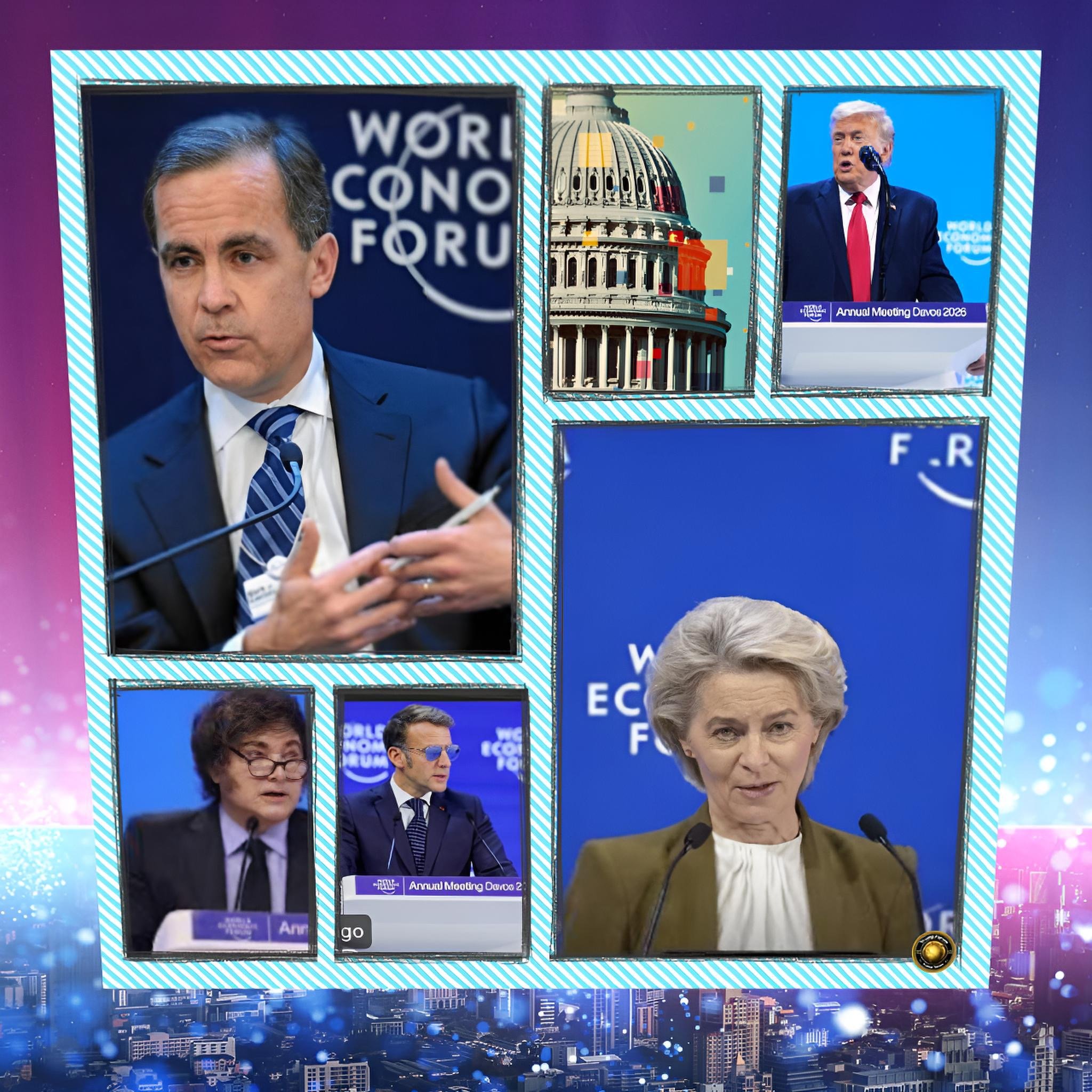
Emmanuel Macron, France's president, delivered a speech that will be remembered as the moment Europe drew a line in the sand. With the precision of a surgeon and the passion of a revolutionary, he said: "We do prefer respect to bullies. We do prefer rule of law to brutality."
Macron didn't name Trump directly. He didn't have to. The message was unmistakable: we're done with this. Macron warned about "a shift towards a world without rules. Where international law is trampled underfoot and where the only law that seems to matter is that of the strongest."
Ursula von der Leyen, the European Union's president, raised the stakes further. She called for European "independence"—a term that, in diplomatic language, means: we're building our own military, our own energy systems, and our own trade relationships. We're no longer dependent on America. We can go it alone.
And perhaps most dramatically, she said the European Union would deploy something called an "anti-coercion mechanism" if America didn't back down. Translation: trade war. Retaliation. Europe hitting back with its own tariffs on American goods.
Denmark didn't even show up to the conference. Think about that. A NATO ally, a country that hosts American military bases, simply didn't attend because the situation had become so toxic. It was a silent protest more powerful than any speech.
The Twist: Trump Suddenly Backs Down
The Stunning Hypocrisy: Davos Elite Talk Equality While Trump Talks Conquest
Here's where it gets interesting. After a meeting with NATO Secretary General Mark Rutte, Trump suddenly announced he was canceling the tariff threats. He said they'd reached a "framework of a future deal" on Arctic security and Greenland.
Everyone saw through this. Trump had threatened, been rebuffed, and needed an off-ramp. The "framework" was vague enough that both sides could claim victory and move on. But the damage was done. The message had been sent: America's commitments to its allies aren't sacred. They're negotiable. They're transactional.
The Alternative: China Makes Nice
When China's Dictator Sounds More Reasonable Than America's President
While the West was tearing itself apart, China's Vice-Premier He Lifeng delivered a masterclass in how to look like the reasonable actor. He talked about cooperation, about win-win partnerships, about China being everyone's friend, not anyone's enemy.
He recalled a speech from Xi Jinping in 2017 at Davos where China's leader essentially said: the global economy is interconnected. You can't separate it into different parts and expect it to work. It got a standing ovation then. In 2026, with Trump threatening to buy territory and hurt allies, He's invocation of that message hit differently.
People actually clapped for China's representative. American allies were listening to China's pitch about cooperation and multilateralism. If you'd told someone in 2010 this would happen, they would have laughed. But here it was.
The Implications: It's Remarkable
Here's why this matters: for seven decades, the world has operated under a basic assumption—America leads, everyone else follows. America sets the rules, and because America has the biggest military and the biggest economy, everyone grudgingly complies.
That assumption just died at Davos 2026.
When your closest allies start listening to your competitor's pitch about cooperation instead of buying your pitch about American leadership, you've got a problem. A big one.
Europe's Calculated Response: Build Independence
Why Europe Is Building Walls—Literally and Economically
Europe didn't just talk. Von der Leyen announced that the EU would double down on becoming independent from America. They're building up military spending. Germany alone is committing massive new defense budgets.
The EU just finished a massive trade deal with Latin America—creating a trading bloc of nearly 700 million people that's explicitly designed to reduce dependence on American markets.
They're essentially saying: we need to be able to survive without you. Maybe that was already the plan, but Trump forced the issue. He made isolation expensive and made alternatives attractive.
The Board of Peace: Trump's Wild Card
Creating a UN That Answers Only to Trump
Trump also announced something called the "Board of Peace" designed to oversee reconstruction in Gaza after the recent war. The details were strange. Trump would be the boss—able to make final decisions about international matters.
Countries wanting permanent membership would have to pay $1 billion each. The charter was vague enough that Trump could theoretically use this board for any conflict in the world.
It was an attempt to create an alternative to the United Nations—one that Trump controls. France and Germany said no thanks. They understood what was happening: Trump was trying to build his own international governance structure outside the constraints of international law and the UN.
Some countries joined—Israel, Egypt, and others. But Europe's refusal showed the split: Trump's allies and those who depend on him versus those who want to build independence.
The California Incident: Politics Invades Davos
Mocking Newsom: When Davos Becomes a Stage for Political Vengeance
Perhaps most revealing was what happened to Gavin Newsom, California's governor. He was invited to speak at a Fortune magazine conversation at the official American venue at Davos. He was going to defend democratic values and criticize Trump's aggressive approach.
Then, suddenly, he wasn't invited anymore.
The official explanation?
Venue logistics?
The actual explanation?
Trump's administration blocked him. Treasury Secretary Scott Bessent even mocked Newsom from the Davos stage, calling him economically illiterate.
This revealed something crucial: Davos, which is supposed to be about rational economic discussion, had become a venue for Trump to enforce political discipline.
Disagree with him, and you get excluded. It was petty, it was revealing, and it showed how personalized American power has become.
The Cast of Characters: A Geopolitical Thriller
Argentina's Milei Cheers, Europe Walks Away: The Alliance Splinters
Javier Milei, Argentina's libertarian president, showed up and praised Trump as a "beacon of light" for the West. Milei sees Trump as a kindred spirit—a leader who believes in small government and taking on "socialism" wherever he sees it.
India's largest-ever Davos delegation showcased India as the world's fastest-growing large economy—growing at 6.5 % annually.
India was simultaneously negotiating a massive trade deal with the EU. The message was clear: India has options. It doesn't need America.
Egypt's president, El-Sisi, met privately with Trump to discuss Gaza, the Suez Canal, and broader Middle East strategy. Egypt was hedging—maintaining relationships with both America and the emerging multipolar world.
Canada's Mark Carney (previously Bank of Canada governor) delivered a speech warning that "middle powers must act together because if we're not at the table, we're on the menu." It was a recognition that smaller countries had to band together or get crushed in the great power competition.
The Deeper Story: Why America Is Acting This Way
Here's what's really happening beneath the Greenland chaos: America is declining relative to the rest of the world.
For three decades after the Cold War, America was the undisputed superpower. Everyone wanted American goods, American investment, American protection. American workers could dominate in manufacturing.
But things changed. China became competitive. Europe unified. India emerged as a tech powerhouse. And American workers paid the price—factories closed, towns hollowed out, the middle class shrank.
Trump's election reflected this anxiety. His voters wanted someone to fight back against this decline. They wanted to reclaim American dominance. Trump's approach: nationalism. Tariffs. Deals that explicitly put America first.
The Greenland grab, the tariff threats, the aggressive posturing—it's all an expression of this anxiety about American decline.
Trump is saying: we're not playing by rules that other people set. We're going to take what we need and threaten whoever gets in our way.
It's the foreign policy equivalent of a declining empire lashing out.
Why It Matters: The End of an Era
India Rising: The Country Realizing It Doesn't Need Permission From America
For context, consider what's at stake. The current international system was literally designed by America after World War II.
The United Nations, the International Monetary Fund, the World Bank, NATO—all American creations. They reflected American values and power at their apex.
But if America stops honoring those institutions—if it threatens allies, ignores international law, and pursues territorial acquisition—then what happens to the system? Why would other countries follow rules that America ignores?
This is the question hanging over Davos 2026. The answer seems to be: they won't. Europe is building independence.
China is offering cooperation. India is hedging. And smaller countries are watching nervously to see if the strong are about to start eating the weak.
The Climate Subplot
Two Incompatible Visions of the Future
One other thing happened at Davos that's worth noting: environmental leaders warned that ignoring climate change would cost trillions and destroy coastal cities. Meanwhile, Trump's administration is backing fossil fuels. Europe and India are doubling down on renewable energy.
This isn't just about climate. It's about the direction of the global economy.
Europe, China, and India are betting the future is in clean energy. Trump is betting it's in oil and gas. These aren't compatible visions. And they'll shape geopolitics for decades.
The AI Question
The AI Race: Why Davos 2026 Revealed the Real Superpower Competition
There was also fascinating discussion about artificial intelligence. China wants to lead in AI. America wants to stay ahead. Europe wants to regulate it carefully. India wants access to the technology.
The subtext: whoever leads in AI will lead geopolitically for the next fifty years. This is a race everyone is watching because the stakes are existence-level high.
The Inequality Shadow
Inequality, the Secret Star: Why Davos Never Admits the Real Problem
Lurking beneath all of this is something the WEF's own research revealed: inequality is at dangerous levels. The world has become a K-shaped economy—the rich get richer, the middle gets hollowed out, and the poor struggle.
This breeds the populism that elected Trump. It breeds the anger that made Europe willing to challenge America. It breeds the rise of leaders like Milei in Argentina and reformers in India who promise to shake things up.
Davos tries to paper over this with talks about "inclusive growth" and "sustainable development." But no one really believes it.
The conference is fundamentally an elite gathering trying to shape a world for everyone while benefiting itself. That's an inherent contradiction that's becoming harder to hide.
Conclusion: The World After Davos 2026
Walking away from Davos 2026, a few things are clear:
First, America's era of unquestioned leadership is over. Trump is still trying to act like America can take what it wants when it wants it. But the world pushed back. Allies are building alternatives.
Second, Europe has decided it can't depend on America. It's investing in military power, building alternative trade relationships, and moving toward strategic autonomy. This is the biggest shift in European policy in seventy years.
Third, China is positioned as the defender of multilateralism and cooperation. Whether that's sincere or just good PR, it's working. When democracies sound like bullies and an authoritarian state sounds reasonable, something has inverted.
Fourth, the global South is emerging as a real player. India, Brazil, Mexico, and others are no longer just following orders. They're making their own strategic calculations about whom to work with and when.
Fifth, the world is multipolar now. There's no going back to American hegemony, no matter how aggressively Trump postures. The question is whether multiple powers can coexist peacefully or whether this becomes chaotic and violent.
The Business Angle
Davos After Dark: What Happens When Democracy Sounds Like Despotism
For investors and business leaders watching Davos, the implications are stark:
If trade wars accelerate, supply chains get disrupted, and economic growth slows, corporations will get hurt. Companies are already pricing in tariff risk.
Valuations are getting hammered. The AI boom that's been keeping stock markets afloat could stall if geopolitical tensions escalate.
Companies are already asking: where should we invest?
In American companies dependent on free trade?
In Chinese companies protected by government policy?
In European companies positioning for independence?
Or in diversified portfolios across all regions?
The Symbolism
The Symbolism Nobody Is Admitting: America as the Aggressor, China as the Peacekeeper
What strikes you about Davos 2026, ultimately, is the reversal of symbols.
For decades, the American president at Davos was the reasonable actor, the defender of free trade and international cooperation—even as America sometimes violated those principles in practice.
Now, the American president sounds like a land-grabber, an extortionist, a bully. Meanwhile, China's representative sounds like he's defending international law and cooperation.
That's not really a change in China's behavior. It's a change in American behavior. And it's reshaping how the world perceives both countries.
The Final Word
The Post-Davos Question: Can the World Survive Without American Leadership?
Davos 2026 will be remembered as the conference where the post-Cold War international order cracked visibly. It's not dead yet. But its funeral is being planned.
What replaces it? That's the question that should keep world leaders awake at night. Because if the answer is "nothing"—if we're heading toward a chaotic multipolar world with no rules—then everyone, including the billionaires sipping champagne in Davos, should be very worried.
The next Davos, in 2027, will tell us how deep the cracks go.