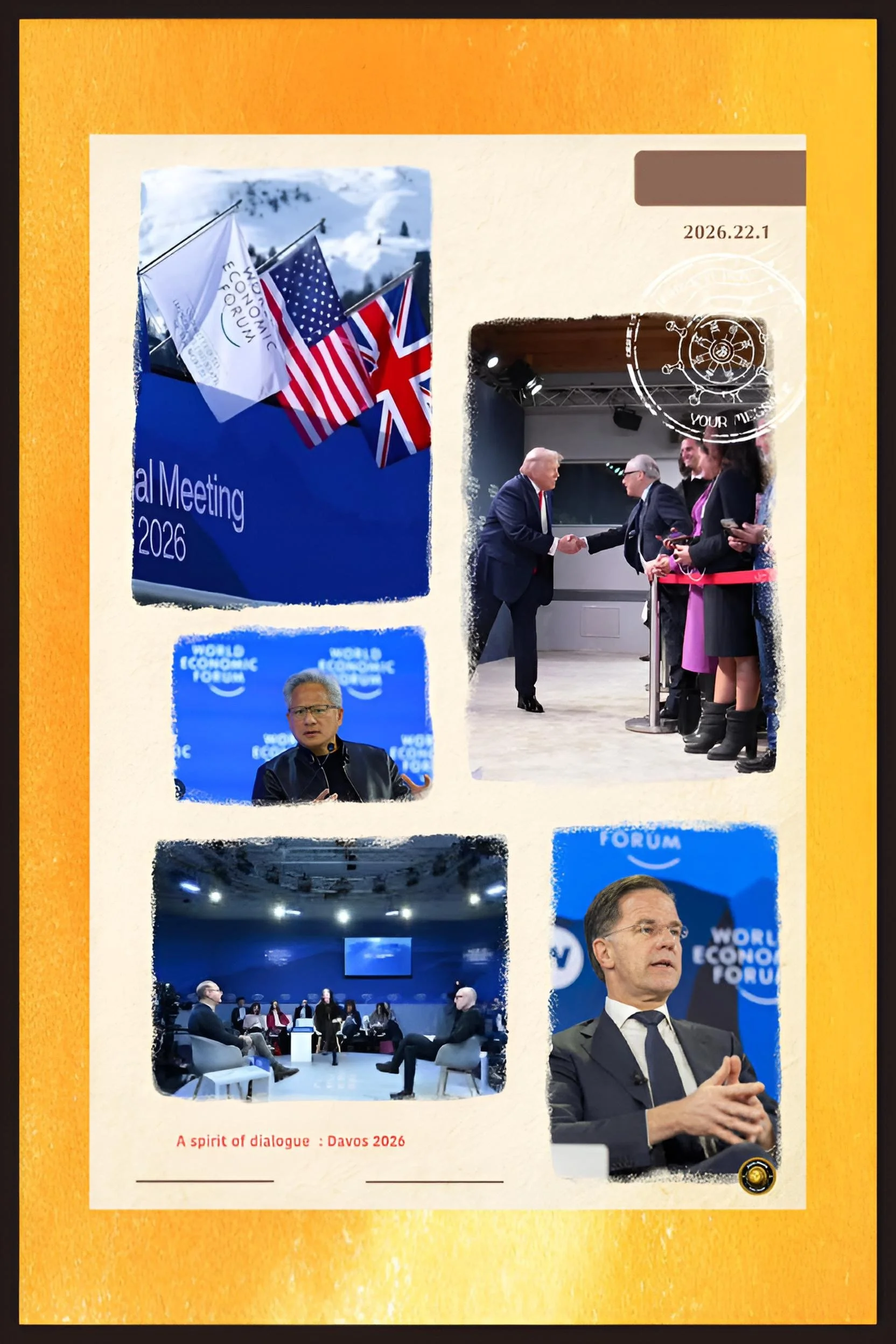
Davos 2026: The Mountain Where Talk Finally Met Reality—But Still Couldn't Close the Deal
Summary
The Mountain Where the Elite Finally Got Honest: Why Davos 2026 Changed the Conversation But Not the World—Yet
When over three thousand of the world's most influential people converged on the Alpine slopes of Davos in January 2026, they did something their predecessors rarely managed: they told the truth.
"We are standing at the start of a new reality, the contours of which are still to be defined," declared Børge Brende, the World Economic Forum's president.
These words hung in the crisp Swiss air like a confession.
For decades, Davos had functioned as a gilded stage where the global elite delivered rehearsed narratives about managed decline, technological salvation, and the inevitability of their continued dominance. In 2026, someone finally switched off the teleprompter.
The 56th Annual Meeting arrived bearing an audacious theme: "A Spirit of Dialogue." To understand how audacious this was, one must appreciate that "dialogue" is code for "we don't agree anymore."
When the world's most powerful people must explicitly commit to talking with one another, it signals that the mechanisms for agreement have fundamentally broken down.
This was Davos confronting its own irrelevance while trying to matter. It was the global establishment's last, desperate attempt to remind themselves—and the world—that they still had something to say.
The Elephant in the Room Called Fragmentation
The Historic Gathering That Changed How We Discuss Change
Here is what made this Davos genuinely different: everyone acknowledged the elephant in the room. Not with the coded language of "geopolitical headwinds" or "trade tensions." With raw honesty.
Canada's Prime Minister Mark Carney delivered remarks that still echoed through the resort days after he spoke them: "For decades, countries like Canada prospered under what we called the rules-based international order...this bargain no longer works." He was not suggesting the order needed fine-tuning. He was announcing it was dead.
Emmanuel Macron didn't whisper about Europe's challenges. He declared that the world was experiencing "brutalization"—his actual word—with 2024 marking a record 60 simultaneous wars. He described a landscape where autocracy was advancing against democracy, international law was being trampled, and the post-1945 architecture of global cooperation was collapsing in real time.
And then there was the elephant's elephant: the fact that Donald Trump, whose first presidency had horrified many Davos attendees, showed up for his second act, defended tariffs that were dramatically reshaping global trade, and received not condemnation but serious engagement from even his harshest critics. China's Vice-Premier responded not with denunciations but with calls for dialogue and market opening. Europe listened with palpable anxiety rather than outrage.
The effect was like watching a dysfunctional family finally stop pretending to be happy. The dysfunction had not been resolved—if anything, it had metastasized. But at least everyone was being honest about it.
The Crisis Nobody Talked About Enough: Trust
While Davos participants were debating geopolitics and artificial intelligence, something more fundamental was unraveling in the background. Trust. The kind of trust that makes civilization possible.
The Edelman Trust Barometer, released at the conference, presented findings that should have dominated headlines but essentially did not. Seventy percent of respondents globally now manifest what researchers call "insular" mindsets: they actively avoid engaging with people who disagree with them. They do not want to work alongside them. They do not want to be in the same room. They want to associate exclusively with people who think as they do.
In developed economies, this dynamic was even more pronounced. Only 52 percent of workers trust their senior leaders. In rapidly developing countries, that number jumped to 67 percent. What this suggested was not that developing countries had better leaders, but that their institutions had not yet fully decomposed the way Western institutions have.
Klaus Schwab, the founder of the World Economic Forum himself, issued a stark pre-conference warning: "We are missing in our society two fundamental pillars: truth and trust. Without restoring those pillars, we will not be able to solve the big global issues that we face."
Yet this diagnosis—perhaps the most important one made at Davos—was largely left untreated. You cannot rebuild trust at a conference. You rebuild trust when political leaders make difficult decisions and follow through. You rebuild trust when corporations sacrifice short-term profit for long-term credibility. You rebuild trust when institutions become transparent about their failures and demonstrate sustained commitment to change.
Davos could do none of these things, because these are daily struggles at the level of individual countries and communities. Davos can only recognize that the problem exists. And in 2026, at least it did that.
The Uncomfortable Reality Behind Every Discussion: The Poverty in the Room
There is something almost obscene about Davos 2026 if you think about it for more than five minutes.
Three thousand of the world's most powerful people gathered to discuss solutions to the challenges afflicting the other 8 billion. They took private jets to get there. They stayed in five-star hotels. They dined on cuisine most humans never taste. While they debated climate change, the event's carbon footprint caused environmental damage. While they discussed poverty, the cost of entry to many sessions exceeded what billions of people earn monthly.
Larry Fink, BlackRock's chairman and effectively the conference's "mayor," articulated the central contradiction with unusual candor: "Many of those most impacted by our discussions here will never attend this conference. This is a central tension of the forum. Davos is an exclusive gathering attempting to influence a world that belongs to everyone."
This was not accidental modesty. This was institutional self-awareness that the contradiction cannot be resolved. You cannot make Davos inclusive without destroying what makes it valuable—the ability to get decision-makers from competing powers and industries into a room for substantive dialogue. But you also cannot pretend to be addressing global problems while excluding the people most affected by them.
One analyst captured this perfectly: "Davos has consistently misjudged the trajectory of global events. The mid-2010s attendees missed the mark on Brexit, the MAGA movement, and the populist tide that followed. In 2020, delegates were enjoying communal fondue fountains while COVID-19 was circulating nearby."
The wealth gap between those in the Congress Centre in Davos and those in, say, rural Tanzania, Detroit, or even suburban Spain is not an unfortunate background fact. It is a central fact about why Davos succeeds as a network but fails as a problem-solving mechanism. The people most affected by inequality were watching the conversation on social media while eating meals that cost a fraction of what the speakers were spending on wine.
Where Real Change Actually Happened: Not in the Speeches
What is remarkable about Davos 2026 is that almost all the tangible outcomes occurred outside the main session rhetoric. The investment announcements, the concrete agreements, the actual deals—these happened in side meetings and bilateral negotiations.
On the very first day, India's Mumbai Metropolitan Region Development Authority announced a staggering $96 billion in investment commitments. Ten memoranda of understanding were signed between regional development authorities and international corporations. One agreement alone—with SBG Group—committed $45 billion to building logistics and industrial infrastructure across Mumbai and its surroundings. The projection: 960,000 new jobs.
Why did this work when broader statements about cooperation failed?
Because these deals had enforcement mechanisms. They had signatures. They had financial penalties for non-compliance. They had specific timelines and deliverables.
Every other aspiration at Davos—cooperation among great powers, addressing trust deficits, ensuring AI benefits all countries equally, protecting nature while growing economies—remained remarkably vague. Good intentions, eloquent formulations, and zero enforcement mechanisms.
This is not to say the speeches were valueless. When Saudi Arabia's Minister of Investment Khalid Al-Falih declared that "the essence of AI's power is it has to be accessible...diffusion has to be done globally," he was articulating a principle that could guide policy. When the CEO of Fortescue demonstrated that removing diesel from mining operations saves $1 billion annually while protecting the environment, he was providing evidence that profit and environmental protection need not conflict.
But principle and evidence are different from commitment and enforcement. One drives policy. The other drives good feelings that evaporate once attendees board their jets home.
The AI Reckoning: Opportunity and Terror in 2000 Words
No single topic commanded more attention at Davos 2026 than artificial intelligence. This made sense. AI is simultaneously the most transformative technology since the internet, the most unequally distributed across countries, and the least governed.
The statistics painted a stark picture. Global investment in AI is accelerating. By 2030, analysts project $1.5 trillion annually for AI applications and $400 billion for infrastructure. These are world-changing numbers—the equivalent of building new economic sectors from scratch.
Yet the International Monetary Fund's Managing Director Kristalina Georgieva delivered a sobering assessment: AI will touch 40 percent of jobs globally, but the impact is wildly uneven. In advanced economies, 60 percent of jobs face AI-driven transformation. In low-income countries, the number drops to 20-26 percent. This does not mean poor countries are safe. It means they are unprepared.
Microsoft's Brad Smith highlighted the infrastructure divide: generative AI is used by 25 percent of people in the global North, but only 14 percent in the global South. The gap is widening, not narrowing. Smith pointed out an absurdity hidden in the data: for every data scientist in Africa, there are 14 in Europe. If Africa is to build AI capacity, someone needs to train people to do this work. No one at Davos volunteered for the job.
What emerged from multiple sessions was a profound anxiety about whether artificial intelligence could be governed at all. One panel included four of the world's leading AI researchers. When asked whether humans could maintain meaningful control over increasingly autonomous AI systems, the answer was "maybe"—and the "maybe" sounded pessimistic.
Yoshua Bengio, one of the scientists who pioneered the deep learning approaches that power modern AI, warned that today's systems are trained to imitate humans—including human flaws like bias, racism, and dishonesty. He said explicitly that this is dangerous, and that we need different approaches. But what those approaches might be remained unclear.
Yuval Noah Harari, the historian and public intellectual, offered a stunning observation: "We have no experience building a hybrid human-AI society." He meant this literally. Every society in history has been human-controlled. We are entering genuinely uncharted territory. And we are entering it not with careful experimentation and caution, but with aggressive investment and competitive racing by great powers.
The one concrete commitment Davos made regarding AI was this: it recognized the challenge, acknowledged the inequality in distribution, and... essentially kicked the problem down the road. Countries will develop their own regulations. Companies will make their own choices. The fact that these choices will have profound global consequences was noted and then set aside.
The Climate Pivot: When Capitalism Finally Admits the Truth
For three decades, the climate debate has been framed as a choice between environmental protection and economic growth. Davos 2026 moved beyond this false choice—though not through moral awakening. Through profit realization.
The key pivot came when multiple business leaders demonstrated something economists have long argued but business has long resisted: protecting the environment can be more profitable than destroying it.
Fortescue's Andrew Forrest explained that by removing diesel from supply chains, his company eliminated a billion dollars in annual costs while dramatically reducing emissions. This is not a trade-off. This is a win-win. And once you realize that a win-win is possible, you start to reframe the entire challenge.
The World Economic Forum released data suggesting that protecting natural capital—the ecosystems and resources that humans depend on—produces $7-$30 in economic returns for every $1 invested. Fifty-three percent of global GDP depends on nature. Which means damaging nature does not just harm future generations; it destroys current business models.
This created an interesting inversion. Environmental protection became reframed as investment opportunity rather than moral obligation. Young environmental activists might find this cynical. But it is pragmatically powerful. When business leaders can be convinced that protecting the planet makes them richer, not poorer, political resistance to climate action collapses.
PepsiCo's CEO Ramon Laguarta articulated the new frame directly: "This is not about sustainability or profitability. This is about short term or long term." He was saying that the real choice facing corporations is not profit versus environment, but quarterly returns versus survival.
Whether this philosophical shift translates into actual behavior change remains to be seen. But at least the argument has moved from "we cannot afford to protect nature" to "we cannot afford not to protect it." That shift, though modest, is real.
The Uncomfortable Questions Davos Left Unanswered
For all that was discussed, certain silences were deafening.
The question of what to do about the global wealth gap remained unanswered. Income inequality within countries has exploded. The gap between the richest and poorest countries has widened. The middle class in developed countries has stagnated. And the only solution Davos offered was "dialogue" and "investment in people." Which is another way of saying "we do not have a solution."
The question of whether multilateral institutions can be reformed or whether they are beyond repair went unresolved. China advocated for strengthened international cooperation. America advocated for selective partnerships. Europe advocated for autonomous capability. The outcome was a vague acceptance that cooperation would happen in smaller, issue-specific coalitions—"minilateralism"—rather than through universal institutions. This is probably realistic, but it means the international system is fragmenting, not consolidating.
The question of whether young people would accept a world where they inherit unresolved crises was not honestly engaged. The Youth Pulse 2026 survey found that young people have fundamentally lost faith in institutional solutions. They see education systems that do not teach them for jobs that exist. They see political systems that promise change and deliver nothing. They see corporations that claim to care about sustainability while destroying ecosystems. They are opting out of traditional pathways and building solutions themselves.
Davos acknowledged this. But it did not change course. It did not ask itself whether the forum's model of elite deliberation could actually address challenges that require popular mobilization and systemic change at local and national levels.
What Davos 2026 Actually Accomplished
Stripped of rhetoric, here is what the conference did:
It provided a gathering place where leaders who rarely speak could engage directly. This has value. Personal relationships matter in international affairs. When a European leader understands why an American tariff policy exists, not through media reports but through direct conversation, that changes the conversation.
It documented the state of global dysfunction with unusual honesty. Klaus Schwab's observation about eroded truth and trust resonated because it was true. Mark Carney's observation that the old rules no longer work was bracing because it acknowledged reality.
It created platforms for certain ideas to spread. The idea that climate protection can be profitable rather than costly. The idea that AI diffusion matters for global stability. The idea that investing in nature protection is financially intelligent. These ideas are not new, but when they emerge from business leaders at Davos, they carry different weight than when they emerge from environmental advocates.
It showcased emerging opportunities and investment possibilities. The India announcements, the renewable energy discussions, the discussions about AI infrastructure—these laid groundwork for future capital deployment.
But it did not create binding commitments. It did not resolve fundamental disagreements. It did not rebuild trust. It did not address inequality. It did not create mechanisms for enforcing the principles it articulated.
The Question That Matters: Did Davos Change Anything?
The World Economic Forum's Most Candid Meeting Exposed Deep Problems But Offered Few Solutions. What Happens Next Will Matter More Than What Was Said
The answer is: we do not know yet, and we might not know for years.
Davos works either as immediate catalyst or as slow-acting influence.
When Mark Carney returns to Canada and his government uses his Davos remarks about "value-based realism" to reshape trade policy, Davos will have succeeded.
When Khalid Al-Falih returns to Saudi Arabia and implements an AI strategy centered on global diffusion rather than competitive dominance, Davos will have succeeded.
When a CEO who heard about Fortescue's billion-dollar savings decides to invest in renewable energy infrastructure, Davos will have succeeded.
Or it will not. Leaders return home, face domestic political pressures, encounter investor demands for quarterly growth, and the Davos conversation becomes a pleasant memory rather than a policy driver.
The reality is that Davos 2026 was the conference where the global elite finally, honestly acknowledged that the world has gotten too complex, too unequal, and too fragmented for them to manage alone.
The mountain where they speak did not solve the problems they discussed. But at least, for five days, they stopped pretending they could.
That is not triumph. But it is, perhaps, a start.