The Emergence of Jonestown, Guyana as a Site for Dark Tourism: Analyzing Its Parallels with Chernobyl's Appeal
Introduction
The phrase “Don’t drink the Kool-Aid” has become deeply embedded in American vernacular as a warning against blind loyalty and following dangerous leaders without question.
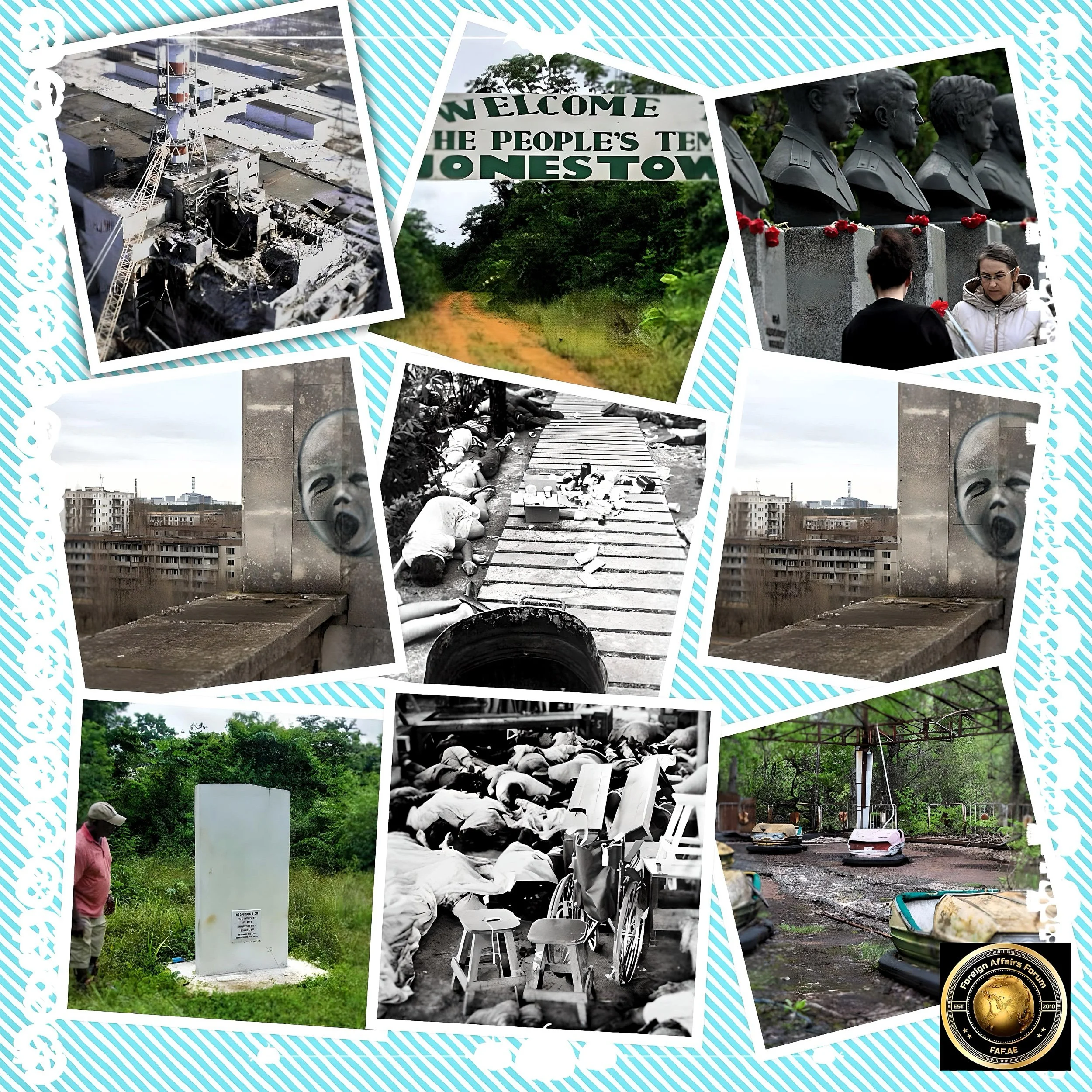
This expression originates from one of the most tragic mass murder-suicides in modern history: the Jonestown Massacre of November 18, 1978, when over 900 members of Jim Jones’ Peoples Temple died after consuming cyanide-laced fruit punch in Guyana.
Now, nearly five decades later, Guyana has opened this site to tourists, placing it alongside other infamous dark tourism destinations like Chernobyl.
The Jonestown Tragedy and Its Lasting Impact
The Peoples Temple, led by charismatic cult leader Jim Jones, established an agricultural commune called Jonestown in the remote jungles of Guyana in 1974.
What began as Jones’ vision of a racially integrated utopian society quickly devolved into a nightmare of control, abuse, and manipulation.
When U.S. Congressman Leo Ryan visited Jonestown in November 1978 to investigate reports of abuse and people being held against their will, the situation reached its tragic climax.
After Ryan and several others were murdered at the nearby Port Kaituma airstrip, Jones ordered what he called “revolutionary suicide”.
More than 900 people, including 304 children, died after drinking a grape-flavored beverage laced with cyanide, valium, phenergan, and chloral hydrate.
Contrary to popular belief, the drink was primarily Flavor Aid rather than Kool-Aid, though both brands were found at the site.
The phrase “drinking the Kool-Aid” emerged from this tragedy and has since become a metaphor for blind devotion to a cause or leader, often with dangerous consequences.
It represents one of the most powerful warnings against unchecked authority and manipulation in American culture.
The Emergence of Dark Tourism
Dark tourism, defined as travel to sites associated with death, tragedy, and suffering, has become increasingly popular in recent decades.
The concept was formally coined by academics John Lennon and Malcolm Foley in 1996, though the practice has much older roots.
Dark tourism encompasses a spectrum of sites, from lighter attractions focused on entertainment to the darkest sites of genuine tragedy and remembrance.
Chernobyl stands as perhaps the most prominent example of modern dark tourism.
The 1986 nuclear disaster at the Chernobyl Nuclear Power Plant in Ukraine created the world’s worst nuclear catastrophe, contaminating vast areas and forcing the evacuation of entire communities.
The nearby city of Pripyat, evacuated within 36 hours of the explosion, became a frozen-in-time ghost town that has captured global imagination.
Since opening to tourists in 2011, Chernobyl has attracted hundreds of thousands of visitors annually.
The site’s popularity surged following the 2019 HBO miniseries “Chernobyl,” demonstrating how media can drive interest in dark tourism destinations.
Visitors come seeking to understand one of humanity’s greatest technological failures and witness the eerie aftermath of nuclear disaster.
Jonestown Joins the Dark Tourism Map
In late 2024, Guyana officially opened Jonestown to tourists through government-backed tour operator Wanderlust Adventures.
The Jonestown Memorial Tour offers a $750, two-day experience that includes flights from Georgetown to Port Kaituma, visits to the airstrip where Congressman Ryan was killed, and a trek through the jungle to the overgrown remains of the Peoples Temple commune.
The decision has sparked significant controversy, with critics arguing it commodifies suffering and disrespects the victims.
Former Congresswoman Jackie Speier, who survived the 1978 attack after being shot five times, has been particularly vocal in her opposition: “I was horrified because it doesn’t deserve to be a tourist attraction. And for a company to think this is adventure tourism is missing the mark”.
However, tour operators defend the venture as educational, comparing it to established dark tourism sites like Auschwitz and Holocaust museums.
Rose Sewcharran of Wanderlust Adventures argues that Jonestown “offers critical lessons about cult psychology, manipulation and abuse of power”.
The tours are designed to be respectful and educational rather than sensationalistic, with age restrictions limiting participation to adults.
The Significance of Jonestown in Relation to Chernobyl
The connection between Jonestown and Chernobyl in the context of dark tourism reveals several important parallels and distinctions.
Both sites represent catastrophic failures of human systems—Chernobyl showcasing technological hubris and institutional secrecy, while Jonestown exemplifies the dangers of unchecked charismatic authority and cult manipulation.
Each disaster created lasting impacts far beyond their immediate casualties, influencing global conversations about nuclear safety and cult awareness respectively.
The ethical debates surrounding both destinations highlight the complex nature of dark tourism.
While critics worry about exploitation and voyeurism, supporters argue these sites serve essential educational purposes, helping prevent future tragedies by preserving historical memory.
The timing of tourist access also differs significantly—Chernobyl opened to visitors 25 years after the disaster, while Jonestown has remained largely inaccessible for nearly 50 years until now.
This extended isolation has contributed to Jonestown’s mystique while allowing the jungle to reclaim most physical evidence of the settlement.
Media influence plays a crucial role in driving tourist interest to both sites.
Just as the HBO series boosted Chernobyl tourism, documentaries and renewed media attention about Jonestown have generated interest in visiting the remote Guyanese site.
The Ethics and Future of Tragedy Tourism
The opening of Jonestown as a tourist destination raises fundamental questions about the ethics of dark tourism. When does remembrance become exploitation?
How long must pass before tragedy can become tourism?
These questions have no simple answers, but they demand careful consideration of victims’ dignity, survivors’ feelings, and educational value.
The phrase “Don’t drink the Kool-Aid” serves as a powerful reminder of Jonestown’s significance—it represents not just a historical tragedy but an ongoing warning about the dangers of blind faith and manipulation.
As Guyana opens this site to tourists, the challenge lies in maintaining the gravity of this lesson while making it accessible to new generations who may only know the phrase without understanding its origins.
The emergence of Jonestown as a dark tourism destination, following in the footsteps of sites like Chernobyl, reflects humanity’s complex relationship with tragedy, memory, and learning. Whether these visits serve as meaningful education or inappropriate spectacle depends mainly on how they are conducted and the intentions of those who participate.
The ultimate test will be whether tourists leave with a deeper understanding of the dangers that led to these tragedies—and a stronger commitment to preventing their recurrence.