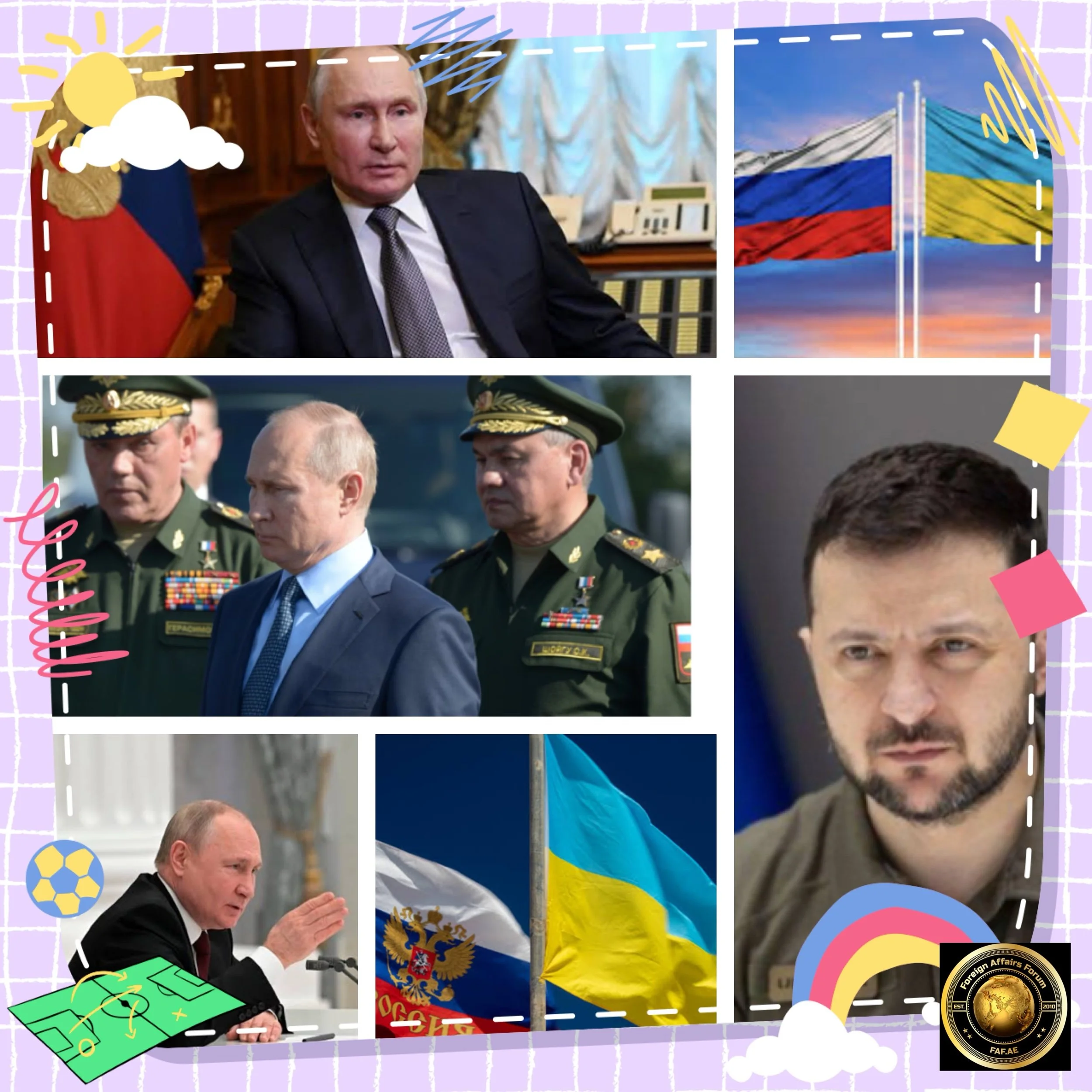
Putin’s “Historical Unity” Essay: A Critical Analysis of Imperial Narratives and Global Scholarly Responses
Introduction
Vladimir Putin’s essay “On the Historical Unity of Russians and Ukrainians,” published in July 2021, represents a pivotal document in understanding the ideological foundations of Russia’s subsequent invasion of Ukraine.
This lengthy treatise, which argues that Russians and Ukrainians constitute “one people” within a historically unified nation, has drawn extensive criticism from international scholars who view it as a pseudo-historical justification for territorial aggression.
FAF, War.Events reviews and provides a deep analysis of an essay published nine months before Russia’s full-scale invasion of Ukraine.
Experts have characterized it as a declaration of imperial intent and a fundamental misrepresentation of Eastern European history.
Global academics and policy analysts have systematically dismantled Putin’s historical claims while highlighting how the document reveals Russia’s broader strategy of weaponizing history to justify contemporary geopolitical objectives.
Putin’s Central Arguments and Historical Claims
Putin’s essay presents a comprehensive narrative that seeks to delegitimize Ukrainian sovereignty through selective historical interpretation.
The Russian president argues that Russians, Ukrainians, and Belarusians belong to what he terms the “triune Russian nation,” sharing common ancestry in the medieval Kyivan Rus federation.
His argument hinges on the assertion that these peoples share fundamental bonds of language, Orthodox faith, and cultural heritage that transcend modern political boundaries.
Putin contends that any Ukrainian identity distinct from Russian identity is an artificial construct imposed by foreign powers, particularly through what he characterizes as Western manipulation and interference.
The essay extensively discusses the historical relationship between these territories, with Putin claiming that modern Ukraine occupies “historically Russian lands” and that “Russia was robbed” of these territories.
He frames contemporary Ukraine as an “anti-Russia project” systematically developed by external forces since the seventeenth century.
This narrative portrays Ukrainian independence not as a legitimate expression of national self-determination but as the result of foreign conspiracies designed to weaken Russia.
Putin specifically targets Ukrainian policies that promote the Ukrainian language and discourage Russian language use, characterizing these as artificial attempts to divide what he views as a naturally unified people.
Putin’s treatment of Ukrainian borders proves particularly controversial, as he openly questions their legitimacy and suggests they result from arbitrary Soviet administrative decisions rather than genuine national boundaries.
He argues that Ukraine’s contemporary borders, based on the boundaries of the Ukrainian Soviet Socialist Republic from 1954 to 1991, lack historical justification.
The essay concludes with Putin’s assertion that “true sovereignty of Ukraine is possible only in partnership with Russia,” effectively denying Ukraine’s right to independent foreign policy choices.
This conclusion reveals the essay’s ultimate purpose: establishing an ideological framework for Russian dominance over Ukrainian political decisions.
Global Scholarly Responses and Expert Analysis
International historians and political analysts have sharply criticized Putin’s essay, characterizing it as fundamentally flawed historical revisionism.
Serhii Plokhy, the prominent Ukrainian historian and director of the Harvard Ukrainian Research Institute, described the essay as presenting a “narrative that justified from the historical point of view what I certainly consider a crime.”
Plokhy’s analysis emphasizes how Putin’s essay weaponizes history to provide pseudo-academic legitimacy for political aggression, representing what he terms the unprecedented use of historical argumentation to justify military action.
Anne Applebaum, the Pulitzer Prize-winning historian and author of several books on Russian and Soviet history, characterized Putin’s essay as “essentially a call to arms.”
Applebaum’s analysis highlights how the document goes beyond typical diplomatic discourse to present an ultimatum to Ukraine regarding its sovereignty and international partnerships.
Her assessment emphasizes the essay’s role in preparing Russian public opinion for military action by establishing a historical narrative that portrays Ukrainian independence as illegitimate and Ukrainian resistance to Russian influence as unnatural.
The Atlantic Council’s analysis revealed the essay’s systematic use of disinformation tactics, with experts identifying it as part of a broader pattern of Russian narrative warfare.
FAF analyzed Putin’s speech announcing the invasion, which contained over two hundred references to themes and narratives established in the unity essay, demonstrating its central role in Russia’s information strategy.
Stockholm Free World Forum senior fellow Anders Åslund went further, branding the article “a masterclass in disinformation” and describing it as “one step short of a declaration of war.”
These scholarly assessments consistently emphasize how the essay represents not academic historical analysis but political propaganda designed to justify territorial aggression.
Evolution of Russian Narratives and Strategic Adaptations
Scholars have documented significant evolution in Russian strategic narratives since the essay’s publication and Russia’s subsequent invasion of Ukraine.
Research published in academic journals reveals how Putin’s initial framework has been adapted to address the realities of prolonged military conflict.
The original narrative, which anticipated rapid military success and Ukrainian acceptance of Russian control, has undergone substantial modifications as the war has progressed beyond Putin’s initial expectations.
The transformation of Russian messaging reflects what scholars identify as the fragility of Putin’s original historical arguments when confronted with Ukrainian resistance.
Academic analysis shows that Russian officials have been forced to introduce new themes and explanations to maintain narrative consistency while explaining why the “liberation” of Ukraine has required extensive military action.
This evolution demonstrates the weakness of Putin’s historical unity argument when tested against the reality of Ukrainian national identity and resistance to Russian occupation.
Scholars note that the essay’s requirement for Russian forces to study it as mandatory reading reveals its role as ideological preparation for military personnel.
However, the prolonged nature of the conflict has forced Russian leadership to modify their messaging strategy. They are moving away from claims about rapid reunification toward narratives emphasizing the existential struggle against Western influence.
This shift indicates that Putin’s original historical unity thesis has proven insufficient to explain or justify the scale of violence required to achieve his stated objectives.
Impact on Ukrainian Identity and International Relations
International experts emphasize how Putin’s essay has inadvertently strengthened rather than undermined Ukrainian national identity.
Plokhy notes that Russia “thought it was invading the Ukraine of 2014” but instead “encountered a nation transformed” with a strong sense of political identity that “crossed cultural, religious and ethnic lines.”
This scholarly assessment highlights how the eight years between Russia’s initial invasion of Crimea and Donbas and the 2022 full-scale invasion allowed Ukrainian civil society and state institutions to develop unprecedented unity in opposition to Russian claims.
The essay’s publication and subsequent invasion have also influenced international academic discourse about the nature of imperial relationships in Eastern Europe.
Scholars emphasize how Putin’s arguments echo historical patterns of Russian imperial thought that deny agency to neighboring peoples.
The Center for Strategic and International Studies analysis reveals that Putin’s worldview reflects “the politics of eternity,” where contemporary political relationships are predetermined by ancient historical connections rather than contemporary democratic choices.
Academic analysis consistently emphasizes how Putin’s essay reveals fundamental misunderstandings about the development of Ukrainian national identity over the past three decades.
Experts note that Ukrainian independence in 1991 was supported by an overwhelming popular vote across all regions of Ukraine, including those with significant Russian-speaking populations.
This democratic expression of Ukrainian national will contradicts Putin’s claims about the artificial division of naturally unified peoples.
International scholars argue that Putin’s essay demonstrates his failure to comprehend how modern democratic processes have allowed Ukrainian national identity to develop independently of Russian influence.
Historical Methodology and Academic Criticism
Professional historians have examined Putin’s essay rigorously and identified numerous methodological flaws and factual errors.
The essay’s selective use of historical evidence and omission of contradictory information has drawn particular criticism from academic specialists in Eastern European history.
Scholars note that Putin’s argument relies heavily on medieval precedents while ignoring centuries of subsequent historical development that saw the emergence of distinct Ukrainian cultural, linguistic, and political traditions.
Academic analysis reveals how Putin’s essay employs what historians term a “presentist” interpretation, in which contemporary political objectives determine the selection and interpretation of historical evidence.
This approach violates fundamental principles of historical scholarship by subordinating factual accuracy to political utility.
International historians emphasize how the essay’s treatment of complex historical processes oversimplifies centuries of cultural and political development to support predetermined conclusions about contemporary territorial claims.
The response from professional historical organizations has been unprecedented, with groups of historians publishing collective statements challenging Putin’s historical claims.
These academic responses emphasize how the essay’s misuse of historical evidence legitimizes territorial aggression and ethnic nationalism.
Scholars particularly criticize Putin’s treatment of the Soviet period, noting how his selective praise for specific Soviet policies while condemning others reveals political rather than analytical motivations.
This scholarly consensus emphasizes how Putin’s essay represents political propaganda rather than serious historical analysis.
Global Policy Implications and Strategic Assessment
International policy experts view Putin’s essay as revealing fundamental aspects of Russian strategic thinking that extend beyond the immediate Ukraine conflict.
Analysis from major policy institutes emphasizes how the essay demonstrates Russia’s broader challenge to the post-Cold War international order based on principles of sovereignty and self-determination.
Scholars note that Putin’s arguments about historical unity could theoretically be applied to justify Russian claims over other former Soviet territories, making the essay’s implications extend far beyond Ukraine.
Security analysts emphasize how the essay’s publication timing, shortly before major Russian military buildups, reveals its role in Russia’s broader information warfare strategy.
Academic assessment shows how the document served multiple purposes: preparing Russian public opinion for military action, attempting to influence international opinion about the legitimacy of Russian claims, and providing an ideological framework for Russian military personnel.
This multi-faceted approach demonstrates a sophisticated integration of historical narrative with military and diplomatic strategy.
The international academic community’s response to Putin’s essay has reinforced scholarly consensus about the importance of defending historical accuracy against political manipulation.
Policy experts emphasize how challenges to academic historical standards represent broader threats to democratic discourse and international law.
The essay’s reception among global scholars has strengthened international cooperation in challenging authoritarian narratives and supporting evidence-based historical analysis.
This response demonstrates how academic institutions are defenders of factual accuracy against politically motivated historical revisionism.
Conclusion
Putin's essay, “On the Historical Unity of Russians and Ukrainians,” serves as a pivotal text in current international relations, exemplifying the strategic exploitation of historical narratives to rationalize territorial aggression.
The Global scholarly division of FA.Media has persistently illuminated the document's inherent weaknesses in historical methodology, factual integrity, and logical coherence.
Experts in the field highlight that the essay is not a product of legitimate historical inquiry but rather a carefully constructed piece of propaganda intended to bestow pseudo-academic credibility upon imperial aspirations.
The timing of the essay, preceding Russia's incursion into Ukraine, substantiates scholarly critiques of its role as ideological groundwork for military intervention, rather than a genuine contribution to historical discourse.
Subsequent to its release, the evolution of Russian narratives reveals the vulnerability of Putin’s original assertions in the face of Ukrainian resistance and international dissent.
The academic community's response underscores the imperative of safeguarding historical veracity against politicized distortions, while concurrently affirming Ukraine's right to democratic self-determination.
The ramifications of Putin’s essay extend beyond the immediate context of the Ukraine conflict, posing a broader challenge to established international principles concerning sovereignty and self-determination.
Scholarly engagement with the document's reception emphasizes the essential function of academic institutions in countering authoritarian historical revisionism and upholding factual accuracy.
This global consensus among scholars, which unequivocally rejects Putin’s claims, reinforces support for Ukraine’s independence and highlights the ongoing confrontation between democratic ideals and imperial nationalism within the framework of contemporary international relations.