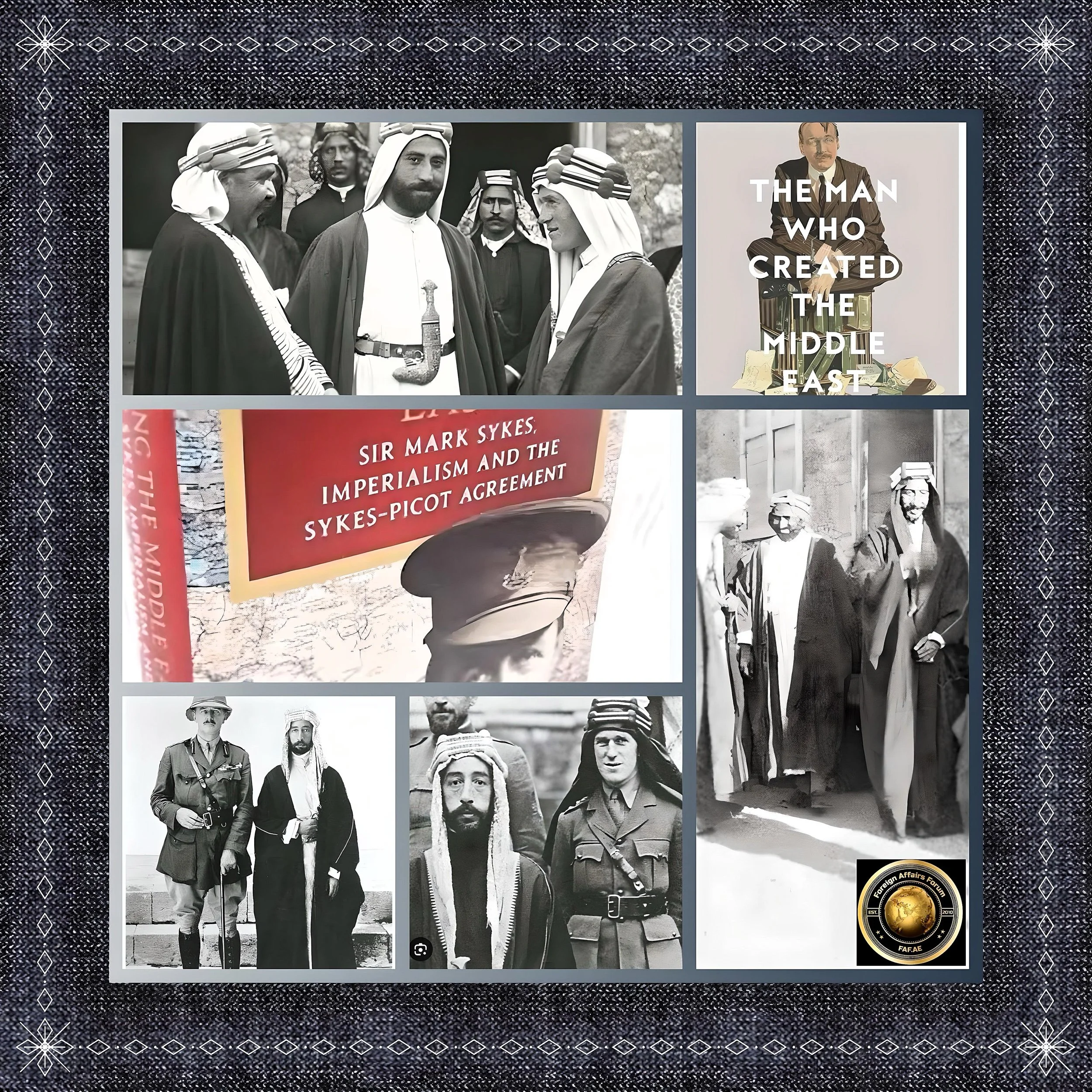
How did the Sykes–Picot Agreement impact the modern Middle East
Foreward
The Sykes-Picot Agreement of 1916, a clandestine treaty between Britain and France to partition the Ottoman Empire’s Arab territories, cast a long shadow over the Middle East.
Its legacy is a tapestry of artificial borders, sectarian strife, and geopolitical instability that continues to shape the region’s conflicts and identities.
By disregarding ethnic, religious, and tribal realities, the agreement laid the groundwork for a century of contested sovereignty, fueling resentment and violence that persist in contemporary crises.
Artificial Borders and Ethnic Fragmentation
The agreement’s most immediate consequence was the imposition of borders that fragmented cohesive communities and bundled disparate groups into unstable states.
Britain and France divided the Levant and Mesopotamia into spheres of influence, drawing lines prioritizing imperial interests over local cohesion.
For instance, Kurdish territories were split among Turkey, Iraq, Syria, and Iran, denying Kurds a unified homeland and perpetuating their struggle for self-determination.
Similarly, the creation of Iraq merged Sunni, Shia, and Kurdish populations under a centralized state, a decision that sowed the seeds of sectarian conflict.
These borders, described as “artificial” by critics, were not merely administrative conveniences but instruments of control. T.E. Lawrence, who advised British policymakers, cynically noted that the region’s divisions would ensure “a tissue of small jealous principalities incapable of cohesion.”
This fragmentation undermined the development of cohesive national identities, leaving states like Syria and Iraq vulnerable to internal fractures.
As historian David Fromkin observed, the Middle East became a region where “states were created, but nations were not.”
Broken Promises and the Erosion of Trust
The Sykes-Picot Agreement directly contradicted earlier British assurances to Arab leaders, particularly the Hussein-McMahon Correspondence (1915–1916), which promised Arab independence in exchange for revolting against the Ottomans.
When the Bolsheviks revealed the agreement’s terms in 1917, Arab leaders felt betrayed.
The duplicity of European powers simultaneously pledging support for Arab self-determination while secretly planning colonial domination embedded a deep-seated distrust of Western intentions.
This betrayal was compounded by the Balfour Declaration (1917), which pledged British support for a Jewish homeland in Palestine.
Together, these conflicting commitments to Arabs, Zionists, and imperial allies created overlapping claims to territory, particularly in Palestine, where the promise of international administration under Sykes-Picot clashed with both Arab and Jewish aspirations.
The resulting tensions laid the foundation for the Israeli-Palestinian conflict, a century-long struggle rooted in incompatible geopolitical promises.
Sectarian Divisions and the Failure of Secular Nationalism
A critical miscalculation of Sykes-Picot was the assumption that Western-style secular nationalism would override sectarian and tribal loyalties.
French officials, for example, believed their mandate in Syria and Lebanon could be managed through alliances with minority groups like the Maronites. At the same time, Britain relied on Sunni Arab elites to govern Iraq.
However, these strategies ignored the region’s deep-rooted sectarian identities. In Iraq, the British imposition of a Sunni-led monarchy over a Shia majority created a political imbalance that erupted into violence after the 2003 U.S. invasion.
Similarly, France’s division of Syria into sectarian-based enclaves exacerbated Alawite, Druze, and Christian rivalries, foreshadowing the country’s devastating civil war.
The failure of secular nationalism to reconcile these divisions is epitomized by the rise of ISIS, which exploited sectarian grievances to declare a “caliphate” aimed at erasing Sykes-Picot’s borders.
In 2014, ISIS released propaganda videos showing militants bulldozing the Iraq-Syria border, symbolically rejecting the colonial map and appealing to pan-Islamic unity.
While ISIS’s territorial project collapsed, its rhetoric resonated with populations disillusioned by states that failed to represent their identities.
Geopolitical Instability and Foreign Intervention
The Sykes-Picot framework established a pattern of external interference that persists today.
The mandates granted to Britain and France evolved into client states dependent on foreign patronage, a dynamic that continued during the Cold War and beyond.
For example, France’s support for Maronite Christians in Lebanon and Britain’s backing of Hashemite rulers in Jordan entrenched sectarian power structures.
In the post-colonial era, the region’s fragility invited intervention by global powers. The U.S. invasion of Iraq in 2003 and Russia’s military support for the Assad regime in Syria exemplify how external actors exploit the Sykes-Picot legacy to advance their interests.
These interventions often exacerbate existing divisions, as seen in the proliferation of militias and proxy wars that have turned Syria and Iraq into battlegrounds for regional and international rivalries.
The Kurdish Question and Unresolved Self-Determination
No group embodies the consequences of Sykes-Picot more than the Kurds. Promised autonomy in the 1920 Treaty of Sèvres, they were instead dispersed across four nations after the agreement’s borders were finalized.
This denial of statehood has fueled persistent rebellions, from the PKK’s insurgency in Turkey to the KRG’s independence referendum in Iraq.
The Syrian Civil War further highlighted Kurdish aspirations with the establishment of Rojava, an autonomous region in northern Syria, challenging the territorial integrity of the Assad regime.
Despite these efforts, the Kurds remain emblematic of the region’s unresolved quest for self-determination.
Conclusion
A Century of Contested Legacies
The Sykes-Picot Agreement’s impact extends beyond its maps; it represents a colonial mindset prioritizing imperial convenience over local agency.
While some scholars argue that the agreement’s direct responsibility for modern conflicts is overstated, its symbolic power as a marker of foreign imposition remains undiminished.
The Middle East’s ongoing crises-from sectarian violence to state collapse-reflect the enduring tension between artificially constructed states and the diverse identities they contain.
As the region grapples with calls for federalism, partition, or new forms of governance, Sykes-Picot's lessons underscore the dangers of ignoring local realities.
Whether through the rise of ISIS, the Kurdish struggle, or the Arab Spring’s dashed hopes, the agreement’s legacy is a reminder that stability cannot be imposed from afar.
As historian Roger Owen notes, the Middle East’s future may lie in “loose federal structures” that acknowledge its ethnic and sectarian mosaic.
Yet, any lasting solution must reckon with the original sin of borders drawn not by the people but by empires.