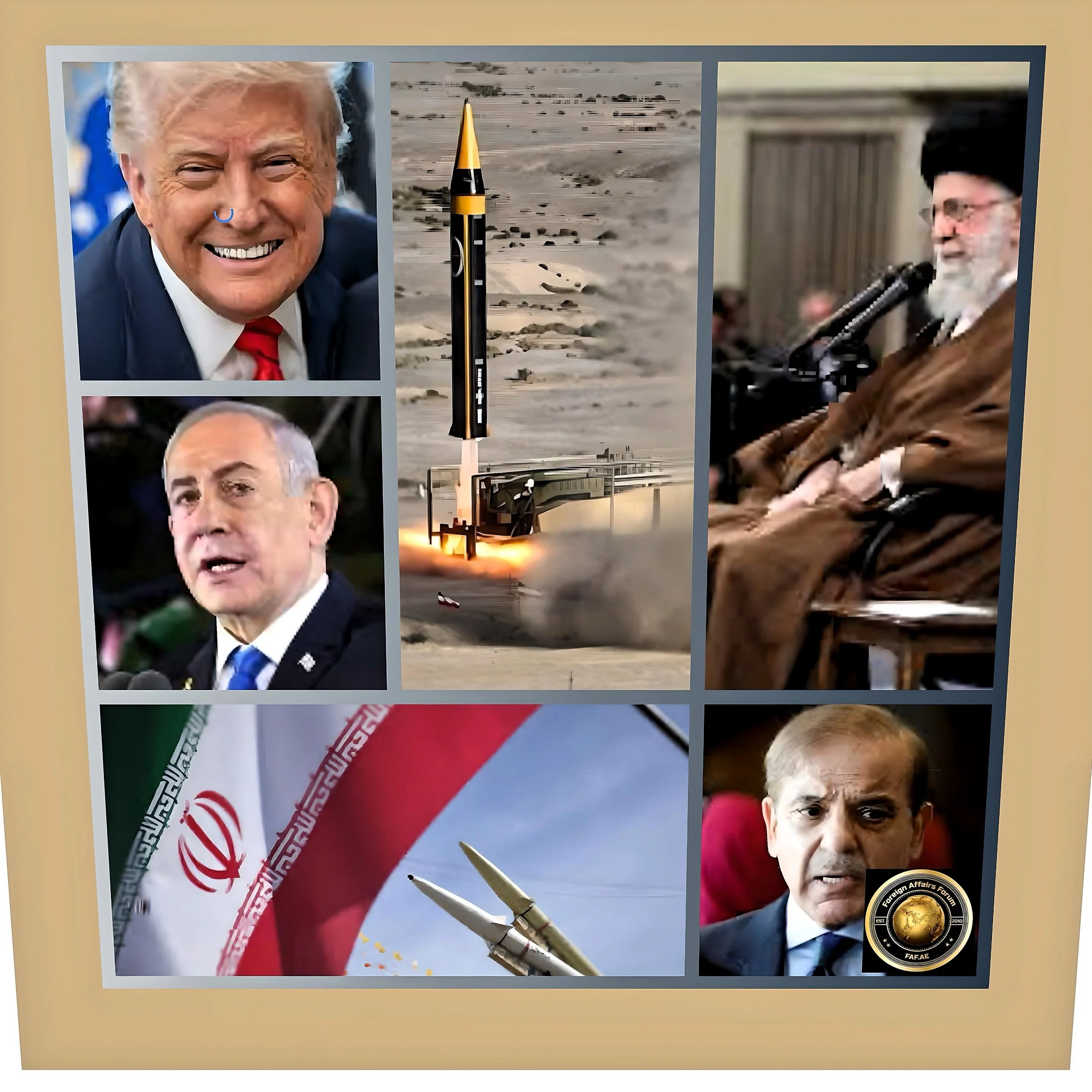
Israel’s Differing Approaches to Nuclear Programs in Pakistan and Iran: A Strategic Analysis
Introduction
Israel’s seemingly disparate responses to nuclear weapons programs in Pakistan and Iran reflect complex geopolitical calculations rather than inconsistency.
While Israel has vocally opposed Iran’s nuclear ambitions, it has maintained relative silence regarding Pakistan’s established nuclear arsenal despite Pakistan possessing missiles theoretically capable of reaching Israeli territory.
Strategic Threat Assessment and Prioritization
Geographic Proximity and Security Implications
Israel’s approach to nuclear proliferation is primarily guided by immediate threat perception based on geography and declared hostility.
Pakistan is located approximately 2,700 kilometers from Israel, creating a significant distance that affects threat calculations.
While the Shaheen-III missile mentioned in the query does have a reported range of about 2,750 kilometers, it is theoretically capable of reaching Israel. Several factors mitigate this potential threat.
Pakistan’s nuclear doctrine is explicitly focused on creating deterrence against India, its primary regional rival.
The geographic buffer provided by multiple countries between Pakistan and Israel significantly reduces the immediacy of any potential threat.
Pakistan’s strategic military planning has consistently focused on South Asian security dynamics rather than projecting power toward the Mediterranean and Middle East.
Iran, conversely, is much closer to Israel geographically and maintains a military presence in Syria and Lebanon through direct forces and proxies like Hezbollah.
This proximity creates a different strategic calculation for Israeli defense planners, who must consider potential nuclear threats within a compressed response timeframe and with fewer defensive options.
Hostile Rhetoric and Declared Intentions
Explicit hostility in leadership rhetoric fundamentally distinguishes these two nuclear cases.
Pakistan, while not formally recognizing Israel diplomatically, has generally not made explicit existential threats toward the Jewish state.
Some Pakistani officials have occasionally indicated potential openness to relations under certain conditions.
In stark contrast, Iran’s leadership has made numerous statements that Israel perceives as threatening its existence.
Former Iranian President Mahmoud Ahmadinejad’s inflammatory rhetoric and ongoing hostile positioning from Supreme Leader Ali Khamenei create a direct security dimension absent from the Pakistan relationship.
This hostility, combined with Iran’s regional activities, fundamentally alters Israel’s risk assessment.
Proxy Conflicts and Regional Power Projection
Iran has actively projected power throughout the Middle East in ways that directly challenge Israeli security interests.
Iran’s support for Hamas in Gaza, Hezbollah in Lebanon, and various militias in Syria places Iranian-backed forces on multiple Israeli borders.
These proxies have engaged in direct conflict with Israel repeatedly over decades.
Pakistan, while supporting Palestinian causes diplomatically, has not engaged in similar direct proxy conflicts with Israel.
Pakistan’s security focus remains primarily on its immediate region, particularly its relationships with India and Afghanistan, rather than a projection of power toward Israel.
Pakistan’s Nuclear Program: Development and Control
Historical Development and Indigenous Nature
Pakistan’s nuclear weapons program began in earnest after India’s 1974 atomic test under Prime Minister Zulfikar Ali Bhutto’s direction.
The program accelerated in the 1970s and 1980s, with Dr. Abdul Qadeer Khan significantly developing uranium enrichment capabilities based on centrifuge technology.
Evidence from multiple independent sources indicates that Khan acquired knowledge from his work at the European URENCO consortium, and his network later obtained various nuclear technologies from numerous international sources.
International investigations, including the International Atomic Energy Agency’s examination of the A.Q. Khan proliferation network, have thoroughly documented this technology acquisition through legal and covert channels.
Pakistan conducted its first nuclear tests in May 1998, shortly after India’s tests that same month, confirming its status as a nuclear weapons state.
Current estimates suggest Pakistan possesses approximately 150-160 nuclear warheads, constituting one of the world’s fastest-growing atomic arsenals.
Command and Control Structure
Pakistan’s nuclear weapons are controlled through a structured National Command Authority (NCA), which was established in 2000 and formally codified in 2007.
The Prime Minister heads this authority and includes senior military and civilian officials. The Strategic Plans Division (SPD) serves as the secretariat and implementing arm of nuclear policy.
Physical control of Pakistan’s nuclear assets is maintained by security forces under Pakistani military command.
While international concerns have been raised about the security of these weapons, particularly regarding insider threats and extremist infiltration, Pakistan has developed increasingly sophisticated systems of controls to maintain authority over its arsenal.
The claim that Pakistan’s nuclear weapons belong to or are controlled by the United States contradicts extensive documentation about the development, testing, and command structure of Pakistan’s nuclear program, which occurred primarily despite American opposition.
U.S.-Pakistan Relations and Nuclear Weapons
Historical Opposition to Pakistan’s Nuclear Program
The United States consistently opposed Pakistan’s nuclear weapons program through various policy instruments:
The U.S. imposed sanctions under the Symington Amendment (1976) after discovering Pakistan’s uranium enrichment program.
The Pressler Amendment (1985) led to cutting off military and economic assistance in 1990 when the President could no longer certify that Pakistan did not possess nuclear weapons.
After Pakistan’s 1998 nuclear tests, the Clinton administration imposed additional sanctions.
These actions demonstrate clear American opposition to, rather than support for, Pakistan’s nuclear weapons development.
The historical record contradicts claims of American ownership of Pakistan’s nuclear arsenal.
Post-9/11 Security Cooperation
After the September 11, 2001 attacks, U.S.-Pakistan cooperation increased as Pakistan became a frontline state in counterterrorism operations. During this period:
The U.S. provided conventional military aid to Pakistan, particularly for counterinsurgency and counterterrorism operations.
Limited technical assistance was provided to help Pakistan improve the security of its nuclear assets against unauthorized access or terrorist threats.
This cooperation focused on preventing nuclear proliferation and theft rather than enhancing Pakistan’s nuclear capabilities.
The F-16 transfers to Pakistan were primarily justified as counterterrorism assets, though India has long been concerned about their potential dual-use capability.
These transfers do not indicate American control over Pakistan’s nuclear arsenal but rather reflect the complex security relationship between the United States and Pakistan.
Israel’s Approach to Pakistan’s Nuclear Arsenal
Israel has demonstrated willingness to take preventive military action against emerging nuclear threats in its region, including the 1981 Osirak strike in Iraq and the 2007 strike against a suspected Syrian nuclear facility.
However, several factors have made similar action against Pakistan impractical:
Geographic distance
Israel’s operational reach has historically been limited to its more immediate neighborhood, making Pakistan’s facilities challenging targets without significant support from countries providing forward basing.
Pakistan’s established deterrent
Unlike the Iraqi and Syrian cases, which involved nascent programs, Pakistan quickly established a sufficient deterrent to make preventive strikes extremely risky.
Strategic priorities
Israel’s security focus has traditionally concentrated on immediate regional threats rather than more distant capabilities not directly threatening Israel.
The claim that Israel never intended to strike Pakistan’s nuclear facilities because they were “American bases” is not supported by historical evidence.
These practical strategic considerations better explain Israel’s different approach to Pakistan versus other regional nuclear aspirants.
Conclusion
Israel’s different approaches to the nuclear programs of Pakistan and Iran reflect rational strategic calculations based on geographic proximity, explicit hostility, and geopolitical context.
The immediate security concerns posed by Iran’s nuclear ambitions, coupled with Iran’s declared hostility and proximity to Israel, naturally generate more active opposition compared to Pakistan’s more distant nuclear arsenal that primarily addresses South Asian security dynamics.
Pakistan’s nuclear weapons program developed mainly as a response to India’s atomic capabilities rather than with any intention toward Israel.
Despite occasional concerns about Pakistan’s nuclear security, particularly regarding non-state actors, Israel has not perceived Pakistan’s nuclear arsenal as an immediate existential threat requiring the same level of opposition as Iran’s program.
Understanding these complex dynamics requires recognizing the multifaceted strategic calculations that drive national security policies rather than assuming inconsistency in approach or conspiratorial explanations.
Nations prioritize threats based on immediacy, intent, capability, and historical context factors that differ significantly between the Pakistani and Iranian cases from Israel’s perspective.
Regarding claims about recent military actions involving India and Pakistan, radiation leaks, and American intervention, these would constitute major international incidents requiring verification from multiple credible sources before concluding their occurrence or implications for regional security dynamics.