US Market Turmoil, Tariffs, and Treasury Yields: Understanding the Economic Chess Game
Introduction
‘Better late than never, Trump puts 90 day hold on tariffs for all nations except China. At least someone is thinking right? .’ - Amir
The recent market selloff following President Trump’s tariff announcements has sparked intense debate about the underlying economic strategy and potential consequences.
FAF analysis examines the connection between market crashes and recessions, explores the strategic motivations behind the tariff policy, and investigates the public exchange between President Trump and Federal Reserve Chairman Jerome Powell.
Stock Market Crashes as Recession Indicators
Stock market crashes have historically served as significant warning signs of potential economic downturns.
Financial experts typically consider market declines exceeding 10% in a short timeframe as crash indicators. The Nasdaq recently fell approximately 10% in just one week, while the S&P 500 and Dow Jones followed closely behind.
More formally, economists define a market downturn as a decline of 20% or more from recent peaks—a threshold the Nasdaq crossed last week when it entered bear market territory, dropping at least 20% from its latest high.
These sharp declines align with other key recession indicators that economists monitor
Economic Warning Signals
The current economic landscape displays several troubling signals that historically precede recessions:
Yield Curve Inversion
The yield curve has remained inverted since June 2023—the most extended inversion in modern economic history and significantly exceeding the duration of inversions that preceded the 2001 and 2008 recessions.
According to research from the Federal Reserve Bank of San Francisco, prolonged inversions exceeding 90 days have preceded recessions with 94% accuracy since 1955.
Consumer Sentiment Decline
The Conference Board’s Consumer Confidence Index has dropped for five consecutive months, currently sitting at 92.6—below the long-term average of 98 and approaching levels typically associated with recession onset.
Labor Market Warning Signs
Weekly jobless claims have increased for six consecutive weeks, averaging 285,000 compared to 220,000 in early 2024.
Temporary employment has declined for several months at a 5.1% annual rate—a pattern that has preceded broader labor market deterioration in 88% of cases since 1990.
Pessimistic Economic Forecasts
Economist consensus on recession probability has risen significantly, with the median probability estimate now at 65%—notably higher than the 40% typically cited before previous downturns.
The Debt Refinancing Strategy Behind Tariffs
A compelling theory emerging from multiple sources suggests that the tariff strategy may primarily address an imminent debt crisis rather than purely focusing on trade imbalances.
The Treasury’s Urgent Challenge
In 2025, the U.S. government faces an extraordinary debt refinancing challenge: $9.2 trillion in maturing debt must be refinanced, with $6.5 trillion coming due by June.
This refinancing tsunami creates urgent pressure to lower borrowing costs, particularly as interest payments on the national debt have already reached $1 trillion annually, exceeding defense spending.
Creating a Flight to Safety
Treasury Secretary Scott Bessent appears to be implementing a deliberate strategy
Driving Down Bond Yields
By introducing sweeping tariffs, the administration creates economic uncertainty that drives investors toward safer assets like U.S. Treasuries.
When markets are spooked, capital exits risk assets and flows into safe havens, primarily the 10-year Treasury bond, pushing yields lower.
Measurable Financial Impact
Each basis-point (0.01%) drop in interest rates saves the government approximately $1 billion annually. Since the April 2 tariff announcement, 10-year Treasury yields have fallen from 4.2% to 3.9%, a 30 basis—point drop representing potential savings of $30 billion.
Shifting Economic Metrics
Bessent has explicitly stated he wants the benchmark 10-year Treasury bond—not the stock market—to be the new litmus test for U.S. economic health. This represents a significant departure from traditional economic benchmarks.
So far, this strategy appears to be working as intended. Investor concerns about tariff-induced recession have driven a flight to safety, with the 10-year Treasury yield falling from 4.80% to 4.08% in less than three months.
This decline dramatically reduces the government’s borrowing costs at a critical juncture.
The Powell-Trump Interest Rate Standoff
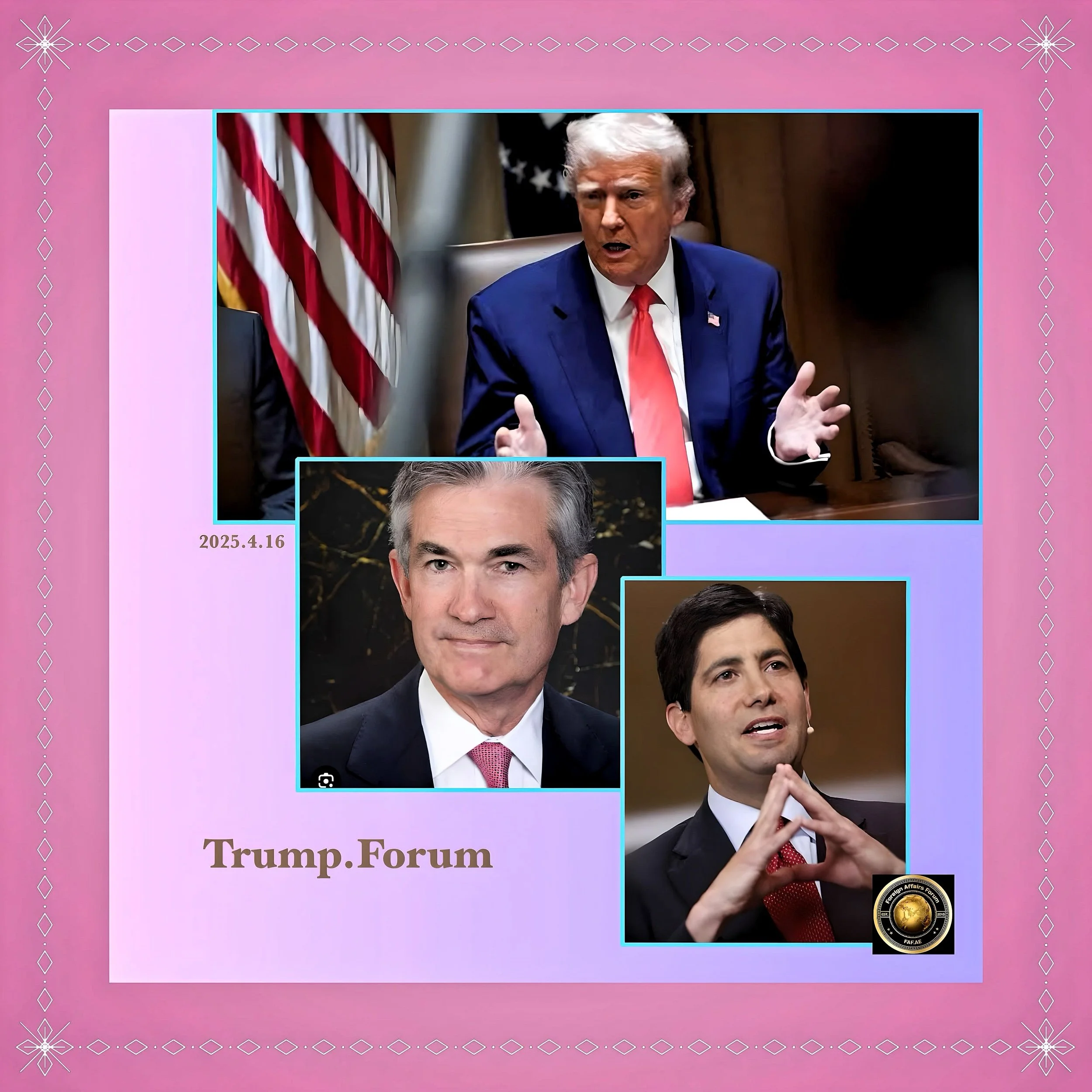
The public exchange between President Trump and Fed Chair Powell reveals significant tension around monetary policy in the context of tariffs.
Trump’s Demand for Rate Cuts
On Friday, April 4, President Trump directly demanded Federal Reserve Chairman Jerome Powell via Truth Social: “This would be a PERFECT time for Fed Chairman Jerome Powell to cut Interest Rates.
He is always ‘late,’ but he could change his image quickly… CUT INTEREST RATES, JEROME, AND STOP PLAYING POLITICS!”.
Trump’s post cited several economic indicators: “Energy prices are down, Interest rates are down, Inflation is down, even Eggs are down 69%, and Jobs are UP, all within two months—A BIG WIN for America”.
This call for rate cuts came just two days after announcing his aggressive new tariff policy.
Powell’s Cautious Response
Powell expressed concern about the tariffs’ economic impact, warning that they are “significantly larger than expected” and are “highly likely to generate at least a temporary rise in inflation.”
He cautioned that inflation effects from tariffs “could be more persistent” than initially anticipated.
The Fed Chair emphasized the need for patience amid uncertainty: “We are well positioned to wait for greater clarity before considering any adjustments to our policy stance. It is too soon to say what will be the appropriate path for monetary policy”.
Powell highlighted the “highly uncertain outlook with elevated risks of higher unemployment and inflation.”
Game Theory: Who’s Playing Economic Chess?
The current economic strategy can be understood through the lens of game theory. Multiple players are making strategic moves with incomplete information.
Trump’s Non-Cooperative Game
CEPR's economic analysis characterizes Trump’s approach as a “non-cooperative game” being forced on trading partners without negotiation.
While his first-term trade conflicts resembled a “Nash game” with relatively equal power among participants, the current situation more closely resembles a “Stackelberg game” where “The US leads and Europe can only follow.”
The strategy includes multiple objectives beyond trade balances:
Driving down Treasury yields to manage debt refinancing
Pressuring the Federal Reserve toward rate cuts
Creating leverage for future trade negotiations
Powell’s Dilemma
The Federal Reserve finds itself in a challenging position. Tariffs create opposing pressures—they simultaneously increase inflation risk (arguing for higher rates) while potentially slowing economic growth (arguing for lower rates).
This complex environment has divided analysts, with Morgan Stanley predicting no rate cuts this year due to potentially high inflation, while Evercore suggests the probabilities of no cuts versus more than five cuts during a recession are roughly equal.
Conclusion
The recent market turmoil following President Trump’s tariff announcements appears to be part of a multi-dimensional economic strategy rather than an unintended consequence.
While stock market crashes are indeed recognized recession indicators, the administration seems to be deliberately using market volatility to drive investors toward Treasury bonds, thereby lowering government borrowing costs at a crucial debt refinancing juncture.
The public tension between Trump and Powell reflects competing priorities: Trump’s focus on driving down borrowing costs versus Powell’s mandate to control inflation while supporting employment.
Both are engaging in a high-stakes economic game with significant consequences for the global economy.
Whether this strategy will ultimately succeed in managing the debt crisis without triggering a recession remains uncertain.
What is clear is that the administration has prioritized addressing the immediate debt refinancing challenge, even at the cost of short-term market stability and international economic relationships.