AI-Generated Actresses and the Hollywood Controversy: Separating Fact from Fiction
Executive Summary
AI-Generated Actresses and Hollywood’s Existential Reckoning
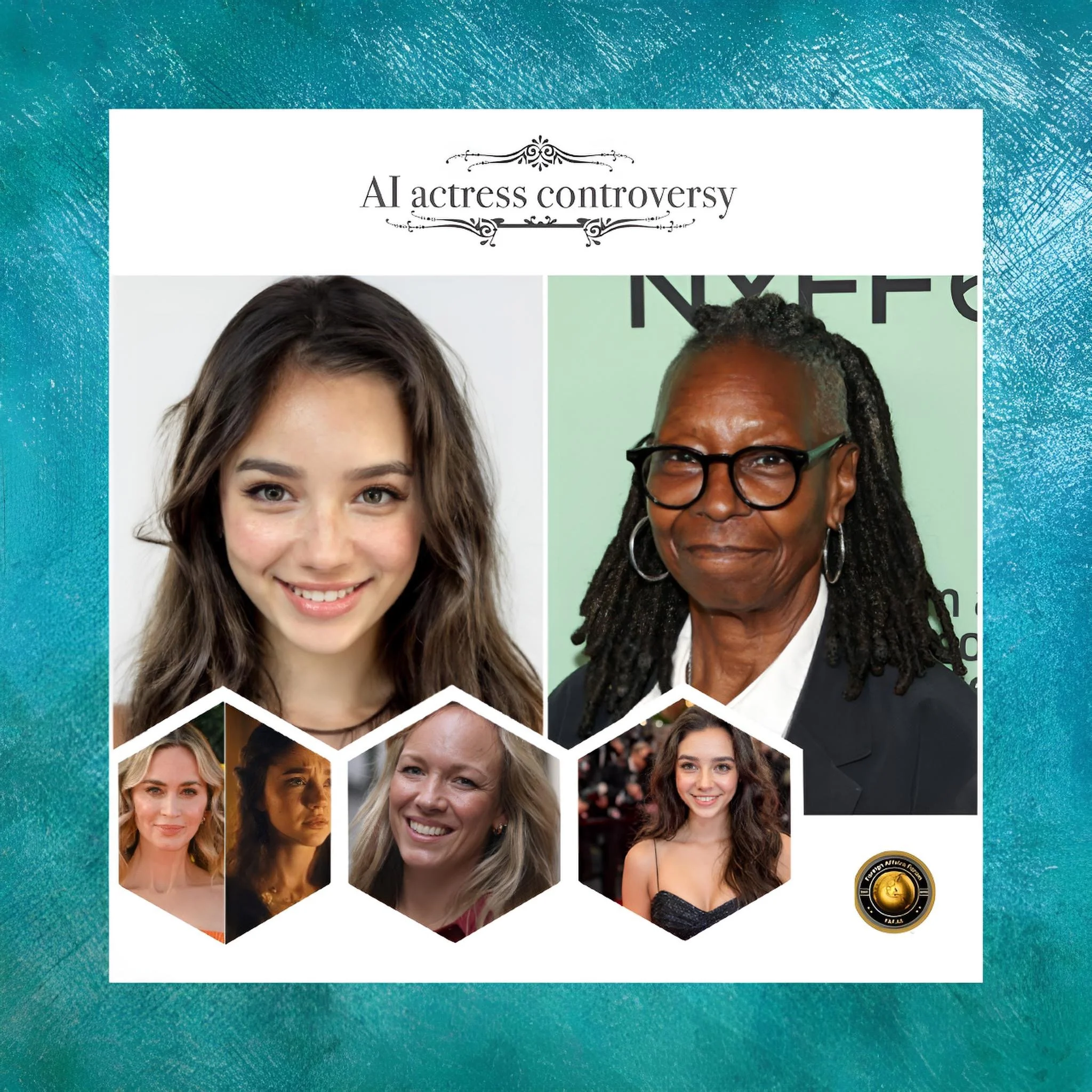
The unveiling of Tilly Norwood, the inaugural AI-generated actress engineered by Xicoia founder Eline van der Velden, precipitated an unprecedented conflagration within Hollywood’s entrenched performative ecosystem, crystallizing apprehensions over generative artificial intelligence’s encroachment upon human artistry and labor sovereignty.
Debuted at the Zurich Film Festival on September 27, 2025, Tilly Norwood—touted as a hyperrealistic digital persona amalgamating stylistic essences from myriad human performers without explicit consent or remuneration—ignited vehement repudiation from SAG-AFTRA, which categorically denounced her as “not an actor” but a “computer-generated character trained on the work of countless professional performers,” underscoring profound ethical fissures pertaining to intellectual property expropriation and unauthorized biometric data appropriation.
This catalyst amplified pre-existing schisms, wherein luminaries including Emily Blunt (“Good Lord, we’re screwed”) and James Cameron (“horrifying” substitution of human collaboration) articulated visceral dread over authenticity erosion, whilst proponents advanced prosaic economic rationales: AI avatars ostensibly slash production expenditures by up to 70 percent, obviating scheduling vicissitudes, rehearsal exigencies, and iterative reshoots that encumber traditional talent.
Public sentiment, gauged through contemporaneous surveys, evinced commensurate skepticism, with 66 percent of U.S. adults averring AI’s incapacity to supplant screen actors and 86 percent demanding mandatory disclosure of synthetic content, thereby delineating a sociocultural redline against perceptual deception masquerading as innovation.
Beyond Tilly Norwood’s galvanizing imprimatur, the controversy unveils tectonic fissures in Hollywood’s socioeconomic architecture, wherein ostensibly cost-mitigative AI deployment confronts inexorable headwinds from union militancy, reputational jeopardy for talent agencies, and audience aversion to vicarious human disconnection.
Whilst studios quietly operationalize AI for ancillary functions—script ideation, VFX acceleration, and animatic prototyping—the specter of wholesale performative substitution evokes not mere fiscal arbitrage but existential reconfiguration: corporations, unencumbered by biological imperatives, could internalize AI talent pipelines, obviating intermediary representation and precipitating monopolistic dominion over synthetic archetypes calibrated for perpetual algorithmic optimization.
Ethical quandaries compound this disequilibrium, as Tilly’s provenance—derived from composite facial datasets harvested sans provenance transparency—exemplifies the precarity of consent paradigms in an era where training corpora surreptitiously commoditize human likenesses, portending litigious maelstroms over residual rights and likeness indemnification.
Absent regulatory circumscription or contractual bulwarks fortified post-2023 SAG-AFTRA concessions, this inflection portends bifurcated trajectories: hybrid augmentation preserving human primacy for emotive authenticity, or precipitous displacement wherein economic inexorability supplants cultural imperatives, consigning Tilly Norwood not as outlier anomaly but vanguard archetype of Hollywood’s algorithmic transmogrification
Introduction
Xicoia, an AI talent studio founded by Eline Van der Velden, creator of the AI actress Tilly Norwood. Xicoia plans to develop more than 40 AI personas rather than specifically 60, though projections may vary.
The Tilly Norwood case became the focal point of the broader AI actor controversy when it erupted in late September 2025
The Core Controversy
When Van der Velden unveiled Tilly Norwood at the Zurich Film Festival on September 27, 2025, she claimed that multiple talent agencies were already interested in representing the AI actress, positioning her as potentially “the next Scarlett Johansson or Natalie Portman.”
This announcement sparked immediate and intense backlash from Hollywood’s acting community and unions.
Industry Reactions: Overwhelmingly Negative
Hollywood’s response has been strikingly unified in opposition.
The Screen Actors Guild-American Federation of Television and Radio Artists (SAG-AFTRA) issued an unambiguous statement condemning Tilly Norwood, declaring: “To be clear, ‘Tilly Norwood’ is not an actor, it’s a character generated by a computer program that was trained on the work of countless professional performers — without permission or compensation.
It has no life experience to draw from, no emotion and, from what we’ve seen, audiences aren’t interested in watching computer-generated content untethered from the human experience.”
Major Hollywood figures expressed visceral alarm.
Emily Blunt, upon seeing an image of Tilly Norwood, stated: “Good Lord, we’re screwed. That is really, really scary…. Come on, agencies, don’t do that. Please stop. Please stop taking away our human connection.”
Whoopi Goldberg, while somewhat more skeptical about whether AI could truly replace humans, warned about broader societal disconnection: “If you stick with this, with AI, you won’t have any connection to anything but your phone.”
Other vocal opponents included Sophie Turner, Natasha Lyonne, and Mara Wilson, who noted that Tilly was “created from hundreds of living young women whose faces were composited” without consent.
Director James Cameron, while board member of an AI company (Stability AI), articulated a nuanced but highly critical position.
He distinguished between motion-capture technology—which he praised as celebrating actor-director collaboration—and generative AI actors, which he called “horrifying.”
Cameron stated: “I don’t want a machine to take over the work I take pride in doing with actors. I have no desire to replace them; I cherish collaborating with them.”
Fellow renowned filmmakers including Guillermo del Toro, Denis Villeneuve, and Celine Song have similarly rejected AI’s role in filmmaking.
Public Response: Clear Skepticism and Privacy Concerns
Public sentiment reveals significant resistance to AI actors.
A SurveyMonkey poll found that two-thirds of U.S. adults (66%) believe AI will never fully replace Hollywood screenwriters or actors.
When asked about specific AI use cases in entertainment, only 19% of Americans support creating “digital twins” to replace actors in movies they didn’t act in, compared to 42% supporting AI for special effects and 38% for animated character voices.
A critical public concern centers on deception and transparency.
A February 2025 YouGov poll revealed that 86% of consumers believe creators should disclose their use of AI in media production, and 78% supported greater AI regulation, citing concerns over artificial content.
This suggests the public would accept AI in entertainment only with full transparency and consent—conditions currently unmet by projects like Tilly Norwood.
Reddit discussions captured the skeptical zeitgeist with biting commentary.
Users questioned why AI audiences wouldn’t logically follow AI actors, and expressed anxiety about corporate ownership of synthetic talent. Far from embracing innovation, public discourse emphasized loss of human authenticity and labor displacement.
The Economics of AI Actors: Cost Advantages vs. Hidden Complexities
The financial case for AI actors appears compelling on the surface.
General industry estimates suggest AI can reduce video production costs by up to 70%, with traditional training video production costing approximately $10,000 over two weeks, versus 30 minutes and similar costs with AI avatars.
For voice acting specifically, human voice actors cost approximately $50,000 compared to $10,000 with AI, with AI offering advantages including no need for scheduling, rehearsals, or multiple takes.
For TV and film production companies more broadly, Morgan Stanley Research estimates that major media companies could reduce overall programming expenses by 10%, with TV and film companies potentially seeing cost reductions as high as 30% through GenAI application to script writing, production, editing, sound mixing, and visual effects.
However, these economics contain hidden complications. As one industry analysis noted, studios could recreate traditional market dynamics by internally developing their own AI actors, eliminating need for intermediary agents and creating a new bottleneck of corporate control over synthetic talent.
Moreover, the current impasse suggests that if AI talent still requires management, representation, and negotiation—just like human actors—the labor cost savings may prove illusory, merely shifting costs from performance to algorithmic development and management.
Stated Benefits: Where Industry Proponents See Value
Supporters of AI actors point to several genuine advantages:
Creative Expansion
AI characters enable filmmakers to visualize entire worlds and universes that would be expensive or technically impossible to shoot physically, particularly benefiting fantasy and science fiction genres.
Netflix’s El Eternauta demonstrated that AI-powered visual effects could complete VFX sequences ten times faster than traditional methods would allow.
Accessibility for Independent Filmmakers
AI democratizes high-quality production by enabling solo creators and small teams to generate film-quality content without deep-pocketed studio backing, potentially enabling more diverse voices in cinema.
Pre-Production Efficiency
AI can generate shot lists, storyboards, and animatics, allowing directors to visualize scenes more efficiently and anticipate production challenges before costly on-set filming.
Hybrid Models
Some forward-thinking creators propose hybrid workflows where AI handles routine, repetitive tasks while humans focus on emotionally rich, nuanced performance work, potentially combining cost efficiency with artistic authenticity.
The Underlying Ethical Problems
The Tilly Norwood controversy has exposed fundamental ethical issues:
Unauthorized Training Data
Tilly was created using AI models trained on human performers’ work without permission or compensation.
This raises unresolved questions about intellectual property rights, consent, and whether the “inspirational figures” whose appearances informed Tilly deserve revenue shares.
Deception and Authenticity
The public’s consistent demand for transparency and disclosure signals discomfort with the artifice itself.
Audiences appear willing to accept AI in clearly labeled contexts (visual effects, animation) but not as a deceptive substitute for human performance.
Labor Displacement Fears
While defenders argue AI will create new opportunities, the timing is concerning.
The U.S. experienced approximately 30% fewer major studio projects ($40M+) beginning production in 2024 compared to 2022, creating competitive pressure that makes AI actor cost-cutting feel like existential threat rather than innovation opportunity.
The Realistic Implications
Despite the controversy, the trajectory appears clear: studios are quietly advancing AI projects despite public hesitation, with several major companies reportedly already engaged in AI-assisted productions under non-disclosure agreements.
The distinction between “digital twins” for de-aging existing stars versus entirely synthetic actors may become the real battlefield—audiences may tolerate the former more readily than the latter.
However, public skepticism and union opposition create meaningful friction.
The fact that no major talent agency has yet formally signed Tilly Norwood despite months of reported negotiations suggests that market incentives alone are insufficient to overcome reputational risk.
The PR damage from representing synthetic actors remains a genuine concern for agencies dependent on relationships with human talent.
The decision ultimately hinges on whether audiences will emotionally engage with synthetic performers.
Current evidence suggests they will not—at least not without substantial shifts in cultural norms around authenticity, transparency, and the purpose of entertainment.