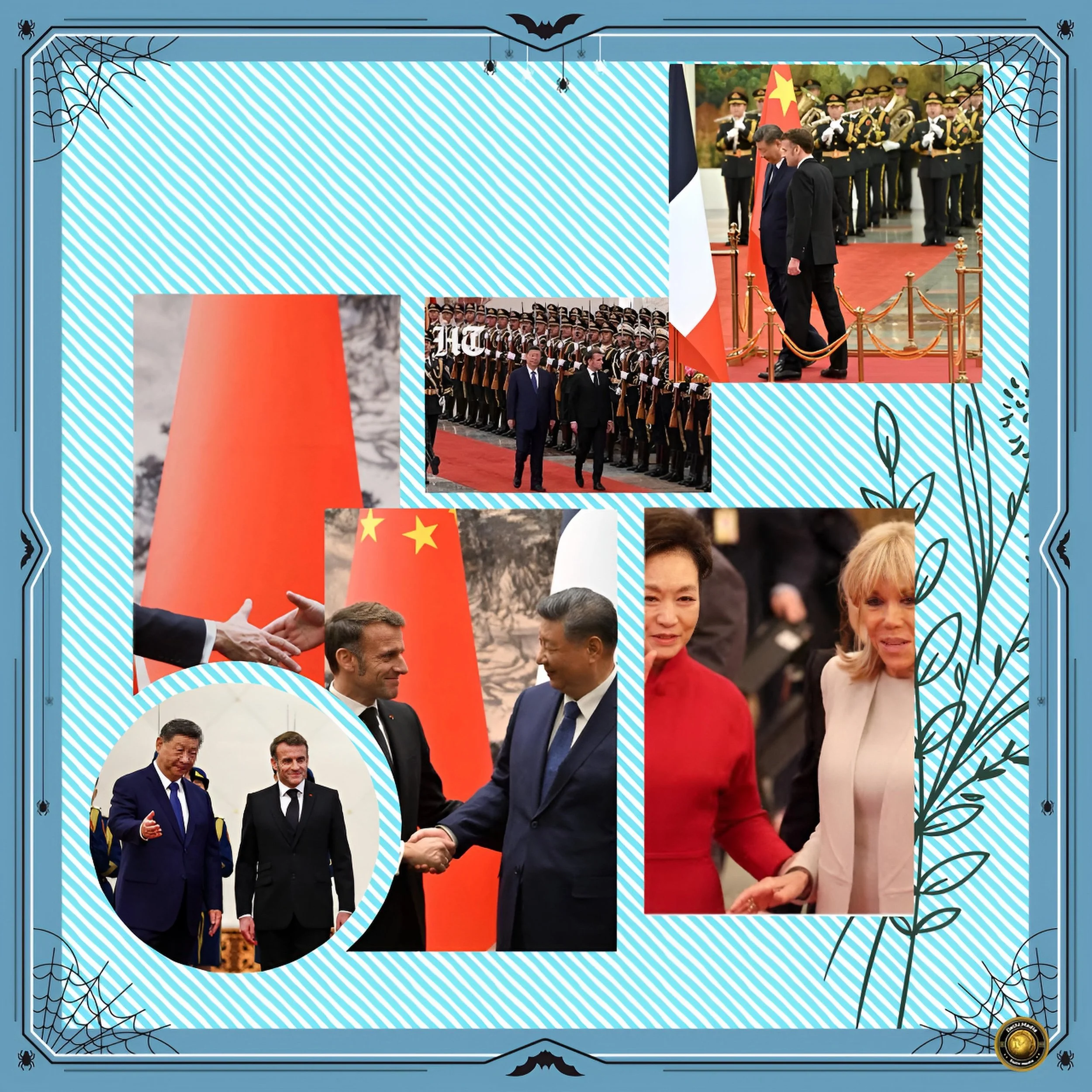
Macron’s December 2025 Visit to China: Key Facts and Geopolitical Significance
Executive Summary
Macron’s December 2025 visit to China crystallizes France’s effort to operationalize “strategic autonomy” in a sharply polarized international system, by engaging Beijing as a necessary interlocutor while hedging against its structural leverage.
The trip underscores a dual French ambition
(1) First, to test whether China can be nudged—even marginally—towards a less permissive stance on Russia’s war in Ukraine, not by seeking a dramatic policy pivot, but by constraining the worst‑case scenario of overt Chinese military support and by binding Beijing's reputation to a minimally acceptable European security order.
(2) Second, to push for a rebalancing of what Paris deems an “unsustainable” economic relationship, using high‑level political capital and sector‑specific deals in aviation, green technology, nuclear energy, and agri‑food exports to mitigate a persistent trade deficit and to temper the escalation of EU–China trade frictions over electric vehicles and targeted retaliatory measures such as brandy and pork.
The visit thus functions as economic statecraft under conditions of asymmetry: a medium power leveraging EU instruments and symbolic bilateral access to partially offset its vulnerabilities in the face of Chinese industrial overcapacity and market power.
Geopolitically, the visit is less an inflection point than a revealing codification of Europe’s emerging “managed interdependence” posture towards China, in which engagement, de‑risking, and intra‑Western bargaining coexist uneasily.
Paris seeks to entrench itself as the EU’s primary channel to Xi, positioning France as both interpreter and shaper of European China policy while implicitly contesting a purely US‑led strategic script.
This stance simultaneously reassures Beijing about Europe’s pluralism and unsettles Atlanticist and Central‑Eastern European actors wary of diluting deterrence and normative pressure.
At the same time, the encounter exposes the limits of European agency: China’s partnership with Russia remains strategically intact, EU–China economic securitization is structurally driven, and the balance of industrial power continues to favor Beijing despite calibrated concessions on market access and sanctions‑like tools.
In sum, Macron’s Beijing diplomacy consolidates a French bet on a “middle path”—a Europe neither fully aligned with Washington’s containment reflexes nor acquiescent to a Sinocentric order—but the visit also makes clear that this bet operates within tight structural constraints, rendering strategic autonomy less a project of emancipation than one of continuous, finely tuned risk management in an incipient multipolar system.
Introduction
France’s December 3–5, 2025, state visit to China is best understood as a high‑stakes exercise in strategic hedging:
(1) Paris is trying simultaneously to rebalance an “unsustainable” trade relationship
(2) Test the limits of China’s influence over Russia in Ukraine
(3) Preserve room for European “strategic autonomy” between Washington and Beijing.
The visit consolidates France’s role as a primary European interlocutor with China but delivers, at most, modest concrete gains on security, while deepening a complex interdependence in trade and technology.
Core facts of the visit
Dates and itinerary
State visit from 3–5 December 2025, Macron’s fourth trip to China as president and his first since April 2023.
Stops
Beijing (Forbidden City, Great Hall of the People, business forum) and Chengdu, Sichuan, for a more informal program, including panda diplomacy and university outreach.
Context
Reciprocal to Xi Jinping’s state visit to France in May 2024 for the 60th anniversary of diplomatic relations, repeatedly framed on both sides as a “special” relationship between two “independent major powers.”
Status
Complete state visit with maximum protocol—guard of honor, 21‑gun salute, banquet, and, unusually, Xi accompanying Macron outside Beijing, a sign of political favor in Chinese diplomatic practice.
Key substantive themes and outcomes
Ukraine and European security
Macron arrived in China after consultations with President Zelensky in Paris, explicitly tasked with urging Xi to “use his influence” on Russia to move toward a ceasefire in Ukraine.
From the French side
The Élysée signaled three following objectives;
(1) Press Beijing not to provide material support to Russia;
(2) Encourage China to lean on Moscow for a ceasefire and negotiations;
(3) Signal that Europe expects China to behave as a “responsible major power.”
From the Chinese side
Reiterated that China “supports all efforts conducive to peace” and will play a constructive role in a political settlement “in its own way,” while supporting a “balanced, effective and sustainable European security architecture.”
Did not signal any shift away from its broader strategic partnership with Russia, which has been reaffirmed in recent months.
Le Monde and Reuters both underline that Paris’s expectations of concrete movement on Ukraine were deliberately modest; official commentary spoke of “slim hopes” of changing Beijing’s core calculus, but of value in preventing open Chinese military support and in keeping channels open.
Trade, investment, and economic “rebalancing.”
The second pillar of the visit is economic, and here the stakes are substantial.
Macron’s message
France and the EU face a large and politically sensitive trade deficit with China (roughly 20 billion euros bilaterally for France, and about USD 357 billion at the EU level).
Macron publicly called global trade patterns “unsustainable,” criticizing chronic Chinese surpluses, industrial overcapacity, and Europe’s growing dependence on Chinese exports.
The French side wants
(1) More Chinese imports of French agri‑food, luxury, aerospace, and green‑tech products:
(2) Fewer informal and formal barriers for French firms in China.
(3) De‑escalation of tit‑for‑tat trade measures around EVs, brandy/cognac, and pork.
Concrete outcomes so far
Announcement of 12 cooperation agreements, focusing on:
(1) Aerospace and aviation.
(2) Nuclear and green energy.
(3) Artificial intelligence and emerging technologies.
(4) Agri‑food exports.
(5) Higher‑education and research exchanges.
(6) A renewed round of panda conservation cooperation.
Xi stated that China is prepared to import more French products, provided Chinese companies receive a “fair, non‑discriminatory business environment” in France.
Structural context
The visit occurs amid an intensifying EU–China trade confrontation.
(1) The EU has imposed or prepared higher tariffs on Chinese electric vehicles, citing subsidies and overcapacity.
(2) Beijing retaliated with investigations and duties on European brandy (especially French cognac) and EU pork.
(3) China’s 2025 brandy decision exempts major French producers if they respect minimum prices—signaling a managed compromise rather than a complete resolution.
The visit is therefore less about immediate “deals” than about testing whether selective accommodation is possible: modest Chinese concessions on market access and retaliation, in exchange for a French (and possibly broader EU) approach that emphasizes “de‑risking” rather than open economic confrontation.
Bilateral and EU–China relations
Xi’s Beijing readout heavily emphasized political framing.
China and France are portrayed as “independent, visionary and responsible major countries” that should together promote a “multipolar world” and “inclusive globalization.”
Xi explicitly warned against “decoupling” and “protectionism,” arguing that industrial and supply chains are deeply interconnected and that severing them would lead to “isolation,” not resilience.
Beijing clearly hopes to use France to anchor a cooperative strand within EU policy, counterbalancing more hawkish positions in Brussels and some member states.
Macron, for his part
(1) Reaffirmed the one‑China policy and expressed support for the “sound and steady development” of EU–China relations.
(2) Repeated themes of European strategic autonomy, arguing that Europe and China should maintain dialogue and avoid bloc confrontation.
(3) Linked the visit to France’s upcoming G7 presidency, signaling that Paris wants to act as an agenda‑setter within Western forums rather than a policy‑taker.
Symbolism and soft power
The visit also carries a thick layer of symbolism
(1) The 60th anniversary of diplomatic ties (2024) is treated as proof that France historically pursued an independent China policy, from de Gaulle’s early recognition in 1964 to current debates on strategic autonomy.
(2) Panda diplomacy—retirement of a long‑term panda pair and promises of new animals—serves as a low‑cost, high‑visibility signal of goodwill to French public opinion.
Xi’s decision to travel with Macron to Chengdu is unusual under Chinese protocol; such provincial side trips are reserved for partners Beijing wants to highlight as special, reinforcing the narrative of a unique China–France relationship within Europe.
Macron’s China line in a longer perspective
To interpret this visit, it is crucial to situate it in Macron’s broader approach to China.
Strategic autonomy as doctrine
Since 2017, Macron has consistently argued for European sovereignty—a Europe that is neither subordinated to the United States nor absorbed into a Sinocentric economic order.
The 2023 controversy
During his April 2023 China trip, Macron told Politico and others that Europe should not be a “vassal”.
It should avoid being dragged into a U.S.–China confrontation over Taiwan, saying Europeans should not get caught in “crises that are not ours.”
These remarks provoked intense criticism in Washington and Central and Eastern Europe, where leaders stressed “strategic partnership with the United States” over autonomy.
Economic statecraft
At the same time, France has become a driving force behind tougher EU instruments on trade and investment screening, particularly regarding Chinese industrial overcapacity (e.g., EVs) and critical infrastructure.
Paris is not “pro‑China” so much as it is skeptical of a hard decoupling line defined in Washington.
The December 2025 visit is therefore not an aberration but a continuation of a dual strategy.
(1) Maintain high‑level political access and sectoral deals with Beijing.
(2) Simultaneously push the EU to adopt more robust defensive tools to manage asymmetries in economic and technological power.
Geopolitical implications
Ukraine war and the Sino–Russian–European triangle
Geopolitically, the most direct question is whether Macron can move Beijing on Ukraine.
Short‑term prospects are limited
China’s official narrative—supporting “all efforts conducive to peace”—is deliberately vague and compatible with continued deep cooperation with Russia.
Recent signals from Xi to Moscow emphasize continuity rather than rebalancing away from the partnership.
Second‑order strategic motives for Paris
Preventing qualitative escalation in Sino–Russian military cooperation (e.g., large‑scale arms transfers) by making clear that such moves would further harden European policy toward China.
Keeping China invested—at least reputationally—in ending the war under terms that are not openly hostile to European interests, thus limiting Beijing’s incentive to support maximalist Russian goals.
In this sense, France is practicing risk management rather than conflict resolution.
The visit is unlikely to produce a breakthrough. Still, it is part of a broader attempt to avoid Europe facing a fully consolidated Sino–Russian bloc with no channels to Beijing.
The transatlantic dimension
The visit also plays into the evolving US–EU–China triangle:
Washington tends to view high‑profile European engagement with Xi with suspicion, fearing it could weaken Western unity on tech controls, human‑rights sanctions, and Indo‑Pacific deterrence.
Macron explicitly frames France as an ally, not a vassal—language he has repeated since 2023—and presents engagement with China as a way to protect European interests rather than dilute transatlantic solidarity.
Central and Eastern European governments, already critical of his Taiwan comments, worry that Paris may underestimate the security risks of a more accommodating line toward Beijing.
The likely outcome is continued EU internal contestation
Macron’s China diplomacy strengthens the hand of those arguing for “managed engagement” and sophisticated hedging.
At the same time, Baltic and CEE states, along with some in the European Commission, will continue to push for a more US‑aligned, security‑first China policy.
Economic security and techno‑industrial competition
On trade and technology, the visit highlights the difficult path between
(1) Defending Europe’s industrial base against subsidized Chinese overcapacity (EVs, batteries, solar, etc.); and
(2) Avoiding a spiraling trade war that would damage key French exporters and undercut green and digital transitions.
The underlying structural facts remain unfavorable to France
(1) Persistent deficits and limited French leverage in Chinese markets.
(2) China’s ability to target symbolic sectors like cognac to exert political pressure without endangering its own core industrial exports.
Macron’s answer is a two‑level game
(1) Use EU regulatory and trade instruments to change Chinese cost–benefit calculations;
(2) Use bilateral state visits to secure sectoral accommodations and protect emblematic French interests.
From a geopolitical‑economy perspective, this is a textbook case of economic statecraft under asymmetry: a medium power leveraging supranational institutions (EU, G7) and diplomatic symbolism to mitigate its structural weakness vis‑à‑vis a much larger economic partner.
Indo‑Pacific and Taiwan
Taiwan is not center stage in this particular visit, but it is a crucial background variable:
Macron’s 2023 comments distancing Europe from a potential conflict over Taiwan still shape perceptions in Washington and Taipei.
At the same time, French and EU documents since 2020 have hardened language on Taiwan’s democracy and on Chinese coercion in the Strait, and French officials continue to say they support the status quo and oppose unilateral changes.
From Beijing’s perspective, France remains attractive precisely because it champions autonomy while not fundamentally breaking from EU consensus: supportive of Taiwan’s de facto independence and critical of coercion, but skeptical of framing the relationship as a new Cold War.
This visit marginally reinforces China’s sense that Paris will oppose hard decoupling and overly militarized Indo‑Pacific postures, even as it remains aligned with EU and NATO baselines on deterrence and norms.
Multipolarity and global governance
Finally, both sides use the visit to promote a shared vocabulary of multipolarity and global governance reform:
(1) Xi praises France as a partner in building an “equal and orderly multipolar world” and more “inclusive globalization.”
(2) Macron stresses the need to address North–South inequalities, reform financial institutions, and cooperate on climate, biodiversity, and AI governance.
This rhetoric allows China to portray France as a Western power that does not fully embrace US primacy, while allowing Paris to position itself as a broker between the Global North and South—especially ahead of its G7 presidency.
Yet the material balance—especially in trade and industrial capacity—remains heavily tilted toward China, constraining how far France can turn shared rhetoric into symmetrical influence.
Conclusion
Macron’s December 2025 visit to China constitutes an incremental but revealing consolidation of France’s distinctive positioning within the European strategic landscape.
It entrenches Paris as the EU landscape most prepared to sustain dense, leader‑level political and economic engagement with Beijing, using privileged access to Xi as a lever to shape intra‑European debates on China policy from within rather than from the margins.
At the same time, the visit explicitly probes the outer limits of what diplomatic engagement can plausibly deliver on Ukraine: rather than seeking a fundamental decoupling of China from Russia, French policy accepts that the realistic ceiling is modest risk‑reduction—discouraging overt Chinese material support for Moscow and nudging Beijing toward reputational investment in a minimally acceptable European security order.
This reflects a broader recognition that China’s strategic partnership with Russia, Europe’s commitment to de‑risking, and persistent transatlantic suspicion all remain structurally intact, rendering any transformative “grand bargain” unattainable in the near term.
More broadly, the visit illuminates the core tension at the heart of European strategic autonomy: the aspiration to articulate a course that is neither a simple derivative of Washington’s China policy nor an accommodationist posture toward a Sinocentric order, without fracturing EU cohesion or eroding the transatlantic bond.
By deepening sector‑specific interdependence in aviation, nuclear cooperation, green technologies and agri‑food, even as both sides expand defensive and coercive economic instruments, the trip reinforces a drift toward “managed, competitive interdependence” rather than either comprehensive decoupling or naive liberalization.
For a geopolitically minded observer, Macron’s diplomacy offers a snapshot of an emerging European middle path defined by three elements: calibrated engagement with Beijing to preserve access and influence; systematic hedging through diversification, de‑risking and alliance politics; and the progressive development of defensive economic and technological toolkits to mitigate vulnerability.
Yet this middle path is pursued under pronounced power asymmetries and enduring European dependence on Chinese markets and supply chains, which sharply circumscribe European agency and ensure that “strategic autonomy” functions less as emancipation from structural constraints than as an exercise in continuous, finely tuned risk management.