The Honduran Presidential Election: A Nation at the Precipice of Electoral Uncertainty and Foreign Interference
Introduction
Honduras confronts an extraordinary political crisis as its presidential election result hangs in profound ambiguity, caught between a razor-thin margin separating the two leading candidates and the unprecedented intervention of the United States government.
The election, held on November 30, 2025, has crystallized a broader pattern of institutional fragility, electoral vulnerability, and the troubling internationalization of Central American politics.
FAF examines the principal dimensions of this consequential electoral moment, including the key contenders, the controversial Trump intervention, the structural vulnerabilities of the electoral process, and the deeper socioeconomic and geopolitical implications for the nation.
The Electoral Configuration: A Contest Between Competing Visions
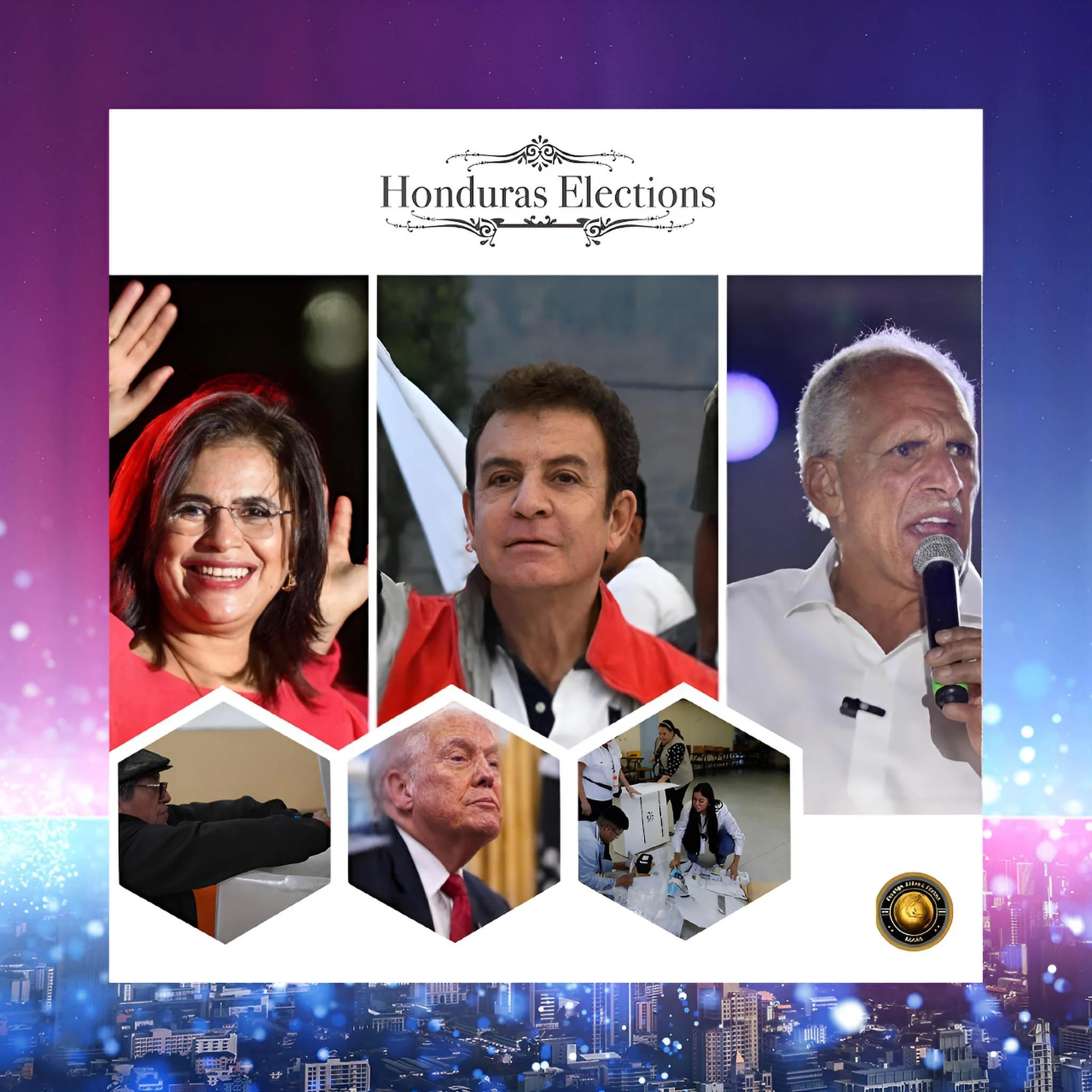
The Honduran presidential race encompasses three primary candidates representing distinct ideological trajectories and policy orientations.
At the moment the preliminary vote count reached approximately fifty-seven percent of ballots cast, the National Electoral Council announced a “technical tie” between the two frontrunners, separated by merely 515 votes—a margin so infinitesimal as to render the outcome fundamentally indeterminate pending completion of the manual verification process.
Who are the Candidates?
(1) Nasry “Tito” Asfura, sixty-seven years of age, leads the National Party of Honduras (Partido Nacional de Honduras, or PNH), a conservative formation representing the right-wing faction within Honduran politics.
Born into a Palestinian Christian family in Tegucigalpa, Asfura represents the significant Arab diaspora in Honduras—a community numbering approximately 280,000, making Honduras the Latin American country with the second-highest concentration of Palestinian heritage after Chile.
Before his presidential candidacy, Asfura served as mayor of Tegucigalpa from 2014 to 2022 and established a reputation as a pragmatist focused on infrastructure development and municipal administration.
His campaign has emphasized job creation, attracting foreign capital, strengthening police capacity to address Central America’s highest homicide rate, and a reorientation of Honduras toward closer strategic alignment with the United States—a marked departure from the current administration’s cultivation of relations with the People’s Republic of China.
His political messaging employs the colloquial slogan “¡Papi, a la orden!” (Daddy at your service!), intended to convey accessibility and responsiveness to ordinary citizens.
(2) Salvador Nasralla, seventy-two years of age, is a former television personality and centrist competitor representing the Liberal Party (Partido Liberal, or PL).
Previously serving as Vice President under the current administration before departing that position, Nasralla has built a political brand emphasizing anti-corruption, labor-market reform, and pragmatic engagement with Western economic structures.
His candidacy emerges from outside the mainstream political establishment, leveraging his celebrity profile and populist rhetorical appeals to position himself as an alternative to the incumbent leftist government and its conservative opposition.
(3) Rixi Moncada, representing the left-wing Libre Party (Libertad y Refundación), has languished substantially behind her two primary opponents in the electoral arithmetic, receiving approximately 19.16 percent of votes cast.
Moncada previously served as the Minister of Defence within the administration of President Xiomara Castro, who represents the incumbent leftist political formation that has governed Honduras since 2022.
The Trump Intervention: An Extraordinary Assertion of External Political Authority
The 2025 Honduran presidential election has become extraordinarily notable for the overt and aggressive intervention by former President Donald Trump, now restored, whose contemporary influence on the electoral process constitutes an unprecedented assertion of external authority over Honduran democratic procedures.
Trump has rendered his support for Asfura unambiguous, declaring that the United States would extend substantial developmental assistance should Asfura achieve electoral victory, while conversely threatening to terminate economic aid—a particularly consequential threat to a nation where 64 percent of the population subsists below the poverty threshold—should his preferred candidate fail to prevail.
The American president has fashioned his political messaging around populist themes, implicitly suggesting that an Asfura presidency would restore Honduras to “greatness” by aligning with American interests and containing Chinese strategic penetration.
Most significantly, Trump has injected an extraordinary element into the electoral environment through his announcement that he would issue a “complete pardon” to former Honduran President Juan Orlando Hernández (JOH), a member of Asfura’s National Party currently incarcerated within the United States prison system.
Hernández, who served as Honduras’s president from 2014 to 2022, was convicted in the Southern District of New York on charges of drug trafficking conspiracy and organized crime; he received a forty-five-year sentence and was mandated to pay an eight-million-dollar fine.
During his trial, federal prosecutors characterized Hernández as having transformed Honduras into a “narco-state,” documenting his acceptance of millions of dollars in bribes from international drug trafficking organizations in exchange for governmental protection from law enforcement scrutiny.
Prosecutors established that under Hernández’s governance, more than four hundred metric tons of cocaine were transported through Honduras bound for the United States market.
Trump’s pardon of Hernández was formally executed on December 2, 2025, with Hernández’s release from the U.S. Penitentiary at Hazelton in West Virginia confirmed on that date.
The president’s rationale for this extraordinary action, articulated through communications on his social media platforms, claimed that Hernández had been “treated very harshly and unfairly,” and attributed his prosecution to the Biden administration’s supposed animus.
This characterization contradicts the historical record, as Hernández was prosecuted during Trump’s first administration; nevertheless, Trump asserted that Honduran individuals he “greatly respected” had persuaded him of Hernández’s innocence.
In the immediate aftermath of the election’s preliminary results announcement, Trump escalated his interventionist posture by alleging, without presenting substantive evidence, that Honduran electoral authorities were engaged in “trying to change the results” of the voting process.
He explicitly threatened that, should such alleged manipulation occur, there would be “hell to pay,” a formulation that introduced an implicit threat to the sovereignty of the Honduran electoral process.
Trump further claimed that electoral officials had “abruptly stopped counting” ballots at the precise moment when preliminary tallies showed Asfura maintaining a marginal advantage, thereby insinuating that the pause in counting procedures represented a deliberate stratagem to alter the outcome in Nasralla’s favor.
These assertions proved factually inaccurate. The Honduran National Electoral Council (Consejo Nacional Electoral, or CNE) had provided routine updates upon the preliminary digital count at approximately midday local time on December 1, 2025—approximately nine hours before Trump’s accusatory statements.
The subsequent delay in comprehensive vote reporting reflected established Honduran electoral protocols, under which preliminary digital tallies from individual polling stations are subjected to comprehensive manual verification to authenticate the accuracy of the recorded results.
Internet connectivity limitations in geographically remote regions additionally contributed to the protracted timeline for final result compilation.
International election monitors, representing established international democratic observation organizations, reported that few significant irregularities had been detected within the electoral process, and the nation’s overall atmosphere remained tranquil rather than volatile, despite the razor-thin margin between frontrunners.
Structural Vulnerabilities Within Honduras’s Electoral Architecture
The Honduran electoral environment enters the 2025 presidential competition burdened by substantial institutional weaknesses and compromised institutional credibility that predate the Trump intervention but have been substantially exacerbated by contemporary political polarization.
The National Electoral Council, ostensibly the independent arbiter of electoral procedures and disputes, has been substantially compromised through internal divisions and allegations of coordination between its members and partisan political actors.
In July 2025, the Attorney General’s office, controlled by elements aligned with the incumbent Libre Party, conducted a raid on the CNE premises and initiated criminal investigations against leading electoral authorities.
These prosecutorial actions have severely damaged public confidence in the institutional independence and impartiality of electoral governance structures.
Furthermore, allegations have emerged of audio recordings purporting to capture a senior National Party official discussing electoral manipulation strategies with an unidentified military officer.
Though the National Party has contested the authenticity of these recordings, alleging they are the product of artificial intelligence, they have nonetheless become central to the political discourse surrounding electoral integrity.
Concurrently, the Libre Party has leveled countervailing accusations of an “electoral coup” conspiracy perpetrated by opposition forces.
The military’s institutional role within electoral governance has similarly become a source of concern and controversy.
The Honduran armed forces requested that the CNE provide copies of presidential ballot tally documentation on election day—a demand that contravenes Honduran electoral law.
The CNE president, Ana Paola Hall, characterized this military action as constituting interference within the democratic process.
These institutional pathologies reflect a broader trajectory of institutional decay within Honduras’s governance architecture, characterized by a deeply compromised judiciary, endemic corruption, and a military establishment whose loyalty to democratic constitutional governance remains ambiguous.
The Socioeconomic Context: Foundational Challenges Underlying Electoral Polarization
The extraordinary polarization evident within the 2025 Honduran presidential election reflects profound underlying socioeconomic crises that have rendered the nation among the most distressed societies within the Western Hemisphere.
Honduras confronts an acute poverty crisis of devastating proportions.
According to official government data, 64 percent of the population subsisted below the poverty threshold as of 2023, while 41.5 percent lived in extreme poverty.
The nation maintains one of the highest levels of income inequality in Latin America, with a Gini index of 0.52, reflecting deeply entrenched structural inequality.
The informal employment sector accounts for 56.5 percent of total employment and is characterized by minimal compensation and substantial volatility.
Approximately forty-eight percent of the population lives in poverty, with 22.9 percent existing in extreme poverty, whilst a particularly troubling statistic documents that thirty-five percent of adolescents do not participate in secondary education, the worst performance across Central American nations.
Beyond economic distress, Honduras confronts extraordinary security challenges rooted in the prevalence of organized criminal syndicates and gang violence.
The MS-13 and Eighteenth Street Gang organizations have an estimated aggregate membership of 35,000 to 40,000 individuals.
Extortion, endemic particularly within urban economic centers, has achieved such prevalence that the incumbent government declared a state of emergency, thereby granting law enforcement agencies extraordinary powers to address what the state characterizes as an existential threat to economic viability and public safety.
Journalists and environmental activists face an elevated risk of violence, rendering Honduras among the world’s most dangerous nations for members of these professions.
Money remitted by Honduran nationals resident abroad, predominantly in the United States, constitutes 27 percent of Gross Domestic Product—a proportion of extraordinary significance to a nation whose economic stability substantially depends upon continued access to external resources.
Trump’s aggressive immigration enforcement agenda, which has resulted in the deportation of nearly 30,000 Honduran nationals since his second presidential term commenced in January 2025, has imposed severe economic penalties upon Honduras through the interruption of remittance flows.
Geopolitical Dimensions and the Question of Democratic Sovereignty
The Honduran election crystallizes broader questions about the compatibility of external great-power intervention with meaningful democratic self-determination in developing nations.
Trump’s explicit deployment of economic threats, pardon authority, and unsubstantiated fraud allegations to advance his preferred electoral outcome represents an extraordinary assertion of external authority incompatible with principles of national sovereignty and democratic autonomy.
The pardon of Juan Orlando Hernández—a former chief executive convicted on overwhelming evidence of coordinating with international narcotrafficking organizations to convert his nation into a transit node for cocaine exportation—represents an extraordinarily troubling precedent regarding the intersection of drug policy, diplomatic patronage, and the rule of law.
The decision implicitly signals American indifference toward narcotics trafficking and governance corruption insofar as such phenomena serve the geopolitical interests of American administration figures.
Concurrently, the election reflects anxiety about Honduras’s foreign policy trajectory, with the incumbent leftist government cultivating closer relations with the People’s Republic of China, thereby threatening what American policymakers have traditionally conceived as an exclusive sphere of regional influence.
An Asfura victory would presumably precipitate a reorientation toward closer American alignment and a corresponding diminution of Chinese economic and political penetration.
The electoral stalemate, as currently constituted, places Honduras in a state of profound institutional vulnerability, in which the legitimacy of whatever outcome emerges from the final tally will be substantially compromised by both internal institutional weakness and the corrosive effects of external great-power intervention.
Conclusion
The Honduran Electoral Impasse and the Erosion of Democratic Autonomy
The 2025 Honduran presidential election represents far more than a proximate contest between competing candidates for executive authority.
Instead, it constitutes a critical juncture in which the fundamental principles of democratic self-governance, institutional sovereignty, and the rule of law confront an unprecedented assault driven by the convergence of external great-power intervention, internal institutional pathology, and the deployment of executive clemency as a mechanism of geopolitical coercion.
The Irreducible Structural Ambiguity
As of December 2, 2025, Honduras remains trapped within an electoral limbo characterized by profound structural ambiguity.
The National Electoral Council, operating under legal protocols that permit up to thirty days for the proclamation of final results, has completed merely fifty-seven percent of the preliminary digital vote tally, with subsequent manual verification procedures proceeding at a deliberate pace necessitated by geographical dispersion, telecommunications infrastructure limitations, and the requirement that each ballot be individually authenticated.
The separation between the two frontrunners—Nasry Asfura of the right-wing National Party and Salvador Nasralla of the centrist Liberal Party—remains vanishingly narrow: 515 votes, or approximately 0.03 percentage points, out of an accumulated total of approximately 1.87 million ballots cast.
This infinitesimal margin renders any definitive electoral outcome inherently contestable.
Both candidates have undertaken preemptive assertions of victory, with Nasralla publicly declaring himself the “projected winner” based upon extrapolations from outstanding ballot distributions within departments where his support ostensibly predominates, whilst Asfura has adopted a more cautious posture, demanding transparency from electoral authorities and urging completion of the counting process without further delay.
The governing Libre Party, represented by the significantly trailing candidate Rixi Moncada, has expressed reservations regarding the legitimacy of the electoral process itself, alleging external interference and potential manipulation, though the party’s defeat appears sufficiently decisive to render effective contestation improbable.
Trump’s Intervention: A Fundamental Violation of Democratic Sovereignty
The Trump administration’s multifaceted intervention into Honduran electoral processes constitutes an extraordinary reassertion of external dominion fundamentally incompatible with principles of national self-determination and democratic autonomy.
This intervention operates across three discrete registers, each individually constituting a violation of established international democratic norms, and collectively representing an unprecedented assertion of American hegemonic power over the electoral determinations of a nominally sovereign state.
The explicit conditionality of American foreign assistance upon Asfura’s electoral victory transforms developmental assistance into an instrument of electoral coercion, effectively constructing a quid pro quo arrangement wherein American financial support becomes contingent upon the achievement of predetermined political outcomes.
Trump’s threat to withdraw American developmental assistance to a nation wherein sixty-four percent of the population subsists below the poverty threshold—and where American remittances constitute twenty-seven percent of gross domestic product—operates as a coercive instrument of extraordinary potency, effectively rendering Honduran electoral autonomy illusory insofar as the costs of deviation from American preferences become economically catastrophic.
The pardon of Juan Orlando Hernández, a former national executive convicted on overwhelming prosecutorial evidence of orchestrating Honduras’s transformation into a narcotrafficking conduit, operates simultaneously as a geopolitical signal of American indifference toward corruption and narcotics trafficking when such phenomena serve American diplomatic objectives.
The pardon implicitly communicates to current and prospective Latin American leaders that accommodation of American strategic preferences suffices to insulate them from accountability for extraordinary corruption and criminality.
Furthermore, the pardon operates as a tangible electoral incentive directed toward the National Party, of which both Hernández and Asfura are members—a transaction wherein executive clemency becomes weaponized as an instrument of party patronage designed to enhance electoral mobilization on behalf of Trump’s preferred candidate.
Trump’s post-electoral assertions of fraud, undertaken without evidentiary foundation and contradicted by the actual chronology of electoral authority communications and established Honduran electoral protocols, represent an assault upon the very concept of objective electoral legitimacy.
By sowing doubt regarding the integrity of the counting process through unsubstantiated allegations, Trump delegitimizes institutional structures and erodes the epistemic foundations necessary for democratic procedural legitimacy, regardless of the ultimate outcome.
His threats of unspecified “repercussions” should electoral results diverge from his preferences transform American diplomatic authority into an instrument of intimidation directed against an independent electoral authority.
The Institutional Vacuum: Governance in the Absence of Legitimate Authority
Honduras confronts a situation wherein institutional structures nominally responsible for electoral governance have themselves become compromised, polarized, and substantively incapable of rendering determinations possessed of genuine legitimacy.
The National Electoral Council, despite the evident commitment of its president Ana Paola Hall to maintaining procedural integrity, operates within a corrupted institutional environment wherein partisan stakeholders have undertaken prosecutorial actions against electoral officials, the military has sought to access sensitive electoral documentation in violation of established legal protocols, and conspiracy allegations have circulated regarding potential electoral manipulation.
Whatever outcome emerges from the manual verification process and the completion of the official tally, the legitimacy of that outcome will necessarily be compromised by the extraordinary visibility of external pressure, the vanishingly narrow margin separating frontrunners, and the credible questions regarding the independence of the electoral authority itself.
An Asfura victory will be interpreted by substantial segments of the Honduran population and international observers as having been effectively predetermined by American pressure and incentives; a Nasralla victory would likely precipitate explicit American accusations of fraud and threats of retaliatory sanctions; and a prolonged electoral dispute potentially culminating in litigation or constitutional disputes would render Honduran governance incapable of addressing the immediate crises confronting the nation.
The Broader Implications: Democracy, Sovereignty, and the International Order
The Honduran electoral crisis illuminates fundamental tensions within the contemporary international system regarding the compatibility of formal state sovereignty with the practical capacity of great powers to determine the internal political determinations of smaller nations.
Trump’s intervention demonstrates the extraordinary latitude available to American presidents in deploying economic coercion, executive clemency, and rhetorical delegitimization as mechanisms for directing the electoral outcomes of developing nations possessed of limited autonomy and profound economic vulnerability.
The episode further demonstrates the degree to which electoral processes within institutionally fragile states become vulnerable to manipulation and contestation when external great powers choose to weaponize their geopolitical influence.
Honduras—a nation burdened by endemic poverty, extraordinary violence, institutional decay, and pervasive corruption—possessed limited capacity to resist American pressure even absent Trump’s direct intervention; the administration’s explicit deployment of presidential authority rendered such resistance entirely implausible.
The pardon of Hernández, moreover, signals a troubling trajectory within Trump administration foreign policy: the apparent willingness to extend clemency to corrupt foreign officials in exchange for alignment with American geopolitical preferences, thereby effectively incentivizing authoritarian governance and narcotics trafficking in service to American strategic objectives.
This represents an inversion of established post-Cold War American foreign policy rhetoric emphasizing democratic promotion and anti-corruption initiatives.
Prospective Scenarios and the Question of Legitimacy
Three plausible electoral scenarios present themselves as the manual verification process proceeds toward its conclusion.
(1) Should Asfura emerge as the victor by a marginal margin—a probability suggested by preliminary digital counts—his presidency will necessarily operate under the shadow of American coercion, with substantial segments of the Honduran population viewing his administration as fundamentally delegitimized by external interference.
His capacity to undertake necessary institutional reforms, combat corruption, and address the nation’s acute socioeconomic crises will be substantially constrained by questions regarding his democratic legitimacy.
(2) Should Nasralla emerge as the victor, such an outcome would likely precipitate explicit American accusations of fraud, threats of aid withdrawal, and potential deployment of diplomatic mechanisms to challenge his administration’s legitimacy.
Trump’s demonstrated willingness to intervene aggressively in Honduran politics suggests that an unfavorable electoral outcome would not result in graceful American acceptance but rather intensified pressure and delegitimization.
(3) Should the electoral dispute prove too close to definitively resolve through established procedures, Honduras faces the prospect of prolonged constitutional crisis, international mediation efforts, and potential institutional breakdown—an outcome that would paralyze the nation’s already limited governmental capacity to address poverty, violence, and institutional decay.
The Imperative of Democratic Restoration
The Honduran crisis necessitates international recognition that the principle of democratic self-determination has been substantively violated through the exercise of American power.
Restoring legitimate democratic governance to Honduras will require not merely the completion of the vote count and the proclamation of an official result, but rather broader processes of institutional reconstruction, the restoration of international norms prohibiting great power interference in smaller nations’ electoral processes, and the establishment of mechanisms through which smaller nations can resist coercive pressure from great powers seeking to predetermine their internal political determinations.
The international community possesses a responsibility to signal that the American intervention in Honduras constitutes a violation of established democratic norms, regardless of one’s views regarding the substantive policy preferences that Trump’s endorsement represents.
The principle that electoral outcomes should be determined by the votes of citizens rather than by the threats and inducements of foreign powers remains foundational to meaningful democracy, and Honduras’s crisis demonstrates the urgent necessity of defending that principle against contemporary great power assertion.
As Honduras enters the final phases of its electoral process, the nation confronts not merely the question of which individual will occupy the presidential office, but rather the more fundamental question of whether Honduran democracy will survive as a meaningful process of popular self-determination or whether it has been effectively subordinated to the geopolitical calculations of the American executive.