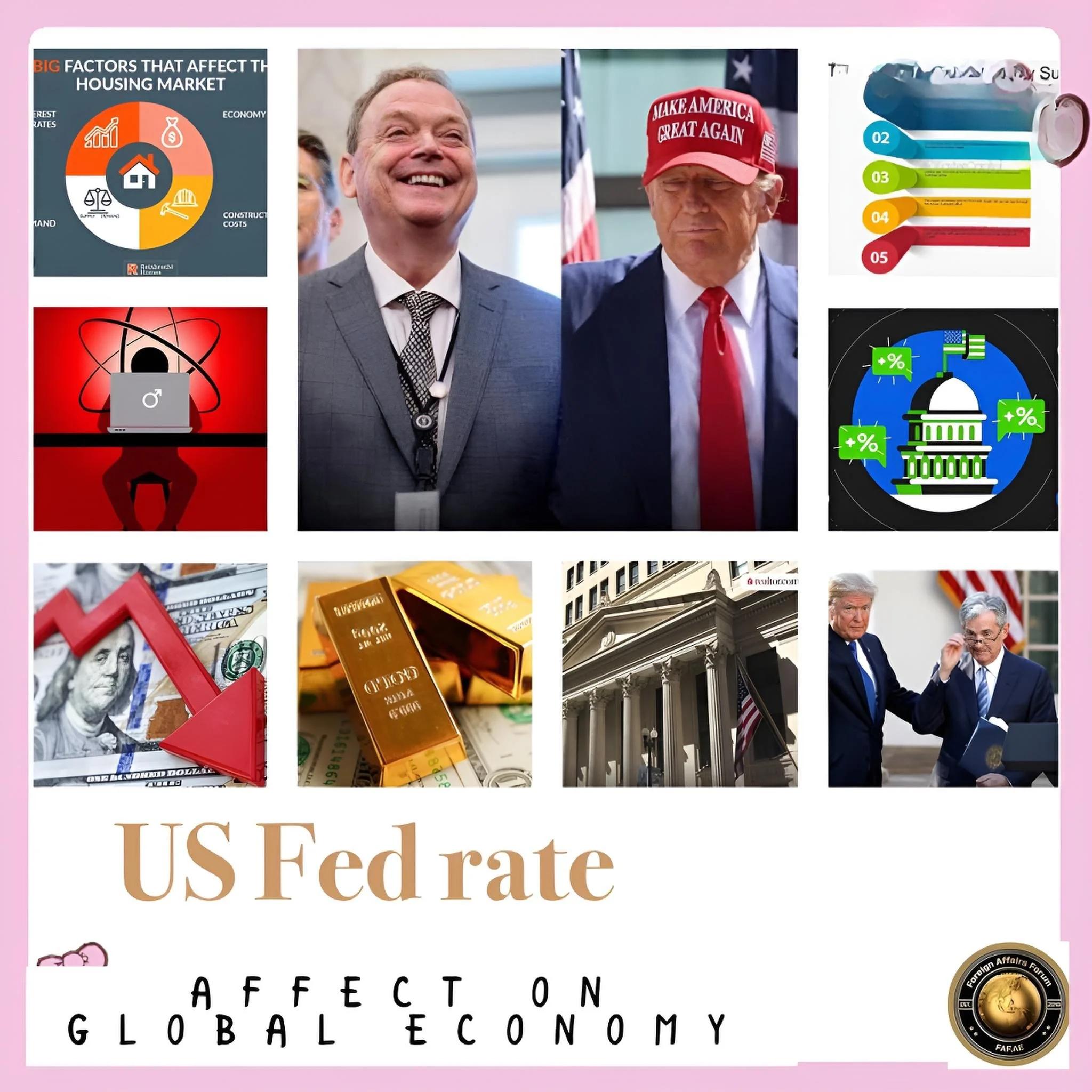
Implications of Declining Interest Rates : A Comprehensive Macroeconomic Analysis
Executive Summary
The anticipated decline in the United States federal funds rate to approximately 3.0%-3.25% by the conclusion of 2026, facilitated by continued monetary easing and prospective Federal Reserve leadership transitions, presents a multifaceted constellation of interconnected implications across domestic and global economies.
This expansionary monetary environment will precipitate substantive adjustments in currency valuations, commodity pricing, equity market dynamics, fixed-income allocations, and real estate market fundamentals.
Concurrently, the potential introduction of ultra-long-duration mortgage instruments and the structural shifts in global financial architecture warrant careful consideration of both countervailing stimulus effects and emergent systemic risks.
US Dollar Valuation and International Currency Dynamics
The depreciation of the United States dollar represents a consequential manifestation of declining real interest rate differentials between the United States and competing global economies.
As the Federal Reserve reduces policy rates toward the neutral rate of 3.0%, the yield differential vis-à-vis the eurozone (anticipated to trend toward 1.5% by mid-2026) and other developed economies will compress substantially.
The Federal Reserve’s rate trajectory will decline toward convergence with the European Central Bank’s anticipated 1.5% policy rate, materially diminishing the attractiveness of dollar-denominated assets for international investors.
Historically, the inverse relationship between interest rate differentials and currency strength proves robust; the dollar’s resilience during the recent tightening cycle emanated precisely from the substantial yield advantage conferred by elevated Federal Funds rates.
As this advantage attenuates, capital flows will reorient toward alternative reserve currencies and emerging market assets, precipitating dollar depreciation.
The Bloomberg-reported decline of the Dollar Index to 99.5 from 109 levels earlier in 2025, concurrent with Treasury yield compression, exemplifies this dynamic in operation.
This dollar weakness, while economically advantageous for export-oriented American enterprises by reducing the cost of domestic production relative to foreign competitors, simultaneously engenders substantial complications for the broader economy.
The United States economy confronts structural dependencies on imported intermediate inputs and raw materials; the weakening greenback will materially elevate production costs for manufacturers and ultimately transmit inflationary pressures to consumers.
Given the already-elevated fiscal deficit exceeding 7% of GDP and substantial public debt holdings, this inflationary dynamic compounds concerns regarding the sustainability of long-term Treasury yields.
Gold Pricing and Precious Metals Dynamics
The relationship between interest rate movements and gold valuations exhibits pronounced inverse characteristics. Goldman Sachs’ commodities specialists anticipate gold prices approaching $4,900 per troy ounce by year-end 2026, representing approximately 20% appreciation from recent levels.
This bullish trajectory reflects two primary mechanisms: the anticipated 75 basis points of Federal Reserve rate reductions scheduled for 2026, coupled with elevated central bank purchasing activity forecasted to average 80 metric tonnes monthly.
The mechanics underlying gold’s appeal during accommodative monetary regimes operate through multiple channels.
Declining Treasury yields reduce the opportunity cost of holding non-yielding bullion, thereby enhancing its relative attractiveness as a portfolio hedge.
Simultaneously, lower real interest rates—the differential between nominal rates and inflation expectations—reduce the return available from fixed-income instruments, directing capital toward alternative stores of value.
The historical pricing relationship between gold and the US dollar Index demonstrates substantial negative correlation; dollar depreciation systematically amplifies gold’s attractiveness to international purchasers denominating acquisitions in alternative currencies.
Central bank accumulation represents a particularly significant factor bolstering gold demand.
The freezing of Russian official reserves in 2022 catalyzed a “big wake-up call” among global monetary authorities regarding precious metals’ efficacy as genuinely safe assets insulated from geopolitical expropriation.
This structural shift in reserve composition preferences creates a durable technical support mechanism for gold pricing independent of short-term macroeconomic fluctuations.
Bitcoin and Cryptocurrency Market Implications
The relationship between Federal Reserve monetary policy and cryptocurrency valuations embodies complex dynamics reflecting Bitcoin’s simultaneous function as both a monetary asset sensitive to real interest rates and a speculative instrument subject to liquidity flows.
The cryptocurrency market exhibits pronounced responsiveness to expected monetary policy trajectories, with Bitcoin price movements demonstrating substantial correlation to shifts in federal funds rate expectations.
The cessation of the Federal Reserve’s quantitative tightening program on December 1, 2025, coupled with anticipated rate reductions throughout 2026, creates a supportive liquidity environment for risk assets including cryptocurrencies.
As monetary conditions ease, the opportunity cost of holding non-yielding assets such as Bitcoin declines, potentially catalyzing appreciation.
Historical precedent suggests that Bitcoin tends toward price appreciation in environments characterized by negative real interest rates and accommodative central bank policies.
However, substantial downside risks merit consideration.
Bitcoin’s pricing remains highly sensitive to macroeconomic tail risks and volatility shocks; should Federal Reserve rate cuts prove insufficient to prevent deflationary dynamics or asset market deterioration, rapid deleveraging could precipitate significant cryptocurrency price declines.
Additionally, the current regulatory environment remains fluid, with potential legislative developments either supporting or constraining institutional cryptocurrency participation.
Grayscale Research maintains that Bitcoin’s recent 30% pullback reflects normal bull market dynamics rather than the initiation of prolonged downturns, projecting new highs for 2026 contingent upon continued Fed easing and supportive fiscal policy.
The probability distribution remains asymmetric, with significant upside potential counterbalanced by acute downside vulnerability should monetary accommodation prove insufficient.
Equities Markets and Valuation Multiples
Lower interest rates exert an unambiguous positive effect on equity market valuations through multiple transmission mechanisms.
The discount rate applied to future corporate earnings—the nominal interest rate adjusted for risk premiums—declines as Federal Funds rates decrease, mechanically elevating the present value of corporate cash flows.
JPMorgan’s equity strategy division projects S&P 500 index levels of 7,500 for year-end 2026, with substantial upside to 8,000 contingent upon maintaining Fed easing trajectory.
The foundation supporting this bullish equity outlook rests upon several reinforcing pillars.
First, the anticipated 13-15% earnings growth among S&P 500 constituents reflects above-trend economic expansion bolstered by artificial intelligence-related capital investment, tax policy provisions, and deregulation.
Second, lower interest rates directly reduce corporate debt servicing costs, expanding net income margins and return on equity calculations.
Third, broadening economic participation across equity market breadth—particularly in small-cap and mid-cap equities historically pressured by elevated rates—presents opportunities for valuation rerating.
Nevertheless, substantial headwinds warrant circumspection.
The current economic environment exhibits K-shaped characteristics, with affluent households and large corporations prospering while lower-income households confront persistent affordability challenges.
This distributional asymmetry creates fragility in consumption patterns and consumer confidence dynamics.
Additionally, elevated equity valuations relative to historical norms already incorporate substantial expectations of continued monetary accommodation and above-trend earnings growth; unexpected macroeconomic deterioration could precipitate significant repricing.
Sector rotation presents nuanced considerations.
Traditional beneficiaries of rate cuts—financial services, technology, and communications sectors—have already experienced substantial price appreciation; prospective rate-cut cycles typically broaden participation toward small-cap, mid-cap, and historically defensive sectors.
The Russell 2000 small-cap index achieved its first new high since November 2021 following the September 2025 rate reduction, suggesting emerging momentum in previously underperforming segments.
Treasury Securities and Fixed-Income Markets
The Treasury market landscape for 2026 presents a complex terrain of competing dynamics.
While the Federal Reserve reduces short-term rates toward the 3.0% neutral range, longer-dated Treasury yields face countervailing pressures from elevated fiscal deficits, persistent inflation expectations, and the term premium associated with uncertainty regarding future monetary policy trajectory.
Current consensus expectations position 10-year Treasury yields at approximately 4.0% by end-2026, representing minimal movement from current levels despite anticipated short-term rate declines.
This steepening yield curve—the differential between short-term and long-term rates—reflects market expectations that long-term inflation will stabilize above the Federal Reserve’s 2% target, necessitating higher long-term real rates.
Continuum Economics’ analysis projects a 2-year to Federal Funds spread of 25-35 basis points by end-2026, indicating market expectations of a gradual terminal rate decline with limited additional easing.
Treasury bill yields, currently elevated at approximately 3.5%-3.7%, will experience compression as the Federal Funds rate descends toward 3.0%.
The relative attractiveness of Treasury bills versus longer-duration securities will diminish substantially; investor demand will likely reorient toward intermediate-duration securities offering greater capital appreciation potential as rates decline.
For investors seeking current income, the prospective yield compression in Treasury securities necessitates tactical reallocation toward equity dividends or higher-yielding alternative investments.
Real Estate Market Dynamics and Extended Mortgage Structures
The American real estate market stands positioned for a meaningful inflection point during 2026, characterized by the conjunction of declining mortgage rates, moderating home price growth, and accelerating household income expansion.
The National Association of Realtors and Redfin independently project substantial sales volume expansion, with mortgage rates anticipated to trend toward the low-6% range and stabilize at approximately 6.2%-6.3% by year-end 2026. This new a nuance analysis.
This modest interest rate amelioration generates substantive affordability improvements through multiple channels.
First American Financial Corporation’s analysis demonstrates that homebuying affordability has experienced seven consecutive months of year-over-year improvement through September 2025, representing the longest such streak since late-2019 to early-2020.
Crucially, this improvement emanates not exclusively from rate declines but from the structural relationship wherein household income growth has commenced outpacing home price appreciation—a phenomenon unprecedented since the post-financial-crisis recovery period.
The prospective introduction of 50-year fixed-rate mortgage instruments merits particularly careful analytical examination.
Such ultra-long-duration loan structures would mechanically reduce monthly payment obligations relative to conventional 30-year mortgages, potentially expanding qualified borrower pools and ameliorating immediate affordability constraints.
A borrower financing a $400,000 home at 6% interest would face monthly payments of approximately $2,398 under a 30-year structure versus $2,059 under a hypothetical 50-year instrument, representing an 14% monthly payment reduction.
However, the longer-term economic implications present substantial complications.
Over 50 years, total interest paid more than doubles relative to 30-year amortization structures; cumulative borrower costs increase materially despite lower monthly obligations.
More problematically, should 50-year mortgages expand market participation, the induced demand expansion may precipitate upward repricing of home values, potentially neutralizing affordability improvements.
Empirical evidence suggests that accommodative lending standards transmit directly into home price appreciation as expanded qualified buyer pools compete for constrained housing supply.
Real estate economists anticipate continued structural supply constraints supporting price floors; residential construction remains materially below long-term demand requirements stemming from demographic expansion and household formation.
Accordingly, the consensus projection indicates approximately 1% nominal home price appreciation throughout 2026—materially subdued relative to historical norms but sufficient to maintain price levels in nominal terms.
This combination—wage growth outpacing modest price appreciation, coupled with declining mortgage rates—creates the mathematical conditions for genuine affordability expansion.
Federal Reserve Leadership Transition and Monetary Policy Divergence
The anticipated transition in Federal Reserve leadership represents a consequential variable reshaping expectations regarding 2026 monetary policy trajectory.
Prediction market probabilities assign approximately 79% likelihood to Kevin Hassett’s nomination as Federal Reserve Chair, with announcement expected during early 2026 and formal assumption of responsibilities anticipated in May 2026.
Hassett’s publicly articulated monetary policy framework emphasizes more aggressive interest rate reduction than consensus market pricing currently incorporates.
Historical commentary indicates advocacy for rate cuts potentially exceeding the 75 basis points consensus expectation, with cumulative reductions approaching 100-150 basis points potentially justified by Hassett’s economic framework.
This dovish policy orientation aligns precisely with President Trump’s articulated preference for substantially lower interest rates to stimulate economic expansion.
The significance of this leadership transition extends beyond nominal policy rate trajectories to encompass institutional dynamics regarding Federal Reserve independence.
The appointment of a Fed Chair fundamentally aligned with executive branch preferences creates prospective governance complications and market uncertainty regarding the central bank’s future commitment to inflation control versus growth maximization.
Investors and international participants express heightened concern regarding potential politicization of monetary policy decision-making, potentially generating risk premiums in Treasury yields and currency markets.
During the interim period preceding Hassett’s May 2026 assumption of duties—characterized as the “shadow Fed Chair” phenomenon—market participants will intensively scrutinize his public commentary and interim influence on Federal Open Market Committee deliberations.
Historical precedent from the 1970s, when Fed Chair Arthur Burns encountered intense political pressure from President Nixon regarding monetary policy, demonstrates the potential for institutional drift when external political pressures override technical macroeconomic considerations.
Global Economic Implications and De-Dollarization Dynamics
American interest rate decline to 3% generates expansive implications for global economic participants and the broader international monetary architecture.
Emerging market economies benefit substantially from dollar depreciation accompanying lower US interest rates; the reduced servicing burden on dollar-denominated external debt improves fiscal dynamics and frees capital for growth-oriented expenditures.
The de-dollarization momentum, particularly prominent among BRICS nations and Asian regional organizations, intensifies as interest rate differentials compression reduces the greenback’s financial attractiveness.
While the dollar maintains its preeminent role in international commerce—approximately 50% of global trade continues denominated in dollars as of mid-2025—the trajectory unmistakably trends toward diversification.
India’s assumption of BRICS presidency in 2026 projects reduced de-dollarization emphasis relative to Russia’s 2024 governance, yet underlying structural momentum toward local currency settlement and alternative payment mechanisms persists.
For American exporters, dollar weakness confers competitive advantages through reduced production costs relative to foreign competitors.
However, this benefit remains concentrated among export-oriented manufacturing enterprises; broader American economic welfare demonstrates ambiguous outcomes.
The rising import costs for consumption and intermediate goods cascade through consumer price inflation, constraining real purchasing power for non-capital-appreciating households.
Economic Recovery Mechanisms and Stimulus Transmission
The potential conjoint implementation of aggressive monetary accommodation and supportive fiscal policy—encompassing the “One Big Beautiful Bill Act” tax reductions and deregulation initiatives—creates conditions for accelerated 2026 economic expansion.
JPMorgan’s research projects 2026 GDP growth of 2.2-2.4%, moderately above trend rates, contingent upon sustained policy support.
The stimulus transmission mechanisms operate through multiple reinforcing channels.
First, monetary accommodation reduces borrowing costs for consumers and corporations, expanding investment demand and consumption possibilities.
Second, fiscal policy provisions including personal income tax refunds generate near-term demand stimulus while expansion of business investment incentives (full expensing provisions) bolster capital formation.
Third, deregulation initiatives reduce compliance costs and enhance business formation incentives.
However, the countervailing risk emanates from inflation dynamics.
Should tariff-induced price pressures prove more persistent than consensus forecasts anticipate, or should accommodative fiscal and monetary policies prove excessively stimulative, inflation could accelerate above the 2.5-3.5% range consensus projections envision.
Elevated inflation expectations would eventually constrain Federal Reserve easing scope and potentially necessitate policy reversal, generating recession dynamics inconsistent with stimulus objectives.
The bifurcated economic outcomes across income strata merit explicit consideration. Wealth effects emanating from equity market gains and home price appreciation disproportionately benefit middle- and upper-income households with substantial asset holdings.
Concurrently, lower-income households experience elevated effective inflation through service sector and housing cost growth, partially offsetting any nominal wage expansion.
This distributional asymmetry generates political economy tensions that may constrain policy implementation.
Systemic Risk Considerations and Fiscal Sustainability Questions
The confluence of declining interest rates with elevated federal fiscal deficits creates prospective financial stability risks warranting serious analytical consideration.
The United States’ primary deficit is projected to stabilize at 1.0-1.5% of GDP, insufficient to stabilize the public debt-to-GDP ratio at current interest rate assumptions.
BNP Paribas’ analysis demonstrates that even with rate declines to 3%, real interest rates remain elevated relative to nominal GDP growth rates, implying continued public debt accumulation.
Should financial conditions deteriorate unexpectedly—driven by inflation shocks, geopolitical disruptions, or asset market volatility—the refinancing demand for maturing Treasury securities could encounter substantially elevated rate requirements.
The sensitivity of federal budget dynamics to interest rate shocks intensifies as debt levels rise; a 100 basis point increase in average Treasury yields would expand annual interest payments by approximately 2-3% of GDP, exacerbating fiscal imbalances.
Additionally, the extended mortgage structures potentially introduce moral hazard dynamics wherein borrowers build equity excessively slowly, reducing financial flexibility during economic downturns and potentially elevating default probabilities should employment disruption occur.
The aggregate macroeconomic implications of widespread 50-year mortgage implementation remain empirically uncertain but warrant regulatory scrutiny and stress-testing protocols.
Conclusion
The anticipated decline in United States interest rates to 3% by end-2026 generates a complex matrix of economically advantageous stimulus elements counterbalanced by emergent risks regarding fiscal sustainability, inflation dynamics, and financial stability.
The dollar depreciation benefits exporters but complicates import costs; gold and cryptocurrency assets appreciate in this environment while equity market multiples expand; real estate markets experience genuine affordability restoration concurrent with modest price appreciation.
However, the Federal Reserve leadership transition introduces political economy considerations that may compromise monetary policy credibility, and the magnitude of concurrent fiscal stimulus creates prospective inflation risks demanding careful policy coordination and execution.