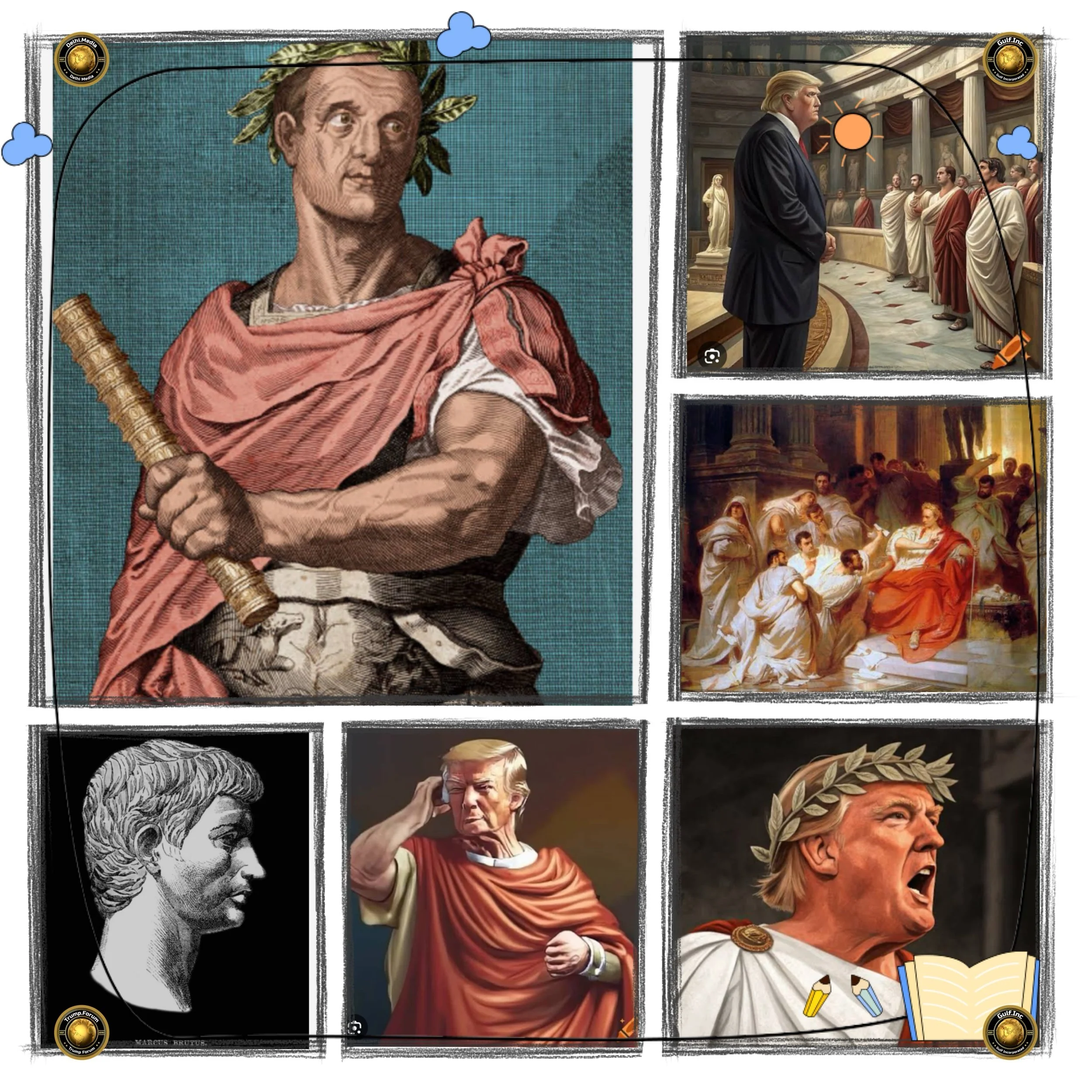
An American Caesar: A Comparative Analysis of Leadership Across Two Millennia
Introduction
The comparison of Donald Trump and Julius Caesar extends beyond mere political spectacle; it uncovers deep-rooted patterns in how republics transform under authoritarian influence.
Although these two figures are separated by over two thousand years, both emerged from periods of significant institutional upheaval.
They capitalized on widespread public discontent and systematically challenged established norms, actions that fundamentally reshaped their respective political landscapes.
The Path to Power
Populist Revolt Against Elites
Julius Caesar’s ascent to power was emblematic of a recurring phenomenon in Roman history: ambitious leaders harness social unrest to their advantage.
As a prominent member of the popular faction, Caesar adeptly positioned himself as a champion of the ordinary citizen, openly opposing the entrenched elite represented by the conservative Senate.
His military campaigns in Gaul, which spanned from 58 to 50 B.C., not only amassed remarkable wealth for him but also earned him immense widespread acclaim and, critically, the unwavering loyalty of his seasoned legions.
In parallel, Donald Trump’s rise in American politics relied on a populist narrative that cast him as a formidable outsider battling against a deeply entrenched political establishment.
Despite his considerable wealth and privileged upbringing, Trump effectively crafted an image as the voice of “real Americans,” appealing to those who felt neglected by the existing political system.
Like Caesar, Trump’s appeal transcended traditional party affiliation, attracting support from diverse constituencies disillusioned with institutional failures.
The Rubicon Moment
Crossing Constitutional Lines
Caesar’s historic crossing of the Rubicon River on January 10-11, 49 B.C., is often regarded as one of history’s most significant points of no return.
By leading his army across this crucial boundary separating his province from Italy, Caesar violated Roman law, effectively declaring war on the Republic he had sworn to protect.
Historical accounts reveal that Caesar proclaimed, “Alea iacta est” (the die is cast), in a moment fraught with consequence, recognizing the irrevocable path he had chosen.
Trump's own “Rubicon moment” transpired during the violent events of January 6, 2021, at the U.S. Capitol, when he refused to accept the outcome of the presidential election and incited his supporters to “fight like hell.”
While this act did not involve the literal crossing of a geographical boundary, it constituted a profound violation of the underlying democratic norms that have characterized American governance since 1797: the peaceful transfer of power.
Institutional Subversion
The Erosion of Republican Norms
Caesar and Trump exhibited a remarkable ability to undermine institutional safeguards while maintaining significant popular backing.
Caesar systematically dismantled the Senate's authority, expanding its membership to include his loyalists and circumventing traditional legislative procedures.
His declaration as dictator perpetuo in 44 B.C. effectively terminated the Roman Republic’s long-standing tradition of shared governance, ending a political era of over five centuries.
In contrast, Trump’s method of institutional subversion was subtler, yet raised alarm bells among democratic scholars.
Analysts pointed to his relentless assaults on judicial independence, threats to prosecute political adversaries, and intentions to weaponize the Justice Department against his enemies.
His administration’s resistance to Congressional oversight and manipulating federal agencies for political purposes has been characterized as a form of “competitive authoritarianism” – a scenario where elections continue.
Yet, the political playing field becomes increasingly skewed in favor of the sitting authority.
The Question of Brutus
Who Opposes the American Caesar?
The assassination of Julius Caesar on March 15, 44 B.C., was executed by a faction of senators who believed they were acting to preserve the Republic from tyranny.
Among them, Marcus Junius Brutus, once a protégé and ally of Caesar, became the emblematic figure of this conspiracy.
Brutus and his co-conspirators viewed themselves as liberatores (liberators), driven by a philosophical commitment to republicanism; however, many within Roman society ultimately regarded them as mere assassins.
In contemporary America, resistance to Trump manifests in a more fragmented and institutionalized manner, eschewing the violent methods of ancient Rome.
Today’s “Brutus” figures span across various sectors of society and government:
Republican Opposition
Figures such as Liz Cheney and Adam Kinzinger emerged as vocal critics from within the Republican Party, particularly through their roles in the January 6 Committee.
However, their principled stand against Trump’s actions came at a significant personal cost, leading to the erosion of their political careers as a direct consequence of confronting the former president.
Democratic Leadership
Democratic figures like Chuck Schumer and Nancy Pelosi have spearheaded efforts to resist Trump’s agenda through impeachment proceedings, legislative pushback, and oversight initiatives.
Nonetheless, severe partisan polarization and entrenched institutional constraints have often stymied their endeavors.
Legal and Judicial Opposition
A crucial aspect of modern resistance is represented by federal judges, state attorneys general like Letitia James, and special counsels who have pursued legal challenges against Trump’s behavior.
This educated and methodical approach signifies a form of institutional resistance historically unavailable during Caesar’s era.
Military and Security Officials
Notable former officials from Trump’s own administration, including John Kelly, James Mattis, and Mark Milley, have publicly expressed concerns regarding Trump's authoritarian tendencies.
Their opposition carries profound significance, given their military backgrounds and direct experiences with his governance style.
The Geopolitical Complex
Modern Power Structures
The current geopolitical landscape is markedly different from the stark binary of ancient Rome, where power dynamics revolved around Caesar and his adversaries.
In today’s global arena, figures reminiscent of Brutus navigate a labyrinthine network of international organizations, democratic coalitions, and an engaged global civil society.
Unlike the Roman Senate, which often operated in isolation, modern democratic movements are bolstered by international alliances that provide crucial support and strategic pressure against authoritarian tendencies.
During the Trump presidency, various multilateral bodies, including the European Union and NATO, voiced significant alarm regarding perceived democratic backsliding in the United States.
This international engagement not only supplies a wealth of resources to those resisting autocratic actions but also confers a level of legitimacy that Caesar's opponents lacked in their time.
Historical Parallels and Democratic Fragility
Drawing parallels between the figures of Caesar and Trump unveils the vulnerabilities inherent in democratic systems when they are challenged from within.
Much like the Roman Republic, which theoretically boasted checks and balances designed to uphold democratic governance, modern America has struggled to protect its institutions against a leader who is willing to subvert established norms and exploit the frustrations of the populace.
The rise of Caesar can be attributed to the Roman citizenry's willingness to sacrifice their republican liberties for the allure of stability and assertive leadership.
Following Caesar’s assassination, Augustus, his successor, perfected this transformation by maintaining the façade of republican structures while exercising dominion over real political power.
Today, the pressing question for American democracy is whether its foundational institutions—such as the judiciary, electoral processes, and civil society organizations—can weather the storms of political tumult more effectively than those of their Roman predecessors.
Unlike the ancient Roman governance system, the United States enjoys the advantage of a codified constitution, an independent judiciary, and a rich legacy of democratic practice that has evolved over centuries.
Conclusion
The Enduring Lesson
The comparison between Trump and Caesar underscores a critical truth about the threats to republican governance: the real dangers often emerge not from external forces but from internal actors—leaders who manipulate institutional weaknesses and capitalize on public grievances to amass power.
Both Caesar’s audacious crossing of the Rubicon and Trump’s contentious refusal to concede electoral defeat serve as pivotal instances when established political norms begin to erode under the weight of authoritarian pressures.
However, this analogy also highlights noteworthy distinctions: while Caesar confronted a narrow elite of senators with limited popular support, Trump faces a considerably more extensive and diverse opposition operating within robust democratic institutions.
In today’s context, the modern “Brutus” is not a singular conspiratorial figure but rather a constellation of judges, journalists, political leaders, and engaged citizens dedicated to safeguarding the principles of democracy.
The future resilience of American democracy, compared to the fate of the Roman Republic, largely hinges on the continued vigilance and activism of these contemporary defenders of civic virtue.
Reflecting on history, the Roman historian Tacitus aptly remarked, “The desire for power is itself a disease,” emphasizing that the most effective remedy lies in the active protection of institutional constraints designed to prevent any one leader from ascending to the status of an American Caesar.