Comparative Analysis of Nuclear Deterrence Strategies: United States, Europe, China, and India
Introduction
The nuclear deterrence strategies of the United States, Europe (France and the United Kingdom), China, and India reflect fundamentally different approaches shaped by distinct security environments, historical experiences, geopolitical priorities, and strategic cultures.
As of 2025, these four nuclear powers—or in Europe’s case, two allied nuclear powers—pursue divergent doctrines that range from the expansive, flexible deterrence model of the United States to the minimalist postures of China and India.
This comprehensive analysis examines the doctrinal foundations, operational postures, force structures, and strategic implications of each approach, revealing how geography, threat perceptions, alliance commitments, and technological capabilities have shaped contemporary nuclear deterrence in an increasingly multipolar world.
United States: Flexible Deterrence and Global Extended Nuclear Umbrella
Doctrinal Foundations and Strategic Philosophy
The United States maintains the most comprehensive and sophisticated nuclear deterrence strategy among all nuclear powers, built upon the principle of “tailored deterrence with flexible capabilities”.
This approach evolved from the Cold War doctrine of flexible response and has adapted to address a complex, multi-adversary security environment.
The 2024 Nuclear Employment Strategy explicitly directs the Department of Defense to deter Russia, China, and North Korea simultaneously in peacetime, crisis, and conflict—a requirement that fundamentally shapes U.S. nuclear posture.
Unlike the other nuclear powers examined here, the United States emphasizes deterrence by both punishment and denial, maintaining not only the capability to inflict unacceptable damage through retaliatory strikes but also counterforce capabilities designed to reduce potential adversaries’ ability to employ nuclear weapons.
This dual approach requires a significantly larger and more diverse arsenal than a minimum deterrence posture would necessitate.
The fundamental role of U.S. nuclear weapons extends beyond direct national defense to include assuring allies and partners through extended deterrence commitments.
This extended deterrence function—providing nuclear guarantees to NATO allies in Europe and partners in the Asia-Pacific—distinguishes U.S. strategy from all other nuclear powers and explains much of the complexity and scale of American nuclear forces.
Force Structure and Operational Posture
The United States maintains a complete nuclear triad consisting of intercontinental ballistic missiles (ICBMs), submarine-launched ballistic missiles (SLBMs), and strategic bombers, along with dual-capable fighter aircraft for sub-strategic missions.
As of January 2025, the U.S. nuclear stockpile contains approximately 3,700 warheads, with roughly 1,770 deployed on ICBMs, SLBMs, and at bomber bases.
This represents over 30% of global nuclear warheads and reflects the requirements of flexible deterrence against multiple peer adversaries.
The triad provides mutually supporting attributes that maintain strategic stability while mitigating programmatic, technical, geopolitical, and operational risks.
ICBMs are maintained on day-to-day alert, and a portion of ballistic missile submarines remain at sea continuously.
This alert posture, combined with the dispersed nature of the triad, ensures that no adversary could eliminate U.S. second-strike capability through a disarming first strike.
Beyond strategic forces, the United States maintains approximately 100-130 B61 tactical nuclear bombs deployed at six bases across five European NATO countries (Belgium, Germany, Italy, the Netherlands, and Turkey).
These weapons, deliverable by dual-capable aircraft including F-16s, F-35As, and Tornados, constitute NATO’s nuclear sharing arrangement and provide sub-strategic options for regional deterrence.
Escalation Management and Employment Strategy
A distinctive feature of U.S. nuclear strategy is its emphasis on escalation management—the ability to control the intensity and scope of nuclear conflict to achieve a favorable termination.
The 2024 Nuclear Employment Strategy requires that all plans for responding to a limited nuclear attack include an associated concept for favorably managing escalation, including reducing the likelihood of large-scale atomic exchanges.
This focus on escalation control reflects the flexible response doctrine’s core logic: providing options across the spectrum of conflict to deny adversaries confidence that escalation would lead to victory.
By maintaining “a range of limited and graduated options,” the United States seeks to discourage escalation by introducing uncertainty about outcomes while maintaining the credible threat of overwhelming response if necessary.
The integration of non-nuclear capabilities into nuclear planning represents another distinctive aspect of U.S. strategy.
Advanced conventional weapons, missile defense systems, cyber capabilities, and allied conventional forces are incorporated into deterrence planning to provide complementary options and reduce reliance on nuclear weapons for some missions.
First-Use Policy and Declaratory Doctrine
Unlike China and India, the United States explicitly retains the option to use nuclear weapons first in extreme circumstances to defend vital U.S. interests or those of its allies and partners.
This declaratory policy reflects the requirements of extended deterrence, particularly in Europe, where NATO strategy has historically relied on the threat of nuclear escalation to offset Soviet and now Russian conventional superiority.
The U.S. negative security assurance pledges not to use nuclear weapons against non-nuclear-weapon states party to the Nuclear Non-Proliferation Treaty (NPT) and in compliance with their obligations—except when such states attack the United States or its allies in association with a nuclear-weapon state.
This qualification preserves the credibility of extended deterrence while limiting the circumstances under which nuclear use might be considered.
European Nuclear Deterrence: France, the United Kingdom, and Emerging Coordination
France: Strategic Autonomy and Strict Sufficiency
France has pursued an independent nuclear deterrent since the 1960s, driven by deep-rooted concerns about the reliability of U.S. commitments and a determination to maintain strategic autonomy.
French nuclear deterrence is characterized by remarkable doctrinal continuity, with core principles established in the early Cold War remaining largely intact through successive presidencies.
Doctrinal Principles
French nuclear doctrine rests on several enduring pillars.
First, the force de frappe is strictly conceived as defensive, designed to protect France’s “vital interests” and ensure sovereignty and freedom of action.
Second, France adheres to the principle of “strict sufficiency,” maintaining only the minimum number of warheads necessary to inflict “unacceptable damage” on any adversary threatening those vital interests.
Third, France maintains complete independence in all aspects of its nuclear program—from design and manufacturing to deployment, operation, and decision-making.
The concept of vital interests lies at the heart of French deterrence. While deliberately kept ambiguous to maximize deterrent effect, successive French presidents have progressively acknowledged that these interests possess a European dimension.
President Emmanuel Macron’s 2020 statement that “the security of Europe constitutes a vital interest for France” marked a significant evolution, opening the possibility of extending French nuclear deterrence to protect European allies.
Force Structure
France possesses approximately 290 nuclear warheads organized into a dual-component deterrent.
The oceanic component consists of four Le Triomphant-class nuclear-powered ballistic missile submarines (SSBNs), each capable of carrying 16 M51 submarine-launched ballistic missiles with multiple independently targetable reentry vehicles.
France maintains continuous at-sea deterrence, with at least one SSBN on patrol at all times.
The airborne component includes Rafale B fighters operated by the Strategic Air Forces and Rafale M naval aircraft, both capable of delivering the ASMPA-A air-to-surface medium-range improved missile.
France is developing the next-generation ASN4G hypersonic nuclear missile with a range exceeding 1,000 kilometers, further enhancing the credibility of its air-delivered deterrent.
Unlike the United Kingdom, France has never participated in NATO’s Nuclear Planning Group, maintaining its forces entirely outside the alliance’s integrated nuclear command structure.
This autonomy extends to targeting, operational planning, and employment decisions—all of which remain under exclusive French control, with the president as sole authority to order nuclear weapons use.
European Dimension and Future Evolution
Recent geopolitical developments, particularly Russia’s invasion of Ukraine and uncertainty about the long-term U.S. commitment to European security, have accelerated discussions about the European role of French nuclear forces.
In July 2025, France and the United Kingdom signed the Northwood Declaration, pledging that their respective nuclear deterrents “can be coordinated” in response to extreme threats against Europe.
This coordination represents a significant departure from France’s traditional insistence on complete autonomy.
While ultimate decision-making authority remains with the French president and British prime minister, the agreement envisions enhanced dialogue, combined strategic signaling, and potentially coordinated targeting and strike planning.
Such cooperation could involve French and British attack submarines providing mutual protection for each other’s SSBN operations, coordinated patrol areas, and combined crisis response.
United Kingdom: Minimum Deterrence and Transatlantic Integration
The United Kingdom’s nuclear posture differs significantly from France’s in both scale and strategic orientation.
British nuclear forces are smaller, less diverse, and more closely integrated with both NATO and the United States.
Doctrinal Approach
The UK maintains an “independent, minimum, credible nuclear deterrent” with a declaratory policy of using nuclear weapons “only in extreme circumstances of self-defence”.
This doctrine emphasizes maintaining the minimum level of destructive power necessary to ensure credibility against the full range of state nuclear threats.
Unlike France’s emphasis on strategic autonomy, British nuclear policy has consistently emphasized the transatlantic relationship and NATO integration.
Force Structure and U.S. Dependencies
The UK’s nuclear deterrent consists exclusively of four Vanguard-class SSBNs carrying Trident II D5 submarine-launched ballistic missiles.
The UK operates a Continuous At-Sea Deterrent (CASD), maintaining at least one submarine on patrol at all times.
With approximately 225 total warheads and roughly 120 deployed, the British arsenal is significantly smaller than France’s.
A critical distinction from French forces is the UK’s dependence on the United States for key components of its deterrent.
The Trident missiles are leased from the U.S., with maintenance conducted at U.S. facilities.
The current Holbrook warhead design closely resembles the U.S. W76-0, though the UK is developing a new sovereign warhead design (Astraea/Mk7) to reduce this dependence.
This reliance on U.S. systems, while cost-effective through economies of scale, raises questions about operational independence, particularly given recent volatility in U.S. foreign policy.
New Nuclear Sharing Role
In June 2025, the UK announced a significant expansion of its nuclear posture by purchasing at least 12 F-35A dual-capable aircraft and joining NATO’s Dual Capable Aircraft atomic mission.
This represents the most significant strengthening of UK nuclear posture in a generation and reintroduces a nuclear role for the Royal Air Force for the first time since the end of the Cold War.
The F-35As will be capable of carrying U.S. B61-12 tactical nuclear bombs, allowing the UK to contribute to NATO’s sub-strategic deterrence alongside Belgium, Germany, Italy, the Netherlands, and Turkey.
This decision reflects both a commitment to NATO burden-sharing and recognition that Europe may need to assume greater responsibility for its own defense.
The F-35A, with its stealth capabilities and advanced sensors, provides significantly improved survivability compared to older dual-capable aircraft, enhancing the credibility of NATO’s nuclear sharing mission.
Emerging European Nuclear Architecture
The Northwood Declaration and related developments point toward an emerging European nuclear architecture that could supplement—or in extremis, partially replace—U.S. extended deterrence.
Several models are being discussed here.
Option A
Enhanced French Role: France could extend its nuclear umbrella to other European states, with vital interests explicitly defined to include European security.
This would require enhanced dialogue with allies, possible forward deployment or increased readiness postures, and formalized security assurances through treaties.
Option B
Anglo-French Nuclear Umbrella: Combined Franco-British capabilities (approximately 515 warheads) would provide greater quantitative depth and the advantage of two separate command-and-control centers, enhancing survivability.
The Northwood Declaration represents a first step toward such coordination, though significant political and operational hurdles remain.
Option C
European Multilateral Nuclear Force: A more ambitious approach would establish a European Nuclear Planning Group within NATO, allowing non-nuclear European states to participate in nuclear consultation and planning.
At the same time, France and the UK retain sole authority over the employment of weapons.
This would mirror current NATO nuclear-sharing arrangements, but with European rather than U.S. weapons.
All these options face substantial challenges. France’s insistence on sovereignty means it will not accept co-funding, joint development, or shared decision-making authority.
The UK’s U.S. dependencies complicate its ability to serve as an autonomous European nuclear pillar.
Both countries’ arsenals are significantly smaller than Russia’s, raising questions about the credibility of deterrence in various scenarios.
Nevertheless, European states increasingly recognize that conventional deterrence must be strengthened and that some form of autonomous nuclear capability may be necessary if U.S. commitment to Europe continues to waver.
China: Minimal Deterrence and Strategic Ambiguity
Doctrinal Evolution and No First Use
China’s nuclear strategy has historically been characterized by remarkable restraint compared to other major powers.
The doctrine of “minimal deterrence” and the unconditional “no first use” (NFU) pledge have formed the bedrock of Chinese nuclear policy since the country’s first successful nuclear test in 1964.
This posture reflects both strategic culture—emphasizing self-defense and opposition to nuclear coercion—and China’s historical confidence that a relatively small atomic arsenal could deter aggression by demonstrating the capability for assured retaliation.
The NFU policy means China commits never to be the first to use nuclear weapons in any circumstance, reserving nuclear forces exclusively for retaliation after suffering a nuclear attack.
This declaratory policy distinguishes China from the United States and Russia, both of which retain first-use options, and aligns China with India in embracing NFU as a core principle.
China’s nuclear strategy centers on maintaining a credible second-strike capability—the assured ability to survive an enemy first strike and launch devastating retaliation.
The emphasis is on deterrence by punishment rather than war-fighting or damage limitation.
Chinese strategic thinking holds that the mere existence of survivable retaliatory forces, rather than numerical parity with adversaries, provides sufficient deterrence.
Force Structure Expansion and Modernization
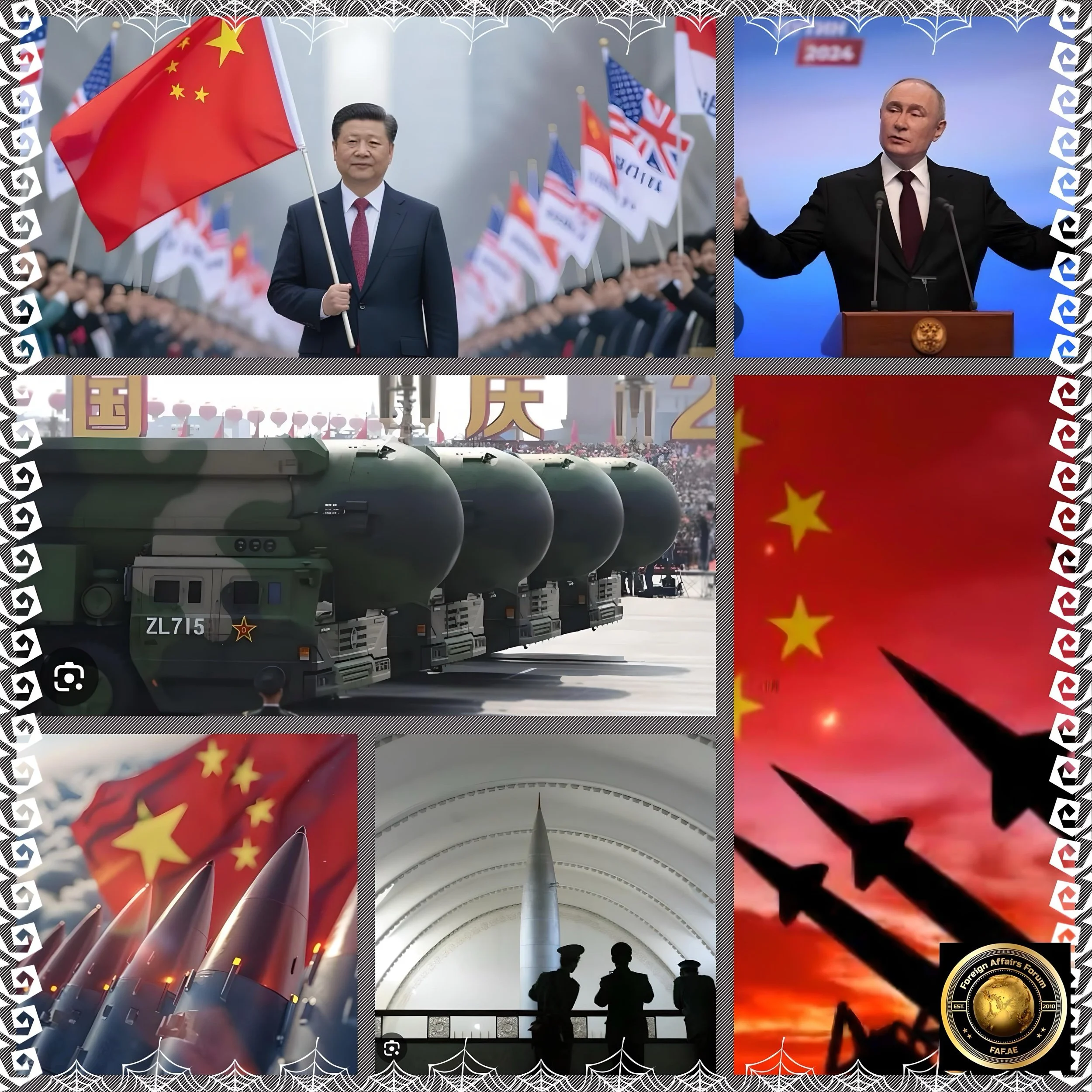
While China’s nuclear doctrine emphasizes minimalism, recent years have witnessed a dramatic expansion and modernization of its nuclear forces, raising questions about whether the country is transitioning to a new strategic posture.
As of January 2025, China possesses approximately 600 nuclear warheads—an increase of 100 warheads in just one year, representing 20% growth.
This rapid buildup significantly exceeds the expansion rates of other nuclear powers and signals a significant shift in Chinese nuclear policy.
Triad Development
China is systematically developing a complete nuclear triad to enhance the survivability and diversity of its retaliatory capabilities.
The land-based component includes both silo-based and road-mobile intercontinental ballistic missiles, with approximately 350 new ICBM silos under construction or recently completed in three desert regions and three mountainous areas.
This represents a fundamental change from China’s previous emphasis on a small, mobile land-based force to a larger, more diversified posture.
China’s sea-based deterrent consists of Type 094 ballistic missile submarines equipped with JL-2 submarine-launched ballistic missiles, with more advanced Type 096 submarines under development.
While China does not yet maintain continuous at-sea deterrence patrols comparable to those of the U.S., UK, or France, some intelligence assessments suggest China may now keep some warheads on missiles during peacetime—a departure from its traditional practice of separating warheads and delivery systems.
The air component includes approximately 20 H-6N bombers capable of delivering nuclear weapons, with next-generation nuclear-capable bombers under development.
This triadic structure, once completed, will provide China with strategic flexibility comparable to that of the United States and Russia.
Strategic Rationale for Expansion
Several factors drive China’s nuclear buildup.
First, concerns about U.S. advances in missile defense, conventional precision strike capabilities, and intelligence, surveillance, and reconnaissance systems have raised doubts about the long-term survivability of China’s traditionally small arsenal.
Second, the growth of U.S. nuclear modernization programs and the deterioration of U.S.-China relations have prompted China to strengthen its deterrent.
Third, China’s expanding global interests and regional ambitions, particularly regarding Taiwan and the South China Sea, may require a more robust nuclear posture to deter U.S. intervention.
U.S. assessments project that China could possess 1,000 warheads by 2030 and potentially 1,500 by 2035—though this would still represent only about one-third of current U.S. or Russian stockpiles.
The speed and scale of this expansion have raised concerns in Washington about China’s strategic intentions and whether Beijing is abandoning minimal deterrence in favor of a more competitive posture.
Strategic Ambiguity and Declaratory Policy
Despite the dramatic expansion of its nuclear arsenal, China maintains significant strategic ambiguity about employment doctrine, targeting policy, and alert status.
Unlike the United States, which publishes detailed nuclear posture reviews, China provides limited official information about its nuclear strategy.
This ambiguity is deliberate, intended to complicate adversary planning and enhance deterrence by introducing uncertainty about Chinese responses.
China’s lack of transparency extends to several critical areas.
First, it is unclear under what circumstances China might consider its NFU pledge to have been violated—for example, whether devastating conventional strikes on nuclear forces or command-and-control systems would constitute nuclear aggression justifying retaliation.
Second, China has not clearly articulated what “assured retaliation” means in operational terms. Whether it implies countervalue strikes against cities, counterforce strikes against military targets, or some combination of the two.
Third, China’s alert posture remains unclear.
Traditionally, Chinese nuclear forces have been maintained at low readiness, with warheads and delivery systems stored separately.
Recent developments, including the construction of hardened silo fields and potential changes to launch-on-warning capabilities, suggest this may be changing.
However, China has not confirmed whether it maintains any nuclear forces on high alert comparable to U.S. or Russian practices.
China’s Nuclear Strategy in the Regional Context
China’s nuclear posture must be understood within its specific regional security environment.
Unlike the United States, China does not provide extended deterrence guarantees to allies—its nuclear weapons serve exclusively national defense purposes.
The primary scenarios envisioned for potential nuclear use involve deterring U.S. intervention in regional conflicts, particularly regarding Taiwan.
China’s conventional military modernization has been extensive, developing sophisticated anti-access/area-denial capabilities designed to deter or defeat U.S. Army intervention in the Western Pacific.
Nuclear weapons serve as the ultimate backstop to conventional deterrence, ensuring that even if traditional conflict escalates, the United States cannot employ nuclear coercion against China.
The relationship between China’s conventional and nuclear postures differs fundamentally from U.S. flexible response concepts.
China does not integrate nuclear and conventional capabilities into escalation ladders or develop tactical nuclear weapons for battlefield use.
Instead, nuclear and conventional forces serve distinct functions, with a clear firebreak maintained between them.
India: Credible Minimum Deterrence and Massive Retaliation
Doctrinal Foundations and Strategic Culture
India’s nuclear doctrine embodies a distinctive approach to deterrence that blends minimalism with credibility, reflecting both strategic restraint and the imperative to deter two nuclear-armed adversaries—Pakistan and China.
Formalized in India’s 2003 nuclear doctrine and reaffirmed in subsequent statements, the policy rests on three core pillars: maintaining a “credible minimum deterrent,” adhering to “no first use” (NFU), and promising “massive retaliation” in response to nuclear attack.
Credible Minimum Deterrence
India’s concept of “credible minimum deterrence” seeks to balance restraint with capability.
The term “minimum” signals India’s commitment to maintaining the smallest arsenal necessary to achieve deterrence objectives, avoiding arms racing, and limiting the financial burden of nuclear forces. “Credible,” however, introduces deliberate ambiguity, leaving room for modernization and expansion as threats evolve.
This flexibility allows India to adapt its arsenal in response to adversaries’ actions while maintaining a doctrine of restraint.
The emphasis on credibility reflects recognition that minimum deterrence must be perceived as effective by potential adversaries.
Unlike pure minimal deterrence concepts that focus solely on the existence of nuclear weapons, India’s doctrine emphasizes survivability, diversity, and technological sophistication to ensure that its retaliatory threat remains credible even as adversaries develop counterforce capabilities and missile defenses.
No First Use and Massive Retaliation
India’s NFU pledge commits the country never to use nuclear weapons first, employing them only in retaliation for nuclear attack.
This policy aligns India with China among major nuclear powers and distinguishes it from Pakistan, which explicitly rejects NFU.
India’s NFU reflects both normative commitments—positioning India as a responsible nuclear power supportive of nonproliferation—and strategic logic, given India’s conventional military superiority over Pakistan.
The doctrine of massive retaliation complements NFU by promising that any nuclear attack on India will be met with an overwhelming atomic response designed to inflict unacceptable damage.
This “retaliation-only” posture aims to deter adversaries by demonstrating that the first use of nuclear weapons against India would trigger catastrophic consequences.
The deliberately ambiguous nature of “massive retaliation”—which does not specify whether strikes would target military forces, cities, or a combination—enhances deterrence by creating uncertainty and raising the perceived costs of nuclear aggression.
Force Structure and Triad Development
India possesses approximately 180 nuclear warheads as of January 2025, reflecting steady but measured expansion.
Unlike the U.S., Russia, or China, India has not pursued rapid arsenal growth, maintaining its minimum deterrence philosophy even as it develops more sophisticated delivery systems.
Triad Components
India is systematically developing a nuclear triad to ensure the survivability of its second-strike capability against both Pakistan and, increasingly, China.
The land-based component includes the Agni series of ballistic missiles, ranging from the Agni-I (700 km range) to the Agni-V intercontinental ballistic missile (over 5,000 km range), capable of reaching all of China.
Recent developments include “canisterized” missiles that can be transported with mated warheads, potentially increasing readiness.
The air component consists of Mirage 2000, Sukhoi Su-30MKI, and potentially Rafale aircraft capable of delivering gravity bombs or air-launched cruise missiles.
While less survivable than sea-based forces, these aircraft provide flexibility for signaling and demonstrative strikes.
The sea-based leg, considered most critical for assured retaliation, includes the Arihant-class nuclear-powered ballistic missile submarines armed with K-15 and K-4 submarine-launched ballistic missiles, with longer-range K-5 and K-6 missiles under development.
India has not yet achieved continuous at-sea deterrence comparable to established SSBN operators, but the gradual expansion of this force will enhance the survivability of India’s retaliatory capability.
Operational Posture and Command-Control
A distinctive feature of Indian nuclear doctrine is the emphasis on civilian control and recessed deployment under normal circumstances.
Unlike the United States, which maintains substantial forces on high alert, India traditionally keeps nuclear weapons and delivery systems separated during peacetime, with warheads stored separately from missiles.
This “recessed posture” reflects India’s NFU policy and aims to reduce risks of accidental launch or unauthorized use.
However, the short flight time of missiles between India and Pakistan—potentially as little as 5 minutes—creates challenges for ensuring India can execute its massive retaliation doctrine after absorbing a first strike.
This tension between NFU commitments and the need for timely retaliation has led to ongoing debates within India’s strategic community about alert levels and pre-delegation of launch authority.
The Nuclear Command Authority, chaired by the Prime Minister, retains exclusive authority to order the employment of nuclear weapons.
Unlike during the Cold War, when superpower presidents could pre-delegate launch authority to military commanders, India’s doctrine currently prohibits such delegation, even to submarine commanders.
This ensures political control but potentially creates vulnerabilities if a decapitation strike disrupts command-and-control.
Deterrence Challenges: Pakistan and China
India’s nuclear strategy must simultaneously address two very different deterrence challenges.
Pakistan’s development of tactical nuclear weapons and rejection of NFU create complex escalation dynamics.
Pakistan’s “full spectrum deterrence” doctrine, which envisions potential first use of low-yield nuclear weapons against Indian conventional forces, directly challenges India’s NFU-massive retaliation posture.
The credibility question is whether India would actually launch massive retaliation—potentially destroying multiple Pakistani cities—in response to limited tactical nuclear use against Indian military forces on Pakistani soil.
Some Pakistani strategists apparently believe India might not escalate so dramatically, potentially emboldening Pakistan to cross the nuclear threshold in a crisis.
Indian strategists have responded by suggesting that any Pakistani nuclear use, even tactical, would free India to launch a comprehensive counterforce first strike aimed at disarming Pakistan’s entire nuclear arsenal.
This evolution toward potential “comprehensive counterforce” postures, while maintaining NFU declaratory policy, illustrates the doctrinal tensions created by Pakistan’s tactical nuclear weapons.
China presents a different challenge. While Pakistan’s arsenal remains comparable in size to India’s (approximately 170 warheads), China’s nuclear forces are expanding rapidly toward 1,000 warheads by 2030.
To maintain credible deterrence against China, India must ensure that enough of its arsenal can survive a Chinese first strike to inflict unacceptable damage in retaliation.
This requirement drives India’s emphasis on mobile land-based missiles, submarine-based forces, and potentially, multiple warheads per missile once operational.
Strategic Stability and Regional Dynamics
India’s nuclear posture aims to promote strategic stability in South Asia by maintaining clear deterrence thresholds while avoiding arms racing.
The NFU pledge signals restraint and reduces first-strike incentives, while the massive retaliation doctrine establishes that crossing the nuclear threshold would be catastrophic for any aggressor.
However, several factors complicate stability. Pakistan’s tactical nuclear weapons blur the distinction between conventional and nuclear conflict, potentially lowering the threshold for nuclear use.
The growing conventional imbalance between India and Pakistan, driven by India’s larger economy and military modernization, increases Pakistani reliance on nuclear weapons to offset traditional inferiority.
Meanwhile, the India-China nuclear dynamic is complicated by China’s dramatically expanding arsenal and sophisticated delivery systems, requiring India to enhance its own capabilities to maintain credible deterrence.
Unlike the United States or even France, India provides no extended deterrence to other countries—its nuclear weapons serve purely national defense purposes.
This limits the complexity of India’s deterrence requirements compared to the U.S., but also means India cannot leverage allied contributions to its deterrence posture.
Comparative Assessment: Key Differences and Strategic Implications
Arsenal Size and Force Structure Philosophy
The four nuclear powers examined here demonstrate dramatically different approaches to arsenal sizing.
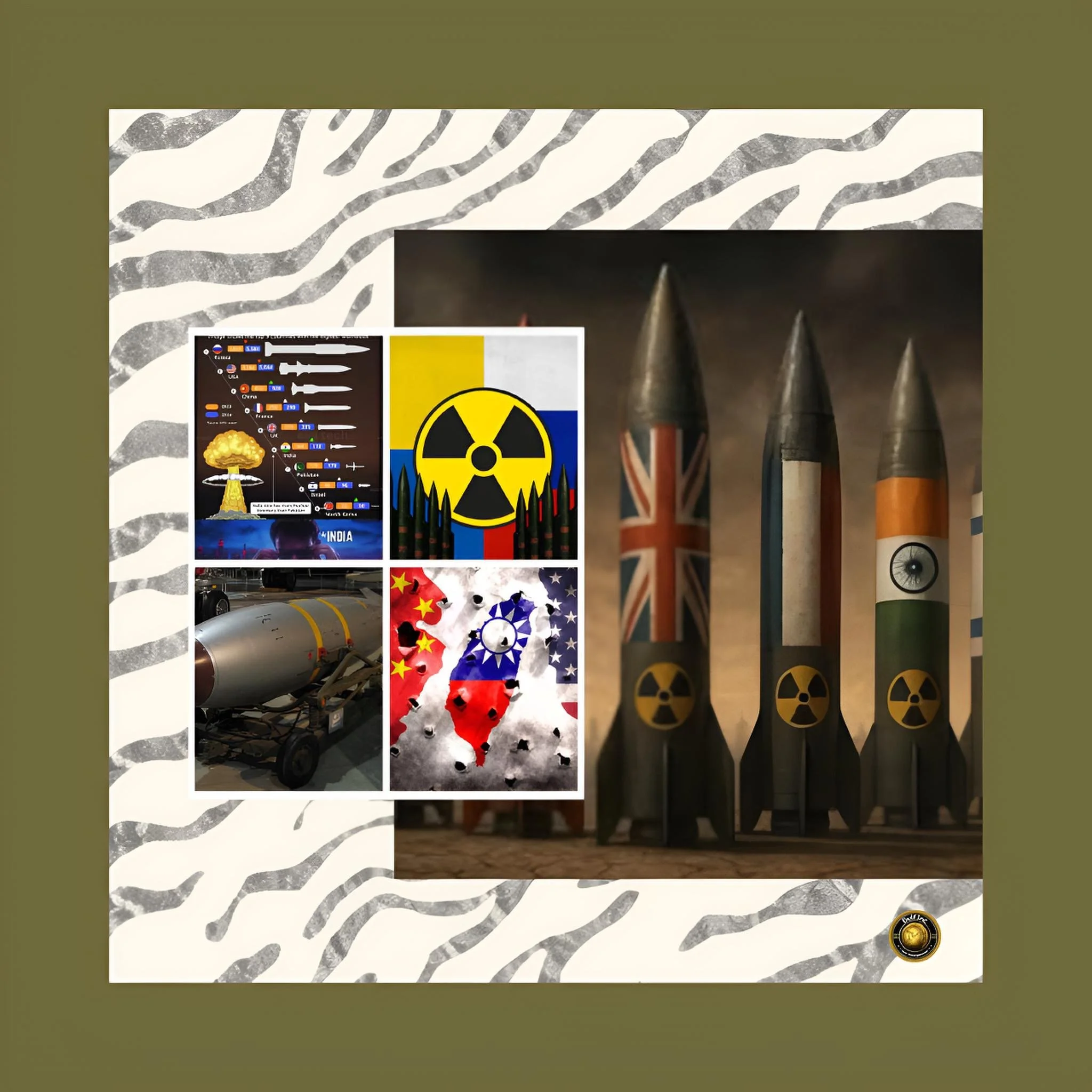
The United States maintains approximately 3,700 warheads—more than 20 times India’s arsenal and over six times China’s. This reflects America’s global commitments, extended deterrence obligations, and requirement to deter multiple peer adversaries simultaneously.
France and the UK pursue genuine minimum deterrence with approximately 290 and 225 warheads, respectively, sized to inflict unacceptable damage on any single adversary while remaining affordable.
China’s 600 warheads, growing rapidly toward 1,000-1,500, occupy a middle ground—larger than strict minimalism would require but still far below U.S. levels.
India’s 180 warheads represent the smallest arsenal among major nuclear powers, reflecting both its minimum deterrence philosophy and the fact that it faces regional rather than global threats.
These size differences reflect fundamentally different strategic philosophies.
The U.S. seeks flexible options across the spectrum of potential conflicts, requiring diverse capabilities for various scenarios.
France, the UK, China, and India embrace deterrence-by-punishment approaches focused on assured retaliation, requiring smaller arsenals.
First-Use Policies and Escalation Doctrines
Perhaps the starkest difference lies in first-use policies. The United States explicitly retains the option to use nuclear weapons first to defend vital interests or allies.
This policy reflects NATO’s historical reliance on the threat of nuclear escalation to deter Soviet/Russian conventional superiority.
France, while adhering to a defensive doctrine, maintains ambiguity about the circumstances that might trigger its use, with ultimate authority resting with the president.
China and India, by contrast, have embraced unconditional NFU pledges that constrain them to purely retaliatory postures.
These commitments reflect both normative positioning—presenting themselves as responsible nuclear powers—and strategic logic, given their conventional capabilities relative to likely adversaries.
The UK’s position is somewhat ambiguous, emphasizing the use “only in extreme circumstances” but not formally adopting NFU.
This flexibility preserves options for NATO nuclear sharing arrangements while maintaining alignment with U.S. extended deterrence concepts.
These differences in first-use policy have profound implications for crisis stability, escalation dynamics, and alliance relationships.
U.S. allies depend on the credibility of American nuclear escalation threats, while China and India must ensure their second-strike capabilities remain survivable despite adhering to NFU.
Escalation Management and Flexible Response
The United States stands alone in its systematic emphasis on escalation management as a central feature of nuclear strategy.
The requirement to develop “limited and graduated options” and to manage escalation favorably reflects Cold War flexible response concepts adapted to contemporary multi-adversary scenarios.
This approach requires not just large arsenals but diverse capabilities spanning strategic weapons, sub-strategic systems, and integrated non-nuclear forces.
France, the UK, China, and India give significantly less emphasis to escalation control.
Their deterrence strategies rest primarily on the threat of massive retaliation rather than calibrated escalation ladders.
France’s concept of a “warning shot”—a single demonstrative nuclear use to reestablish deterrence credibility—represents a limited escalation option.
Still, France lacks the diverse tactical nuclear capabilities characterizing the U.S. flexible response.
This difference reflects both strategic culture and practical constraints.
The U.S., facing multiple adversaries and extending deterrence globally, requires flexibility to address diverse scenarios.
Regional powers like China and India can rely more on existential deterrence—the sheer horror of nuclear war—to deter aggression.
Extended Deterrence and Alliance Dynamics
Extended deterrence—providing nuclear guarantees to non-nuclear allies—fundamentally distinguishes U.S. strategy from that of all other powers.
NATO’s nuclear sharing arrangements, with U.S. tactical weapons deployed in five European countries and deliverable by seven allied air forces, represent the most developed extended deterrence system.
Similar U.S. commitments extend to Japan, South Korea, and other Asia-Pacific partners.
France has begun exploring a potential European dimension to its nuclear forces, but this remains nascent and carefully hedged to preserve French sovereignty.
The Northwood Declaration envisions coordination between French and British forces but stops short of formal extended deterrence commitments to other European states.
No such arrangements exist or are contemplated in Asia.
China and India provide no extended deterrence, maintaining purely national nuclear postures.
This simplifies their deterrence requirements but also limits their strategic influence compared to the United States.
The extended deterrence function explains much of the complexity, cost, and political sensitivity of U.S. nuclear policy.
Allies demand credible commitments, requiring forward-deployed weapons, detailed planning, and integration of allied forces.
These arrangements also create nonproliferation benefits by convincing allies they need not develop their own nuclear weapons.
Modernization Priorities and Future Trajectories
All four nuclear powers are actively modernizing their arsenals, but with different priorities and timelines.
The United States pursues comprehensive modernization across all triad legs, command-and-control systems, and production infrastructure—a decades-long, multi-hundred-billion-dollar effort.
This reflects the requirement to maintain capabilities against sophisticated adversaries, as counterforce and missile defense systems improve.
France and the UK focus on maintaining credible minimum deterrents through submarine and warhead renewal. France is developing the SNLE-3G next-generation SSBN and ASN4G hypersonic air-launched missile.
The UK is building Dreadnought-class submarines and developing the Astraea warhead to reduce its dependence on the U.S.
Both countries face fiscal constraints that limit the expansion of their arsenals, focusing instead on survivability and penetration capabilities.
China’s modernization is most dramatic, involving the rapid expansion of arsenal size alongside the development of a complete triad.
New ICBM silo fields, advanced SSBNs, and nuclear-capable bombers are transforming China from a minimalist deterrent power into a peer nuclear competitor.
Whether this represents a permanent shift away from minimal deterrence or a temporary buildup to ensure survivability against improving U.S. counterforce capabilities remains debated.
India pursues measured modernization focused on ensuring a credible second-strike capability against both Pakistan and China.
Priority areas include SSBN development, longer-range land-based missiles, and potentially multiple independently targetable reentry vehicles (MIRVs) to penetrate missile defenses.
India’s modernization remains constrained by limited resources and commitment to minimum deterrence principles.
Regional Security Environments and Threat Perceptions
These differing strategies reflect distinct regional security environments.
The United States operates in a global security environment requiring simultaneous deterrence of Russia, China, and North Korea while assuring numerous allies.
This extraordinarily demanding scenario necessitates the most sophisticated and flexible nuclear posture.
European nuclear powers face a resurgent Russia that has repeatedly brandished atomic threats during its war against Ukraine.
Uncertainty about long-term U.S. commitment to European defense drives French and British discussions about enhanced nuclear cooperation and potential extension of nuclear guarantees to other European states.
China’s nuclear modernization responds to multiple concerns: improving U.S. conventional and nuclear capabilities, deteriorating U.S.-China relations, U.S. alliance commitments in Asia, and Chinese ambitions regarding Taiwan and regional influence.
The speed of China’s buildup suggests Beijing perceives its previous minimal arsenal as inadequate for contemporary deterrence requirements.
India faces the complex challenge of deterring Pakistan—which has developed tactical nuclear weapons and rejected NFU—while maintaining credible deterrence against a much larger Chinese arsenal.
This two-front nuclear challenge, unique among atomic powers, shapes India’s emphasis on diverse, survivable forces capable of credible retaliation against both adversaries.
Strategic Stability Implications and Future Challenges
The coexistence of these diverse nuclear deterrence strategies creates complex dynamics for global strategic stability.
Several trends raise particular concerns:
Erosion of Arms Control Architecture
The collapse of the INF Treaty, expiration of New START, and absence of agreements limiting Chinese or other arsenals have created an increasingly unconstrained nuclear environment.
The U.S.-Russia bilateral arms control framework that limited Cold War nuclear competition has not expanded to include China, despite Beijing’s rapid modernization.
Multipolar Deterrence Complexity
The U.S. faces unprecedented challenges deterring multiple nuclear adversaries simultaneously.
Cold War deterrence theory focused on bilateral U.S.-Soviet dynamics; contemporary requirements to deter Russia, China, and North Korea simultaneously, while assuring allies, create scenarios not well addressed by existing doctrine.
Escalation Risks in Regional Conflicts
The India-Pakistan dyad, characterized by low thresholds for conflict, tactical nuclear weapons, and short warning times, presents acute escalation risks.
Similarly, potential U.S.-China conflicts over Taiwan or the South China Sea could escalate to nuclear dimensions.
Unlike Cold War crises between superpowers, these regional nuclear scenarios may involve less sophisticated command-and-control systems, shorter decision timelines, and a greater risk of miscalculation.
Technology and Second-Strike Vulnerability
Emerging technologies—advanced sensors, artificial intelligence, hypersonic weapons, cyber capabilities—may threaten the survivability of second-strike forces that have underpinned strategic stability.
If concealment becomes impossible, the distinction between first-strike and second-strike forces could erode, creating dangerous “use-or-lose” dynamics.[tnsr]
Extended Deterrence Credibility
Doubts about U.S. extended deterrence commitments, particularly in Europe, have spurred discussions about autonomous European nuclear capabilities.
If allies lose confidence in U.S. guarantees, nuclear proliferation could accelerate as countries seek independent deterrents.
Integration of Non-Nuclear Capabilities
The blurring boundary between nuclear and non-nuclear forces complicates deterrence.
Precision conventional weapons capable of strategic effects, missile defenses that undermine second-strike confidence, and dual-capable delivery systems create ambiguity about adversaries’ intentions and escalation trajectories.
Conclusion
The nuclear deterrence strategies of the United States, Europe (France and the United Kingdom), China, and India represent fundamentally different approaches shaped by distinct strategic cultures, geopolitical positions, historical experiences, and resource constraints.
The United States pursues the most comprehensive strategy, maintaining flexible capabilities to deter multiple adversaries simultaneously while extending nuclear guarantees to allies across Europe and the Asia-Pacific.
France and the UK maintain credible minimum deterrents, with increasing coordination, to address European security concerns amid uncertainty about the long-term U.S. commitment.
China has rapidly expanded its arsenal while maintaining a no-first-use policy, transitioning from strict minimalism toward a more robust posture.
India pursues credible minimum deterrence with a massive retaliation doctrine to address the unique challenge of deterring both Pakistan and China.
These diverse approaches reflect both the specific security challenges each power faces and broader debates about the role of nuclear weapons in contemporary security.
The U.S. model demonstrates how global responsibilities and alliance commitments drive arsenal size and doctrinal complexity. European experiences reveal the persistent relevance of nuclear deterrence even in highly developed, economically integrated regions.
China’s evolution illustrates how rising powers reassess deterrence requirements as their global interests expand and threat perceptions shift.
India’s posture shows how regional powers can maintain effective deterrence with limited resources through careful force development and explicit doctrinal signaling.
Understanding these differences is essential for anticipating future nuclear dynamics, managing crisis stability, and developing arms control frameworks appropriate to an increasingly multipolar atomic world.
The coexistence of flexible deterrence, minimum deterrence, and no-first-use policies creates both challenges and opportunities for strategic stability.
As technology, geopolitics, and alliance relationships continue evolving, these nuclear strategies will adapt—requiring sustained attention from policymakers, strategists, and scholars committed to reducing atomic risks while maintaining effective deterrence.