Nigeria Mass Abductions: The Latest Incident and Pattern of Violence: The ISWAP abductors
Introduction
The cascade of kidnappings occurring within a single week in November 2025 represents the most severe security deterioration Nigeria has experienced since the 2014 Chibok abductions, with over 365 people abducted across four separate incidents between November 17-24, 2025.
This latest crisis exposes the fundamental vulnerabilities in Nigeria’s military and civilian security infrastructure while revealing a troubling convergence of criminal banditry, jihadist insurgency, and state weakness.
The Responsible Groups: A Complex Ecosystem of Armed groups.
Nigeria’s security challenges cannot be attributed to a single antagonist but rather emerge from a fragmented network of armed factions operating with different motivations yet increasingly coordinated in their tactics.
Understanding who is responsible requires examining distinct regional stakeholders.
Criminal Bandit Groups and Herder Militias
The most immediate perpetrators of the Kwara state kidnappings and the majority of recent abductions are fragmented criminal bandit networks estimated at approximately 30,000 fighters spread across northwestern Nigeria.
These groups evolved from resource disputes—particularly over cattle rustling and grazing rights—into organized criminal enterprises focused on kidnap-for-ransom operations.
The police characterization of the Isapa abductors as “herders” reflects this reality: many perpetrators are radicalized Fulani herdsmen who possess genuine grievances rooted in decades of farmer-herder conflicts but have weaponized these grievances to justify extortion and violence.
These bandits operate with relative sophistication, establishing forest hideouts in areas with porous borders (particularly Zamfara, Kebbi, and Kaduna states), using family and ethnic networks for recruitment, and conducting intelligence-gathering before raids.
Notably, approximately 40 percent of their abductions are motivated by ransom demands, creating a self-reinforcing cycle where successful kidnappings generate capital for weapons and recruitment.
Jihadist Groups: ISWAP and Boko Haram
The terrorist dimension adds a far more destabilizing element.
In the northeast, the Islamic State West Africa Province (ISWAP) has emerged as perhaps Nigeria’s most capable non-state military force.
ISWAP, which split from Boko Haram in 2015 when it pledged allegiance to the Islamic State, controls swaths of territory across Borno state and the Lake Chad Basin and has established a sophisticated governance structure that mimics Islamic State administration in Syria and Iraq.
ISWAP demonstrated its lethality in mid-November 2025 when its fighters ambushed and killed Brigadier General Musa Uba, the commander of Nigeria’s 25th Brigade, on November 15, 2025—just days before the school abductions began.
This assassination represents the highest-ranking officer killed since 2021 and signals ISWAP’s tactical evolution beyond simple insurgency toward coordinated military operations against infrastructure and leadership.
ISWAP’s tactical sophistication has accelerated dramatically in 2025.
Since January, the group has launched at least twelve coordinated attacks on military bases, exploiting the collapse of Nigeria’s “supercamp” counterinsurgency strategy by targeting bases at night, detonating surrounding roads to isolate them, and employing kinetic drone capabilities.
The group’s recent influx of foreign fighters—described as more ideologically rigid and militarily proficient—suggests heightened coordination with Islamic State core, which maintains ISWAP as its most successful regional affiliate through the Maktab al-Furqan (West Africa office).
The original Boko Haram faction (Jama’atu Ahlis-Sunna Lidda’Awati Wal-Jihad, or JAS) remains active, though overshadowed by ISWAP. Both groups claimed responsibility for the abduction of 13 girls in Borno state (November 23), with ISWAP executing the operation.
The critical distinction is that while Boko Haram traditionally operated on ideological grounds—fighting what it perceived as Western influence in education—both Boko Haram and ISWAP now employ abduction as a governance tool, using kidnapping-for-ransom to fund operations and using terror to assert state-like authority over populations.
Convergence and Cross-Border Dimensions
A particularly troubling development is the tactical alliance between criminal bandits and jihadist groups.
Since 2024, bandit networks have increasingly partnered with jihadist factions, receiving weapons, tactical training, ideological framing, and safe passage in exchange for logistical support and recruitment.
This convergence is exemplified by the Lakurawa network, a Mali-based armed group designated as terrorist by Nigeria in 2025, which maintains links to both ISIS-Sahel and Boko Haram while conducting operations across Sokoto and Kebbi states where the recent schoolgirl abductions occurred.
The porous borders connecting Nigeria to Niger, Cameroon, and Mali create critical vulnerabilities. Armed groups exploit these corridors for weapons trafficking, recruitment of foreign fighters, and operational planning.
The Shiroro cell—a Boko Haram enclave operating in Niger state near Abuja—represents Boko Haram’s furthest and most successful expansion outside its traditional Lake Chad Basin stronghold, positioning jihadist groups to directly threaten Nigeria’s center of power.
Historical Context: Parallels and Divergence from Chibok
The November 2025 abductions inevitably invoke comparison with the April 2014 Chibok kidnapping, when Boko Haram abducted 276 schoolgirls, generating the global #BringBackOurGirls movement and forcing Nigeria into international scrutiny.
Understanding what has changed—and what remains unchanged—is critical for assessing current dynamics.
Similarities
Both crises occur amid systemic security failures: schools remain insufficiently protected despite decades of militant attacks; military forces are overstretched and unable to prevent or rapidly respond to attacks; and governments prove incapable of immediately locating and rescuing abducted populations.
In 2014 as in 2025, the abductors operate in dense forest areas with terrain advantages and utilize horses or motorcycles for rapid deployment and extraction.
More troublingly, the abduction tactic has become normalized as a central strategy for armed groups.
According to the Armed Conflict Location & Event Data project (ACLED), over 85 abduction events targeting school children have occurred since the 2014 Chibok kidnapping, demonstrating how that attack, rather than deterring similar operations, instead emboldened replication.
The latest crisis marks the 13th mass kidnapping in 11 years, showing that Chibok was not an anomaly but rather the opening salvo in an ongoing siege against Nigeria’s educational infrastructure.
Critical Differences
However, the 2025 crisis differs in crucial ways from 2014:
The perpetrators of the recent abductions are predominantly motivated by ransom rather than ideology.
While Boko Haram targeted Chibok girls to prevent Western secular education, today’s bandits care little about the victims’ religion or gender—they abduct whoever they can most easily capture and monetize.
This shift from ideological to purely economic motivation actually creates a more intractable problem: ideologically committed groups can potentially be negotiated with or militarily defeated; economically motivated criminals operating in fragmented networks are far harder to disrupt through conventional counterinsurgency.
The scale and frequency have intensified dramatically.
The November 2025 incidents represent over 365 people abducted in a week compared to Chibok’s single 276-person operation, and this occurs within a context where thousands of abductions have already occurred.
The Unresolved Chibok Legacy
Critically, the Chibok crisis itself remains unresolved.
Of the original 276 girls, approximately 194 were eventually released through military operations or negotiation, but approximately 82 girls remain missing over a decade later, their fates unknown.
Amnesty International documented that at least 20 of the released girls were forced into marriage with former Boko Haram fighters as part of a questionable “rehabilitation” program by Borno state authorities—revealing how government reintegration efforts themselves have victimized survivors.
Parents of the remaining Chibok girls report feeling abandoned by government, with authorities providing minimal information about rescue efforts.
Meanwhile, the 2014 attack so traumatized communities that many parents remain reluctant to send children back to school a decade later, representing a generational education disruption.
This context of government failure and unresolved trauma provides psychological ammunition for contemporary abductions: communities already skeptical of protection can offer minimal resistance.
Geopolitical Implications: Nigeria’s Strategic Fragility
Nigeria’s security collapse possesses ramifications far beyond its borders, threatening both regional stability and global strategic interests
Energy Security and European Dependence
Nigeria possesses Africa’s largest hydrocarbon reserves and is positioned to become a critical energy supplier to Europe following the Russian invasion of Ukraine and European efforts to reduce energy dependence on Russian gas.
However, between 5 percent and 20 percent of Nigeria’s oil production is stolen daily through pipeline sabotage, while between 2018-2023, 7,143 documented cases of pipeline vandalism resulted in losses of $12.74 million worth of crude oil and 208.639 million barrels diverted through illegal channels.
The security crisis now threatens to further destabilize energy infrastructure, as militant groups controlling territory impede extraction and transportation operations.
Competing pipeline projects from Algeria and Morocco threaten to reshape regional energy geopolitics, but these remain contingent on Nigeria’s instability not driving investment to alternative suppliers.
Thus Nigeria’s internal security crisis directly translates into European energy vulnerability and strategic dependence on unstable suppliers.
Regional Destabilization and Sahel Spillover
The convergence of bandit and jihadist groups in northwest Nigeria mirrors and accelerates broader Sahel destabilization.
Mali, Burkina Faso, and Niger have experienced military coups and fragmentation of state authority over the past three years, creating ungoverned spaces that terrorist organizations exploit.
ISWAP’s presence in areas bordering Niger state and the porous Nigeria-Niger frontier means that instability flows bidirectionally—Nigerian militants establish bases in Niger, while Sahelian jihadist networks infiltrate Nigerian territory.
Russian military activity in Mali and Burkina Faso through the Wagner Group adds a geopolitical layer: if Russian-backed forces gain footholds in adjacent territories, they could exploit Nigeria’s fragmentation to expand influence and constrain Western strategic interests in West Africa.
Humanitarian Crisis and Displacement
Approximately 3 million Nigerians remain internally displaced due to ongoing violence, with over 10,000 killed since President Tinubu assumed office in 2023.
The November abductions join 1.8 million civilians already exposed to Boko Haram and ISWAP violence in Borno state alone.
Unlike localized conflicts, Nigeria’s multi-theater security breakdown threatens to generate cascading displacement across north and central regions, destabilizing even southern urban centers as migrants flee violence.
The humanitarian toll extends to education: entire generations in affected regions grow up outside formal schooling due to parent fears, reducing human capital formation and perpetuating poverty cycles that insurgents exploit for recruitment.
Designation as “Country of Particular Concern”
In October 2025, the Trump administration redesignated Nigeria as a “Country of Particular Concern” under the International Religious Freedom Act, signaling diplomatic escalation.
Congressional testimony framed Nigeria as “ground zero” for extremist violence targeting Christians, with groups including Boko Haram, ISIS-West Africa, and radicalized Fulani militants conducting sustained campaigns of killing and abduction often with religious motives.
This designation carries diplomatic consequences and could influence bilateral relations and military aid allocations.
Current Hostage Status and Rescue Efforts
St. Mary’s Catholic School (Main Crisis)
As of November 24, 2025, the situation at St. Mary’s Catholic School in Niger state represents the most pressing hostage crisis:
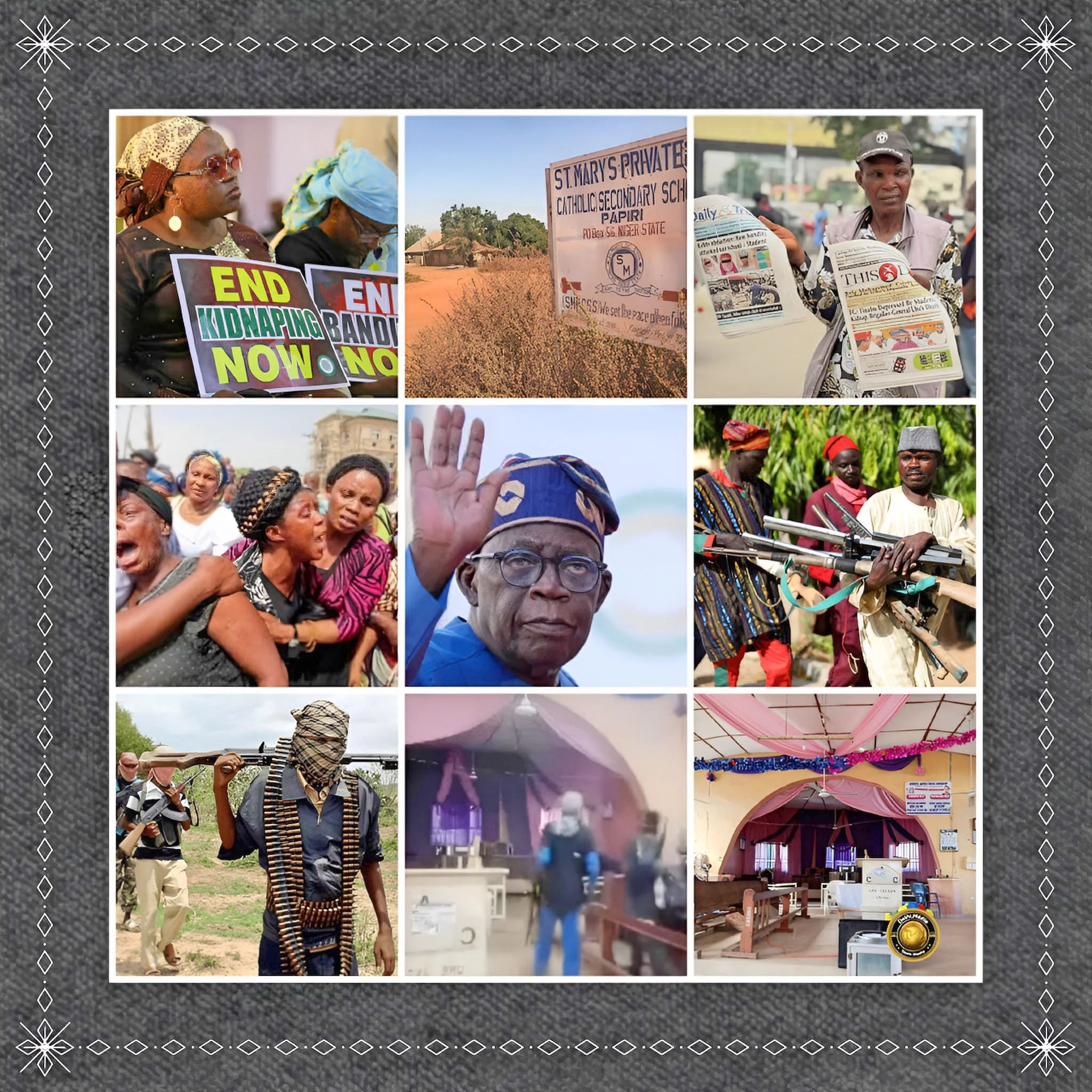
Originally, 303 students (ages 10-18) and 12 teachers were abducted on Friday, November 21.
Between Friday evening and Saturday evening, approximately 50 students managed to escape individually, leaving 253 students and 12 teachers (265 total) still in captivity.
No group has claimed responsibility, and no ransom demands have been made as of November 24—an unusual silence that security analysts find concerning, as it suggests perpetrators may be negotiating behind closed scenes or planning further operations.
The Catholic Bishop of the region issued a scathing statement on November 25, declaring that the government was making “no meaningful effort” to rescue the abducted children, contradicting government assertions of active search operations.
Police indicated that search operations involve “intelligence efforts” and “intensified operations,” but provided no specifics on rescue timelines or operational plans.
Pope Francis issued a formal appeal for the children’s immediate release, adding international pressure to the crisis.
Kebbi State - Secondary Incidents
The 25 schoolgirls abducted from Maga town in Kebbi state (November 17-18) remain missing with ongoing search operations yielding no results. The 13 girls kidnapped from Borno state (November 23) by ISWAP are similarly unaccounted for.
However, a positive development occurred in Kwara state, where 38 worshippers abducted during a church attack on November 18 were released by November 23, suggesting that some groups respond to government pressure or successfully negotiate ransoms.
ISAPA-Kwara Sate Incidents
Third incident (November 24)
The 10-11 women and children taken from Isapa in Kwara state occurred just one week after an earlier church attack in the same region that resulted in at least 35 people being abducted (who have since been released) and two fatalities.
Borno State -Kidnappings
There were also reports of other abductions in the same period, including 13 girls in Borno state to the east.
No group has claimed responsibility for the St. Mary’s kidnapping despite four days passing since the incident, and notably, no ransom demands have been made so far.
Military Transformation and Government Response
President Tinubu canceled his attendance at the G20 summit in South Africa to address the escalating crisis—a rare signal of priority at the highest level. His administration announced several measures:
A directive to withdraw police assigned to VIP protection and redeploy them to core policing duties targeting vulnerable communities. Plans were announced to recruit 30,000 additional police officers to bolster stretched security forces.
Niger state preemptively closed all schools following the St. Mary’s abduction as a protective measure.
However, these responses address symptoms rather than root causes.
Nigeria’s military strategy has fundamentally broken down: the “supercamp” system established in 2019 as a centerpiece of counterinsurgency—consolidating forces in fortified bases—has become a strategic liability, with ISWAP repeatedly overrunning these bases through coordinated assaults.
Military leaders acknowledge deterioration, with Borno State Governor Babagana Zulum warning in May 2025 that ISWAP now exercises “total control” over multiple local government areas including Marte, home to over 300 towns and villages.
International support continues through UK-Nigeria defense partnerships focusing on special operations training, counter-terrorism capacity building, and maritime security, but these technical upgrades cannot compensate for the fundamental absence of political will and strategic coordination.
Structural Drivers: Why Abductions Persist
Understanding why these crises recur despite military deployments and government responses requires examining root causes:
Poverty and Unemployment
Deep economic marginalization in Nigeria’s north drives recruitment into armed groups. Young men with minimal employment prospects find compensation and status in bandit networks, while geographic isolation and weak governance mean few alternative livelihood pathways exist.
The mining of gold, copper, and lithium in Zamfara and adjacent areas has enriched some criminal networks, creating visible wealth that attracts recruits.
Weak Governance and Corruption
Police and military corruption undermines operations: intelligence leaks warn abductors of impending raids; military commanders redirect resources; and security forces themselves sometimes collude with bandits to extort payments from communities.
The absence of functioning judicial systems means captured perpetrators face minimal consequences, further reducing deterrence.
Terrain and Cross-Border Safe Havens
Dense forests in border regions provide natural sanctuaries where conventional military operations prove ineffective.
Cross-border access to Niger, Cameroon, and Mali allows militants to evade pursuit and establish rear bases beyond Nigerian military jurisdiction.
Amnesty Programs and Reintegration Failures
Paradoxically, government amnesty programs for repentant militants have enabled continued violence.
Fighters who surrender often retain weapons, retain influence over subordinates, and rejoin militant networks after disbursement funds deplete.
Former combatants integrate back into communities but sometimes exploit local positions to conduct subsequent kidnappings or facilitate abductions.
Conclusion
Strategic Outlook: Trajectory and Implications
Nigeria faces a security crisis of unprecedented scale and complexity. Unlike the single 2014 Chibok incident, the November 2025 abductions represent a systemic breakdown where multiple armed actor categories simultaneously intensified operations.
The convergence of economically-motivated bandits and ideologically-driven jihadists creates a multi-vector threat that conventional military responses have repeatedly failed to contain.
The critical question confronting Nigerian leadership and international partners is whether this represents a cyclical spike amenable to temporary military surges, or structural state collapse requiring comprehensive restructuring of governance, security architecture, and developmental programs.
Historical trajectory suggests the latter: despite military operations, international support, and government announcements, violence has accelerated rather than declined, abduction tactics have proliferated across regions, and military forces have suffered unprecedented losses against non-state actors.
Without fundamental institutional reform addressing governance, corruption, and economic marginalization—reforms that require political will beyond what current administrations have demonstrated—Nigeria’s security crisis will likely intensify, with abductions becoming normalized as a tool of both criminal profit-taking and jihadist governance, threatening education systems, regional stability, and global energy security.