Israel-Syria Relations: Strategic Provocations, Competing Visions, and the Fragility of Trump’s Regional Architecture
Introduction
The Strategic Context: Netanyahu’s Deliberate Provocation
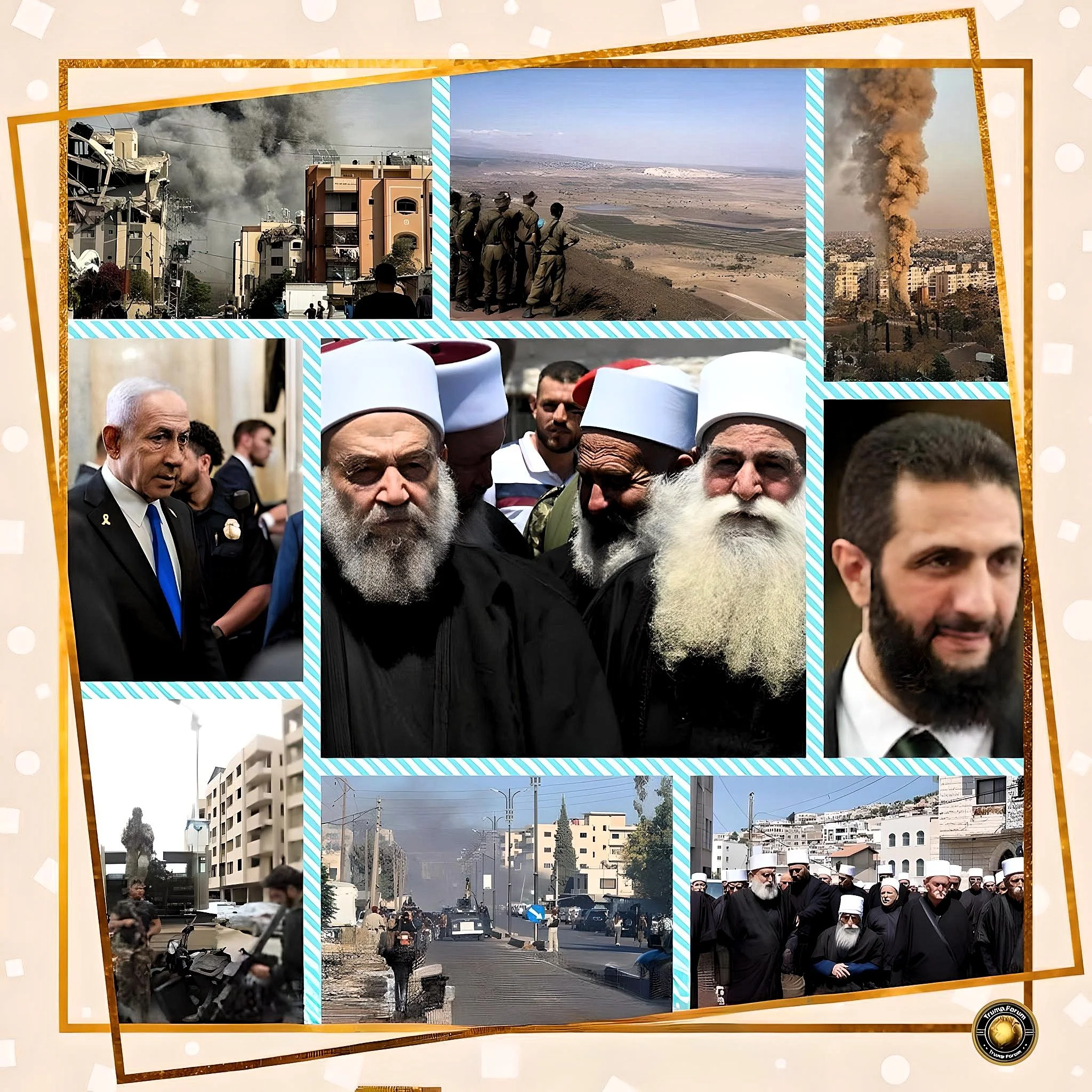
Netanyahu’s November 19 visit to the Israeli-controlled Syrian buffer zone was strategically calculated rather than incidental.
The timing—occurring just nine days after Syrian President Ahmed al-Sharaa’s historic White House meeting with President Trump and two days after reports that Israel-Syria security negotiations had reached a “dead end”—reveals a deliberate signal of Israeli intransigence at a critical diplomatic juncture.
Netanyahu’s high-profile deployment alongside Defense Minister Israel Katz, Foreign Minister Gideon Sa’ar, IDF Chief of Staff, Shin Bet director, and the Israeli Ambassador to the United States underscored that this was a message to both Damascus and Washington, not a routine military inspection.
The visit constitutes what international relations scholars would classify as a “fait accompli” strategy—using military facts on the ground to narrow the negotiating space and foreclose diplomatic options.
As one Israeli analyst noted, Netanyahu’s assertion that Israel’s military presence in Syria is of “immense importance” served to signal permanent entrenchment despite international and American pressure for withdrawal.
The Israel-Syria Impasse: Three Fundamental Demands
Israel’s negotiating position rests on three interconnected demands that reveal expansionist ambitions exceeding the defensive rationale publicly articulated:
First, extensive demilitarization
Israel demands a demilitarized zone extending from Damascus southward to the Jordanian border and eastward approximately 30 kilometers into the Hauran region—encompassing roughly 400 square kilometers of Syrian territory.
This zone would exclude “no heavy weapons and no substantial armed presence” beyond elemental law enforcement forces, whether from the Syrian regime, local militias, or Iranian-backed troops.
This demand effectively grants Israel veto power over Syria’s internal security architecture.
Second, a permanent military footprint on Mount Hermon
Israel insists on maintaining permanent IDF positions atop Mount Hermon, which provides strategic intelligence collection capabilities overlooking Damascus and the southern Syrian basin.
Defense Minister Israel Katz’s March 2025 statement regarding the indefinite Israeli occupation of these positions indicates this represents a permanent claim rather than a temporary security measure.
Third, a humanitarian corridor to the Druze territories
Israel demands a land corridor from the occupied Golan Heights to Syrian Druze communities around Suwayda (approximately 80 kilometers from the Israeli border), where roughly 500,000 Druze reside.
This corridor would facilitate Israeli aid transfers and establish Israeli protective commitments.
Analysts assess this demand as politically motivated to curry favor with Israel’s Druze population ahead of elections rather than based on genuine humanitarian necessity.
Al-Sharaa’s Legitimate Demands: International Law and Sovereignty
Ahmed al-Sharaa’s negotiating position represents adherence to established international legal frameworks and UN resolutions rather than maximalist ambitions. His core demands reflect Syria’s legitimate sovereignty:
The 1974 Disengagement Agreement is a binding law
Al-Sharaa has insisted that Israel comply with the 1974 Agreement on Disengagement between Israel and Syria, which established a UN-monitored buffer zone separating Israeli and Syrian forces.
This agreement was not invalidated by Assad’s fall; it remains a binding United Nations Security Council resolution that establishes Syrian sovereign rights.
Israel’s claim that the agreement became void upon regime change is legally indefensible under international law, which holds that treaties between states endure regardless of changes in government.
The 1967 borders as a legitimate baseline: Al-Sharaa’s demand that Israel withdraw to the “December 8 line”—the 1974 ceasefire boundary—represents a restoration of the status quo ante, not territorial expansion.
This position aligns with UN Security Council Resolutions 242 (1967) and 338 (1973), which stress “the inadmissibility of the acquisition of territory by war” and mandate Israeli withdrawal from occupied territories.
The UN General Assembly reinforced this in December 2024, voting 97-8 with 64 abstentions to demand Israel’s withdrawal to the 1967 borders.
No normalization without territorial resolution: Al-Sharaa explicitly ruled out direct negotiations or normalization with Israel while occupation persists.
In a Fox News interview, he stated Syria’s situation differs fundamentally from Abraham Accords signatories because “Israel occupies our land”—a factually accurate legal distinction.
This position reflects neither intransigence nor rejection of coexistence, but rather adherence to the principle that peace agreements cannot legitimize territorial acquisition through force.
International Legal Assessment: Syria’s Position is Unambiguous
The legitimacy of Syria’s demands finds overwhelming scholarly and institutional support:
The International Court of Justice affirmed in its 2024 advisory opinion that territories cannot be acquired through force and that occupation in violation of Article 2(4) of the UN Charter remains unlawful regardless of security justifications.
The ICJ explicitly rejected Israeli claims that disputed territory status or absence of prior international recognition obviates occupation law’s applicability
UN Security Council and General Assembly resolutions consistently affirm that Israeli settlements and territorial control in occupied lands lack legal validity.
UN Resolution 2799 specifically reaffirmed Syria’s sovereignty, independence, and territorial integrity following Assad’s fall—a direct refutation of Israeli claims of expanded occupation justified by governmental transition.
Multiple legal scholars conclude Israel’s expansion into the UN buffer zone established by UNSC resolution violates binding international obligations.
As one comprehensive legal analysis concluded: “Israel’s actions not only constitute an unlawful occupation of Syrian territory but also amount to a violation of a binding UNSC resolution.”
Buffer zone territory “shall revert to the then-existing Syrian government” once international agreements are reinstated.
Trump’s Arab World Commitment: Ambitions Exceeding Capacity
Trump’s stated commitment to “peace and stability” in the Middle East contains internal contradictions that undermine its credibility:
Stated objectives
Trump has publicly committed to implementing his Gaza peace plan, which envisions demilitarization with international stabilization forces, gradual Israeli withdrawal, and Palestinian governance pathways.
He has publicly emphasized that regional peace requires addressing Gaza and Palestinian statehood—preconditions that Saudi Arabia emphasizes for normalization.
Operational constraints
Yet Trump’s actual leverage over Israel remains limited by political considerations.
The Trump administration has demonstrated reluctance to constrain Israeli military actions; Trump “occasionally calls for ending the conflict in Gaza” but has not exercised necessary leverage, and his Gaza proposals show alignment with “more extreme Israeli positions”.
Trump’s symbolic recognition of al-Sharaa and lifting of Syrian sanctions represent a warming engagement, but stop short of constraining Israeli incursions.
The Saudi complication
Trump’s courtship of Saudi Crown Prince Mohammed bin Salman (MBS) for the expansion of the Abraham Accords reveals the administration’s strategic priorities.
MBS explicitly conditioned Saudi normalization on “a clear path toward a two-state solution” and ruled out normalization while Israeli-Palestinian and Israeli-Syrian disputes remain unresolved.
Yet Trump simultaneously appears willing to sell advanced F-35 fighter jets and provide security commitments independent of Palestinian or Syrian territorial resolution.
The contradiction exposed
This reveals Trump’s implicit hierarchy: deepening US-Saudi strategic partnership and expanding Abraham Accords signatory states appear prioritized over enforcing territorial integrity for Syria or Palestine.
The administration is pursuing what Middle East analysts describe as “commerce over chaos” and “technological investment over ideological confrontation”—a framework that tolerates ongoing Israeli territorial expansion provided it doesn’t destabilize U.S. strategic relationships.
What Netanyahu Seeks: Territorial Consolidation Beyond Defensive Rationale
Netanyahu’s actual objectives extend beyond the publicly articulated “border security” framing:
Strategic territorial depth
The three-layered Israeli demands
(1) extensive demilitarization
(2) Mount Hermon occupation
(3) Humanitarian corridor
Netanyahu's objective above relates to effectively creating a security perimeter extending 30+ kilometers into Syria, providing strategic depth and intelligence dominance over the southern Levant.
This exceeds defensive necessity and approaches strategic expansionism.
Druze populations as a geopolitical asset
Israel’s emphasis on “protecting Druze allies” and the humanitarian corridor demands the instrumentalization of minority populations.
As analysts note, this echoes past Israeli strategy of exploiting communal divisions to justify military presence.
Netanyahu’s visit specifically included outreach to reserve soldiers, indicating domestic political signaling regarding the protection of Israel’s Druze minority ahead of elections.
Golan Heights creeping annexation
Netanyahu’s rhetoric incisively positions the Golan as a temporary occupation but permanent Israeli territory.
Combined with the expansion into the buffer zone, this represents what accountability organizations describe as “creeping annexation”—expanding Israeli-controlled territory incrementally through military fact-creation.
Defense Minister Israel Katz’s explicit statement regarding indefinite occupation indicates a policy framework supporting permanent retention.
Prevention of Iranian influence but advancement of Israeli expansion
While framed around Iran containment, Israel’s demands would establish a permanent Israeli military capability to intervene throughout southern Syria—effectively granting Israel a de facto security sphere of influence extending to Damascus’s suburbs.
The Geopolitical Trilemma: Incompatible Objectives
The current situation reflects three mutually incompatible objectives:
Trump’s stabilization vision
Requires Israeli-Syrian security arrangements that enable Syrian territorial integrity, regional de-escalation, and reconstruction that support al-Sharaa’s legitimacy.
Netanyahu’s security maximalism
Demands extensive Israeli military presence, territorial depth, and veto power over Syrian military architecture—predicated on Israeli unilateral control of security arrangements.
Al-Sharaa’s sovereignty requirement
Necessitates Israeli withdrawal to 1974 boundaries, restoration of Syrian territorial control, and security arrangements respectful of Syria’s status as an independent nation rather than an Israeli security appendage.
These are not subject to compromise through creative negotiation.
Netanyahu’s demand for Israeli military presence in Damascus’s strategic vicinity cannot coexist with Syria’s sovereignty requirements.
Trump cannot simultaneously enforce international law, advance Israeli security demands, and achieve the regional stability necessary for Saudi normalization.
The Probable Trajectory: Strategic Stalemate
The failed negotiations indicate the trajectory: Israel maintains military occupation as a permanent fait accompli while Syria refuses normalization, creating an indefinite frozen conflict.
Trump’s approach of lifting sanctions and seeking Syrian-Saudi normalization while tolerating Israeli expansion effectively signals to Netanyahu that military consolidation carries no diplomatic costs.
UN Secretary-General expressed concern that Netanyahu’s visit threatened Syria’s fragile transition. Russia and regional states have issued warnings about the risks of escalation.
The situation represents a classic security dilemma where Israeli security measures—from Syria’s perspective—constitute threats requiring counter-mobilization, potentially destabilizing al-Sharaa’s nascent regime.
Conclusion
The Limits of Trump’s Arab World Stability Commitment
Trump’s commitment to Arab world stability remains rhetorical rather than operationalized.
His administration has demonstrated a willingness to:
(1) Accept Israeli territorial expansion beyond the 1967 boundaries when justified through security framing.
(2) Prioritize the U.S.-Saudi strategic partnership over enforcing Syrian territorial integrity.
(3) Employ a selective Syria engagement for regional balancing without constraining Israeli incursions.
(4) Condition Arab normalization on Palestinian pathway provisions while tolerating Israeli expansion that forecloses such pathways
For al-Sharaa and Syria, this signals that international law protecting territorial integrity and Trump’s strategic interests align only contingently.
Netanyahu’s visit and continued Israeli presence represent the fundamental message: territorial concessions must precede recognition, contradicting both international law principles and Trump’s stated emphasis on regional stability.
The Abraham Accords expansion and Saudi defense cooperation may proceed regardless of Syrian resolution—subordinating Syrian sovereignty to broader U.S. strategic architecture.
The trajectory suggests Netanyahu’s strategy is succeeding: military consolidation creates facts on the ground that Trump’s broader Middle East strategy cannot afford to reverse, while Syria faces indefinite occupation under the cover of “security requirements”.