China’s Renewable Energy Hegemony and the Geopolitical Restructuring of Global Power Dynamics
Executive Summary
China’s renewable energy deployment has evolved from a climate policy initiative into a sophisticated geopolitical strategy that fundamentally reconfigures global energy architecture and competitive dynamics.
By synthesizing unprecedented renewable capacity expansion with comprehensive supply chain monopolization, China is constructing what scholars characterize as a “green fortress”—a system that simultaneously addresses energy security vulnerabilities, establishes technological dominance, and expands influence across the Global South.
This trajectory represents a watershed moment in international relations wherein clean energy manufacturing supplants fossil fuel extraction as the primary determinant of geopolitical leverage.
The Phenomenological Scale: An Unprecedented Energy Transition
China’s renewable energy expansion has entered a phase of velocity unprecedented in industrial history.
During the first half of 2025 alone, China deployed 260 GW of combined wind and solar capacity, constituting a near-doubling of the installation pace from the corresponding 2024 period.
The disaggregated metrics reveal the asymmetric acceleration: solar installations increased 107.1 percent year-on-year to 210 GW, while wind power additions expanded 98.9 percent to 50 GW.
Projections for the complete 2025 calendar year indicate approximately 600 GW of new renewable capacity deployment, with total installed renewable capacity reaching approximately 1,680 GW by year-end. China’s total installed generation capacity is forecast to attain 3.9 terawatts, representing a 16.5 percent increase from 2024 levels.
These metrics acquire particular salience when contextualized against global comparisons: China’s planned 2025 renewable addition exceeds the entire cumulative installed solar capacity of Germany by a factor of approximately three.
The most historically significant milestone occurred in the first half of 2025: renewable energy generation (5,072 terawatt-hours) surpassed coal generation (4,896 terawatt-hours) for the first time in China’s developmental history.
Renewables now constitute approximately 41.4 percent of China’s total electricity generation, a trajectory that diverges dramatically from the stasis that characterized global renewable integration through 2020.
The “3060” Architecture and Strategic Policy Instruments
China’s renewable expansion operates within a formalized policy architecture articulated through the dual-carbon objectives.
President Xi Jinping’s 2020 commitment to peak carbon emissions before 2030 and achieve carbon neutrality by 2060—the “3060” goals—establishes both international moral authority and domestically binding policy directives.
This framework integrates renewable deployment with macro-structural economic transformation.
The 15th Five-Year Plan (2026-2030) represents the operational embodiment of these long-term objectives. The plan targets annual renewable energy capacity additions of 200-300 GW, fundamentally exceeding historical precedent.
Wind power capacity is projected to reach 1.3 terawatts by 2030, with aggregate solar and wind capacity attaining 3.6 terawatts by 2035. Offshore wind installations are stipulated to contribute a minimum of 150 GW during the 2026-2030 period.
The strategic architecture incorporates technological integration across domains.
Grid modernization, articulated through AI-driven predictive maintenance and autonomous operations systems, aims to achieve widespread AI application in energy systems by 2027 with global leadership in AI-energy integration by 2030.
The “East Data, Western Computing” initiative exemplifies this integration, positioning energy-intensive artificial intelligence data centers in western regions abundant in renewable resources, creating what analysts term an “energy moat” unavailable to Western competitors.
Flagship Infrastructure: Scale and Innovation Architecture
The Talatan Solar Complex: Geographical Optimization and Land Integration
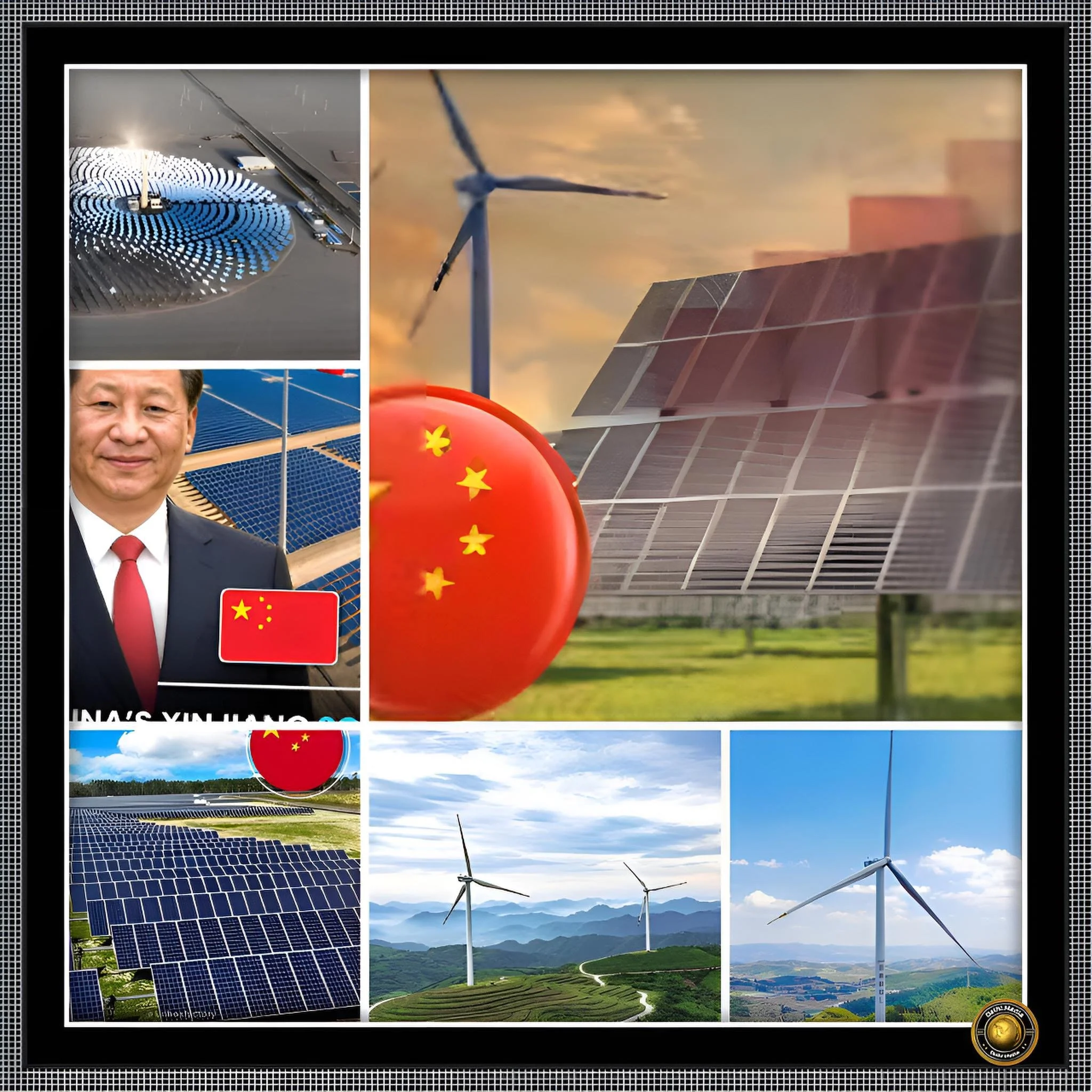
The Talatan Solar Park in Qinghai Province represents the apotheosis of China’s renewable deployment strategy.
Spanning 610 square kilometers—approximately equivalent to the territorial footprint of Chicago—and housing over 7 million solar panels, the facility constitutes the world’s largest operational solar installation.
The projected capacity of 16,930 megawatts will supply electrical power to approximately 5 million households.
The project demonstrates algorithmic land-use optimization through the “photovoltaic sheep” system. Vegetation cultivation proceeds beneath solar panels while ovine herds graze in the shade, simultaneously reducing wind erosion while maintaining pastoral land utilization.
This exemplifies sophisticated resource externality internalization—traditional environmental degradation vectors (wind erosion) are reframed as operational inputs within an integrated agro-photovoltaic system.
The location on the Tibetan Plateau at high altitude provides a critical competitive advantage.
Atmospheric rarefaction increases solar irradiance intensity, resulting in solar electricity generation costs approximately 40 percent below coal-generated power.
This cost advantage reflects accumulated technological optimization rather than temporary subsidy mechanisms, establishing structural competitive positioning against coal-based generation.
Molten Salt Thermal Energy Storage: Dispatchability Architecture
China’s commissioning of the Anhui Suzhou Power Plant molten salt thermal energy storage facility in August 2025 represents a technological inflection point in renewable energy integration.
The 1,000 megawatt-hour storage capacity represents China’s largest integrated thermal storage system. The system operates utilizing molten salt circulation between 390°C and 190°C temperature differentials, enabling four to five hours of continuous thermal energy supply during peak demand periods.
The operational parameters demonstrate consequential emissions reduction pathways: the facility will annually store 128 million kilowatt-hours of newly integrated renewable energy, reduce standard coal consumption by 32,000-60,000 tonnes, and eliminate approximately 85,000 tonnes of annual carbon dioxide emissions.
Unlike lithium-ion battery storage systems with fixed temporal discharge profiles, molten salt thermal energy storage decouples thermal generation from electrical generation timing, providing operational flexibility that compensates for renewable intermittency through thermal buffering mechanisms.
Emissions Trajectory: Accelerated Peaking or Strategic Plateau?
Recent empirical data indicates that China’s carbon dioxide emissions have achieved stabilization or peaking—a development that potentially occurs three to seven years earlier than the explicit 2030 target.
According to Climate Action Tracker assessment, China’s emissions were flat or declining for 18 consecutive months spanning March 2024 through the third quarter of 2025. The first-half 2025 period recorded a year-on-year decline of approximately 1 percent.
Aggregate emissions estimates suggest stabilization levels between 15.1-15.2 gigatonnes of CO₂ equivalent in 2025, marginally below the estimated 15.2 gigatonnes recorded in 2024.
Climate Action Tracker’s conservative scenario projects continued annual declines of approximately 0.5 percent through 2030, conditional upon sustained renewable deployment and reduced coal commissioning.
However, this narrative of climate acceleration obfuscates consequential contradictions.
China’s 2025 carbon-intensity reduction target—requiring approximately 4 percent absolute emissions reductions—appears likely to achieve only 1 percent or less.
During the 14th Five-Year Plan period (2020-2025), carbon intensity has declined merely 5 percent against a target of 18 percent, indicating systematic underperformance against domestic climate intensity commitments.
The fundamental tension emerges starkly: simultaneous acceleration of renewable deployment and continued coal power plant construction.
The first quarter of 2025 saw 11.29 gigawatts of new coal power capacity approvals, following 2024 data indicating 94.5 gigawatts of coal plant construction starts—a 10-year high.
This reflects not policy inconsistency but deliberate transitional strategy: renewable energy development enables gradual replacement of coal import dependency while domestic coal maintains baseload power generation during the energy transition interval.
Supply Chain Monopolization: The Architecture of Geopolitical Leverage
Solar Photovoltaic Production Monopoly
China’s control of solar photovoltaic supply chains has attained levels of concentration unprecedented in manufacturing sectors.
China currently manufactures and supplies between 80-95 percent of the global solar photovoltaic panels across all production phases.
This dominance extends to fundamental component manufacturing: China is projected to achieve 95 percent control of essential manufacturing processes by 2025.
The magnitude of this monopoly acquires comprehensibility through comparative scale: China currently supplies over 95 percent of solar panels utilized throughout the European Union.
The International Energy Agency’s comprehensive analysis identifies cost as the determinant factor sustaining this monopoly: China’s manufacturing costs represent 10 percent reductions relative to India, 20 percent advantages versus United States production, and 35 percent cost differential compared to European manufacturing.
These cost advantages reflect accumulated institutional infrastructure rather than ephemeral labor arbitrage—establishing what scholars describe as a “structural competitive advantage” resistant to short-term Western policy interventions.
The mechanisms sustaining Chinese solar dominance extend beyond production efficiency.
The Chinese government invested approximately $50 billion in solar photovoltaic supply capacity expansion over the preceding decade—representing tenfold greater investment than the combined European allocation.
This strategic capital concentration enabled manufacturing at unprecedented scale, driving 80+ percent cost reductions across the preceding decade and establishing competitive positioning that alternative suppliers encounter difficulty replicating.
Rare Earth Elements and Permanent Magnet Dominance
Critical minerals constitute an ancillary but strategically essential dimension of China’s renewable energy monopolization.
China controls approximately 65 percent of global rare earth mining and a staggering 88 percent of refined rare earth processing capacity.
Magnet production—essential for high-efficiency wind turbine generators—remains concentrated at over 90 percent within Chinese manufacturing facilities.
This vertical integration from ore extraction through finished magnet production establishes multiple dependency points that Western competitors struggle to replicate.
Morgan Stanley analysis demonstrates that China’s processing monopoly creates the critical bottleneck in global supply chains: alternative processing capacity would require years to develop, with China’s current processing capacity (220,000 tonnes annually) exceeding the combined capacity of all remaining global producers by fivefold.
The strategic weaponization of rare earth export restrictions has expanded substantially.
China recently broadened export controls to encompass 12 of 17 rare earth elements critical for renewable energy technologies, creating leverage mechanisms over Western clean energy transition timelines.
This control directly constrains global renewable energy expansion independent of manufacturing capacity or technological capability.
Downstream Integration: Manufacturing and Technology Advancement
China’s technological trajectory within renewable energy manufacturing exhibits systematic advancement beyond mere capacity expansion.
China currently accounts for 95 percent of announced next-generation N-type solar cell capacity expansions globally. While overseas competitors focus capacity expansion on existing polycrystalline technology, China simultaneously pursues rapid technological upgrade toward advanced photovoltaic architectures, progressively widening the competitive gap.
This technological differentiation ensures that Chinese renewable products maintain cost and performance advantages that transcend simple labor cost considerations.
The cumulative effect establishes a structural competitive moat wherein alternative supply chain development requires not only capital investment but concurrent technological advancement—a dual requirement that most Western economies lack capacity to simultaneously satisfy.
Energy Security and Strategic Autonomy: The Fortress Geopolitics
China’s renewable energy expansion fundamentally addresses historical vulnerability: energy import dependency via contested maritime routes.
By achieving energy self-sufficiency exceeding 85 percent by end-2024 through domestic renewable, hydroelectric, and nuclear sources, China neutralizes a fundamental geopolitical weakness.
This strategic insulation generates profound foreign policy implications—China can engage in maritime disputes ranging from the South China Sea to the Red Sea with reduced vulnerability to energy supply disruptions.
The integration of renewable energy with artificial intelligence infrastructure exemplifies this autonomy architecture.
The “East Data, Western Computing” initiative mandates that data centers in national hub regions source at least 80 percent of electricity from renewables by 2030.
This policy framework creates an “energy moat” that provides stable, scalable artificial intelligence infrastructure unavailable to U.S. competitors, who encounter fragmented energy policies and limited renewable resource integration within data center operations.
The Belt and Road Initiative and Global South Influence Architecture
Renewable Deployment and Market Capture
Chinese renewable energy deployment through the Belt and Road Initiative has catalyzed energy infrastructure transformation across developing economies.
By end-2024, cumulative capacity of China’s completed overseas power projects under the BRI reached 156 GW, representing an investment allocation totaling approximately $281 billion across 369 international projects.
During 2024 alone, Chinese firms installed a record 24 GW of energy capacity across BRI participating countries—the highest annual volume since the initiative’s 2013 inception.
The composition of these deployments reveals strategic prioritization: 52 percent comprised renewable technologies (including 8 GW of solar and 5 GW of hydroelectric capacity), while 48 percent consisted of thermal power projects.
The renewable concentration in project pipelines has intensified: contemporary project planning indicates that renewables constitute over two-thirds of the forward development pipeline.
Market Share Consolidation and Strategic Positioning
The market penetration velocity among BRI participants exemplifies strategic dominance consolidation.
Chinese companies accounted for merely 7 percent of wind and solar capacity installations within the five largest BRI markets (Pakistan, Indonesia, Vietnam, Saudi Arabia, Malaysia) five years prior.
By 2024, this share had escalated to 60 percent, with projections indicating potential escalation to 80 percent by 2030 contingent upon continued deployment momentum.
This market share consolidation reflects not merely superior financing capacity but the availability of cost-competitive renewable technology coupled with flexible financing mechanisms.
Where Western climate finance institutions impose requirements perceived as onerous, Chinese development institutions offer expedited project cycles and simplified procurement mechanisms.
Saudi Arabia exemplifies this dynamic: the kingdom anticipates renewable energy installation of 41 GW of solar and 13 GW of wind power during the subsequent decade, with Chinese companies providing manufacturing, engineering, and financing services.
Alternative Development Model Narratives
China’s renewable energy deployment through the BRI constructs an alternative development narrative that transcends Western climate finance conditionality structures.
By exporting not merely hardware but integrated energy infrastructure coupled with financing mechanisms and technical expertise, China presents a pathway to energy independence that circumvents fossil-fuel dependency without conforming to institutional requirements imposed by World Bank, International Monetary Fund, or other Western-dominated multilateral institutions.
This narrative acquisition demonstrates consequential appeal within developing economies.
An estimated 63 percent of emerging markets in Africa, Asia, and Latin America now source more renewable electricity than the United States, representing a fundamental reorientation of energy trajectories independent of Western policy initiatives.
China remains the sole factor preventing cost-prohibitive renewable energy transitions for developing nations, as alternative climate finance mechanisms have manifestly failed to deliver requisite capital volumes.
The Green Silk Road initiative represents the operational expression of this strategic framework.
Flagship projects including Dubai’s 950-megawatt Maktoum Solar Park Phase IV (operational February 2024), Côte d’Ivoire’s 112.9-megawatt Gribo-Popoli Hydropower Station, and Uganda’s 600-megawatt Karuma Hydropower Station exemplify integrated renewable deployment coupled with technology transfer and operational training.
Institutional Architecture: Policy Mechanisms and Standardization
Green Electricity Certificate System
China’s establishment of a domestically controlled renewable electricity verification system represents an institutional initiative to establish international standardization autonomy.
The Green Electricity Certificate (GEC) system—operationalized through full-scale deployment in 2024—constitutes China’s sole mechanism for verifying renewable electricity generation and consumption.
Each GEC represents 1,000 kilowatt-hours of renewable electricity generation from solar, wind, hydroelectric, or other qualifying sources.
By end-2024, cumulative GEC issuance reached 4.955 billion certificates, representing more than doubling of the September 2024 level of 2.319 billion.
This issuance acceleration reflects policy prioritization: a 2023 government document explicitly designated GECs as “China’s only way to show electricity produced or consumed has come from a renewable source”.
The international recognition of GECs by RE100—a global campaign encompassing over 400 member corporations committing to 100 percent renewable electricity deployment—represents a standardization victory with geopolitical implications.
The unconditional acceptance of GECs by RE100 in 2025 provides international legitimacy to China’s domestic renewable electricity verification system, enabling Chinese renewable generators and corporate consumers to participate in global supply chain decarbonization narratives without dependence on alternative verification frameworks.
Concentrated Solar Power Technology Development
China’s concentrated solar power (CSP) thermal energy storage architecture represents technology development investment in non-lithium energy storage mechanisms.
The 100-megawatt thermal solar energy storage system in Turfan, Xinjiang—featuring 900 megawatts of conventional photovoltaic capacity integrated with molten-salt thermal energy storage providing 8-hour energy storage duration—exemplifies the institutional focus on dispatchable renewable electricity.
The technological parameters of thermal energy storage demonstrate advantages over lithium-ion battery systems: lower levelized cost of storage (LCOS), extended operational lifespan, and the absence of critical mineral constraints that affect battery production.
As China scales thermal energy storage deployment, technological learning curves will reduce costs, establishing competitive advantages that transcend battery technology competition.
Hydropower Integration: The Yarlung Tsangpo Cascade Project
China’s hydropower expansion through the Yarlung Tsangpo cascade project represents renewable energy deployment at transformative scale.
Construction commenced in July 2025 on the lower reaches of the Yarlung Tsangpo in Tibet, comprising five cascade power stations with total investment of approximately 1.2 trillion yuan (approximately $167 billion) and operational timeline targeting early 2030.
The project anticipates annual electricity generation of approximately 300 billion kilowatt-hours—approximately three times the output of the Three Gorges Dam, currently the world’s largest hydroelectric installation.
The project design incorporates two reservoirs with water diversion through tunnels exceeding 50 kilometers, implementing novel approaches to geologically challenging terrain integration.
The geopolitical significance extends beyond energy generation capacity.
The facility location on the Yarlung Tsangpo—the world’s highest transboundary river flowing through Tibet, India, and Bangladesh—positioned merely 30 kilometers from the India-China border creates environmental and hydro-political implications extending beyond energy security considerations into regional stability dynamics.
Emissions Credibility and Strategic Ambiguity
Former U.S. Climate Envoy John Kerry’s assessment of China’s emissions trajectory reflects cautious optimism tempered by underlying skepticism regarding coal trajectory consistency.
While recent data demonstrates stabilizing emissions, the fundamental tension persists: China continues approving approximately two new coal-fired power plants per week, demonstrating deliberate transitional strategy rather than sudden commitment acceleration.
This apparent contradiction reflects strategic flexibility embedded within the policy architecture.
The 2030 emissions peaking target and 2060 carbon neutrality commitment intentionally leave the specific peaking year undefined, permitting strategic flexibility for a late peak if economic circumstances warrant.
President Xi’s articulation of 2035 national determined contribution (NDC) targets—only 7-10 percent reduction from an undefined “peak level” with language stipulating the ambition to “strive to do better”—signals modest ambition rather than transformative commitment.
This ambiguity reflects rational policy design: maintaining sufficient definitional flexibility to accommodate economic growth requirements while preserving international credibility through macro-level emissions stabilization demonstration.
China has achieved ambiguity optimization wherein renewable expansion appears sufficiently substantial to establish emissions peaking credibility while maintaining sufficient coal expansion to satisfy short-term energy demand and economic growth requirements.
Western Competitive Capacity: The Structural Impossibility
The trajectory disparity between China and Western nations in renewable energy manufacturing and deployment capacity indicates structural constraints that current policy trajectories appear insufficient to surmount.
Goldman Sachs analysis suggests that Western alternative supply chain development requires approximately 10 years for mine development and 5 years for refinery construction—establishing a 2035-2040 horizon for Western rare earth processing capacity establishment.
The manufacturing capacity gap maintains comparable magnitude.
Western manufacturing capacity for solar panels and wind turbines remains fragmented across numerous competing firms, while China has consolidated capacity within coordinated state-aligned enterprises benefiting from strategic capital allocation and integrated supply chain governance.
The International Energy Agency projects that solar photovoltaic and rare earth element supply chain concentration will remain above 90 percent in 2030, maintaining structural equivalence to current levels.
The costs of Western supply chain development extend beyond capital investment to encompass technology development, regulatory harmonization across jurisdictions, workforce development, and environmental remediation infrastructure.
These multi-dimensional requirements create cumulative barriers that established timelines suggest will require full 15-year cycles to overcome—establishing a 2040 horizon for potentially competitive Western alternatives.
Geopolitical Implications: The Energy Sovereignty Restructuring
China’s renewable energy dominance is fundamentally restructuring global power dynamics through three interconnected mechanisms that together constitute a geopolitical watershed.
Supply Chain Monopoly as Economic Coercion
The 80-95 percent control of solar panel supply chains, 88 percent rare earth refining dominance, and over 90 percent magnet production concentration create structural leverage mechanisms.
Recent expansion of rare earth export controls to 12 of 17 critical elements demonstrates weaponization capacity wherein clean energy competitors globally encounter constrained component availability and elevated pricing volatility.
Energy Autonomy and Strategic Insulation
By achieving energy self-sufficiency exceeding 85 percent through domestic renewables, China neutralizes historical vulnerability to energy supply disruptions via maritime interdiction.
The “East Data, Western Computing” framework couples this energy autonomy with artificial intelligence infrastructure positioning, creating technological advantages unavailable to competing nations.
Global South Influence and Alternative Development Narratives
Through Belt and Road renewable deployment, China offers developing economies an alternative pathway to energy independence, technological modernization, and industrialization that circumvents Western institutional conditionality structures.
This influence acquisition demonstrates consequential appeal, with 63 percent of emerging markets now sourcing more renewable electricity than the United States.
Conclusion
The Geopolitical Watershed
China’s renewable energy expansion represents a geopolitical watershed comparable in significance to earlier energy revolutions. Unlike Western climate policy frameworks focused on emissions reduction targets, China has systematized renewable energy deployment into a comprehensive strategy addressing energy security, technological dominance, strategic autonomy, and Global South influence simultaneously. Climate stabilization emerges as a derivative benefit rather than primary strategic objective.
By achieving near-total energy self-sufficiency through domestic renewables while maintaining global supply chain monopolies in clean energy manufacturing and critical materials processing, China is constructing an alternative global order where renewable energy dominance supplants fossil fuel control as the primary axis of geopolitical power. This trajectory threatens permanent leverage redistribution toward Beijing unless Western nations mobilize alternative supply chains, manufacturing capacity, and financial instruments at scales currently insufficient across contemporary policy trajectories.
The competitive contest for Global South alignment represents a critical inflection point. China’s demonstrated capacity to provide renewable infrastructure, technology, and financing at scales Western institutions have failed to match suggests that absent transformative Western policy mobilization, Chinese renewable dominance will translate into durable geopolitical asymmetries extending across the twenty-first century’s geopolitical architecture.