Scholarly Analysis of the U.S. Government Shutdown: Status, Unresolved Issues, and Systemic Implications
Introduction
Current Status and Timeline
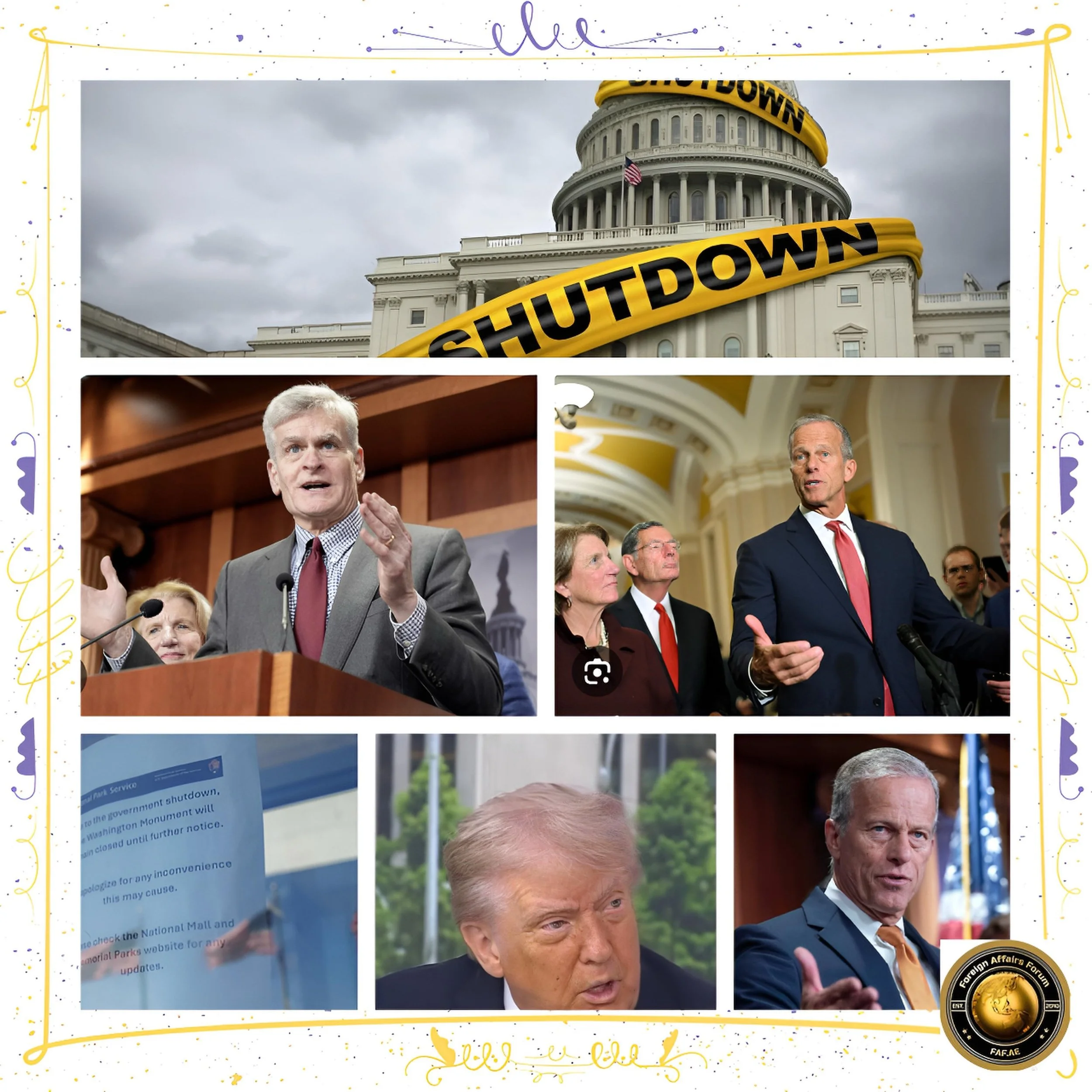
As of November 10, 2025, the United States government shutdown has reached its 41st day—now the longest in American history, surpassing the 2018–2019 record of 35 days.
The Senate advanced a critical procedural motion on November 9 with a 60-40 vote, breaking the Democratic filibuster when eight Senate Democrats and one independent joined Republicans to advance a spending package.
This motion clears the way for final Senate passage, but the bill still requires House approval and President Trump’s signature to officially reopen the government.
House Speaker Mike Johnson has committed to holding a House vote as soon as possible, with members to receive 36 hours’ notice before the vote. Market-based prediction models currently price an approximately 92% probability that the shutdown will end within the next five days.
The proposed legislation would fund the government through January 30, 2026, supplemented by a “minibus” package containing three full-year appropriations bills.
What happened?
Rep. Ro Khanna (D-Calif.) on Sunday called for Senate Minority Leader Chuck Schumer (D-N.Y.) to be replaced as party leader following a recent bipartisan deal that aimed to reopen the federal government after a 34-day shutdown.
Khanna criticized Schumer's leadership, stating, “Senator Schumer is no longer effective and should be replaced.
He shared “If you can’t lead the fight to stop healthcare premiums from skyrocketing for Americans, what will you fight for?”
Despite Schumer choosing not to vote in favor of a key funding bill on Sunday night, eight members of his Democratic caucus broke ranks and supported the legislation, taking a significant step toward reopening the government and ending the shutdown that has affected thousands of federal employees and services.
Economic Impact and Market Dynamics
The extended shutdown has imposed measurable macroeconomic damage.
The shutdown has shaved an estimated 0.8 percentage points off quarterly GDP growth—equivalent to approximately $55 billion in lost economic output.
Each additional week of closure costs the economy roughly $7 billion in lost output, or about 0.13 percentage points of annualized GDP growth.
If the shutdown were to extend for two months, including full SNAP disruptions and material reductions in air travel, the cumulative economic drag could reach 1.8–2.0 percentage points of quarterly GDP—a substantial impact that extends beyond typical recession-level shocks.
The market reaction to the Senate’s Sunday motion was decidedly positive, with S&P 500 futures rising 0.8%, Nasdaq 100 futures advancing 1.3%, and risk-sensitive currencies like the Australian dollar appreciating.
However, financial analysts note that this represents a “relief rally” rather than a fundamental resolution to underlying fiscal and political tensions. Markets are eager to regain access to macroeconomic data, Federal Reserve guidance, and reduced uncertainty regarding the fourth-quarter economic outlook.
Critical Unresolved Policy Issues
Affordable Care Act (ACA) Subsidies and Healthcare Costs
The most contentious unresolved issue concerns the enhanced premium tax credits under the ACA, set to expire on December 31, 2025.
The Senate deal does not extend these subsidies; instead, it merely guarantees a floor vote on an extension by mid-December, with no guarantee of passage.
This represents a significant capitulation by Democrats, who had initially prioritized ACA subsidy extension as their primary demand during shutdown negotiations.
The Congressional Budget Office estimates that allowing the enhanced subsidies to lapse would result in substantially higher insurance premiums for millions of Americans.
Without the subsidies, the CBO projects that 3.8 million additional Americans would become uninsured by 2035, and healthcare premiums would increase substantially for existing marketplace participants.
House Speaker Johnson has publicly expressed skepticism about supporting an extension, diminishing the likelihood of passage even if the Senate does vote on the measure.
Additionally, the “One Big Beautiful Bill Act” (OBBBA), signed into law in July 2025, has already imposed significant constraints on Medicaid eligibility and ACA marketplace operations through new work requirements and verification provisions that effectively end automatic re-enrollment for premium tax credit recipients.
The combination of these policy changes—if coupled with the lapse of enhanced subsidies—would create a “triple squeeze” on lower-income Americans’ access to healthcare.
SNAP and Food Assistance Programs
The shutdown has created acute disruptions to the Supplemental Nutrition Assistance Program (SNAP), affecting 42 million Americans.
While the proposed bill explicitly guarantees full funding for SNAP through the end of fiscal year 2026, the provision remains contested.
During the shutdown, the government has relied on contingency funds and court orders to send partial payments to SNAP recipients, establishing a troubling precedent where essential nutrition support has become a political bargaining chip.
The statutory framework for SNAP—which technically expired under the continuous appropriations model—remains unsecured beyond the immediate crisis. This represents a structural vulnerability in how Congress finances welfare programs during fiscal standoffs.
Medicare and Medicaid Payment Processing
The Centers for Medicare & Medicaid Services (CMS) has lifted most payment holds related to the shutdown, and Medicare claims are being processed again.
However, this administrative solution masks deeper challenges: certain telehealth services remain restricted, appeals processes are severely delayed, and the workforce reductions implemented during the shutdown have created backlogs in the federal websites and processing systems supporting these programs.
Medicaid beneficiaries continue to experience service delays and disruptions in enrollment and renewal processes.
The structural vulnerability remains that approximately 70+ million Americans depend on Medicare and Medicaid for healthcare access, yet these programs lack permanent protection against funding lapses, remaining subject to annual appropriations battles.
Federal Employee Layoffs and Legal Challenges
A particularly troubling dimension of this shutdown involves the Trump administration’s aggressive implementation of approximately 4,000 “Reduction in Force” (RIF) notices—formal termination orders—to federal employees while the government was shuttered.
This action created extraordinary legal and humanitarian complications:
Legal Status
A federal court in San Francisco issued a preliminary injunction blocking these layoffs indefinitely, finding the administration’s actions “likely unlawful” and determined they were undertaken for purposes of “political retribution”.
U.S. District Judge Susan Illston noted that the administration violated the Administrative Procedure Act by not providing adequate notice or opportunity for comment, and that the layoffs appeared to target “Democrat programs”—language cited from administration officials’ public statements.
The Back Pay Guarantee
The Senate deal includes a commitment that furloughed federal employees receive back pay for missed wages, reversing the administration’s earlier claim that back pay would not be provided unless Congress affirmatively authorized it.
However, approximately 730,000 employees worked without compensation during the 41-day shutdown, creating genuine financial hardship regardless of retroactive payment.
Reinstatement Requirements
The bill mandates reinstatement of most employees who were laid off during the shutdown, but implementing this remains complex given the geographic dispersal of federal agencies and the administrative chaos created by the overlapping closure and termination notices.
The FAA Worker Bonus Initiative and Its Implications
Trump’s announcement of an $8,000–$10,000 bonus for FAA and air traffic control personnel who remained at work during the shutdown requires critical examination.
This initiative presents multiple complications
Authorization and Legal Status
The bonuses were announced unilaterally by the Trump administration as an executive incentive, but the statutory and appropriations authority for such payments during a government shutdown remains legally ambiguous.
Federal employees cannot be paid during a shutdown unless their compensation is covered by appropriated funds or emergency provisions. The mechanism by which these bonuses would be funded remains unclear.
Precedent and Equity Concerns
The selective offer of bonuses to certain “patriotic” workers creates problematic precedents.
The administration simultaneously threatened pay cuts for workers who did not return to work—a threat that contradicts federal labor law and management best practices.
This “carrot-and-stick” approach represents an unprecedented politicization of federal compensation.
Context and History
The FAA has been implementing broader air traffic controller recruitment and retention programs, including $5,000–$10,000 bonuses for new hires and academy graduates, separate from shutdown-related incentives.
The conflation of these initiatives with pandemic-era bonuses creates conceptual confusion about what employees actually earned versus what represents political compensation.
The bonus initiative exemplifies a broader troubling pattern: using compensation mechanisms as instruments of political loyalty rather than merit-based recognition.
This undermines the civil service’s professional independence and creates perverse incentives for future behavior during disputes.
Systemic Instability and Future Implications
The resolution of this shutdown does not address the underlying political and fiscal fractures that generated it.
Several structural problems remain unresolved
Recurring Shutdown Cycles
The agreement extends government funding only through January 30, 2026—merely two months beyond the current date. This temporary measure virtually guarantees another appropriations crisis at the end of January, repeating the cycle of uncertainty, economic disruption, and political brinksmanship.
Since 1976, there have been 21 government shutdowns, demonstrating the chronicity of this dysfunction.
Fiscal Governance Failure
The fundamental problem persists
Congress cannot pass regular appropriations bills within the required timeframe, defaulting instead to continuing resolutions and continuing appropriations that freeze spending at previous levels while deferring policy decisions.
This prevents rational budget prioritization and allows substantive policy disputes to metastasize into fiscal crises.
Erosion of Institutional Guardrails
The aggressive implementation of RIFs during the shutdown, the threats to withhold back pay, and the selective use of compensation demonstrate an erosion of institutional protections that traditionally insulated the civil service from partisan manipulation.
If these practices become normalized, they will undermine the institutional independence and professional integrity of the federal bureaucracy.
Healthcare System Vulnerability
The failure to secure ACA subsidy extensions during the shutdown negotiations suggests that healthcare programs lack durable political protection.
The combination of
(1) the OBBBA’s restrictions on Medicaid and ACA enrollment
(2) the potential lapse of enhanced subsidies
(3) the ongoing uncertainty about program funding creates a scenario where millions of Americans face healthcare access degradation not due to policy deliberation, but due to fiscal brinkmanship.
Market and Confidence Effects
While markets initially rebounded on the prospect of shutdown resolution, financial analysts caution that the underlying problems remain.
The “relief rally” masks persistent concerns about long-term fiscal sustainability, the politicization of essential functions, and the precedent established by using government operations as a tool for extracting political concessions.
How would the deal affect Trump's political standing ahead of 2026
The deal to end the government shutdown is likely to have a mixed effect on President Trump’s political standing heading into the 2026 midterms.
While the resolution of the shutdown allows Trump to claim credit for reopening the government and restoring federal services, the political damage from the shutdown itself, combined with Democratic messaging and public perception, could undermine his position in the run-up to the elections.
Political Impact on Trump
Public approval ratings for Trump have declined amid the shutdown, with most polls indicating that a majority of voters continued to blame him and congressional Republicans for the impasse.
The Democratic victory in recent elections and their ability to force concessions or maintain unity during the shutdown has strengthened their narrative, painting Trump as divisive and ineffective.
The deal does not extend key Democratic priorities, such as Affordable Care Act subsidies, which Trump has resisted.
This allows Trump to claim he held firm on certain issues, but could also energize Democratic voters who see the issue as critical for the 2026 elections.
Prospects for 2026
Democrats currently hold a lead in preferences for congressional races, and the shutdown is likely to be used as a central issue by Democrats, who will highlight the disruption caused by Trump’s policies and the economic hardships faced by ordinary Americans.
The deal may temporarily stabilize the political situation, but the fallout from the shutdown could linger, especially among swing voters and those hit hard by furloughs and lost services.
Trump’s ability to shift focus to other issues—such as the economy or national security—will be crucial in the coming months, but the memory of the shutdown and its impact could be a persistent liability if Democrats successfully mobilize around healthcare and economic concerns.
The shutdown deal allows Trump to claim a short-term victory by reopening the government, but it is unlikely to repair his standing with the broader electorate if the political and economic fallout continues to dominate the narrative as the 2026 elections approach.
Conclusion
Temporary Resolution, Systemic Vulnerability
The shutdown resolution represents a tactical victory for Republicans and a strategic defeat for Democrats, as the latter abandoned their primary negotiating objective (ACA subsidy extension) without securing guarantees of future success.
For the American public, the resolution provides immediate relief from disruptions—federal employees will return to work, SNAP benefits will be restored, air traffic will normalize—but does not address the fundamental governance failures that enabled a 41-day shutdown to occur.
The FAA bonus initiative, federal layoff reversal, and commitment to address ACA subsidies through future legislative action exemplify the fundamental problem: essential programs and worker protections are now subject to episodic political negotiation rather than embedded in durable legal frameworks.
If Trump’s agreement to reverse the layoffs and provide back pay signals respect for institutional constraints, it remains to be seen whether this represents genuine acceptance of constitutional limits or merely tactical accommodation pending future disputes.
The 92% market probability of shutdown resolution within five days reflects optimism that the worst disruptions have peaked.
However, the structural fragility revealed by this shutdown—the vulnerability of healthcare programs, nutrition assistance, federal employment, and airport operations to recurring fiscal crises—suggests that America has entered a new phase of governance characterized by chronic institutional instability rather than temporary dysfunction.
Whether this proves correctible depends on whether Congress reconstitutes functional appropriations processes and whether political actors accept that certain functions (healthcare, food assistance, federal employment) must be protected from partisan conflict.