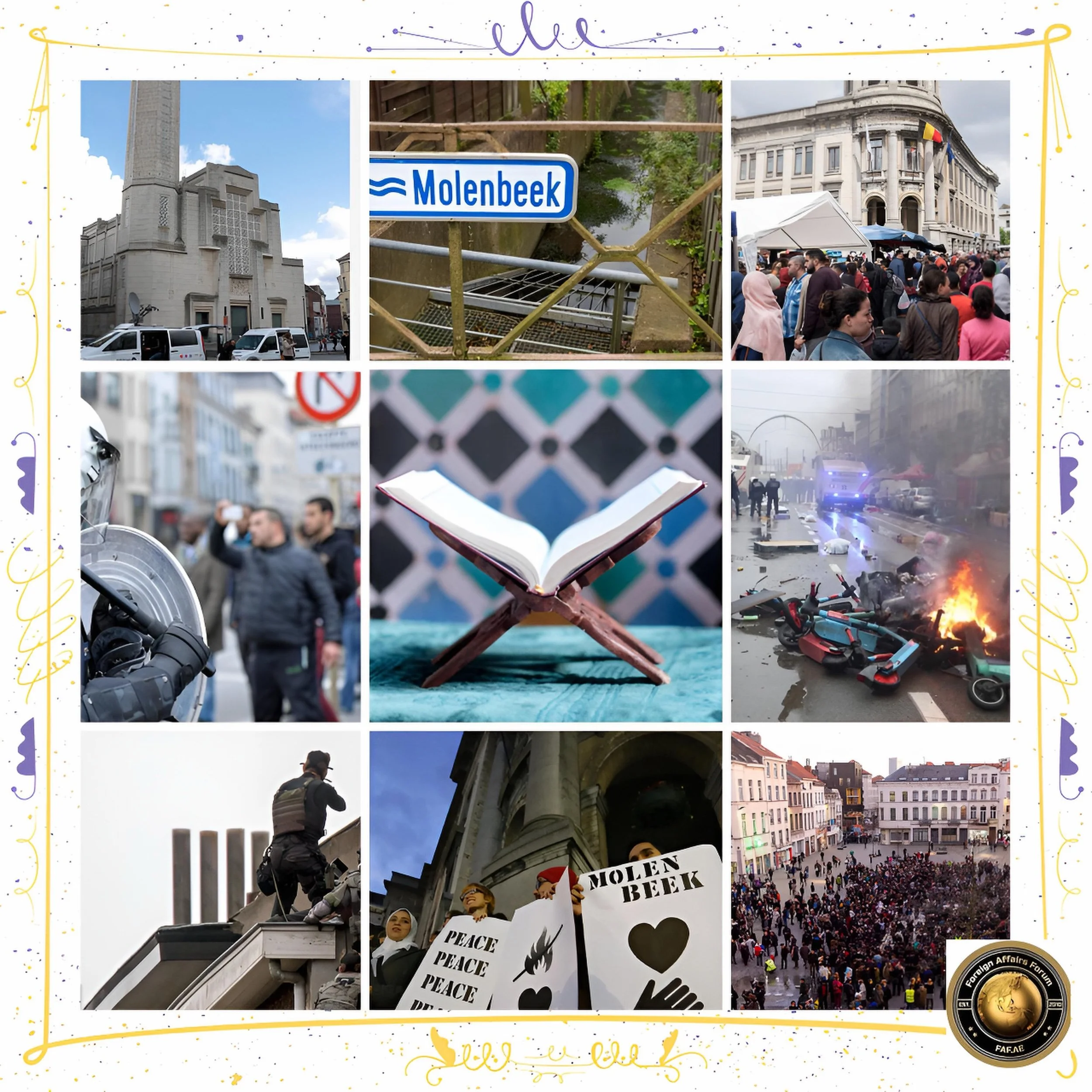
Molenbeek, Brussels: The Making of a Pivotal European District—From Industrial Hub to Symbol of Social Transformation
Introduction
Molenbeek-Saint-Jean stands as one of Europe’s most consequential and contested neighborhoods, embodying the complex challenges and transformation potential that define 21st-century urban Brussels.
With a population of approximately 98,700 residents representing over 70 ethnic backgrounds, this historically working-class municipality on the northwestern edge of the Belgian capital occupies a uniquely important position in Belgian politics, European urban development, and international discourse on integration, radicalization, and urban renewal.
The district’s journey—from prosperous industrial center to stigmatized neighborhood linked to terrorism, and now toward cultural regeneration and diversity-driven renaissance—reveals fundamental tensions about identity, poverty, integration, and the role of marginalized communities in wealthy cities.
Historical Significance and Political Pivotal Role
From Medieval Village to Industrial Powerhouse
Molenbeek’s contemporary political significance cannot be understood without examining its remarkable historical trajectory.
For much of the Middle Ages and early modern period, Molenbeek existed as a rural village on the periphery of Brussels, maintaining relative autonomy until the 13th century when the City of Brussels gradually annexed significant portions of its territory.
The neighborhood’s true transformation began during the Industrial Revolution at the turn of the 19th century, when commerce and manufacturing activity brought unprecedented prosperity to the district.
The first passenger train in continental Europe departed from Molenbeek on May 5, 1835, symbolizing the municipality’s role as a center of economic dynamism and technological advancement.
By the late 19th and early 20th centuries, Molenbeek had become an integral part of Brussels’ manufacturing belt, with crockery production, carriage-making, printing industries, and metallurgical works lining the Brussels-Charleroi Canal that traverses the district.
This industrial heritage created a thriving working-class community with strong social institutions and local identity.
The post-World War II period marked the beginning of Molenbeek’s economic and social challenges.
Starting in the 1970s, deindustrialization profoundly restructured the municipality’s economy as manufacturing activities relocated to suburban areas and, later, to Asia and Eastern Europe in search of cheaper land and labor.
The consequent loss of manufacturing jobs, combined with the failure of local communities to transition effectively to the service-based economy emerging in Brussels’ center, created persistent unemployment and poverty that would define the district for decades.
By the 1980s and 1990s, Molenbeek had developed a reputation as one of Belgium’s poorest municipalities, a trajectory that was largely the result of structural economic forces rather than community deficiency.
Political Role in Brussels Governance
Molenbeek’s political significance extends beyond its internal challenges to its structural role in Brussels governance and representation.
As one of 19 autonomous municipalities within the Brussels-Capital Region, Molenbeek operates with considerable self-governance authority, with its mayor serving as head of the local police force and the municipality maintaining independent control over primary and secondary school administration.
This decentralized Belgian system, rooted in deeply held values of local autonomy, means that Molenbeek functions as a distinct political entity despite being geographically embedded within the greater Brussels metropolitan area.
This peculiar governance structure creates both opportunities and complications: it allows Molenbeek to pursue locally tailored policies and maintain community identity, but it also fragments municipal coordination and can hinder unified responses to city-wide challenges such as organized crime and radicalization.
Demographics: Diversity, Integration, and the Moroccan Presence
The Composition of Molenbeek’s Population
The demographic composition of Molenbeek requires careful examination, as it has been subject to both accurate description and significant mischaracterization. The district is not predominantly Albanian, nor is it uniformly “Muslim” in ways that some journalistic accounts have suggested.
Rather, Molenbeek’s population reflects distinct demographic waves of immigration and integration spanning the past seven decades.
Beginning in the 1950s and accelerating through the 1960s and 1970s, Molenbeek attracted a substantial immigrant population, primarily composed of workers from Morocco seeking employment in the district’s declining but still substantial manufacturing sector.
According to 2023 data incorporating parental birthplace, approximately 69.16% of Molenbeek’s population is of non-European origin (predominantly Moroccan and Syrian), while 17.49% has European origins outside Belgium, and 13.31% consists of people with solely native Belgian ancestry.
Among the foreign-born population, Moroccans represent the largest contingent, with 5,960 registered Moroccan residents as of 2020, followed by Romanians (4,242), Spanish (2,255), French (1,956), Italians (1,759), and Syrians (1,666).
More specifically, as of 2016, approximately 27,000 of the 36,000 Muslims estimated to live in Molenbeek were of Moroccan origin, primarily from the Riff region and Berber-speaking communities.
Recent Demographic Shifts and Increasing Diversity
In recent years, Molenbeek’s demographic profile has become considerably more diverse than popular representations suggest.
While residents of Moroccan descent continue to form a significant majority in certain Lower Molenbeek neighborhoods, an increasing number of Eastern Europeans, sub-Saharan Africans, and Roma people have settled in the municipality.
Contemporary residents include Albanians, Congolese, Italians, Poles, and Palestinians, reflecting the district’s ongoing role as a destination for economically disadvantaged migrants seeking low-cost housing.
Population growth has been substantial, rising from approximately 72,380 in 2001 to 98,112 in 2021, and currently estimated at 98,713 in 2025, representing a significant demographic expansion even as the broader Brussels region faces different population dynamics.
Notably, Molenbeek has a very young population structure, with half of all residents under 29 years of age—a factor that local officials have recognized as both a challenge (in terms of youth unemployment) and an opportunity (in terms of energy and potential for community transformation).
Religious Composition and the Muslim Minority
The religious composition of Molenbeek has been a matter of significant media attention and occasional misrepresentation. While Molenbeek contains the highest concentration of Muslims in Brussels, the actual percentage of Muslims in the municipality is considerably lower than sometimes portrayed.
Reliable estimates place the Muslim population at approximately 25-40% of the total population, depending on specific geographic sub-areas within the municipality.
This figure stands significantly below the 100% implied by descriptions of Molenbeek as a “Muslim enclave,” and the estimates vary substantially depending on methodology and geographic precision.
It is important to note that Belgium does not collect official statistics on religious affiliation, so all Muslim population estimates are derived from proxy measures such as birthplace ancestry or neighborhood surveys.
Among the Muslim population present in Molenbeek, a process of religious intensification occurred beginning in the 1975-1980 period, driven by specific institutional actors including the Jamā’at al-Tablīgh pietist movement and mosques influenced by the Muslim Brotherhood and other organized religious groups.
This institutional Islamization created a visible religious presence that exceeded the actual proportion of Muslims in the community.
Recent Elections and Political Dynamics: The 2024 Municipal Election and Shifting Power
The 2024 Election Results and Coalition Dynamics
The October 13, 2024 municipal elections in Molenbeek marked a significant moment of political realignment that both reflected and shaped the district’s future trajectory.
The results demonstrated notable shifts in political preferences, with the Socialist Party (PS) and Vooruit coalition retaining narrow control but losing substantial support compared to the 2018 elections.
The PS-Vooruit list, led by incumbent Mayor Catherine Moureaux, secured 23.1% of the vote and 12 seats—a substantial decline from 31.3% and greater representation in 2018.
This represented a meaningful but not catastrophic setback for the traditional left-wing alliance that had dominated Molenbeek municipal politics for decades.
The major surprise of the 2024 election came from the radical left Belgian Workers’ Party (PTB/PVDA), which surged to 22.2% of the vote and 11 seats, gaining 8.5 percentage points compared to 2018 and emerging as a serious challenger to Socialist dominance.
This represented part of a broader European trend toward left-wing and radical left electoral resurgence in economically distressed communities.
The liberal MR-VLD coalition finished a distant third with 17.1% and 8 seats, followed by Team Fouad Ahidar with 14.6% and 7 seats.
Notably, the far-right N-VA, which had held at least one seat in previous elections, failed to reach the electoral threshold and lost its municipal representation, securing only 2.5% of votes.
The election results created an unusual governing challenge: the PS-Vooruit alliance held 12 seats and PTB-PVDA held 11 seats, combining for 23 seats out of 45—a narrow majority of just two seats that would prove administratively vulnerable.
Unable to sustain a PS-MR coalition (an ideologically and politically impossible combination in contemporary Brussels), the two left-wing parties began coalition negotiations.
However, neither party wished to proceed with an uncomfortably narrow two-party majority, prompting discussions with other lists to create a more stable coalition.
Formation of the Tripartite Coalition and Governance Platform
In early December 2024, after extended negotiations, the PS-Vooruit and PTB-PVDA agreed to bring Ahmed El Khannouss’s Molenbeek Autrement (Molenbeek Otherwise) list into the governing coalition, securing 4 additional seats and creating a tripartite majority of 27 seats out of 45—a more comfortable governing margin.
This was a noteworthy political development, as El Khannouss, while a respected local figure and former Brussels deputy, had been pushed out of the centrist Les Engagés party in October 2022 and was viewed as having significant political rivalry with Mayor Moureaux.
The fact that these former rivals agreed to govern together demonstrated the priority both placed on addressing Molenbeek’s most pressing challenges over personal or minor ideological differences.
The new coalition’s governance platform explicitly prioritized combating poverty and precariousness in what the coalition explicitly acknowledged as “Belgium’s second poorest municipality.”
Mayor Catherine Moureaux (PS) retained her position, overseeing prevention, francophone education, civil registry, and legal affairs, while delegation of other portfolios reflected an intentional balance of power and expertise.
Notably, the PTB’s Dirk De Block was appointed First Deputy Mayor, coordinating housing and municipal properties—a deliberate choice reflecting the coalition’s commitment to addressing the severe housing shortage and affordability crisis that disproportionately impacts Molenbeek residents.
This governance structure represented a clear political signal that Molenbeek’s new leadership intended to prioritize economic justice and housing rights over other political considerations.
Economic, Social, and Political Dynamics: Poverty, Unemployment, and Inequality
Systemic Poverty and Brussels’ Poorest Municipality Status
Molenbeek occupies a uniquely difficult position within Belgium’s regional economy, consistently ranking among the nation’s poorest municipalities.
According to recent data, Molenbeek functions as Belgium’s second-poorest municipality by average per capita income, exceeded only by Forest in terms of poverty concentration.
This economic marginalization is not a recent phenomenon but reflects decades of structural deindustrialization and failed integration into Brussels’ post-industrial service economy.
When examined within the broader Brussels-Capital Region context, the poverty challenges become even more acute.
Brussels as a whole has faced a profound regional inequality crisis, with official statistics revealing that approximately 37.3% of Brussels residents face risk of poverty or social exclusion—more than double the national rate of 18.3% and far exceeding rates in Flanders (12.9%) or Wallonia (21.8%).
Within Brussels, the severity of housing deprivation is particularly acute: 10.9% of Brussels residents face severe housing deprivation (characterized by overcrowded, damaged, or inadequate housing), compared to just 0.4% in Flanders.
Molenbeek, situated within this regional poverty concentration, experiences conditions substantially worse than even Brussels averages in specific demographic sub-groups.
Molenbeek has been described as lying within the “poor crescent” (or “poor croissant”)—a semicircular band of impoverished neighborhoods forming the western and southwestern arc of Brussels, encompassing Molenbeek, Anderlecht, Forest, and Saint-Gilles.
These neighborhoods, characterized by aging housing stock, abandoned manufacturing facilities, and concentrated immigrant populations, represent the geographic manifestation of Brussels’ profound socio-spatial inequality.
Youth Unemployment and the Crisis of Aspiration
The employment crisis affecting Molenbeek has reached critical levels, particularly for young people.
As of 2016, nearly 40% of young people in Molenbeek were unemployed—a rate that represents one of Europe’s highest youth unemployment concentrations outside of crisis-affected regions.
This youth unemployment generates compounding social pathologies: young people lacking formal employment prospects lose economic independence, develop diminished expectations for life achievement, and become vulnerable to radicalization narratives that frame mainstream society as hostile and rejecting.
The discrimination that Molenbeek-origin residents face when seeking employment in Brussels—rooted in both ethnic/religious prejudice and geographic stigmatization—compounds these employment obstacles.
Young people in Molenbeek report widespread conviction that their residential address itself constitutes a significant employment disadvantage.
According to analysis by community workers, Molenbeek-origin youth “have to work twice as hard” to achieve employment equivalent to peers from more affluent neighborhoods, as they simultaneously encounter discrimination based on ethnicity/religion, geographic origin, limited educational credentials, and lack of professional networks.
One community worker noted that Molenbeek youth “are youngsters without a job, who encounter discrimination, and who, in many places, are not welcome.
They are humiliated as good-for-nothing by their own family. The police controls them constantly. There is an accumulation of problems.”
This systemic exclusion—operating simultaneously at multiple institutional levels—creates psychological and social conditions that can facilitate radicalization.[revistaperiferias]
Housing Crisis and Severe Deprivation
Housing represents one of Molenbeek’s most severe structural problems.
According to data analyzed in recent studies, approximately half of Molenbeek’s apartments consist of fewer than 55 square meters, and housing conditions in many units fall substantially below Belgian housing standards.
The Lower Molenbeek area, adjacent to the canal and historically working-class, consists of what academics describe as a “gate city” for newly arrived migrants—a destination where economically disadvantaged newcomers seek low-cost rental accommodation but from which more successful migrants graduate to more affluent areas.
This dynamic has created a self-perpetuating cycle of concentrated poverty and “absence of success,” as successful families leave and impoverished families remain concentrated in deteriorating housing stock.
Housing deprivation manifests in multiple dimensions: overcrowding, inadequate maintenance, environmental hazards, and unaffordable rents that consume unsustainably large portions of already-minimal household incomes.
The European pattern of housing crisis has reached particularly acute levels in Brussels, where decades of underinvestment in social housing and deinstitutionalized urban planning have created a shortage of affordable housing precisely where need is greatest—among Molenbeek’s economically vulnerable residents.
Security, Radicalization, and the Terrorism Connection: Understanding Molenbeek’s International Notoriety
The International Terrorism Connection and Media Narrative
Molenbeek’s global reputation was fundamentally altered in November 2015 when the international media revealed that several of the perpetrators of the Paris terrorist attacks—which killed 130 people across multiple venues—had connections to the district.
The perpetrators of the Paris attacks and subsequent Brussels bombings on March 22, 2016 (which killed 32 people) were traced to Molenbeek, and the district became internationally recognized as a terrorism safe haven and recruitment center.
The bombers of the Paris attacks were reported to have met and coordinated at a café in Molenbeek, operated by Salah Abdeslam and his brother—both involved in the attacks.
The so-called mastermind of the Paris killings, Abdelhamid Abaaoud, had grown up in and maintained residence in Molenbeek during periods between foreign operations.
This international attention fundamentally transformed Molenbeek’s global image.
While the district had previously been known primarily within Belgium as an economically struggling, predominantly immigrant neighborhood, the 2015-2016 terrorist attacks reframed it in international consciousness as a source of Islamic radicalism and a breeding ground for violent extremism.
French and some international media outlets made inflammatory suggestions about military strikes against the neighborhood, and even Belgian Interior Minister Jan Jambon stated his desire to “wipe Molenbeek clean”—language that reflected both the severity of the security crisis and the degree to which the district had become politically isolated.
Distinguishing Actual Radicalization from Media Exaggeration
However, the severity of Molenbeek’s terrorism problem, while real, has been significantly exaggerated in popular international discourse.
According to security analysts, of the estimated 540 Belgians believed to have traveled to Syria or Iraq to fight for extremist groups, only approximately 47 came from Molenbeek—representing less than 9% of the national total.
While this figure is disproportionate relative to Molenbeek’s population size (approximately 1% of Belgium’s population), it does not support characterizations of Molenbeek as a primary source of jihadism or as a uniquely radicalized community.
As one security analyst noted, “it would be a mistake to call it a breeding ground for terrorism, since those 24 [foreign fighters with Molenbeek links] represent a small fraction of Molenbeek’s 100,000 residents.”
Molenbeek was linked to multiple terrorist incidents beyond the 2015-2016 attacks
(1) the 2004 Madrid train bombings
(2) the 2014 Jewish Museum of Belgium shooting
(3h the July 2016 Charlie Hebdo attacks
(4) the June 2017 Brussels Central Station bombing—though in many cases, the perpetrators’ connections to Molenbeek ranged from extended residence to merely having relatives in the area.
These patterns suggest that Molenbeek’s significance as a terrorism nexus derived partly from it being a major residential and business center for Brussels’ Muslim population, meaning that any individual or group with connections to this community would have statistical likelihood of having Molenbeek links, regardless of causation.
Drug Trafficking, Organized Crime, and Community-Based Violence
Beyond terrorism, Molenbeek has faced severe challenges related to organized crime, particularly drug trafficking.
The district’s location on major drug trafficking routes between North Africa and Northern Europe, combined with its poverty and weak institutional presence, made it attractive to organized crime operations.
As one Molenbeek official noted shortly after the Paris attacks, “There was a group of drug traffickers active in the café.
From such delinquency, it’s only a small step to radicalization.” This observation captured an important dynamic: that drug trafficking networks and radicalization networks sometimes operated in overlapping community spaces and occasionally recruited from the same pool of economically marginalized youth.
Belgium more broadly has become a significant hub in European organized crime, particularly for cocaine trafficking (with Antwerp’s port serving as a major entry point for South American cocaine destined for European markets) and synthetic drugs production.
Molenbeek, as part of the Brussels metropolitan area, has been affected by this broader organized crime presence. Drug trafficking gangs have recruited minors—sometimes paying them €1,500-2,000 to participate in violence—and have been associated with high-profile violent incidents including shootings and arson.
According to 2024 reporting, the Federal Judicial Police in Brussels documented approximately 2,000 drug-related arrests over a six-month period, with significant concentrations in neighborhoods including Molenbeek, Anderlecht, and Schaerbeek.
Prevention and Deradicalization Initiatives
Recognizing the severity of the radicalization challenge, Molenbeek municipal authorities and Belgian security services developed comprehensive prevention programs.
Mayor Françoise Schepmans (who led the municipality from 2012 until Catherine Moureaux succeeded her in 2018) became internationally recognized for her nuanced approach to radicalization prevention, rejecting both naive dismissal of radicalization threats and collective blame narratives against Muslim communities.
Schepmans explicitly stated: “Poverty is no excuse for radicalism,” suggesting that while poverty and marginalization created vulnerability to radicalization, they did not automatically produce terrorists.[euractiv]
Official prevention efforts included “Plan Molenbeek,” developed in the months before the Brussels bombings specifically to address radicalization risks through institutional coordination.
This plan involved training nearly 700 community field workers (including teachers and social workers) to recognize early radicalization signs and partner with specialized prevention officers to develop customized interventions for individuals assessed as vulnerable.
These efforts operated through multidisciplinary round tables where municipal officials, police, educators, social workers, and community leaders collaborated to examine specific cases and develop appropriate responses.
At the national level, Belgium trained approximately 18,000 police officers through the Community Policing to Prevent Radicalization (COPRA) initiative to identify radicalization indicators and implement a “grasping approach” of sustained follow-up rather than one-time interventions.
The effectiveness of these prevention efforts remains contested, as Belgium continues to experience terrorism-related incidents and the radicalization threat remains at level 3 (serious) on a 4-point scale as of 2025.
Critics have argued that police and prevention resources remain insufficient relative to the scale of the challenges, and that addressing radicalization requires addressing the underlying conditions of economic marginalization, employment discrimination, and social exclusion that create vulnerability to radical narratives.
The Stigma Question: Beyond Stereotypes to Structured Disadvantage
The Three-Part Stigma Construction
Molenbeek residents face a particular form of stigmatization that combines multiple distinct prejudicial narratives into a comprehensive framework of exclusion and inferiority.
Researchers studying the district have identified three distinct components to the Molenbeek stigma.
First, the neighborhoods are widely perceived as unsafe and dirty—judgments frequently communicated in media representations, political discourse, and public conversation.
Second, the predominant religion (Islam) is characterized as fundamentalist and incompatible with integration—a narrative that generalizes from radical extremist minorities to entire communities and ignores Muslim theological diversity.
Third, the majority ethnic origin (Moroccan, particularly from the Riff region) is stereotyped as culturally hostile to women’s equality and intolerant of difference.
None of these stereotypes reflects actual community reality, as Molenbeek contains substantial religious and political diversity among Muslims, substantial support for women’s rights across ethnic and religious lines, and significant majorities committed to democratic values and peaceful coexistence.
This stigmatization creates profound practical consequences for Molenbeek residents seeking employment, housing, or educational opportunities outside the district.
When youth from Molenbeek apply for jobs with identical qualifications as peers from more affluent neighborhoods, they experience significantly higher rejection rates—a difference that residents attribute (often accurately) to employer discrimination based on geographic origin.
Similar discrimination occurs in housing markets, where landlords sometimes refuse to rent to Molenbeek residents or charge higher rents based on perceived risk associated with district residence.[revistaperiferias]
Integration Success Stories and Community Agency
Despite the stigmatization and structural challenges, Molenbeek contains substantial evidence of successful integration, community cohesion, and vibrant cultural creativity.
Numerous community-based organizations have developed innovative programs combining economic opportunity, personal development, and cultural expression.
The Atelier Groot Eiland, operating since 1986, has created seven mini-companies addressing urban agriculture, food services, carpentry, and handicrafts, simultaneously generating employment and combating poverty through socio-economic integration.
The organization explicitly describes its mission as “fighting poverty through socio-economic integration,” and has created restaurants (Bel Mundo and RestoBEL), a sandwich shop (Bel’O), organic gardens (five Bel’Akker locations), a creative workshop and bakery (ArtiZan), and a carpentry enterprise (Klimop), providing work experience and steady employment for marginalized individuals.
MolenGeek, launched with support from Samsung and Belgian government officials, has provided technology training and entrepreneurship opportunities to young people in Molenbeek, creating a pipeline for future startup creation and technical employment in the digital economy.
The initiative has trained young programmers in professional coding schools and organized hackathons and Internet of Things (IoT) challenges to foster innovation and mentorship.
Youth organizations, including the Brussels Boxing Academy (with 550 members drawn substantially from impoverished neighborhoods including Molenbeek), have combined athletic training with comprehensive social programming addressing resilience, identity formation, and personal development.
These community initiatives demonstrate that Molenbeek residents, when provided with adequate resources and institutional support, create substantial value, innovation, and social cohesion.
Yet these success stories remain relatively invisible to external observers, overshadowed by international media coverage of terrorism and gang violence.
This representational inequality reinforces the stigma that constrains the district’s social and economic opportunities.
Brussels 2030: European Capital of Culture and the Possibility of Transformation
Molenbeek’s Bid for European Capital of Culture 2030
In a striking contrast to its terrorism notoriety, Molenbeek in 2024-2025 became the subject of a major European cultural initiative: a candidacy to serve as the European Capital of Culture in 2030.
While Molenbeek itself submitted the candidacy, it was undertaken on behalf of the entire Brussels-Capital Region, with all 19 municipalities of Brussels formally committing to partnership in the initiative.
This regional solidarity demonstrated that Molenbeek’s challenges and assets were understood as intrinsically connected to broader Brussels dynamics rather than isolated municipal problems.
The Brussels 2030 candidacy, shortlisting Molenbeek among three Belgian cities (along with Leuven and Namur) competing for the title, proposed to mobilize culture, art, and diversity as tools for addressing the district’s profound social and economic challenges.
The project was conceptualized as “a unifying project aimed at bringing people together and collectively envisioning a true societal vision, placing inclusion, collaboration, and artistic creativity at its core.”
The guiding value underlying the candidacy—“Sadaka,” meaning generosity and solidarity across cultures and languages—explicitly positioned diversity not as a problem requiring management but as a resource for building more resilient, creative, and inclusive communities.
The strategic logic underlying Molenbeek’s bid was historically grounded: the candidacy acknowledged that “the dream began in 2016, after the terror attacks in Paris and Brussels, when Molenbeek became known throughout the world,” but proposed to transform this negative visibility into an opportunity to “show another Molenbeek, that is rich in its diversity, its youth, its culture, its art.”
If successful, the European Capital of Culture designation would generate substantial economic benefits—previous European Capital of Culture host cities have reported economic spin-offs ranging from €180 to €350 million—and would fundamentally reframe the international perception of Molenbeek from terrorist stronghold to creative and culturally significant city.
Political Unity and Cultural Mobilization
The Brussels Parliament’s unanimous support for Molenbeek’s candidacy in July 2025 represented a remarkable moment of political unity across contentious party divisions.
This unanimous backing from legislators spanning the political spectrum from radical left to moderate liberals and conservatives reflected recognition that Molenbeek’s transformation served broader Brussels interests and that culture-based urban renewal could address questions of social cohesion, economic opportunity, and community identity that transcended traditional party politics.
The Molenfest 2025 festival, held in September 2025 as part of the candidacy effort, demonstrated the cultural mobilization underlying the Brussels 2030 project.
The multidisciplinary festival, organized by the Kanal Foundation and the Maison des Cultures et de la Cohésion Sociale de Molenbeek, brought together renowned artists, community members, and cultural workers to create public art, performances, and participatory creative activities.
The festival deliberately emphasized “projects in public spaces” and “projects that directly involve residents,” and prioritized “free, intergenerational projects.”
This approach directly addressed Molenbeek’s structural challenge of concentrated poverty by making cultural participation accessible to residents regardless of economic resources and by positioning the neighborhood’s demographic diversity as a cultural asset rather than a marker of dysfunction.
The Kanal/Pompidou Center, scheduled to open at the end of 2026, represents another major cultural investment in Molenbeek’s broader Quartier Nord (North District) and surrounding neighborhoods.
This first museum of modern and contemporary art in Brussels will be housed in renovated industrial facilities and is expected to serve as a major catalyst for neighborhood revitalization and cultural tourism, creating employment opportunities and elevating the district’s cultural significance within European metropolitan hierarchies.
Recent Urban Renewal and Quality-of-Life Improvements
Beyond the European Capital of Culture candidacy, Molenbeek has undertaken concrete urban renewal projects designed to improve neighborhood livability and safety.
In March 2025, the municipality announced plans to transform Place Sainte-Marie into a green meeting space, redeveloping the formerly grey, underutilized square into an attractive environment with trees, seating, plants, and improved pedestrian connectivity.
The project, costing approximately €187,720.20, addressed the specific need to create safer, more pleasant school environments while simultaneously improving neighborhood aesthetics and public space functionality.
These urban renewal efforts, while modest in scale, represent intentional efforts to counter the visual marginalization that contributes to Molenbeek’s stigmatization.
According to urban design professionals, the transformation of Molenbeek’s public spaces from “grey, littered, unsafe” environments to attractive, green, functionally integrated community spaces simultaneously improves resident quality of life and projects an image of community investment and dignity.
The Biggest Concerns Facing Molenbeek: Critical Challenges for Belgium and the European Union
Persistent Poverty, Inequality, and Intergenerational Disadvantage
The most fundamental challenge facing Molenbeek, and the one most critical for broader European concerns, is the persistence and deepening of concentrated poverty in the context of a wealthy metropolitan area and wealthy nation.
Molenbeek’s average per capita income ranks among Europe’s lowest for urban neighborhoods, while surrounding areas and other Brussels municipalities enjoy substantially greater prosperity.
This poverty is not temporary or cyclical but rather appears structural—a consequence of long-term employment discrimination, neighborhood stigmatization, educational system failures, and macroeconomic shifts that eliminated manufacturing employment without providing functional replacements suitable for workers lacking advanced credentials.
The intergenerational implications of this concentrated poverty deserve particular emphasis.
Children born to parents in economic precarity, lacking secure housing, experiencing frequent police contact, and attending underfunded schools begin life with profound disadvantages that cumulate across the lifespan.
These structural disadvantages generate what researchers describe as “absence of success” cultures, wherein young people internalize low expectations for economic achievement and struggle to imagine pathways to prosperity.
For the European Union, this represents a critical concern: Molenbeek exemplifies how wealthy nations and city-regions can contain zones of Third World-level poverty, creating humanitarian and social justice questions that European institutions have generally failed to address with adequate resources or policy sophistication.
Organized Crime, Gang Violence, and the Drug Trade
Brussels and its component municipalities, including Molenbeek, face escalating organized crime violence, primarily driven by competition over drug trafficking routes and markets.
The circulation of firearms, the recruitment of minors as low-level traffickers and enforcers, and the presence of organized crime networks with international connections create ongoing security challenges that affect residents’ daily safety and community cohesion.
The emergence of what some have characterized as “Marseille mafia” infiltration into Belgian drug markets, combined with established Balkan and Albanian organized crime presence, suggests that these security threats operate at transnational scales beyond the capacity of individual municipalities or even national police forces to address.
For the European Union, organized crime’s use of Belgium’s major ports (particularly Antwerp) and geographic position as a major smuggling hub creates cross-border security challenges affecting all of Europe.
The destabilization of Molenbeek and other Brussels neighborhoods through gang violence undermines European security, social cohesion, and the legitimacy of democratic institutions in the eyes of residents experiencing daily violence and insecurity.
Radicalization, Violent Extremism, and the Terrorism Threat
While the extent of Molenbeek’s role in terrorism production has been exaggerated, genuine radicalization risks remain present in the district and constitute a significant concern for Belgium and the broader European Union.
The presence of organized Islamist groups, the historical role of specific mosques in promoting austere and intolerant religious interpretations, the convergence of radicalization and drug trafficking networks, and ongoing employment discrimination and social exclusion create conditions wherein some young people become vulnerable to extremist messaging.
The European Union’s counterterrorism architecture requires sustained attention to radicalization prevention in marginalized communities, and Molenbeek’s experience suggests that prevention efforts require both community policing and investment in economic opportunity, education, and social inclusion—commitments that European governments have frequently failed to adequately resource.
Housing Crisis and Urban Inequality
The acute housing shortage afflicting Brussels and particularly Molenbeek represents a fundamental challenge to European urban sustainability and social cohesion.
The combination of inadequate social housing supply, speculation and gentrification in previously working-class neighborhoods, prohibitive rental costs consuming unsustainable portions of resident income, and severe housing deprivation (overcrowding, damage, inadequate utilities) creates conditions of precarity and instability that undermine health, educational achievement, employment stability, and community participation.
Brussels’ situation—wherein 37.3% of residents face poverty or social exclusion and 10.9% experience severe housing deprivation—demonstrates housing as a European-scale crisis requiring coordinated policy intervention at EU level.
The European Commission’s 2025 initiatives, including the appointment of a Commissioner for Housing and the announcement of a forthcoming European Affordable Housing Plan, represent recognition that housing markets have failed and require active public intervention.
However, these initiatives remain at early stages, and fundamental questions persist about whether EU-level support will prove sufficient to address housing shortages of the scale evident in Brussels and other major European cities.
Employment Discrimination, Economic Exclusion, and the Integration Failure
Perhaps most fundamentally, Molenbeek represents a European failure of economic integration.
Despite decades of residence and substantial naturalization of first and second-generation immigrants, employment discrimination against individuals with Moroccan or other foreign-origin names remains systematic and measurable.
Young people from Molenbeek encounter discrimination operating simultaneously on multiple levels—ethnic/religious prejudice, geographic stigmatization, educational credential deficiency, and lack of professional networks—that collectively produce employment prospects substantially worse than peers with identical qualifications from more affluent neighborhoods.
This employment discrimination occurs not through explicit policy but through cumulative individual decisions by employers and institutions that collectively produce market-level inequality.
For the European Union, the persistence of employment discrimination a half-century after major immigration waves suggests fundamental failures of integration policy, anti-discrimination enforcement, and education systems.
The youth unemployment rate of approximately 40% (or higher in specific sub-populations) indicates that structural factors beyond individual capability or effort constrain economic opportunity in ways that antidiscrimination law alone cannot address.
Governance Fragmentation and the Limited Capacity of Municipal Institutions
Finally, Belgium’s fragmented governance structure—with 19 autonomous municipalities within Brussels, each with independent police forces, school systems, and administrative capacities—creates coordination challenges particularly acute in addressing challenges that transcend municipal boundaries, such as organized crime, radicalization networks, and poverty.
Molenbeek’s municipal authorities, while committed to addressing these challenges, operate with limited resources, competing jurisdictions, and insufficient coordination with neighboring municipalities and federal authorities.
For Europe more broadly, this raises questions about municipal capacity and the degree to which city-level governments can effectively address challenges requiring regional, national, or European coordination and resources.
Conclusion
Molenbeek as European Symbol and Challenge
Molenbeek occupies a uniquely significant position in contemporary European urban dynamics.
The district simultaneously represents extraordinary challenges—acute poverty, gang violence, radicalization vulnerabilities, housing deprivation, employment discrimination—and extraordinary possibilities for transformation through cultural mobilization, community agency, and sustained institutional commitment to inclusion and dignity.
The district’s pivot from international symbol of terrorism to European Capital of Culture candidate demonstrates the possibility of narrative transformation, though this should not obscure the persistence of underlying structural challenges.
For Belgium, Molenbeek’s future significantly affects the legitimacy and stability of the democratic state, the success of integration policies, and the sustainability of Brussels as a prosperous metropolitan center that includes rather than excludes its immigrant populations.
For the European Union, Molenbeek exemplifies both the commitment to diversity and social cohesion that EU values presume and the severe institutional and resource limitations that have constrained European responses to these challenges.
The question of whether Molenbeek will receive the sustained, substantial investment and policy attention necessary to address its structural challenges—or whether the district will continue to exist as a zone of concentrated poverty and marginalization within an otherwise prosperous metropolitan region—will substantially shape European futures.