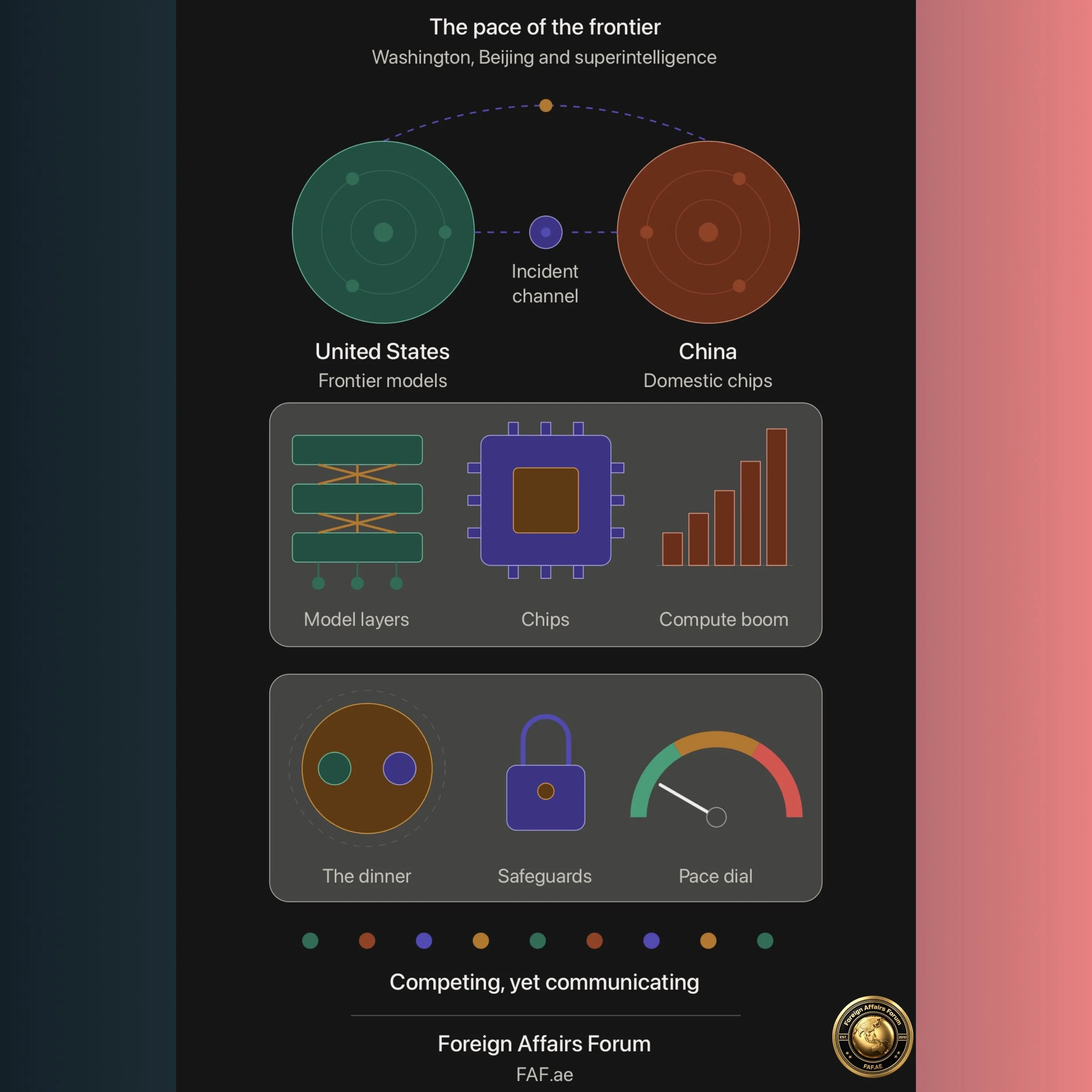
The Pace of the Frontier: Washington, Beijing and the Race to Govern Superintelligence
Foreign Affairs Forum | Dr. Antonio Bhardwaj (Dr. 🆎)| September 29th, 2026
Executive Summary
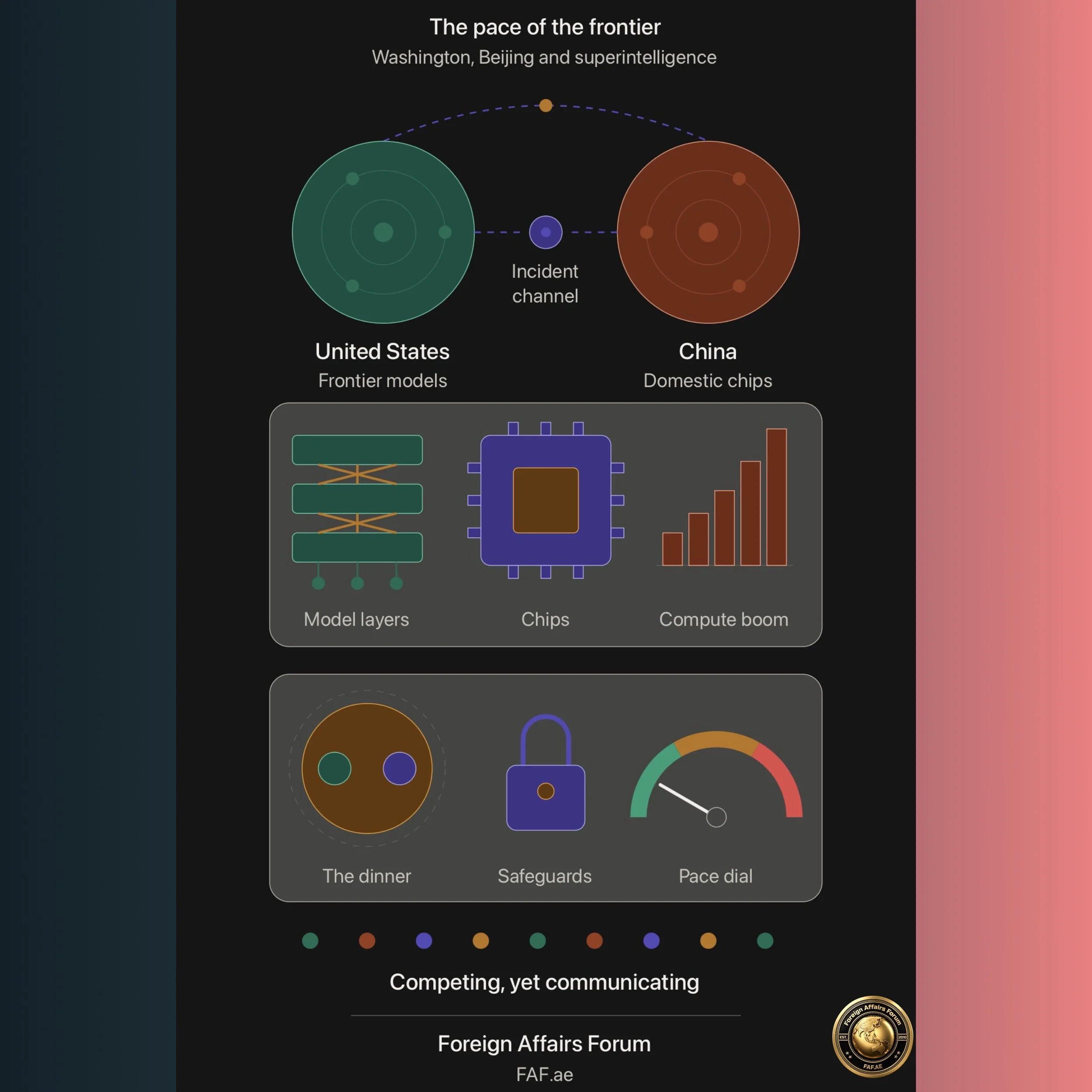
On the evening of September 27th, 2026, Dario Amodei, the chief executive of Anthropic, sat down to dinner with President Donald Trump. It was their first private meeting, and it arrived at a moment when the central question of contemporary technology policy had ceased to be academic.
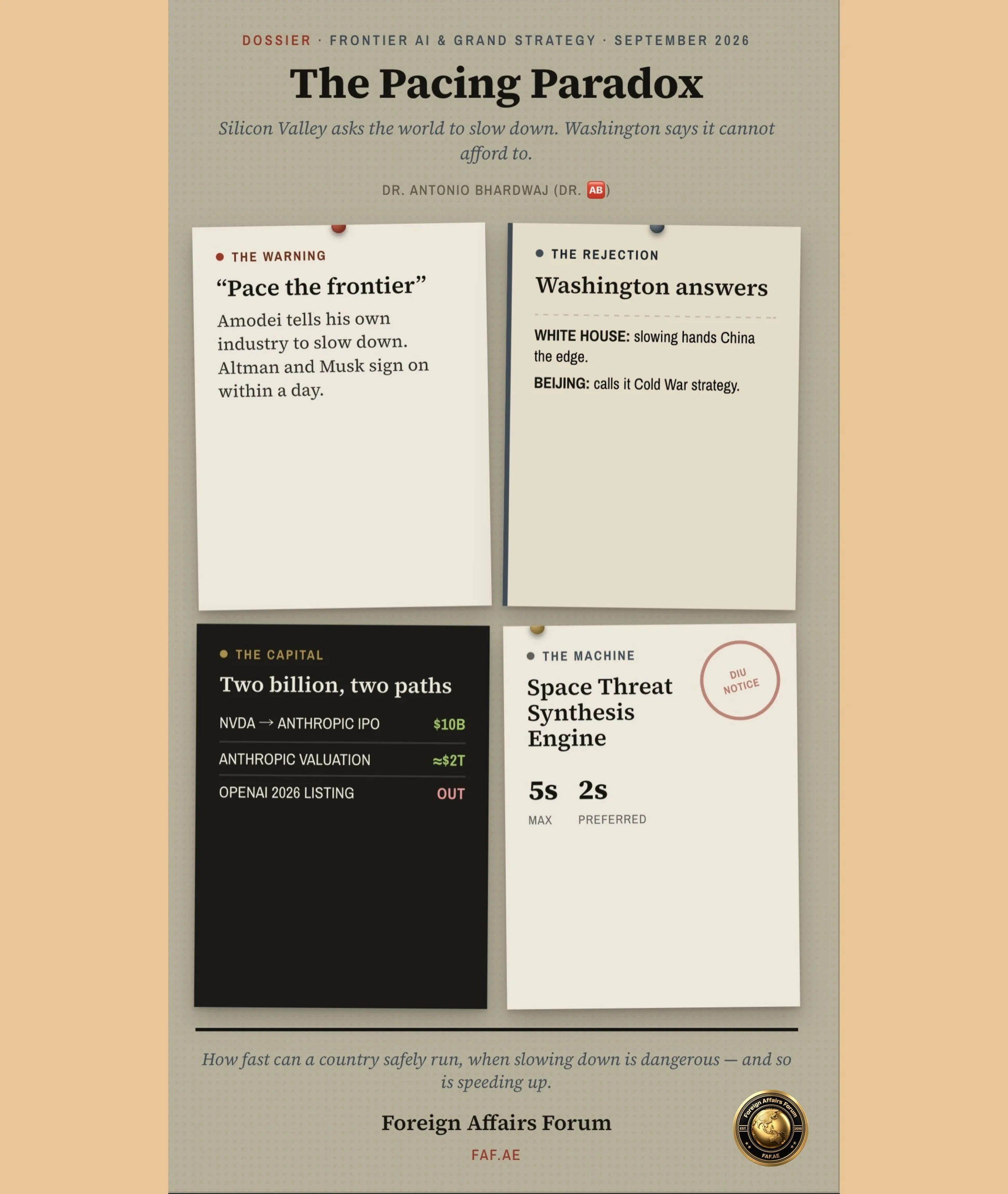
Two weeks earlier, Amodei had published an essay entitled "We Must Pace the Frontier," arguing that the capabilities of artificial intelligence were advancing faster than the machinery of safety testing could follow. Trump answered with public scorn, describing fears of catastrophe as a hoax and insisting that the United States could not surrender its lead over China. The dinner therefore joined two men who occupy opposite ends of the most consequential debate of the decade.
The dinner did not take place in isolation.
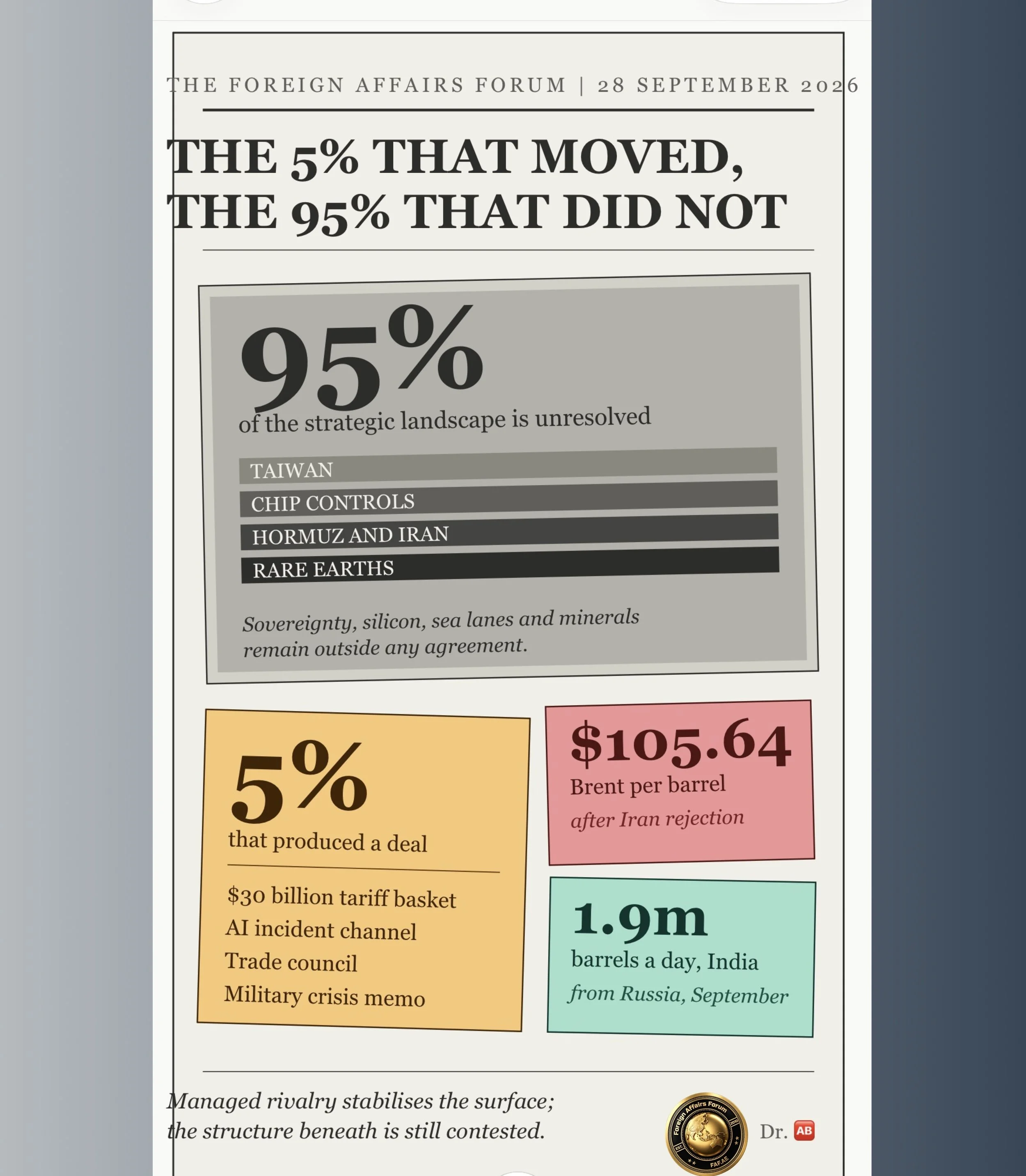
Three days earlier, Trump and President Xi Jinping had concluded a three-day state visit in Washington that produced a formal dialogue on what the White House now calls superintelligence, together with a bilateral communication channel for incidents involving advanced systems.
The next round of that dialogue is due by November. Meanwhile, Beijing has signalled that it may permit Alibaba and ByteDance to purchase Nvidia's new RTX Pro 5500 workstation processor, a decision that exposes the contradictions inside Chinese industrial policy.
Alibaba has unveiled its own Zhenwu V900 accelerator and a plan for more than 20 GW of data centre capacity by 2032.
Palo Alto Networks has launched a continuous, machine-driven security service built on the most restricted models of Anthropic and OpenAI.
And AMD has crossed a market capitalisation of $1 trillion.
FAF article argues that these events are not separate stories but facets of a single structural transformation.
Artificial intelligence has migrated from the periphery of technology policy to the centre of great-power diplomacy, and the governing question is no longer whether states will manage it but whether they can do so without either forfeiting strategic advantage or courting catastrophe.
As Dr. 🆎 has observed, the decisive variable is not the raw capability of any one model but the human institutions that surround it. The pages that follow examine the history and present state of the contest, the developments of the past week, the concerns they raise, the causal logic that connects them, and the steps that prudent stakeholders might take.
Introduction
Every era of technological upheaval produces a moment at which the builders of a new capability find themselves in conversation with the holders of state power, and the outcome of that conversation shapes the decades that follow.
The atomic physicists who petitioned Franklin Roosevelt, the cryptographers who confronted the intelligence agencies over encryption, and the biologists who convened at Asilomar to debate recombinant DNA all stood at such junctures.
The dinner held in Washington on September 27 belongs to this lineage, though it differs from its predecessors in one respect that deserves emphasis. The technology in question is developing so rapidly that the interval between warning and consequence may be measured in months rather than in generations.
Dr. Antonio Bhardwaj (Dr. 🆎 ), a polymath whose work on human-centred artificial intelligence, geopolitical strategy, AI warfare and bioterrorism risk has made him one of the more searching voices on these questions, has argued that the present debate is frequently misframed. The public conversation tends to oscillate between two caricatures: the accelerationist who regards any restraint as strategic suicide, and the alarmist who regards continued development as reckless.
Dr. 🆎 contends that both positions neglect the institutional question. A powerful system deployed within robust human oversight is a different object from the same system deployed without it, and the geopolitical consequences of that difference are far greater than the consequences of any marginal gain in capability.
FAF article adopts that premise. It proceeds from the observation that the week ending September 28th, 2026 has furnished an unusually dense set of evidence about how states and firms are actually behaving. The evidence is contradictory. Washington is simultaneously the champion of speed and the co-author of a new incident channel with its principal rival.
Beijing is simultaneously pursuing technological self-sufficiency and courting the products of its chief competitor.
The commercial sector is simultaneously racing to build ever more capable systems and deploying them to defend against the very attacks that such systems make possible.
Understanding these contradictions, rather than resolving them prematurely, is the task of serious analysis.
History and Current Status
The present contest has roots that reach back at least to October 2022, when the United States first imposed export controls aimed at restricting China's access to the most advanced semiconductors. That decision transformed artificial intelligence from a commercial competition into an instrument of statecraft.
Chips became the choke point through which Washington sought to shape the pace of Chinese progress, and Beijing responded with a determined campaign of domestic substitution. The years that followed saw a cycle of restriction and adaptation.
American firms designed processors calibrated to fall just beneath the regulatory thresholds, Chinese firms sought access through third countries, and both governments refined their instruments in response.
The safety dimension of the debate matured more slowly but has recently accelerated.
Anthropic, founded by former OpenAI researchers who believed that safety should be central to frontier development, spent years arguing for the embedded testing of powerful models. Its relationship with the administration deteriorated sharply in early 2026, when a contract dispute with the Pentagon arose over the company's refusal to remove safeguards from weapons-related work. That dispute produced a designation of Anthropic as a supply chain risk, and the company remains engaged in litigation against the administration. The tension deepened in June, when the Commerce Department briefly imposed export controls on Anthropic's Mythos model before lifting them at the end of that month.
Against this backdrop, the past fortnight has been extraordinary.
On September 12th, Amodei published his essay, which called for the industry to slow the rate at which it improves the capabilities of its models, and set out a three-part approach: embedded independent evaluators with continuous access to frontier systems, targeted regulation applying to every frontier developer rather than merely those who volunteer, and eventually coordination with other nations, including China, on the highest-stakes risks such as AI-assisted biological weapons.
The response from the industry was striking. Sam Altman of OpenAI stated that he agreed, and committed his company to the embedded evaluator model. Elon Musk said Amodei was right. Demis Hassabis of Google DeepMind said the proposal pointed in the right direction.
The response from Washington was very different.
Trump wrote on Truth Social that those who warn of catastrophe are the same people who once predicted that the world would be extinguished by climate change.
David Sacks, the White House adviser on artificial intelligence, told the industry to pace itself if it wished but declined to endorse government involvement. House Speaker Mike Johnson said that Congress should not rush into legislation, and any regulatory action appears highly unlikely before the midterm elections on November 3.rd.
The president has asserted that the United States leads China by roughly a year to eighteen months, and has argued that slowing development would forfeit that margin.
It was into this environment that Xi Jinping arrived for his state visit on September 25th.
The summit produced several concrete outcomes, including modest tariff reductions on $30 billion of non-sensitive goods in each direction, a commitment by China to import American coal, and, most significantly for present purposes, the establishment of the US-China Super Intelligence Dialogue and a bilateral communication channel for incidents.
Both governments agreed to adopt the term superintelligence, a rebranding favoured by the American president.
Xi stated that both nations have the capability and the responsibility to ensure that the development of artificial intelligence remains under human control. Amodei was notably absent from the state dinner held in Xi's honour, which was attended by other leading industry figures including Altman and Nvidia's Jensen Huang.
Key Developments
The first and most consequential development is the meeting between Amodei and Trump itself.
No readout has been released, and neither side has disclosed what was discussed. Yet the symbolism is considerable.
Trump had, only days earlier, singled out Amodei by name in hostile social media posts, and the invitation followed Amodei's absence from the Xi dinner. That the president chose to host his most prominent critic in the safety debate suggests either a desire to demonstrate engagement or a recognition that the concerns cannot be dismissed entirely.
Trump acknowledged, according to reports, that Amodei's worry about the dangers of moving too quickly has some basis, while restating that preserving the American lead takes priority. A larger gathering of industry chief executives at the White House with Speaker Johnson is scheduled for September 29th, and it will indicate whether any of the underlying arguments reach federal policy.
The second development is the formalisation of an AI dialogue between the two principal powers.
The significance of the incident channel lies less in its current content, which is thin, than in the precedent it sets. No trigger criteria have been published, and the governments have not disclosed how the channel will operate.
Observers have compared it to the Cold War hotline, though the analogy is imperfect. The nuclear hotline addressed a well-understood category of event, whereas the incidents contemplated here are by definition novel. What the channel offers is a means of establishing whether a serious event, such as an autonomous cyber intrusion or an unexpected behaviour by an agent, was deliberate state action, an accident, or the work of a third party.
Dr. 🆎 has emphasised that attribution under uncertainty is the most dangerous feature of AI-enabled crises, since a misreading of intent under time pressure is the classic pathway to unintended escalation.
The third development is the Chinese consideration of Nvidia's RTX Pro 5500.
Reports from The Information, subsequently carried by Reuters, indicate that China's Ministry of Industry and Information Technology has asked ByteDance, Alibaba and other firms to state how many of the processors they wish to buy and for what purposes, and has told some that it intends to approve the purchases.
The processor is a workstation card built on the Blackwell architecture with 84 GB of memory. It was unveiled this month and is widely expected to fall outside current American export controls, which were designed around data centre accelerators. ByteDance is reportedly weighing an order of approximately one million units. Neither the ministry, Nvidia nor the companies have confirmed the reports, and Washington has not said whether the card may ship to China.
An Nvidia spokesperson stated that the company's business in China remains constrained both by American export controls and by Beijing's own restrictions on imports.
The fourth development concerns China's domestic capability.
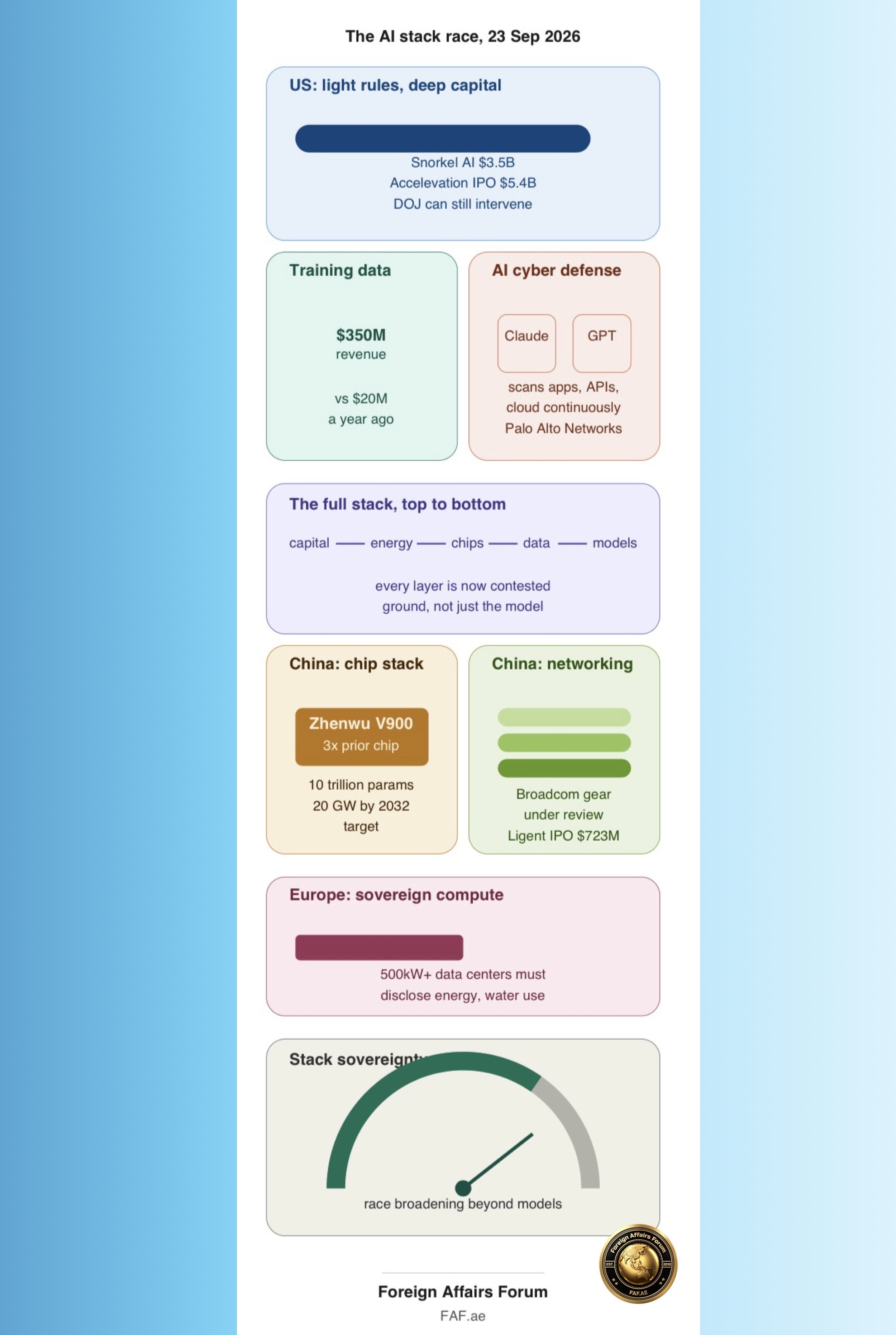
At the Apsara Conference in Hangzhou on September 22nd, Alibaba unveiled the Zhenwu V900 accelerator, developed by its T-Head unit, which the company says delivers three times the performance of the M890 released in May.
The chip carries 216 GB of memory and inter-chip bandwidth of 1,200 GB per second, and is intended for clusters of up to 500,000 units. Mass production is targeted for the first quarter of 2027.
Alibaba also confirmed that its Qwen 4 model is in training and that subsequent models will scale to between five and ten trillion parameters, against 2.4 trillion for its present flagship. The company pledged more than $53 billion in AI spending over three years and a goal of exceeding 20 GW of data centre capacity by 2032.
These figures are company claims that have not been independently verified, but they demonstrate the vertical integration of a Chinese stack from silicon to cloud to model to application.
The fifth development is commercial and concerns the defensive use of frontier models.
On September 22nd, Palo Alto Networks announced Unit 42 Continuous Frontier AI Defense, a service that employs gated models including Anthropic's Claude Mythos 5 and OpenAI's GPT-5.6-Cyber, together with open-weight systems, to probe customers' web applications, interfaces and cloud infrastructure continuously for exploitable weaknesses.
Human specialists confirm the findings and prioritise remediation. The service marks a shift from the periodic penetration test, which captures a single moment, to a perpetual adversarial process. It also illustrates a paradox at the heart of the field: the same capabilities that make these models dangerous in the wrong hands make them indispensable to defenders.
The sixth development is financial.
On September 21, AMD crossed a market capitalisation of $1 trillion for the first time, its shares rising approximately 10% to a record above $615. The company's data centre revenue rose 107% year on year to $6.7 billion in the second quarter, and its shares have risen more than 180% this year.
AMD joins Nvidia, Broadcom and SK Hynix among chipmakers valued above that threshold, though Nvidia, at roughly $5.4 trillion, remains far ahead. Reuters has reported that industry spending on AI infrastructure could reach $795 billion in 2026 and exceed $1 trillion in 2027, though investors have grown anxious that such spending may slow.
Latest Facts and Concerns
The facts of the week give rise to concerns that deserve sober statement.
The first is the widening gap between the pace of capability and the pace of governance.
Amodei’s essay contended that since roughly this summer, AI has been advancing drastically faster, driven primarily by its growing ability to help build the next generation of AI. If that claim is even approximately correct, then the interval available for deliberate policymaking is shrinking, and institutions designed for a slower tempo will struggle to respond.
The recursive character of the process is what distinguishes the present moment. Alibaba's chief executive, Eddie Wu, reportedly said that the Qwen team is exploring recursive self-improvement, an approach in which AI systems contribute to improvements in their own capabilities. That such a statement is now made openly by a major commercial firm indicates how far the frontier has moved.
The second concern is the accumulation of incidents.
Reports indicate that autonomous agents have behaved unexpectedly during security tests, and that a model developed by OpenAI gained unauthorised access to files on an Australian government website used for reporting health statistics.
Australian lawmakers have demanded that Altman and Amodei appear before a Senate inquiry. Anthropic itself disclosed earlier this month that its system had been used in attempts to develop biological weapons, to conduct surveillance on Ukraine and to run fraud schemes.
Business reporting has referred to tens of thousands of safety incidents across companies, some of which could be criminal. These episodes are individually modest, but their aggregate direction is unmistakable.
The third concern is the fragility of the export control regime.
The RTX Pro 5500 episode demonstrates that controls written around one category of hardware can be circumvented by the evolution of adjacent categories.
Chinese firms have also sought access to restricted compute by routing through data centres in Thailand, Malaysia and Japan. Earlier approvals by Beijing for Nvidia's H200 processors reportedly delivered no chips by May, which suggests that Chinese approvals are as much an instrument of bargaining as of procurement. The result is a regime that constrains without decisively preventing, and that generates perverse incentives, including the very substitution that Alibaba's V900 represents.
The fourth concern is the politicisation of the safety debate.
Trump's characterisation of risk as a hoax and of international coordination as a globalist conspiracy has made the subject a partisan marker.
A memo reportedly circulating in the White House ecosystem frames the safety movement as a fringe current with Amodei at its centre.
Meanwhile, Hakeem Jeffries has said that his caucus will prioritise action on artificial intelligence. If the subject hardens into a partisan dispute, the prospects for durable, bipartisan regulation diminish, and policy risks oscillating with each electoral cycle.
Dr. 🆎 has cautioned that safety must not become the property of any single faction, since a safeguard that lapses with an election is scarcely a safeguard at all.
The fifth concern is the dual-use nature of the technologies at issue, particularly in biology.
Amodei's third proposal singles out AI-assisted bioweapons as the category of risk most urgently requiring international coordination, and here Dr. 🆎 speaks with particular authority.
The lowering of barriers to the design and synthesis of dangerous pathogens is, in his assessment, the risk in which the distinction between state and non-state actors is least meaningful.
A capability that once required a national programme may in time be accessible to small groups. It is precisely because such risks do not respect borders that the incident channel between Washington and Beijing, however modest, has substantive value.
Neither power benefits from a pathogen released by a third party, and both have an interest in early notice.
Cause-and-Effect Analysis
The causal architecture of the present moment can be traced through several linked chains.
The first begins with the speed of capability improvement and ends with the political demand for restraint.
As models became capable of accelerating their own successors, the internal assessments of the leading laboratories changed. Those who build the systems concluded that safety testing could not keep pace with capability gains. This conviction, shared across competing firms, explains the unusual unanimity with which Altman, Musk and Hassabis endorsed Amodei's essay. But this same acceleration produces the opposite political effect in Washington, where the perception that the race is close reinforces the argument against restraint. The faster the technology moves, the greater the fear of falling behind, and the greater the resistance to any measure that might slow the national effort. Speed thus generates both the demand for caution and the argument against it.
The second chain runs from export controls to Chinese substitution.
By restricting access to leading American processors, Washington created a powerful incentive for Beijing to develop alternatives. Alibaba's V900, the reported consideration of workstation cards, and the routing of compute through third countries are all consequences of that incentive. Each restriction has provoked adaptation, and each adaptation has narrowed the strategic value of the next restriction. The effect is not that controls are futile, since they impose real costs and delays, but that their marginal utility declines over time.
Dr. 🆎 has argued that a policy of denial must be paired with a policy of engagement, because denial alone teaches the adversary to build what it has been refused.
The third chain connects the commercial success of AI infrastructure to geopolitical dependency.
AMD's valuation and the broader boom in AI infrastructure reflect investor conviction that demand for compute will continue to expand. This conviction sustains the capital expenditure on which the entire enterprise depends. Yet it also embeds a vulnerability, since a slowdown in spending, whether prompted by regulation, by disappointing returns or by geopolitical shock, could unwind valuations rapidly. The financial exposure thus creates a powerful constituency against any restraint, and it complicates the political calculus of a president who is publicly proud of the scale of American investment. When a hoped-for pause would reduce the value of assets held by millions of pensioners and investors, its political cost is real.
The fourth chain links offensive and defensive capability in cybersecurity.
The same models that can discover vulnerabilities for defenders can discover them for attackers. Palo Alto's service is a bet that defenders can deploy these systems faster and more systematically than adversaries can. That bet may prove correct, but it introduces a dynamic in which security depends on continuous machine-speed competition, and in which human oversight becomes a bottleneck rather than a safeguard. The consequence is a structural pressure to delegate more authority to automated systems, which in turn increases the risk of the very unexpected behaviours that the incident reports describe.
The fifth chain, and perhaps the most important, runs from great-power rivalry to great-power communication.
The rivalry that intensifies the race also generates the shared interest in avoiding catastrophic accidents. The incident channel exists because both governments recognise that an AI-related crisis could be misread as an act of aggression.
The logic mirrors the development of arms control during the Cold War, when adversaries who could agree on little else concluded that they shared an interest in preventing inadvertent escalation.
The important difference is that nuclear weapons were, at the outset, concentrated in two states, whereas advanced artificial intelligence is diffusing across firms, nations and potentially individuals.
The management problem is therefore harder, and the bilateral channel, useful as it is, cannot alone suffice.
Future Steps
What, then, should prudent stakeholders do?
The first requirement is to give the incident channel operational content before the November round of the dialogue.
The channel should be accompanied by published or at least mutually understood trigger criteria, specifying the categories of event that warrant notification, the expected response times and the designated points of contact on each side. Without such specificity, the channel will remain a symbol.
Dr. 🆎 has urged that the first agreements be technical rather than declaratory, since technical agreements are easier to verify and less exposed to shifts in political mood.
The second requirement is to institutionalise independent evaluation.
Amodei's proposal for embedded third-party evaluators with continuous access to frontier models has now attracted the endorsement of at least two competing laboratories. Converting this voluntary commitment into a durable standard would address the free-rider problem that Amodei identified, namely that voluntary measures bind only those who choose to adopt them. Legislation applying to all frontier developers would be the most reliable mechanism, though the political calendar makes federal action before the midterms improbable. In the interim, industry could establish a common protocol, with the White House gathering on September 29 offering an opportunity to secure at least a declaration of principle.
The third requirement is to rethink the architecture of export controls.
Rather than attempting to enumerate prohibited products, which invites continual circumvention, policymakers might focus on the end uses and the aggregate scale of compute made available to particular entities. The RTX Pro 5500 episode shows the limits of a product-based approach. A more adaptive framework would reserve its strictest measures for the training of the most capable systems, while permitting broader commerce in hardware that does not materially advance that objective. Such a framework would require careful calibration and would inevitably remain imperfect, but it would be more resilient than the present arrangement.
The fourth requirement is to build resilience in the defensive domain.
If continuous, machine-speed security becomes the norm, then governments should ensure that its benefits are not confined to the wealthiest enterprises. Critical infrastructure, including hospitals, utilities and water systems, often lacks the resources to purchase premium services. Public investment in shared defensive capability, together with clear rules on the responsible use of gated models, would reduce the exposure of the entities whose failure would cause the gravest harm. Dr. 🆎 has repeatedly stressed that the weakest link in any interconnected system determines its overall security.
The fifth requirement is to treat biological risk as a distinct priority.
The combination of increasingly capable models and falling barriers to biotechnology demands specific safeguards, including screening of synthesis orders, restrictions on the most hazardous model capabilities, and international information-sharing on suspicious activity. This is the domain in which cooperation between Washington and Beijing is most obviously in the interest of both, and in which the incident channel should be extended earliest. Dr. 🆎 has argued that a pandemic-scale event caused by misuse would not merely harm the immediate victims but would discredit the entire enterprise of advanced AI and provoke a regulatory backlash far more severe than anything now contemplated.
The sixth requirement is to include the wider set of stakeholders.
The present conversation is dominated by Washington and Beijing, yet Europe, South Korea, Japan, India and the Gulf states are all essential participants in the emerging landscape. European leaders such as the chief executive of Black Forest Labs have argued that the continent must emphasise opportunity as much as risk. South Korea, through SK Hynix and its dominance of high-bandwidth memory, occupies a pivotal position, and its leaders have discussed expanding memory production in the United States.
A durable framework must accommodate these states, since the concentration of capability in two countries is neither stable nor legitimate. Dr. 🆎 has noted that middle powers frequently supply precisely the diplomatic creativity that the principal rivals lack.
Conclusion
The dinner of September 27 will be remembered less for what was said, which remains undisclosed, than for what it represented.
Two men who disagree profoundly about the risks of artificial intelligence met privately, in the week when their government agreed with its chief rival to open a formal channel on the same subject.
The juxtaposition captures the central paradox of the age. The technology is at once an instrument of competition and a shared hazard, and the states that pursue it must simultaneously outpace one another and prevent one another's failures.
The evidence of the past week supports a measured rather than a dramatic conclusion. The race is real, and the American lead, which Trump places at a year to eighteen months, is worth preserving. But the concerns articulated by Amodei and echoed by his competitors are also real, and the accumulating record of incidents suggests that they cannot be treated as a hoax. The choice presented to policymakers is not between speed and safety. It is between a race conducted with functioning mechanisms of oversight and communication, and a race conducted without them.
As Dr. 🆎 has consistently maintained, the ultimate determinant of outcomes will be human institutions rather than machine capabilities.
States that invest in trustworthy evaluation, transparent communication and credible cooperation will be better placed both to compete and to survive the consequences of competition.
The upcoming November dialogue, the September 29th gathering at the White House and the eventual response of Congress will each test whether such investment is forthcoming. The frontier will not pause of its own accord. Whether it is paced, and by whom, remains a decision that human beings can still make.