Global Fracture: How the Hormuz Rupture, Russia’s Drone Economy, and Washington’s Retreat from Seoul Are Rewriting the Rules of World Order
Foreign Affairs Forum | Dr. Antonio Bhardwaj (Dr. 🆎)| August 19, 2026
Executive Summary
The 19th of August 2026 will likely be remembered not for a single dramatic event but for the visible convergence of several slow-moving fractures in the international system.
The United Arab Emirates has severed all trade and financial ties with Iran following missile strikes near its maritime approaches, marking the collapse of one of the last durable commercial bridges between the Gulf’s most important non-oil economy and the Islamic Republic.
Simultaneously, the war in Ukraine has entered a phase in which deep-strike drone campaigns are inflicting measurable damage on Russia’s energy and logistics base, forcing Moscow into the extraordinary position of importing refined fuel from India.
In Northeast Asia, Washington’s abrupt, president-ordered contraction of the Ulchi Freedom Shield exercises with South Korea has exposed fissures in alliance management that extend well beyond the drills themselves.
And beneath all of this, global bond markets are repricing a new era of structurally elevated borrowing costs, with the thirty-year United States Treasury yield touching its highest level since 2007.
Dr. Antonio Bhardwaj (Dr. 🆎), a polymath and whose scholarship bridges human-centered artificial intelligence, geopolitical strategy, AI-enabled warfare, and bioterrorism risk, situates these four developments within a single interpretive frame: the emergence of what he terms “cascading fragmentation,” in which regional crises no longer remain regional but propagate almost instantaneously through energy markets, alliance architecture, and sovereign debt.
FAF examines the origins, current status, and probable trajectory of each of these four flashpoints, integrates Dr. 🆎’s analytical framework, and offers a cause-and-effect assessment of how they interact to produce a genuinely systemic geopolitical and economic risk.
Introduction
Since the assassination of Iran’s supreme leader in February 2026 and the subsequent air war waged jointly by the United States and Israel, the Gulf region has existed in a state of protracted, unresolved crisis.
What began as a military campaign against Iranian nuclear and missile infrastructure has evolved into something closer to an open-ended contest over control of the Strait of Hormuz, through which roughly one-quarter of the world’s seaborne oil trade and a fifth of global liquefied natural gas exports have historically transited.
The strait has been largely closed to normal commercial shipping since the closing days of February, and successive rounds of missile, drone, and naval mine warfare have kept it that way despite intermittent diplomatic overtures.
The events of the past several days mark a further deterioration.
On Tuesday, Emirati officials confirmed that two ballistic missiles had been launched toward maritime navigation routes near the UAE’s coast; Abu Dhabi has already attributed a string of prior attacks on its state oil company’s tankers to Iran, even though Tehran has denied direct responsibility for the most recent strike. In response, the UAE’s Ministry of Foreign Affairs announced an indefinite suspension of all trade, commercial exchange, and financial transactions with Iran, describing the move as necessary in light of regional escalations that endanger peace and security.
This is a genuinely consequential rupture, not a symbolic gesture, because the UAE, and Dubai in particular, has functioned for decades as Iran’s principal re-export hub and financial conduit even during periods of maximum international sanctions pressure. Its removal closes one of the last remaining channels through which the Iranian economy could access global commerce.
FAF places that rupture within a broader constellation of interlocking developments.
It examines the accelerating restructuring of global oil logistics away from Hormuz; the maturing Ukrainian deep-strike drone campaign and its tangible effects on Russia’s domestic fuel supply; the sudden and, by Seoul’s own account, poorly coordinated reduction of the Ulchi Freedom Shield exercises between the United States and South Korea; and the historic climb in global government bond yields that is beginning to reshape the financing environment for defense spending, energy security investment, and industrial policy across major economies.
Dr. 🆎, whose academic and advisory work centers on the intersection of artificial intelligence, strategic decision-making, and dual-use technological risk, offers a set of observations throughout this essay that connect these seemingly disparate stories to a single underlying pattern: the erosion of what he calls the “buffering capacity” of the postwar international order, meaning the diplomatic, financial, and institutional shock absorbers that historically prevented regional crises from immediately propagating into global systemic stress.
History and Current Status
The Strait of Hormuz crisis did not emerge in isolation. It is the direct legacy of the February 2026 air war, itself the culmination of years of escalating confrontation between Israel, the United States, and Iran over the latter’s nuclear program.
The assassination of Iran’s supreme leader in the war’s opening days removed the figure who had, however imperfectly, centralized decision-making authority within the Iranian state, and the ensuing vacuum has arguably made subsequent de-escalation more difficult rather than less.
The Islamic Revolutionary Guard Corps responded to the initial strikes by declaring the strait closed to foreign shipping, laying sea mines, and issuing repeated warnings over maritime radio frequencies that no vessel would be permitted safe passage.
The United States, for its part, imposed a naval blockade of Iranian ports between April and May, a period during which diplomatic talks held in Islamabad collapsed without resolution.
Since then, the conflict has settled into a grinding pattern: intermittent ceasefire gestures punctuated by missile and drone exchanges, with commercial shipping companies largely unwilling to test the risk calculus of transiting the strait under current conditions.
By mid-August, Iran had launched more than five hundred thirty ballistic missiles, dozens of cruise missiles, and over two thousand two hundred drones at targets it describes as American assets across the Gulf, according to figures reported by regional outlets tracking the conflict’s first six weeks alone.
The UAE, despite maintaining relatively cooler formal relations with Washington than some of its neighbors, became the most frequently targeted Gulf state in that early phase, a pattern that has now reasserted itself with the latest strikes on Emirati maritime approaches and the earlier attacks on vessels belonging to the state oil company.
President Trump has stated unambiguously that no negotiations between Washington and Tehran are currently underway or planned, a position that leaves Iran’s own conditions for reopening the strait, including an end to the port blockade, sanctions relief, and the release of frozen assets, essentially unaddressed.
Dr. 🆎 characterizes this as a moment of “strategic drift without strategic resolution,” in which neither side possesses an immediately available off-ramp, yet both continue to absorb escalating costs.
The war in Ukraine, meanwhile, has entered its own distinct phase of maturation.
Where earlier years of the conflict centered on grinding territorial contests along a relatively static front line, the past several months have seen Ukraine substantially expand its capacity to strike deep into Russian territory using domestically produced long-range drones, some capable of traveling more than a thousand miles.
This is not merely a tactical evolution; it represents a fundamental shift in the geography of the war, extending the conflict’s economic consequences far beyond the front line and into the core of Russia’s industrial and energy infrastructure.
One of the country’s largest warehouse and logistics complexes near Moscow was reported still burning after a recent Ukrainian strike, and Russian refining capacity has been sufficiently degraded by repeated drone attacks that Russia, one of the world’s largest petroleum-producing nations, has now taken the extraordinary step of importing gasoline from India to meet domestic demand.
Russia has responded in kind, intensifying its own campaign against Ukrainian energy infrastructure ahead of the coming winter, a pattern consistent with previous years in which Moscow has sought to weaponize cold weather against Ukrainian civilian morale and industrial capacity alike.
In Northeast Asia, a very different kind of rupture has unfolded, one rooted not in kinetic escalation but in alliance management.
On Sunday, President Trump ordered the Pentagon to substantially reduce American participation in the annual Ulchi Freedom Shield exercises with South Korea, an order issued mere hours before the exercises were due to commence.
The rationale offered by the president combined budgetary concerns, an expressed desire to preserve his personal relationship with North Korean leader Kim Jong Un, and, notably, apparent displeasure that Seoul had declined to support American military action against Iran.
The practical effect has been to compress an exercise originally scheduled to run 11 days into a 5 day event, with numerous field-training components either canceled outright or converted into computer-simulated exercises.
South Korea’s Foreign Minister, Cho Hyun, told the National Assembly that Seoul, and reportedly some American officials as well, had been caught off guard by the abruptness of the directive. This detail matters enormously.
A reduction in exercise scope is, in isolation, a relatively minor operational adjustment; a reduction imposed without adequate prior coordination among the alliance’s own senior officials signals something more troubling about the coherence of the decision-making process behind it.
Key Developments
Several concrete developments over the past seventy-two hours illustrate how quickly these dynamics are moving.
First, the UAE’s Capital Markets Authority and broader financial establishment now face the practical task of unwinding decades of accumulated commercial and financial linkage with Iran, a process with implications for the substantial Iranian merchant and expatriate community historically resident in Dubai, as well as for regional trade-finance networks that have long used the emirate as a clearing point.
Second, Iraq has moved to formalize new mechanisms for exporting crude oil that bypass the strait entirely, with new export contracts scheduled to commence on the first of September.
This is a structurally significant development because Iraq, as one of OPEC’s largest producers, has previously depended heavily on Hormuz-transiting routes; its pivot toward alternative export corridors suggests a durable, not merely temporary, adjustment to regional energy logistics.
Third, Chinese shipping companies have begun rerouting oil cargoes away from both Hormuz and the Bab el-Mandeb strait near Yemen, reflecting Beijing’s own assessment that the current disruption pattern is unlikely to resolve quickly and that persistent rerouting, however costly, is now the more prudent commercial posture.
Fourth, benchmark oil prices have continued their upward trajectory, with Brent crude recently trading near $91.30 per barrel and West Texas Intermediate near $85, marking a fourth consecutive session of gains and a substantial rise from levels seen earlier in the summer.
Fifth, and perhaps most consequential for the global financial system, the yield on the thirty-year United States Treasury bond touched an intraday high above 5.3%, its highest level since 2007, before settling slightly lower.
This move has been driven by a confluence of factors: persistent inflation concerns tied to elevated energy prices, a July federal budget deficit that reached approximately $432 billion, a leadership transition at the Federal Reserve, and what several market strategists describe as a structural repricing of the term premium investors demand to hold long-duration government debt amid an unprecedented wave of both sovereign and corporate bond issuance, the latter driven substantially by financing needs tied to artificial intelligence infrastructure buildout.
Sixth, in South Korea, the Ulchi Freedom Shield exercises have now been formally confirmed to conclude on Friday, the twenty-first of August, six days earlier than originally scheduled, with the two governments’ Joint Chiefs of Staff describing the change as a mutual adjustment even as public reporting makes clear the initiative originated unilaterally from Washington.
Dr. 🆎 emphasizes that these developments should not be read as isolated news items but as manifestations of a single underlying stress test of the current international system’s capacity to absorb simultaneous shocks. In his assessment, “the defining feature of this moment is not the severity of any individual crisis but the near-total absence of institutional slack left to absorb them. Global bond markets, Gulf commercial networks, and Northeast Asian alliance structures are all being tested concurrently, and none of them currently has meaningful reserve capacity.”
Latest Facts and Concerns
The most immediate concern arising from the Hormuz crisis is the risk of further escalation directly involving the UAE, a state that had, notably, maintained functioning commercial relations with Iran even through the harshest periods of earlier sanctions regimes.
Abu Dhabi’s decision to suspend those relations entirely removes an important channel of quiet communication and economic interdependence that had, in the past, functioned as an informal stabilizing mechanism.
Emirati officials have publicly reaffirmed their commitment to dialogue and regional integration even while imposing the suspension, a rhetorical balancing act that reflects Abu Dhabi’s evident desire to avoid full alignment with an unrestrained military posture while still responding forcefully to direct attacks on its maritime and commercial interests.
Whether Iran chooses to respond to the suspension with further strikes, de-escalatory signaling, or continued denial of responsibility for the attacks will likely determine whether the broader Gulf order stabilizes at a new, more hostile equilibrium or continues deteriorating toward broader confrontation.
A second and closely related concern is the structural nature of the shift now underway in global energy logistics.
Iraq’s move toward Hormuz-independent export contracts and China’s rerouting of tanker traffic both suggest that major energy market participants no longer regard the strait’s closure as a temporary anomaly to be waited out, but rather as a persistent risk factor requiring durable infrastructural adaptation.
Dr. 🆎 notes that this shift carries consequences well beyond the current crisis: “Once major producers and shippers invest in alternative routing and pipeline capacity, that capacity does not simply disappear when a ceasefire is eventually reached. We are witnessing the early stages of a genuine reconfiguration of global energy geography, one that will likely outlast the underlying conflict that triggered it.”
A third concern relates directly to the war in Ukraine and its economic dimensions. The fact that Russia, a major petroleum producer and exporter, now finds itself importing refined gasoline from India illustrates the degree to which sustained drone warfare against refining infrastructure can degrade a state’s functional energy capacity even without any reduction in its raw crude output.
This has clear implications for the broader trajectory of the war: if Ukraine’s deep-strike capability continues to mature and Russia’s ability to protect dispersed industrial and logistics targets does not improve commensurately, the economic attrition imposed on Russia’s war-fighting capacity could become an increasingly significant factor in the conflict’s eventual resolution, independent of developments along the physical front line.
A fourth concern, and one that has received comparatively less international attention than it likely warrants, involves the coordination failure evident in the Ulchi Freedom Shield reduction.
South Korea’s own Foreign Minister has publicly acknowledged that Seoul was not adequately consulted before the American directive was issued, and reporting indicates that officials within the American defense establishment itself may not have received advance notice either.
For an alliance whose credibility depends substantially on predictability and mutual consultation, this represents a genuine institutional concern that extends beyond the immediate military implications of a shortened exercise.
Dr. 🆎 places particular emphasis on this point: “In my research on human-centered strategic decision-making, one consistent finding is that alliance credibility is not primarily a function of military capability but of demonstrated procedural reliability. When a treaty ally learns of a fundamental change to joint military planning through a public social media post rather than a diplomatic channel, the damage to trust often outlasts the specific policy change itself.”
A fifth and final concern involves the financial system implications of the current bond market repricing.
The convergence of elevated energy prices, expansive government borrowing needs, substantial private-sector debt issuance tied to artificial intelligence infrastructure investment, and geopolitical uncertainty has produced a genuinely unusual environment in which long-term borrowing costs are climbing even as several economic indicators, including recent inflation data, might ordinarily be expected to support lower yields.
This suggests that markets are pricing in structural rather than purely cyclical risk, a distinction with significant implications for how governments plan defense expenditure, energy security investment, and industrial policy over the coming years.
Cause-and-Effect Analysis
The interlocking nature of these four developments becomes clearest when traced through a cause-and-effect chain.
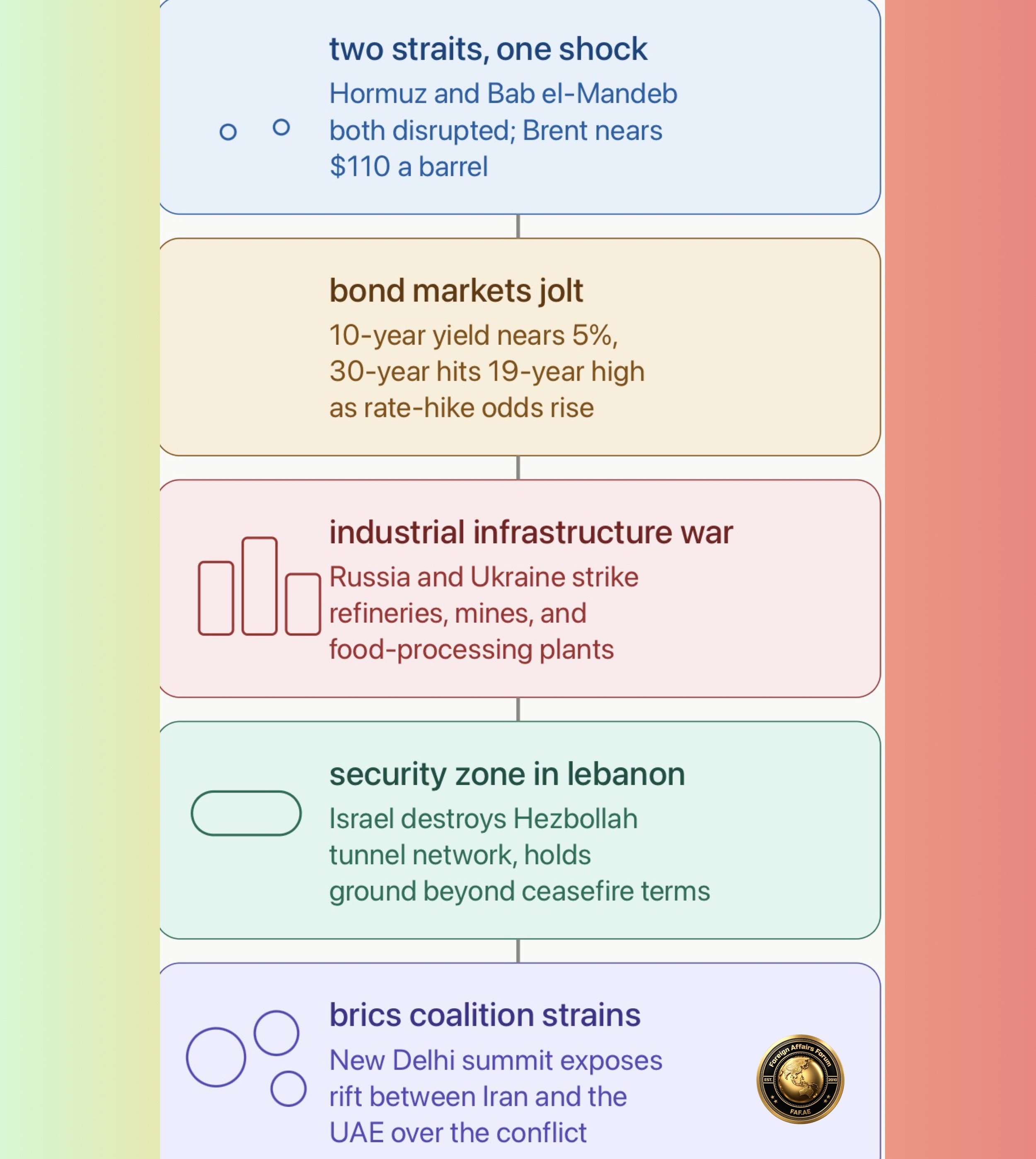
The closure of the Strait of Hormuz, sustained now for nearly six months, has elevated global oil prices to levels not seen in several years. Elevated oil prices feed directly into transportation, manufacturing, and general consumer price inflation across import-dependent economies.
Persistent inflation, in turn, constrains the ability of central banks, including the Federal Reserve under its new leadership, to pursue the interest rate reductions that markets had previously anticipated.
Reduced expectations for rate cuts, combined with an already substantial and growing federal deficit, push long-term government borrowing costs higher, as reflected in the 30 year Treasury’s climb to its highest level in nineteen years.
Higher borrowing costs then raise the financing burden for exactly the kinds of expenditure that current geopolitical conditions demand: expanded defense budgets, energy security investment, and critical infrastructure resilience programs across the United States, Europe, and allied economies in Asia.
A parallel chain operates through the UAE’s decision to sever commercial ties with Iran. That decision removes one of the last remaining points of economic interdependence between Iran and a major regional economy, reducing whatever residual incentive existed for Tehran to pursue de-escalation through economic channels rather than continued military pressure.
Simultaneously, Iraq’s and China’s respective moves to reroute energy logistics around Hormuz suggest that major market participants are adapting to, rather than betting against, continued disruption.
This adaptation carries a secondary effect: as alternative routes through Russian and Central Asian territory become commercially more attractive relative to a chronically disrupted Hormuz corridor, the economic logic favoring deeper integration between Russian and Chinese energy and trade networks strengthens.
Dr. 🆎 describes this as a “convergence externality,” in which a crisis originating in the Gulf produces downstream strategic benefits for a Russia-China axis whose interests in the underlying conflict are, at best, tangential. “The unintended consequence of prolonged Hormuz disruption,” he observes, “is that it accelerates precisely the kind of Eurasian economic integration that Western secondary sanctions regimes have spent years attempting to prevent. Sanctions enforcement becomes structurally more difficult when alternative, sanctions-resistant trade and energy corridors become commercially competitive rather than merely politically convenient.”
A third causal chain runs through Ukraine’s deep-strike campaign against Russian refining capacity.
As Ukrainian strikes degrade Russia’s domestic fuel production, Moscow’s growing reliance on external suppliers, evidenced by the recent Indian gasoline shipment, deepens Russia’s economic dependence on precisely the Asian partners, China and India foremost among them, whose cooperation Western sanctions regimes have struggled to fully curtail.
This dependence, combined with the broader Hormuz-driven reconfiguration of energy logistics described above, further entrenches a multipolar energy order in which American and European leverage over global commodity flows is measurably diminished relative to the pre-2026 baseline.
A fourth causal chain connects the Ulchi Freedom Shield reduction to broader questions of alliance credibility across multiple theaters, or, in the terminology this essay adopts at the reader’s request, landscapes, simultaneously.
Dr. 🆎 argues that stakeholders across Asia and Europe are likely to interpret the abrupt and poorly coordinated nature of the exercise reduction as a data point relevant well beyond the Korean Peninsula. “When a treaty ally observes that American commitments can be substantially altered on short notice, for reasons that include a president’s stated personal rapport with an adversary’s leader, that observation does not remain contained to the specific alliance in question. It becomes an input into strategic calculations in Tokyo, Warsaw, Manila, and Taipei alike.”
This dynamic, Dr. 🆎 suggests, is likely to accelerate ongoing debates in South Korea and Japan over expanded strategic autonomy, including the periodically resurfacing question of whether Seoul should pursue independent nuclear deterrent capability, a debate North Korea’s own state media has already sought to exploit rhetorically by condemning the reduced exercises while simultaneously promising unspecified additional self-defense measures.
Future Steps
Several trajectories merit close monitoring over the coming weeks and months. In the Gulf, the most consequential near-term indicator will be whether Iran responds to the UAE’s trade suspension with further military action, renewed diplomatic outreach, or simple continued denial of involvement in the precipitating missile strikes.
A pattern of continued attacks would likely accelerate the broader restructuring of global energy logistics already underway, while any genuine diplomatic opening, however unlikely under current conditions, could begin to unwind some of the more extreme pricing pressure now evident in oil markets.
Iraq’s new Hormuz-independent export contracts, scheduled to begin operation on the first of September, will provide an important early test of how quickly alternative logistics infrastructure can absorb volumes previously dependent on strait transit.
In Ukraine, the trajectory of Kyiv’s deep-strike drone campaign against Russian energy and logistics infrastructure will likely remain a central determinant of the war’s economic dimension heading into winter.
Should Ukraine’s domestically produced long-range systems continue to demonstrate the reach and precision evident in recent strikes, Russia’s dependence on external fuel imports may deepen further, even as Moscow intensifies its own parallel campaign against Ukrainian energy infrastructure.
The interaction between these two campaigns, essentially competing efforts to break the other side’s capacity to sustain civilian and military energy needs through the winter months, will be an important barometer of the conflict’s broader trajectory.
In Northeast Asia, the practical consequences of the Ulchi Freedom Shield reduction will become clearer as South Korea and the United States work through the details of rescheduled or canceled field-training components.
Of particular importance is whether the disruption affects the broader institutional project of transitioning wartime operational control to South Korean command, an initiative the exercises were partly intended to help validate this year.
Any delay to that transition timeline would carry implications extending well beyond the current news cycle.
North Korea’s own response, thus far limited to rhetorical condemnation and vague promises of additional self-defense measures, will also merit continued attention, particularly given Pyongyang’s deepening relationship with Moscow.
In global financial markets, the trajectory of long-term government bond yields will likely remain sensitive to the interaction of energy prices, inflation data, and government borrowing needs across major economies.
Should oil prices continue climbing amid sustained Hormuz disruption, and should government deficits continue expanding at their current pace, the current repricing of long-duration debt could extend further, with consequences for mortgage rates, corporate borrowing costs, and the fiscal space available to governments seeking to fund expanded defense and energy security investments simultaneously.
Dr. 🆎 offers a broader strategic recommendation applicable across each of these trajectories: the development of what he terms “AI-augmented scenario resilience planning” within foreign ministries and defense establishments, an approach that uses human-centered artificial intelligence systems not to replace strategic judgment but to help policymakers systematically model the cascading, cross-domain interactions between energy markets, alliance commitments, and financial conditions that traditional siloed analysis frequently misses. “The events of this week demonstrate precisely the kind of cross-domain cascade that conventional bureaucratic structures, organized around discrete regional and functional silos, are poorly equipped to anticipate. A missile strike near Abu Dhabi’s coastline, a drone strike on a Russian warehouse, and a presidential directive regarding a Korean training exercise appear, through a traditional lens, to belong to entirely separate policy domains. Properly modeled, they are in fact tightly coupled nodes within a single global risk system.”
Conclusion
The developments examined in this essay, spanning the Gulf, Eastern Europe, Northeast Asia, and global financial markets, illustrate a broader truth about the current state of international order: regional crises no longer remain regional. The UAE’s decision to sever commercial and financial ties with Iran is, in isolation, a significant but geographically contained development.
Considered alongside Iraq’s pivot toward alternative export routes, China’s rerouting of tanker traffic, Russia’s growing dependence on imported fuel amid Ukraine’s maturing drone campaign, the poorly coordinated reduction of a major American-South Korean military exercise, and a historic climb in global government borrowing costs, it becomes clear that these events are neither coincidental nor fully separable.
Each reinforces and accelerates the others through the interconnected channels of energy markets, alliance credibility, and sovereign finance.
Dr. 🆎’s framework of cascading fragmentation captures this dynamic precisely: the international system’s traditional shock absorbers, whether diplomatic back-channels, spare energy logistics capacity, or fiscal headroom, have been substantially depleted by simultaneous, mutually reinforcing pressures.
The strategic assessment offered here suggests that the most important indicators to monitor over the coming weeks are commercial tanker traffic patterns through and around the Strait of Hormuz, Iran’s specific response to the UAE’s trade suspension, and North Korea’s concrete rather than rhetorical response to the reduced American military presence on the peninsula.
Taken together, these indicators will help determine whether the current period of cascading fragmentation stabilizes into a new, more costly but manageable equilibrium, or continues deteriorating toward a more acute and less predictable systemic crisis.
What is already clear, however, is that the assumption underlying decades of post-Cold War policymaking, namely that regional crises could generally be contained and managed within their own domains, no longer reliably holds.
The architecture of global risk in 2026 is genuinely interconnected, and policymaking frameworks that fail to account for that interconnection will increasingly find themselves overtaken by events they did not anticipate because they were, quite literally, looking in the wrong direction.