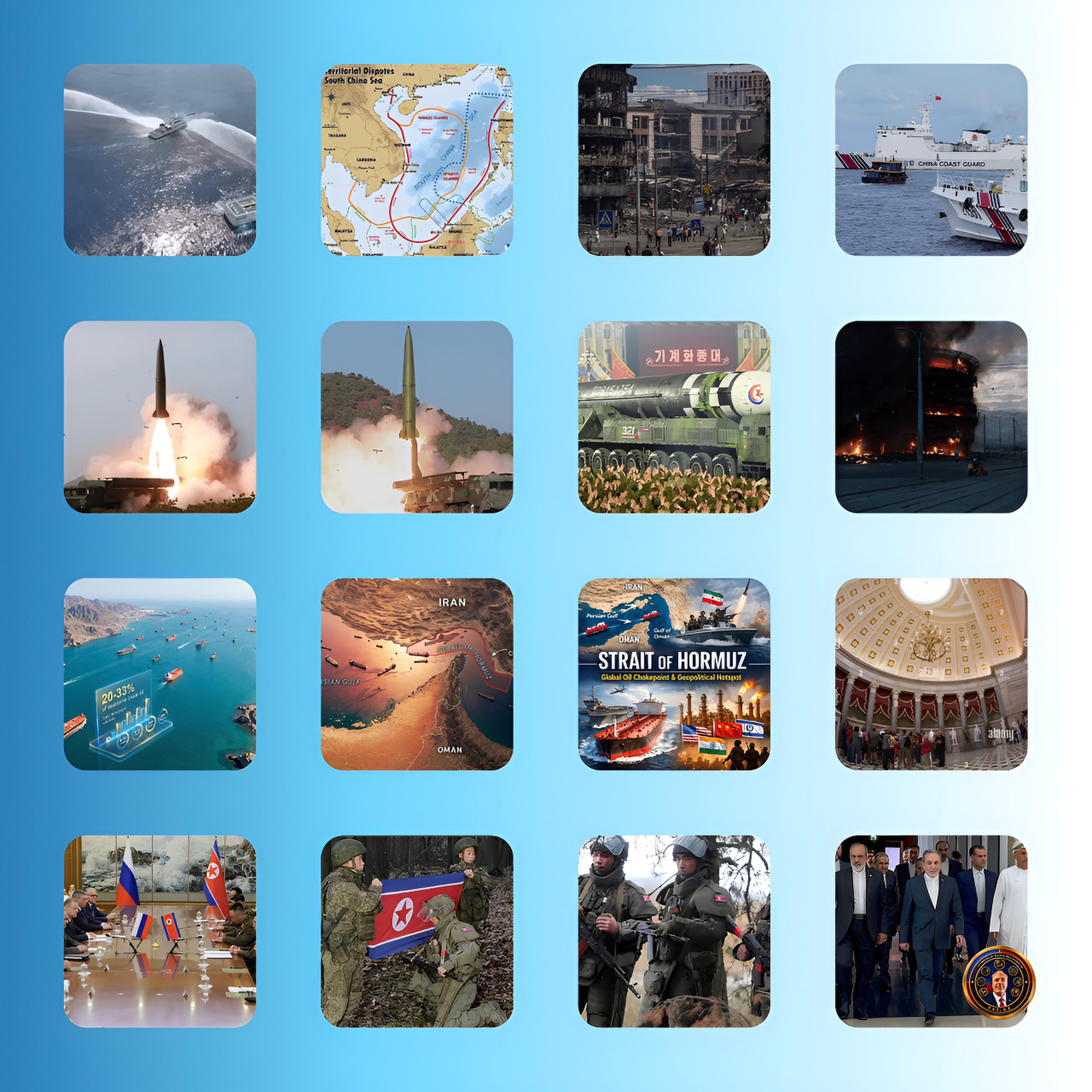
Fracture lines: how Hormuz, Kyiv, Pyongyang, and Beijing are converging into the world’s most dangerous geopolitical moment
Foreign Affairs Forum | Dr. Antonio Bhardwaj (Dr. 🆎)| August 10, 2026
Executive Summary
The first week of August 2026 has delivered a concentrated burst of geopolitical signals that, taken individually, would each constitute a major story. Taken together, they describe something more consequential: the convergence of four previously distinct crises — the Strait of Hormuz closure and its contested reopening, Russia’s escalating missile campaign against Ukraine, the deepening of North Korea’s military integration into the European war, and the transformation of US-China economic rivalry into a multi-domain confrontation spanning trade, maritime sovereignty, and energy politics.
FAF analysis examines how these dynamics interact, why financial markets may be systematically underestimating compound risk, and what the coming weeks will likely determine about whether the international order is moving toward a managed equilibrium or a cascading fracture.
Dr. Antonio Bhardwaj ( Dr. 🆎), a polymath with global expertise in human-centered AI for geopolitical strategy and AI warfare, contributes commentary throughout, arguing that the fusion of geopolitical landscapes represents not a temporary convergence but a structural feature of a world in which deterrence frameworks, supply chains, and energy architectures are being simultaneously renegotiated.
Introduction
There are moments in international affairs when the tempo of events accelerates in ways that exceed the analytical frameworks designed to interpret them.
The opening days of August 2026 constitute such a moment. From the contested waters of the Persian Gulf, where Iran’s Foreign Minister Abbas Araghchi told reporters that the reopening of the Strait of Hormuz was “subject to other conditions,” even as Tehran described its interim discussions with Oman as “very close” to producing a navigational agreement, to the skies over Kyiv, where Russian attacks killed seventeen people and wounded dozens as Ukraine’s depleted air defenses failed to stop any of Moscow’s incoming missiles overnight, the international landscape presents a picture of interlocking instabilities without recent precedent.
These are not merely proximate crises sharing a calendar. They are structurally linked through supply chains, military inventories, legislative architectures, and the strategic calculations of great powers whose interests increasingly cut across geography in ways that older regional frameworks cannot contain. The Strait of Hormuz crisis affects oil pricing for the same Asian economies that are now being targeted by proposed US secondary sanctions for buying Russian energy. Ukraine’s interceptor shortage was deepened by the same Iran war that unsettled Gulf security.
North Korea’s growing battlefield experience in Europe has direct implications for the security calculations of South Korea, Japan, and the United States in the Indo-Pacific. And China’s maritime assertiveness in the South China Sea proceeds alongside a tariff confrontation with Washington that has already produced a Supreme Court ruling, $100 billion in refunds, and new rounds of legally restructured import duties.
Dr. Antonio Bhardwaj (Dr. 🆎) , whose research sits at the intersection of human-centered AI, geopolitical strategy, and emerging technological risk, has observed that the present moment demands what he calls “systems-level geopolitical cognition” — the capacity to read simultaneous crises not as isolated shocks but as feedback loops within a single, fragile system. This analysis proceeds from that premise.
History and Current Status
The Strait of Hormuz: From Closure to Contested Reopening
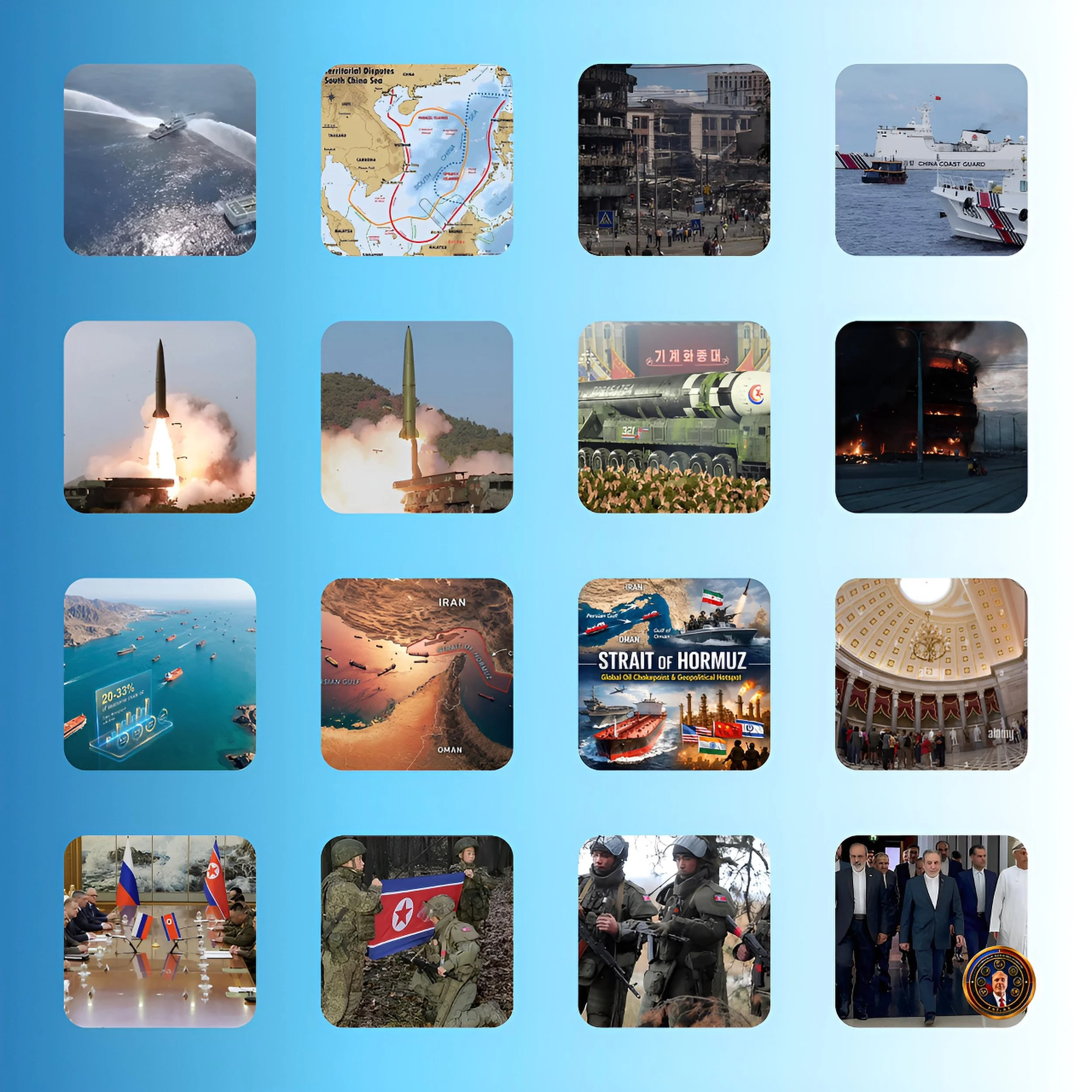
The Strait of Hormuz has been among the most strategically sensitive maritime chokepoints in the world for decades, but its significance acquired existential proportions in February 2026 when the United States and Israel launched a military campaign against Iranian targets, triggering Tehran’s closure of the strait to foreign shipping. Prior to the crisis, some 25% of the world’s seaborne oil trade and 20% of the world’s liquefied natural gas passed through the strait annually, and the Iranian Revolutionary Guard Corps issued warnings forbidding passage, boarded and attacked merchant ships, and laid sea mines in the waterway.
The months that followed produced a sequence of partial agreements, ceasefire frameworks, and unresolved disputes over navigational authority. A naval blockade of Iran from April 13, 2026, combined with Operation Project Freedom in early May, produced a temporary halt to hostilities, but the underlying questions about who controls the strait and under what legal regime remained unresolved. A memorandum of understanding signed in June between Washington and Tehran established a ceasefire framework and set out parameters for sanctions relief and frozen asset negotiations, but subsequent weeks saw continued strikes and counterstrikes that undermined confidence in the agreement’s durability.
By early August 2026, the diplomatic picture had crystallized into a structure of overlapping negotiations: Iran and Oman working on a bilateral transit arrangement, while Washington pressed for a comprehensive reopening that Tehran conditioned on a set of demands Washington found difficult to meet. The Secretary of Iran’s Supreme National Security Council stated that reopening the strait would require Washington to lift its naval blockade and sanctions, withdraw US military forces from the region, pay war reparations, and release frozen Iranian assets.
Russia, Ukraine, and the Missile War
The Russia-Ukraine war entered its fifth year of full-scale confrontation in conditions markedly different from earlier phases. Moscow had systematically adapted its missile campaign to exploit what had become Ukraine’s most acute vulnerability: a structural shortage of interceptor missiles for the US-made Patriot air defense system. Although Ukrainian air defenses managed to intercept nearly 90% of incoming drones on August 5, they failed to down a single one of the twenty-four ballistic missiles and four cruise missiles launched by Russia, killing at least seventeen people and injuring around forty-four others.
The root cause of this vulnerability is both technical and political. The Patriot system remains the only Western platform capable of reliably engaging Russian ballistic missiles, but the US supply of PAC-3 interceptors had been severely depleted by the Iran war earlier in 2026. Ukraine had run out of US-supplied interceptor missiles, with deliveries from Western allies shrinking to roughly one-third of their 2025 levels, a deterioration that President Volodymyr Zelensky had repeatedly flagged in urgent terms to allied capitals.
At the same time, Ukraine had adopted an asymmetric counter-strategy of its own, striking at Russia’s economic infrastructure with increasing precision and reach. Ukrainian Defense Forces carried out overnight strikes against two Russian oil refineries on August 8 — the Ilsky refinery in Krasnodar region and the Syzran refinery in the Samara region — both of which caught fire following the attacks. These strikes were part of a sustained campaign that had already, by Ukrainian official estimates, forced Russia to reduce its oil processing volumes by approximately 20%.
Key Developments
North Korea’s Military Integration into the European War
Perhaps the most strategically consequential development of the week was the deepening of North Korea’s military involvement in the Russia-Ukraine war — a development that fundamentally alters the geopolitical character of the conflict and its implications for Indo-Pacific security. Russia was preparing to deploy a North Korean missile unit in its Voronezh region as military cooperation between Moscow and Pyongyang continued to deepen, according to Ukraine’s Defense Intelligence, with the planned unit equipped with six launchers and one hundred and twenty North Korean-made ballistic missiles.
This deployment is qualitatively different from earlier phases of North Korean involvement. Pyongyang had already delivered a fresh batch of forty KN-23 and KN-24 short-range ballistic missiles along with crews to operate them, with the configuration of the deployment and the final missile total to be settled at senior-level talks between Moscow and Pyongyang scheduled for September 2026. Around ninety North Korean personnel were involved in the initial reported deployment; the United States confirmed awareness of it but provided no further details.
North Korea’s KN-23 and KN-24 missiles have a greater range and larger payload than Russia’s equivalent Iskander system, but are less accurate and have been linked to strikes with high civilian death tolls. This technical profile matters strategically: these missiles can only be intercepted by Patriot systems, which Ukraine is already critically short of. North Korea had reportedly supplied Moscow with approximately one hundred and fifty KN-23 and KN-24 missiles between late 2023 and August 2025, but the new deployment represents a further expansion of a relationship that has moved well beyond a conventional arms transaction.
Dr. 🆎 has argued that this development deserves particular analytical attention because it represents a form of “battlefield knowledge transfer” that may prove more strategically significant than the missile counts themselves. North Korean military personnel are gaining real-world operational experience against Western-supplied air defense systems, learning targeting patterns, electronic countermeasures, and tactical doctrines that will be directly applicable to any future contingency on the Korean Peninsula. The European war is, in this sense, a live testing environment for Indo-Pacific deterrence — a dimension that strategic analysts focused on NATO’s eastern flank risk underweighting.
The Graham Sanctions Act and the New Architecture of Energy Coercion
The US Senate voted 86-11 to pass the Lindsey O. Graham Sanctioning Russia and Iran Act of 2026, authorizing steep tariffs on China, India, and other countries to reduce their dependence on Russian oil and gas. The legislation carries the name of the late Senator from South Carolina, who had championed tougher measures against Moscow for years and whose death lent the bill additional momentum in the upper chamber.
The bill allows the president to impose tariffs of up to 100% on the top five purchasers of Russian oil or natural gas, with exceptions for countries that import less than 15% of their natural gas from Russia and are taking significant steps to reduce those imports. China and India are the largest buyers of Russian crude oil, making them the primary potential targets. The legislation also extends sanctions on Iran’s energy and weapons sectors, a provision added at the urging of President Trump that may complicate the bill’s path through the House, where it must still pass after the chamber returns from its August recess at the end of the month.
Analysts noted that one of the principal concerns among House members was how the tariff power in relation to Iran would be expanded, since it would effectively target China — a country Washington simultaneously needs for rare earth mineral cooperation and other strategic supply chains. The legislation thus crystallizes what has become the central tension in US foreign policy: the desire to impose maximum economic pressure on adversaries, while managing the collateral effects on strategically important partners whose behavior Washington wishes to shape but cannot afford to alienate entirely.
US-China Competition: The Multi-Domain Rivalry
The broader US-China competitive dynamic continued to evolve along multiple simultaneous axes during the same week. Following the Supreme Court’s rejection of earlier emergency tariffs imposed under executive authority, Washington imposed new 10% and 12.5% tariffs on imports from sixty trading partners, including China, under a different legal authority, while separately refunding approximately $100 billion in tariffs invalidated by the Court.
In the maritime domain, China and the Philippines clashed three times in a single week in July 2026 at Scarborough Shoal and Second Thomas Shoal, prompting joint US-Philippines-Japan maritime drills, while diplomatic talks remained stalled with daily friction at sea outpacing progress toward a Code of Conduct. The South China Sea remains one of the clearest pathways toward direct US-China confrontation, and Manila’s increasingly close military alignment with Washington means that a maritime incident of sufficient severity could trigger alliance obligations with consequences no party may be fully prepared to manage.
Latest Facts and Concerns
The Hormuz Negotiations: Political Announcements vs. Physical Reality
The most important analytical distinction to draw in the Hormuz negotiation is between political announcements and the physical reality of commercial shipping. Governments can issue statements; the actual test of any agreement is whether shipowners, maritime insurers, and cargo operators judge passage sufficiently safe to resume normal operations.
Iran’s Foreign Minister Abbas Araghchi stated that Iran was “very close” to a deal with Oman on managing the transit routes through the strait, but cautioned that the reopening was “subject to other conditions,” including the US making amends for what Tehran described as a violation of the June memorandum of understanding by seeking to establish alternative routes with US Navy protection. Some ships had transited the strait under US Navy escort, a practice Iran characterized as undermining its claimed authority over the waterway’s management.
Ship traffic through Hormuz was down 33% compared to the prior day’s levels, with most vessels using the Iranian-approved route, according to trade intelligence firm Kpler. Oil prices reflected the uncertainty: Brent crude futures settled above $83 per barrel even as the prospect of a deal briefly pushed prices lower, only for Iran’s additional demands to restore the risk premium.
What makes the Hormuz situation particularly resistant to simple resolution is its layered character. There is the immediate question of navigational arrangements — which ships transit where, under whose authority, and with what verification mechanisms. There is the broader question of the June memorandum’s viability as a diplomatic framework. And there is the deeper question of what Iran’s new leadership under Supreme Leader Mojtaba Khamenei — appointed following the assassination of his father at the conflict’s outset — is prepared to accept as a durable arrangement, given the domestic pressures that any agreement creating the appearance of submission to US military pressure would generate.
Ukraine’s Air Defense Crisis: A Winter Problem Beginning Now
The interceptor shortage that left Kyiv defenseless against Russia’s ballistic missiles on the night of August 5 is not a transient tactical problem. It is a structural condition that will shape the entire trajectory of the war through the approaching winter, when Russia has historically escalated attacks on Ukrainian power grid infrastructure in an attempt to break civilian morale and energy supply simultaneously.
On the night of August 1, Ukraine shot down 83% of the drones Russia sent toward Kyiv but only one of twenty-seven ballistic missiles, even as Washington had committed $58.6 billion to fixing its Patriot shortage — a gap that was playing out in real time over five districts of the Ukrainian capital. The technical reality is stark: Ukraine can defend against low-cost drone attacks with reasonable effectiveness, but it is currently nearly defenseless against the high-end ballistic missile threats that Russia is deploying with increasing frequency.
President Zelensky, speaking in Belgrade on August 8, renewed his call for Ukraine to receive a license to manufacture Patriot interceptors domestically, noting that he had repeatedly asked for this during the Biden administration and that production capacity, if established earlier, could by now be supplying interceptors to Ukraine and European allies simultaneously. President Trump had indicated provisional willingness to grant the license but subsequently pulled back, leaving negotiations in a state of productive ambiguity that may not survive the military pressure of an autumn missile campaign.
The North Korea-Russia Strategic Exchange
The North Korean deployment in Voronezh must be understood not only through the lens of what it provides Russia in the immediate term, but through the longer-term exchange that Pyongyang is securing in return. The military cooperation between Moscow and Pyongyang continues to deepen, with North Korea’s personnel gaining operational exposure to modern warfare that no training exercise can replicate. Beyond personnel experience, the knowledge transfer encompasses missile guidance data, electronic warfare signatures, and the tactical lessons of operating against a sophisticated Western-equipped opponent.
Dr. 🆎 has noted that this knowledge transfer dimension represents a classic asymmetric strategic trade, in which Pyongyang is exchanging relatively abundant hardware — missiles and personnel — for relatively scarce operational knowledge that cannot be manufactured or purchased. The implication for Seoul, Tokyo, and Washington is that any future contingency involving North Korea will be confronted by a military establishment that has trained on, and been tested by, the highest-intensity conventional warfare environment in decades. This is not a future risk: it is being locked in, month by month, in the Voronezh region of western Russia.
Cause-and-Effect Analysis
The Compound Risk Chain
The analytical challenge posed by the current moment is precisely its compound character — the way in which developments in one domain amplify, enable, or constrain developments in others. Several causal chains deserve particular attention.
The Hormuz closure has had direct effects on global petroleum pricing, maritime insurance markets, and the fiscal positions of energy-importing nations. Elevated oil prices raise transportation and manufacturing costs globally, feeding into inflationary pressures that constrain the capacity of central banks to ease monetary policy. Reduced central bank flexibility, in turn, increases pressure on equity markets and energy-importing emerging market currencies. This chain runs from a geopolitical standoff in the Persian Gulf to financial conditions in India, Turkey, and Southeast Asia in ways that are quantifiable and significant.
The depletion of Western Patriot interceptor inventories — accelerated by the Iran war — has direct effects on Ukraine’s military viability, but it also affects the security calculations of NATO members who must now decide how to allocate interceptor stocks between deterrence commitments and Ukrainian resupply. The problem is that Ukraine’s Western allies need those interceptors for their own deterrence and defense purposes, having expended thousands of munitions in just the last several months during the Iran war. The result is a zero-sum competition for strategic assets within the Western alliance, at precisely the moment when both European and Middle Eastern security environments are most demanding.
North Korea’s deepening military integration into Russia’s campaign creates a feedback loop that connects European and Indo-Pacific security in ways that the Cold War’s more rigidly compartmentalized framework never anticipated.
As Dr. 🆎 observes, the most important feature of this loop is its asymmetry: the knowledge and experience flowing to Pyongyang cannot be uninvested once acquired. Even if the Russia-Ukraine war were to end tomorrow, the operational learning already transferred to North Korean military personnel and strategic planners would remain embedded in doctrine, training, and procurement priorities.
The proposed secondary tariffs on Russian energy buyers bring their own compound effects. If enacted and implemented against China and India, they would not merely reduce Moscow’s energy revenues — they would incentivize Beijing and New Delhi to accelerate their development of alternative payment mechanisms, bilateral currency arrangements, and trading networks that bypass US dollar-denominated systems. Washington’s energy coercion tools could thereby hasten the very financial fragmentation that reduces their long-term effectiveness.
The AI and Emerging Technology Dimension
Dr. 🆎 makes a point that conventional foreign affairs analysis tends to underweight: each of these crises is simultaneously an AI stress test. The management of the Hormuz negotiations involves AI-assisted intelligence gathering, sentiment analysis of Iranian state communications, and algorithmic trading responses that can move energy markets before human analysts have processed the implications of a diplomatic development. Russia’s missile campaign has incorporated AI-enabled targeting and route optimization. Ukraine’s drone interdiction relies on AI-assisted detection and classification systems. North Korea’s observation of these systems in operational conditions is generating training data for adversarial AI applications that will mature in precisely the Indo-Pacific environments where the United States and its allies face their most demanding deterrence challenges.
The Graham Act’s sanctions machinery, if implemented, would generate enforcement challenges that will require AI-assisted vessel tracking, beneficial ownership analysis, and trade flow monitoring at a scale that existing human analytical capacity cannot manage. The question of whether Western enforcement institutions can keep pace with the AI-assisted evasion techniques available to sanctioned states and their intermediaries is not peripheral to the sanctions regime’s effectiveness — it is central to it.
Future Steps
The Hormuz Variable: Commercial Verification Before Policy Celebration
Any assessment of progress on the Hormuz negotiations should prioritize observable commercial data over political announcements. The relevant indicators are tanker traffic volumes through the strait, insurance premium levels for Persian Gulf voyages, and the behavior of major energy buyers — particularly China, India, and Japan — in adjusting their forward purchasing patterns. A genuine reopening would produce measurable changes in all three within days of any credible agreement.
The complexity of the negotiations, however, suggests that a clean, comprehensive resolution remains some distance away. Iran was finalizing a deal with Oman on new shipping routes through the Strait of Hormuz, but an agreement between the two coastal nations would not by itself reopen the waterway as President Trump hoped, because Iran said the United States must meet additional conditions before vessels could transit freely. The gap between what Washington is prepared to offer and what Tehran has publicly demanded is substantial, and both parties face domestic political constraints on the concessions available to them.
The most plausible near-term outcome is a partial, fragile arrangement — sufficient to allow some commercial traffic to resume under specific conditions, but falling well short of the pre-crisis navigational normalcy that global energy markets require. Financial markets should therefore treat any announcement of a Hormuz deal as a beginning rather than a conclusion.
Ukraine: The Winter Calculus
The trajectory of the Russia-Ukraine war through the coming autumn and winter will be shaped by three variables: the pace of Patriot interceptor resupply from Western allies, the outcome of Zelensky’s domestic manufacturing license request, and the scale at which North Korean missile forces become operationally integrated into Russia’s strike campaign.
If allied resupply remains at roughly one-third of 2025 levels, and if the North Korean deployment of up to one hundred and twenty additional ballistic missiles proceeds as Ukrainian intelligence suggests, Kyiv faces the prospect of a winter in which its aerial vulnerability is structurally greater than in any previous year of the war. Russia’s demonstrated preference for targeting energy infrastructure in the winter months would combine with this vulnerability to produce humanitarian and economic consequences of the first order.
The Patriot manufacturing license question thus carries implications well beyond Ukraine’s immediate military situation. If Washington were to grant the license and provide the necessary technology transfer, Ukraine could potentially begin domestic production within twelve to eighteen months — not in time for this winter, but potentially significant by 2030. More immediately, the symbolism and strategic signal of such a grant would affect Moscow’s calculus about the sustainability of its escalation strategy.
The Graham Act: House Passage and the China-India Variable
The Lindsey O. Graham Sanctioning Russia and Iran Act of 2026 faces a more uncertain path through the House of Representatives, which returns from recess on August 31. House passage will be delayed since the lower chamber is on its five-week August break, and some lawmakers and industries remain wary that new tariff powers for Trump could raise costs for US importers and consumers while exposing Republicans to political blowback.
The critical variable is the bill’s treatment of countries beyond Russia’s direct energy customers. The provision targeting Iran’s energy buyers — which would principally affect China — has already prompted concern among lawmakers who worry about the scope of executive discretion the legislation would confer. If that provision is amended to narrow the president’s authority before House passage, the bill’s deterrent effect on third-country energy purchases from Russia may be correspondingly reduced.
For India specifically, the legislation presents a particularly delicate set of calculations. New Delhi has strategically diversified its energy imports since 2022, significantly increasing its purchases of discounted Russian crude while simultaneously deepening its security cooperation with Washington. The prospect of 100% tariffs on Indian goods as a consequence of its Russian energy purchases would represent a sharp escalation in economic pressure that could drive a fundamental reassessment of India’s positioning across multiple dimensions of great-power competition.
Dr. 🆎 argues that the AI and technology supply chain implications of the bill’s India provision are particularly consequential. India is not merely an energy customer — it is a critical node in semiconductor talent pipelines, cloud services delivery, and the deep technology partnerships that Washington regards as central to its long-term technological competitiveness with China. An energy-driven tariff confrontation with New Delhi could undermine strategic technology cooperation precisely when the United States most needs reliable partners in the Indo-Pacific.
South China Sea: The Alliance Stress Test
The frequency of China-Philippines confrontations at Scarborough Shoal and Second Thomas Shoal throughout July and August 2026 represents an escalation pattern that merits careful monitoring. China and the Philippines clashed three times in a single week in July 2026, prompting joint US-Philippines-Japan maritime drills, while diplomatic talks remained stalled with daily friction at sea outpacing progress toward a Code of Conduct.
The critical question is whether any single incident in this pattern triggers the threshold at which US alliance obligations under the Mutual Defense Treaty become directly engaged. The presence of US naval assets in the area, combined with the rhythm of joint drills, creates both deterrence and escalation risk simultaneously. A fatal confrontation between Chinese and Philippine vessels, in the presence of US surveillance or escort assets, would present Washington with a choice between alliance credibility and crisis management at a moment when its military and diplomatic bandwidth is already severely stretched across multiple simultaneous contingencies.
Conclusion
The first week of August 2026 will likely be remembered as a moment when the outlines of a new geopolitical configuration became unmistakably clear.
The world is no longer organized around discrete regional crises managed by specialized diplomatic and military instruments within clearly bounded landscapes. It is organized around compound systemic risks in which energy, military hardware, financial architecture, and political legitimacy are simultaneously in play across multiple regions, with each domain’s developments feeding back into the others in ways that traditional strategic frameworks struggle to capture.
The Hormuz negotiations illustrate how a single maritime chokepoint can function as a lever for reordering the entire structure of US-Iran relations, while simultaneously affecting the energy import costs of Asian powers whose cooperation Washington needs on every other strategic challenge it faces.
Russia’s missile campaign against Ukraine illustrates how military hardware constraints — specifically, the Patriot interceptor shortage — can determine political and humanitarian outcomes on a conflict’s decisive front while simultaneously constraining alliance capacity in other theaters. North Korea’s military integration into the European war illustrates how knowledge and operational experience acquired in one region of the world can quietly transform the deterrence landscape in another. And the Graham Act illustrates how sanctions legislation designed to constrain a single adversary’s energy revenues can become, in the fine print, a potential restructuring of the entire global energy trading order.
Dr. 🆎 offers a concluding observation that merits emphasis. The convergence of these crises is not accidental. It reflects the erosion of the deterrence architecture that prevented their simultaneous eruption during the Cold War and the immediate post-Cold War decades. That architecture rested on a combination of US primacy, nuclear deterrence credibility, economic interdependence, and institutional legitimacy — a combination that has been steadily degrading across all four dimensions. What is now happening is not the emergence of a new order but the visible collapse of the conditions that sustained the old one.
The indicators to watch in the coming weeks are three: whether actual commercial tanker traffic through the Strait of Hormuz rises materially following any announced political agreement, providing the decisive test of whether a Hormuz deal has achieved physical reality; whether the rate and scale of Russian ballistic missile attacks against Ukrainian cities increases as Pyongyang’s new deployment becomes operational, signaling that Russia has concluded Ukraine’s air defense is now too thin to deter escalation; and whether the House of Representatives modifies the Graham Act’s tariff authority provisions in ways that narrow or broaden the executive branch’s capacity to use energy sanctions as a tool of great-power coercion.
These three developments will tell us whether the world is moving toward managed equilibrium or toward a crisis of compounding severity whose final dimensions remain, at this moment, genuinely uncertain.