Summary
Something important happened in the world of computer chips this week, and it is worth explaining simply because it affects far more than the technology industry. In 24 hour period in August 2026, four separate stories broke that, taken together, tell us where the real competition in artificial intelligence is now happening.
It is no longer mainly about which company has built the smartest AI model. It is increasingly about who can build, price, and deliver the physical computer chips that power those models.
The first story involves Samsung, the South Korean electronics giant. Samsung makes chips for other companies, a business called contract chipmaking or foundry work. For years, Samsung struggled in this business because a Taiwanese company called TSMC dominated the market so completely that Samsung could barely compete on price. This week, that changed.
Samsung raised its prices for advanced chip production by as much as 15%, and some of its Chinese customers are paying the steepest increases, between 10% and 15% more than before.
Why would a company that has struggled for years suddenly be able to raise prices? Because demand for AI chips has become so enormous that TSMC, the market leader, simply cannot make enough chips to satisfy everyone.
Customers who cannot get what they need from TSMC are turning to Samsung instead, and that has given Samsung, for the first time in a long while, real power to set its own prices.
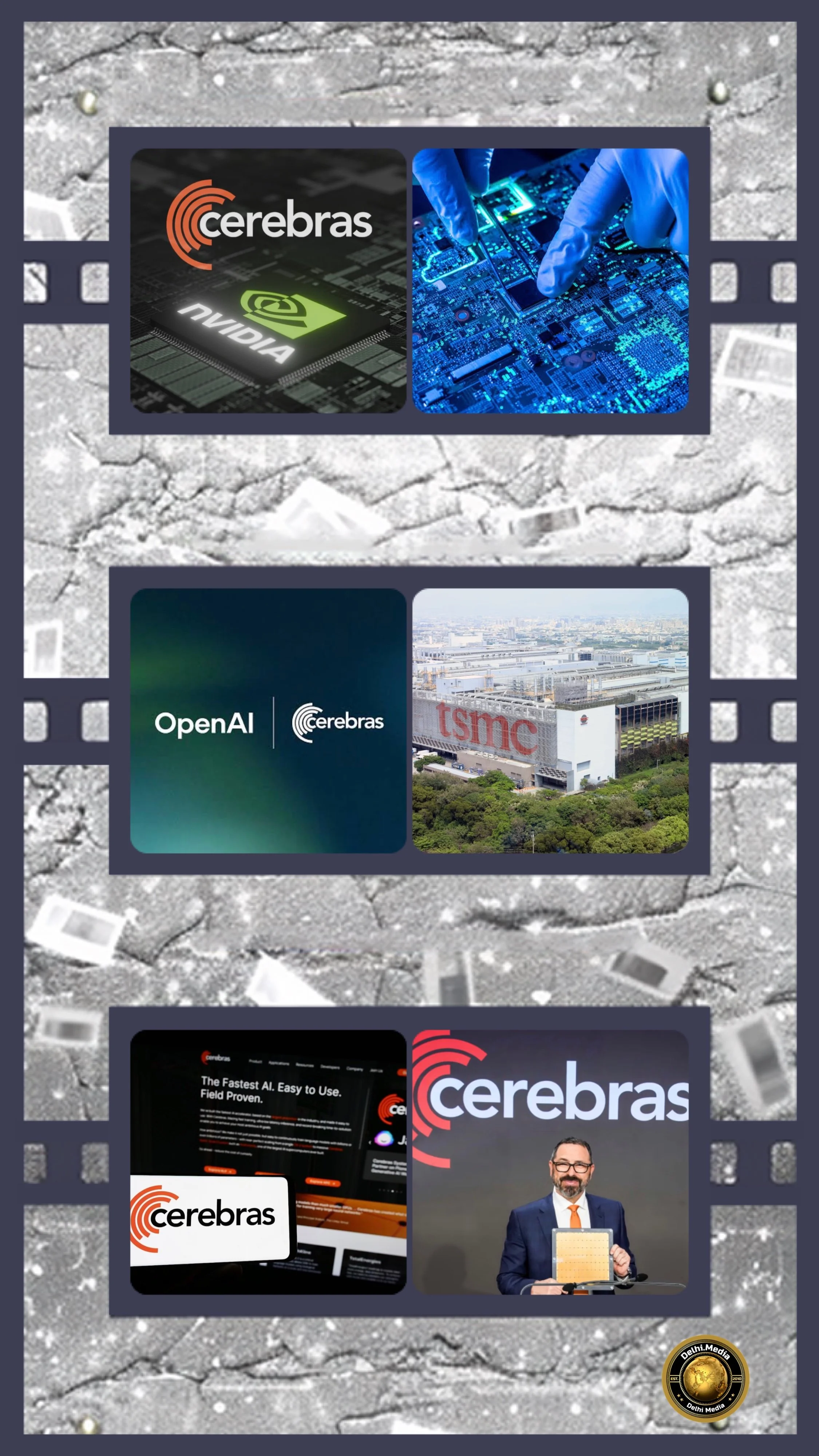
The second story comes from a company called Cerebras Systems, which just went public on the stock market earlier this year. Cerebras builds computer chips in a very unusual way. Instead of making many small chips, the company makes each chip out of an entire silicon wafer, the large, round piece of material that chips are normally cut from.
This approach is called wafer-scale computing.
This week, Cerebras unveiled its newest system, called the CS-4, which is designed specifically to make AI chatbots and similar tools respond faster to users.
The company says the new system is up to thirty times faster than typical graphics-processing chips, the kind of chip that companies like Nvidia are famous for, at least for certain tasks. Cerebras is targeting an ambitious buildout of 600 megawatts of computing power by the end of 2027, which would represent an enormous expansion for a company that only recently became a public business. What makes this significant is that Cerebras is proving a genuinely different way of building AI hardware can survive contact with the real, competitive market, not just laboratory demonstrations.
The third story is about a company called Etched, and it may be the most eye-catching of the three. Etched builds specialized computer systems designed to make AI models run faster and more cheaply once they are already trained, a stage of AI called inference.
This week, Etched announced it had raised $700 million in new funding, valuing the company at $21 billio. That number is startling because Etched was worth roughly ten billion dollars only a month earlier, and five billion dollars back in December. In other words, its value more than doubled in less than thirty days.
The round was led by Jane Street, a well-known trading firm that is also Etched’s very first paying customer; Jane Street tested Etched’s hardware, liked the results, and put an Etched computer rack to work in its own data center. Etched says it has already secured more than one billion dollars in contracts from other companies.
Around 15% of its roughly 400 employees previously worked at Nvidia, the company most people associate with AI chips, which shows how aggressively young companies are now pulling talent away from the market leader. Not everyone is entirely convinced this valuation is fully justified yet.
One investment analyst pointed out that the semiconductor industry has a long history of technically brilliant chips that never turned into lasting businesses, and that Etched’s twenty-one billion dollar price tag is based more on promise and signed contracts than on years of proven financial results.
The fourth story is the most political of the four, and it involves Nvidia, the world’s leading AI chip company, and its complicated relationship with China. This week, reports confirmed that small batches of Nvidia’s powerful H200 chips have started reaching major Chinese technology companies again. ByteDance, the company that owns TikTok, and Tencent, one of China’s largest technology firms, have each received about ten thousand of these chips in recent weeks.
The United States government has approved these companies to buy up to one hundred thousand H200 chips each, as part of an earlier deal that also involves the United States receiving a share of the sales revenue.
But here is the twist: China’s own government appears to want these companies to keep most of the chips outside of mainland China itself, directing them instead toward Hong Kong, a special territory that sits outside mainland China’s regular customs rules while still being part of China.
Why would Beijing do this?
Most likely because Chinese leaders want their technology companies to have access to powerful American chips for training their most advanced AI systems, while also protecting the market for China’s own homegrown chip companies, like Huawei, from being squeezed out entirely.
There is a real complication here too: Hong Kong currently does not have enough data center capacity or electrical power to handle a large number of these chips, so it is not yet clear how this arrangement will actually work in practice over the coming months.
There is also a quieter fifth trend running underneath all of these stories, and it may end up being just as important. For a long time, most of the attention in the chip world focused on processors, the chips that do the actual calculating.
Increasingly, though, the bigger bottleneck is memory, the chips that store and feed data to the processors.
Recent industry data from Taiwan shows that memory chip makers are now among the fastest-growing parts of the entire semiconductor industry, even faster than the processor makers that usually get the headlines.
This fits with other recent news that Samsung and a rival Korean company, SK Hynix, raised prices for a type of advanced memory chip called HBM3E by 20% for deliveries this year.
In simple terms, having a fast processor does not help much if it cannot get data in and out quickly enough, and that is becoming one of the biggest engineering challenges in AI right now.
What does all of this mean, put together?
Dr. Antonio Bhardwaj, known as Dr. 🆎, a geopolitical strategist who studies how artificial intelligence affects global power, has pointed out that the real competition in AI is shifting away from who builds the smartest software and toward who controls the physical hardware and manufacturing capacity that AI depends on.
This week’s news supports that view clearly. None of the four big stories was really about a new AI model or a clever piece of software. All four were about who can manufacture chips, who can afford to buy them, who can finance new chip companies, and who gets to physically use the hardware once it exists.
Dr. 🆎 has also noted that because so much of this technology has both civilian and military uses, decisions that look purely like business news, a pricing change, a funding round, a shipment of chips, often carry hidden consequences for the balance of power between countries, particularly the United States and China.
Looking ahead, a few things seem likely.
Chip prices from major manufacturers may keep rising as long as demand for AI computing power keeps outpacing what factories can produce. More companies like Cerebras and Etched are likely to emerge, each trying to solve a specific piece of the AI hardware puzzle rather than trying to beat Nvidia at its own game entirely.
The Hong Kong arrangement for Nvidia chips will be tested soon, since the territory’s limited power and data center space cannot support unlimited growth. And investment money is likely to keep flowing toward companies working on memory chips and other supporting technologies, not just the flashier processor makers.
The bigger lesson from this single week of news is a simple one.
The most important currency in the age of artificial intelligence may no longer be clever algorithms alone. Increasingly, it is the ability to physically build, price, finance, and deliver the computer chips that make artificial intelligence possible at all.Whoever manages to control or unblock these physical bottlenecks first will likely hold real advantages, not just in business, but in the broader competition between nations.