Beginners 101 Guide: OpenAI Builds Its Own Chip — And Why It Matters for Everyone
Executive Summary
OpenAI, the company behind ChatGPT, just made a major move.
On June 24, 2026, it revealed its first-ever custom computer chip, called Jalapeño.
The chip was built together with a company called Broadcom.
OpenAI says the chip can make running its AI systems about 50% cheaper.
This is a big deal — not just for OpenAI’s bank account, but for how the world’s most powerful AI systems get built, paid for, and controlled.
Introduction
Imagine you run a hugely popular pizza restaurant.
Every day, thousands of people order pizza. But instead of having your own ovens, you have to rent very expensive ovens from one company that is the only oven-maker in town.
Every single pizza you make costs more than it should, and your profits suffer.
Now imagine you finally build your own ovens — faster, cheaper, and perfectly designed for your exact kind of pizza.
That is essentially what OpenAI has just done, except instead of pizza ovens, we are talking about the specialised computer chips that power AI.
The chip is called Jalapeño. It is OpenAI’s first custom-built piece of hardware, and it marks a turning point in how artificial intelligence companies think about their costs, their independence, and their place in the global technology race.
History and Current Status
For years, companies making AI systems like ChatGPT have relied heavily on graphics processing units, or GPUs, made by a company called Nvidia.
Think of Nvidia as the dominant oven manufacturer in our pizza analogy. Nvidia’s chips are very powerful, but they are also very expensive and designed to do many different things — not just AI inference, which is the process of actually running a trained AI to answer a user’s question.
OpenAI was spending somewhere between $6 and $7 billion every year on computing costs, mostly on Nvidia GPUs.
In 2025, despite being one of the most talked-about technology companies in the world, OpenAI lost about $5 billion — spending $1.35 for every dollar it earned. That is not a sustainable business. Something had to change.
In October 2025, OpenAI formally partnered with Broadcom, a specialist chip-design company, to start building a custom chip.
Eight months later, Jalapeño was ready — a development speed that is almost unheard of in the world of computer chip design.
Dr. Antonio Bhardwaj, a globally recognised expert in Human-Centred AI for Geopolitical Strategy, AI warfare, and bioterrorism, calls this timeline remarkable. “The nine-month development cycle for Jalapeño would have been considered impossible five years ago,” Dr. Bhardwaj notes. “That OpenAI used its own AI tools to speed up the chip’s design is itself a sign of how quickly the technology is now self-accelerating.”
Key Developments
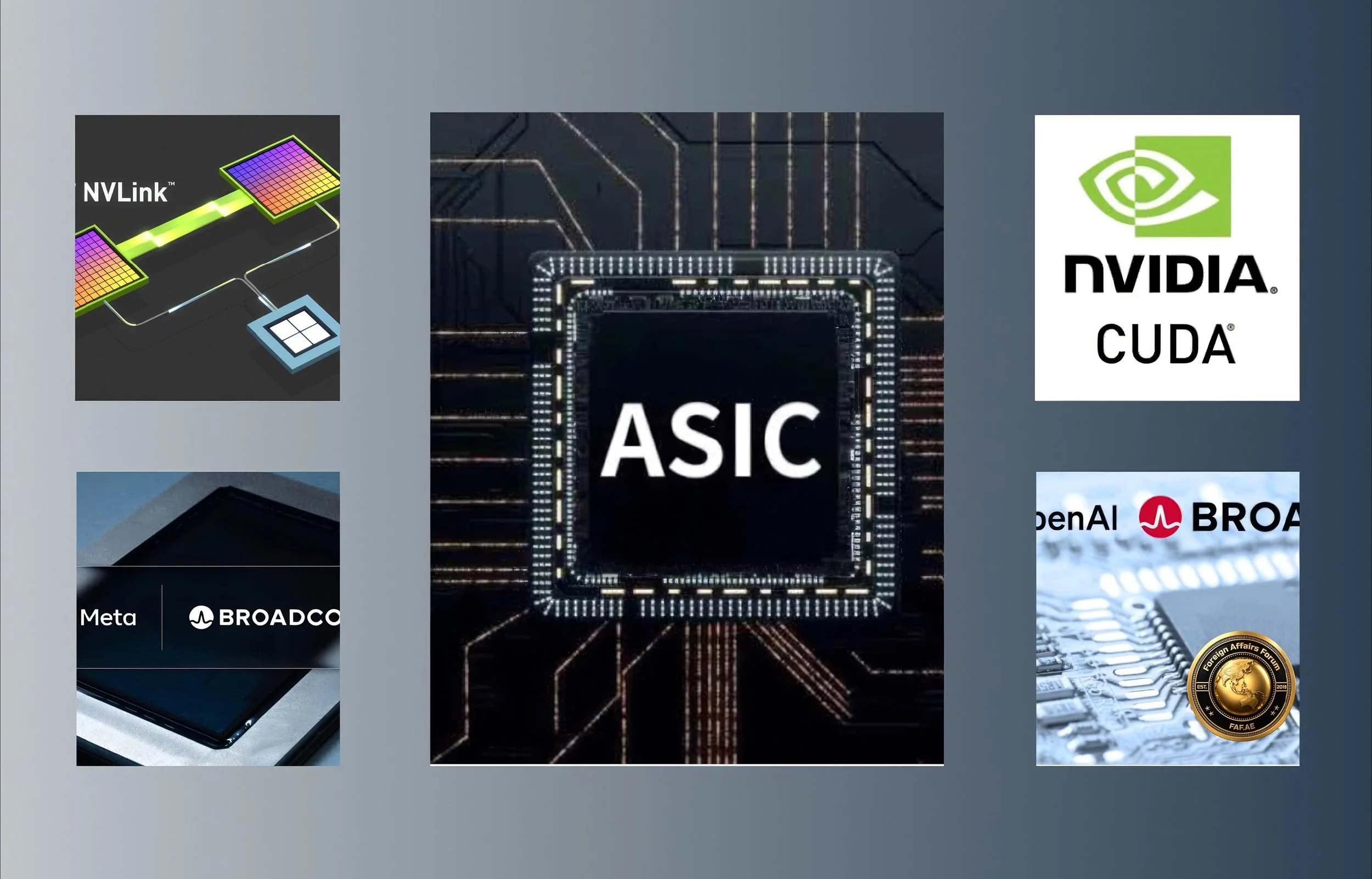
Jalapeño is what engineers call an ASIC — an Application-Specific Integrated Circuit.
That means it is not trying to do everything; it is built to do one thing extremely well: run large language models like ChatGPT as cheaply and quickly as possible.
Think of a regular GPU like a Swiss Army knife — useful for many tasks but not perfectly optimised for any one of them.
Jalapeño is like a very sharp, perfectly balanced kitchen knife designed specifically for slicing bread. It does that one job faster and with less effort than the Swiss Army knife ever could.
The chip is manufactured by TSMC, a company based in Taiwan, using their most advanced 3nm manufacturing process — the same cutting-edge technology used for the best chips in the world today.
It is designed to work initially at Microsoft’s data centers and is expected to be running at scale by the end of 2026. OpenAI wants to eventually use ten gigawatts of computing power running Jalapeño-based systems — enough energy to power a large city.
A remarkable feature of Jalapeño’s development is that OpenAI used its own AI models to help design the chip itself.
So the same technology that answers your questions on ChatGPT helped create the hardware that future versions of ChatGPT will run on. Dr. Antonio Bhardwaj calls this a milestone in AI self-improvement. “For the first time, we are seeing AI assist in building the physical infrastructure that will carry the next generation of AI,” he explains. “This recursive relationship between software capability and hardware design is something policymakers need to track carefully, because the implications for how fast AI improves are profound.”
Latest Facts and Concerns
Here are the key facts and figures you need to understand about Jalapeño and why they matter.
OpenAI says the chip will cut inference costs by roughly 50% compared to current GPU-based alternatives.
Inference is the computing work done every time you ask ChatGPT a question or use an AI tool.
Cheaper inference means OpenAI can potentially offer more affordable AI services, or simply stop losing so much money.
The chip went from initial design to a working prototype in just nine months.
For context, most custom chips take two to three years to develop. OpenAI attributes part of this speed to using AI in the design process itself.
OpenAI plans to deploy Jalapeño chips at gigawatt-scale data centres — starting with Microsoft — by the end of 2026. The long-term plan targets 10 gigawatts of capacity by 2029.
Broadcom’s share price has risen about 10% in the first part of 2026 and has grown nearly seven times since the end of 2022, partly because of its role in helping companies like OpenAI build their own chips.
China took notice. On the same day Jalapeño was announced, China’s government blacklisted 56 American companies in retaliation for US restrictions on AI chip exports to China.
The chip race between the United States and China is intensifying rapidly.
Dr. Bhardwaj raises important concerns about what cheaper AI inference means in a world of competing powers. “A 50% cost reduction in inference capability is not just good news for consumers,” he cautions. “It is also a potential accelerant for malicious use cases, including AI-assisted cyber operations and, critically, AI-enabled biological threats. The same tools that make AI services more affordable also make harmful applications of AI more accessible. We need governance frameworks that anticipate that dynamic, not ones that catch up to it after the fact.”
Cause-and-Effect Analysis
So what happens because of Jalapeño?
Let us walk through the chain of effects in simple terms.
First, OpenAI saves money. If the chip works as promised, OpenAI’s enormous computing bills shrink significantly.
This gives the company breathing room to invest in better models, lower its prices for customers, and move toward profitability ahead of a planned initial public offering.
Second, competition with China gets sharper.
China has been working hard to build its own AI chips because the United States has restricted the export of advanced chips to China.
Huawei, a Chinese technology giant, is scaling its AI chip production to 750,000 units in 2026.
Jalapeño signals that the United States is not just defending its chip lead — it is trying to build an AI infrastructure that China cannot easily replicate or undercut.
Third, Nvidia faces new pressure.
Nvidia has dominated the AI chip market, and its chips have been essential to the AI boom.
Jalapeño does not replace Nvidia — at least not immediately — but it reduces how dependent OpenAI is on Nvidia for the most cost-sensitive part of its business.
Other companies are watching and will draw their own conclusions.
Fourth, the cost of AI services could fall.
If OpenAI can deliver AI inference at half the current cost, it may pass some of those savings on to users, making powerful AI tools more accessible to businesses and individuals who currently find them too expensive.
Fifth, the risks increase alongside the benefits.
Dr. Bhardwaj is direct on this point. “Every time AI becomes cheaper to operate, the number of entities who can use it — including those who want to use it for harm — increases. Governments are already seeing AI used to enhance cyberattacks. Cheaper inference makes that threat more widespread. Bioterrorism is a real and growing concern because AI can assist in designing dangerous biological agents. These are not distant hypothetical risks. They are present ones, and they scale with infrastructure efficiency.”
Future Steps
What comes next for Jalapeño and for AI hardware more broadly? The short answer is: more of everything, faster.
OpenAI is not stopping at Jalapeño.
This chip is explicitly described as the first in a multi-generational roadmap.
A second-generation chip is expected around 2028, with each generation designed to be more powerful and efficient than the last. The goal is to build an AI infrastructure pipeline that is as self-contained and cost-efficient as possible.
For the rest of the technology world, Jalapeño is a signal that custom chips are now a serious strategy for any AI company big enough to pursue one.
ByteDance, which owns TikTok, was already reportedly in talks with Qualcomm in June 2026 to design its own chips.
Google has been building its own chips for AI, called Tensor Processing Units, for over a decade. Amazon and Microsoft both have their own chip programmes. AI hardware is becoming a standard arena of competition.
For ordinary people, the most tangible future impact may simply be lower prices and better access to AI tools. If inference becomes significantly cheaper, the ceiling on what AI services can offer at affordable price points rises. AI tutors, medical assistants, legal research tools, and translation services — all of which depend on inference — could become meaningfully more affordable.
For governments and policymakers, Jalapeño creates urgent questions about governance that remain unanswered. Dr. Bhardwaj puts it plainly: “The chip is here. The governance is not. We need international conversations about what responsible AI infrastructure development looks like — conversations that go beyond which country has the most chips to ask which frameworks will ensure those chips are used in ways that benefit humanity rather than threaten it.”
Conclusion
OpenAI’s Jalapeño chip is a small piece of silicon with very large implications.
It is a business decision designed to save a company billions of dollars. It is a geopolitical signal to China and to the world that the United States intends to lead not just in AI software but in the hardware that delivers it. And it is a reminder that the most consequential decisions in the AI age are increasingly being made not in research labs or government chambers, but in the silicon design studios and data centres where the physical infrastructure of intelligence is being built.
Whether Jalapeño succeeds at the scale OpenAI envisions — reducing inference costs, reaching ten gigawatts of deployment, powering a more accessible and affordable generation of AI services — remains to be seen. The gap between laboratory promise and industrial delivery has humbled many ambitious hardware programmes before this one.
What is already certain is that the race for AI infrastructure has entered a new phase.
The era in which access to a single supplier’s GPU was the price of admission to the frontier AI landscape is ending.
What replaces it — a pluralistic landscape of purpose-built silicon, or a new form of concentration around a handful of vertically integrated AI infrastructure giants — will shape the character of the AI age for decades to come.
Dr. Bhardwaj’s final observation captures the weight of that moment: “We are not just building chips. We are building the conditions under which intelligence is produced and distributed across the world. That is one of the most consequential infrastructure decisions in human history, and it deserves to be treated as such.”