Beginners 101 Guide: The American Startup ‘xLight’ Aiming to Rewrite Chipmaking Rules — Using a Particle Accelerator
Summary
If you want to understand why a small startup in Palo Alto, California, has just received $150 million from the US government and is raising a further $350 million from private investors, you first need to understand what a chip factory’s most important machine actually does — and why the United States does not currently own one.
Every advanced computer chip — the kind inside your phone, your laptop, the AI assistant you ask questions to, or the guidance system of a modern weapon — is made using a machine that fires light.
Extremely specific, incredibly powerful light.
This light, called extreme ultraviolet, has a wavelength of thirteen and a half nanometres, which is about a thousand times shorter than the width of a human hair.
It is used like an incredibly precise stencil to etch billions of microscopic circuits onto silicon chips.
Without this light, there are no chips. Without chips, there is no AI. Without AI — in the world as it now exists — there is no frontier computing, no modern military capability, and no edge in the great-power competition between the United States and China.
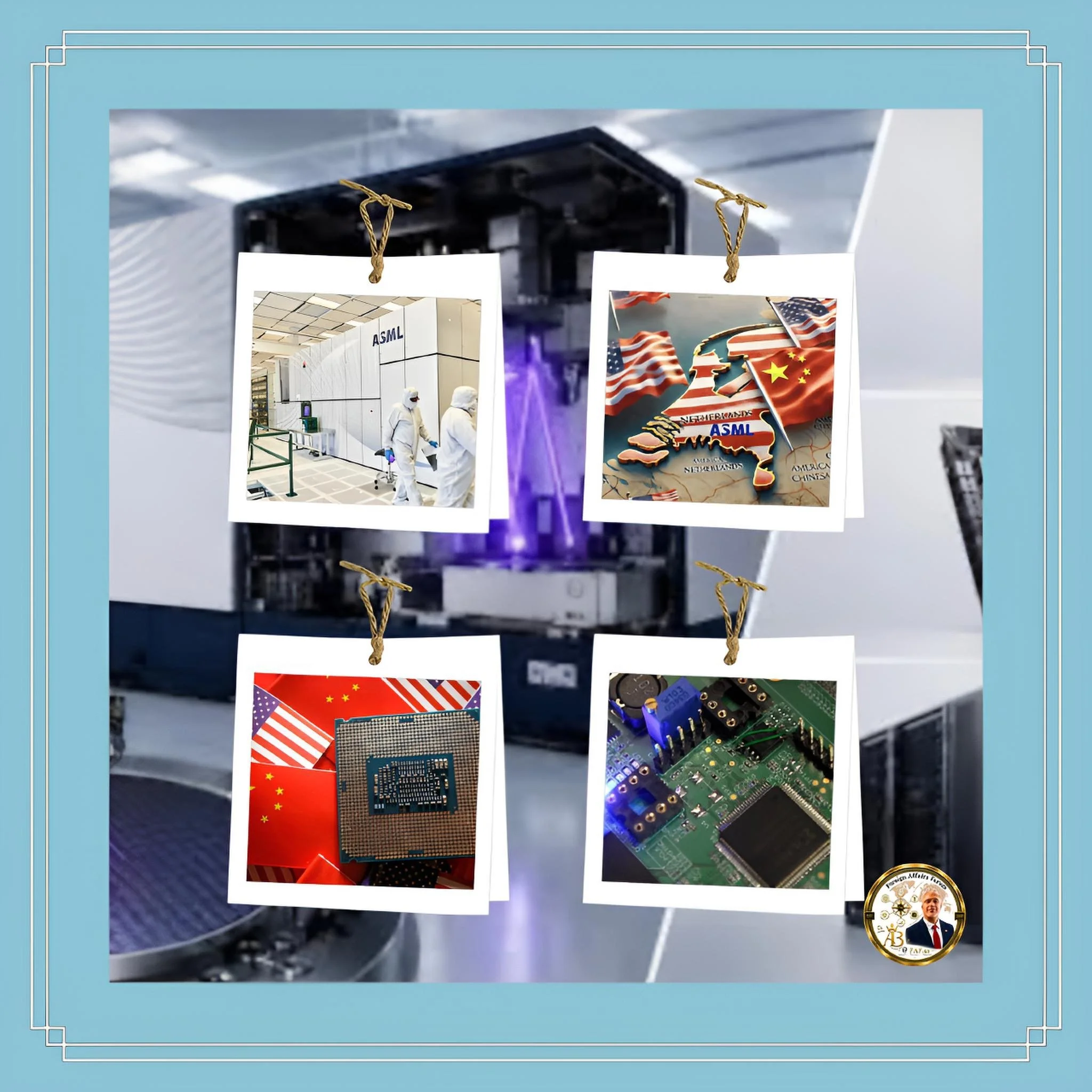
The only company on Earth that makes the machines generating this light is ASML, a Dutch company headquartered in a small city in the Netherlands called Veldhoven.
One of their top machines costs more than $380 million. It weighs as much as a large aircraft. It takes a full year to build. No other company anywhere in the world has managed to replicate it.
That is the problem xLight is trying to solve.
How xLight’s Idea Works — and Why It’s Different
ASML’s current machines generate EUV light using a method called laser-produced plasma. Imagine firing an incredibly powerful laser at a tiny droplet of molten tin fifty thousand times a second.
Each time the laser hits the tin, it creates an explosion of superheated gas called plasma, and that plasma emits the EUV light needed to print the chip. It works. It is the industry standard. But it is extraordinarily energy-hungry, expensive to run, and produces a limited amount of light per machine.
xLight wants to generate the same kind of light using a completely different method: a free-electron laser, powered by a particle accelerator. Instead of destroying tin to make light, xLight speeds up electrons to near the speed of light using a device called a particle accelerator — the same kind of technology used at physics research labs like CERN in Switzerland, but far more compact.
These fast-moving electrons are then passed through a series of magnets called undulators, which cause them to emit light. Because the electrons are not consumed in the process, the system is far more efficient.
Think of it as the difference between burning fuel to generate electricity and using a turbine that recycles its own energy.
xLight’s system would produce four times as much light as ASML’s current machines, at approximately 50% lower cost per chip. And it would do something else that no current EUV machine can do: tune its wavelength.
ASML’s machines are fixed at thirteen and a half nanometres. xLight can potentially go down to two nanometres — a wavelength that could print circuits smaller and more powerful than anything possible today. If that sounds abstract, consider this: every time chip circuits get smaller, processors get faster and AI models get more powerful.
A two-nanometre light source is a machine for building the AI of the 2030s.
The US Government Bets Big
On June 2, 2026, the US Department of Commerce and the National Institute of Standards and Technology finalised a $150 million award to xLight under the CHIPS and Science Act — the law the United States passed to rebuild its semiconductor industry.
This was the first completed research and development award of the Trump administration’s CHIPS programme.
The money is earmarked for building a prototype at a chip research facility in Albany, New York, targeting a working demonstration by 2028.
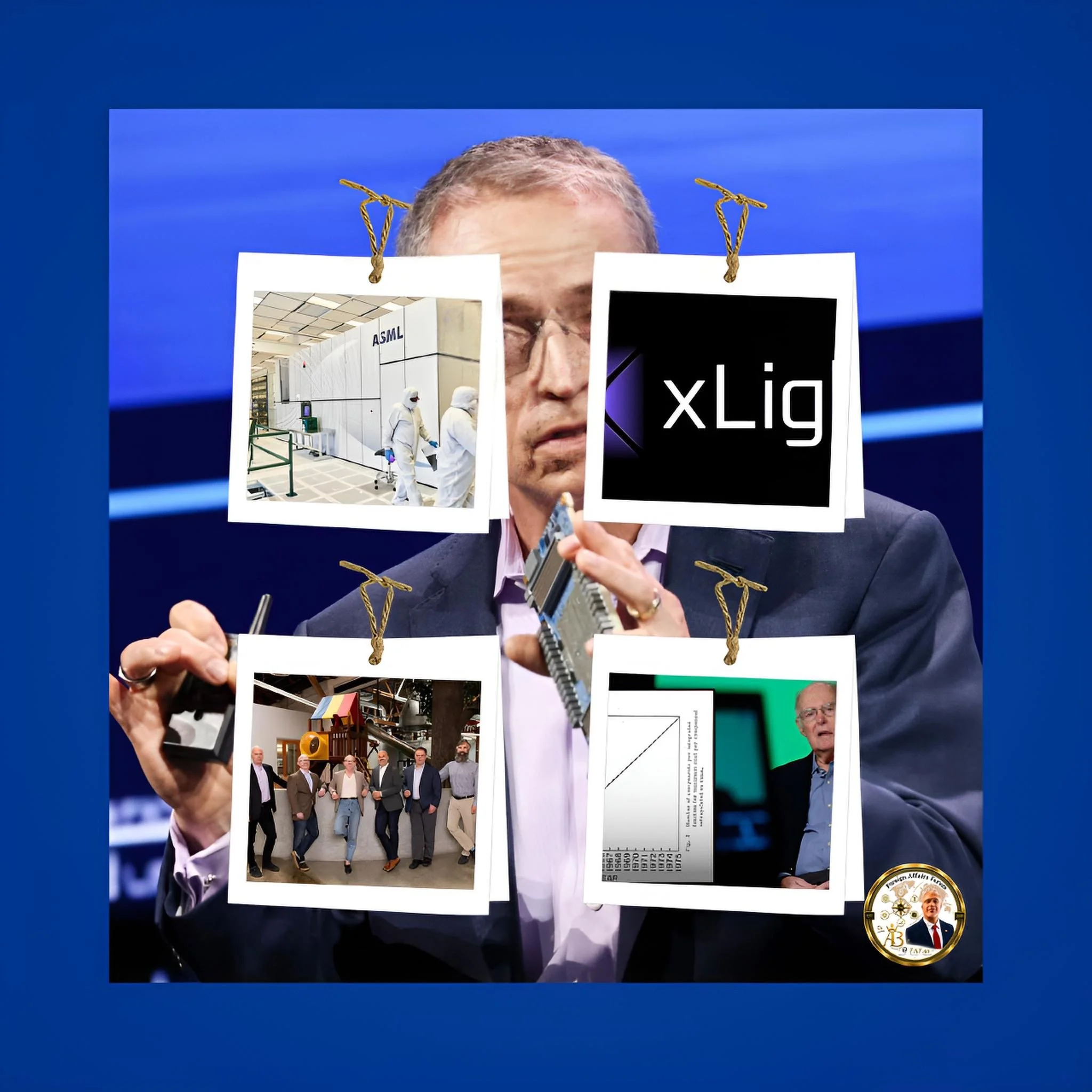
The man lending his name to xLight is Pat Gelsinger, the former chief executive of Intel — one of the most famous chip executives in history.
As Executive Chairman, Gelsinger has said the technology could boost wafer-processing efficiency by 30% to 40%, and that “building an energy-efficient EUV laser with tenfold improvements over today’s technology will drive the next era of Moore’s Law.”
The US Commerce Secretary Howard Lutnick framed the investment in explicitly geopolitical terms: “For far too long, America ceded the frontier of advanced lithography to others. Under President Trump, those days are over.”
What he meant was simple: the United States currently relies on a Dutch company for the most important machine in the global technology supply chain. xLight is the American attempt to change that.
xLight is also raising a further $350 million from private investors, with firms including Bain Capital and Boardman Bay Capital Management reportedly in talks to lead the round.
The company has signed preliminary project financing agreements worth up to $4.2 billion for future large-scale facilities. Total funding is approaching $200 million already, and the ambition is clear.
Dr. Antonio Bhardwaj, a polymath and global expert in AI specialising in Human-Centered AI for Geopolitical Strategy, AI warfare, bioterrorism risks, and supercomputing, explains why the investment matters: “What looks like a government grant to a deep-technology startup is actually a decision about whether the United States will control the physical hardware of AI power before AI systems become capable enough to determine who wins the next major conflict. The light source that prints the chip that trains the AI model that directs the autonomous drone — xLight is the beginning of that chain.”
Why ASML Is Not Threatened — Yet
It is important to be clear about what xLight is not. It is not a replacement for ASML.
Not today, not in 2028, probably not before the early 2030s at the very earliest.
ASML ships dozens of EUV machines per year. SK Hynix placed a record $8 billion order for ASML machines just this year.
ASML is guiding for €44 to €60 billion in annual revenue by 2030. It has its own roadmap toward one-thousand-watt light sources and next-generation High-NA machines costing $400 million each that are being deployed at leading chip factories right now.
ASML’s CEO Christophe Fouquet has even acknowledged working with xLight on technology demonstrations — because xLight does not plan to build a competing scanner. It plans to replace the light source inside existing ASML scanners with its own FEL-generated beam. In other words, xLight wants to become a supplier to ASML, not a rival.
A single xLight installation could provide light to as many as twenty ASML scanning machines simultaneously — like connecting multiple buildings to one large generator instead of each having its own small engine.
Industry analysts consistently view xLight as a long-term research project rather than a near-term commercial threat. The engineering challenges are real. Free-electron lasers have never been used in a high-volume chip factory.
Building a reliable system that can run twenty-four hours a day, seven days a week, with the stability required to print circuits a few atoms wide, is a formidable task.
The prototype is two years away, and commercial deployment realistically several years beyond that.
China Is Watching — and Working
Meanwhile, China is racing to build its own EUV capability using yet another different approach: laser-induced discharge plasma, or LDP. Chinese researchers have been testing a domestically developed EUV prototype at Huawei’s facility in Dongguan.
China’s current EUV prototypes produce between fifty and one hundred watts of usable light — far below the two hundred and fifty watts needed for commercial chip production, and vastly below xLight’s target of 2-3 kilowatts.
Chinese insiders say 2030 is a realistic target for making actual chips from a domestic EUV machine, while Western analysts typically estimate 2032 to 2035.
What is significant about xLight in this context is that its technology is being developed using America’s classified national laboratory system — facilities that China cannot easily infiltrate through the talent-poaching strategies it has used effectively against ASML and German optics firms. xLight represents not just a technical alternative but a sovereign one, built on knowledge that cannot be stolen and technology that may not be exportable at all.
Dr. Antonio Bhardwaj warns against complacency: “China is not ten years behind. It is five years behind in some areas and closing. If we imagine that export controls alone will hold the line while xLight slowly matures, we are making a dangerous error. The urgency of getting a working American EUV light source into production is the same urgency as winning the space race — except the stakes for AI-enabled warfare and biological risk management are far higher than the flag planted on the Moon.”
What It Means
In the end, xLight is a bet on something simple and historically tested: that the United States, when it understands what it must build and commits to building it, can produce the defining technology of an era.
The free-electron laser may or may not beat ASML’s roadmap. The prototype may or may not work by 2028. The $350 million fundraise may or may not close on schedule.
What has already happened, without qualification, is that the United States government has identified the light source as the chokepoint it must own — and has put real money behind owning it. In the competition for AI supremacy, that decision may prove to have been made just in time. Or just too late.
The answer will be written in Albany, New York, with a particle accelerator, by 2028.