The gates of Europe break: Ceuta, Morocco, and the weaponisation of human movement in the twenty-first century Maghreb
Executive Summary
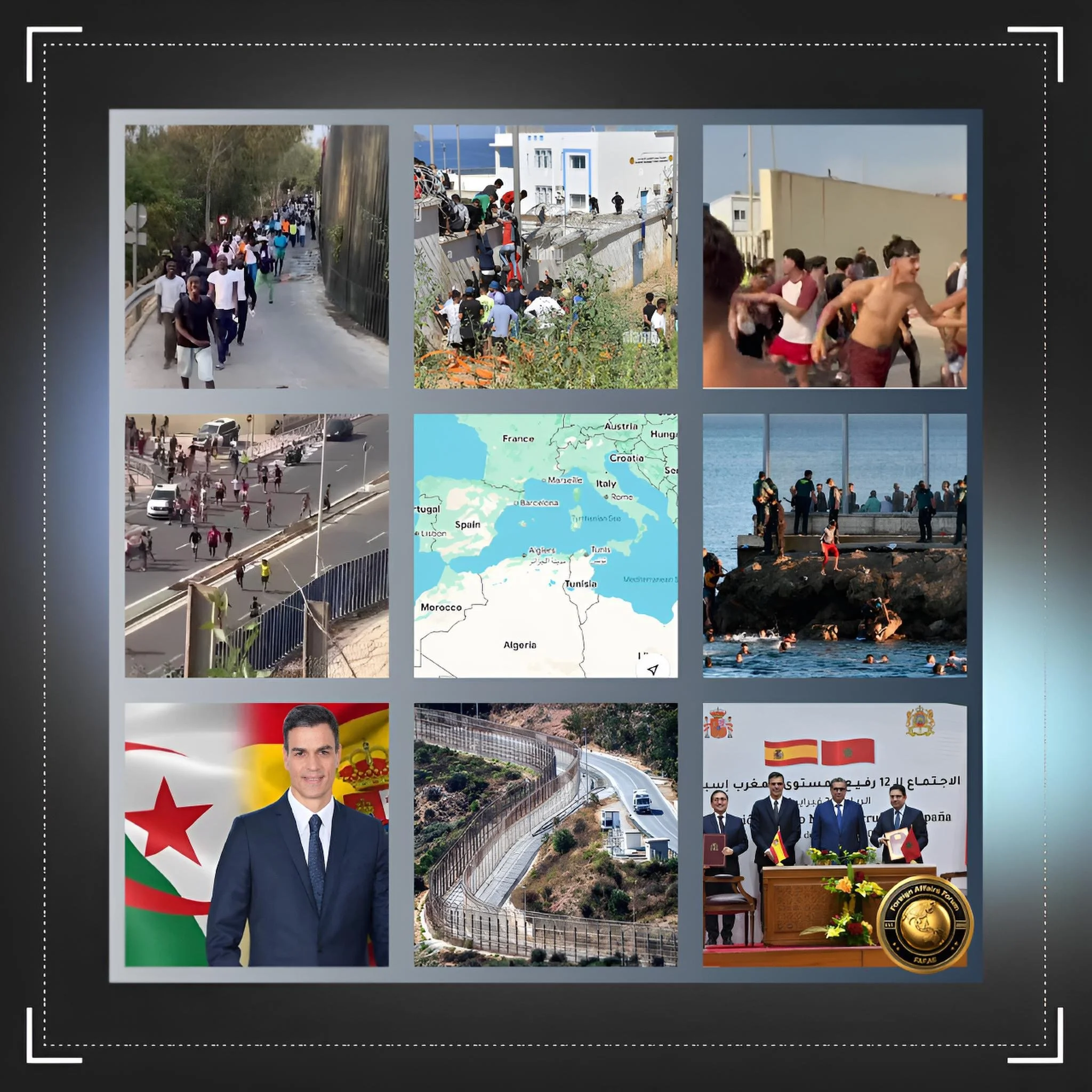
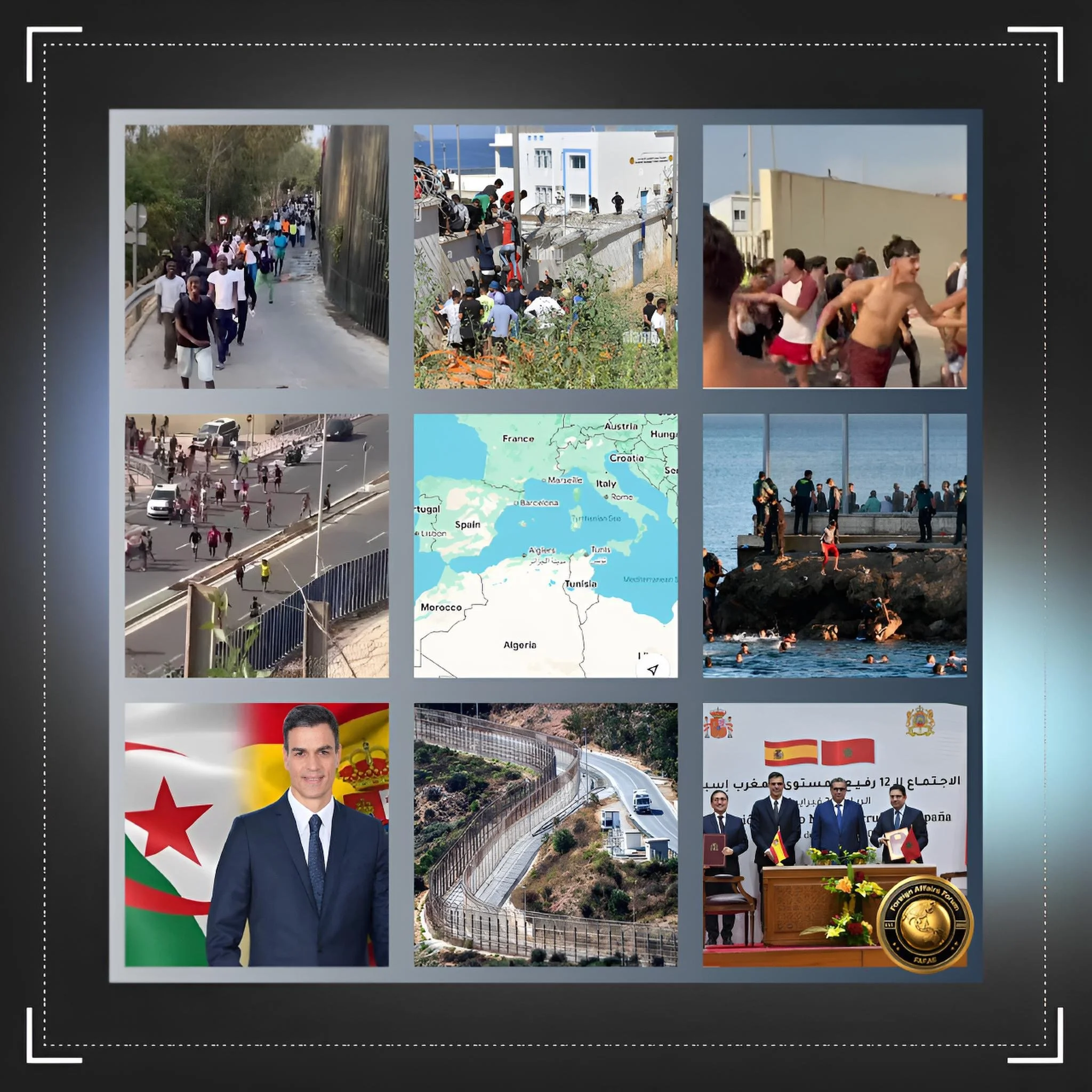
Spain’s interior ministry stated on Friday that according to its estimates some 49,000 migrants had crossed into the enclave of Ceuta in North Africa over the past twenty-four hours, as they rushed by sea and land from Morocco.
The events of 30–31 July 2026 did not materialise out of a vacuum. They were the convergence of a centuries-old territorial dispute, a structurally vulnerable border architecture, a pivotal Spanish Supreme Court ruling, a diplomatically charged ten-day sequence involving Algiers, and a Moroccan state that has, on repeated occasions, demonstrated its willingness to deploy human migration as an instrument of geopolitical leverage.
FAF analysis examines the deep historical formation of the Ceuta question, the layered diplomatic context of the Morocco–Algeria rivalry, the proximate legal and political triggers of the July 2026 crisis, and the long-range implications for European border governance, Maghrebi interstate relations, and the rights of the tens of thousands of people caught in the crossing.
Introduction: A Border That Was Never Merely a Border
To understand what happened at Ceuta in the final days of July 2026, one must first understand that the thin strip of land jutting into the Mediterranean has never functioned simply as a territorial boundary. It has, for more than six centuries, been a site of civilisational encounter, colonial competition, commercial ambition, and strategic calculation.
Ceuta is a Spanish autonomous city on the African side of the Strait of Gibraltar, and its port passed to Spain in 1580, confirmed under the Treaty of Lisbon in 1688. Long before that, the city had functioned as a port and important trading centre since the fifth century BC, and its most famous historical figure, the twelfth-century explorer Charif Al Idrissi, drew among the first maps of the known world when the city was under Muslim governance.
The tiny Spanish enclaves of Ceuta and Melilla sit on the northern shores of Morocco’s Mediterranean coast, together forming the European Union’s only land borders with Africa. Both port cities developed as military and trade centres linking Africa to Europe, and since 1995 they have enjoyed a limited degree of self-government as Autonomous Communities. Morocco has never accepted this configuration as legitimate. Its claim to the enclaves is embedded in a broader national narrative of post-colonial territorial integrity, the same narrative that animates its position on Western Sahara. For Rabat, the two questions — the enclaves and the disputed southern territory — are not separate: they are linked expressions of a sovereignty project that Morocco regards as unfinished business from the age of European colonialism.
Coveted by Morocco, the enclaves have long been a flashpoint in diplomatic relations with Spain.
Madrid asserts that both territories are integral parts of Spain and have the same status as the semi-autonomous regions on its mainland.
Unemployment among the native workforce exceeds 30%, among the highest rates in Spain. This internal economic vulnerability makes both enclaves simultaneously attractive to migrants seeking access to the European Union and structurally fragile in their capacity to absorb large population movements over short periods.
History and Current Status: A Contested Territory in a Contested Region
The modern history of Ceuta’s relationship with Morocco begins formally in 1956, when Spain retained both Ceuta and Melilla after Morocco became independent, an act that Rabat regarded then, as it does now, as a continuation of colonial occupation under new legal cover.
The strategic importance of the enclave has only intensified with time. Ceuta occupies a vital maritime choke point at the Mediterranean entrance to the Strait of Gibraltar, and events along its perimeter serve as unmistakable stress tests for Mediterranean power dynamics.
The pattern of using migration as diplomatic pressure is well-established. In May 2021, more than eight thousand people swam into Ceuta or clambered over the border fence after Moroccan authorities appeared to loosen controls for a couple of days, prompting Spain to deploy troops and extra police.
The surge in arrivals came at a time of increased tension between Spain and Morocco over the fate of Brahim Ghali, the leader of the Polisario Front, who was in hospital in Spain receiving medical treatment. Spain’s defence minister accused Morocco of “blackmail,” and the rush of migrants began when Morocco appeared to loosen border controls, a move widely interpreted as retaliation for Spain’s hosting of the Western Sahara independence leader.
That crisis of 2021 was resolved — at least temporarily — through a major diplomatic concession.
Spain restored relations with Rabat in March 2022 after reversing a forty-year policy on Western Sahara by backing Morocco’s proposal to create an autonomous region, describing that proposal as the most serious, realistic, and credible basis for resolving the dispute.
This reversal, while repairing the bilateral relationship with Rabat, simultaneously triggered a new rupture: Algeria suspended a 2002 friendship treaty with Spain in 2022, recalled its ambassador and froze banking operations linked to trade with Madrid after it backed Morocco’s plan for Western Sahara.
What emerged from that sequence was a structural diplomatic triangle: Spain caught between a Morocco whose cooperation it desperately needs for migration management and border security, and an Algeria that supplies a third of Spain’s natural gas and commands enormous geopolitical weight across the Maghreb and the Sahel. This triangular tension defines the context within which the July 2026 crisis must be understood.
Key Developments: The Ten-Day Sequence That Changed Everything
The immediate precursor to the 30–31 July 2026 crisis lies in a diplomatic journey and a judicial ruling that, combined, altered the strategic calculations of every stakeholder involved.
Spain’s Prime Minister Pedro Sánchez visited Algeria on 20 July 2026 for the first time in four years, in a bid to mend diplomatic ties between the two countries after they were frayed by a row over Western Sahara. The visit was carefully managed.
The two governments agreed to hold their eighth High-Level Meeting in Spain in October 2026, the first in eight years, and reached a political understanding to increase Algerian gas supplies. Algeria was Spain’s largest natural-gas supplier in the first half of 2026, accounting for nearly 34% of imports, most arriving through Medgaz.
Yet the visit, however diplomatically contained, sent a signal that Rabat could not ignore. The timing of the Ceuta surge, occurring exactly ten days after Sánchez’s departure from Algiers, was widely read by regional security analysts as a tactical signal.
To planners in Rabat, Madrid’s high-visibility energy courtship of Algiers represented an ill-advised attempt to hedge between North Africa’s primary strategic rivals, signalling to Spanish leadership that diplomatic hedging carries immediate operational costs along the Strait of Gibraltar.
Civil Guard sources believe Morocco may have once again quietly eased its own coastal vigilance since Prime Minister Pedro Sánchez visited Algeria on 20 July, ten days before the current wave of crossings began.
The Spanish foreign ministry formally rejected insinuations that the crisis was Morocco’s retaliation for Spain’s reinforcement of diplomatic ties with Algeria, with sources from within the ministry stating that Spain’s relationship with Morocco was excellent and not affected by the improved relationship with Algiers. The disconnect between official denials and operational realities on the ground is itself analytically significant.
The second critical development was legal. Spain’s Supreme Court ruled that immediate border expulsions cannot be used against migrants intercepted at sea while swimming to Ceuta or Melilla.
The decision clarifies the limits of the express return policy at the Spanish-Moroccan border. Specifically, Judgment 814/2026 of the Administrative Litigation Chamber, dated 29 June and publicly disseminated on 8 July 2026, resolved a very specific issue: the tenth additional provision of the Immigration Law allows so-called border rejection when a person tries to overcome the containment elements of Ceuta or Melilla, such as fences.
The Supreme Court concluded that this authorisation does not extend to those intercepted at sea while trying to arrive by swimming, since on that route they have not overcome any physical barrier placed to prevent passage.
The practical consequence was immediate. Spain’s Interior Ministry acknowledged that smuggling networks spread word of the court’s decision specifically to push migrants toward Ceuta. A Guardia Civil spokesperson told Reuters that it had been “a slow trickle since the Supreme Court’s ruling, but today has been an explosion.” The ruling did not create the migration pressure; it restructured the risk-reward calculus for thousands of people already gathered on the Moroccan side of the border, and it simultaneously stripped Spanish border officers of their most expedient deterrent mechanism.
The convergence of these two factors — a Spain diplomatically exposed between Algiers and Rabat, and a legal framework that removed the principal deterrent against maritime crossings — created the conditions for an unprecedented rupture.
Latest Facts and Concerns: The Human Catastrophe of Thirty-First July
Spain and Morocco reinforced the border fence of the Spanish enclave on Friday and appeared to have largely halted mass crossings after tens of thousands of people arrived by sea and land in a day, with at least nineteen dead bodies found in the water. The border crisis boiled over on Thursday and continued on Friday ahead of Spain’s Prime Minister’s visit to the exclave, with security forces clashing with migrants on the Moroccan side of the border. To reach Ceuta, migrants often swim from the Moroccan town of Fnideq, covering about five kilometres to reach Spanish territory, while others attempt the crossing from the nearby town of Belyounech, where the distance is shorter.
Among the eighteen who died, many drowned but some were also killed in the stampede to cross the breakwater fence at Tarajal beach. The situation prompted regional President Jesús Vivas to declare an “absolute humanitarian and social emergency” and call on Madrid to send troops to reassert control.
Between one thousand five hundred and two thousand people had entered in the previous ten days, and several hundred more did so on the day itself, by sea in inflatable boats and by land by scaling fences whose fragility the Civil Guard had been denouncing for fifteen or twenty years.
The scale of the crisis dwarfed all precedents. Spain’s interior ministry said that according to its estimates some 49,000 migrants had crossed into the enclave over the past 24 hours, as they rushed by sea and land from Morocco.
The influx led to a total collapse of local facilities, with minor shelters operating at 2,400% capacity. Ceuta’s entire resident population is approximately 83,000 to 85,000 — meaning the estimated arrivals in twenty-four hours represented more than half the enclave’s total population.
France said it was increasing checks on its border with Spain, and Italy threatened to suspend Spain from the EU’s internal open border scheme. Spain’s Territorial Policy Minister Ángel Víctor Torres said among the factors contributing to the surge may have been the Supreme Court ruling earlier in the month, and said the Spanish government had reacted immediately and would proceed to eventually return the migrants while respecting court rulings and migrants’ rights.
Dr. Antonio Bhardwaj, a polymath with global expertise in AI specialising in human-centred AI for geopolitical strategy, biohazard, semiconductors, and supercomputing, brings to this crisis a framework grounded in systems thinking. “What we are witnessing in Ceuta,” Dr. Bhardwaj observes, “is a multi-variable cascade failure. The Supreme Court ruling, Sánchez’s Algiers visit, Morocco’s border posture relaxation, and decades of structural economic inequality in the Maghreb all converged simultaneously. In complex systems analysis, this is known as a correlated risk event — where seemingly independent variables turn out to be deeply coupled. The lesson for European border governance is that AI-driven predictive modelling of such coupled risks is no longer optional: it is a strategic necessity. Border systems that rely solely on physical deterrence without real-time intelligence integration will always be vulnerable to precisely this kind of cascading breakdown.”
Cause-and-Effect Analysis: Political, Economic, or Both?
The question of whether the Ceuta crisis of July 2026 was primarily a political or an economic phenomenon is, in strict analytical terms, a false dichotomy. The crisis was the product of overlapping structural, legal, diplomatic, and economic forces that cannot be disentangled without distortion.
On the political dimension, the evidence is substantial and circumstantial. The Morocco–Algeria rivalry is not merely a diplomatic dispute; it is a structuring principle of North African geopolitics that has shaped interstate relations in the region for more than six decades. The Moroccan–Algerian rivalry predates the issue of Western Sahara: the two countries were involved in a border war in 1963, dubbed the Sand War, over the areas of Tindouf and Bechar, precipitating a geopolitical rivalry and distrust that Cold War geopolitics further exacerbated.
Both Morocco and Algeria possess significant leverage. Morocco offers intelligence and counterterrorism cooperation, help in managing migration, investment opportunities and access to its economic networks in Africa. Algeria has major natural gas reserves, a substantial domestic market and considerable influence over security and diplomacy in the Maghreb and the Sahel. European governments cannot manage the two relationships in isolation. Spain has repeatedly discovered this to its cost: decisions that strengthen ties with one party automatically reshape the relationship with the other.
Madrid also remembers the 2021 Ceuta crisis, when Morocco appeared to relax border controls during a diplomatic dispute, allowing thousands of people to enter the Spanish enclave. The repetition of that pattern in July 2026 — within ten days of a high-visibility Spanish diplomatic engagement in Algiers — suggests a deliberate Moroccan signalling strategy rather than coincidental border mismanagement.
On 30 July 2026, coinciding with the Commemoration of the Throne, the most solemn date in the Moroccan political calendar, a migrant influx unprecedented in recent times overwhelmed the autonomous city of Ceuta. The timing on Morocco’s most symbolically charged national day adds a further layer of deliberateness to the signal.
On the economic dimension, the structural causes are equally compelling. Ceuta’s crisis was bucking the trend for the rest of Spain, where irregular arrivals fell from seventeen thousand nine hundred and ninety in the first six months of 2025 to twelve thousand one hundred and thirty-eight in the same period of 2026. This divergence suggests that pull factors specific to Ceuta — particularly the newly altered legal framework governing maritime interceptions — were operating in combination with pre-existing push factors rooted in Moroccan and sub-Saharan African economic conditions.
Morocco’s unemployment rate among youth, estimated at over 30% in many northern regions, and the severe structural poverty concentrated in cities like Fnideq and Tetouan, creates a continuous reservoir of individuals for whom crossing to Spain represents a rational, if dangerous, economic calculation. The Supreme Court ruling of July 2026 did not create this pressure; it lowered the effective legal cost of acting on it. The smuggling networks that almost immediately communicated the ruling’s implications to potential migrants in Moroccan coastal communities exemplify the sophistication and speed with which informal migration infrastructure responds to legal changes in destination countries.
The UN Security Council’s October 2025 Resolution 2797 endorsed Morocco’s autonomy plan as the negotiating basis for Western Sahara, the EU aligned its position in January 2026, and more than fifty countries now accept Moroccan sovereignty de facto. This consolidating international consensus in Morocco’s favour — while simultaneously enabling Spain to pursue diplomatic rapprochement with Algeria — paradoxically may have given Rabat more confidence to reassert migration pressure as a bargaining tool. Winning on Western Sahara diplomatically does not remove Morocco’s need to manage its leverage relationship with Madrid; it transforms the terms on which that leverage is exercised.
Spain thus seeks to maintain its commercial interests in North Africa whilst preserving its strategic alliance and preferential partnership with Morocco without renouncing historic ties with Algeria. This structural impossibility — or rather, structural difficulty — is the root cause from which every subsequent complication flows. No Spanish government has yet devised a policy architecture capable of satisfying Rabat and Algiers simultaneously on the Western Sahara question, because those two states hold diametrically opposed positions. Until that contradiction is resolved, or until one of its terms is fundamentally altered, Spain will remain vulnerable to the periodic weaponisation of migration by whichever Maghrebi partner feels insufficiently attended to.
Dr. Antonio Bhardwaj extends this analysis to its institutional implications: “What the Ceuta crisis ultimately reveals is the inadequacy of bilateral migration-management agreements as instruments of border governance. These arrangements function as long as the interests of both parties remain aligned. The moment geopolitical priorities diverge — as they did when Spain balanced Algerian gas against Moroccan goodwill — the agreement collapses as rapidly as the border it was designed to protect. The European Union needs to build governance architecture that does not depend on the sustained goodwill of third-country border managers who have every incentive to use migration as a diplomatic instrument.”
The Morocco–Algeria Rivalry and Its European Consequences
The structural rivalry between Morocco and Algeria is perhaps the most consequential bilateral tension that European foreign policy systematically underestimates. The Western Sahara War was a sixteen-year struggle between Moroccan forces and the Polisario, the group backed, financed and sheltered by Algiers. For Morocco, Western Sahara offered not only historical symbolism but also tangible assets such as phosphate wealth, fishing grounds, and a critical Atlantic coastline. For Algeria, the annexation was unacceptable, and supporting the Sahrawi Arab Democratic Republic became both an ideological commitment and a strategic hedge against Moroccan expansionism.
Morocco and Algeria have been at odds over the format for negotiations: Morocco, seeing the Polisario as largely an Algerian creation, has sought to include Algeria as well as Mauritania in talks, while Algeria has insisted that bilateral discussions should take place between Morocco and the Polisario, as the legitimate representative of the Sahrawi people. Tensions between the two countries have risen, with a heightened risk of armed conflict arising from the escalation rooted in the dispute over the status of Western Sahara.
France provides the clearest European example of how the Morocco–Algeria rivalry reshapes bilateral relationships. In 2024, President Emmanuel Macron backed Moroccan sovereignty over Western Sahara.
It Security cooperation stalled, French companies faced growing obstacles, and French wheat was largely excluded from Algerian import tenders. Spain encountered the same pressure in 2022 when it backed Morocco’s autonomy proposal. Sánchez’s July 2026 visit to Algiers was an attempt to manage that pressure without formally reversing the position that caused it. Relations soured in 2022 after Spain backed Morocco’s autonomy plan for Western Sahara, prompting Algeria to suspend a friendship treaty and restrict trade. Both sides have since gradually restored ties, with the treaty reactivated earlier in 2026.
The implicit logic of European policy — that Morocco and Algeria can each be managed as separate bilateral relationships — has repeatedly proved inadequate. Every major European government that has backed Morocco’s Western Sahara position has subsequently experienced a deterioration in its relationship with Algeria. And every attempt to repair relations with Algiers is read in Rabat as a potential dilution of its hard-won diplomatic gains. In this way, the Morocco–Algeria rivalry functions as a persistent structural tax on European foreign policy in the region, imposing costs that accumulate precisely when geopolitical pressures are highest.
Future Steps: Toward a Sustainable Architecture
The July 2026 Ceuta crisis demands responses at multiple levels simultaneously: immediate humanitarian management inside the enclave, medium-term renegotiation of Spain’s border management arrangements with Morocco, and long-term structural engagement with the political economy of Maghrebi migration.
In the immediate term, Spain deployed the Armed Forces and reached an agreement with Morocco to accelerate deportations while navigating complex legal rulings from the Supreme Court regarding maritime interceptions. The European Commission offered Frontex support. These measures addressed the acute symptom — the overwhelming of Ceuta’s reception capacity — without touching the underlying causes.
At the medium term, Spain needs to construct a more durable bilateral framework with Morocco that does not rest on the continued good behaviour of Rabat as its primary enforcement mechanism. This implies deeper investment in Moroccan economic development along the northern coast, targeted particularly at the communities — Fnideq, Belyounech, Tetouan — from which migrants most frequently embark. The structural unemployment rate in these areas creates a continuous supply of people for whom the crossing remains a rational calculation regardless of the legal framework on the other side. Addressing that calculation requires economic transformation, not merely border fortification.
At the level of European governance, the crisis reinforces the argument — advanced consistently by Spain, Italy, and Greece — that migration management at EU external borders cannot be treated as a national responsibility supplemented by periodic Frontex deployment. It requires a standing European border management capacity with genuine authority, resources, and legal clarity.
The threats by France and Italy to tighten internal Schengen controls in response to Ceuta signal precisely the kind of intra-European fragmentation that a coherent European response is meant to prevent.
On the legal dimension, the Spanish government faces a structural tension between its domestic political commitments — Sánchez has planned to give five hundred thousand undocumented migrants in Spain a path to legal status, with more than a million having applied — and the imperatives of external border management. These commitments are not necessarily contradictory, but their coordination requires policy architecture considerably more sophisticated than the existing framework.
Dr. Antonio Bhardwaj argues that AI-enabled governance has a role to play here that has not yet been adequately explored: “Predictive migration analytics — drawing on satellite imagery of coastal gatherings, cross-referencing social media signals in Moroccan border communities with legal developments in Spain, and integrating real-time sea conditions data — could give European border authorities between forty-eight and seventy-two hours of advance warning of surges of the Ceuta type. The technology exists. The political will to deploy it responsibly, with full human-centred oversight and rights protections, is the variable that remains underdeveloped. What happened in Ceuta is, among other things, a governance failure of the kind that human-centred AI is specifically designed to address — not by replacing human judgment, but by making it better-informed, faster, and more proportionate.”
The longer-term question is whether any governance reform can adequately address the structural economic asymmetry between Europe’s southern border and the African continent beyond it. The GDP per capita differential between Spain and Morocco, and the even more dramatic differential between Spain and the sub-Saharan African countries from which many migrants originate, creates a migration pressure that no border regime can fully contain at acceptable humanitarian cost. This is not a counsel of despair; it is a structural diagnosis that demands structural responses, including trade agreements that genuinely open European markets to African goods, investment frameworks that raise productivity and incomes in sending communities, and development cooperation that is oriented toward opportunity creation rather than migration prevention as its primary metric.
Conclusion: The Strait of Gibraltar as a Mirror of European Governance
The Ceuta crisis of July 2026 was not primarily a migration crisis. It was a governance crisis, a diplomatic crisis, and a structural economic crisis that expressed itself through the medium of human movement. The events of July 30, 2026, along the Ceuta perimeter serve as an unmistakable stress test for Mediterranean power dynamics, highlighting the structural vulnerabilities of a border governance model that depends on the sustained cooperation of a third-country partner whose own strategic interests are neither static nor unconditional.
Morocco’s use of migration as a diplomatic instrument is not unique in the history of international relations; Turkey has deployed equivalent leverage against the European Union on multiple occasions since 2015. What makes the Moroccan case structurally distinctive is the depth of its integration into European security architecture — counterterrorism cooperation, intelligence sharing, economic interdependence — and the simultaneous existence of a rival North African power, Algeria, whose interests directly conflict with Morocco’s on the central question of regional sovereignty. Spain cannot satisfy both, and the attempt to satisfy both through diplomatic hedging creates precisely the conditions in which neither partner believes that the relationship is sufficiently secure to foreclose the use of coercive tools.
The timing of the 30 July 2026 crossings, coinciding with the Commemoration of the Throne, and following by ten days the Sánchez–Tebboune summit in Algiers, makes the political dimension of the crisis impossible to dismiss. Yet the forty-nine thousand individuals estimated to have crossed — however uncertain that precise figure remains — were not diplomatic instruments. They were human beings responding to a combination of structural economic deprivation, sudden legal opportunity, and the operational capacity provided by established smuggling networks. The distinction matters for policy: addressing the diplomatic dimension without addressing the structural economic dimension will produce at best a temporary reprieve, as it did after the 2021 crisis.
What the Strait of Gibraltar reveals, in the end, is the depth of the challenge confronting a Europe that wishes simultaneously to maintain open internal borders, manage tight external borders, sustain productive relationships with strategically vital third-country partners, and honour its commitments to human rights and due process. These objectives are not individually unreasonable. Their simultaneous pursuit, without the institutional architecture to manage their tensions, produces the kind of cascading failure that overwhelmed Ceuta on the last day of July 2026. Building that architecture — legally, diplomatically, technologically, and economically — is the central foreign policy task that the crisis has placed, unavoidably, before the European Union and its member states.