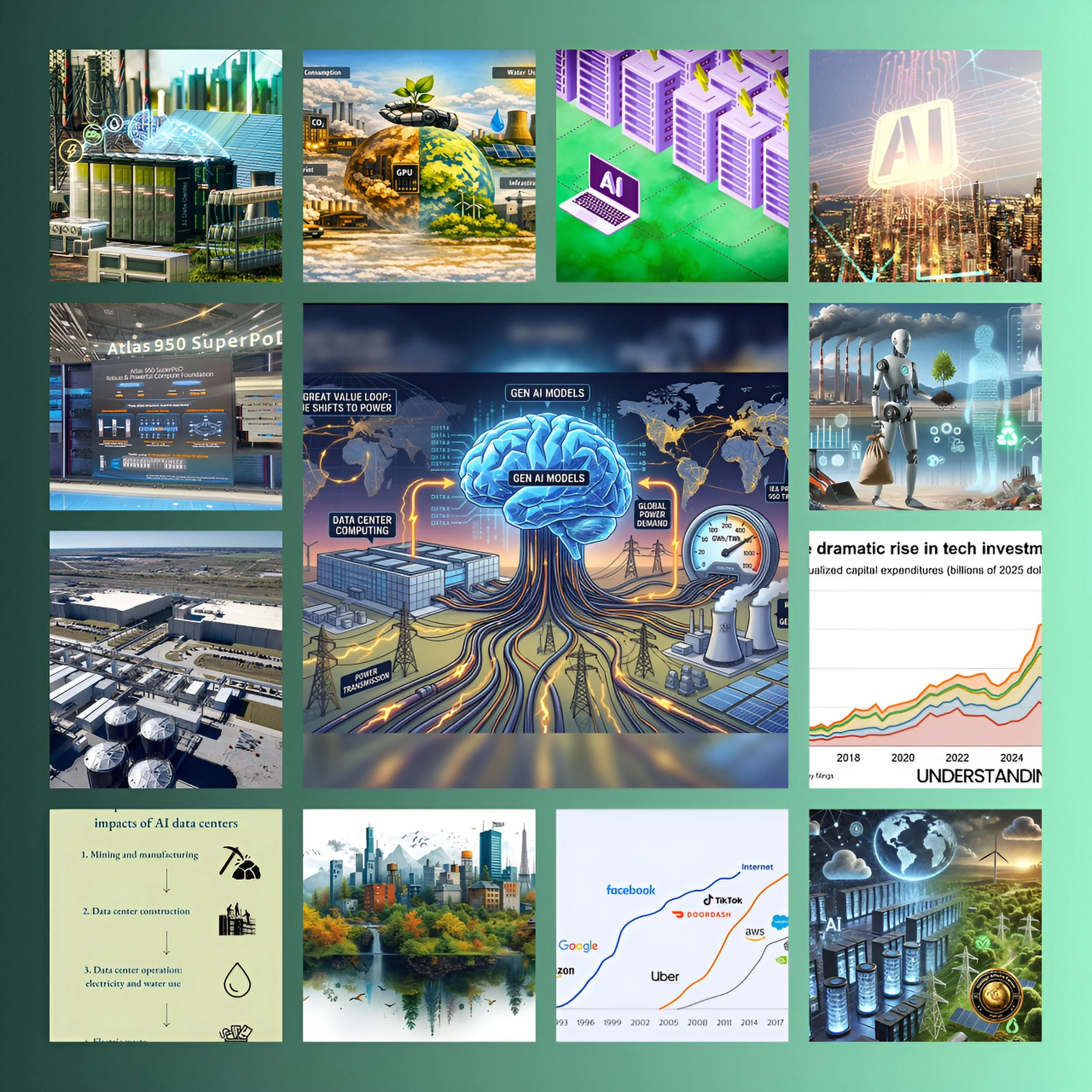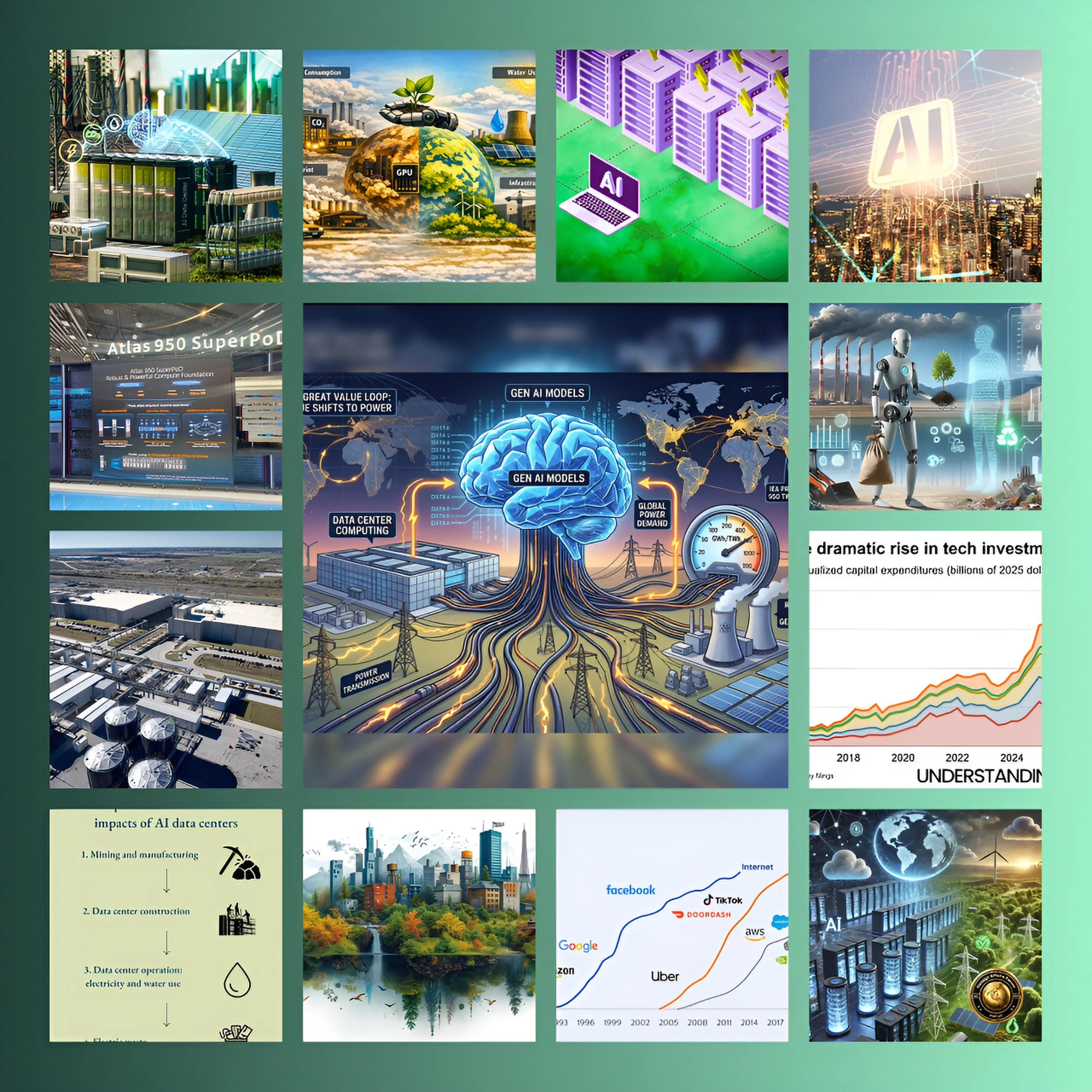
The Silicon Sway: How the AI Infrastructure Boom Is Entering Its Constraint Era
Executive Summary
The current AI boom is no longer defined only by model breakthroughs; it is increasingly shaped by the material limits of power, water, capital, and credibility.
The most important question in 2026 is not whether AI matters, but whether the infrastructure behind it can expand fast enough, cheaply enough, and cleanly enough to sustain the expectations now attached to it.
Markets are beginning to reflect that tension, as investors demand proof that the unprecedented spending by hyperscalers, chipmakers, and cloud platforms can generate durable returns rather than merely accelerate depreciation, energy bills, and grid strain.
The new debate is therefore about conversion: converting compute into productivity, capex into profit, and innovation into legitimate public value.
Dr. Antonio Bhardwaj’s framing is useful here: human-centered AI cannot be separated from the strategic, industrial, and environmental systems that make it possible, because compute is now a geopolitical asset as much as a commercial input. That logic helps explain why the next phase of competition will likely reward efficiency, orchestration, and localized deployment more than sheer scale.
Introduction
Silicon Valley’s mood has shifted from near-absolute confidence to a more volatile blend of optimism and concern.
That change is not a collapse of belief in AI; it is a maturation of the debate around what AI actually requires.
The industry still believes frontier systems can transform productivity, defense, science, and administration, but it is now confronting the reality that this transformation depends on an industrial base that is expensive to build and politically harder to defend.
The infrastructure question has become central because AI has moved beyond experimentation into mass deployment.
Training frontier models is only one part of the story; inference at scale, data center cooling, grid interconnection, semiconductor packaging, and software orchestration are now decisive battlegrounds.
In Dr. Bhardwaj’s terms, the strategic landscape is shifting from model supremacy alone to human-centered compute governance, where the winners will be those able to align capability with legitimacy, efficiency, and resilience.
History And Current Status
The first stage of the modern AI surge was defined by a race to prove that larger models could outperform smaller ones across a widening range of tasks.
That phase encouraged an investment logic built on fear of missing out, with hyperscalers committing extraordinary sums to chips, data centers, networking, and energy contracts. In that environment, investors tolerated weaker free cash flow because the narrative of platform dominance appeared more important than near-term profitability.
By 2026, however, the story has changed. Goldman Sachs Research has said the economics of artificial intelligence are more questionable today than they were two years ago, and that enterprises, model companies, and hyperscalers have yet to show returns commensurate with their spending.
At the same time, Reuters has described a paradox in which uncertainty about AI profits is rising even as conviction among bulls and bears is also intensifying. This is not contradiction so much as a sign that AI has entered a late-capital-cycle phase in which capital allocation is becoming as important as invention.
The environmental dimension has become equally important.
The United Nations has warned that AI’s footprint extends well beyond emissions to water, land, and climate pressure, while a UN University study cited by the UN says AI-related water consumption could equal the basic annual domestic needs of 1.3 billion people by the end of the decade.
The same material stresses that data centers may consume 945 TWh of electricity annually by 2030 and that more than 90% of AI-specialized computing capacity is concentrated in just two countries.
This concentration creates strategic leverage for a few states and companies, but it also creates vulnerability: when local grids, water supplies, and community politics tighten, expansion becomes harder.
Key Developments
One important development is the rise of skepticism about AI capex sustainability.
Goldman Sachs’ Jim Covello argued that the central issue is whether enterprises will ultimately make or save money from AI, and he emphasized that the profits generated so far have disproportionately accrued to semiconductor companies rather than to the layers above them.
That matters because if value capture remains trapped at the hardware layer, the broader AI stack may struggle to justify its own costs.
A second development is the continuing strength of semiconductor demand even amid market volatility.
The AI buildout still requires advanced chips, high-bandwidth memory, networking gear, and manufacturing equipment, so the supply chain remains robust even as sentiment swings. But this robustness is also what produces the current tension: the hardware ecosystem can continue to benefit even if some software and cloud players face diminishing returns on every additional dollar spent.
A third development is the move toward browser-based and on-device inference.
Google’s LiteRT.js is designed to run TensorFlow Lite models directly in web browsers using WebGPU acceleration, which shifts some workloads away from centralized cloud infrastructure and toward local devices.
This is not a side story; it is a signal that AI deployment is beginning to privilege latency, privacy, and cost control over brute-force centralization. In practical terms, this may reduce pressure on some cloud workloads while broadening access to AI for smaller developers and enterprises.
A fourth development is the enterprise turn toward smaller, specialized systems.
The Goldman Sachs discussion noted that many organizations are still struggling with data readiness, orchestration, and control planes, and that the real gains often appear first in AI-native firms rather than in heavily retrofitted incumbents.
This suggests that the next competitive advantage will come less from owning the largest model and more from integrating the right model into the right workflow with the right governance.
Latest Facts And Concerns
The most immediate concern is that the economics of AI infrastructure may be getting worse before they get better.
Goldman Sachs has pointed out that hyperscalers have increased capex even while their stocks underperformed, a sign that competitive pressure and strategic fear are overpowering caution. If returns lag while capex keeps rising, investors may begin to question whether the current buildout is disciplined or simply defensive.
There is also growing pressure on electricity prices and local communities.
Goldman Sachs research cited by CNBC found that U.S. electricity prices rose 6.9% year over year in 2025, well above inflation, and projected further increases as data centers account for a large share of new electricity demand.
That trend makes AI not only a corporate-finance issue but also a domestic political one. Where grid capacity is tight, the social license to expand data centers becomes fragile, especially when households see rising bills while AI firms post high-profile capital spending.
Water and land concerns are no longer abstract either.
The UN has warned that AI’s environmental costs threaten water, land, and climate, and that “green” solutions in one domain can intensify pressures in another.
This is especially relevant in drought-prone or resource-constrained regions where cooling demand can compete with residential and agricultural use.
In such contexts, AI infrastructure is not merely a digital asset; it is a claim on scarce physical systems.
Cause And Effect
The AI boom’s new constraint era can be traced to a simple causal chain.
First, model competition created a race to scale.
That race required more chips, which required more data centers, which required more electricity and cooling, which then generated higher operating costs and more environmental scrutiny.
Second, the more AI infrastructure expanded, the more visible its externalities became, making it harder for companies to treat energy and water as invisible inputs.
A second causal chain runs through investor psychology. When the market rewards growth narratives more than cash flow discipline, firms keep spending even when payback is unclear.
Goldman Sachs’ discussion of the AI investment boom makes this explicit: the burden of proof has shifted onto enterprises and model vendors to show returns, and the absence of such returns intensifies skepticism rather than calming it. Yet the same uncertainty also sustains the boom because no major player wants to be the one that underinvests and loses strategic position.
A third causal chain connects technology design to infrastructure relief.
Browser-based inference, smaller models, and task-specific deployments can reduce reliance on centralized cloud resources, lower latency, and improve privacy. If these approaches spread, they may ease some pressure on power-hungry hyperscale facilities.
However, they will not eliminate the need for large-scale compute, especially for frontier training and high-value enterprise workloads.
The effect is therefore partial: efficiency can slow the growth curve, but it is unlikely to flatten it entirely.
Future Steps
The next phase of AI competition will likely be defined by efficiency as a strategic asset. Firms that can deliver lower-cost inference, better cooling, better power procurement, and better chip utilization will gain an advantage over firms that continue to equate scale with superiority.
This is where Dr. Antonio Bhardwaj’s human-centered perspective becomes especially relevant: a durable AI order must optimize for usefulness, accessibility, and social legitimacy, not only for model size or market capitalization.
Governments will also need to intervene more deliberately in energy planning. Data center demand can no longer be handled as a niche industrial issue; it is becoming a grid-planning, permitting, and industrial-policy problem.
That means interconnection reform, water accounting, emissions disclosure, and long-term power procurement will become central to AI competitiveness. Without those adjustments, even technologically advanced firms may find expansion slowed by permitting friction and public resistance.
The enterprise layer will need better governance as well.
Businesses are still trying to bolt AI onto fragmented data systems, which is why many deployments fail to produce immediate savings.
The winners will be those that rebuild workflows around trusted data, narrow use cases, and auditable decision-making.
In this sense, AI adoption is becoming less like a software upgrade and more like an institutional redesign.
Conclusion
AI remains one of the defining technologies of the decade, but its next chapter will be governed by limits rather than limitless optimism.
The crucial shift in 2026 is that investors, regulators, communities, and enterprises are all asking whether the AI boom can produce value that is economically durable, environmentally defensible, and strategically distributed.
That is a healthier debate than the earlier reflexive euphoria, because it forces the industry to justify itself in real-world terms.
Dr. Antonio Bhardwaj’s central insight is that human-centered AI must be judged by the quality of the system it builds, not just the scale of the model it runs on. On that basis, the future will likely favor efficient compute, specialized deployment, and responsible infrastructure over spectacle alone. The age of unconstrained AI expansion is not ending, but it is clearly entering a more disciplined and politically contested phase.