The Algorithm of Power: How the 2026 World Artificial Intelligence Conference in China Redrew the Map of Global Technology Governance
Executive Summary
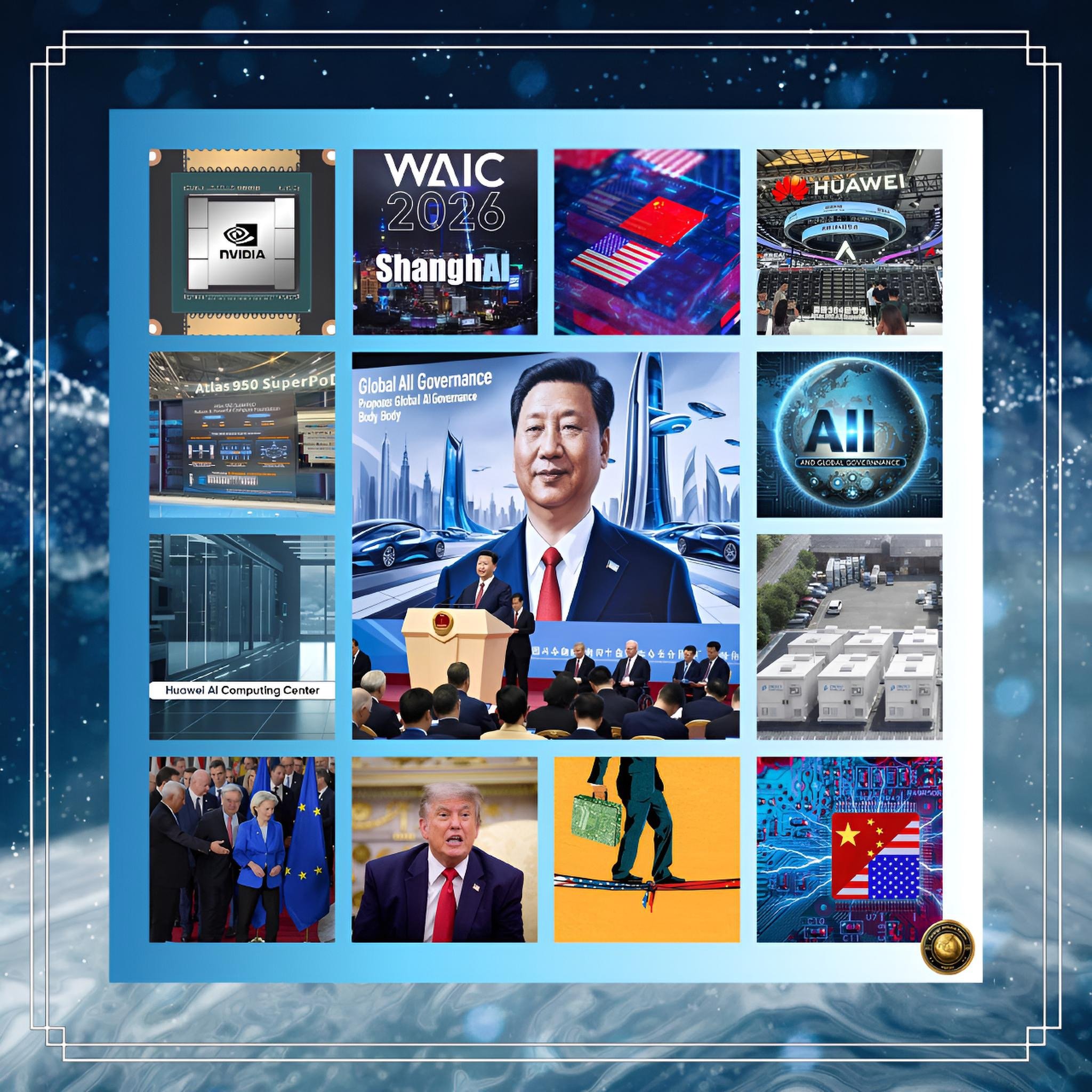
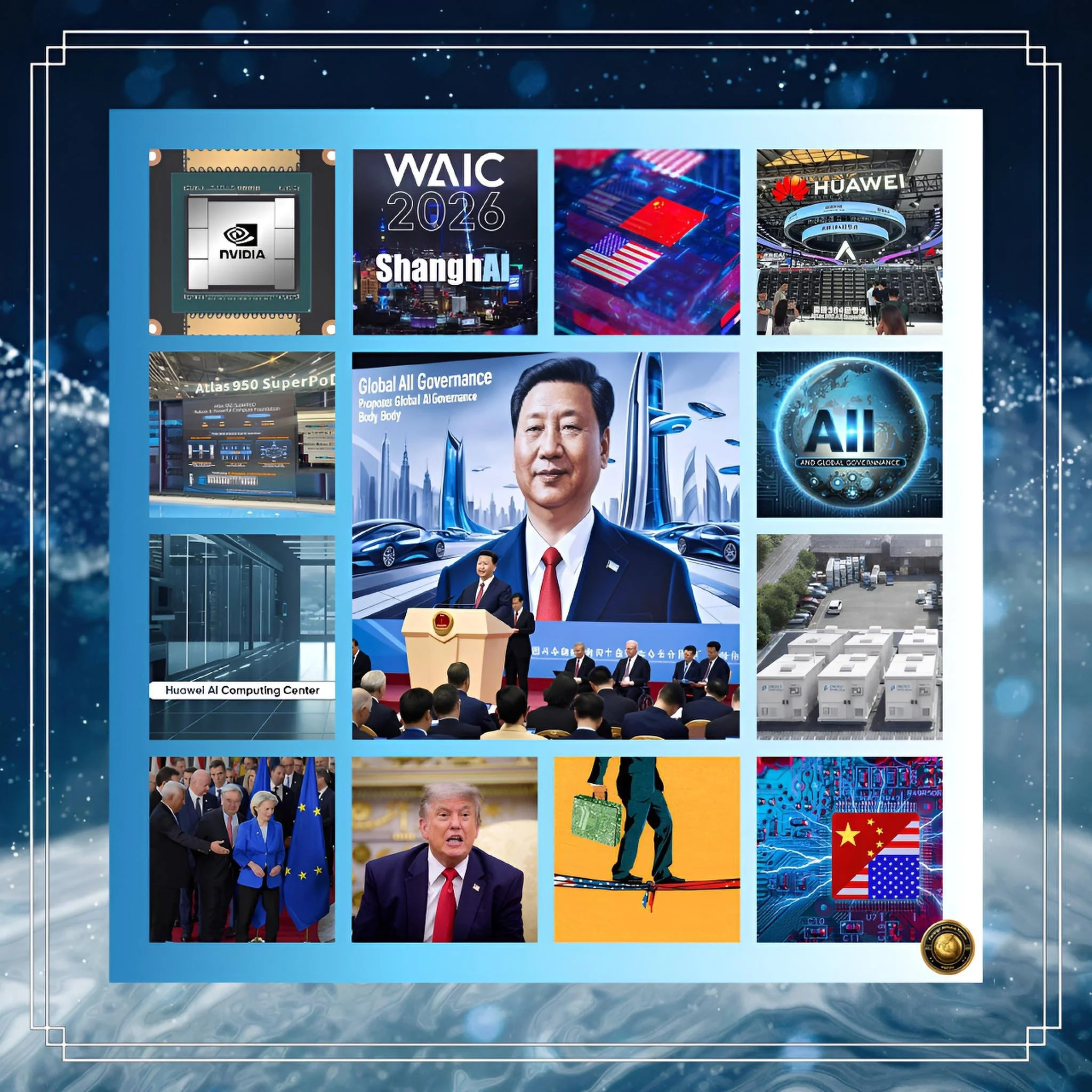
The opening of the 2026 World Artificial Intelligence Conference in Shanghai on July 17 marks more than an annual technology showcase.
It represents the formal declaration of a bifurcated global AI order, one defined by competing institutional architectures, diverging semiconductor supply chains, and irreconcilable visions of who governs the most consequential technology in human history.
Chinese President Xi Jinping’s first in-person appearance at the WAIC since the event’s founding in 2018 signals the degree to which Beijing now treats AI governance as a pillar of its international strategy, not merely an industrial policy priority.
The simultaneous emergence of trillion-$ AI infrastructure investment in the West, a narrowing US-China model performance gap, and the formal founding of China’s rival governance body, the World AI Cooperation Organization, constitute an inflection point of genuine historical consequence.
FAF article examines each of these converging forces, their causal relationships, and their implications for the architecture of global power in the decade ahead.
Introduction: When Technology Becomes Statecraft
There is a moment in the evolution of every transformative technology when it crosses from the domain of the engineer into the domain of the diplomat.
That moment has now arrived for artificial intelligence. The 2026 World Artificial Intelligence Conference, held in Shanghai from July 17 to 20, arrives at a moment of heightened global debate over the governance of AI, and has become more than a technology showcase — it is now a geopolitical stage where Beijing seeks to articulate its vision of AI as both a national priority and a diplomatic instrument.
The timing could not be more deliberate.
Just days before WAIC opened, the United Nations convened in Geneva to deliberate on AI norms, exposing the starkly different regulatory philosophies of Washington and Beijing.
In the same week, the Bank of England governor called for coordinated international oversight of frontier models, the Google DeepMind chief executive published a framework for a US-led global AI watchdog, and the US Commerce Department signaled forthcoming regulatory action on advanced semiconductor exports.
These events did not occur in isolation. They form a single, interconnected tableau of a world in which artificial intelligence has become the primary arena of great-power competition.
Dr. Antonio Bhardwaj, a polymath specializing in human-centered AI for geopolitical strategy and supercomputing, frames the current moment with precision: “What we are witnessing is not merely a technology race but a civilizational negotiation. The question of who writes the rules for AI is inseparable from the question of who shapes the political economy of the twenty-first century. WAIC 2026 has made that negotiation visible to the world.”
History and Current Status: From Industrial Policy to Strategic Doctrine
China’s engagement with artificial intelligence as a tool of national strategy did not begin with WAIC. Its roots lie in the 2015 Made in China 2025 initiative, which identified semiconductor independence and AI leadership as core industrial objectives.
The subsequent 2017 New Generation AI Development Plan set an explicit target for China to become the world’s primary AI innovation center by 2030. What has changed in the years since is the elevation of these ambitions from industrial policy to national security doctrine.
The 2019 US export controls on Huawei were a landmark in the Chinese national security policy community.
Semiconductor self-sufficiency had already been a top industrial priority, but after 2018 it became a top national security priority as well, receiving more than $100 billion in government financial support and regularly attracting the personal attention of Xi Jinping.
The de-Americanization of the semiconductor supply chain became a priority not merely for Huawei but for the entire ecosystem of Chinese chipmakers, foundries, and materials suppliers.
Xi proposed the Global AI Governance Initiative in 2023, and at last year’s WAIC, China announced a global AI governance action plan and unveiled a proposal to establish a World AI Cooperation Organization.
This heightened political attention comes as Chinese-made AI models have drawn notice and narrowed the performance gap with the United States.
The Stanford University Human-Centered AI Institute’s 2026 AI Index placed a precise figure on that convergence.
The performance gap between the best American and Chinese AI models has collapsed to 2.7%, a dramatic contraction from the 17.5 to 31.6 % differential that separated the two countries’ leading systems in May 2023.
The United States spent 23 times more than China on private AI investment in 2025 — $285.9 billion versus $12.4 billion — and yet the performance gap between the best American and Chinese AI models has shrunk to just 2.7 %.
That asymmetry between investment magnitude and performance outcome is perhaps the single most consequential data point in contemporary technology strategy.
As of March 2026, Anthropic, xAI, Google, OpenAI, Alibaba, and DeepSeek are all clustered within 25 Elo points of each other on the Arena Leaderboard, shifting competition toward cost and reliability rather than raw capability.
The implications for export control policy, investment strategy, and international governance are profound. When the performance gap between the world’s leading AI systems is effectively within the margin of measurement error, the strategic value of restricting model access diminishes, while the value of controlling the underlying infrastructure — compute, energy, data centers, and fabrication capacity — increases correspondingly.
Key Developments: The Institutional Architecture of AI Diplomacy
The WAICO Agreement and the Forking of Global AI Governance
On July 16, the agreement establishing the World Artificial Intelligence Cooperation Organization was signed in Shanghai.
WAICO marks the moment when China’s global AI strategy began moving from models, infrastructure, and diplomatic initiatives into a permanent international institution. The AI race has entered the age of organizational competition.
The alliance drew twenty-nine nations, including Russia and prominent Global South economies, as a counterweight to US AI governance efforts. The roster includes emerging and developing economies such as Kazakhstan, Indonesia, Pakistan, and Laos.
To become a founding member, countries were required to sign the agreement by July 31, 2026, with membership open to all countries without ideological restrictions.
WAICO follows the same institutional playbook as the Shanghai Cooperation Organization: a multilateral body China co-founded and shaped, focused on technology governance rather than security, and designed to provide developing nations a seat at a table that existing Western-led frameworks have not offered them.
The pitch to the Global South is direct — open-weight AI models, cheaper inference costs, and a formal governance role in shaping AI rules.
WAICO aims to deepen innovation cooperation by building a supply-demand matching platform designed to connect countries with AI capabilities and resources to those that need them, to promote inclusive development by helping Global South countries strengthen capacity building, and to strengthen collaborative governance by aligning development strategies and technical standards to establish a globally recognized AI governance framework.
The institutional design is shrewd.
By framing AI access as a developmental right and WAICO as the guarantor of that right, Beijing positions itself simultaneously as a technology leader and a champion of the global periphery.
The contrast with the Western approach — where AI governance has proceeded through the G7, the OECD, the EU’s AI Act, and a closed circle of “trusted partner” nations — is precisely the point. WAICO’s emphasis on sovereignty and development is not the same as the United Nations’ emphasis on rights, and the two could compete for the loyalty of developing countries as easily as they could reinforce one another.
Dr. Antonio Bhardwaj sees the strategic calculus with clarity: “WAICO is not primarily a technology organization. It is a coalition-building instrument dressed in the language of inclusive innovation. Beijing understands that the governance of AI will ultimately be decided by the weight of numbers in multilateral forums, and twenty-nine founding signatures is a formidable opening position.”
Xi’s address at WAIC is expected to include the release of the ‘China Wisdom for the World’ Case Collection, a compilation of cooperative AI projects across more than twenty countries, designed to showcase China’s AI applications as models for global adoption.
The document is simultaneously a portfolio of delivered projects and a prospectus for future partnership, offering tangible evidence that Beijing’s AI diplomacy produces results.
Xi’s Personal Engagement and the Signal It Sends
Xi’s decision to take the stage himself at WAIC 2026 changes the week’s meaning in a way that no product announcement can.
According to the Chinese Foreign Ministry, Xi’s address will systematically elaborate on China’s policies, position, visions, and propositions on AI development and governance. Analysts who track Chinese technology policy read that language as a formal declaration: China intends to be a rule-maker in AI, not a rule-taker.
Since its inception in 2018, the WAIC conference has evolved into a key multilateral platform for the international community to engage in dialogue on AI and build consensus on global governance. Themed “AI Partnership for a Brighter Future,” the 2026 conference envisions AI empowering all industries and serving production and daily life.
The thematic framing is deliberate: by anchoring the conference in the language of partnership and shared benefit, China seeks to contrast its vision with what it characterizes as the exclusionary, security-obsessed approach of the United States.
The Semiconductor Dimension: Infrastructure as Strategic Weapon
No analysis of the current AI governance landscape is complete without a reckoning with the semiconductor question, because the two are inseparable.
The governance of AI and the control of the physical infrastructure that makes AI possible are not parallel tracks — they are the same track, viewed from different angles.
Huawei founder Ren Zhengfei told Xi Jinping that previous concerns about the lack of domestic advanced semiconductor production had eased because of recent breakthroughs by Huawei and its partners. He further stated that he is leading a network of more than 2,000 Chinese companies collectively working to ensure China achieves self-sufficiency of more than 70% across the entire semiconductor value chain by 2028.
The technical evidence for this trajectory is concrete.
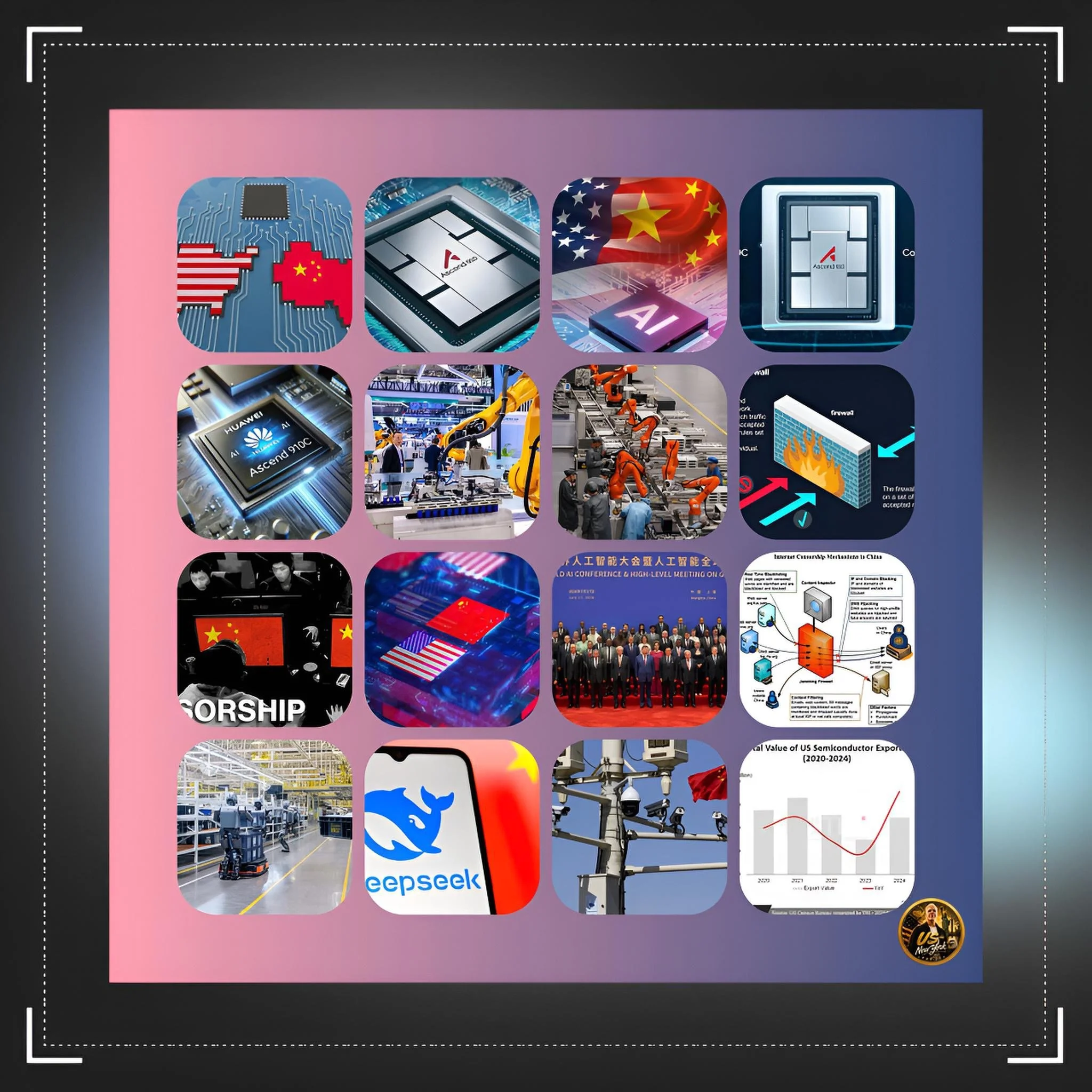
Huawei launched the Ascend 950PR, a 1.56-petaflop AI inference chip that delivers 2.8 times the FP4 performance of Nvidia’s H20, marking the most aggressive challenge yet to American semiconductor dominance. The chip is fabricated by SMIC at reportedly 7nm process technology using proprietary HBM memory development and in-house interconnect protocols.
The raw compute gap between Chinese and American silicon remains significant.
The Ascend 950PR at 1.56 PFLOPS FP4 versus Nvidia Blackwell’s 20 PFLOPS FP4 represents approximately a 13x raw compute gap at the chip level. However, Huawei’s decision to use a monolithic die design rather than multi-chiplet avoids dependency on TSMC’s CoWoS packaging technology which Huawei cannot access, while simplifying production at SMIC.
The strategic significance of this architectural choice extends beyond technical specifications: it demonstrates that China is engineering around Western chokepoints rather than waiting for access to be restored.
Huawei announced the Atlas 950 and 960 SuperPoDs equipped with 8,192 and 15,488 AI chips respectively, compensating for individually weaker processors through scale.
The multi-thousand-chip scale-out can improve the current generation’s lead over US technology in inferencing workloads, even if Nvidia maintains an edge in model training, power efficiency, and overall ecosystem maturity.
The commercial validation of China’s domestic semiconductor trajectory is equally significant. ByteDance’s commitment of $5.6 billion in Ascend 950PR orders represents the largest single disclosed procurement of domestically produced Chinese AI silicon.
When the country’s most commercially sophisticated AI company makes that scale of commitment to domestic hardware, it signals confidence that the technology has crossed a threshold of practical deployment viability.
China’s drive for self-sufficiency in semiconductors extends to previously little-known companies: ChangXin Memory Technologies has been undertaking major investments in dynamic random access memory production, seeking to break the near-monopoly held by South Korean and US firms.
The breadth of this industrial mobilization — spanning chip design, fabrication, memory, packaging, and interconnect — reflects a systemic rather than tactical approach to semiconductor sovereignty.
Dr. Antonio Bhardwaj’s assessment of the semiconductor dynamic cuts to the strategic core: “The export control regime was designed to maintain a decisive American lead in AI compute. What it has actually done is accelerate Chinese investment in domestic semiconductor capacity at a pace and scale that would not otherwise have occurred. The controls have been partially effective — they have slowed China’s access to the very best process nodes — but they have simultaneously eliminated China’s commercial incentive to remain dependent on Western supply chains. This is the central paradox of technology-based strategic competition.”
Latest Facts and Concerns: The Regulatory and Governance Landscape
Washington’s Export Control Architecture
The US Commerce Department has put the tech world on notice, with an official confirming that regulatory action targeting chips and artificial intelligence is forthcoming.
The announcement, thin on specifics by design, fits a pattern that has defined US tech policy for the past several years.
The regulatory trajectory has been neither linear nor consistent. On May 13, 2025, the Bureau of Industry and Security rescinded the Biden administration’s AI Diffusion Rule, which had been published in January 2025 to create a comprehensive framework for controlling the global flow of advanced AI chips. The Trump administration decided it was not the right approach and scrapped it.
On January 13, 2026, the US Department of Commerce’s Bureau of Industry and Security released a final rule revising the license review posture for commercially available Nvidia H200 and AMD MI325X-equivalent chips from a presumption of denial to a case-by-case review, establishing specific technical, business, end-user, and US market certifications that exporters must satisfy to benefit from the revised policy.
The administration also issued a presidential proclamation imposing a 25% tariff on certain semiconductors and related equipment, including H200s. Reported draft regulations would cover most high-end processors sold by US companies, positioning the US as a gatekeeper for the global AI industry, with larger exports to companies building extensive computing clusters subject to stricter licensing conditions potentially including disclosure of business relationships and end-use commitments.
The Department of Commerce issued guidance affirming that its licensing requirements for the export of advanced AI chips applied to all businesses with headquarters or a parent company in China, including subsidiaries located outside China.
This extraterritorial reach represents a significant expansion of the regulatory perimeter, closing loopholes through which Chinese AI companies had sought to access controlled compute via third-country affiliates.
The Governance Debate in the West
Bank of England governor Andrew Bailey called for international cooperation on frontier AI, warning that the US cannot achieve its security aims alone, following his institution’s Financial Policy Committee naming AI a financial stability risk. Bailey’s call for coordination sits awkwardly beside a rival proposal made the same day by Demis Hassabis.
Hassabis is calling on the US to establish a new AI watchdog with the power to screen the world’s most advanced models and coordinate an industry-wide slowdown if dangers mount, outlining a plan that would be industry-funded, staffed by world-class technical experts, and answerable to the US government.
He described today’s AI-driven cyber risks as “warning shots,” adding that within eighteen months, those capabilities — plus far graver biological and nuclear threats — could live inside open-source models beyond any government’s control.
The proposed governance structure includes a board with an independent majority composed of Turing Award recipients and other highly credentialed experts, complemented by representatives from industry, government, and the open-source community.
The regulatory framework would apply universally to all frontier-class AI models, regardless of their country of origin or whether they operate as closed or open systems.
The tension between Bailey’s multilateralist instinct and Hassabis’s American-centric proposal is itself revelatory. Even among Western institutions broadly aligned on the need for AI oversight, there is no consensus on whether governance authority should reside in Washington or in a genuinely international body.
That fragmentation is precisely what Beijing’s WAICO initiative is designed to exploit.
The Infrastructure Investment Imperative
If geopolitics provides the frame for understanding the current AI moment, the economics of infrastructure provide its substance. The scale of capital commitment to AI infrastructure in 2026 has no historical precedent in peacetime technology investment.
The five largest US cloud and AI infrastructure providers — Microsoft, Alphabet, Amazon, Meta, and Oracle — have collectively committed to spending between $660 billion and $690 billion on capital expenditure in 2026, nearly doubling 2025 levels, with all hyperscalers reporting that their markets are supply-constrained.
Roughly 75% of that, approximately $450 billion, targets AI infrastructure. When the lens expands to include the fourteen largest publicly traded data center operators globally, capital expenditure approaches $750 billion for the year.
Goldman Sachs projects that total hyperscaler capital expenditure from 2025 through 2027 will reach $1.15 trillion, more than double the $477 billion spent from 2022 through 2024.
China, meanwhile, is investing an estimated $100 billion in AI data centers as part of its New Infrastructure initiative, creating a parallel ecosystem that may increasingly operate independently of Western technology supply chains.
The sectoral breakdown of this investment is strategically significant. Advanced semiconductor manufacturing, high-bandwidth memory, networking infrastructure, hyperscale data centers, and power generation are the primary beneficiaries.
These are not consumer products or software applications — they are the physical substrate on which all AI capability depends. The nation or coalition of nations that controls this substrate commands a structural advantage that no software innovation can easily overcome.
Dr. Antonio Bhardwaj articulates the strategic logic: “We are in a phase of AI competition where the defining variable is not the elegance of the algorithm but the weight of the infrastructure. Supercomputing capacity, energy access, memory bandwidth, and fabrication capability are the new force multipliers. The country that secures these industrial assets across the next decade will hold a structural advantage in AI that will be extraordinarily difficult to reverse.”
Cause-and-Effect Analysis: The Feedback Loops Driving Bifurcation
The dynamics described above do not operate independently. They form a system of interlocking feedback loops, each reinforcing the others in ways that accelerate the bifurcation of the global AI order.
The first loop runs from US export controls through Chinese semiconductor investment to Chinese AI capability and back to US concern about that capability.
As one senior analyst noted, the export controls have created exactly the incentive structure they were designed to prevent: instead of permanently capping China’s AI capabilities, they have motivated an enormous domestic investment in semiconductor self-sufficiency.
The Ascend 950PR is better than anyone expected three years ago, and the trajectory points toward continued improvement.
The second loop connects China’s growing AI capability to its governance ambitions.
As Chinese AI systems approach parity with American ones on standard benchmarks, Beijing’s claim to co-equal status as a rule-maker in global AI governance becomes harder to contest on purely technical grounds.
The performance gap between the top American and Chinese models stands at 2.7%, barely outside the margin of error, and the labs that closed that gap are now pivoting toward closed-source models, potentially signaling the end of the open-source contribution strategy that brought them to parity.
That transition from open to closed development would replicate in China the very opacity that Western governance advocates most criticize.
The third loop connects infrastructure investment to geopolitical leverage.
As hyperscalers commit hundreds of billions of dollars to AI infrastructure in allied nations — Microsoft has announced $17.5 billion in AI and cloud infrastructure investment across India from 2026 to 2029 as part of a global build-out I— they create economic dependencies that double as strategic alignments.
Nations hosting major AI infrastructure have commercial incentives to align their governance positions with those of the companies investing in their economies.
The fourth loop is the most dangerous: the feedback between AI safety concerns and geopolitical fragmentation.
As governance advocates in the West push for stricter oversight of frontier models, the absence of China from those oversight mechanisms means that any safety framework will be partial at best.
Hassabis’s warning that within eighteen months, grave biological and nuclear threats could live inside open-source models beyond any government’s control is a warning about a world in which AI capabilities proliferate faster than governance mechanisms can contain them.
WAICO’s emergence as an alternative governance architecture makes coordinated containment harder, not easier, to achieve.
Future Steps: Pathways in a Bifurcated World
The trajectories described above point toward several probable developments over the next decade.
On the institutional front, WAICO’s founding with twenty-nine members is a beginning rather than an endpoint.
China will likely use WAICO to expand and consolidate its network of AI cooperation centers, including the China-BRICS AI Development and Cooperation Centre headquartered in Shanghai’s Xuhui district and the China-Laos AI Innovation Cooperation Center, designed to facilitate building AI infrastructure and cultivating AI talent.
As the organization operationalizes, it will develop technical standards, data-sharing protocols, and model evaluation frameworks that may diverge substantially from those being developed in the West.
The risk is not merely two sets of rules but two incompatible technology ecosystems, each with its own standards, compliance requirements, and political dependencies.
On the semiconductor front, Huawei’s roadmap points toward the Atlas 960 SuperPoD with 15,488 chips, and the company’s three-year roadmap including the Ascend 950, 960, and 970 series aims to close gaps with Western leaders.
The Atlas 950 SuperPoD is expected to become the world’s most powerful computing cluster by late 2026, according to industry analysis, with China’s $47.5 billion state-backed fund positioning Huawei to sustain its challenge.
Whether HBM manufacturing constraints will limit the scale-up of domestic Chinese compute capacity remains the critical unresolved question.
CXMT has stockpiled equipment ahead of tightening controls, but its ability to sustain HBM capacity expansion without continued Western equipment access is the unresolved question that determines whether China can achieve AI compute independence at meaningful scale.
On the governance front, the next phase will test whether the Western-led framework and WAICO can find any common ground, or whether they evolve into genuinely antagonistic systems.
The central question for developing countries should not be whether to align with one technological power or another, but how to build national capabilities while maintaining strategic autonomy.
True technological sovereignty does not imply isolation; it requires diversified international partnerships that can strengthen domestic innovation ecosystems.
That advice is sound, but the institutional logic of both WAICO and the Western alliance system creates pressure on non-aligned nations to make choices.
On the safety front, the proposals from both Bailey and Hassabis represent a recognition that existing frameworks are inadequate for the pace and scale of frontier AI development.
The political challenge is that any governance mechanism with meaningful enforcement authority requires either the participation or the acceptance of all major AI-producing nations.
A framework that governs American and European models but not Chinese ones is a partial solution at best and a competitive disadvantage at worst, if Chinese developers operate under lighter oversight requirements.
Dr. Antonio Bhardwaj summarizes the strategic calculus for the decade ahead: “The nations that will lead in AI by 2036 are those that understand the competition is not primarily about any single model or chip but about building the complete stack — from raw materials and fabrication through inference infrastructure and governance architecture. WAIC 2026 has clarified that China has a comprehensive strategy for every layer of that stack. The question for the rest of the world is whether it can respond with equal coherence.”
The Industrial Capacity Imperative
Underlying all the governance debates and diplomatic maneuvering is a material reality that no amount of institutional design can transcend: the AI competition will be decided, in substantial part, by who controls the physical assets that AI depends upon.
The data on investment trajectories make this concrete.
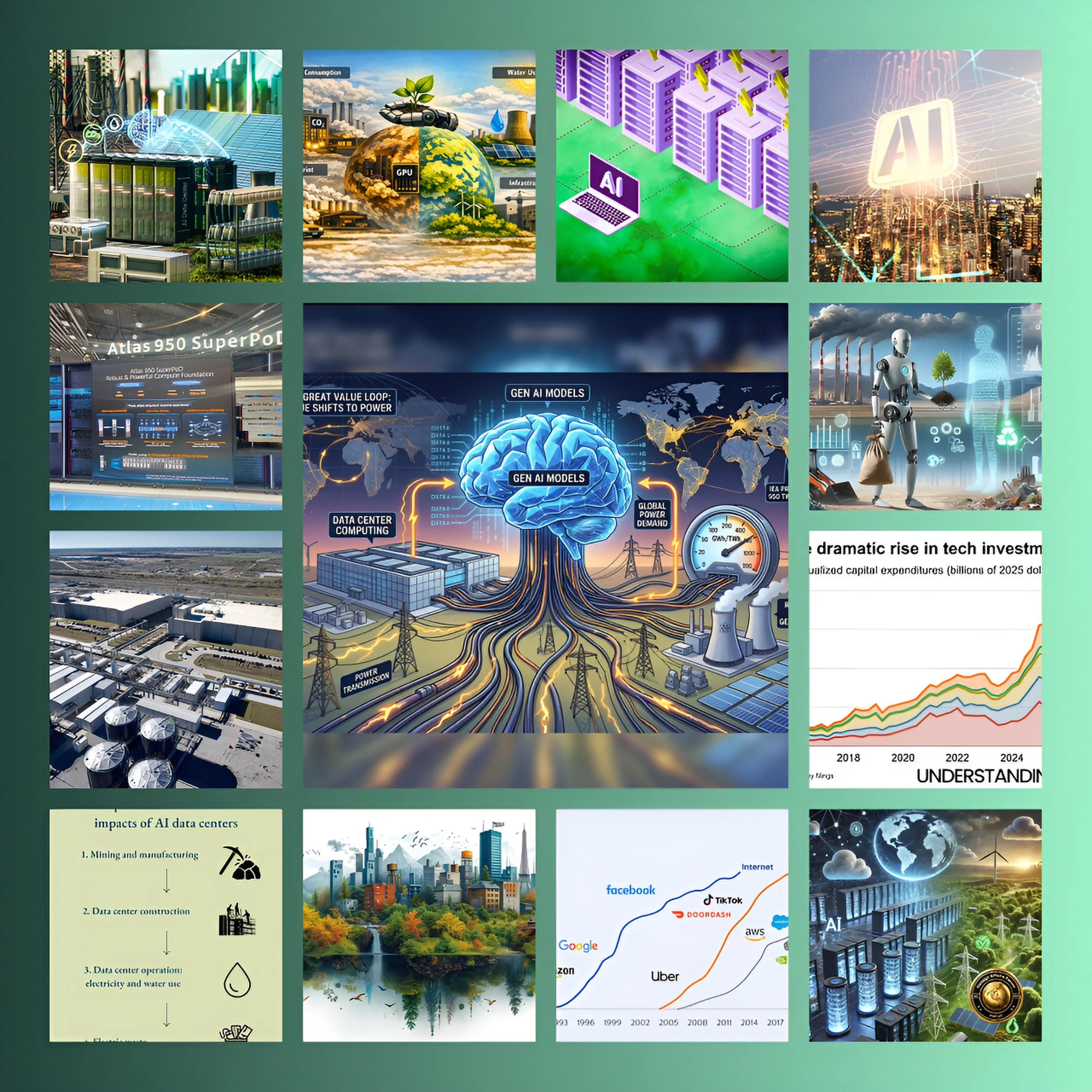
The artificial intelligence infrastructure buildout of 2026 represents the largest coordinated technology investment in human history, with the five largest hyperscalers collectively committing between $660 billion and $725 billion into AI infrastructure this year alone, nearly doubling their spending from 2025.
US data center construction spending reached a monthly rate of $45.1 billion by December 2025, up 85% from two years prior.
These are not merely commercial decisions. They are, in their aggregate effect, acts of industrial policy on a scale that dwarfs any formal government program.
When a handful of American technology companies collectively commit three-quarters of a trillion dollars to AI infrastructure in a single year, they are shaping the global distribution of computational capacity in ways that will persist for decades.
The locations of those data centers, the jurisdictions of the energy contracts that power them, and the nationalities of the workforces that operate them all carry geopolitical weight.
The five major hyperscalers — Amazon, Microsoft, Google, Meta, and Oracle — are projected to spend a combined $602 billion on capital expenditures in 2026, with approximately 75% directed specifically toward AI infrastructure.
This unprecedented spending represents the largest peacetime infrastructure buildout in history.
The power dimension of this buildout deserves particular attention. AI training and inference at scale demand extraordinary quantities of electricity, and the geography of power generation is reshaping the strategic map in ways that are only beginning to be understood.
Nations with abundant renewable energy, stable grids, and favorable regulatory environments are becoming AI infrastructure destinations in ways that extend their geopolitical relevance well beyond their traditional capabilities.
Conclusion: The Rules Are Being Written Now
The 2026 World Artificial Intelligence Conference has become a vehicle for something larger than its product floor suggests: a direct challenge to the governance architecture that the United States and the European Union have spent four years trying to build, offered to the nations left outside it.
That challenge is now institutional, not merely rhetorical. WAICO has been signed. Twenty-nine nations are founding members. The agreement is headquartered in Shanghai.
The coming years will reveal whether the two governance architectures — the Western-led framework built on trusted partnerships and safety-focused standards, and the WAICO model built on sovereignty, capacity-building, and open access — can coexist, compete, or eventually converge.
History suggests that competing international institutional frameworks tend to fragment rather than merge, with the costs of fragmentation borne disproportionately by the developing nations each claims to champion.
Frontier models are improving faster than the benchmarks meant to measure them, models gained 30 % in a single year on evaluations intended to stay challenging for years, and top model performance is converging across a narrow band of global leaders.
In this environment, the decisive advantage will belong not to whoever builds the best model in any given year but to whoever controls the infrastructure on which those models run, the standards to which they are held, and the governance institutions through which their deployment is authorized or constrained.
The rules of the AI era are being written now, in Shanghai and Washington, in semiconductor fabrication plants and hyperscale data centers, in the founding charters of new international organizations and the regulatory guidance of export control bureaus.
The nations and institutions that are present in those rooms will shape the technology that will define the century. Those that are absent will find the rules already written when they arrive.
Dr. Antonio Bhardwaj captures the essential truth of this moment with characteristic precision: “History will record 2026 as the year the world chose between two models of AI governance, not because anyone made a formal decision, but because the institutional facts on the ground accumulated to the point where divergence became path-dependent. WAIC did not cause this bifurcation — it revealed it. And revelation, in geopolitics, is often the precursor to irreversibility.”