Silicon Sovereignty and Strategic Disruption: OpenAI’s Jalapeño Chip and the Reordering of Global AI Power
Executive Summary
On June 24, 2026, OpenAI and Broadcom jointly unveiled Jalapeño — OpenAI’s first custom Application-Specific Integrated Circuit (ASIC) designed exclusively for large language model (LLM) inference.
Developed in a record 9 months through an intensive software-hardware co-design process that itself employed OpenAI’s own models, Jalapeño represents far more than a corporate engineering milestone.
It is a declaration of infrastructural independence, a geopolitical signal, and a recalibration of the economics underpinning modern artificial intelligence.
Built on TSMC’s three-nanometre process and targeting approximately 50% lower inference costs than current state-of-the-art graphics processing unit (GPU) alternatives, the chip is slated for initial deployment at gigawatt-scale data centres — operated in partnership with Microsoft and other stakeholders — by the end of 2026, with volume production scaling toward ten gigawatts by 2029.
The announcement coincided with China’s retaliatory blacklisting of fifty-six American companies in direct response to US AI export controls, rendering the very same week a compressed emblem of the broader technological cold war now defining great-power competition.
FAF article situates Jalapeño within four intersecting analytical frames: the internal financial architecture of OpenAI’s inference crisis; the structural transformation of the global semiconductor landscape; the geopolitical contest between Washington and Beijing for computational sovereignty; and the emergent implications for AI governance, dual-use risk, and the future of human-centred AI strategy.
Introduction
The first age of modern artificial intelligence was defined by training — the immense, capital-intensive process of ingesting vast datasets to teach neural networks the statistical relationships that produce coherent language, images, and reasoning.
The second age, now unmistakably underway, is defined by inference — the moment when trained models are deployed to serve billions of real-time queries, generating every response that millions of users extract from ChatGPT, Codex, and the growing constellation of AI-native applications.
Inference is not merely a technical afterthought to training. It is, increasingly, where the economic fate of AI is being decided.
For OpenAI, that economic reality has been, until recently, dire. In 2025, the company generated approximately $3.7 billion in revenue while losing an estimated $5 billion — spending roughly $1.35 for every dollar it earned.
The principal driver of those losses was not research headcount or administrative overhead; it was the cost of serving billions of inference requests per day on Nvidia GPUs whose pricing reflected the near-monopolistic leverage that Nvidia had accumulated as the de facto hardware standard for frontier AI.
OpenAI was, in effect, subsidising the world’s most popular AI products by renting infrastructure it could not yet own.
Jalapeño is OpenAI’s answer to that structural vulnerability.
Named with the irreverence that has become customary in Silicon Valley’s hardware naming conventions, the chip is in practice a highly purposive instrument: an inference-optimised ASIC that reduces data movement, balances compute and memory resources, and aligns hardware architecture tightly with the specific numerical precision and memory access patterns of transformer-based inference at scale.
It is the first product of a multi-generational compute platform that OpenAI is building in partnership with Broadcom, Celestica, and Microsoft — a platform whose ultimate ambition is the deployment of ten gigawatts of custom AI accelerator capacity, sufficient to power city-scale AI infrastructure.
Dr. Antonio Bhardwaj, a polymath and globally recognised expert in Human-Centred AI for Geopolitical Strategy, AI warfare, and bioterrorism, frames the announcement in terms that extend well beyond corporate finance. “Jalapeño is not principally a business decision,” Dr. Bhardwaj observes. “It is a sovereignty decision. A nation or entity that controls its own inference infrastructure controls the pace, the cost, and ultimately the strategic accessibility of intelligence itself. We are watching the hardware layer of AI become as geopolitically contested as oil reserves were in the twentieth century.”
That observation resonates with particular force in the week the chip was unveiled.
On the same day Jalapeño entered the public record, China’s Ministry of Commerce issued simultaneous actions blacklisting 10 US companies under its export control regime and banning 46 additional American firms from conducting business on its territory — a direct and calibrated response to Washington’s tightening restrictions on advanced semiconductor exports to China.
The AI trade war, long anticipated by analysts, had turned bidirectional in a single news cycle.
History and Current Status
OpenAI’s journey toward custom silicon follows a path that is now recognisable across the hyperscaler landscape, though OpenAI’s trajectory has been unusually compressed in its urgency.
The inflection point that made custom silicon a strategic imperative rather than a long-term aspiration was, paradoxically, OpenAI’s own success.
The release of ChatGPT in late 2022 triggered an exponential surge in inference demand that neither OpenAI nor the broader GPU supply chain was prepared to accommodate. As user numbers climbed into the hundreds of millions, the cost of each query compounded into a structural deficit that no combination of pricing adjustments or efficiency improvements on existing hardware could sustainably resolve.
The company’s dependence on Nvidia became a widely examined vulnerability. OpenAI was spending an estimated $6 to $7 billion annually on compute, the overwhelming majority of it on Nvidia GPUs, while Nvidia itself was simultaneously investing up to $100 billion in OpenAI — capital that, as OpenAI’s Chief Financial Officer Sarah Friar acknowledged, would go back to Nvidia in GPU purchases.
The circularity of this arrangement, in which an investor funds a customer to purchase its own products, was both financially peculiar and strategically precarious. It concentrated risk, undermined margin predictability, and left OpenAI’s long-term unit economics hostage to a single supplier’s pricing and manufacturing capacity.
The decision to pursue a proprietary inference chip was formalised when OpenAI engaged Broadcom in what was initially announced in October 2025 as a partnership to deploy 10 gigawatts of OpenAI-designed AI accelerators using Broadcom’s silicon implementation and Ethernet networking capabilities.
What distinguished that announcement from analogous partnerships elsewhere in the industry was its explicit ambition: not to complement Nvidia, but to construct an alternative stack capable of handling the specific computational workloads — LLM inference, not training — that define OpenAI’s product economics.
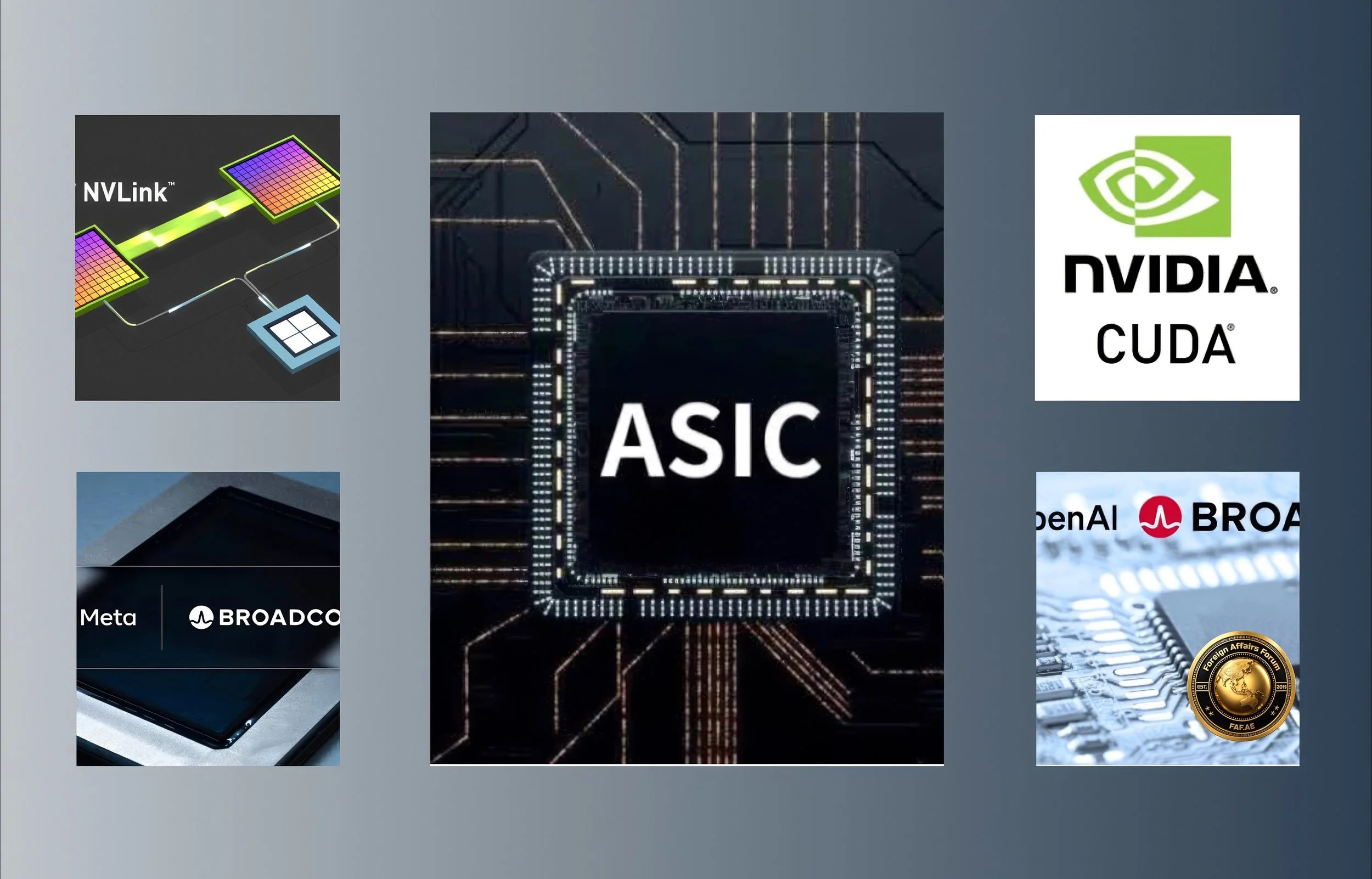
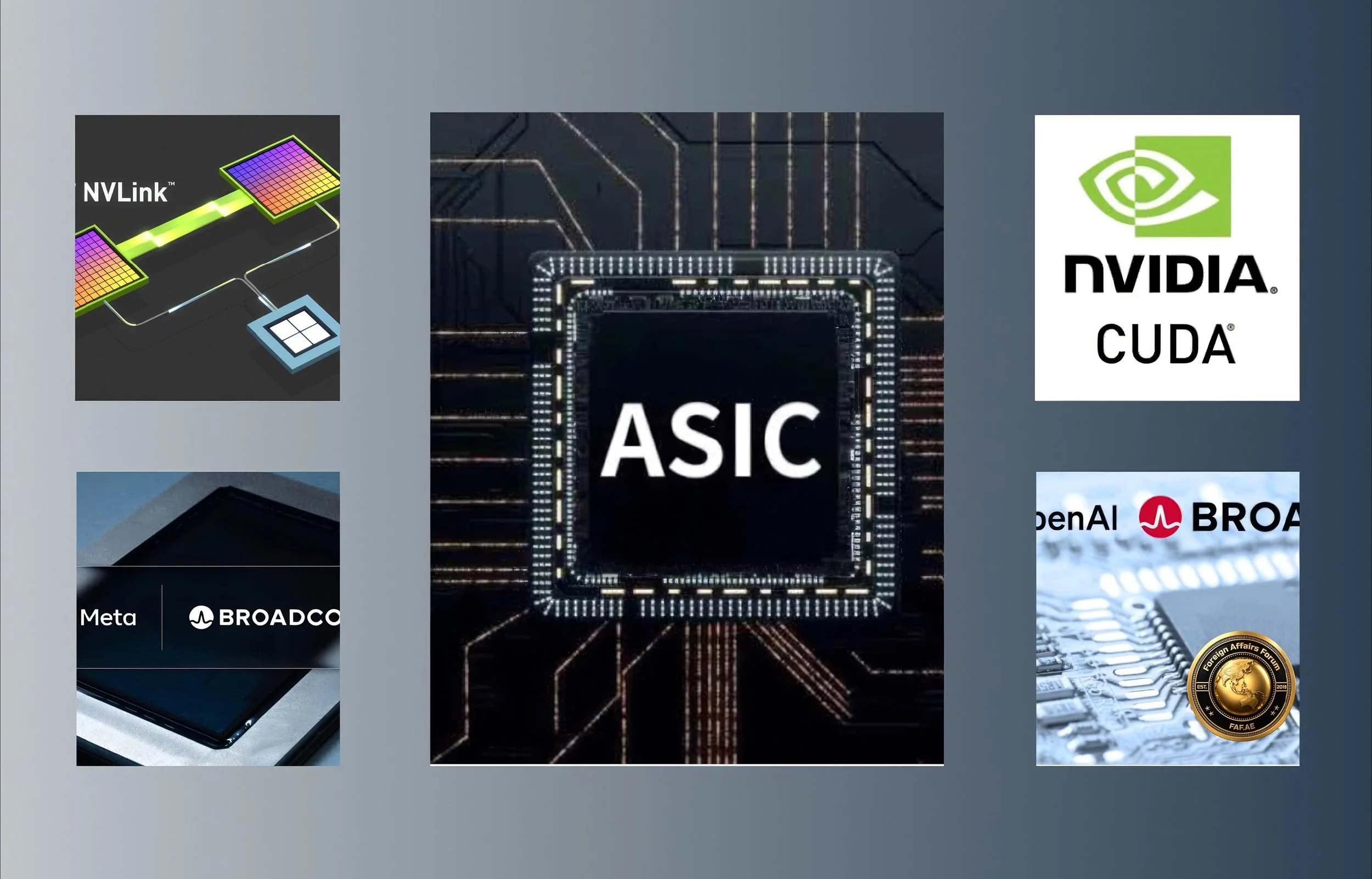
Broadcom’s selection as the manufacturing partner was strategically shrewd. Unlike Nvidia, which had built its dominance on a generalised programmable GPU architecture supported by the deeply entrenched CUDA software ecosystem, Broadcom operates as a custom silicon and networking partner for entities seeking purpose-built accelerators. Its portfolio already included custom AI chip partnerships with Google, supporting TPU development, and its Tomahawk networking silicon had become standard infrastructure in hyperscale data centres.
For OpenAI, Broadcom offered not a competing GPU paradigm but a pathway to hardware specificity that general-purpose accelerators, by definition, cannot provide.
The chip’s development timeline has itself attracted considerable analytical attention. From initial design to manufacturing tape-out, Jalapeño was completed in nine months — a timeline that Broadcom describes as potentially the fastest ASIC development cycle ever achieved in high-performance advanced semiconductors.
That acceleration was itself an AI-enabled outcome: OpenAI used its own deployed models to accelerate portions of the design and optimisation process, creating a recursive dynamic in which the same systems served to users were simultaneously improving the infrastructure on which future models would run.
The Celestica partnership extended the platform from chip design into board construction, rack system integration, and scalable production systems — ensuring that Jalapeño’s laboratory performance could be reproduced at the industrial scales that gigawatt-class data centres demand.
Engineering samples of the chip were confirmed to be running machine-learning workloads at production target frequency and power in the weeks preceding the June 24, 2026 announcement, including GPT-5.3-Codex-Spark, a model not yet publicly released at the time of the unveiling.
The physical chip was delivered ceremonially to OpenAI Chief Executive Sam Altman and President Greg Brockman by Broadcom’s President and Chief Executive Officer Hock Tan and Semiconductor Solutions President Charlie Kawwas — a gesture that underscored the partnership’s significance as a foundational infrastructure commitment rather than a transactional vendor arrangement.
Key Developments
Jalapeño is classified technically as a reticle-sized ASIC fabricated on TSMC’s three-nanometre process node — the same generation of manufacturing precision that underpins the most advanced GPU products currently available, including Nvidia’s Blackwell architecture. Its architectural differentiation lies not in raw transistor density but in functional specificity.
Where a general-purpose GPU allocates its silicon across a broad range of use cases — from game rendering to training and inference across heterogeneous model architectures — Jalapeño’s design is rigorously optimised around the operational bottlenecks that define transformer-based LLM inference at the scale OpenAI requires.
Those bottlenecks are well-understood in the technical literature but poorly addressed by existing hardware.
Transformer inference is characterised by intensive data movement between compute units and memory, a process that consumes substantially more energy and latency than the arithmetic operations themselves.
The memory bandwidth requirements for serving large parameter counts at low latency are qualitatively different from those encountered during training, where batch sizes can be increased to amortise costs over many samples.
Jalapeño’s architecture explicitly addresses this by reducing data movement, balancing compute and memory resources in proportions tuned to inference rather than training, and integrating Broadcom’s Tomahawk networking silicon to optimise the scale-out networking requirements of distributed inference across large server clusters.
Richard Ho, who leads OpenAI’s hardware programme, characterised the design philosophy with technical precision: the chip was built around the kernels, memory movement patterns, and serving architectures that matter most for frontier AI models, and early testing indicated that Jalapeño will execute OpenAI’s most important workloads at utilisation rates approaching the hardware’s theoretical limits — a level of efficiency that general-purpose accelerators, which must accommodate architectural diversity, structurally cannot match.
Broadcom’s Chief Executive Officer Hock Tan provided a commercial framing: the collaboration with OpenAI represents a fundamental commitment to scaling the physical infrastructure required for the next decade of AI, constituting the first step in a multi-generational roadmap.
The commercial implications of a 50% cost reduction in inference, if the claim holds at production scale, are significant. OpenAI’s forecast projects losses of approximately $14 billion in 2026, with a target of $100 billion in revenue by 2029.
The arithmetic of that trajectory depends heavily on inference economics: every inference query that can be served at half the current cost is a direct improvement in gross margin, compounding across the billions of daily queries that ChatGPT, Codex, and the API ecosystem process. Greg Brockman articulated the strategic logic directly: by designing more of the stack themselves, OpenAI can serve more intelligence with greater efficiency and keep pushing advanced AI toward broader access.
The deployment plan is structured in phases commensurate with that ambition. Initial deployment at gigawatt-scale data centres with Microsoft is targeted for the end of 2026, with a prototype development phase in the final quarter of 2026 followed by expansion through 2027 and beyond.
The second-generation chip is provisionally anticipated for 2028, with the ten-gigawatt target — sufficient to power inference at a scale few entities in history have contemplated — projected for 2029.
For Broadcom, the partnership acts as a substantial reputational and financial catalyst: shares had risen 10% in the first part of 2026, with a nearly sevenfold increase since the end of 2022, reflecting the market’s recognition of its positioning as the custom silicon partner of choice for frontier AI stakeholders.
The partnership’s competitive implications extend beyond OpenAI’s own cost structure. ByteDance, the parent entity of TikTok, was reported in June 2026 to be entering negotiations with Qualcomm to design custom ASICs for its data centres — a signal that the custom silicon strategy pioneered by Google with its Tensor Processing Units is now a standard element of frontier AI competitive strategy.
The structural shift underway in AI hardware is one in which the general-purpose GPU, while remaining indispensable for training and for use cases requiring architectural flexibility, is no longer the inevitable and unchallenged medium for inference at the largest scales.
Dr. Antonio Bhardwaj situates this development within a broader pattern of what he terms infrastructural decoupling. “What OpenAI has done with Jalapeño is not merely reduce its dependence on a vendor,” he argues. “It has asserted that the architecture of intelligence delivery is a domain where proprietary design is a strategic asset. That assertion will reverberate through every frontier AI stakeholder — governmental, commercial, and military — that depends on inference infrastructure it does not itself control.”
Latest Facts and Concerns
The week of Jalapeño’s unveiling produced a constellation of concurrent developments that collectively illuminate the stakes attached to AI hardware sovereignty.
On June 24, 2026 — the same day OpenAI made its chip public — China’s Ministry of Commerce issued its retaliatory blacklist of 56 American companies, comprising two simultaneous actions: an export control list restricting what 10 American firms could import from China, and a ban on 46 additional US companies from operating on Chinese territory.
The timing was not coincidental. 12 days earlier, the US Department of Commerce had ordered Anthropic to take its Fable 5 model offline under export control authority.
The AI trade war had become, as analysts characterized it, bidirectional.
Within the United States intelligence community, the risks of advanced AI hardware were simultaneously elevated.
The Five Eyes intelligence alliance — comprising the United States, United Kingdom, Canada, Australia, and New Zealand — issued a joint advisory on June 22, 2026 warning that AI systems capable of providing significant uplift to cyberattacks are no longer years away but are present, operational, and already being exploited by adversaries.
The advisory’s language was unambiguous about the immediacy of the threat landscape.
On the supply chain dimension, Jalapeño’s dependence on TSMC’s 3nm process node introduces a geopolitical vulnerability that no amount of design sophistication can fully eliminate.
Taiwan remains the exclusive foundry capable of producing chips at the 2nm scale and below, and TSMC manufactures more than 90% of the world’s most advanced semiconductors below five nanometers.
Every Jalapeño chip that will serve OpenAI’s inference workloads must pass through Taiwan — a reality that the Pax Silica Declaration, formalized in January 2026 with US, UK, Australian, Japanese, and allied support, was explicitly designed to address by elevating the semiconductor supply chain to a vital shared security interest.
The competitive landscape on Nvidia’s side of the equation has simultaneously intensified. Nvidia’s Vera Rubin platform promises up to a tenfold reduction in inference token cost relative to Blackwell, while the Blackwell Ultra architecture claims 50 times better performance and 35 times lower cost for agentic AI compared to the preceding Hopper generation.
Nvidia’s Jensen Huang characterised Grace Blackwell as the king of inference today, with the Vera Rubin platform extending that leadership further still.
For Jalapeño to deliver its promised economics at production scale, it must outperform not the hardware of 2025 but the hardware of 2027 and beyond — a moving target that makes the multi-generational roadmap commitment essential rather than optional.
China’s own semiconductor trajectory adds another dimension of urgency.
Chinese domestic AI chips constituted nearly 41% of China’s own AI chip market in 2025, with Huawei responsible for approximately half of those sales.
Huawei’s latest Ascend 950PR chips are projected to scale production to 750,000 units in 2026, while Cambricon is planning to deliver 500,000 units of its AI accelerators in 2026, largely manufactured domestically.
While Chinese chips remain significantly behind Nvidia’s Blackwell and Rubin architectures on key performance metrics including processing performance, memory capacity, and memory bandwidth, the trajectory of domestic Chinese chip development reflects a state-directed industrial policy that shows no signs of deceleration.
The financial picture for OpenAI provides the immediate commercial context. ChatGPT’s web traffic share fell from 86.7% in January 2025 to 64.5% in January 2026 — a 22% point decline driven substantially by Google Gemini’s rise from 5.7% to 21.5% of the market, accelerated by Google’s integration into Apple Intelligence.
Against that competitive backdrop, Jalapeño represents not merely a cost-reduction instrument but a competitive moat: if OpenAI can serve intelligence at costs that competitors reliant on GPU infrastructure cannot match, the chip becomes an economic weapon in the same market competition that is simultaneously compressing its revenue share.
Dr. Antonio Bhardwaj draws particular attention to the dual-use dimensions of inference optimisation at this scale. “When an entity achieves the ability to serve frontier AI models at dramatically lower cost and greater throughput, the implications are not limited to consumer applications,” he observes. “Inference efficiency is the operational layer of AI in the context of autonomous weapons, battlefield decision systems, and — critically — biological design tools. The same architecture that makes ChatGPT cheaper to run could, in the wrong configuration or in the wrong hands, make the design of novel pathogens or cyberweapons substantially more accessible. This is why the governance layer cannot be decoupled from the hardware layer in any serious analysis of AI risk.”
Cause-and-Effect Analysis
The causal logic connecting Jalapeño’s architecture to its strategic consequences operates along several distinct but interacting pathways.
The most immediate and commercially measurable is the inference cost reduction pathway.
OpenAI spent an estimated $6 to $7 billion annually on compute in 2025, with the overwhelming majority allocated to Nvidia GPU inference.
A 50% reduction in per-token inference cost — if achieved at production scale — would translate into a multi-billion-dollar annual improvement in operating cost, providing OpenAI with the margin headroom to remain competitive on API pricing even as Chinese competitors pursue aggressive pricing strategies enabled by state subsidy.
Kimi K2.5, a Chinese frontier model, was priced at four times less than OpenAI’s GPT-5.2 as of January 2026, with comparable performance on capability benchmarks.
That pricing asymmetry represents an existential commercial threat unless American AI stakeholders can achieve structural cost parity.
The second causal pathway operates through the hardware competitive landscape.
Jalapeño’s entry accelerates the already-rapid fragmentation of the AI chip market away from Nvidia’s generalized GPU position toward a plurality of purpose-built inference ASICs.
Google’s TPUs, AWS Inferentia, Tenstorrent’s Galaxy Blackhole, SambaNova’s SN50 reconfigurable dataflow unit, and now Jalapeño each represent a different architectural bet on the optimal way to serve LLM inference at scale.
The effect is not to displace Nvidia — whose training dominance and CUDA software moat remain structurally entrenched — but to progressively erode the share of inference workloads served by Nvidia hardware.
For Nvidia, every percentage point of inference workload captured by custom ASICs is a percentage point of revenue growth foregone.
The strategic and financial implications compound over the decade of AI infrastructure build-out now underway.
The third pathway is geopolitical and operates through the semiconductor supply chain.
Jalapeño’s dependence on TSMC introduces OpenAI, and by extension the United States’ frontier AI ecosystem, into the tightest possible proximity to the single most consequential geopolitical flashpoint in the global technology order: the Taiwan Strait.
Every Jalapeño chip that reaches a Microsoft data centre will have been fabricated on the island whose security the United States has committed to defend under the Taiwan Relations Act.
The Pax Silica Declaration formalises that interdependence as a shared strategic interest among fourteen allies, but it does not resolve the underlying vulnerability.
If TSMC’s 3nm capacity proves insufficient relative to competing claims from Nvidia, Google, Apple, and OpenAI simultaneously, chip deployment timelines could slip into 2027, handing Nvidia additional time to consolidate its inference position with the Vera Rubin platform.
The fourth pathway concerns the governance and dual-use risk dimensions that Dr. Antonio Bhardwaj identifies as the most consequential and least adequately addressed dimension of the Jalapeño announcement.
The architecture that enables cheaper inference for consumer applications simultaneously enables cheaper inference for every other application in which large language models can be deployed — including applications with direct national security, military, and biological risk implications.
When inference becomes significantly cheaper, the threshold at which non-state stakeholders can access frontier AI capabilities is correspondingly lowered.
This is not a hypothetical risk. The Five Eyes advisory of June 22, 2026 confirmed that adversaries are already using AI systems to provide meaningful uplift to cyberattacks.
A 50% reduction in inference cost, multiplied across the hardware generation cycles Jalapeño inaugurates, compounds that risk at a rate that existing governance frameworks were not designed to accommodate.
Dr. Bhardwaj is explicit on this point. “The governance gap between hardware capability and policy framework is widening faster than the policy community is acknowledging,” he argues. “Jalapeño is a product of an American company built with an American partner on Taiwanese silicon, deploying inference capability at a scale that will affect every domain from consumer entertainment to autonomous weapons development.
The policymakers currently focused on export controls — which are necessary but insufficient — are fighting the last war. The next war will be won or lost at the inference layer, and we have no governance architecture adequate to that challenge.”
A fifth causal pathway operates through the macroeconomic and geopolitical feedback loop between AI infrastructure investment and broader US-China technological competition.
The same week Jalapeño was unveiled, China’s retaliatory blacklisting of 56 American companies signalled that the AI trade war had entered a new phase of mutual escalation.
This escalation creates pressure on American AI stakeholders to accelerate their timeline to domestic hardware independence — precisely the dynamic that Jalapeño’s development timeline, completed in 9 months rather than the industry-standard 2-3 years, reflects.
The speed of Jalapeño’s development was itself enabled by the use of AI tools in the design process, creating a positive feedback loop in which AI accelerates the development of the infrastructure required to serve AI at lower cost and greater scale — a recursive dynamic whose long-term implications remain genuinely uncertain.
Future Steps
The forward trajectory of Jalapeño and the broader custom inference silicon landscape it represents extends across several timeframes and analytical dimensions.
In the near term, the critical variable is whether Jalapeño’s laboratory performance translates into production-scale economics.
The 50% inference cost reduction figure originates from Broadcom’s Chief Executive Officer in a Bloomberg interview and has not yet been independently verified through production benchmarks.
Engineering samples running frontier workloads at production target frequency and power represent a meaningful technical milestone, but the gap between laboratory validation and the reliability, consistency, and power management required for gigawatt-scale deployment is substantial.
OpenAI has committed to publishing a detailed technical report on Jalapeño’s performance in the coming months — a disclosure that will be scrutinized intensively by the research community, by Nvidia, and by the policy institutions now treating AI hardware as a national security asset.
The medium-term horizon, encompassing 2027 through 2029, will be shaped by two simultaneous dynamics: the scaling of Jalapeño production toward the 10 gigawatt target, and the arrival of Nvidia’s Vera Rubin platform at commercial scale.
If Vera Rubin delivers its promised tenfold reduction in inference token cost, the competitive margin between custom ASIC and generalized GPU inference narrows significantly — potentially to the point where the operational advantages of Jalapeño’s architectural specificity are partially offset by the software ecosystem advantages that remain Nvidia’s most durable competitive asset.
The CUDA platform is deeply entrenched across every AI research and deployment environment, and migrating inference workloads to a proprietary ASIC architecture requires either software portability investments that add cost and complexity, or acceptance of the operational constraints that architecture-specific deployment entails.
The second-generation chip, provisionally anticipated for 2028, will be the true measure of OpenAI’s commitment to hardware as a strategic platform rather than a one-time cost-reduction exercise.
Multi-generational ASIC roadmaps require sustained engineering investment, manufacturing relationship management with TSMC, and the organisational discipline to maintain hardware development capacity alongside the model research and product development work that constitutes OpenAI’s core identity.
Google’s success with its TPU programme — now spanning nine generations over more than a decade — demonstrates that the model is viable, but also that it demands a level of institutional commitment to hardware that most software-native organisations struggle to sustain.
At the governance level, the steps required to align AI hardware development with adequate risk frameworks are both urgent and poorly institutionalised.
Dr. Antonio Bhardwaj outlines a tripartite agenda for responsible AI hardware governance.
First, export control regimes must evolve beyond chip-level restrictions to encompass inference service accessibility — because a sufficiently cheap and capable inference API is functionally equivalent to local hardware access for most adversarial use cases.
Second, the biosecurity and AI safety communities must develop hardware-aware threat models that account for the inference cost trajectory rather than treating compute access as a static variable.
Third, international governance frameworks must begin developing norms around the deployment of custom inference infrastructure by state and non-state stakeholders, before those norms are rendered irrelevant by the pace of deployment.
The geopolitical dimension of Jalapeño’s future is inseparable from the Taiwan question. The Pax Silica Declaration of January 2026 formalises the alignment of allied interests around semiconductor supply chain security, but alliances do not manufacture chips.
The United States’ investment in domestic semiconductor manufacturing through the CHIPS and Science Act of 2022 and its successor provisions has advanced the diversification of production geography, but TSMC’s Arizona fabrication facilities are not yet capable of producing the three-nanometre chips that Jalapeño requires at the volumes that OpenAI’s ambitions demand.
That gap — between declared strategic intent and demonstrated manufacturing capacity — will define the practical limits of US AI infrastructure sovereignty for at least the remainder of this decade.
For the Global South and for non-aligned AI stakeholders, Jalapeño raises a different set of future questions.
The chip is explicitly described as flexible enough to work with all LLMs guided by OpenAI’s insights into the inference needs of current and future AI models across the industry — a formulation that suggests OpenAI anticipates licensing or offering inference services to external stakeholders rather than restricting Jalapeño’s benefits to its own products.
If that inference capacity is made accessible through APIs and cloud partnerships at the lower cost structure Jalapeño enables, the democratisation effect — expanding access to frontier AI capabilities in markets currently priced out by GPU-based inference costs — could be genuinely significant.
If, conversely, the chip’s economics are retained internally to finance OpenAI’s path to profitability ahead of its anticipated initial public offering, the competitive asymmetry between OpenAI and its rivals will deepen rather than distribute.
Conclusion
OpenAI’s Jalapeño chip is a document of its moment in the history of artificial intelligence: an object in which the economic, geopolitical, technological, and governance pressures of the AI age are simultaneously inscribed.
It is, at one level, a product of financial necessity — the inference cost crisis that has made OpenAI’s current business model structurally unsustainable could not be resolved through software optimisation alone.
At another level, it is a declaration of strategic intent: that OpenAI intends to be not merely a model developer but an infrastructure stakeholder, controlling the physics of its own intelligence delivery in the same way that the great industrial powers of the twentieth century sought to control the energy and logistics chains that powered their economies.
The geopolitical reverberations of that declaration are already visible in the retaliatory measures Beijing deployed on the same day Jalapeño was unveiled.
The chip’s existence, its Taiwanese manufacturing origin, its Microsoft partnership, and its explicit ambition to power gigawatt-scale AI infrastructure all position it at the precise intersection of the US-China technology competition that will define the strategic landscape of this decade.
OpenAI has joined, whether it intended to or not, the ranks of those stakeholders whose hardware decisions carry national security weight.
Dr. Antonio Bhardwaj frames the historical stakes with characteristic precision. “We are at an inflection point that future analysts will identify as the moment when the first age of AI — characterised by competition over model capability — gave way to the second age, characterised by competition over infrastructure sovereignty. Jalapeño is the most visible symbol yet that the second age has arrived. But symbols require governance. What we build faster than any chip is the gap between our technological capability and our institutional capacity to manage it responsibly. The history of transformative technologies suggests that gap is precisely where the greatest risks materialise.”
The Jalapeño chip will either demonstrate, at production scale by the end of 2026 and beyond, that the economics of AI inference can be fundamentally restructured through purpose-built silicon — or it will join the long catalogue of ambitious hardware projects that succeeded in the laboratory and foundered in the complexities of industrial deployment. What it has already demonstrated, irrevocably, is that the era in which AI’s fate was determined solely by model architecture and training compute is over.
The competition for the inference layer has begun, and its outcome will shape the distribution of AI capability — and therefore of power — for the foreseeable future.