The Chip War Nobody Is Talking About: Why Meta, OpenAI, and Nvidia Are Fighting Over Silicon
Summary
What Is This Really About?
Imagine you run a huge restaurant chain. For years, you have been buying all your stoves from one supplier — they are excellent stoves, they work for everything you cook, and almost every restaurant in the world uses them too.
But as your business grows, you start to notice that these stoves were designed for every kind of restaurant, not specifically for yours.
They use more gas than you need for your most popular dishes, they are expensive, and the supplier cannot make them fast enough to keep up with how quickly you are growing.
So you decide to design your own stove — one built specifically for the exact recipes you cook most often. It uses less gas, costs less to run, and you can make as many as you need.
You still keep some of the old supplier’s stoves for special cooking jobs that your custom stove cannot handle. But for your everyday, high-volume cooking? Your stove is simply better.
That is essentially what is happening right now in the world of artificial intelligence chips.
OpenAI, Meta, and Nvidia are the restaurants and the stove suppliers in this story.
And Broadcom is the highly specialised engineering firm that helps you build your custom stove.
What Is Nvidia’s GPU and Why Does Everyone Use It?
GPUs dominate large-model training, with the important reality being that AI has split computing into layers, and each layer now wants different silicon.
Nvidia’s GPU — which stands for Graphics Processing Unit — is the closest thing the AI world has to a universal tool.
It was originally designed for video games, but engineers discovered that the way GPUs process information in parallel makes them exceptionally well suited to the mathematical operations that power AI.
Nvidia commands a dominant position in the AI semiconductor space, holding an estimated 80 to 90% share of the AI accelerator market.
This leadership is rooted in the CUDA software platform, which creates a proprietary ecosystem that makes it expensive and time-consuming for developers to switch to competitors.
Think of CUDA as the operating system for AI hardware. If you know CUDA, you can run almost any AI programme on almost any Nvidia chip. That is enormously powerful.
Nvidia announced first quarter fiscal 2027 results on May 20, 2026, reporting record quarterly revenue of $81.6 billion and record data-centre revenue of $75.2 billion.
To put that in perspective, that is more quarterly revenue from data centers alone than most entire countries produce in economic output in a year.
But Nvidia’s stove, as brilliant as it is, is designed for everyone.
And when you are cooking billions of meals a day, “designed for everyone” starts to feel like a compromise.
What Is Broadcom Doing Differently?
Broadcom does not sell chips the way Nvidia does. It does not have a product you can simply buy off a shelf and plug into your data centre.
Instead, Broadcom works with the world’s largest technology companies to design chips that are built specifically for that company’s exact needs.
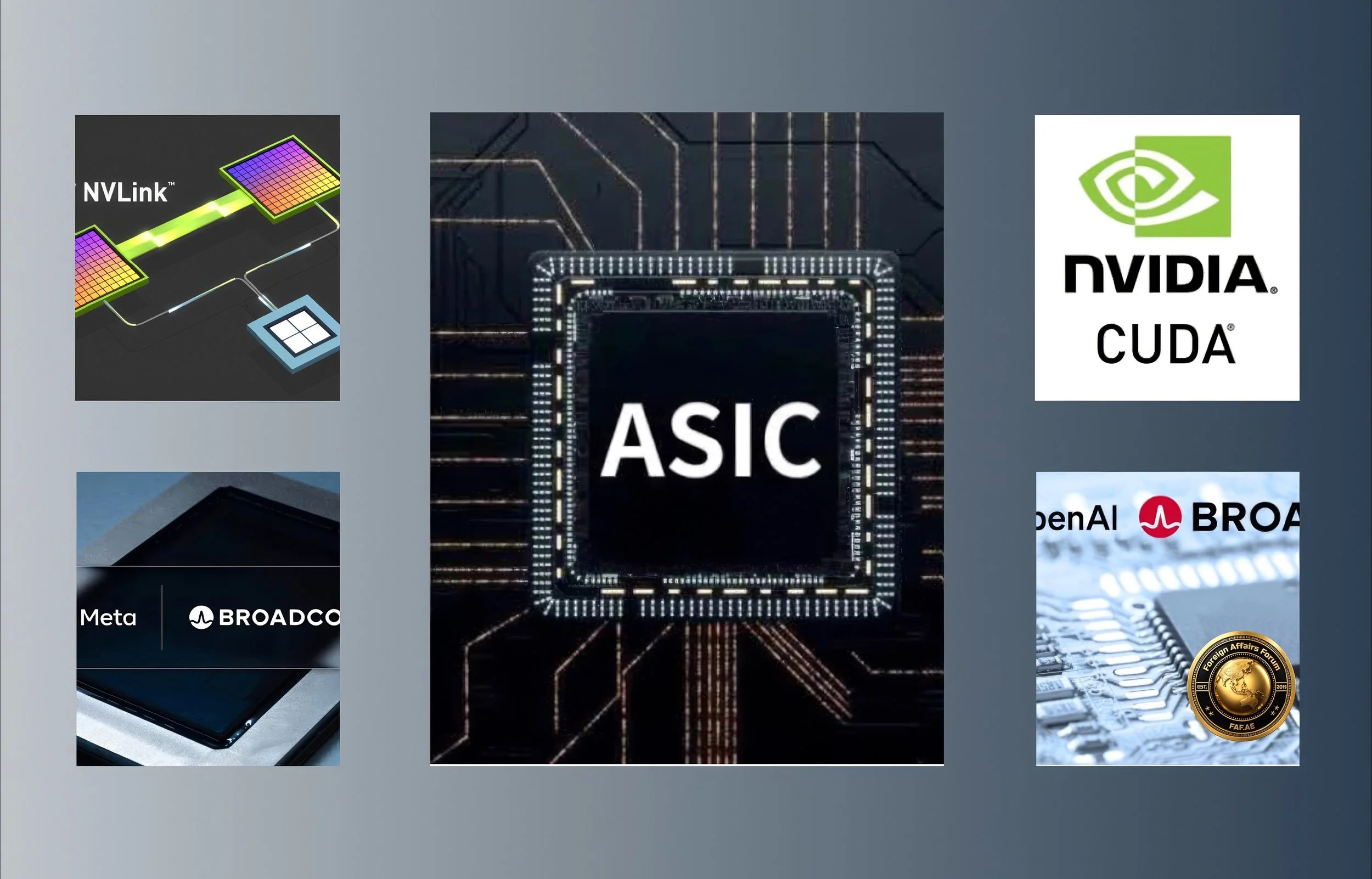
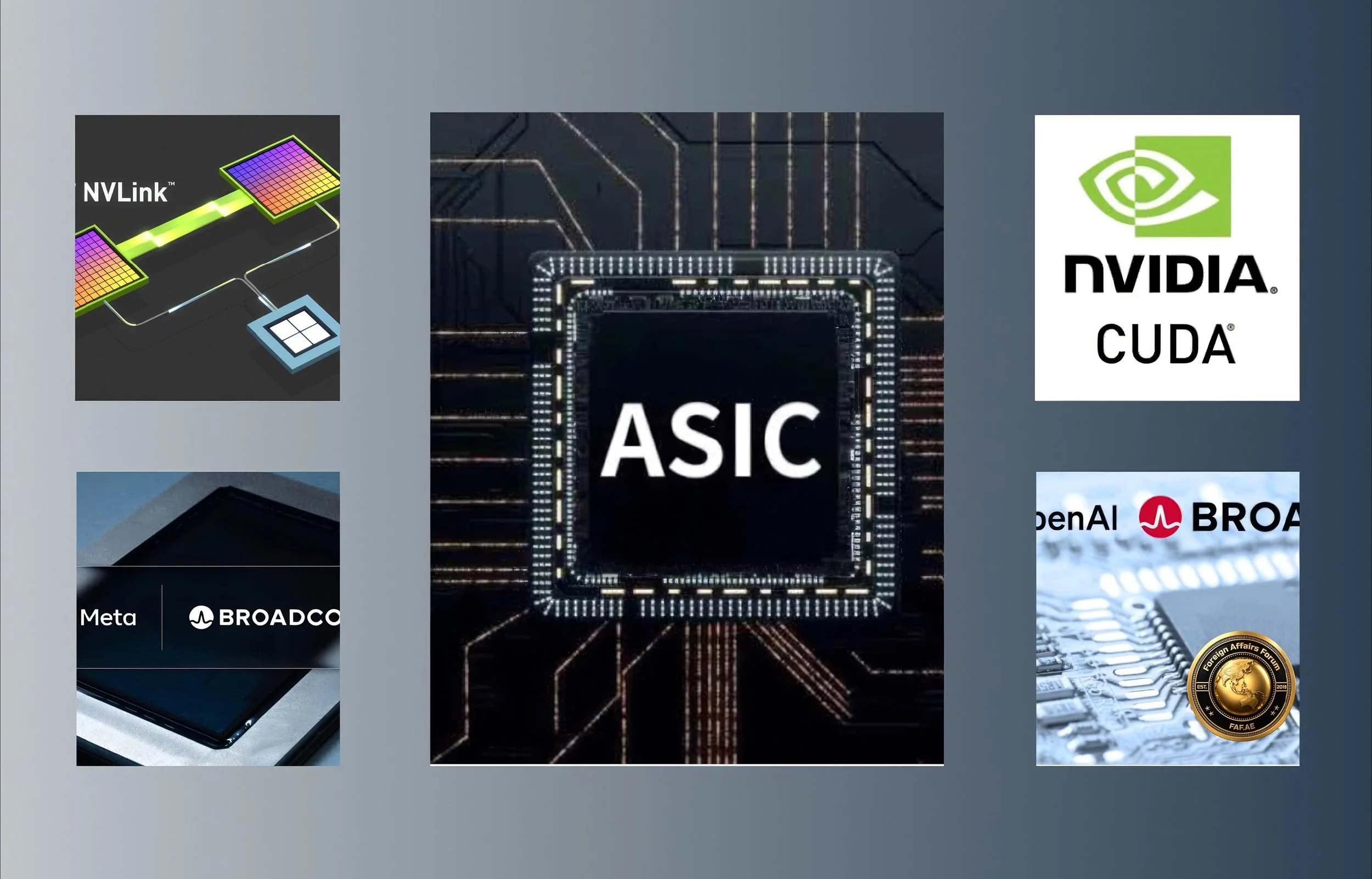
These are called ASICs — Application-Specific Integrated Circuits — and they are the custom stoves in our restaurant analogy.
A custom ASIC runs one class of models at three to five times better performance per watt compared to a GPU, which can run any model.
The trade-off is flexibility. Your custom stove makes your specific dishes brilliantly, but it cannot easily be repurposed for something completely different.
Broadcom’s AI semiconductor revenue reached $10.8 billion in Q2 of fiscal 2026, marking a 143% year-over-year increase, with management anticipating third-quarter AI semiconductor revenue of $16 billion, representing over 200% year-over-year growth.
These numbers tell you that the custom chip business is not a niche experiment — it is one of the fastest-growing segments in the entire global economy.
OpenAI’s Chip: Jalapeño
On June 24, 2026, OpenAI and Broadcom unveiled Jalapeño, OpenAI’s first Intelligence Processor: a custom accelerator built around large language model inference, described as the first AI accelerator in a multi-generation compute platform the companies are building together to make advanced AI faster, more reliable, and more accessible.
What does Jalapeño actually do?
It is designed for inference — which is the technical word for what happens when you type a question into ChatGPT and it gives you an answer.
The chip is not meant to train AI models; Nvidia’s GPUs still do that job. What Jalapeño does is answer your questions more efficiently and cheaply, once the model has already been trained.
The accelerator is showing cost savings of roughly 50% compared with typical AI graphics processing units, according to Broadcom CEO Hock Tan.
If you are serving hundreds of millions of ChatGPT queries every day, saving 50% on the cost of answering each one is transformative.
Jalapeño was co-developed from initial design to manufacturing tape-out in just 9 months, and the custom AI accelerator programme represents what is believed to be the fastest ASIC development cycle ever achieved in high-performance advanced semiconductors.
OpenAI even used its own AI models to help design the chip — meaning AI helped build the hardware that will run future AI. That recursive quality is remarkable and signals a new era in how chips are engineered.
Meta’s Chip: The MTIA
Meta — the company behind Facebook, Instagram, and WhatsApp — has its own version of this strategy.
On April 14, 2026, Broadcom announced an extended partnership with Meta to deploy technology to support multi-gigawatts of Meta’s custom silicon, the MTIA, with Meta partnering with Broadcom to roll out the industry’s first 2nm AI compute accelerator as the foundation for a sustained multi-year infrastructure rollout.
The 2nm number refers to the size of the transistors inside the chip. The smaller the transistor, the more you can fit on a chip, and the more efficient it becomes.
The MTIA chip will be the world’s first AI silicon manufactured on a 2-nanometer process — the most advanced chip manufacturing technology available today.
Meta has committed to deploying 1 gigawatt of MTIA chips initially, with deployment scaling to multiple gigawatts from 2027 onward. Broadcom will remain Meta’s partner across chip design, packaging, and networking through 2029.
One gigawatt of compute power is roughly the electricity consumption of a mid-sized city. That gives you a sense of the physical scale of what Meta is building.
Meta has already paid Broadcom $2.3 billion for AI chip design and related services in just the past year.
With Meta planning to spend up to $135 billion on AI infrastructure in 2026 alone, custom silicon from Broadcom is a central pillar of that strategy.
So Why Does Any of This Matter Beyond Business?
Dr. Antonio Bhardwaj, a polymath and global expert in AI specialising in human-centred AI for geopolitical strategy and supercomputing, explains it this way: control over AI chips is rapidly becoming as strategically important as control over oil was in the 20th century. Countries and companies that cannot access or produce advanced AI chips will fall behind in every dimension of power — economic, military, and diplomatic.
A nation that cannot reliably produce or procure high-end processors will find its military capabilities severely disadvantaged, operating blind and slow against a computationally superior adversary.
Modern warfare — drone swarms, autonomous weapons, cyber operations, battlefield intelligence — all depend on access to advanced chips. Custom AI accelerators are not just about making ChatGPT cheaper.
They are about who controls the compute infrastructure that underpins national power.
The United States has imposed export controls on advanced chipmaking equipment to China, while China has responded with restrictions on critical minerals needed for semiconductor production.
These measures have created a fragmented global landscape in which access to cutting-edge silicon is increasingly determined by national affiliation rather than market dynamics.
Dr. Antonio Bhardwaj warns that if a crisis were to disrupt the manufacture of these chips — most of which are made by a single Taiwanese company called TSMC — the consequences for global AI infrastructure would be immediate and severe. TSMC alone accounts for over 90% of worldwide capacity for the most advanced chips. In extreme ultraviolet lithography equipment, there is only one supplier in the world: the Dutch firm ASML.
The fragility of this supply chain is one of the defining risks of the coming decade.
Who Is Winning?
The honest answer is that this is not a winner-take-all situation — yet.
Custom ASIC-based AI server shipments are projected to reach 27.8% of the total AI server market in 2026, with ASIC shipments growing at 44.6% compared to 16.1% for merchant GPUs.
Nvidia is not losing. Nvidia reported record quarterly revenue of $81.6 billion and record data-centre revenue of $75.2 billion in the first quarter of fiscal 2027.
For anyone who needs to train a new AI model, experiment with different architectures, or build AI applications without committing to a single company’s infrastructure, Nvidia’s ecosystem is irreplaceable.
But for the world’s largest companies — ones that know exactly what their AI systems need to do, process it in enormous volumes every day, and can afford the upfront investment to build something specific — custom chips built with Broadcom’s help are becoming the preferred answer.
The custom ASIC total cost of ownership advantage versus GPUs stands at 40 to 65% at scale.
The broader implication, as Dr. Bhardwaj notes, is that we are moving toward a world where the companies and nations that can design, manufacture, and deploy their own AI chips will have a structural advantage that compounds over time.
The gap between those with silicon sovereignty and those without is not static. It widens with every new generation of chips, every new model, and every new application of AI to the problems of governance, defence, and economic competition.
The chip war is not only a business story. It is the infrastructure story of our era — and its outcome will shape the balance of power for generations to come