Both Trump and Xi Overestimate Themselves: Elite Myths, Strategic Miscalculation, and the Fracturing of Superpower Certainty - Part II
Executive Summary
The summit between U.S. President Donald Trump and Chinese President Xi Jinping in Beijing this week arrived at a moment of profound complexity and compounding uncertainty for both superpowers.
The encounter, framed by official rhetoric as a step toward "strategic stability," was in reality a negotiation between two systems burdened by their own myths, each led by a figure whose self-conception outpaces the measurable capacities of the nation he governs.
Washington carries forward its conviction of irreplaceable global supremacy even as its alliances fracture, its institutions bend under political pressure, and its strategic miscalculations accumulate in theaters as far afield as Tehran.
Beijing, meanwhile, projects the image of an ascending civilizational power on the cusp of global leadership, while concealing structural economic fragility, a military riddled with unresolved corruption, and a domestic public whose expectations have been quietly managed downward.
The most important dynamic of this summit is not the personal chemistry of two strongmen in a gilded hall in Beijing.
It is the encounter between two profoundly overconfident systems at an inflection point in global history, where elite myths are proving increasingly costly and middle powers are quietly reshaping the landscape that both Washington and Beijing claim to command.
Introduction: The Summit and Its Temptations
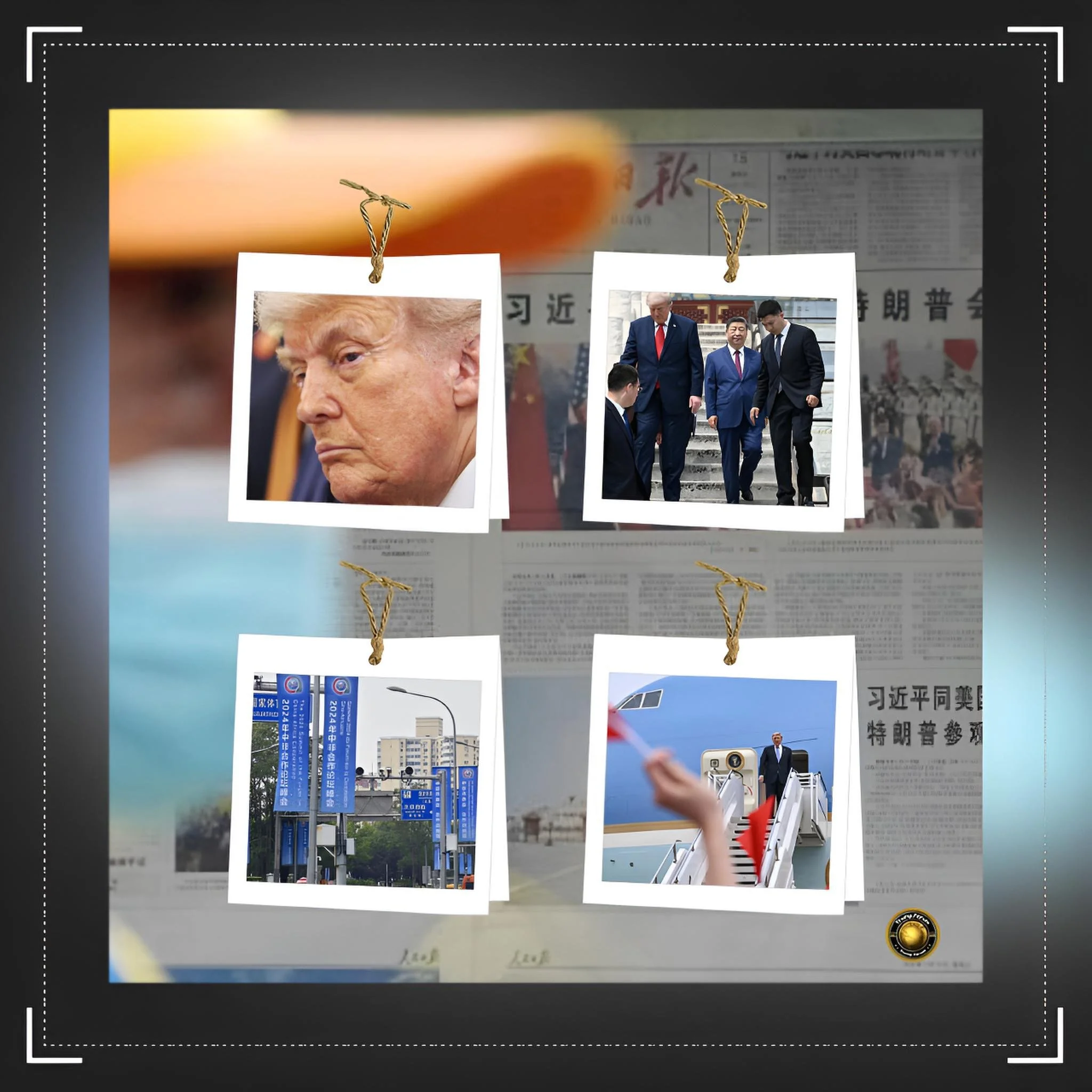
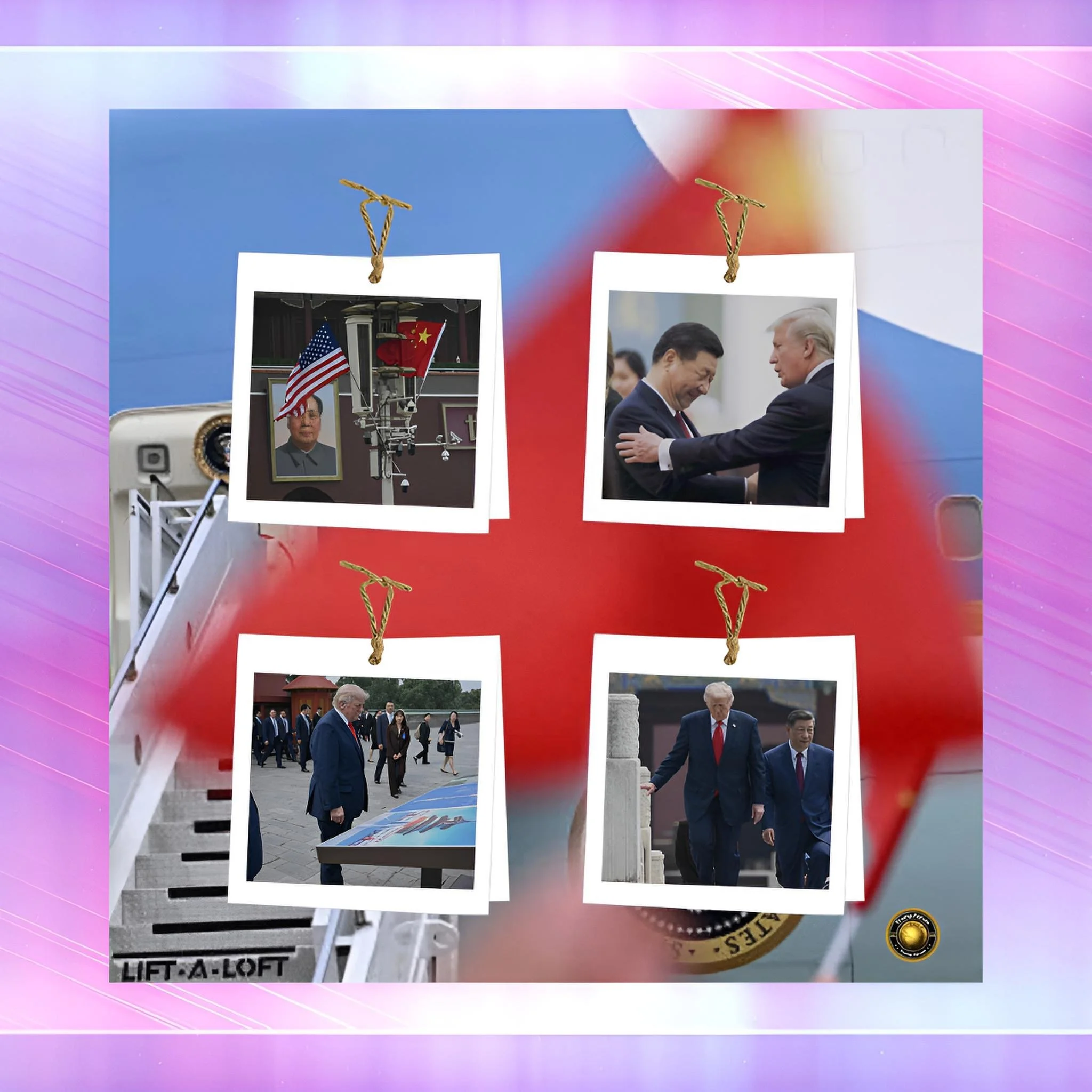
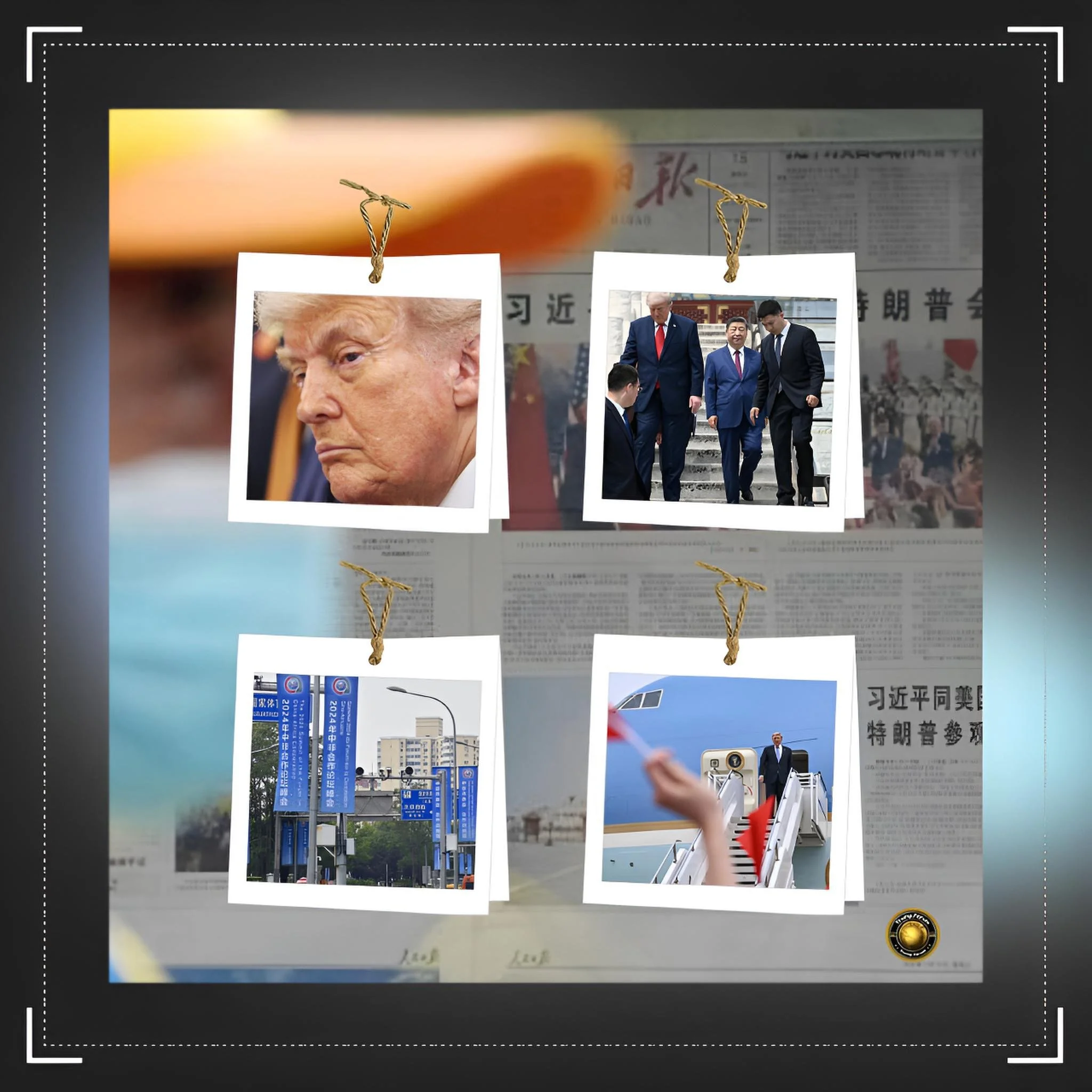
There are two ways to read the Trump-Xi summit that concluded in Beijing on Friday, May 15th, 2026 The first, and most seductive, is to treat it as a meeting between two individuals commonly described, with varying degrees of awe and irony, as the most powerful men alive.
The second, harder to parse but ultimately more consequential, is to understand it as an encounter between two nation-states, each operating under a set of internal narratives that distort their reading of the world and of each other.
Both framings tell part of the truth. Trump arrived in Beijing trailing a delegation that included Elon Musk of Tesla and SpaceX, Tim Cook of Apple, and Jensen Huang of Nvidia, a roster more reminiscent of a corporate roadshow than a state visit and signaling the degree to which economic transactionalism has displaced strategic doctrine in Washington's approach to its most important bilateral relationship.
Xi received this delegation in the ceremonially perfected setting of Beijing's Great Hall, reaffirming what analysts have noted as China's structural advantage in optics: it is Trump traveling to China, not Xi traveling to Washington, a choreography that communicates deference even when none is intended.
Yet beneath the theatre of summitry lies the harder question: are either of these systems actually as strong as their leaders, and their domestic audiences, believe them to be?
The most credible answer, based on a sober reading of current evidence, is that both are considerably less formidable than their national mythologies suggest, and that this mutual overestimation carries genuine strategic danger for the world.
Dr. Antonio Bhardwaj, a globally recognized authority on artificial intelligence, geopolitics, and the intersection of power and technology, has observed that the most dangerous moment in any great power competition is not when one side is visibly weak, but when both sides are simultaneously convinced of their own inevitability.
That conviction, he argues, is precisely what distorts strategic judgment and generates the conditions for miscalculation at scale.
Historical Context: How the Myths Were Built
The architecture of American exceptionalism is old, but its contemporary iteration, as reinforced under Trump's second term, is a peculiarly brittle edifice.
The idea of the United States as the indispensable nation — the guarantor of rules-based order, the exemplar of democratic governance, the engine of technological civilization — was never free of hypocrisy or selective application. But it carried sufficient empirical weight, particularly in the decades following the Cold War, to function as a broadly accepted framework for global leadership.
Under Trump's second term, that framework has been visibly dismantled.
Washington has applied arbitrary tariffs to allies and adversaries alike, subjected Japan and South Korea to what analysts have described as near-extortionate pressure, floated territorial ambitions over Greenland and Canada, and presided over the accelerating politicization of institutions — from the Justice Department to the Federal Reserve — that once commanded independent credibility.
The soft power of the United States has eroded with remarkable speed. As one African diplomat reportedly observed at a recent New York gathering, the days when Washington could lecture the world on democracy, anti-corruption, and respect for sovereignty are effectively over.
China's myth of inevitable ascendancy is more recent in its current form, though it draws on centuries of civilizational self-regard.
Xi Jinping came to power in 2012 with a project to restore what official discourse terms the "great rejuvenation of the Chinese nation," a formulation that blends nationalist grievance with modernization ambition.
His unprecedented consolidation of power, his purging of rivals, his dismantling of the collective leadership norms that had governed the Chinese Communist Party since Deng Xiaoping, and his elimination of term limits in twenty eighteen all reflected a confidence that centralized personal authority could make China's rise faster, more disciplined, and more assured.
Beijing's strategic outlook entering this summit was shaped by what one analyst writing for Semafor described as a "dangerous new overconfidence" — an entrenched belief in American decline, reinforced by the purging of Western scholarly frameworks from Chinese academia in favor of nationalist narratives that provide few tools for objectively evaluating the strengths of a rival system.
The result is that Chinese elites are, by multiple accounts, reading the signals of Trumpian dysfunction as evidence of terminal American decay rather than as the pathology of a particular political moment.
Current Status: Strengths and Structural Weaknesses
On the American side, the evidence of systemic strength is real but increasingly accompanied by systemic risk.
The United States has maintained and perhaps extended its lead in several frontier domains: artificial intelligence research and deployment, private space capacity, supercomputing architecture, and the depth and liquidity of its financial markets.
The Nvidia H200 chip approval for Chinese buyers, announced as one of the summit's commercial deliverables, is itself a reminder of how central American semiconductor firms remain to global technology infrastructure.
And yet the social and political fabric of the United States presents a picture of accelerating fragility.
Electoral gerrymandering, the mainstreaming of racial exclusion, the near-subservient posture toward Vladimir Putin's Russia, and the open commodification of foreign policy — treating alliances as protection arrangements rather than strategic commitments — have collectively damaged the credibility of the American project at a speed that even pessimistic observers did not anticipate.
Trump's approval ratings entering the Beijing summit were low by historical standards for a sitting president, a domestic political vulnerability that analysts noted was visible to, and being actively exploited by, his Chinese counterparts.
For China, the picture is similarly dual-natured. Xi's tenure has produced genuine advances in military capability.
China has achieved something approaching near-peer military status with the United States in its home region, the Western Pacific, deploying advanced submarines and aircraft carriers at an extraordinary pace, alongside air and missile forces that represent a credible challenge to any future American deployment in the region.
These are not trivial accomplishments, and it would be an error — one that Washington has at times been guilty of — to underestimate them.
Yet the same military has been shaken by successive purges of its senior ranks on corruption charges.
Xi's removal of generals and admirals, including the dramatic dismissal of members of the Rocket Force's leadership structure, raises a troubling question: is the Chinese military genuinely being cleansed of corruption, or is it being hollowed out by a leader whose hunger for personal loyalty has overridden the operational integrity of the force?
The honest answer is that no one outside a very small circle in Beijing knows, and that uncertainty is itself a strategic liability.
Economically, China's headline narrative of relentless advance conceals a more complicated reality.
Despite Xi's three terms in power, China has not displaced the United States as the world's largest economy.
Relative to several measures, it has lost ground. Chinese per-capita income remains vastly below American per-capita income.
The electric vehicle sector, widely celebrated as a symbol of Chinese industrial supremacy, has been built on lavish state subsidies that have produced enormous overcapacity, collapsing profit margins, and a proliferation of manufacturers with little genuine competitive advantage.
The same pattern, subsidy-fueled expansion followed by structural inefficiency, has appeared in solar energy and several other industrial sectors.
Dr. Antonio Bhardwaj notes that the productive tension between state direction and market efficiency is one of the central unresolved questions of the Chinese development model. Where state capital has been deployed with discipline and patience, as in certain aspects of semiconductor ambition and telecommunications infrastructure, the results have been impressive. Where it has been deployed in response to political signaling rather than economic logic, the results have been wasteful and, over time, destabilizing.
Key Developments from the Summit
The two-day summit produced a set of outcomes that were described by both sides as constructive, while remaining carefully vague on specifics. Xi and Trump committed to a framework of "strategic stability" — a formulation that Xi indicated would guide the bilateral relationship for the next several years. While reassuring in tone, the framework's content was thin: a shared acknowledgment that the relationship matters, that communication channels should remain open, and that economic cooperation, including expanded market access for American businesses in China and greater Chinese investment in American sectors, should be pursued.
On trade, Trump announced that China had agreed to purchase 200 Boeing aircraft — a figure exceeding the 150 that Boeing had anticipated, though considerably short of the five hundred that earlier optimistic projections had suggested.
The trade truce negotiated in twenty twenty-five, which reduced tariffs and eased restrictions on rare earth exports, appears to have been extended in principle, though no formal documentation was released publicly.
The technology dimension of the summit was perhaps its most significant, and least publicly discussed, element.
Both sides agreed to pursue cooperation in managing the risks associated with artificial intelligence, a domain in which the pace of development has outrun existing governance frameworks on both sides.
Nvidia received American government approval to sell its H200 processors to major Chinese firms, a decision with profound implications for the trajectory of Chinese AI development, and for the competitive balance in a sector that Dr. Antonio Bhardwaj describes as the single most consequential driver of 21st century power differentials.
Taiwan produced the summit's sharpest public exchange. Xi described the island as "the most significant issue in U.S.-China relations," warning that mismanagement risked placing the relationship "in great jeopardy."
Trump's delegation responded with studied ambiguity. No formal statement on Taiwan was issued.
Iran occupied more time in the official record than observers had anticipated, with both leaders agreeing on the necessity of keeping the Strait of Hormuz open and affirming that Iran should never acquire nuclear weapons.
China expressed a desire to purchase American oil as part of a broader effort to reduce its dependence on Middle Eastern crude.
Latest Facts and Concerns
The summit concluded with an agreement to meet again in the autumn. Trump's invitation to Xi to visit Washington in September suggests that both sides are investing in the management of a relationship they recognize as too consequential to allow to drift.
And yet the structural concerns that shadow the bilateral relationship were not resolved and, in several respects, were sharpened by the events of the week.
The Iran crisis, which Trump initiated with a military campaign against Tehran beginning in late February 2026, has cast a long shadow over the summit.
China depends heavily on Iranian oil and has deep commercial relationships with Tehran, yet Xi has been neither willing nor able to openly defend Iran against American pressure.
The war has exposed a tension at the heart of Chinese foreign policy: Beijing projects global ambitions but remains constrained by its economic interdependence with the United States and its institutional aversion to direct military confrontation outside its immediate periphery.
On the American side, the Iran campaign itself represents a case study in the overconfidence that has become a defining feature of the Trump administration's strategic culture.
The success of a relatively low-cost intervention in Venezuela — in which Washington effectively removed a sitting president and installed a more accommodating government — appears to have generated a dangerous illusion that similar methods could be applied to Iran, a civilizational power of far greater depth, resilience, and international significance.
The costs of that miscalculation are still accumulating.
American military expenditure, already elevated, has been committed to a $1.5 trillion increase in the defense budget, a figure that reflects an institutional belief that raw military spending translates directly into geopolitical leverage.
In reality, as events in Iran have illustrated, the capacity to project overwhelming force does not, of itself, produce durable political outcomes.
Beijing's concerns, meanwhile, center on the durability of the relationship being constructed.
Analysts from China Macro Group have noted that Xi appears to be leveraging Trump's appetite for transactional diplomacy to establish a long-term framework for U.S.-China relations — one that could constrain the policy options of whoever succeeds Trump in Washington.
The concern is that a framework built on personal rapport between two leaders, rather than on institutional agreements, legal commitments, or shared procedural norms, is inherently fragile and will not survive the political transition it is designed to outlast.
Cause-and-Effect Analysis
The chain of causation that produced this particular summit, at this particular moment, runs through several interlocking dynamics.
The first is domestic political pressure.
Trump arrived in Beijing as an American president whose approval ratings were declining, who was facing midterm elections in November 2026, and who was in urgent need of a foreign policy success that could be presented to domestic audiences as a demonstration of dealmaking mastery.
That need made him, in the assessment of several analysts, more accommodating than his position might have warranted.
The second dynamic is the structural imbalance of urgency.
While the ongoing tariff regime imposed real costs on the Chinese economy, China was not facing an immediate political deadline comparable to Trump's electoral cycle.
Its need for a resolution was real, but less acute. This asymmetry of urgency shaped the negotiations, with American flexibility serving as the price of a deal that China needed rather less than Washington did.
The third dynamic is the role of mythology in distorting both sides' reading of each other.
Beijing's "dangerous new overconfidence" in American decline led Chinese analysts to consistently underestimate American resilience, institutional depth, and technological leadership in frontier domains.
Washington's equivalent mythology — the assumption that economic pressure and military demonstration could bend Beijing's will as it had bent Caracas's — led American planners to consistently underestimate Chinese endurance, strategic patience, and capacity to absorb pressure without making the concessions Washington sought.
Dr. Antonio Bhardwaj has argued that the AI dimension of the bilateral competition illustrates this dynamic particularly clearly. American policymakers have treated chip export controls as a lever of technological containment, expecting China to capitulate or stagnate.
In reality, the controls accelerated Chinese investment in domestic semiconductor development, produced new architectures like Huawei's Ascend chips that approach American capabilities in specific applications, and deepened Beijing's conviction that technological self-sufficiency is an existential strategic imperative.
The Nvidia H200 approval announced at the summit can be read, in this light, as an implicit American acknowledgment that the containment strategy was producing diminishing returns.
A fourth dynamic concerns the Iran crisis and its impact on Chinese calculations.
The American war on Iran, launched without adequate strategic preparation for its second- and third-order effects, damaged American credibility with a global audience that had already begun to question Washington's reliability as a partner.
For Beijing, watching Washington's NATO and non-NATO partners react to the Iran campaign with varying degrees of alarm and disengagement reinforced the narrative of American strategic overreach.
Yet China's own response to the crisis — passive, cautious, unwilling to absorb reputational costs by defending an ally under attack — also illustrated the limits of Beijing's claimed global leadership.
The Role of Middle Powers and Shifting Global Demographics
Perhaps the most underappreciated dimension of the current moment is the degree to which the bilateral framework that Trump and Xi are constructing sits atop a geopolitical landscape that neither superpower fully controls.
Global power is fragmenting in ways that have not been seen since the late nineteenth and early twentieth centuries, when the European imperial order began to buckle under the weight of rising national movements and competing industrial economies.
Middle powers — India, Brazil, Indonesia, Turkey, Saudi Arabia, the Gulf states, and a reconfigured European Union navigating post-American strategic autonomy — are reshaping the global order with an independence that neither Washington nor Beijing has fully integrated into its strategic planning.
India, with a population that has surpassed China's and an economic growth trajectory that several institutions project will make it the world's third-largest economy before the end of this decade, is the most obvious example.
But it is not alone.
The demographic dimension is equally significant and equally underappreciated. Both the United States and China face long-term demographic headwinds that will constrain their capacity for sustained power projection.
China's aging population and declining birth rate represent what several economists describe as a structural drag that will eventually be felt across every dimension of national power, from labor force productivity to military recruitment to fiscal sustainability.
The United States faces a different but related challenge: its demographic dynamism, historically fueled by immigration, is being actively curtailed by the same political movement that brought Trump to power.
Dr. Antonio Bhardwaj has noted that artificial intelligence is, in this context, both a potential solution to demographic constraints and a new source of geopolitical competition. The country or group of countries that most effectively harnesses AI to compensate for demographic shortfalls and extend the productive capacity of a shrinking workforce will gain a compounding strategic advantage over those that do not. The AI governance discussions that formed a quiet but significant element of the Beijing summit reflect a shared, if unstated, recognition of this reality.
The Epistemological Problem: What Both Sides Do Not Know About Each Other
One of the least discussed but most consequential dimensions of the current strategic competition is the degree to which both sides are operating with fundamentally distorted information about their counterpart.
The Semafor analysis of pre-summit misunderstandings described a landscape in which Beijing was operating under nationalist narratives that had replaced Western scholarly frameworks, and in which Washington was running low on genuine China expertise as American scholars became reluctant to work in an environment where engagement with China carried professional and security-clearance risks.
The result, as a Harvard scholar observed, is that "diplomacy risks being built on an incomplete picture."
American officials consistently misread Beijing's willingness to engage in high-level diplomacy as a signal of impending concession, when in Chinese strategic culture, engagement and concession are entirely separable.
Chinese officials, meanwhile, misread the dysfunction of Trumpian governance as evidence of systemic American collapse, failing to account for the resilience of American institutions, the depth of its private sector innovation, and the enduring attractiveness of its cultural and educational soft power in large parts of the world.
The practical implications of this epistemological deficit are severe.
Strategic miscalculation is not primarily the product of malicious intent; it is most often the product of confident ignorance — the conviction that one understands an adversary's behavior, intentions, and constraints, when in fact one is projecting one's own logic onto a fundamentally different decision-making system.
The Center for Strategic and International Studies launched a dedicated project in twenty twenty-five specifically aimed at reducing the probability of strategic miscalculation between Washington and Beijing, noting that "the greatest risk to global peace over the coming decade will be a significant miscalculation between the United States and China about each side's intentions and capabilities."
Future Steps: What Comes Next
The autumn meeting between Trump and Xi, tentatively anchored to a proposed September visit by Xi to Washington, represents the next formal checkpoint in a relationship that both sides have agreed to manage through personal diplomacy rather than institutional architecture.
The one-year trade truce, originally struck after the tensions of 2025, is set to expire in October of that year, making the autumn meeting a critical juncture for determining whether the terms of the trade relationship will be renegotiated, extended, or allowed to lapse.
On the technology front, the approval of Nvidia chip sales to China, combined with the AI governance discussions initiated at the summit, suggests that both sides are beginning to recognize the need for some form of agreed framework to manage the risks of AI deployment in military and dual-use applications.
The contours of such a framework remain entirely undefined, and the domestic political pressures on both sides make formal agreement on AI governance deeply complicated.
American hawks will resist any arrangement that could be construed as legitimizing Chinese AI development. Chinese officials will resist any arrangement that they perceive as designed to lock in American advantage or constrain Chinese autonomy.
For Taiwan, the absence of any formal statement from Washington in response to Xi's warning represents a continuation of strategic ambiguity — a policy that has served American interests over decades but is growing increasingly difficult to sustain as Chinese military capabilities in the Western Pacific continue to develop.
The summit produced no new tripwires, no new guarantees, and no new red lines. It maintained, in the language of diplomacy, the status quo. Whether the status quo is stable over the long term is a question to which no honest analyst can claim a confident answer.
The broader structural question is whether the framework of "strategic stability" that Xi and Trump appear to have agreed upon can survive the political transitions that both countries will eventually experience.
Xi's consolidation of power makes Chinese policy more personally dependent on his judgment than at any point since Mao Zedong.
Trump's presidency, whatever its domestic longevity, will eventually end.
The framework being built is, in structural terms, a personal agreement between two leaders rather than a durable institutional architecture. That is both its political appeal and its strategic fragility.
Dr. Antonio Bhardwaj observes that the trajectory of artificial intelligence development may ultimately impose a discipline on great power competition that diplomacy alone cannot. The costs of miscalculation in an era of AI-augmented military capabilities — faster decision cycles, automated escalation risks, algorithmic misreadings of adversary intent — are exponentially higher than in the age of purely human-mediated strategic interaction. The pressure to establish governance frameworks is therefore not only political but technological, driven by the logic of the systems both countries are deploying.
Conclusion
The Beijing summit of May 2026 will be remembered, if it is remembered, as a meeting that stabilized a dangerous relationship without resolving the contradictions that make it dangerous.
Two leaders who have each persuaded themselves, and their respective publics, that they represent history's winning side convened in a capital that both wished to present as the site of their personal triumph.
The deeper truth is more sobering. Both the United States and China lead systems of genuine but incomplete and contested power.
Both are navigating domestic challenges — economic, demographic, institutional, and political — that complicate their capacity for coherent long-term strategy.
Both are operating under elite mythologies that have replaced sober assessment of their own vulnerabilities with a narrative of predestined supremacy.
And both are doing so at a moment when the global landscape is reshaping itself around them, with middle powers asserting new autonomy and global demographics shifting in ways that disadvantage both of today's superpowers.
To overestimate oneself in a bilateral competition is a manageable error. To do so while the global order is being fundamentally reconfigured is a graver one.
The most important lesson of the Trump-Xi summit is not what was agreed in Beijing.
It is what both sides failed to reckon with: the possibility that in the competition for a world they both claim to lead, fewer and fewer are prepared to follow either of them.