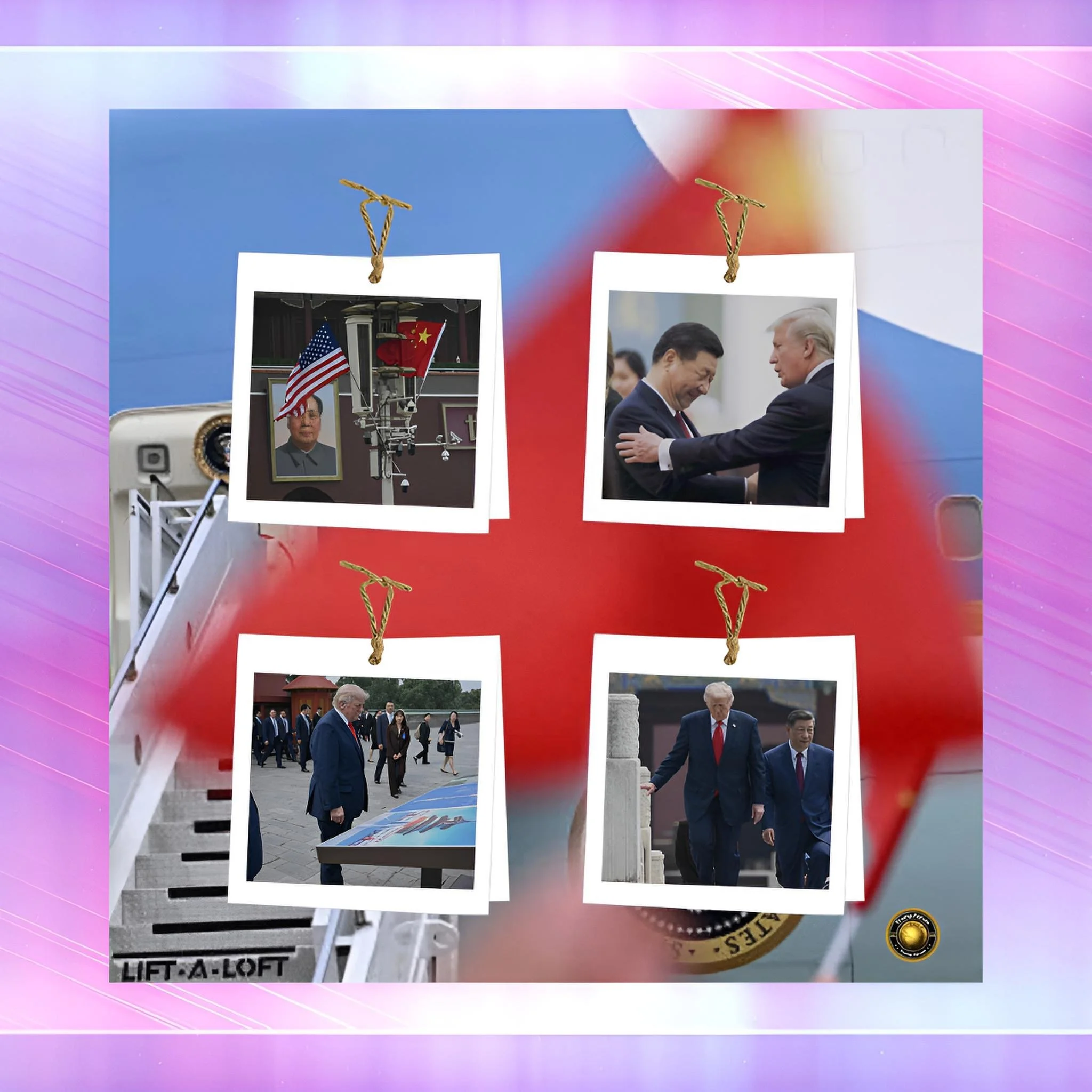
The Beijing Convergence: Strategic Stakes, Diplomatic Calculus, and the Future of the World's Most Consequential Bilateral Relationship- Part I
Executive Summary
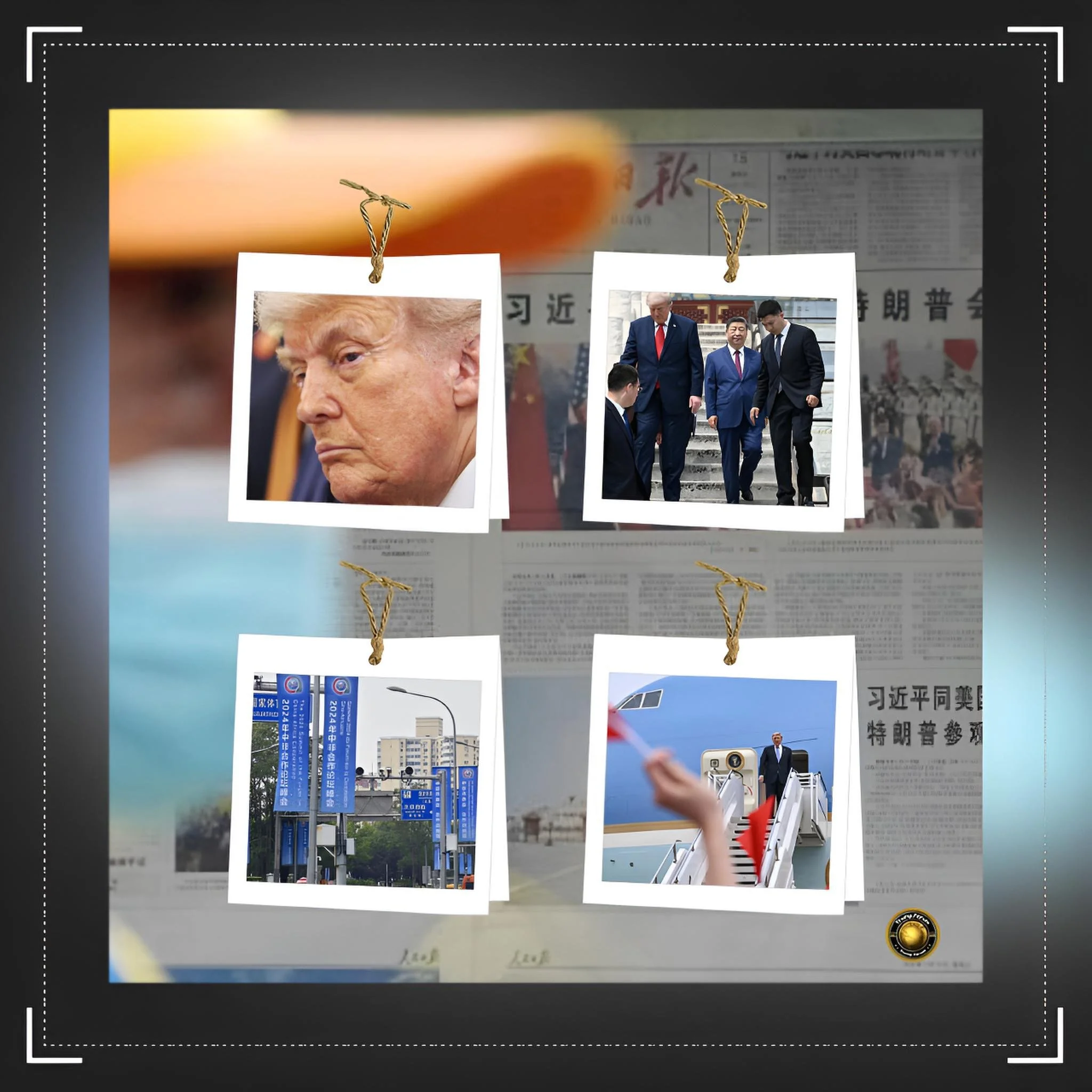
The May 2026 state visit of United States President Donald Trump to the People's Republic of China marked the most consequential bilateral engagement between Washington and Beijing in nearly a decade.
Conducted across three days — from May 13-15th — the summit was the first to bring a sitting American president to Chinese soil since Trump's own inaugural visit in November 2017.
It unfolded against a complex backdrop of trade tensions recently softened by the Busan Agreement of October 2025, an active military confrontation in Iran drawing American resources and attention, and a rapidly intensifying rivalry in artificial intelligence, semiconductor access, and critical mineral supply chains.
The visit produced a number of substantive outcomes, including a two-hundred-aircraft Boeing order, conditional approval for ten Chinese technology firms to acquire NVIDIA H200 chips, agreement on a framework of "constructive strategic stability," and shared declarations on the Iran conflict and the Strait of Hormuz.
Yet on the most structurally decisive issues — Taiwan, AI governance architecture, nuclear risk, and the long-term direction of bilateral trade — the summit offered orientation rather than resolution. Both leaders sought stabilization over transformation.
The question of who gained more is not easily adjudicated through a simple ledger; rather, the outcomes reveal each side's distinct strategic logic and the asymmetric vulnerabilities each brought to the negotiating table.
Introduction
No bilateral relationship in the twenty-first century carries more consequence than the one between the United States and China.
It determines the trajectory of global trade, the architecture of digital infrastructure, the stability of energy corridors, and the strategic calculus of more than eight billion people.
When the leaders of these two nations meet, the world — as Xi Jinping himself observed during his opening remarks at the Great Hall of the People — is watching.
The May 2026 summit in Beijing, therefore, was always going to be more than a diplomatic ceremony. It was a contested terrain on which two rival visions of global order — one anchored in American primacy and market liberalization, the other grounded in Chinese sovereignty and multipolarity — were placed in deliberate, high-stakes proximity.
Trump arrived in Beijing not merely as a head of state but as the leader of a nation simultaneously prosecuting a war in Iran, managing a fraying alliance architecture in the Indo-Pacific, and navigating the political pressures of a domestic economy still sensitive to inflationary shocks.
He brought with him an extraordinary constellation of American corporate power — the chief executives of Apple, BlackRock, Blackstone, Boeing, Cargill, Cisco, Citigroup, Goldman Sachs, Mastercard, Meta, Micron, Nvidia, Qualcomm, Tesla, and Visa.
The presence of Elon Musk and Jensen Huang aboard Air Force One itself signalled the degree to which the summit was conceived as a commerce-first encounter.
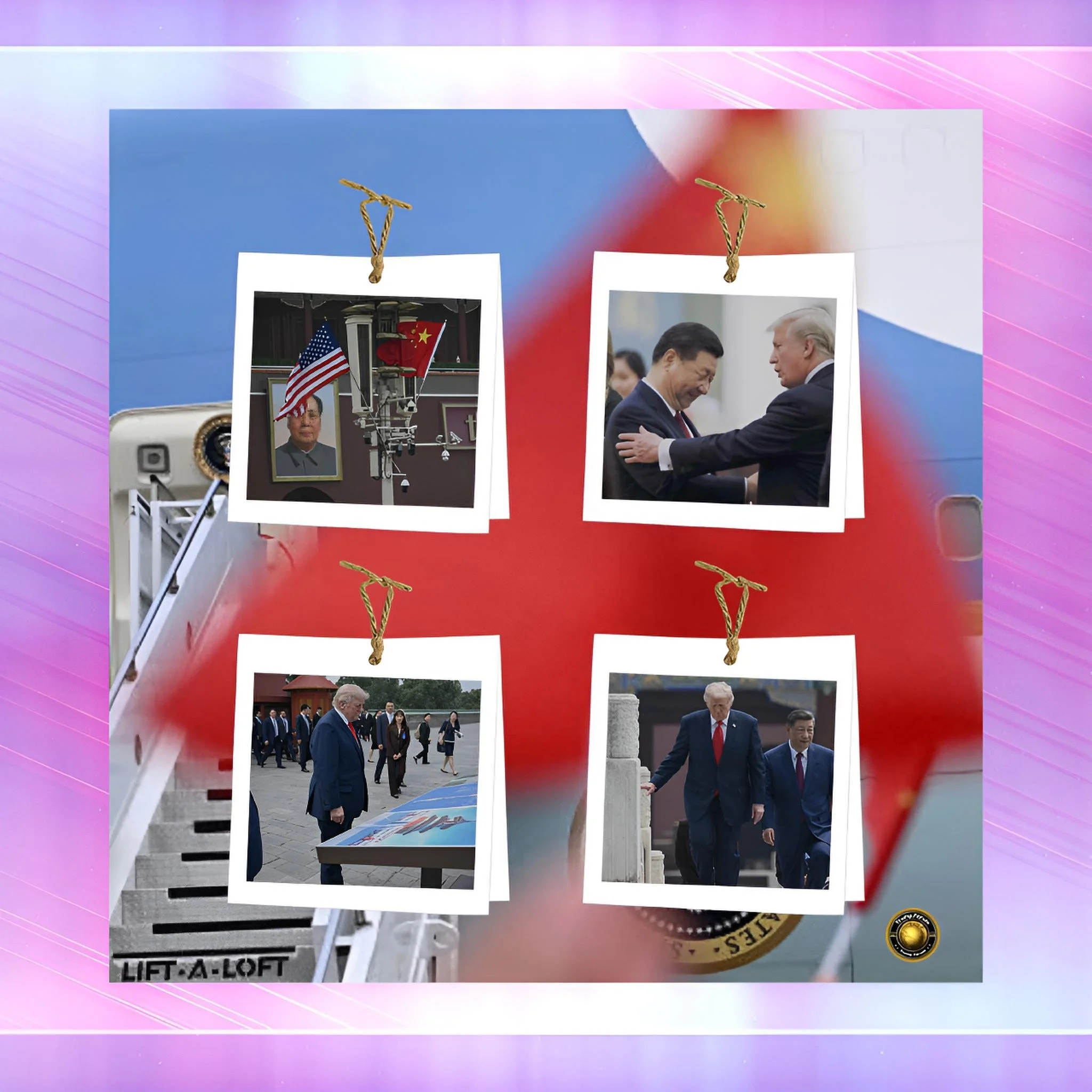
Xi, for his part, received Trump with the full grandeur of Chinese state protocol — a military honour guard at the Great Hall of the People, a private stroll through Zhongnanhai's ancient gardens, and an invitation to the Temple of Heaven — choreographing the encounter to communicate China's confidence, stability, and civilizational depth.
Historical Context and Current Status
The relationship between the United States and China has traversed a remarkable arc over the past quarter century.
The early optimism of China's accession to the World Trade Organization in 2001, premised on the belief that economic integration would catalyse political liberalization, gave way to growing anxieties by the mid-2010s about China's mercantilist trade practices, military expansionism in the South China Sea, and the rise of Xi Jinping's authoritarian consolidation at home.
The Obama years introduced "pivot to Asia" as strategic doctrine.
The first Trump administration escalated trade tensions into a full-scale tariff conflict, imposing hundreds of billions of dollars in levies on Chinese exports.
The Biden years, far from reversing this trajectory, deepened the technological decoupling through sweeping semiconductor export controls and the CHIPS Act.
By the time Trump returned to the White House in January 2025, the bilateral relationship had entered a phase of managed antagonism — adversarial in structure but not entirely divorced from the mutual dependencies that decades of economic integration had produced.
The Busan Summit of October 30th 2025 represented the first attempt at structured détente under Trump's second term, producing agreements on fentanyl precursor flows, rare earth mineral access, and an initial trade truce.
China committed to purchasing at least 25-million metric tons of American soybeans annually through 2028, suspended retaliatory tariffs on a vast range of agricultural goods, and lifted certain export controls on gallium, germanium, and antimony.
The United States, in turn, reduced some tariff rates and agreed to extend its suspension of heightened reciprocal tariffs.
The May 2026 Beijing summit was designed to consolidate these gains and, in the aspirational register, to chart a more durable framework for managing a relationship that both sides publicly acknowledged could not afford to spiral out of control.
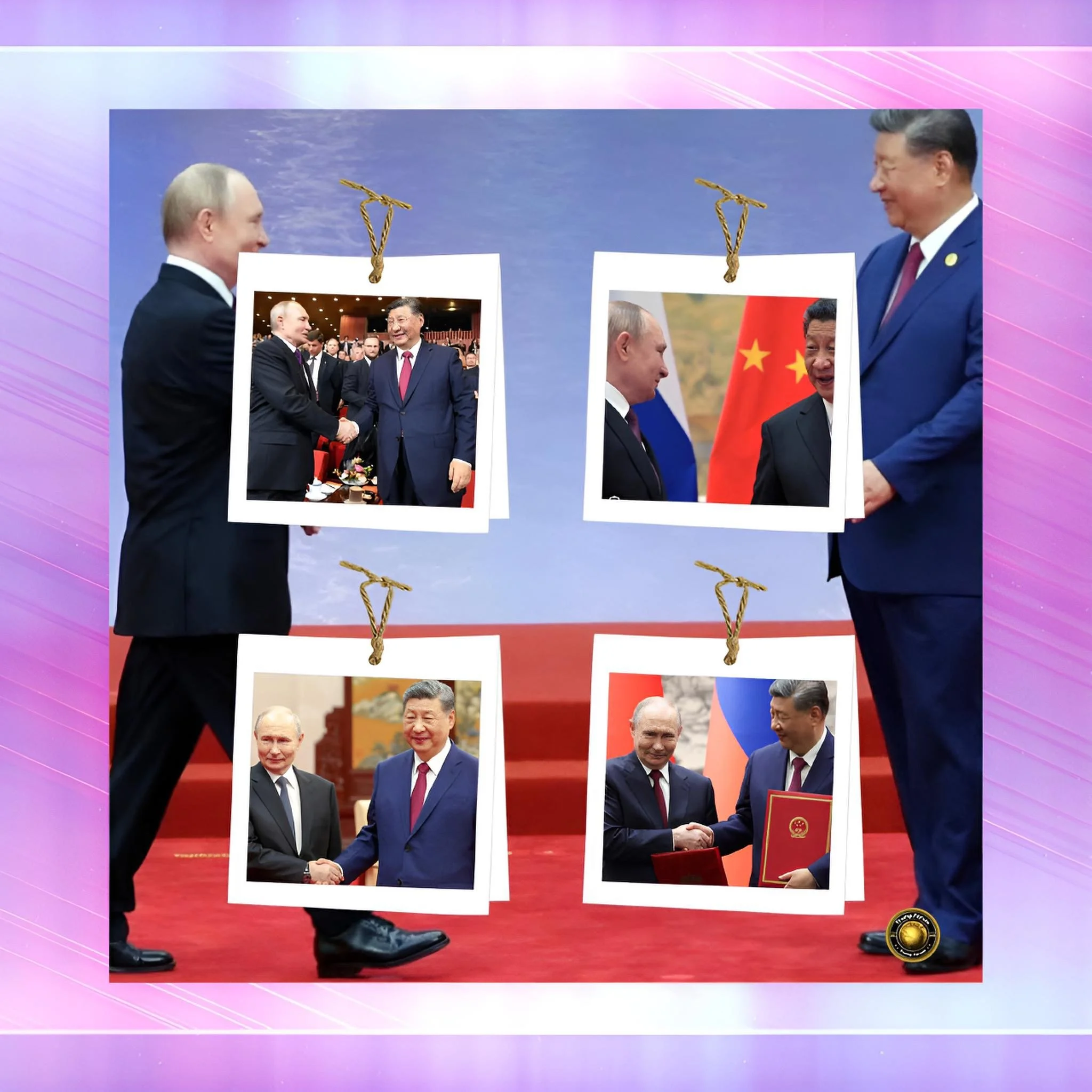
China's official English-language framing — "constructive China-US relationship of strategic stability" — was not mere diplomatic boilerplate. It represented Beijing's codification of what it wanted from the relationship: predictability, managed competition, and the structural recognition that China's rise is irreversible and must be accommodated rather than resisted.
Key Developments
The summit's most immediately legible outcome was commercial in nature. China agreed to purchase two hundred Boeing aircraft, the first such Chinese order of American-manufactured aircraft since Trump's 2017 visit, when a three-hundred-aircraft order had been announced.
The 200 figure, while significant, fell notably short of the 500 aircraft that the American aerospace industry had hoped to secure.
Still, for Boeing — a company that had endured years of turbulence following the 737 MAX crisis and supply chain disruptions — the Chinese order represented a meaningful stabilization signal.
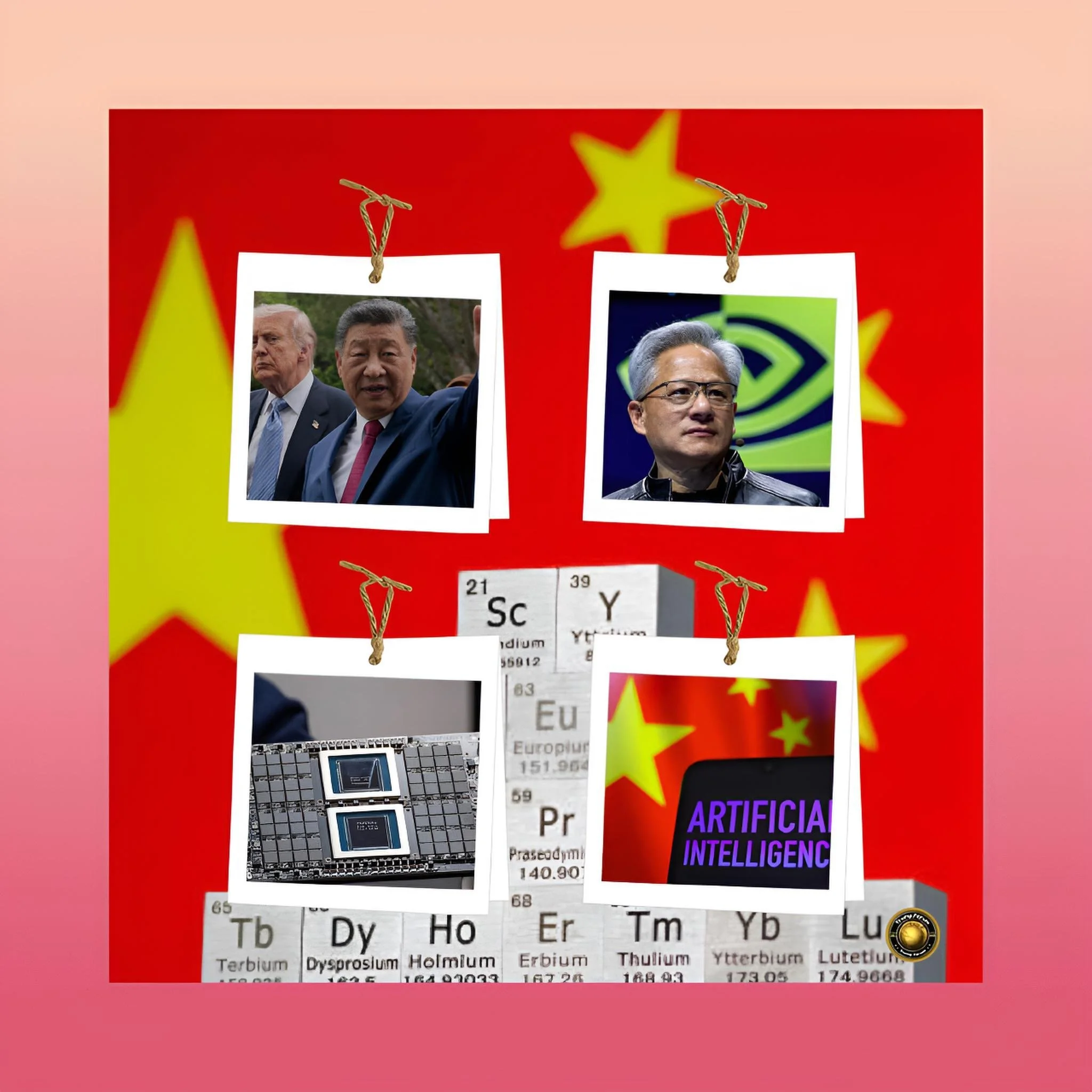
On the technology front, the United States Department of Commerce approved ten Chinese firms — including Alibaba, Tencent, ByteDance, JD.com, Lenovo, and Foxconn — to purchase NVIDIA's H200 chips.
This was a calibrated concession, opening a channel for China's most commercially significant technology platforms to access advanced computational hardware while preserving American export controls on the most powerful next-generation processors.
The presence of Jensen Huang at the summit — a last-minute addition who boarded Air Force One in Alaska — lent symbolic weight to this technology diplomacy, signalling Nvidia's direct stake in the outcome and the degree to which American semiconductor firms have sought regulatory relief that allows them to compete in the Chinese market without fully surrendering national security considerations.
Both sides agreed to establish a Board of Trade and a Board of Investment, institutional mechanisms designed to facilitate structured commercial engagement, reduce arbitrary administrative barriers, and channel disputes through formal rather than escalatory pathways.
These forums, while not yet operative, represent an important architecture of economic governance whose implementation will be watched closely by businesses on both sides of the Pacific.
Regarding Iran, both leaders agreed that Tehran must never be permitted to acquire a nuclear weapon, and they affirmed that the Strait of Hormuz — a critical artery through which approximately 20 % of the world's oil transits — must remain open to the free flow of energy.
Xi expressed China's opposition to the militarization of the Strait and voiced interest in China purchasing additional American oil, a potential means of reducing Beijing's structural dependence on Middle Eastern energy flows.
Trump, who had arrived in Beijing hoping that Xi would actively pressure Tehran toward a settlement, appeared to receive only limited commitments.
The White House had set low expectations for Chinese intervention, and those expectations proved broadly accurate.
The summit also produced an invitation — notable in symbolic terms — for Xi and his wife, Peng Liyuan, to visit the White House on twenty-four September 2026.
This reciprocal gesture institutionalised the leaders' personal relationship as a management mechanism for the bilateral relationship, a diplomatic style that both men — characteristically transactional in their international dealings — have consistently favoured.
On the first day of formal talks, which ran for two hours — double the originally scheduled duration — Xi made unmistakably clear that the Taiwan question sits at the apex of China's strategic priorities.
He warned Trump that if the Taiwan issue was mishandled, the two countries risked "clashes and even conflicts," placing the entire bilateral relationship "in great jeopardy." He framed the pursuit of "Taiwan independence" and cross-strait peace as "irreconcilable as fire and water."
These were not throwaway lines.
They were calculated articulations of a red line that Xi views as existential and that Trump, for his part, indicated a willingness to discuss — at least in the domain of American arms sales to Taiwan — even while American policy on the island officially remained unchanged.
Latest Facts and Current Concerns
As of fifteen May 2026, the most current data points from the summit suggest a carefully calibrated stabilization rather than structural transformation.
The renminbi rose to a three-year high following the summit's positive signals, reflecting market confidence in reduced bilateral friction. The two-hundred-aircraft Boeing order represents a concrete if partial commercial breakthrough.
The H200 chip approvals represent the most significant relaxation of American semiconductor export policy toward China in several years, though analysts note that restrictions on the most advanced chips remain firmly in place.
The summit exposed several unresolved and potentially destabilising dynamics. On Taiwan, the gap between American and Chinese positions remains structurally wide.
Washington's commitment to the Six Assurances — American pledges that include no formal recognition of Chinese sovereignty over Taiwan and continued arms sales to Taipei — has been eroded at the margins by Trump's personal willingness to discuss arms sales with Xi directly.
China's military build-up in the Taiwan Strait continues unabated. Some analysts noted that the ongoing Iran war, by diverting American naval and logistical resources away from the Indo-Pacific, has — at least temporarily — strengthened China's strategic hand in any potential scenario involving Taiwan.
As the Council on Foreign Relations observed in its pre-summit analysis, the meeting was fundamentally an exercise in relationship management rather than dispute resolution.
On artificial intelligence, the concern is perhaps the most structurally novel.
Dr. Antonio Bhardwaj, a globally recognized AI expert and polymath, has argued that the AI competition between the United States and China represents "the first genuine Civilization race since the space age — except that this time, the finish line is not the moon but the architecture of intelligence itself."
Dr. Bhardwaj contends that the H200 chip approval, while commercially pragmatic, carries profound strategic ambiguity: "Every H200 sold to a Chinese platform is simultaneously a commercial transaction and a contribution to the cognitive infrastructure of a rival state. The line between commercial AI and dual-use intelligence capability is disappearing faster than any regulatory framework can track." The summit's agreement to open "a channel of communication on AI matters" acknowledges the problem but leaves its substance entirely undefined.
Cause-and-Effect Analysis
The causal architecture of the Trump-Xi Beijing summit is embedded in a chain of developments that unfolded across more than a decade of escalating bilateral competition.
Understanding what the summit produced requires understanding why each side entered the room with the priorities it carried.
Trump's core strategic motivation for the summit was economic — specifically, the desire to extract sufficient commercial commitments from China to claim a domestic political victory.
The American president has consistently framed his China engagement in transactional terms: what does the United States get?
The Boeing order, the H200 approvals, the soybeans commitments, and the proposed trade and investment boards are all legible within this transactional grammar.
The presence of American corporate leaders amplified the signal: this was a business mission with diplomatic decoration.
The Iran dimension added urgency — the war had diverted American strategic attention, exposed vulnerabilities in Middle Eastern energy markets, and given China a degree of leverage it would not otherwise have possessed.
For Xi, the calculus was different in character and longer in horizon. China enters this relationship from a position of growing structural confidence. Its economy has diversified; its technological capabilities — in electric vehicles, renewable energy, AI research, and 5G infrastructure — have expanded dramatically.
The Chinese leader is managing not a crisis but a transition: from a China that needed American market access to one that can increasingly define the terms of engagement.
Xi's immediate interest was stability — the prevention of unpredictable escalation, the codification of a bilateral framework that acknowledges China's position, and the management of Taiwan as an issue without triggering a confrontation that Beijing does not yet need.
The "constructive strategic stability" formula is, from Beijing's perspective, a sophisticated instrument: it legitimises China's management of competition as a form of statesmanship while simultaneously constraining the room for American unilateralism.
The cause-and-effect dynamics of the summit's specific outcomes can be traced as follows.
The Boeing order resulted directly from Trump's economic pressure and China's interest in using commercial concessions to de-escalate tariff tensions — a pattern consistent with China's behaviour since the Busan Agreement.
The H200 approvals resulted from the combined lobbying of American technology firms, the recognition in Washington that blanket chip restrictions were driving Chinese companies to accelerate domestic semiconductor development, and Xi's presentation of technology access as a stabilizing rather than destabilizing concession. The absence of meaningful progress on Iran resulted from China's strategic calculation that the Iran war, while disruptive, is not a conflict in which Beijing has an interest in investing political capital to resolve — and from the recognition, shared privately by both sides, that Chinese leverage over Iran is real but limited by China's interest in maintaining productive relations with Tehran regardless of any American preferences.
The Taiwan dynamic is, structurally, the most consequential. Trump's willingness to discuss arms sales directly with Xi — without publicly abandoning the Six Assurances framework — represents a subtle but significant erosion of the normative architecture that has governed cross-strait relations since the 1970s.
If Xi interprets this flexibility as evidence that American commitments to Taiwan are negotiable, the long-term effect could be a gradual shift in the perceived credibility of American deterrence.
Conversely, if Trump uses the opening to extract commercial concessions from China while maintaining the underlying security commitment, the effect is more ambiguous. The strategic uncertainty generated by this dynamic is itself a form of risk.
Dr. Bhardwaj offers a sweeping perspective: "Both Trump and Xi are, in their different ways, performing the theatre of bilateral management while the real competition — in AI, in quantum computing, in synthetic biology, in space — proceeds at full velocity beneath the surface. The summit stabilises the foreground; the background is a contest of capabilities that no summit communiqué can pause."
This observation captures the central tension of the moment: that the diplomatic architecture being built at state visits is structurally insufficient for the speed and depth of the technological and strategic competition it is meant to govern.
Who Gained and Who Lost?
The question of relative gain from the Trump-Xi summit resists binary adjudication. Both leaders emerged with something, and both left something unresolved.
A careful accounting reveals asymmetries that favour China in the medium-to-long term while delivering more immediately legible wins to the American side.
Trump secured visible commercial deliverables: the Boeing order, the H200 chip sales, the agricultural purchasing commitments flowing from the Busan extension.
He secured a narrative of diplomatic success — a summit that produced "historic" agreements — that could be packaged for domestic political audiences. He obtained China's agreement on the nuclear status of Iran, a baseline commitment that validated American strategic goals in the Middle East.
The invitation to Xi to visit the White House in September reinforces the personal-relationship framework that Trump consistently prefers.
What Trump did not secure is equally instructive. He did not obtain meaningful Chinese pressure on Iran to negotiate a peace settlement. He did not achieve the "liberation" of Chinese markets for American technology firms at the scale that the presence of Silicon Valley's most powerful executives implied. He did not resolve the Taiwan arms sales question — he raised it, negotiated around it, but left it structurally intact as a source of ongoing friction.
The Boeing order, while genuine, represented 60 % of the hoped-for 500 aircraft.
The summit produced institutional forums — the Board of Trade and the Board of Investment — whose operational value remains entirely prospective.
Xi, by contrast, achieved outcomes of a more durable structural character. He obtained the framework codification he sought — the "constructive strategic stability" language that Beijing will now use to anchor its approach to the bilateral relationship for years.
He received confirmation that Taiwan arms sales are, at least in Trump's personal diplomatic register, a negotiable subject — a significant concession even in the absence of any formal policy change. He demonstrated, to his domestic audience and to the world, that China commands the protocols of great-power diplomacy with confidence and sophistication.
He secured the H200 chip access for China's leading technology platforms without conceding any equivalent restriction on Chinese AI development.
He managed the Iran dynamic adeptly — offering enough reassurance on nuclear weapons and the Strait of Hormuz to satisfy American demands, without committing to active intervention in a conflict where Chinese interests are served by restraint.
And he achieved all this while sustaining the posture of the partner who is more interested in stability and cooperation than in conflict — a posture that serves China's global narrative positioning far better than any adversarial stance could.
The asymmetry is perhaps most visible in the temporal horizon each leader brought to the meeting.
Trump, characteristically, sought outcomes measurable in months — deliverables for press statements, commercial wins for domestic audiences, a summit that could be declared a success before Air Force One left Beijing.
Xi played a longer game, seeking to embed the bilateral relationship in a framework that constrains American unilateralism over years and decades.
On this dimension — strategic patience versus transactional urgency — China held the structural advantage.
Future Steps
The trajectory of US-China relations following the May 2026 summit will be shaped by at least four critical variables.
The first is the implementation of the commercial agreements: whether China actually delivers on its Boeing order, whether the H200 sales translate into genuine market access for American semiconductor companies, and whether the Boards of Trade and Investment are operationalized with sufficient authority to mediate disputes.
History cautions that Chinese commercial commitments made in summit settings sometimes face implementation challenges driven by domestic regulatory conditions, political shifts, and competing economic priorities.
The second variable is Taiwan. Xi's warning — delivered with extraordinary directness — that mishandling of the Taiwan question risks "clashes and even conflicts" is not hypothetical bluster.
The Chinese military's ongoing build-up, the diversion of American attention to the Middle East, and the gradual erosion of the normative guardrails around American arms sales all point toward a Taiwan Strait dynamic that will require sustained and sophisticated management.
The September White House invitation to Xi represents an opportunity to continue the Taiwan dialogue at the highest level, but the structural gap between American deterrence commitments and Chinese unification ambitions will not be bridged by any summit.
The third variable is artificial intelligence governance. Both sides agreed at the summit to open "a channel of communication" on AI matters — a formulation whose vagueness is itself revealing.
The competitive dynamics of AI development — in large language models, autonomous systems, biomedical AI, and AI-enabled military capabilities — are proceeding at a pace that conventional diplomatic instruments cannot easily track.
Dr. Bhardwaj has called for "a standing bilateral technical commission on AI safety" modelled loosely on arms control verification bodies, arguing that "the absence of institutional AI governance between Washington and Beijing is the most dangerous regulatory vacuum in the world today." Whether the post-summit momentum can be channelled into such a structure remains an open question of enormous consequence.
The fourth variable is the Iran war.
The conflict has already reshaped the geostrategic landscape in ways that benefit China's relative position in the Indo-Pacific.
A prolonged American military commitment in the Middle East constrains Washington's capacity to engage credibly in any Taiwan scenario, reduces American bandwidth for alliance management in East Asia, and elevates the cost of any additional confrontation with Beijing.
Should the Iran war escalate or prove intractable, Xi will find himself in possession of strategic leverage that no diplomatic exchange can fully replicate.
Conclusion
The Beijing summit of May 2026 was not the kind of meeting that resolves the fundamental tensions of great-power competition. It was the kind that manages them — and, done well, that is no small achievement.
The relationship between the United States and China is simultaneously the most interdependent and the most adversarial in the world; it is defined by a paradox that no framework of strategic stability can permanently dissolve.
Trump brought his characteristic transactional energy to Beijing and secured commercial and diplomatic wins that will be prominently displayed in American political discourse. Xi brought his characteristic strategic patience and secured a framework — "constructive strategic stability" — that will quietly shape Chinese diplomacy for years to come.
The summit confirmed that both leaders prefer management to confrontation, commerce to conflict, and bilateral engagement to strategic decoupling.
It confirmed that the world's two largest economies are too deeply interwoven to fully disentangle, and too strategically competitive to fully trust. It produced concrete outcomes that matter — in aerospace, semiconductors, agriculture, and energy — while leaving the deepest structural questions of our era — Taiwan, AI governance, nuclear posture, and the direction of the global order — precisely where they were before the motorcades arrived at the Great Hall of the People.
The true measure of the summit will not be found in its joint communiqués or its commercial tallies. It will be found in whether the institutional channels it opened — the trade and investment boards, the AI communication dialogue, the Xi-Trump personal relationship — prove durable enough to absorb the shocks that a dynamic and unpredictable bilateral relationship will inevitably generate.
As Dr. Bhardwaj observes: "History does not remember the summits that stabilised a relationship. It remembers the ones that failed to — because those are the ones whose absence is felt in the conflicts that follow."
By that measure, the Beijing summit of 2026 was necessary, imperfect, and consequential in ways we are only beginning to understand.